Emergency Elevator Service on Weekends: Charges, Cost Factors, and What Property Owners Need to Know
What Are the Additional Charges for Emergency Elevator Service on a Weekend?

Weekend emergency elevator service carries surcharges beyond standard weekday rates. These premiums typically reflect overtime labor differentials, on-call technician dispatch fees, and — on federal holidays — additional holiday-rate multipliers. The exact dollar amounts vary by service company, contract terms, and the scope of work required, but the surcharge structure is consistent across the industry.
Understanding how these charges are structured — before a breakdown occurs — is one of the most important steps a building owner or property manager can take. Emergency calls outside normal business hours trigger multiple cost layers simultaneously: the base labor rate, the overtime or after-hours differential, trip charges, parts markups, and sometimes a minimum billable hour requirement. Each of these layers compounds the final invoice, which is why a Saturday morning entrapment can produce a service bill that surprises even experienced facilities managers.
Property owners in Signal Hill, Long Beach, Los Angeles, and Orange County can reduce exposure to unpredictable emergency charges by working with a Certified Qualified Conveyance Company (CQCC) — the credential required under California law — that offers clearly documented after-hours rate schedules and comprehensive maintenance contracts.
How Is After-Hours Emergency Service Defined for Billing Purposes?
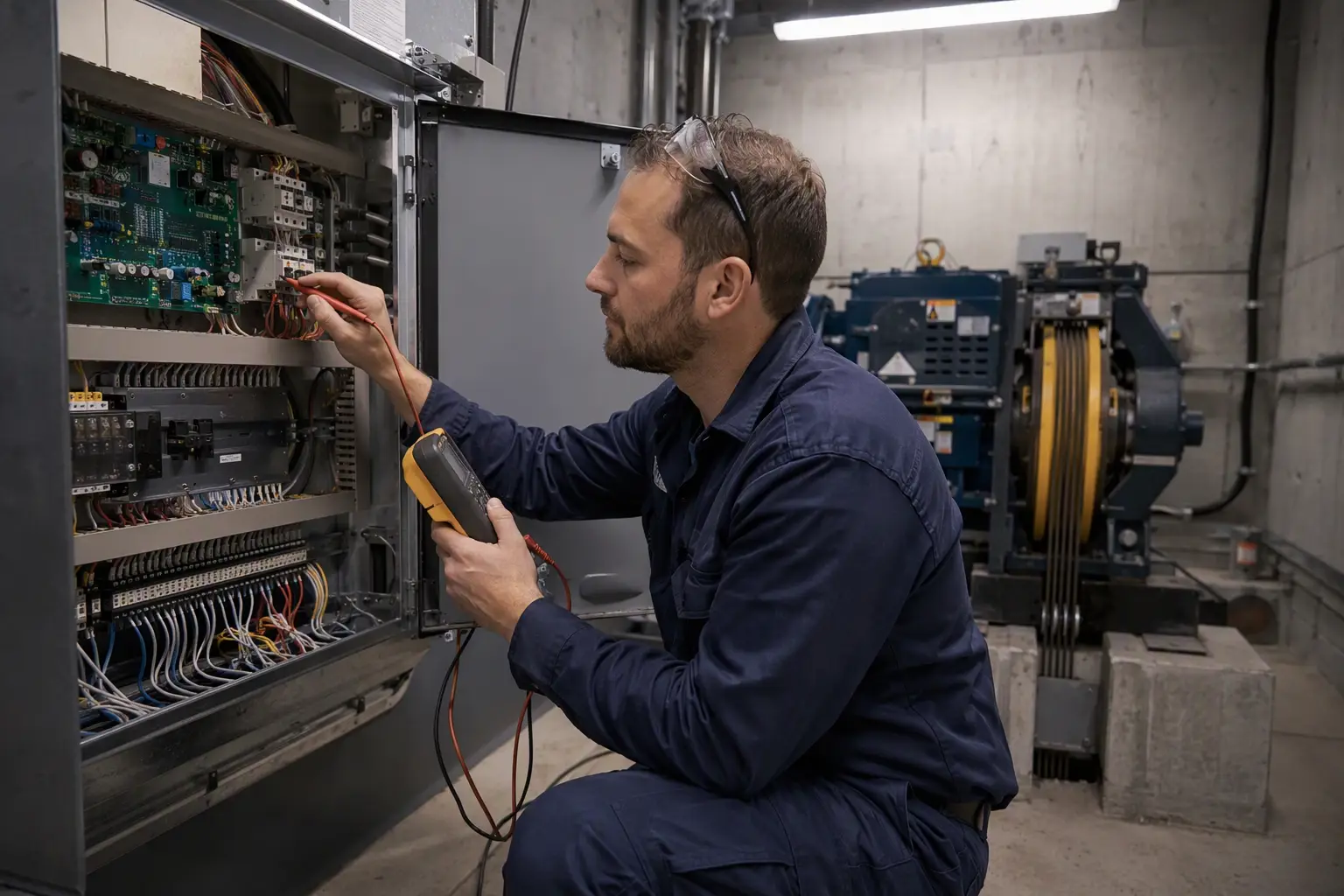
“After-hours” is defined contractually by the service agreement, not by a universal industry standard, and the definition directly determines when premium rates apply.
Most elevator service companies define standard business hours as weekday daytime windows — commonly Monday through Friday — and classify all calls received outside those hours as after-hours or emergency service. Weekends, public holidays, and late-night calls on weekdays are generally grouped under this premium category. Some contracts further distinguish between “after-hours” (evenings and weekends during normal calendar days) and “emergency” (passenger entrapment, safety-critical failures), with higher surcharge tiers for true emergencies. Property managers should request explicit definitions in writing before executing any service contract.
What Cost Components Make Up a Weekend Emergency Service Bill?
A weekend emergency elevator invoice is almost never a single line item — it is a stack of discrete charges, each governed by different contractual provisions.
The components typically include:
- Base labor rate: The standard hourly rate for a Certified Competent Conveyance Mechanic (CCCM), as required under California law for anyone working unsupervised on a conveyance.
- Overtime or after-hours differential: A multiplier applied to the base rate for work performed outside standard hours — weekends, evenings, and holidays commonly attract higher multipliers than standard weekday overtime.
- Holiday-rate surcharge: A further premium for work performed on federally or state-recognized holidays, sometimes applied as an additional multiplier on top of the overtime differential.
- Trip charge or dispatch fee: A flat fee to cover the cost of mobilizing and dispatching a technician, independent of hours worked.
- Minimum billable time: Many contracts require payment for a minimum number of hours (commonly two to four) regardless of how quickly the issue is resolved.
- Parts and materials markup: Replacement components sourced for an emergency call are frequently billed at retail or above-retail pricing, unlike parts supplied under a full-maintenance contract.
- Portal-to-portal time: Some agreements bill travel time from the technician’s location to the site, which can add substantially to the total on a weekend when technicians may not be pre-positioned near commercial properties.
How Do Full-Maintenance Contracts Affect Weekend Emergency Charges?
A full-maintenance contract is the single most effective tool for controlling emergency service costs, because it pre-negotiates labor rates, parts coverage, and after-hours call response terms before any breakdown occurs.
Under a full-maintenance agreement, after-hours labor charges are typically included or capped, meaning a Saturday entrapment call does not automatically trigger every premium billing layer described above. By contrast, time-and-materials (T&M) agreements expose building owners to the full market rate for every emergency call. California law recognizes this distinction operationally as well: under California Code of Regulations, Title 8, Cal/OSHA’s Elevator Safety Orders, an elevator covered by a full maintenance contract with a licensed C-11 elevator company may be eligible for a permit to operate lasting up to two years rather than the standard one year — a direct regulatory incentive for comprehensive maintenance coverage. Property managers should evaluate the total cost of ownership under both contract structures before assuming a basic service agreement saves money.
Does California Law Require Elevators to Have Emergency Service Coverage?
California law requires that every elevator in operation hold a valid permit to operate issued by Cal/OSHA, but it does not mandate that owners maintain a specific after-hours emergency service contract.
Under California Labor Code Sections 7300–7324.2 and the California Code of Regulations, Title 8, Elevator Safety Orders, the obligation is to keep the conveyance in safe operating condition and to hold a current permit to operate. Operating an elevator without a valid permit is a violation. While no statute prescribes how quickly an emergency must be responded to, the practical and liability consequences of an unresolved entrapment or safety failure — including Cal/OSHA stop-use orders — make documented emergency response capability a necessity for any responsible building owner. Companies performing this work must be certified by Cal/OSHA as a Certified Qualified Conveyance Company (CQCC), and mechanics working on the equipment without supervision must hold Certified Competent Conveyance Mechanic (CCCM) certification.
What Is the Difference Between an Emergency Call and a Callback Under a Service Contract?
An “emergency call” and a “callback” are distinct service categories with different billing treatments under most maintenance agreements.
A callback refers to a service visit required because a reported problem was not fully resolved during a previous maintenance visit — typically covered under contract terms at no additional charge. An emergency call is an unscheduled response to a new breakdown or safety event, such as a passenger entrapment, door malfunction, or loss of drive power. Emergency calls, particularly those on weekends or holidays, are subject to the premium rate structure described above unless the maintenance contract explicitly includes after-hours emergency labor coverage. Building owners should read their agreements carefully to understand which events trigger which billing category.
How Do Weekend Emergency Rates Compare to Standard Weekday Service Rates?
The table below illustrates the general structure of cost differentials commonly found in elevator service agreements — not absolute dollar figures, which vary by company and contract, but the layered multiplier structure that drives weekend and holiday invoices higher than weekday calls.
| Service Period | Typical Rate Category | Common Billing Add-Ons | Parts Pricing | Minimum Billing Window |
|---|---|---|---|---|
| Standard Weekday Hours | Base labor rate | None, or minimal trip charge | Contract rate or cost-plus | One hour (typical) |
| Weekday Evening / After-Hours | Base + overtime differential | Dispatch / call-out fee | Retail or above | Two hours (typical) |
| Saturday | Base + weekend premium | Dispatch fee + portal-to-portal | Retail or above | Two to four hours (typical) |
| Sunday | Base + higher weekend premium | Dispatch fee + portal-to-portal | Retail or above | Two to four hours (typical) |
| Federal / State Holiday | Base + holiday-rate multiplier | Dispatch fee + portal-to-portal + holiday surcharge | Retail or above | Four hours (typical) |
| Full-Maintenance Contract (Any Hour) | Pre-negotiated or included | Often waived or capped | Included or contract rate | Defined in contract |
Note: The figures above represent general industry billing structures based on widely observed contract formats. Actual rates depend on the specific service agreement. Always request a written rate schedule from your provider.
What Happens If a Passenger Is Trapped in an Elevator on a Weekend?
Passenger entrapment is a life-safety event that must be treated as an immediate emergency regardless of the day or time, and it triggers a specific response protocol.
- Call emergency services (911) immediately if the passenger reports a medical emergency, the elevator is stalled between floors, or any immediate physical danger is present.
- Activate the elevator’s two-way emergency communication system — under the ASME A17.1 Safety Code for Elevators and Escalators, elevators must be equipped with a means of two-way communication for passenger assistance.
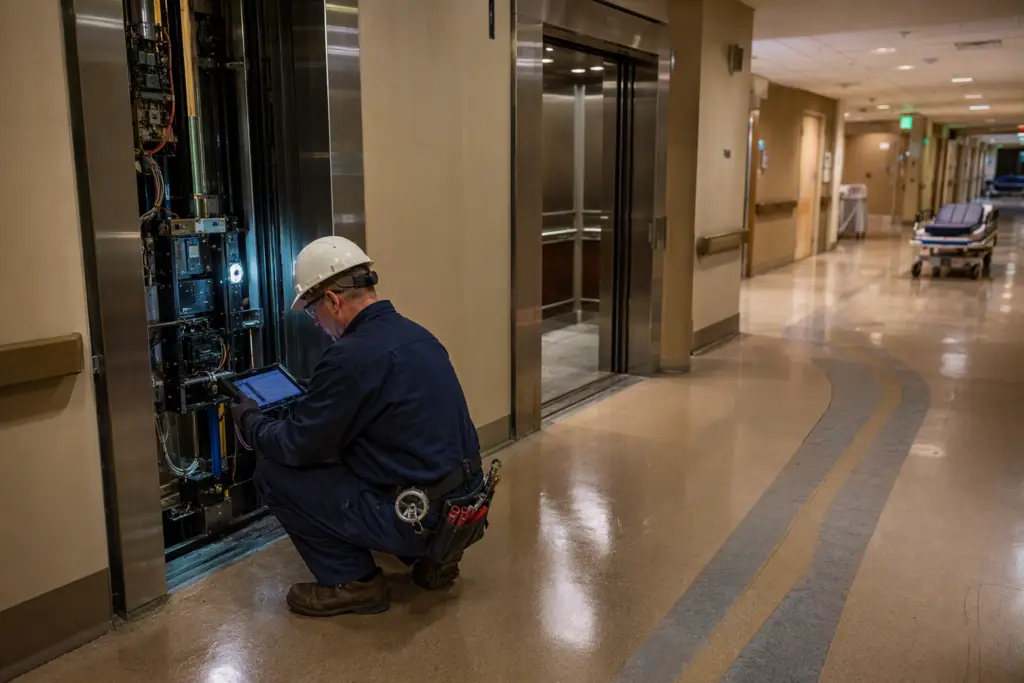
- Contact your elevator service company’s emergency line to dispatch a CCCM-certified technician for the rescue.
- Do not attempt to open elevator doors manually or instruct passengers to exit between floors — this creates severe fall and injury hazards.
- Keep the passenger calm and informed by maintaining communication through the intercom or by voice contact at the door, confirming that help is on the way.
- Document the time the entrapment was reported, the time the technician arrived, and the time the passenger was safely released — this record is important for both insurance and Cal/OSHA compliance purposes.
- After the rescue, do not return the elevator to service until the root cause of the entrapment has been diagnosed and corrected by a qualified mechanic.
What Qualifications Must a Technician Have to Perform Weekend Emergency Repairs in California?
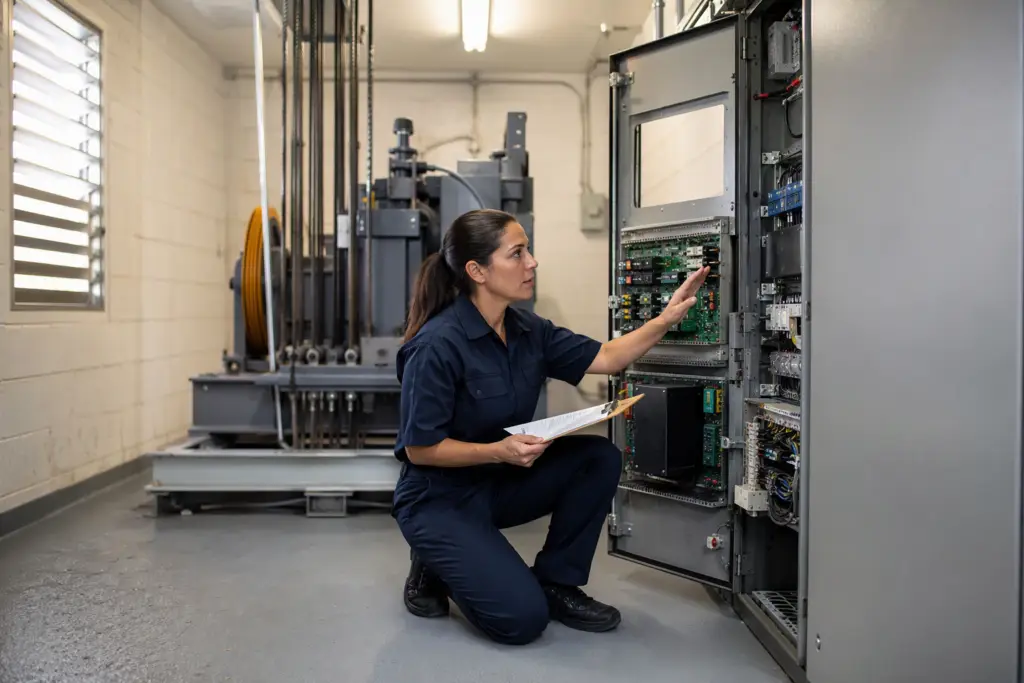
In California, any mechanic who works on an elevator without direct supervision must hold a Certified Competent Conveyance Mechanic (CCCM) credential issued by Cal/OSHA.
This requirement applies equally on weekends, holidays, and evenings — there is no after-hours exemption. The company dispatching the technician must also hold a Certified Qualified Conveyance Company (CQCC) certification from Cal/OSHA’s Elevator Unit. To obtain CQCC status, a company must hold a current C-11 Elevator Contractor license issued by the California Contractors State License Board (CSLB) and carry valid workers’ compensation and liability insurance. Building owners should verify both the CQCC certification and the C-11 license of any company before authorizing emergency repairs — working with an uncertified contractor can jeopardize the elevator’s permit to operate and expose the property owner to liability. Liftech Elevator operates as a CQCC-certified company serving Signal Hill, Long Beach, Los Angeles, and Orange County.
How Can Building Owners Reduce Exposure to High Weekend Emergency Costs?
Proactive maintenance is the most reliable strategy for minimizing the frequency — and therefore the cumulative cost — of weekend emergency calls.
Specific risk-reduction measures include:
- Executing a full-maintenance contract with a CQCC-certified provider, which typically pre-negotiates after-hours labor terms and covers preventive part replacement before failures occur.
- Scheduling regular lubrication, adjustment, and inspection visits during standard business hours to catch developing issues before they become Saturday-morning emergencies.
- Reviewing the annual inspection report issued by a Certified Competent Conveyance Inspector (CCCI) or Cal/OSHA engineer and acting promptly on any noted deficiencies.
- Maintaining a log of unusual sounds, slow door operation, or intermittent leveling problems — early symptom reporting allows mechanics to address root causes during scheduled visits.
- Confirming the emergency communication system is functional during every maintenance visit, as a non-functioning intercom can escalate an entrapment into a more serious incident.
- Asking for a written after-hours rate schedule before signing any service agreement so there are no billing surprises when an emergency does occur.
Does the ADA Impose Any Requirements Related to Emergency Elevator Availability?
The Americans with Disabilities Act (ADA) does not mandate specific emergency response timeframes for elevator outages, but it does impose accessibility obligations that create an indirect urgency around rapid restoration of service.
In multi-story buildings where elevators are the accessible means of vertical travel for people with mobility impairments, an extended weekend outage effectively denies those individuals access to upper floors — which can constitute a failure to maintain accessible features under ADA requirements. The ADA requires that accessible features be maintained in working condition, with allowance for isolated or temporary interruptions due to maintenance or repairs. A prolonged outage — particularly one where the owner delayed contacting a service provider — may not qualify as a reasonable temporary interruption. This reality reinforces the business and legal case for engaging a service provider with genuine weekend emergency capability.
What Should Be in an Elevator Emergency Service Agreement?
A well-drafted emergency service clause in an elevator maintenance contract should address at minimum the following provisions.
- Definition of emergency: Clear language specifying what events qualify as emergencies versus standard service calls.
- After-hours rate schedule: Explicit hourly rates or multipliers for evenings, Saturdays, Sundays, and holidays, rather than a vague reference to “prevailing overtime rates.”
- Trip charge and minimum hour policies: Written disclosure of any flat dispatch fee and the minimum billable time per emergency visit.
- Parts pricing: Whether emergency parts are billed at cost, cost-plus, retail, or are covered under the contract.
- Technician qualification confirmation: Confirmation that all dispatched mechanics hold current CCCM certification under California law.
- Escalation protocol: The procedure if the primary on-call technician is unavailable — who is the backup, and how is dispatch managed?
- Documentation requirements: What records will be provided after each emergency visit (work order, parts used, diagnosis, corrective action taken)?
How Do Los Angeles Buildings Handle Emergency Elevator Service Differently?
Los Angeles operates its own elevator and conveyance inspection program through the Los Angeles Department of Building and Safety (LADBS), which means the local authority having jurisdiction (AHJ) in Los Angeles has its own enforcement structure alongside the statewide Cal/OSHA framework.
For building owners in the City of Los Angeles, this means that compliance obligations may involve both the LADBS program and state-level Cal/OSHA requirements. Emergency service calls do not change the qualification requirements — dispatched mechanics must still hold CCCM certification and the company must still be CQCC-certified under state law — but the permit-to-operate and inspection records that an emergency call may put into question must satisfy both the city and state programs. Property managers in Los Angeles should confirm with their service provider that the company is familiar with both regulatory layers. Liftech Elevator serves the Los Angeles market with knowledge of both the LADBS program context and the statewide Cal/OSHA elevator regulatory framework.
What Records Should Be Kept After a Weekend Emergency Service Visit?
Thorough documentation after an emergency service call protects building owners in the event of an insurance claim, regulatory inspection, or liability dispute.
Records to retain include the written work order from the service company (documenting the nature of the failure, parts replaced, and corrective action taken), the technician’s name and CCCM credential number, the time the call was placed, the time the technician arrived, the time the elevator was returned to service, and the invoice with an itemized breakdown of all charges. This documentation also supports the annual inspection process — Cal/OSHA and the elevator owner are both served by a clear maintenance and repair history. Under California law, arranging the annual reinspection is the elevator owner’s responsibility, and a well-maintained service record demonstrates ongoing compliance diligence to the inspecting authority.
How Often Should Elevators Be Inspected to Minimize Emergency Breakdowns?
California law requires every conveyance to be inspected at least once per year, and consistent compliance with this schedule is one of the most effective breakdown-prevention tools available.
The annual inspection, performed by a Cal/OSHA safety engineer or a Certified Competent Conveyance Inspector (CCCI), assesses whether the elevator meets the requirements of the California Elevator Safety Orders, which adopt the ASME A17.1/CSA B44, 2004 edition for installations placed under contract on or after May 1, 2008. A conveyance found safe receives a permit to operate for up to one year — or up to two years if the elevator is covered by a full-maintenance contract with a licensed C-11 company. Regular maintenance visits between annual inspections — including lubrication, safety device testing, and door adjustment — reduce the probability of a component failure that would otherwise produce a weekend emergency call. Liftech Elevator recommends that property managers treat the annual inspection date as the minimum, not the target, for service engagement.
What Is the Role of ASME A17.1 in Emergency Repair Standards?
The ASME A17.1 Safety Code for Elevators and Escalators establishes the technical safety requirements that govern elevator design, installation, inspection, testing, and maintenance — including the safety devices and communication systems that are critical during an emergency.
California has adopted the ASME A17.1/CSA B44, 2004 edition through its Elevator Safety Orders for installations placed under contract on or after May 1, 2008. Relevant to emergency scenarios, ASME A17.1 specifies requirements for emergency lighting, emergency two-way communication, door reopening devices, and automatic rescue operations (ARO) for hydraulic and traction systems. When a weekend emergency call is triggered by a failure of one of these code-required safety systems, the repair cannot be deferred — restoring the system to code compliance is a condition of returning the elevator to service. This is one reason emergency repair scopes can be broader — and more expensive — than routine maintenance visits.
What Questions Should Building Owners Ask When Comparing Emergency Service Providers?
Selecting the right emergency elevator service provider requires evaluating more than the quoted hourly rate.
- Is the company certified as a CQCC by Cal/OSHA, and does it hold a current C-11 license from the CSLB?
- Are all dispatched mechanics certified as CCCMs by Cal/OSHA?
- What is the written after-hours rate schedule — base rate, overtime multiplier, holiday multiplier, dispatch fee, and minimum billable hours?
- How are emergency parts priced relative to contract parts pricing?
- Does the company serve the specific city or county where the property is located?
- What is the escalation procedure if the on-call technician is unavailable?
- What documentation is provided after each emergency service call?
- How does the full-maintenance contract structure compare to a time-and-materials agreement for after-hours cost exposure?
Building owners in Signal Hill, Long Beach, Los Angeles, and Orange County can bring these questions directly to Liftech Elevator to evaluate how a full-maintenance relationship compares to their current service arrangement.
How Does Cal/OSHA Enforcement Relate to Weekend Emergency Situations?
Cal/OSHA has authority to issue stop-use orders and citations for elevators found to be operating without a valid permit or in an unsafe condition — and this authority does not pause on weekends.
If a weekend emergency reveals that an elevator has a lapsed permit to operate, or if the emergency itself is a reportable safety incident, the building owner may face enforcement consequences in addition to repair costs. Under California law, no elevator may be operated without a valid, current permit to operate issued by Cal/OSHA, and the permit must be posted conspicuously in the elevator car. A permit obtained through a full-maintenance contract with a CQCC-certified company — which can extend to a two-year term under California regulations — reduces the administrative risk of a lapsed permit compounding an already costly emergency event. Building owners are responsible for arranging their own annual reinspection under California law, making calendar management of permit expiration dates a critical property management function.
Are There Situations Where Emergency Service Charges Can Be Disputed or Waived?
Certain contractual and factual circumstances can support a discussion with the service provider about charges assessed for a weekend emergency call.
Common grounds for disputing or seeking a reduction in emergency charges include situations where the breakdown resulted directly from a deficiency identified but not corrected during the previous maintenance visit, where the contract’s definition of “covered emergency” is ambiguous and the call arguably falls within its scope, or where the minimum billable hours charged exceed what the contract specifies. Building owners should document all service events carefully and retain copies of all work orders, inspection reports, and contracts. Disputes are far easier to resolve when the contract language is clear and both parties have contemporaneous records. This is another reason why requesting itemized written rate schedules before executing any service agreement — rather than after receiving a large invoice — is strongly advisable.
What Steps Should a Property Manager Take Right Now to Prepare for a Weekend Elevator Emergency?
Preparation before a failure occurs is the most cost-effective form of emergency management.
- Locate and review the current elevator maintenance agreement — identify the after-hours rate schedule, emergency contact number, and coverage terms before they are needed in a crisis.
- Verify that the elevator’s permit to operate is current and posted in the car as required by California law.
- Confirm the service company holds current CQCC certification from Cal/OSHA and a valid C-11 license from the CSLB.
- Test the elevator’s emergency two-way communication system during the next scheduled maintenance visit and document the result.
- Post the emergency service contact number in the elevator machine room and at the building management station.
- Train building staff on the passenger entrapment protocol so the correct steps are taken without delay on a weekend when management may not be on-site.
- Schedule a free elevator assessment with Liftech Elevator to review the current condition of the equipment and the terms of the existing service agreement — identifying gaps before a breakdown is always less expensive than addressing them after one.
Emergency elevator service on weekends carries real and sometimes substantial premium costs — but those costs are manageable when building owners understand the billing structure, maintain compliant equipment through regular service, and partner with a properly certified provider. Liftech Elevator serves property owners across Signal Hill, Long Beach, Los Angeles, and Orange County with Cal/OSHA CQCC-certified service and a clear commitment to transparent maintenance practices.
Contact Liftech Elevator for a free elevator assessment. Call us today at 562-997-3639 to review your current service contract, verify your permit-to-operate status, and understand exactly what you would pay if a weekend emergency occurred — before it does.
Need elevator service you can rely on? Liftech Elevator is ready to help.