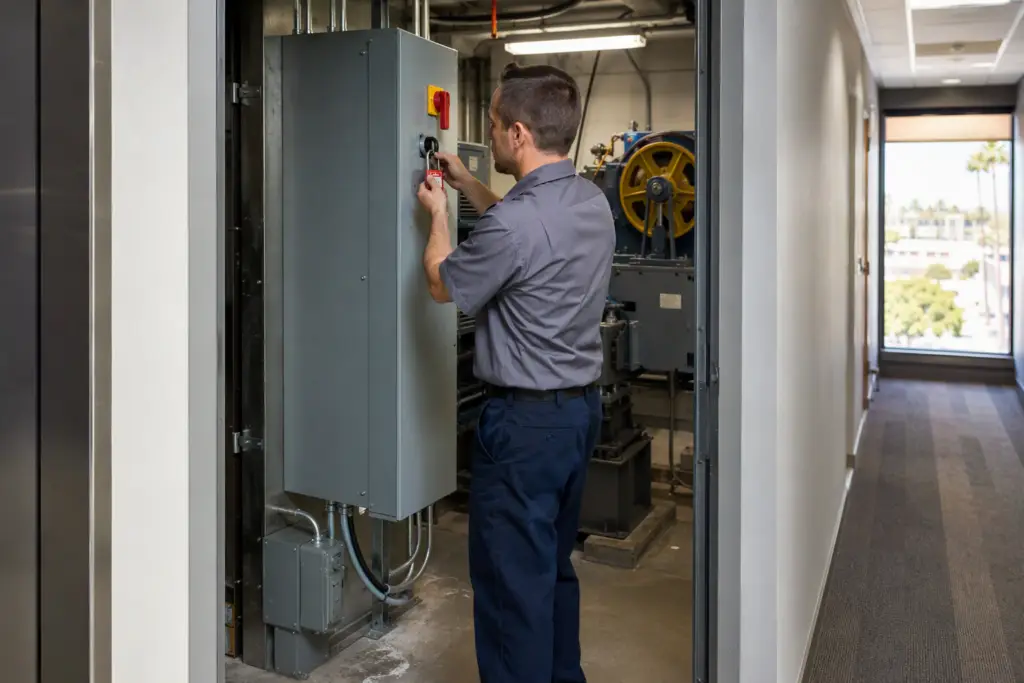
24/7 Elevator Repair for Healthcare Facilities in Southern California
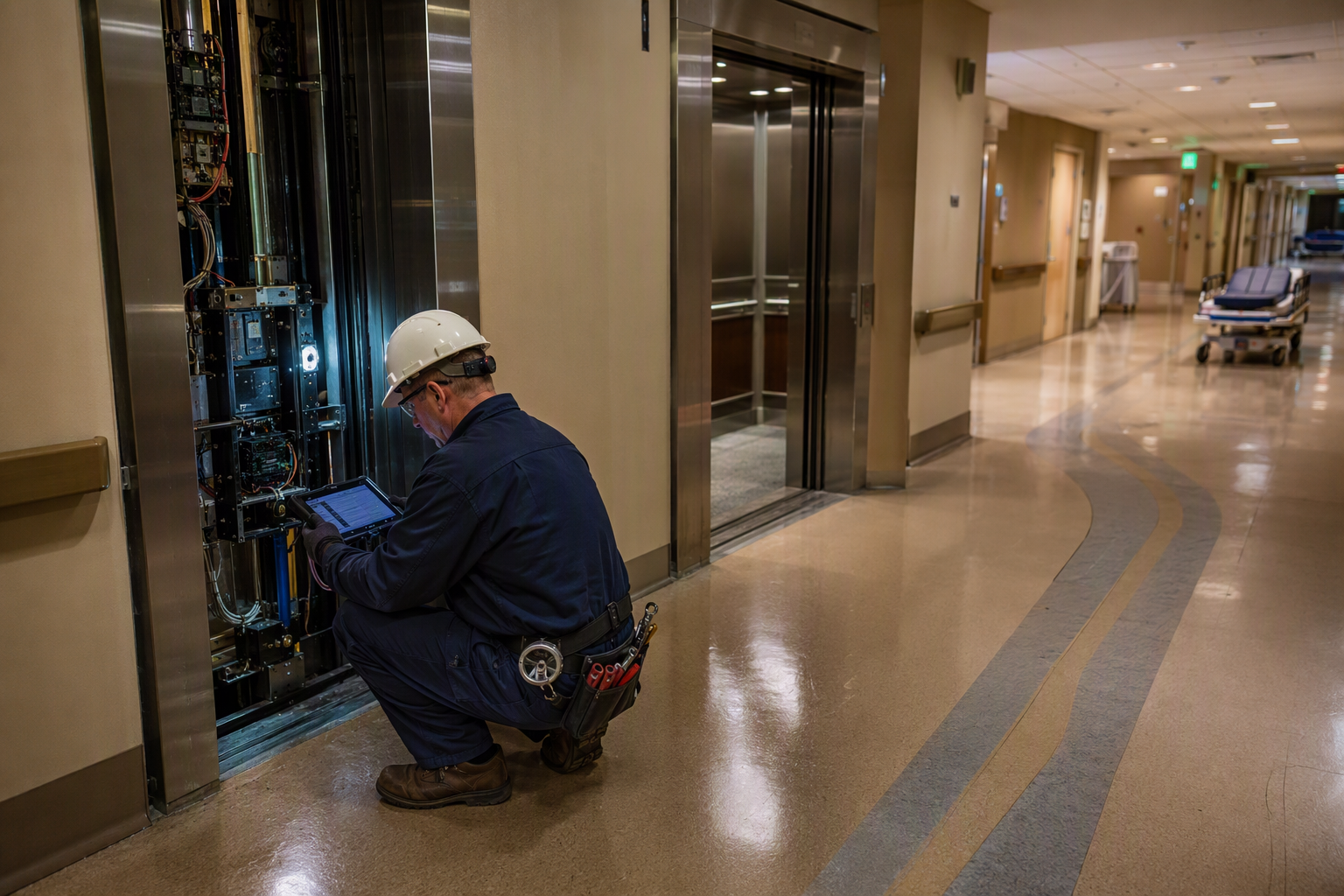
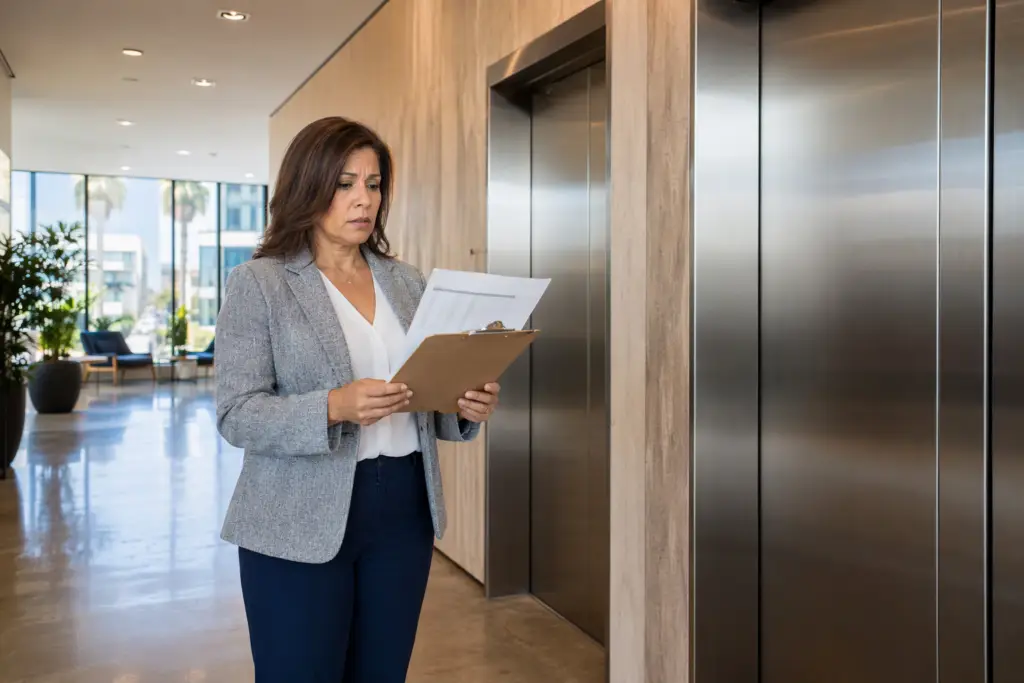
In a hospital, skilled nursing facility, or outpatient surgery center, a disabled elevator is never just an inconvenience — it can interrupt the movement of patients, medical equipment, and emergency responders. Healthcare elevator systems operate under some of the most demanding regulatory and operational standards in any industry. Understanding those requirements, and knowing what to do when a unit fails at 2 a.m., is essential for every facility manager in Southern California.
Why Healthcare Facilities Need 24/7 Elevator Repair Coverage
Hospitals and healthcare campuses run continuously. Patient transport between floors, medication delivery, gurney movement, and emergency response do not pause overnight or on weekends. When an elevator goes out of service in a clinical environment, the consequences extend beyond inconvenience: staff must reroute patients through alternative paths, surgery schedules can be disrupted, and in worst-case scenarios, emergency evacuation plans are compromised.
California Labor Code Sections 7300–7324.2 govern elevator operation across the state. Under this framework, administered by the Division of Occupational Safety and Health (Cal/OSHA), Elevator Unit, no elevator may operate without a valid permit to operate. A unit that is out of service or operating in an unsafe condition may be subject to Cal/OSHA action, which makes prompt, qualified repair a legal — not merely operational — priority.
Liftech Elevator holds the credentials required to perform repair work in California: Certified Qualified Conveyance Company (CQCC) status issued by Cal/OSHA and a C-11 Elevator Contractor license from the California Contractors State License Board (CSLB). Every mechanic dispatched to a healthcare site is a Certified Competent Conveyance Mechanic (CCCM), as required by California law.
What Compliance Standards Apply to Healthcare Elevators in California?
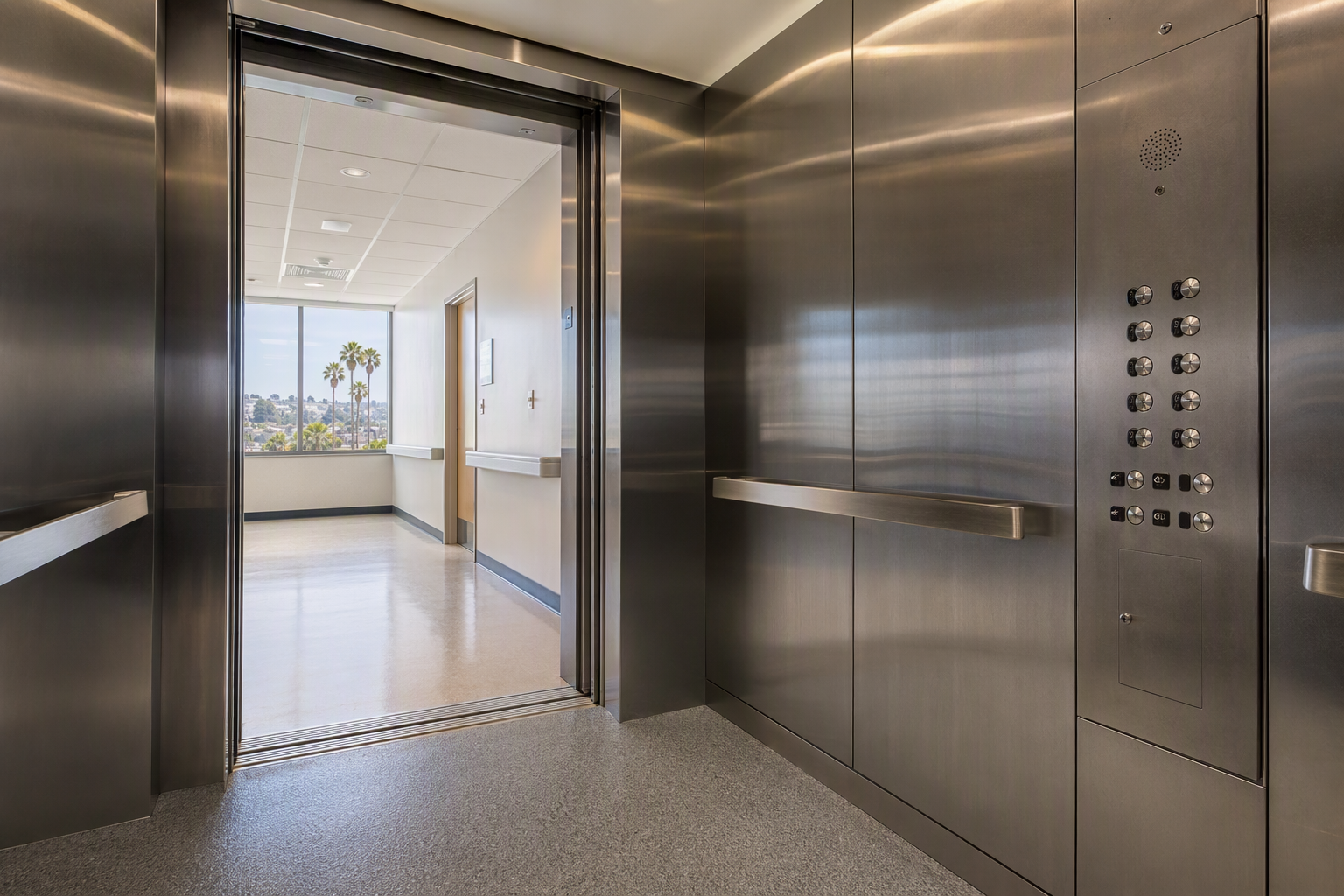
Healthcare elevator compliance in California involves overlapping federal and state requirements. Facility managers should be familiar with each layer.
ASME A17.1 — The Safety Code for Elevators and Escalators
California has adopted the ASME A17.1/CSA B44 Safety Code for Elevators and Escalators, 2004 edition, under its Group IV Elevator Safety Orders (California Code of Regulations, Title 8, Sections 3000–3146), effective May 1, 2008, for units installed under contracts signed on or after that date. This code governs construction, installation, operation, inspection, testing, maintenance, alteration, and repair of elevators in California facilities, including hospitals and long-term care settings.
California’s Standards Board held a public hearing on June 18, 2026, regarding a proposed Group V update that would incorporate portions of ASME A17.1-2019. No effective date has been posted as of 2026. Facility managers should monitor Cal/OSHA’s Elevator Unit page for updates.
ADA Accessibility Requirements
The Americans with Disabilities Act (ADA) requires that elevators in healthcare facilities remain accessible to individuals with disabilities. Car dimensions, door widths, control panel heights, and audible/visual signals must comply with ADA Standards for Accessible Design. In a healthcare setting — where patients may use wheelchairs, walkers, or hospital beds — ADA-compliant elevator operation is inseparable from patient safety and legal compliance. A malfunctioning elevator that blocks ADA access can expose the facility to federal civil rights liability.
California Permit and Inspection Requirements
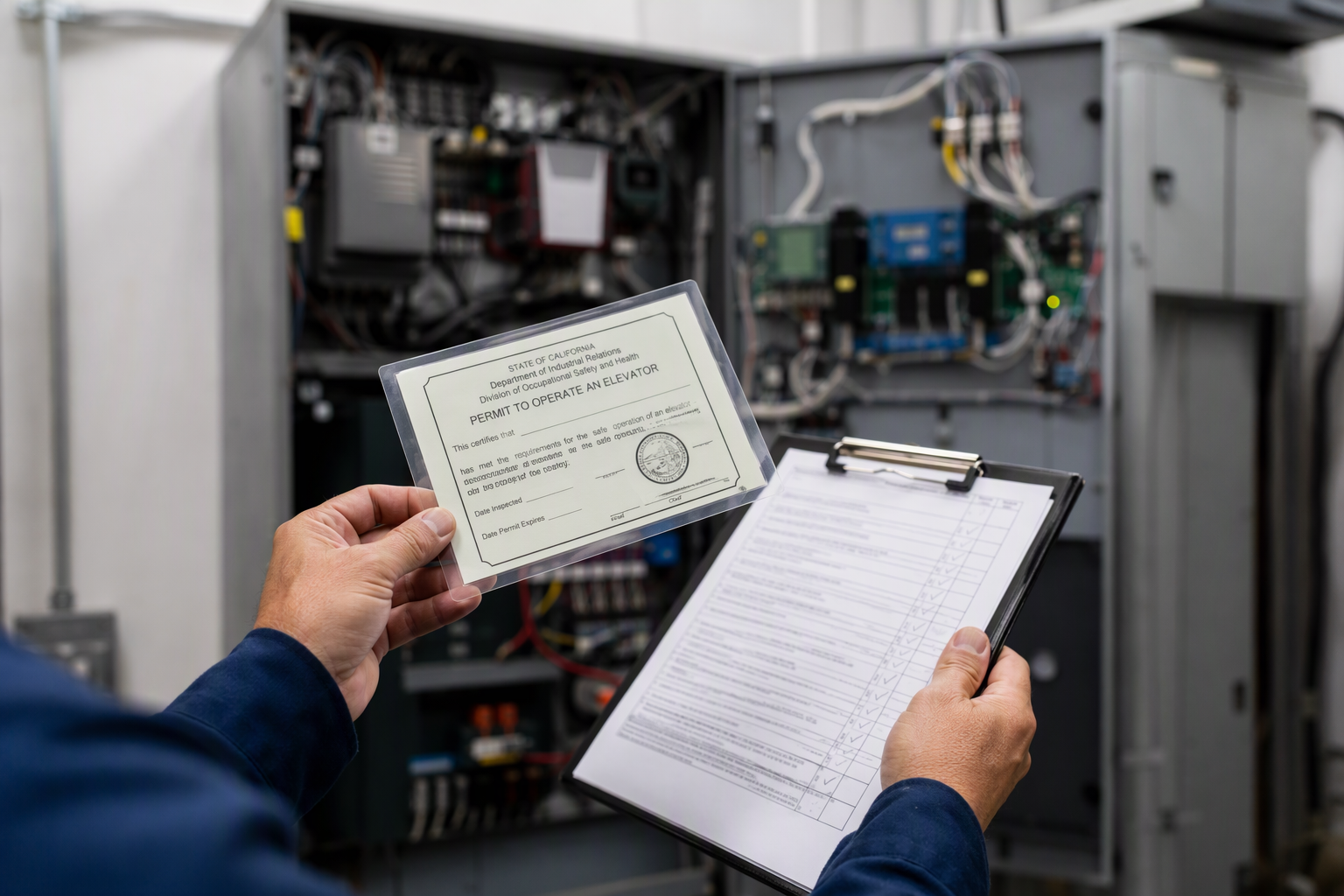
Under California law, every conveyance must be inspected at least once a year. A conveyance found to be in safe condition receives a permit to operate for up to one year. Facilities that maintain a full maintenance contract with a CQCC-certified, C-11-licensed company may qualify for a permit of up to two years. Arranging the annual reinspection is the elevator owner’s responsibility — not the state’s. Only State of California safety engineers and Certified Competent Conveyance Inspectors (CCCI) may perform these inspections.
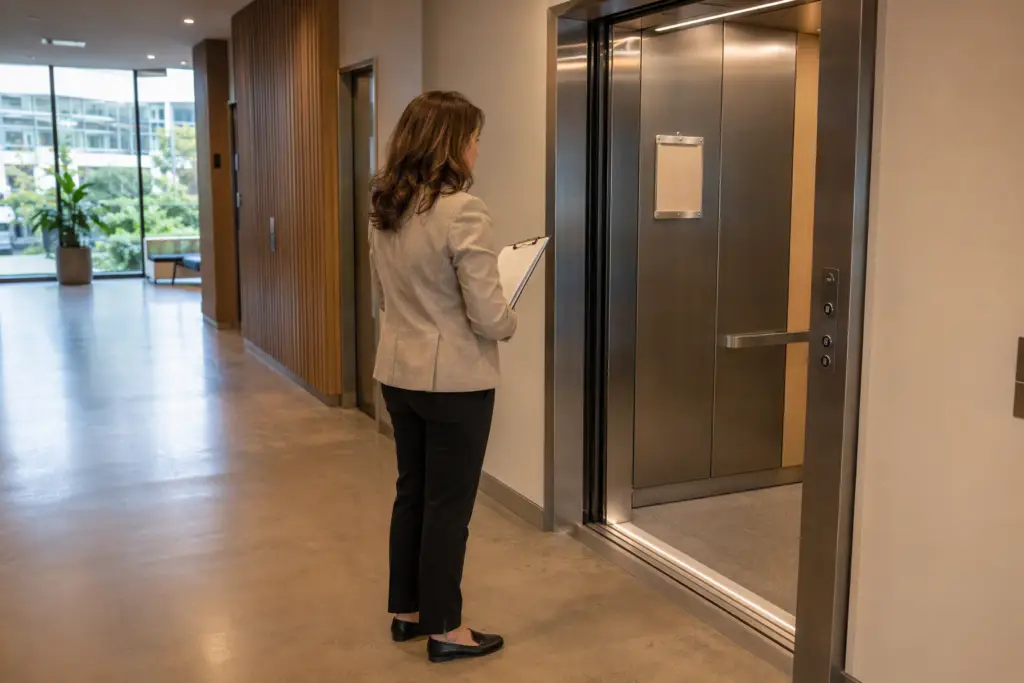
The permit to operate must be posted conspicuously inside the elevator car at all times. During any Joint Commission survey, CMS inspection, or state licensing visit, a missing or expired permit can trigger findings against the facility.
Los Angeles Jurisdiction
Facilities located within the City of Los Angeles should be aware that Los Angeles operates its own elevator and conveyance inspection program through the Department of Building and Safety (LADBS), in addition to state oversight. Liftech Elevator is familiar with both the Cal/OSHA framework and the requirements of the LADBS program as it applies to healthcare facilities in Los Angeles.
What Should a Healthcare Facility Do Immediately When an Elevator Fails?
- Ensure passenger safety. If anyone is trapped inside the car, contact your local fire department. Do not attempt to open doors manually without trained personnel.
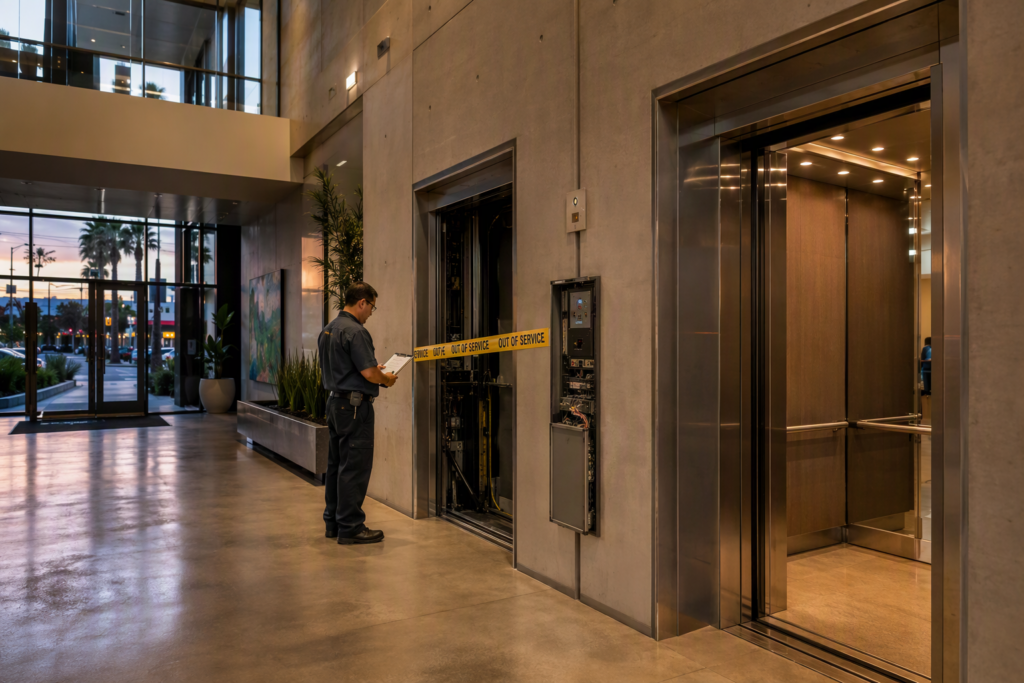
- Place the elevator out of service. Post clear signage at all floor landings directing patients, visitors, and staff to alternate routes or available elevators.
- Activate your emergency transport protocol. Notify nursing leadership, patient transport teams, and the emergency department of the unit status so patient care can be rerouted without delay.
- Contact a CQCC-certified elevator service company. Only a Certified Qualified Conveyance Company using Certified Competent Conveyance Mechanics may legally perform repairs in California. Contact Liftech Elevator to dispatch a qualified technician.
- Document the failure. Record the time, the nature of the malfunction, any error codes displayed, and any affected patients or staff. This documentation supports your Cal/OSHA compliance record and any insurance or incident reporting requirements.
- Notify your facilities director and compliance officer. Healthcare facilities subject to Joint Commission accreditation or CMS Conditions of Participation may have internal reporting timelines for equipment failures affecting patient safety.
- Arrange inspection before return to service. Depending on the nature of the repair, Cal/OSHA or the local authority having jurisdiction may need to inspect the unit before it is placed back in service.
How Often Must Healthcare Elevators Be Inspected in California?
California law requires every conveyance to be inspected at least once per year. A unit found in safe condition receives a permit to operate for up to one year. If the facility holds a full maintenance contract with a C-11-licensed, CQCC-certified company, Cal/OSHA may issue a permit for up to two years. Scheduling and arranging the reinspection is the responsibility of the elevator owner — the healthcare facility itself. Failing to maintain a current permit to operate can result in a unit being ordered out of service, creating significant disruption to patient care.
What Types of Elevator Repairs Are Most Common in Hospital Settings?
Healthcare environments place extraordinary demands on elevator systems. Units carry heavy loads — hospital beds, medical equipment carts, and high daily passenger volumes — around the clock. Common repair categories in clinical settings include:
- Door operator failures — Automatic door mechanisms are among the most frequently serviced components in high-traffic healthcare elevators. Misaligned, slow-closing, or non-responsive doors present both safety and ADA compliance risks.
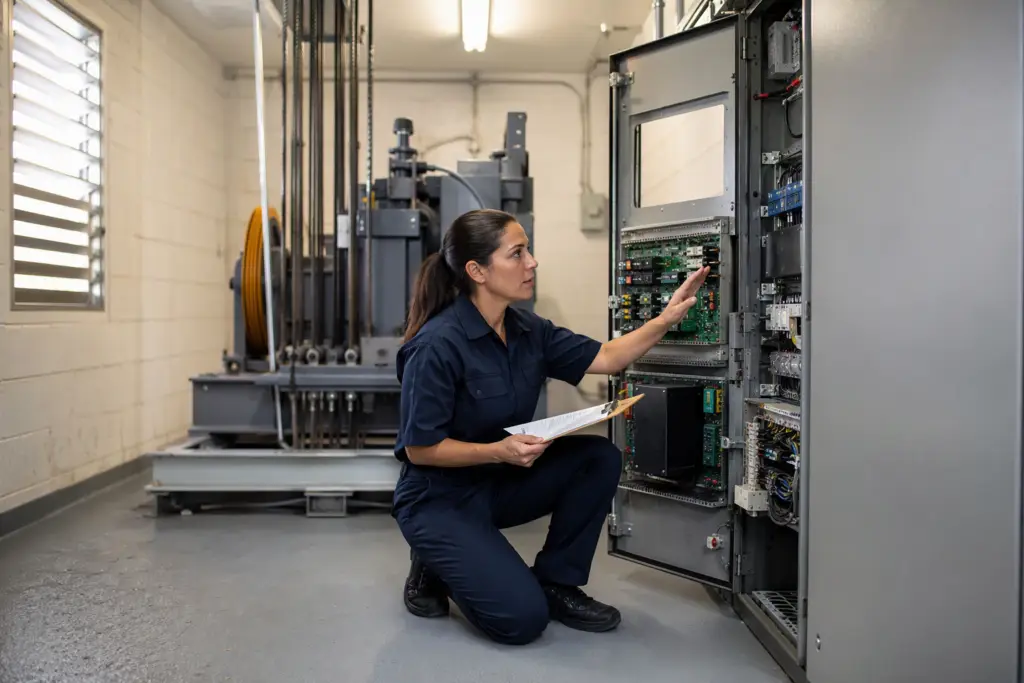
- Control system faults — Modern hospital elevators rely on sophisticated microprocessor controls. Software errors, sensor failures, and communication faults between car and machine room components can take a unit offline.
- Drive and motor issues — Hydraulic systems, traction motors, and variable-frequency drives are subject to wear under continuous operation. Unusual sounds, slow travel, or jerky movement often indicate drive-system concerns.
- Emergency communication systems — Hospitals must maintain reliable two-way communication within elevator cars for emergency situations. Failure of the intercom or alarm system may trigger compliance findings.
- Leveling problems — An elevator that does not level precisely with the floor creates a tripping hazard and can make it impossible to roll a gurney, wheelchair, or heavy cart in or out safely.
- Hydraulic fluid leaks — In hydraulic elevator systems, fluid leaks can create both mechanical failures and environmental hazards, requiring prompt response.
Liftech Elevator technicians are experienced with the specific mechanical and control systems found in healthcare facilities across Signal Hill, Long Beach, Los Angeles, and Orange County.
What Is a Full Maintenance Contract and Why Does It Matter for Hospitals?
A full maintenance contract with a CQCC-certified company covers routine lubrication, adjustments, safety tests, parts replacement, and repair callouts. For California healthcare facilities, a full maintenance contract carries a specific regulatory benefit: Cal/OSHA may issue a permit to operate for up to two years — rather than the standard one year — for elevators covered under such agreements. For a busy hospital managing multiple elevators, this can reduce the administrative burden of annual inspections and provide greater scheduling predictability.
Beyond the permit benefit, a full maintenance contract supports the proactive approach to uptime that healthcare facilities require. Preventive maintenance reduces the likelihood of unplanned failures during peak patient care hours.
How Does ADA Compliance Affect Elevator Repair Timelines in Healthcare?
Under the ADA, healthcare facilities are required to maintain accessible routes throughout the building. When an elevator serving as the primary accessible route between floors is out of service, the facility may need to demonstrate that an equivalent accessible path remains available. If no equivalent path exists, the facility is at risk of an ADA access violation for every hour the elevator remains down. This legal exposure reinforces why healthcare facilities cannot treat elevator repairs as routine work-order items that can wait for business hours.
What Makes Healthcare Elevator Repair Different from Other Industries?
Several factors distinguish elevator repair in clinical environments from commercial or residential work:
- Infection control protocols — Technicians working in hospitals and care facilities must comply with the facility’s infection control policies, which may include personal protective equipment requirements, restricted access to certain zones, and decontamination procedures.
- Patient privacy (HIPAA) — Elevator repair in areas where patient information is visible or audible requires discretion and, in some cases, escort by facility staff.
- Coordination with clinical operations — Scheduling non-emergency repair or maintenance work requires coordination with nursing supervisors, patient transport, and facilities management to minimize disruption to patient care.
- Code enforcement risk — A healthcare facility cited for an elevator violation during a Joint Commission survey or CMS inspection can face findings that affect accreditation status. Prompt, documented, code-compliant repairs are essential.
Which California Agencies Oversee Elevator Safety in Healthcare Facilities?
Primary oversight rests with the Cal/OSHA Elevator Unit, California Department of Industrial Relations, which enforces the California Labor Code Sections 7300–7324.2 and the California Code of Regulations, Title 8, Elevator Safety Orders. The California Contractors State License Board (CSLB) issues the C-11 Elevator Contractor license required for companies performing elevator work.
In the City of Los Angeles, the Department of Building and Safety (LADBS) operates its own elevator inspection program. Healthcare facilities in Los Angeles should ensure compliance with both the LADBS program and Cal/OSHA requirements.
At the federal level, OSHA standards apply to the safety of workers — including elevator mechanics and hospital staff — in and around elevator equipment.
Questions Your Inspector Will Ask
When a Cal/OSHA safety engineer or Certified Competent Conveyance Inspector arrives at a healthcare facility, they are likely to raise the following questions. Facility managers should be prepared to answer each one:
- Is the current permit to operate posted inside each elevator car? California law requires conspicuous display of the permit at all times.
- Who arranged the reinspection, and when was it scheduled? Scheduling the annual reinspection is the owner’s responsibility.
- Does the facility have a full maintenance contract with a CQCC-certified company? This determines whether a one-year or two-year permit applies.
- Can you produce records of the most recent safety tests? Inspectors review test documentation to verify compliance with the applicable edition of ASME A17.1.
- Have any alterations been made to the elevator since the last inspection? Any material alteration requires a Cal/OSHA permit before work begins.
- Is the emergency communication system functional? Inspectors will test in-car communication devices.
- Are door safety devices — including door reopening mechanisms — operating correctly? This is a critical safety check, particularly in facilities where patients may be slow to enter or exit.
- Has the elevator been serviced only by CCCM-certified mechanics working for a CQCC-certified company? Any work performed by uncertified individuals may void compliance standing.
How Should a Healthcare Facility Choose an Elevator Repair Company?
California law leaves no ambiguity here: only a Certified Qualified Conveyance Company (CQCC) using Certified Competent Conveyance Mechanics (CCCM) may maintain, repair, alter, or replace components on a conveyance. Beyond the baseline legal requirements, healthcare facilities should evaluate elevator service partners based on:
- Familiarity with the specific elevator systems in use at the facility
- Experience working within hospital infection control and access protocols
- Documented responsiveness and service records
- Ability to support Cal/OSHA inspection preparation and permit renewal
- Parts availability for time-critical repairs
Liftech Elevator serves healthcare facilities across Signal Hill, Long Beach, Los Angeles, and Orange County, holding all required California certifications and licenses to perform compliant elevator repair and maintenance work in clinical environments.
What Happens If a Healthcare Facility Operates an Elevator Without a Valid Permit?
Operating an elevator in California without a valid permit to operate issued by Cal/OSHA is a violation of California Labor Code Sections 7300–7324.2. Cal/OSHA has authority to order the unit out of service. In a healthcare environment, a forced shutdown of an elevator by a regulatory authority — rather than a controlled maintenance outage — creates far greater disruption to patient care operations and can attract additional scrutiny during subsequent inspections. Maintaining current permits and scheduling reinspections proactively is far preferable to responding to an enforcement action.
Schedule Your Healthcare Elevator Assessment Today
Elevator downtime in a clinical environment is a patient safety and compliance issue, not just a facilities problem. Whether a unit has failed unexpectedly or a facility’s maintenance program needs a compliance review, Liftech Elevator provides certified elevator repair and maintenance services for healthcare facilities across Signal Hill, Long Beach, Los Angeles, and Orange County.
Contact Liftech Elevator for a free elevator assessment — 562-997-3639
Need elevator service you can rely on? Liftech Elevator is ready to help.