Best Elevator Maintenance Company in Long Beach: Your Complete FAQ Guide
After more than 15 years maintaining, repairing, and modernizing elevator systems across Long Beach, Signal Hill, Los Angeles, and Orange County, I’ve seen firsthand what separates a reliable elevator maintenance company from one that cuts corners. Whether you manage a mid-rise office building on Pine Avenue, a senior living facility in Belmont Shore, or a commercial high-rise near the Port of Long Beach, this guide answers every question I hear from property managers and building owners — completely and honestly.
What Makes a Truly Great Elevator Maintenance Company in Long Beach?
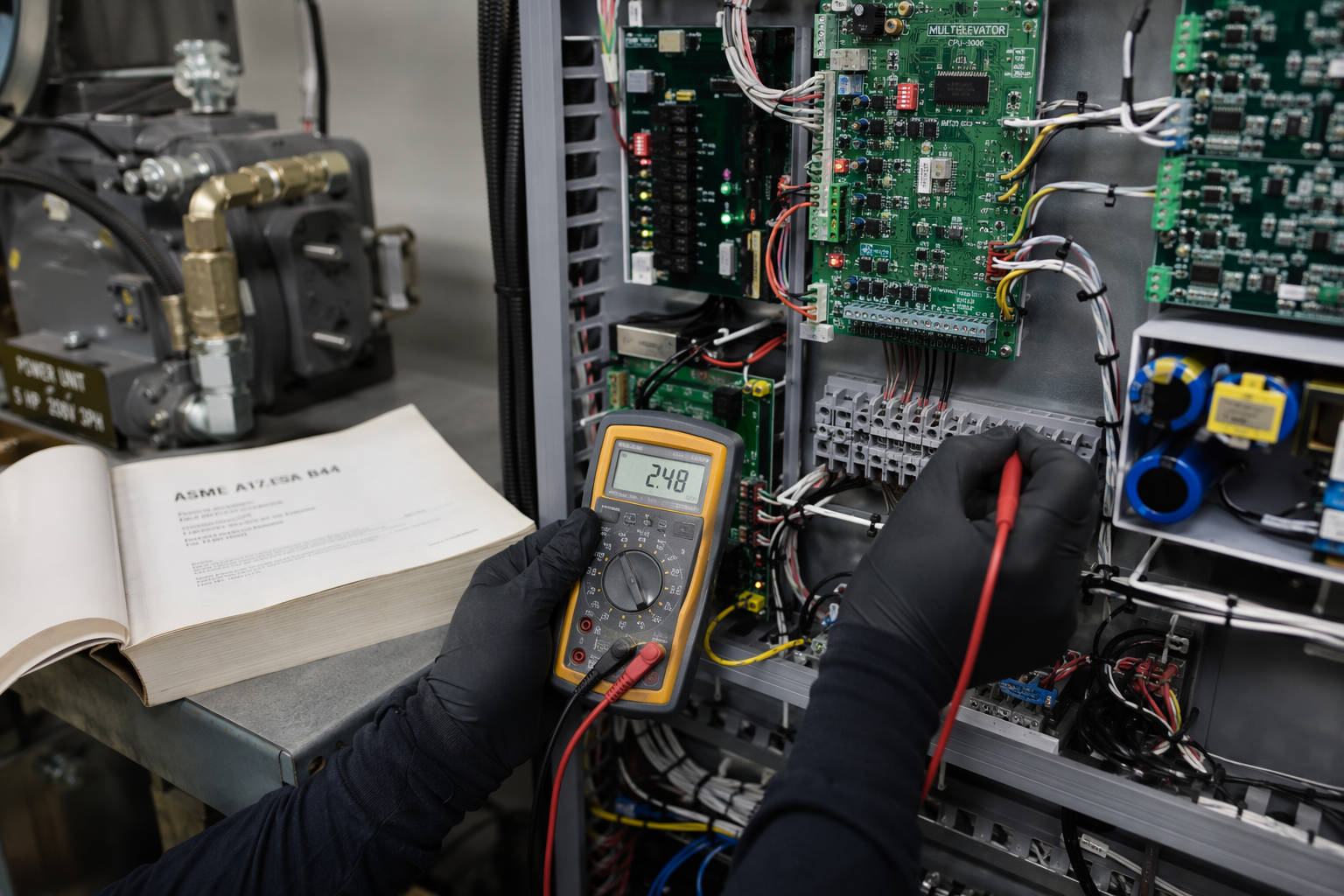
The best elevator maintenance company in Long Beach combines state-licensed technicians, ASME A17.1 code compliance, rapid response times, transparent pricing, and a documented preventive maintenance program — not just reactive repairs.
Over my career, I’ve taken over contracts from dozens of companies that promised low prices but delivered deferred maintenance, missed inspections, and equipment failures that cost building owners far more in emergency repairs and liability exposure. The true benchmark of a great elevator company is whether your equipment passes California Division of Occupational Safety and Health (Cal/OSHA) inspections consistently, year after year.
Key indicators of a top-tier provider include: IUEC (International Union of Elevator Constructors) certified mechanics, a documented maintenance log for every unit, 24/7 emergency dispatch, familiarity with California-specific Title 8 elevator regulations, and a proactive modernization roadmap so your equipment never falls behind code.
How Often Should Elevators Be Inspected in California?
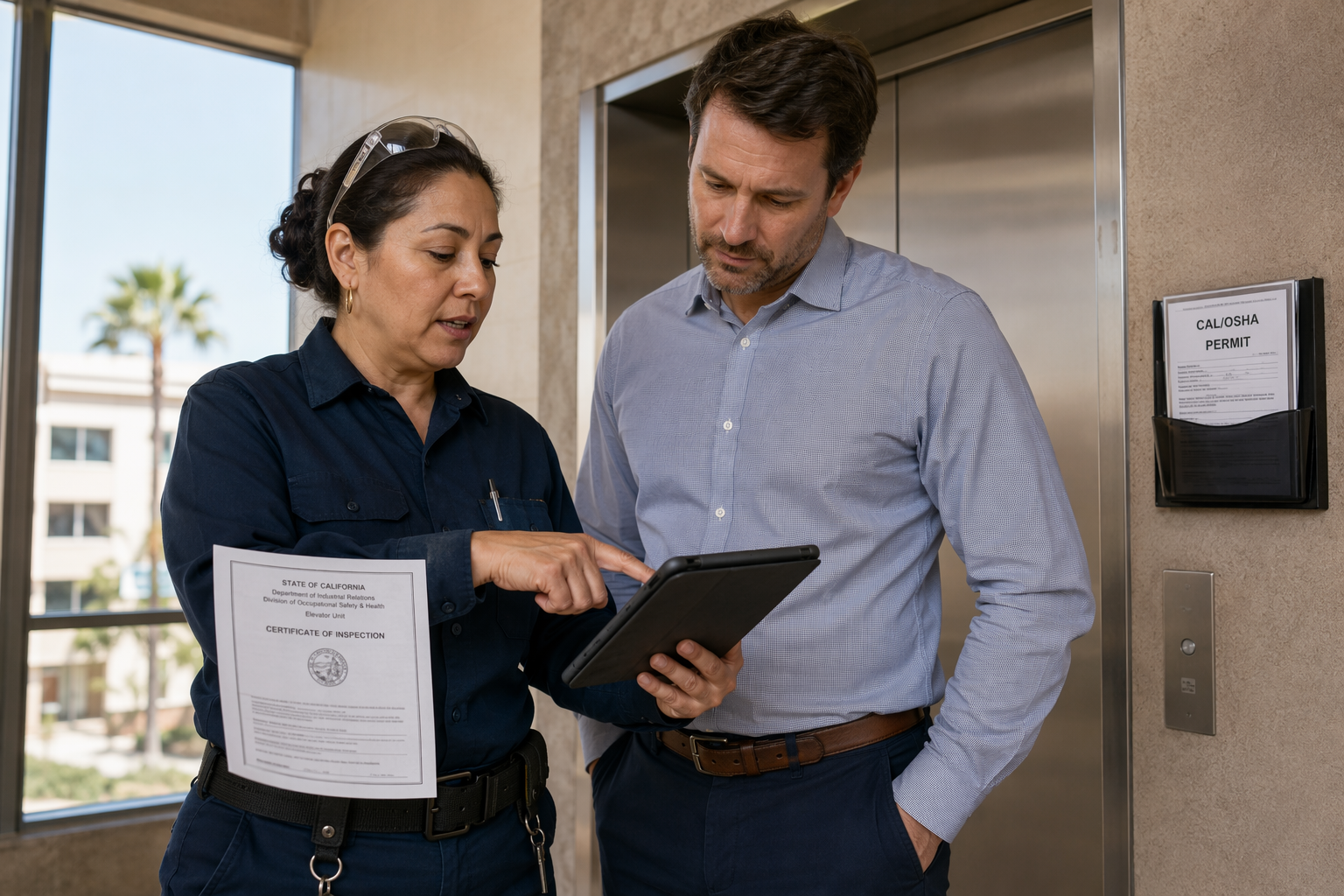
In California, elevators must be inspected and certified annually by a qualified elevator inspector under Cal/OSHA’s Elevator, Ride, and Tramway Unit, and quarterly maintenance checks are the industry best practice under ASME A17.1.
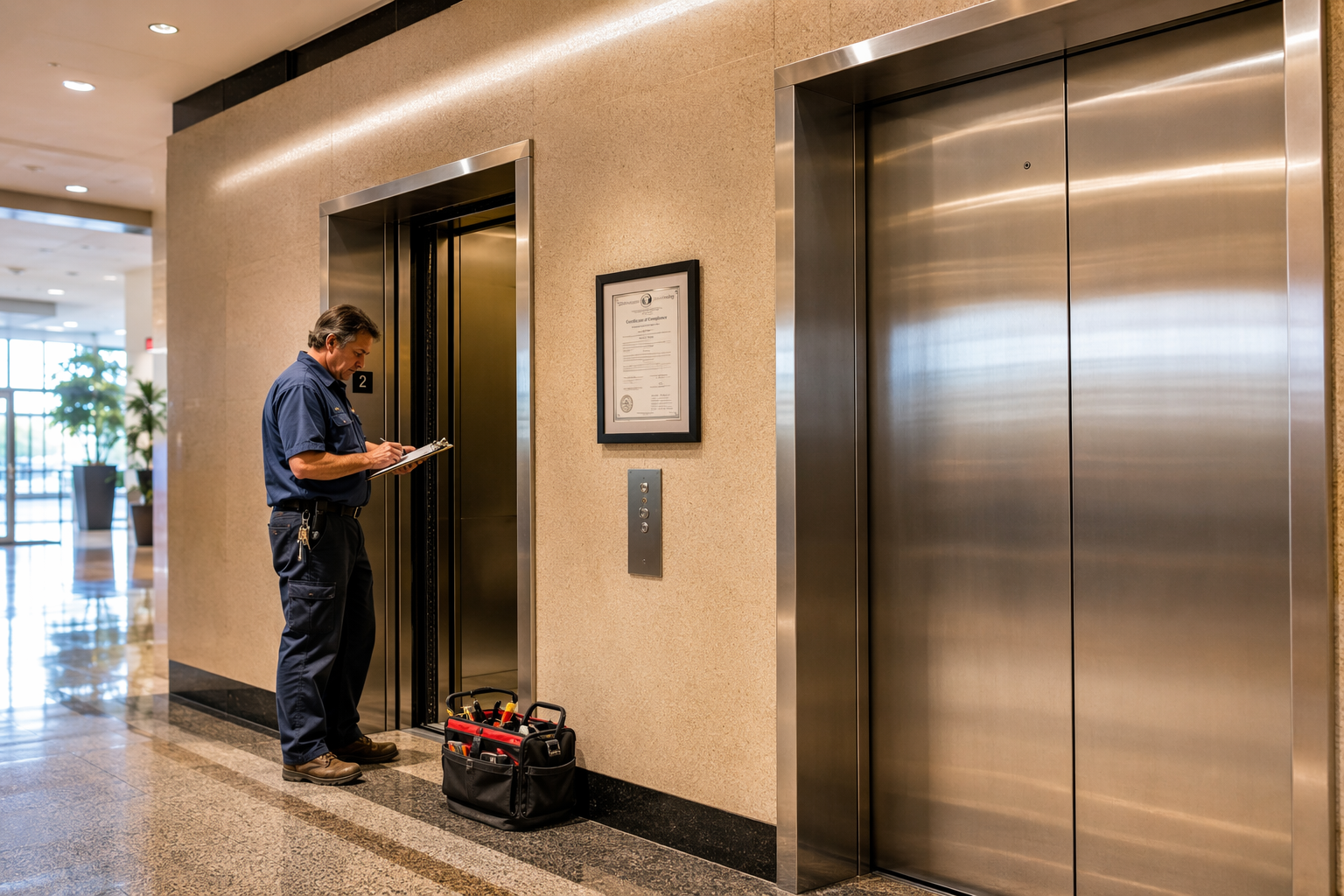
California Code of Regulations Title 8, Section 3001 et seq. governs elevator safety and mandates that every elevator, escalator, and related conveyance hold a current Certificate of Compliance issued after a passing annual inspection. Failure to maintain a valid certificate exposes building owners to fines, forced equipment shutdown, and significant liability.
Beyond the state-mandated annual inspection, the ASME A17.1/B44 Safety Code for Elevators and Escalators — the governing technical standard adopted in California — recommends a full preventive maintenance visit at minimum every three months. High-traffic commercial elevators (those making 200+ trips per day) benefit from monthly technician visits. Liftech Elevator structures its maintenance agreements around these benchmarks, not arbitrary scheduling chosen for contractor convenience.
What Does Elevator Preventive Maintenance Actually Include?
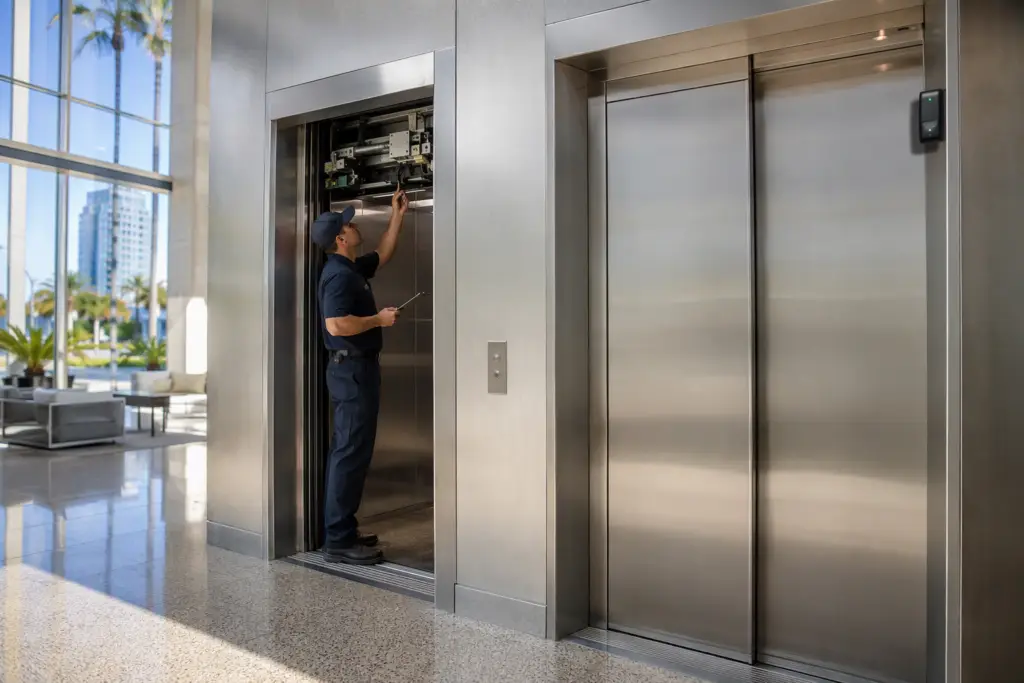
A proper preventive maintenance visit covers mechanical, electrical, hydraulic, and safety systems — typically 40 to 60 individual inspection and lubrication points per elevator, as outlined in ASME A17.1 Rule 8.6.
Here is what a certified technician should document and perform on every scheduled visit:
- Lubrication of guide rails, hoist ropes, sheaves, and door operator mechanisms
- Inspection and adjustment of door contacts, door gibs, and safety edges
- Testing of safeties, buffers, and governor rope tension
- Verification of emergency lighting, communication systems, and alarm bells
- Controller cabinet cleaning and inspection of relay contacts or solid-state boards
- Hydraulic fluid level and pressure checks (for hydraulic units)
- Motor room ventilation and temperature verification
- Inspection of pit for water intrusion, lighting, and stop switches
- Review and update of maintenance log with findings and corrective actions
Companies that compress this work into a 20-minute visit and hand you a green tag are not performing code-compliant maintenance. A thorough PM visit on a standard traction elevator takes 2 to 4 hours.
What Are the California Elevator Compliance Codes That Apply in Long Beach?
Long Beach elevator owners must comply with California Title 8 CCR elevator regulations, ASME A17.1-2019 (the code edition currently adopted in California as of 2026), and ADA accessibility standards under the Americans with Disabilities Act.
The regulatory framework can feel overwhelming, so here is a practical summary:
- California Title 8, CCR §3001–§3173: Governs safety, licensing, inspections, and permits for all conveyances in the state
- ASME A17.1/B44-2019: The technical safety code for design, installation, operation, and maintenance
- ASME A17.3: Retroactive safety requirements for existing elevators — this is frequently overlooked but critically important for older Long Beach buildings
- ADA Standards for Accessible Design (2010): Governs cab dimensions (minimum 80″ height, 51″ × 68″ interior for new installations), control panel heights, Braille signage, and door timing
- Long Beach Municipal Code: Building permit requirements for elevator installations and major modifications
As of 2026, California continues to enforce seismic safety requirements under Title 8 that require specific counterweight guarding and pit ladder standards — a compliance gap I see in roughly 30% of older buildings I assess for the first time.
How Much Does Elevator Maintenance Cost in Long Beach?
Elevator maintenance in Long Beach typically costs between $150 and $600 per month per elevator depending on equipment type, age, number of floors, and contract scope — with full-service agreements providing the best long-term value.
| Elevator Type | Visit Frequency | Estimated Monthly Cost (2026) | What’s Typically Included |
|---|---|---|---|
| Hydraulic (2–4 floors) | Quarterly | $150 – $275 | PM visits, lubrication, minor adjustments |
| MRL Traction (low-rise) | Quarterly | $200 – $350 | PM visits, controller checks, safety testing |
| Geared Traction (mid-rise) | Monthly | $300 – $450 | Full PM, parts, callbacks included |
| High-Rise Traction (10+ floors) | Monthly | $400 – $600+ | Comprehensive full-service, 24/7 priority dispatch |
| Residential Home Elevator | Semi-annual | $90 – $180 | Basic PM, safety check, lubrication |
Be cautious of “loss leader” contracts priced below $100/month — these are typically designed to lock you in, then generate revenue through inflated parts markups and callback charges. A transparent maintenance agreement should clearly define what is and is not included before you sign.
What Is the Difference Between a Full-Service and an Examination-Only Maintenance Contract?
A full-service contract includes both labor and parts for covered repairs, while an examination-only contract covers just the technician’s visit — leaving you to pay separately for every part and repair that is found necessary.
Examination-only contracts can appear attractive on paper at $80–$120/month but routinely cost building owners two to three times more annually once parts and labor invoices are factored in. For buildings with older equipment (pre-2000 controllers, DC motor drives, or relay logic panels), a full-service agreement is almost always the better financial decision because component failures are more frequent and more costly.
Liftech Elevator offers both contract types and will provide a frank recommendation based on your equipment age and usage profile — not based on which option generates more revenue for us.
How Do I Know If My Elevator Is Safe and Code-Compliant Right Now?
Your elevator is safe and code-compliant if it holds a current California Certificate of Compliance, has a dated maintenance log on file, and has no outstanding correction orders from the Cal/OSHA Elevator Unit.
You can verify your elevator’s permit and inspection status through the California DIR Elevator Unit. The certificate should be posted in or near the elevator cab. If you cannot locate a current certificate, or if the most recent inspection date is more than 12 months ago, your building may be operating an unlicensed conveyance — a violation that carries fines and exposes you to liability if an incident occurs.
Beyond the certificate, look for these warning signs: unusual noises during travel, leveling errors at floor stops, slow or erratic door operation, and any visible oil leakage in the pit. These are not cosmetic issues — they are early indicators of system failures that worsen without intervention.
What Should I Do Immediately If My Elevator Breaks Down or Traps Passengers?
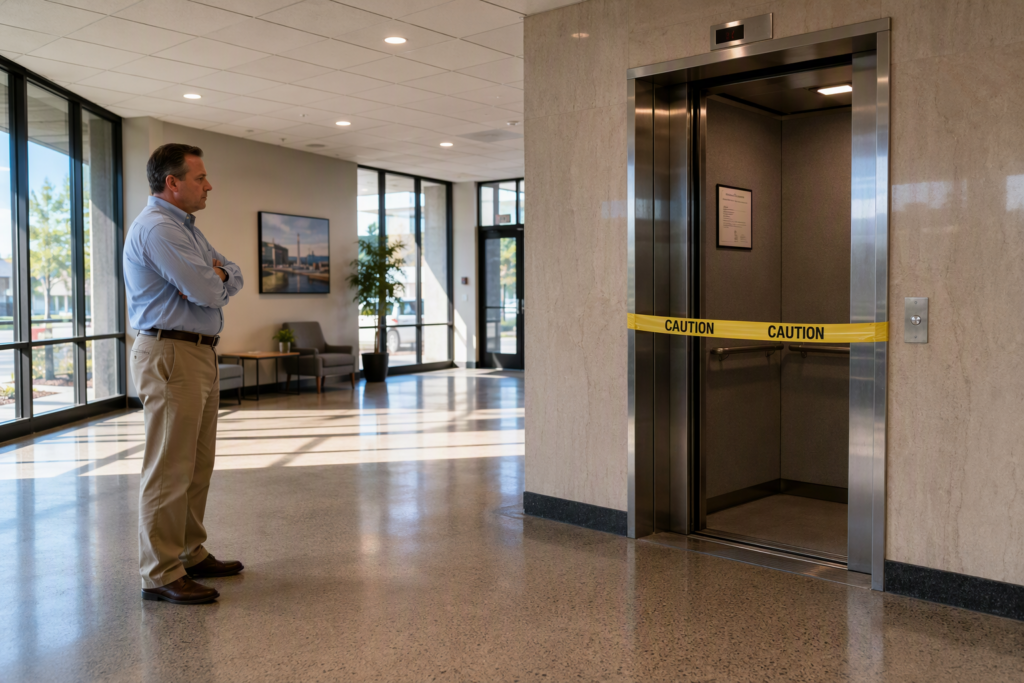
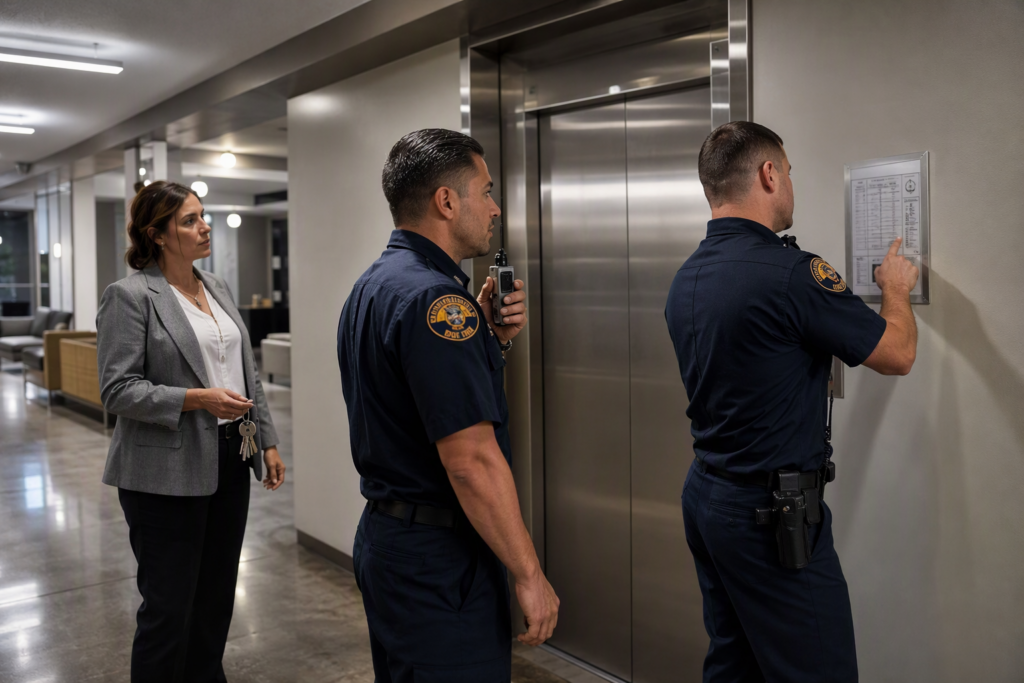
If passengers are trapped in an elevator, your immediate priority is communication, safety confirmation, and dispatching a certified technician — never attempt a self-rescue by forcing doors open.
- Immediately establish voice communication with the trapped passengers using the emergency phone inside the cab or through the building intercom system.
- Confirm passengers are not injured and reassure them that help is on the way. Advise them not to attempt to force open doors or exit the cab between floors.
- Call 911 if any passenger has a medical emergency, is in distress, or if the cab is stopped between floors with no indication of moving.
- Contact your elevator maintenance company’s 24/7 emergency dispatch line immediately — note the exact elevator ID, floor location of the cab, and the number of trapped passengers.
- Do not allow building staff, security, or untrained individuals to attempt to manually lower the elevator or force the cab doors — improper rescue attempts have caused fatalities.
- Document the time, conditions, and all actions taken for your incident report and potential insurance or liability purposes.
- Once the technician arrives and safely evacuates passengers, keep the elevator out of service until a full diagnostic inspection is completed and the root cause is identified.
Liftech Elevator maintains a 24/7 emergency response line for exactly these situations, with a target dispatch time of under 60 minutes for clients in Long Beach and surrounding service areas.
How Long Does an Elevator Modernization Take, and When Is It Necessary?
Most elevator modernization projects in Long Beach take between 4 and 12 weeks depending on scope, with full cab-and-controls modernizations typically requiring 6–10 weeks and phased projects completed floor-by-floor with minimal downtime.
Modernization becomes necessary — not just desirable — when equipment reaches 20–30 years of age and original replacement parts are no longer manufactured, or when ASME A17.3 retroactive safety requirements mandate upgrades. As of 2026, the specific triggers include:
- Relay logic controllers that can no longer be programmed to meet current safety logic requirements
- DC motor drives for which spare SCR components are no longer available
- Non-compliant door operators that cannot be retrofitted with current UL-listed safety edges
- Hydraulic units with single-bottom cylinders installed prior to 1972 (California requires PVC liner retrofits under Title 8)
- Buildings undergoing major renovation where ADA compliance triggers accessibility upgrade requirements
A well-executed modernization extends equipment life by 20–25 years and typically reduces energy consumption by 30–50% when modern variable-frequency drives (VFDs) replace older motor starters.
What Certifications Should I Look for When Choosing an Elevator Company in Long Beach?
At minimum, your elevator maintenance company must hold a California Elevator Contractor License (issued by Cal/OSHA), employ IUEC-certified mechanics, and carry a minimum of $1 million in general liability and workers’ compensation insurance.
Here is the complete checklist I recommend to every property manager I work with:
- California Elevator Contractor License: Verify through the California DIR Elevator Unit
- IUEC Journeyman Certification: Confirms technicians have completed a 5-year apprenticeship program
- QEI (Qualified Elevator Inspector) Certification: For inspection work (issued by NAESA International)
- General Liability Insurance: Minimum $1 million per occurrence, $2 million aggregate
- Workers’ Compensation Insurance: Mandatory in California — never hire a contractor without it
- Manufacturer Authorization: For proprietary equipment brands (Otis, KONE, Schindler, ThyssenKrupp), check whether the contractor is authorized or independent
Does Liftech Elevator Service All Types of Elevator Equipment in Long Beach?
Yes — Liftech Elevator services hydraulic, traction, MRL (machine-room-less), residential, commercial, and freight elevator systems from all major manufacturers, as well as escalators and platform lifts throughout Long Beach and the greater Los Angeles area.
Our technicians are trained and experienced with equipment from Otis, KONE, Schindler, ThyssenKrupp, Dover, Montgomery, Fujitec, Mitsubishi, and independent manufacturers. We maintain proprietary diagnostic tools and technical manuals for each platform, which significantly reduces diagnostic time and prevents misdiagnosis — a common problem with general contractors who service elevators as a secondary offering.
How Do I Compare Elevator Maintenance Companies Before Signing a Contract?
Compare elevator maintenance companies on five criteria: technician certifications, contract scope transparency, average response time, local references, and whether they provide a written maintenance log after every visit.
When requesting bids, ask each company these specific questions:
- What is the certifications status of the technician who will actually service my unit?
- What is your guaranteed response time for emergency calls?
- Does your contract include parts and callbacks, or are those billed separately?
- Can you provide three local references from buildings similar to mine?
- Do you carry a California Elevator Contractor License — and can you provide the license number?
- What is your process when a part is on backorder and the elevator is out of service?
- Do you provide a written, signed maintenance log after every visit?
Any contractor that hesitates or cannot answer these questions directly should be disqualified. Transparency is not a premium feature — it is a baseline expectation.
What Are the Most Common Elevator Problems in Long Beach Buildings?
The most common elevator problems I encounter in Long Beach buildings are door malfunctions (accounting for roughly 60–70% of service calls), leveling errors, hydraulic fluid contamination, and outdated controller faults — most of which are preventable with consistent preventive maintenance.
Long Beach’s coastal climate adds an extra layer of complexity: salt air accelerates corrosion on exposed metal components, door tracks, and hoist rope terminations. Buildings within 1 mile of the shoreline — think Belmont Shore, Naples, and Downtown Long Beach — require more frequent lubrication cycles and corrosion-inhibiting treatments than inland properties. This is a detail that many out-of-area contractors miss entirely when structuring maintenance programs for Long Beach properties.
What Is the ADA Requirement for Elevators in Commercial Buildings?
Under the 2010 ADA Standards for Accessible Design, commercial elevators must have a minimum cab interior of 80 inches in height, hall call buttons positioned between 15 and 48 inches above the floor, Braille and tactile floor designations, a minimum door open time of 3 seconds, and audible and visual floor indicators.
For existing buildings undergoing renovations that affect the path of travel, ADA compliance triggers can require elevator upgrades even when the elevator itself is not directly part of the renovation project. This is a frequently misunderstood obligation under the ADA’s “path of travel” requirements. Building owners should consult with a certified accessibility consultant and their elevator contractor before beginning any significant tenant improvement project.
Residential elevators in private single-family homes are generally exempt from ADA requirements, though Fair Housing Act accessibility standards may apply to multifamily residential buildings with four or more units built after 1991.
How Does the Annual Cal/OSHA Elevator Inspection Process Work in California?
California’s annual elevator inspection is conducted by a Cal/OSHA-approved Qualified Elevator Inspector (QEI), who performs a full safety test and issues either a Certificate of Compliance or a correction order — building owners must correct all violations before a certificate is issued.
The inspection process typically works as follows:
- Building owner or elevator contractor submits a permit renewal application and fee to the Cal/OSHA Elevator Unit prior to the certificate expiration date.
- A QEI-certified inspector is assigned and coordinates a test date with the elevator contractor, who must be present to operate the equipment and witness tests.
- The inspector performs a full Category 1 safety test (or Category 5 full-load safety test on the applicable 5-year cycle), covering all safety devices, interlocks, buffers, and emergency systems.
- If all tests pass, a new Certificate of Compliance is issued and must be posted in or adjacent to the elevator.
- If deficiencies are found, a correction order is issued. The elevator may be placed out of service if the violations are immediately dangerous — the contractor has a specified period to complete corrections and request a re-inspection.
Proactive maintenance throughout the year is the single most effective way to ensure a clean annual inspection. I have never seen a well-maintained elevator fail an annual inspection on a major item.
What Are the Energy Efficiency Options for Older Elevators in Long Beach?
The most impactful energy efficiency upgrades for older Long Beach elevators are variable-frequency drive (VFD) motor controllers, LED cab lighting, regenerative drives, and standby power management systems — which together can reduce elevator energy consumption by 30–60%.
For building owners focused on sustainability benchmarks — particularly those pursuing LEED certification or responding to California’s Title 24 energy compliance requirements — elevator modernization is often a faster payback than HVAC upgrades. A VFD retrofit on a mid-rise traction elevator typically pays back in 3–5 years through reduced electrical demand charges alone. Regenerative drives go a step further by feeding recovered energy back into the building’s electrical grid during descent, making them particularly effective in high-rise applications.
How Quickly Can an Elevator Company Respond to Emergency Calls in Long Beach?
A reputable elevator maintenance company should guarantee emergency response in Long Beach within 2–4 hours, with trapped passenger situations warranting a contractually committed response time of 60 minutes or less.
Response time is one of the most important — and most commonly misrepresented — metrics in elevator service. Many companies advertise “24/7 service” but route after-hours calls to an answering service that dispatches an on-call technician who may be hours away. Always ask prospective contractors: “Where is your on-call technician stationed, and what is your contractual response time commitment in writing?”
Liftech Elevator maintains technicians local to Long Beach and Signal Hill, specifically to ensure that our emergency response commitments are physically achievable — not just marketing language.
Can a Building Owner Switch Elevator Maintenance Companies Mid-Contract?
Yes, a building owner can switch elevator maintenance companies, though the process requires reviewing your existing contract for termination clauses, obtaining maintenance logs and as-built drawings from the outgoing contractor, and scheduling a condition assessment before the new contractor assumes responsibility.
A few critical steps when transitioning:
- Review your current contract for auto-renewal clauses and required notice periods (typically 60–90 days)
- Request complete maintenance logs, wiring diagrams, and parts documentation from the outgoing company — you are legally entitled to this information
- Schedule an independent condition assessment before the new contractor’s first PM visit so that any existing deficiencies are documented as pre-existing and not attributed to the incoming contractor
- Confirm the transition timing does not create a gap in your Cal/OSHA permit coverage
I recommend this process specifically because it protects all parties and ensures continuity of safety — not because it generates more work for the incoming contractor.
What Should Be Included in an Elevator Maintenance Log?
A compliant elevator maintenance log must document the date of each visit, the name and certification of the technician, all items inspected or lubricated, any deficiencies found, corrective actions taken, and parts replaced — in accordance with ASME A17.1 Rule 8.6.2.
Under California Title 8 regulations, maintenance logs must be kept on-site and made available to Cal/OSHA inspectors upon request. Digital maintenance logs are acceptable and increasingly common, but building owners should ensure they have consistent access to log records — not just the contractor. If your current maintenance company cannot produce a complete, itemized log for the past 12 months of service visits, that is a significant red flag.
Why Should I Choose Liftech Elevator for My Long Beach Building?
Liftech Elevator combines IUEC-certified local technicians, full ASME A17.1 and Cal/OSHA compliance expertise, transparent maintenance agreements, and deep familiarity with Long Beach’s specific coastal and high-rise conditions — making us the practical choice for building owners who want reliable, compliant elevator service without surprises.
We serve Long Beach, Signal Hill, Los Angeles, and Orange County with a team that lives and works in these communities. We are not a national franchise routing calls through a distant call center. When you call Liftech Elevator, you speak directly with a technician or a service coordinator who knows your building, your equipment, and your history.
Our approach is straightforward: we document everything, we explain what we find in plain language, and we do not recommend repairs that are not necessary. We price our contracts transparently and we stand behind our work. That philosophy has earned us long-term relationships with property managers, HOAs, healthcare facilities, and commercial building owners throughout the greater Long Beach area.
Ready for Reliable, Code-Compliant Elevator Service in Long Beach?
Whether you need a new maintenance contract, a second opinion on a repair estimate, a modernization assessment, or emergency service, Liftech Elevator is ready to help. Our certified technicians serve Long Beach, Signal Hill, Los Angeles, and Orange County.
Contact Liftech Elevator for a free elevator assessment.
Call us today: 562-609-3478
We are available 24 hours a day, 7 days a week for emergency service calls.