Top Rated Elevator Maintenance Company Los Angeles: Complete FAQ Guide
After 15+ years maintaining and inspecting elevators across Los Angeles County and Orange County, I’ve fielded thousands of questions from building owners, property managers, and facility directors about elevator maintenance. This comprehensive FAQ hub exists to give you straight, technically accurate answers — no fluff, no sales spin — so you can make the best decisions for your building and your passengers.
Whether you manage a high-rise in downtown Los Angeles, a mid-rise in Long Beach, a commercial property in Signal Hill, or a mixed-use development in Orange County, the compliance requirements, maintenance best practices, and safety standards covered here apply directly to your situation. Let’s get into it.
What makes an elevator maintenance company “top rated” in Los Angeles?
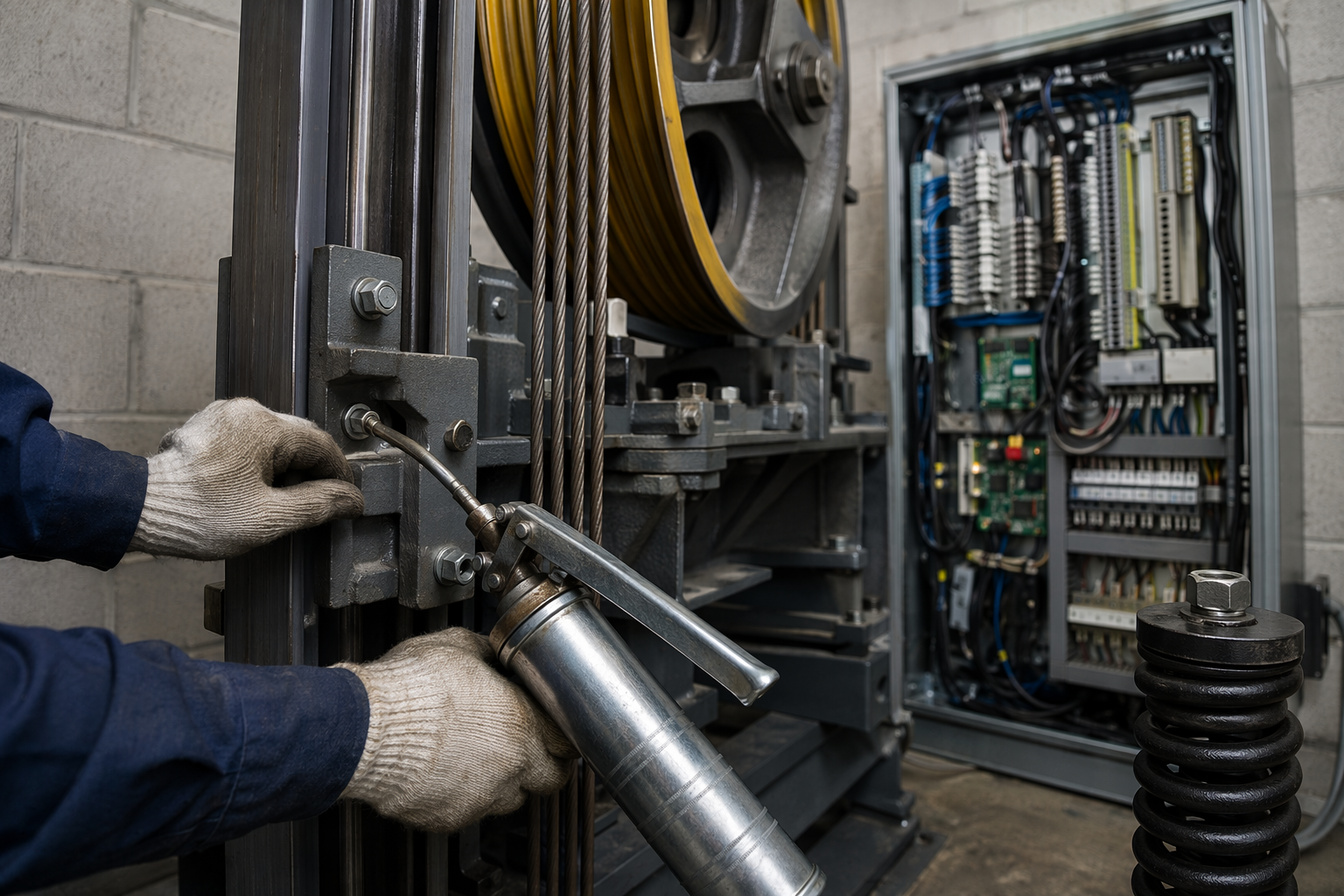
A top rated elevator maintenance company in Los Angeles combines IUEC-certified technicians, full ASME A17.1 and California Title 8 compliance, documented response times under 2 hours for emergencies, and a verifiable track record of zero safety violations on CAL/OSHA inspections.
In my experience, the single biggest differentiator between a mediocre elevator company and an exceptional one isn’t price — it’s technician certification and accountability. The ASME A17.1 Safety Code for Elevators and Escalators sets the national baseline, but California enforces additional requirements through Title 8 of the California Code of Regulations. A top rated company knows both codes inside and out and maintains meticulous inspection records that hold up to CAL/OSHA scrutiny.
Other markers of a genuinely top rated provider: transparent maintenance contracts with no hidden fees, 24/7 emergency dispatch with documented average response times, a dedicated local presence (not a national chain managing your account from a call center two states away), and references from comparable properties in your market. Liftech Elevator checks every one of these boxes for clients across Los Angeles, Long Beach, Signal Hill, and Orange County.
How often do elevators in Los Angeles need to be professionally maintained?

Los Angeles elevators require monthly preventive maintenance visits at minimum under most full-service contracts, with quarterly oil changes, annual safety tests, and the mandatory 5-year CAT 1 and periodic CAT 3/5 load tests required by California Title 8.
Monthly visits aren’t optional — they’re the industry standard established by ASME A17.1 Section 8.6 and reinforced by California’s Elevator Safety Order. During each monthly visit, a certified technician should be checking door operator adjustments, lubricating guide rails, testing safety circuits, verifying brake adjustment, and logging all findings in a maintenance control program (MCP) document.
Many building owners make the mistake of accepting quarterly maintenance to save money. In 15 years of field work, I’ve seen that false economy result in emergency repair bills 3–5 times larger than the maintenance savings. Monthly service catches small issues — a worn roller guide, a slightly misadjusted door clutch — before they become costly shutdowns or, worse, safety incidents.
What does elevator maintenance cost in Los Angeles in 2026?
In 2026, elevator maintenance contracts in Los Angeles typically range from $300–$900 per month per unit depending on elevator type, age, service scope, and whether the contract is oil-and-grease-only or full coverage including parts and repairs.
| Contract Type | Typical Monthly Cost (Per Unit) | What’s Covered | Best For |
|---|---|---|---|
| Oil & Grease Only | $300 – $450 | Lubrication, minor adjustments, visual inspection | New elevators under OEM warranty |
| Lubrication + Parts | $450 – $650 | All of above + parts replacement (caps on major components) | Mid-age elevators (5–15 years) |
| Full Maintenance | $650 – $900 | All parts, labor, adjustments, callbacks included | Older elevators, high-traffic buildings |
| Modernization + Maintenance Bundle | $500 – $750 (post-mod) | Full coverage after upgrade; includes warranty period | Buildings undergoing elevator modernization |
These figures reflect the Los Angeles market specifically. Orange County and Long Beach pricing is comparable. Always compare contracts on a total cost-of-ownership basis — a cheap oil-and-grease contract on a 30-year-old hydraulic elevator is almost never the economical choice once you factor in callback labor rates ($150–$250/hour in LA in 2026) and parts markups.
What is ASME A17.1 and why does it matter for Los Angeles building owners?
ASME A17.1 is the national Safety Code for Elevators and Escalators published by the American Society of Mechanical Engineers, and it forms the technical foundation for California’s elevator safety regulations, meaning non-compliance exposes building owners to fines, shutdowns, and liability.
California adopts ASME A17.1 by reference in Title 8, Section 3000 of the California Code of Regulations — the Elevator Safety Order. The 2022 edition of ASME A17.1 (the most current as of 2026) includes requirements for seismic sensors (critical for Los Angeles), door reopening devices, emergency lighting, and accessibility features aligned with the Americans with Disabilities Act (ADA).
For building owners in Los Angeles, this means your maintenance provider must be current on the 2022 code edition. A technician still working from 2010-era procedures isn’t just outdated — they may be signing off on inspections that don’t meet current California requirements, putting your operating permit at risk.
What are the required elevator inspections in California?
California requires annual CAT 1 safety tests (no-load, full-speed governor and safety device tests), 5-year CAT 5 tests (full-load safety tests), and periodic state inspections by a CAL/OSHA Certified Competent Elevator Inspector (CCEI) — all documented in an approved maintenance control program.
Here’s the breakdown of California’s mandatory inspection categories under Title 8:
- CAT 1 (Annual): Rated-speed governor and safety test with no load. Must be performed by a certified technician and witnessed by a CCEI or approved special inspector.
- CAT 3 (Every 3 Years): Applies to hydraulic elevators — pressure vessel and piping tests.
- CAT 5 (Every 5 Years): Full-load safety test at 125% rated load. This is the most demanding test and requires significant pre-test maintenance preparation.
- State Periodic Inspection: CAL/OSHA DOSH (Division of Occupational Safety and Health) conducts periodic inspections and issues permits to operate. A failed inspection results in a red-tagged elevator — it cannot run until deficiencies are corrected.
Missing any of these dates doesn’t just mean a fine — it can mean your elevator operating permit is void, exposing you to significant liability if an incident occurs. Liftech Elevator maintains a proactive test scheduling system that notifies clients 90 days before any mandatory test is due.
How do I know if my elevator is ADA compliant?
ADA compliance for elevators is governed by the ADA Standards for Accessible Design, specifically Section 407, which mandates minimum cab dimensions of 51″ x 80″, Braille and raised-character controls, door reopening devices, and audible/visual floor indicators.
Many older elevators in Los Angeles buildings — particularly those built before 1993 when the ADA took full effect — fail one or more of these requirements. The most common deficiencies I find during assessments are: undersized control button mounting heights, missing or worn Braille signage, non-functioning audible signals, and door timing that doesn’t provide adequate time for mobility-impaired passengers.
ADA compliance isn’t just a federal obligation — California’s Building Code (CBC) Section 11B reinforces and in some cases exceeds federal ADA requirements. A thorough accessibility audit should be part of any comprehensive elevator assessment, especially if you’re facing a building permit renewal or tenant complaints.
What is the difference between elevator maintenance and elevator modernization?
Elevator maintenance preserves the existing system’s safe, code-compliant operation through scheduled service and repairs, while elevator modernization replaces aging components — controls, motors, door operators, or entire cab interiors — to extend useful life, improve performance, and meet current code requirements.
The decision between continued maintenance and modernization is one of the most financially significant choices a building owner makes. As a general rule, when annual repair and maintenance costs exceed 30–40% of the modernization cost, modernization becomes the economically rational choice. For a traction elevator in Los Angeles, a full modernization runs $60,000–$200,000+ depending on scope; a hydraulic modernization typically runs $40,000–$120,000.
Signs that modernization may be overdue: recurring entrapments, frequent door callbacks, outdated relay logic controls (pre-microprocessor systems), visible machine room oil leaks, or equipment that’s 25+ years old and approaching obsolescence. Modernized elevators also typically reduce energy consumption by 30–50%, which matters significantly for California’s Title 24 energy compliance requirements.
What should I look for in an elevator maintenance contract in Los Angeles?
A solid Los Angeles elevator maintenance contract must specify response times for entrapments (1 hour max), define what “full maintenance” includes in writing, identify the specific technician certifications required, and include provisions for annual CAT 1 test performance and documentation.
After reviewing hundreds of elevator contracts over my career, here are the clauses I tell every building owner to scrutinize or negotiate:
- Entrapment response guarantee: Should be 60 minutes or less, 24/7/365. Get this in writing with a service credit if the contractor misses it.
- Exclusions list: Some “full maintenance” contracts exclude vandalism, cab interiors, or major hydraulic components. Read every exclusion carefully.
- Technician assignment: You want a dedicated or regular technician who learns your equipment — not a rotating roster of unfamiliar faces.
- Ownership of maintenance records: You own your maintenance log and MCP documentation. Any contractor claiming otherwise is a red flag.
- Termination clauses: Many national contractors bury 5-year auto-renewal provisions with penalty exits. Insist on 30-day termination with no penalty after the first year.
- Price escalation caps: Annual increases should be capped at CPI or 3–5%, not open-ended.
How quickly should an elevator company respond to an entrapment in Los Angeles?
Industry best practice and most California maintenance contracts require entrapment response within 60 minutes, though top rated companies like Liftech Elevator target a 30–45 minute response window across Los Angeles, Long Beach, Signal Hill, and Orange County.
Entrapment response isn’t just a customer service issue — it’s a safety and legal obligation. California’s Elevator Safety Order requires that building owners have a posted emergency phone number with 24-hour live answering capability and that entrapments are resolved without undue delay. “Undue delay” has been interpreted in California case law to mean anything beyond 90 minutes is potentially actionable.
From a practical standpoint, Los Angeles traffic patterns mean that a company without local technician dispatch — one that routes calls through a national center and trucks in a tech from across the county — cannot reliably meet a 60-minute window during peak hours. Local presence is non-negotiable for genuine emergency capability.
Are there specific elevator regulations for Los Angeles County versus the City of Los Angeles?
Yes — elevators in the City of Los Angeles fall under LADBS (Los Angeles Department of Building and Safety) jurisdiction for permit issuance, while elevators in unincorporated Los Angeles County and other municipalities are regulated by CAL/OSHA’s Elevator Unit, which creates dual compliance obligations for some properties.
This jurisdictional distinction trips up even experienced property managers. LADBS issues elevator permits within city limits and conducts its own periodic inspections separate from CAL/OSHA. If you’re in an incorporated city within LA County (like Signal Hill or Long Beach), you’re under that city’s building department for permits but still subject to California Title 8 for technical standards.
The practical implication: your elevator maintenance contractor needs to be familiar with LADBS procedures, not just state Title 8. LADBS has specific documentation requirements for permit applications, test witnessing, and violation correction notices that differ from the state process. A contractor without LADBS experience can cost you weeks of delays on permit renewals.
What are the most common elevator violations found during Los Angeles inspections?
The most frequently cited elevator violations in Los Angeles inspections include: non-functioning door reopening devices, expired or missing maintenance control program (MCP) documentation, improper machine room conditions, inadequate emergency lighting, and overdue CAT 1 or CAT 5 safety tests.
Based on my experience accompanying CCEI inspections and reviewing violation notices, here’s the frequency breakdown of what gets cited most often in LA County:
- MCP documentation gaps — Missing or unsigned monthly maintenance logs (cited in ~45% of violation notices I’ve reviewed)
- Door system defects — Non-functioning or improperly adjusted door reopening devices
- Machine room violations — Storage of non-elevator materials, inadequate lighting, unsealed penetrations
- Overdue tests — CAT 1 or CAT 5 tests not performed within required intervals
- Seismic device issues — Required for California installations; often found defective or improperly mounted in older systems
- Emergency communication failures — Two-way communication system not functioning or not monitored
Every one of these violations is preventable with proper monthly maintenance and a disciplined inspection calendar. The fact that they’re cited so frequently is a direct reflection of inadequate maintenance programs — not inevitable equipment failure.
How do I switch elevator maintenance companies in Los Angeles without service disruption?
To switch elevator maintenance companies without disruption, provide written notice per your current contract terms (typically 30–90 days), secure all maintenance records and MCP documentation before the transition date, and have the new contractor conduct a baseline inspection at least 30 days before assuming responsibility.
The transition process is something I walk building owners through regularly, and the biggest mistake I see is failing to secure documentation from the outgoing contractor. You are legally entitled to all maintenance logs, test records, permits, and MCP documentation for your elevator — this is your property, not the contractor’s. Demand it in writing as part of the transition.
A smart transition timeline looks like this: Give notice per contract terms → schedule new contractor baseline inspection → obtain all records from outgoing contractor → ensure no test due dates fall during the transition gap → confirm permit transfer with LADBS or CAL/OSHA as applicable. Liftech Elevator provides a complimentary transition assessment to help building owners identify any outstanding compliance issues before they become the new contractor’s liability.
What is a Maintenance Control Program (MCP) and is it required in California?
A Maintenance Control Program (MCP) is a written document required by ASME A17.1 Section 8.6 and California Title 8 that specifies the tasks, intervals, and procedures for maintaining a specific elevator — and yes, it is legally required for every elevator operating in California.
The MCP requirement was formally incorporated into ASME A17.1 in the 2007 edition and has been California law since adoption. The MCP must be equipment-specific (not a generic template), must be kept on-site or accessible on-site, and must include a log of all maintenance activities with technician sign-off and dates.
During a CAL/OSHA inspection, the MCP is one of the first documents an inspector requests. An incomplete, generic, or unsigned MCP can result in a citation even if the elevator itself is mechanically perfect. I’ve seen buildings receive violations solely because their maintenance contractor was using a photocopied generic form rather than an equipment-specific MCP. This is a compliance shortcut that puts building owners at legal risk.
How do seismic requirements affect elevator maintenance in Los Angeles?
Los Angeles’s position in Seismic Zone 4 means elevators must be equipped with seismic switches (counterweight derailment switches, oil buffer switches for hydraulic units, and pit stop switches) per ASME A17.1 Section 8.4 — all of which must be tested and documented as part of regular maintenance.
California is one of very few states where seismic elevator requirements carry genuine urgency. The 1994 Northridge earthquake resulted in dozens of elevator entrapments and accelerated California’s adoption of stringent seismic protection requirements. Current requirements under ASME A17.1 Part 8.4 and California Title 8 include:
- Seismic switches in the machine room and pit that stop the elevator during ground motion
- Counterweight derailment guards on guide rails
- Retainer plates on sheaves to prevent rope derailment
- Provisions for returning elevator to a landing after seismic shutdown (in newer or modernized systems)
Many older Los Angeles elevators have partial seismic upgrades from the post-Northridge era but haven’t been brought to current 2022 ASME A17.1 standards. A comprehensive seismic compliance audit is something every LA building owner with an elevator older than 20 years should prioritize in 2026.
What questions should I ask when interviewing elevator maintenance companies?
The seven most critical questions to ask any elevator maintenance company are: What are your technicians’ certifications? What is your documented average emergency response time? Do you carry $2M+ liability insurance? Who will be my dedicated technician? How do you handle MCP documentation? Can you provide three local references? What are your contract exit terms?
I’d add two more questions that most building owners never think to ask: “Show me a sample MCP you’ve produced” (reveals documentation quality immediately) and “What is your process for staying current with ASME A17.1 updates?” (reveals whether the company invests in ongoing technician training or coasts on decade-old knowledge).
Red flags in the interview process: vague answers about response times, resistance to providing references from comparable properties, inability to explain their MCP process clearly, contracts that require more than 30 days to review, and pricing that seems significantly below market (often a sign of oil-and-grease-only service being sold as full maintenance).
How long does elevator maintenance take per visit?
A properly performed monthly elevator maintenance visit on a standard traction or hydraulic elevator should take 2–4 hours per unit — anything significantly shorter likely means critical inspection and lubrication tasks are being skipped.
This is one of the most revealing benchmarks in the industry, and most building owners have no idea what “normal” looks like. I’ve done thousands of monthly maintenance visits across LA County. A thorough visit on a single-car hydraulic or traction elevator includes: machine room inspection and lubrication, governor testing, brake adjustment check, door operator cleaning and adjustment, guide rail lubrication, pit inspection, safety circuit testing, and log documentation. That takes time — and it should.
If your elevator technician is in and out in 30–45 minutes, something is being skipped. Ask to see the maintenance log and cross-reference the tasks completed against your MCP. If the log shows everything completed in 40 minutes, the documentation isn’t accurate — and inaccurate maintenance logs are a liability issue in addition to a safety concern.
What is the typical lifespan of an elevator, and when should Los Angeles building owners consider replacement?
Traction elevators have a mechanical lifespan of 20–30 years before major component replacement or full modernization is required, while hydraulic elevators typically require significant work at 15–25 years — though with proactive maintenance, cab systems can operate safely well beyond these thresholds with targeted modernization.
In Los Angeles specifically, I factor in three variables beyond age: seismic upgrade status, energy code compliance (California Title 24), and parts availability. An elevator with obsolete relay logic controls may be mechanically sound but faces parts obsolescence risk — when a relay board fails, you may be waiting 6–8 weeks for a custom part, leaving your building elevator-less and your ADA obligations unfulfilled.
The modernization decision matrix I use with clients: if annual maintenance + repair cost exceeds 35% of modernization cost for two consecutive years, modernize. If the elevator fails CAT 5 and repair cost exceeds 50% of modernization cost, replace the failing components as part of a full modernization. If the elevator is pre-1990 with original controls, proactively plan modernization within 3–5 years regardless of current condition.
Does Liftech Elevator service commercial and residential buildings?
Yes — Liftech Elevator services both commercial and residential properties including office buildings, hotels, hospitals, apartment complexes, condominiums, and retail centers across Los Angeles, Long Beach, Signal Hill, and Orange County, with maintenance programs tailored to each occupancy type.
The maintenance needs of a hospital elevator running 24/7 are fundamentally different from those of a 10-unit residential building with a single-car elevator running light duty. At Liftech Elevator, we configure maintenance programs around actual usage data, occupancy type, equipment specifications, and the building’s specific compliance obligations — not a one-size-fits-all service tier.
For residential buildings, we also understand the sensitivity around scheduling and building access. Monthly maintenance visits are coordinated with building management to minimize tenant inconvenience, and we provide documentation that satisfies HOA insurance requirements as well as city building department records requests.
What geographic areas does Liftech Elevator serve in Southern California?
Liftech Elevator provides elevator maintenance, repair, modernization, and inspection services throughout Los Angeles County — including the City of Los Angeles, Long Beach, and Signal Hill — as well as Orange County, with local technicians and dispatch capability in all service areas.
Local presence matters enormously in this industry. National elevator companies with regional dispatch hubs often struggle to meet the 60-minute entrapment response standard in Los Angeles during peak traffic hours — a technician dispatched from a hub 25 miles away in LA traffic can easily be 90 minutes out. Liftech Elevator’s strategy of maintaining technician coverage locally across our service footprint in Los Angeles, Long Beach, Signal Hill, and Orange County is a direct response to that reality.
If you manage properties in multiple markets across LA County and Orange County, having a single maintenance contractor with genuine local presence in all your locations simplifies contract management, ensures consistent documentation standards, and provides a single point of accountability for your entire portfolio’s compliance calendar.
How can I verify that an elevator maintenance company is properly licensed and insured in California?
In California, elevator maintenance contractors must hold a valid C-11 Elevator Contractor license from the California Contractors State License Board (CSLB), and technicians must hold certification from CAL/OSHA as Certified Competent Elevator Mechanics (CCEM) — both are verifiable through free public databases.
Here’s the verification checklist I give to every building owner evaluating a new elevator contractor:
- C-11 License: Verify active status at CSLB.ca.gov. Confirm no disciplinary actions on record.
- CAL/OSHA CCEM Certification: Technicians should be able to present their certification card on request.
- General Liability Insurance: Minimum $2,000,000 per occurrence; request a current certificate of insurance naming your building as additional insured.
- Workers’ Compensation Insurance: Active and current — your liability exposure if a technician is injured on your property without this is significant.
- IUEC Membership: International Union of Elevator Constructors membership indicates the technician participates in ongoing code education and training.
Never take a contractor’s word on any of these — verify independently. A legitimate, well-run elevator company will not be offended by this request; they’ll have the documentation ready.
Ready to Work With a Top Rated Elevator Maintenance Company in Los Angeles?
If you manage a building in Los Angeles, Long Beach, Signal Hill, or Orange County and you’re unsatisfied with your current elevator service — or you’re not sure your elevator is fully compliant with California Title 8 and current ASME A17.1 standards — the best next step is a no-obligation professional assessment.
Contact Liftech Elevator for a free elevator assessment. Our IUEC-certified technicians will review your maintenance records, inspect your equipment, identify any compliance gaps, and provide a transparent, itemized recommendation — with no pressure and no hidden agenda.
Call Liftech Elevator today: 562-609-3478
We respond to all assessment requests within one business day. For emergency service, our dispatch line is staffed 24 hours a day, 365 days a year.