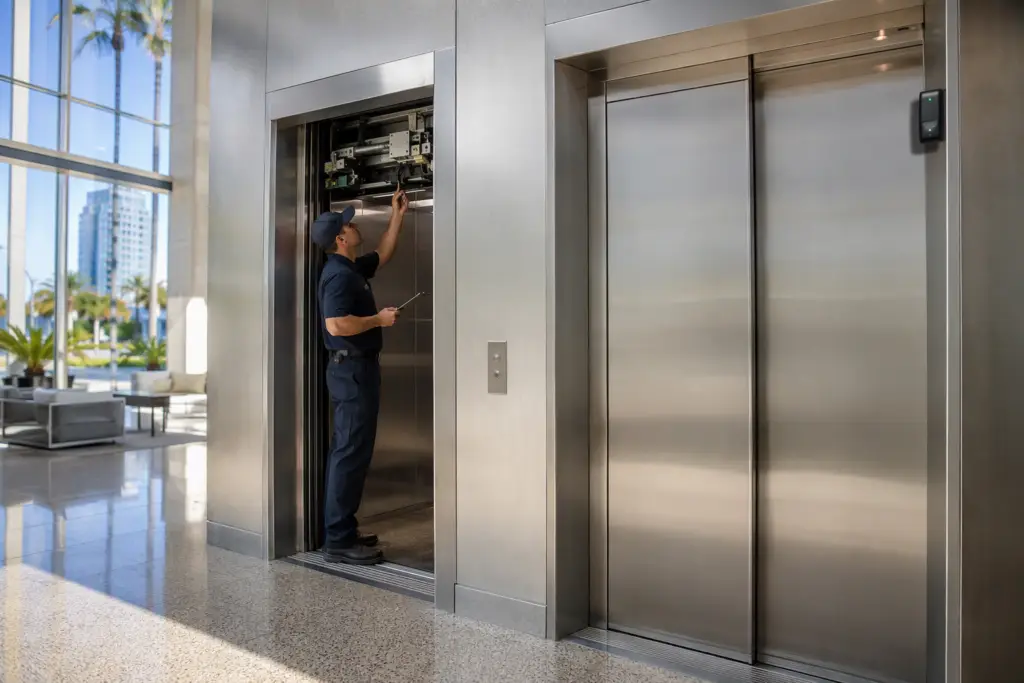
Who Should I Contact & How Often Should Elevators Be Inspected?
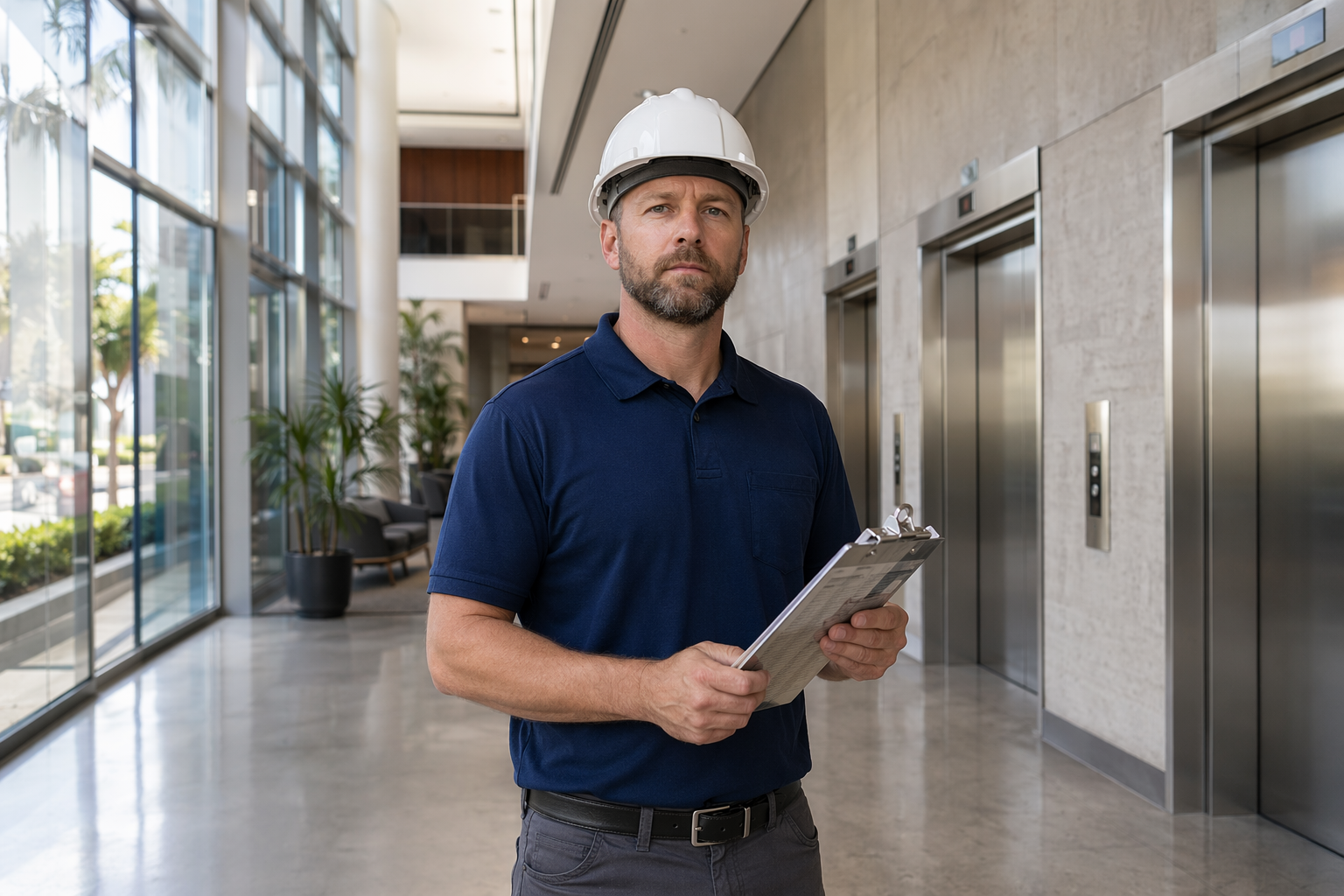
After 15 years in the field — from hydraulic lifts in Long Beach retail centers to high-rise traction elevators in Downtown Los Angeles — the questions I hear most from building owners are always the same: “Who do I actually call?” and “How often does this thing need to be looked at?” This FAQ hub page answers both questions in full, covering California state requirements, federal ADA compliance, inspection costs, and everything in between.
How Often Should Elevators Be Inspected by Law in California?
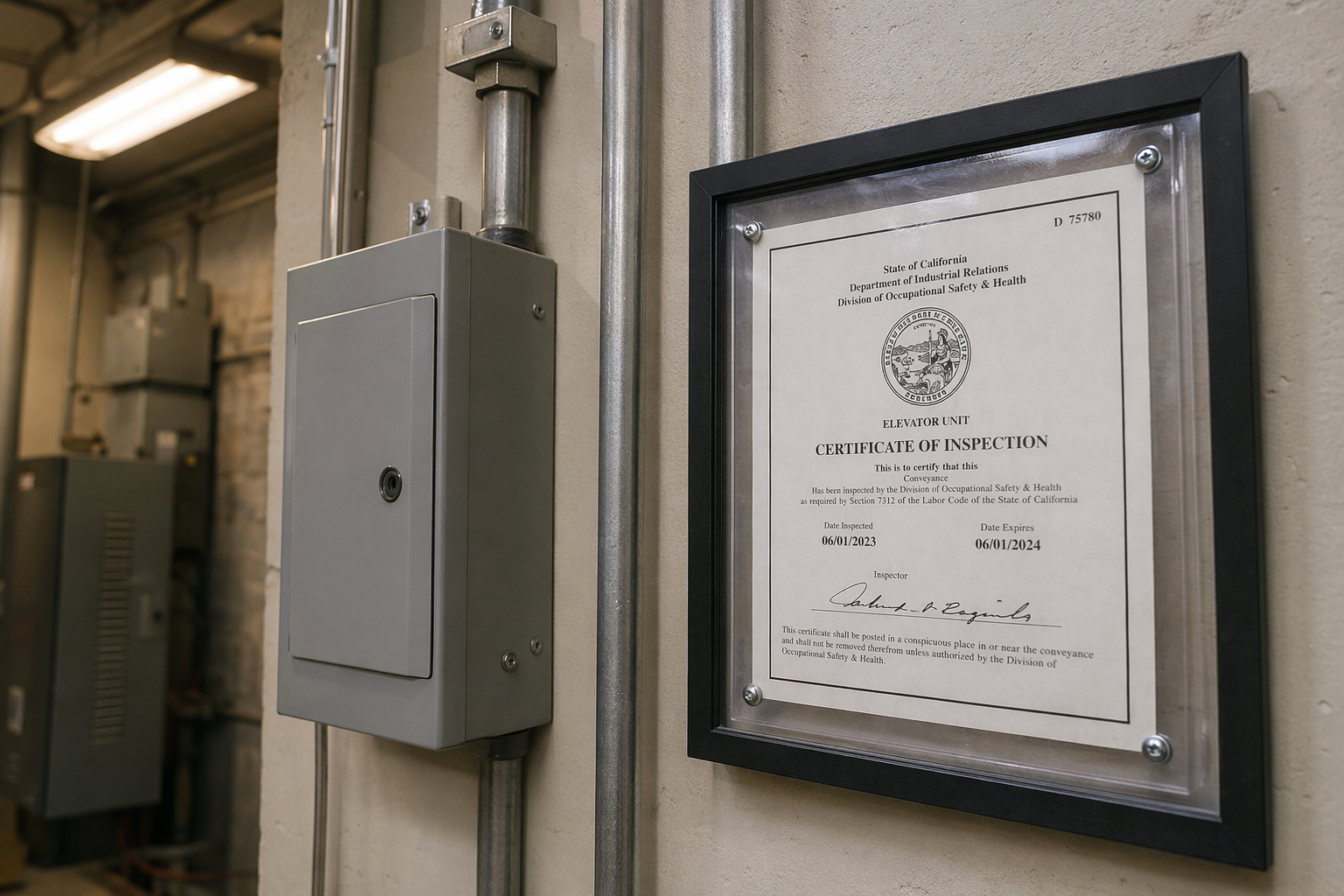
In California, elevators must receive a full safety inspection at least once every 12 months, as required under California Title 8, Division 1, Chapter 4 (Elevators, Escalators, and Other Conveyances), enforced by Cal/OSHA’s Elevator Unit.
The annual inspection must be performed by a Certified Elevator Inspector (CEI) who meets the requirements set by the ASME A17.1/CSA B44 Safety Code for Elevators and Escalators, the industry’s governing standard updated most recently in 2022 and currently referenced in 2026 California enforcement guidelines. Failure to obtain a valid Certificate of Inspection (COI) can result in the elevator being shut down, building violations, and fines starting at $500 per day in Los Angeles County.
Beyond the mandatory annual inspection, most elevator manufacturers and service contractors — including our team at Liftech Elevator — recommend a separate preventive maintenance visit every 30–90 days depending on the building’s elevator traffic load and equipment age.
Who Should I Contact to Schedule an Elevator Inspection?

You should contact either a state-certified Elevator Inspection company, your local building department, or a licensed elevator service contractor who employs Certified Elevator Inspectors (CEIs) — all three paths are valid in California depending on your building type and ownership structure.
Here is how each contact path works in practice:
- State/Cal/OSHA Elevator Unit: Handles mandatory annual safety inspections for most commercial buildings. You can initiate contact through the California DIR Elevator Safety portal.
- Local Building & Safety Department: Required for new installations, modernizations, and post-permit inspections. In Los Angeles, this is LADBS; in Long Beach, it is the Development Services Department; in Orange County cities, it varies by municipality.
- Licensed Elevator Service Contractor: For routine maintenance inspections, equipment assessments, and pre-inspection readiness checks. Companies like Liftech Elevator serving Signal Hill, Long Beach, Los Angeles, and Orange County CA can manage both the compliance paperwork and the physical inspection coordination.
A critical point many building owners miss: the mandatory annual inspection and the ongoing maintenance contract are two separate things. The annual inspection certifies legal compliance. The maintenance contract keeps the elevator actually safe between those inspections.
What Is the Difference Between an Annual Inspection and a Maintenance Inspection?
An annual inspection is a government-mandated compliance check that results in a Certificate of Inspection, while a maintenance inspection is a proactive service visit performed by your elevator contractor to identify wear, lubricate components, and prevent breakdowns before they happen.
Think of it like a car: the annual inspection is your DMV smog check — it either passes or fails based on a checklist. The maintenance visit is your oil change and tune-up schedule that keeps the car running reliably between those checkpoints. Both are non-negotiable for safe, compliant operation.
Under ASME A17.1 Rule 8.6, maintenance, repair, and replacement of elevator components must be performed by qualified elevator mechanics. In California, this means IUEC-affiliated technicians operating under state licensing requirements.
How Often Should Elevator Maintenance Be Performed (Not Just Inspections)?
Elevator maintenance should be performed every 1–3 months for most commercial installations, with high-traffic elevators in buildings with 10+ daily users requiring monthly service visits.
The table below breaks down recommended maintenance frequencies by elevator type and usage level, based on ASME A17.1 guidance and 2026 industry best practices:
| Elevator Type | Usage Level | Recommended Maintenance Frequency | Mandatory Annual Inspection |
|---|---|---|---|
| Hydraulic (low-rise) | Low (1–50 trips/day) | Every 3 months | Yes — annually |
| Hydraulic (low-rise) | High (50+ trips/day) | Every 1–2 months | Yes — annually |
| Traction (mid/high-rise) | Moderate (50–200 trips/day) | Every 2 months | Yes — annually |
| Traction (mid/high-rise) | High (200+ trips/day) | Monthly | Yes — annually |
| MRL (Machine Room-Less) | Any | Monthly to every 2 months | Yes — annually |
| Residential Home Lift | Low | Every 6 months | Yes — annually (CA requirement) |
| Accessibility Lift / LULA | Any | Every 3 months | Yes — annually |
| Escalator | Any commercial | Monthly | Yes — annually |
What Happens If an Elevator Fails Its Annual Inspection in California?
If an elevator fails its annual inspection in California, Cal/OSHA will issue an Order to Comply and the elevator must be taken out of service immediately until the deficiencies are corrected and a re-inspection is completed.
In 2026, Cal/OSHA’s Elevator Unit has increased enforcement activity across Los Angeles and Orange County, with particular focus on older traction elevators built before 1990 and hydraulic units that have not undergone modernization to meet current ASME A17.3 (Existing Installations) requirements. Common failure points include:
- Outdated door interlock systems (non-compliant with ASME A17.1 Rule 2.12)
- Insufficient pit depth or headroom clearance
- Worn or degraded governor and safety gear components
- Non-compliant emergency lighting or communication systems
- Oil leaks in hydraulic systems (environmental violation in addition to safety)
The cost of emergency repairs after a failed inspection is typically 3–5 times higher than the cost of proactive maintenance. This is exactly why our team at Liftech Elevator offers pre-inspection readiness assessments — so you are never caught off guard on inspection day.
What Does the ASME A17.1 Code Require for Elevator Inspections?
The ASME A17.1/CSA B44 Safety Code requires periodic inspections and tests of all elevator components including safety devices, buffers, governors, door systems, and electrical controls, with specific intervals defined by equipment type and test category.
Key ASME A17.1 inspection and test intervals include:
- Periodic Inspection (Rule 8.11): Every 12 months for most elevator types
- Hydraulic Pressure Relief Test: Every 12 months
- Rated Load Test (Category 1): Every 12 months for safeties, buffers, and governor
- Full Load Test (Category 5): Every 5 years for traction elevators — this is a comprehensive test requiring the car to run at 125% rated load
- Oil Buffer Test: Every 5 years for traction installations
California adopts ASME A17.1 as the baseline code but adds state-specific amendments through Title 8 CCR. Always verify with your local jurisdiction, as cities like Los Angeles and Long Beach may have additional requirements layered on top of state code.
Does ADA Compliance Affect Elevator Inspection Requirements?
Yes — the Americans with Disabilities Act (ADA) Title II and Title III require that elevators in public accommodations and commercial facilities remain accessible and operational, meaning ADA compliance must be evaluated as part of any inspection or modernization review.
ADA elevator requirements that inspectors commonly flag in Southern California buildings include:
- Minimum cab interior dimensions: 68″ depth x 51″ width for new construction
- Door reopening devices that respond to obstruction without contact (per ADA Standards §4.10.6)
- Braille and raised character floor designations on all call buttons
- Two-way emergency communication system (not just an alarm bell)
- Maximum 1/2″ vertical change in floor level at elevator thresholds
Buildings that were constructed or renovated after January 26, 1992 must meet full ADA elevator standards. Older buildings are subject to “readily achievable barrier removal” standards, which still require meaningful accessibility improvements. If your elevator was last modernized more than 15 years ago, an ADA compliance review should be part of your next inspection cycle.
How Much Does an Elevator Inspection Cost in Los Angeles and Orange County?
A standard annual elevator inspection in Los Angeles or Orange County typically costs between $150 and $500 for the inspection certificate fee payable to the state, with additional contractor fees ranging from $200 to $800 if you hire a service company to prepare and facilitate the inspection.
Here is a cost breakdown you can expect in the Southern California market in 2026:
- Cal/OSHA Annual Inspection Fee: $125–$300 (state fee, varies by elevator type)
- Pre-Inspection Contractor Assessment: $150–$400
- Monthly Maintenance Contract (hydraulic, low-rise): $150–$350/month
- Monthly Maintenance Contract (traction, mid/high-rise): $300–$700/month
- Category 5 Five-Year Full Load Test: $800–$2,500 depending on elevator size and complexity
- Emergency repair visit (after failed inspection): $500–$5,000+
The math is straightforward: a consistent maintenance contract averaging $250/month costs $3,000/year. A single emergency repair after a failed inspection can cost the same or more. Proactive maintenance with a qualified contractor is always the better financial decision.
Who Is Responsible for Scheduling Elevator Inspections — the Building Owner or the Tenant?
In California, the legal responsibility for scheduling and maintaining current elevator certifications rests with the building owner or property manager, not the tenant — regardless of what a lease agreement may state.
Under California Health & Safety Code Section 7301–7321 and Title 8 CCR, the “owner” of an elevator — defined as the person or entity that owns the building or has accepted legal responsibility for the conveyance — is required to ensure the elevator is permitted, inspected, and maintained. This responsibility cannot be contracted away to a tenant through a lease clause.
In practice, this means:
- Commercial building owners must maintain active elevator permits and COIs
- HOAs are responsible for elevators in common areas of condominiums and residential complexes
- Landlords of mixed-use buildings are responsible even if tenants operate businesses using the elevator
- Property management companies can coordinate inspections on behalf of owners but do not assume legal liability unless specifically contracted to do so
What Qualifications Should an Elevator Inspector Have?
An elevator inspector performing mandatory California safety inspections must hold a Qualified Elevator Inspector (QEI) certification from the ASME QEI Certification program, and in California must additionally be licensed by Cal/OSHA’s Elevator Unit.
When vetting any inspection or service company, ask for the following credentials:
- ASME QEI Certification: Required for inspectors performing code-required periodic inspections
- Cal/OSHA Elevator Permit Authorization: State-specific license to perform inspections in California
- IUEC (International Union of Elevator Constructors) Affiliation: Indicates mechanic-level training for maintenance technicians
- NAESA International Membership: National Association of Elevator Safety Authorities — a mark of professional credibility
- General Liability Insurance: Minimum $1M coverage, verify with certificate
Be cautious of companies that cannot produce current licensing documentation or those who quote unusually low rates — in elevator safety, corners cut during inspections can result in catastrophic equipment failures.
How Do I Know If My Elevator Is Overdue for Inspection?
Your elevator is overdue for inspection if the Certificate of Inspection (COI) posted inside the elevator cab has an expiration date that has passed, or if you cannot locate a current COI at all — both are immediate red flags requiring action.
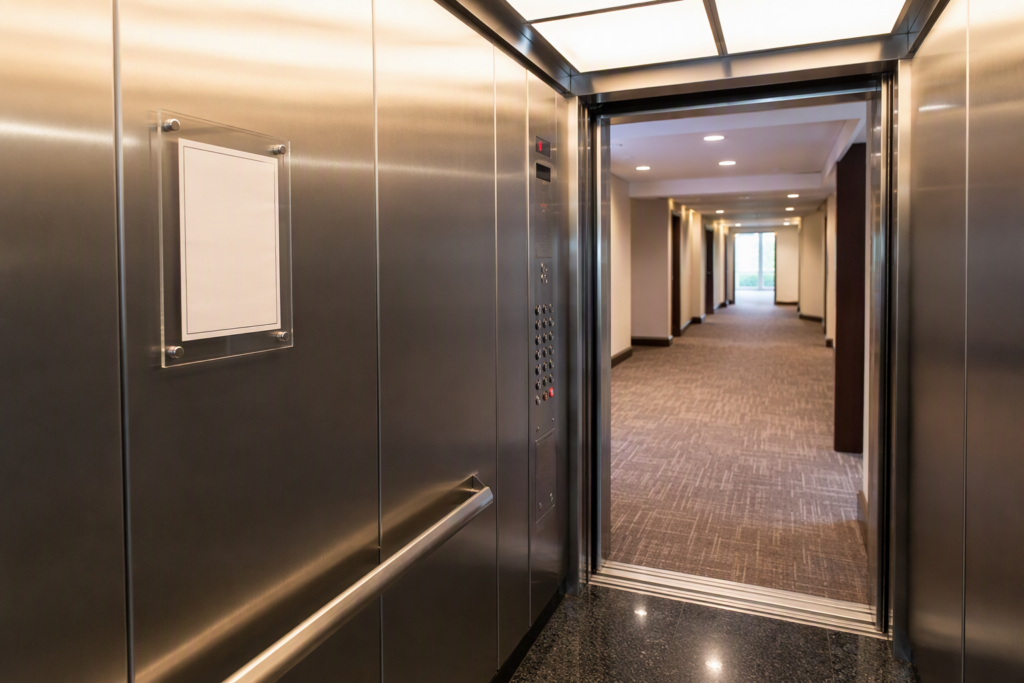
In California, elevators are required to display a valid Certificate of Inspection in a visible location within the cab. The certificate shows the elevator ID number, permitted load capacity, inspection date, and expiration date. Here is how to audit your current status:
- Check the posted COI in the elevator cab for the expiration date
- Search the Cal/OSHA Elevator Unit public database using your elevator permit number
- Contact your building department to confirm the permit status on file
- Request an inspection history report from your current elevator service contractor
If you have recently acquired a property and cannot determine the inspection history, treat it as overdue and schedule an assessment immediately. Purchasing or taking over management of a building with expired elevator certifications exposes you to liability from day one.
What Should I Expect During an Elevator Safety Inspection?
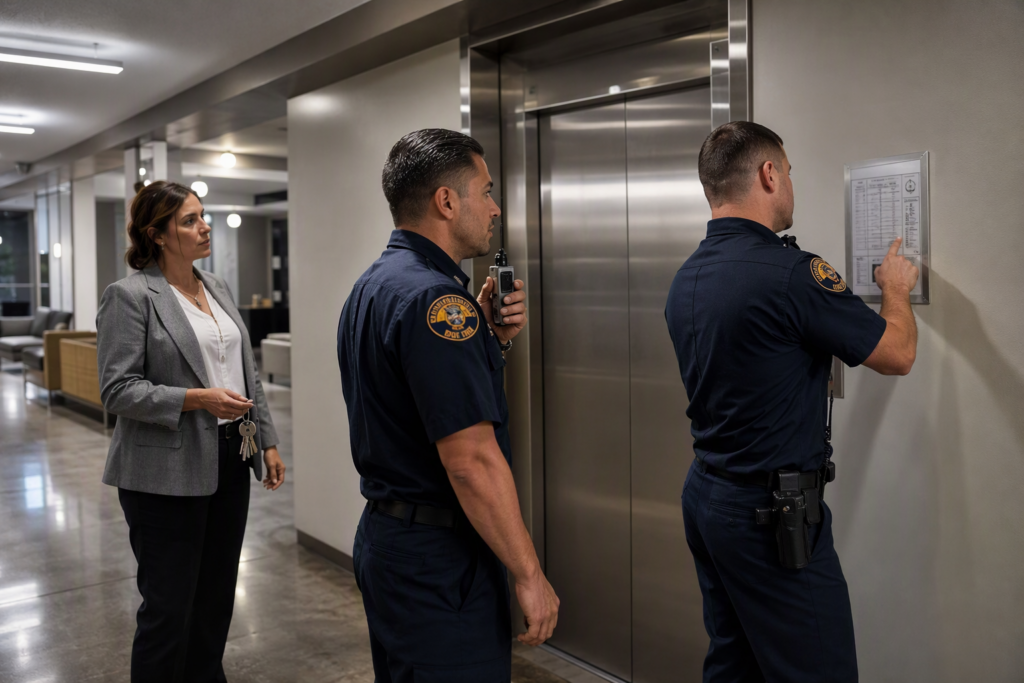
During a California elevator safety inspection, the inspector will test and examine all major mechanical, electrical, and safety systems including the door operation, overspeed governor, safety brakes, pit and overhead clearances, emergency lighting, and the two-way communication system — typically over a 1–3 hour period.
A standard annual inspection checklist under ASME A17.1 and California Title 8 CCR includes:
- Door closing force and reopening device function
- Leveling accuracy (cab floor must be within ±1/2 inch of floor level)
- Emergency stop switch operation
- Pit inspection: lighting, stop switch, ladder, sump pump if applicable
- Machine room conditions: temperature, lighting, access security
- Rope or hydraulic cylinder condition
- Buffer and counterweight clearances
- Governor and safety gear operation
- Emergency phone/communication test (must connect to a live answer)
- Load capacity placard verification
Pro tip from the field: ensure your machine room is clean, accessible, and at a temperature below 104°F (40°C) before inspection day. Inspectors can and do issue violations for machine room conditions unrelated to the elevator mechanism itself.
Can I Use the Same Company for Both Maintenance and Annual Inspections?
In California, the same licensed elevator company can perform both maintenance and annual inspections only if they hold the appropriate QEI inspection certification — however, some jurisdictions prefer or require a third-party independent inspector to ensure objectivity.
There are valid arguments on both sides of this question:
Using one company for both: Streamlines scheduling, reduces cost, and gives the inspector intimate familiarity with the equipment’s history. This is the most common arrangement for smaller building portfolios in Signal Hill, Long Beach, and suburban Orange County.
Using a separate inspection company: Provides an independent second set of eyes with no financial incentive to overlook issues. This is preferred by risk managers at large commercial real estate portfolios, hospitals, and government facilities.
Regardless of which approach you choose, ensure your maintenance contractor maintains a detailed service log for every visit. When an inspector reviews your equipment, a well-documented maintenance history is one of the strongest indicators of a well-managed elevator — and it can make the difference between a passed inspection and a costly reinspection.
How Long Does It Take to Get an Elevator Inspection Scheduled in Southern California?
In Los Angeles and Orange County, scheduling a mandatory annual elevator inspection through Cal/OSHA typically takes 4–12 weeks depending on inspector availability and backlog, which is why building owners should initiate the process at least 60 days before their current certificate expires.
In 2026, inspection backlog has increased in both LA County and Orange County due to a surge in new construction and a limited number of state-licensed QEI inspectors. Common scheduling timelines:
- Cal/OSHA State Inspection Unit: 6–12 weeks (varies significantly by district)
- Third-Party QEI Inspector (private): 1–4 weeks
- Emergency inspection (failed equipment, liability exposure): 24–72 hours through private inspection services
Liftech Elevator works with a network of Cal/OSHA-authorized inspectors and can help coordinate inspection scheduling as part of your maintenance contract — significantly reducing the administrative burden on property managers who oversee multiple buildings.
What Are the Most Common Elevator Violations Found During Inspections in California?
The most common elevator violations discovered during California annual inspections are door interlock failures, worn rope or cylinder conditions, non-functional emergency communication systems, improper machine room conditions, and outdated safety devices that no longer meet current ASME A17.1 or California Title 8 standards.
Based on field experience across hundreds of inspections in the Los Angeles basin and Orange County, here are the top 10 violations by frequency:
- Non-functional or non-code-compliant emergency phone (must reach a live person 24/7)
- Door interlock failures or worn door contacts
- Pit water intrusion or inoperable pit lighting
- Hydraulic oil leaks or seal degradation
- Governor rope wear beyond allowable limits
- Missing or expired Certificate of Inspection posting
- Inadequate machine room lighting or access security
- Cab floor-to-landing leveling exceeding ±1/2 inch tolerance
- Outdated or missing firefighter service (Phase I/Phase II) functionality
- Non-ADA-compliant cab signage or control panel height
Do Residential Elevators in California Require the Same Inspections as Commercial Ones?
Yes — residential elevators in California are subject to state inspection requirements under Title 8 CCR if they are installed in multifamily buildings or any structure open to the public, though single-family home lifts have a modified inspection pathway under certain conditions.
For residential applications in Southern California:
- Single-family home elevators: Not regulated by Cal/OSHA for annual inspection, but must pass initial permit inspection and are strongly recommended for voluntary annual service
- Condo/HOA common-area elevators: Fully subject to Cal/OSHA annual inspection requirements — the same as any commercial building
- Multifamily apartment building elevators (5+ units): Fully regulated, annual COI required
- Mixed-use residential/commercial: Regulated as commercial for all purposes
How Does Elevator Modernization Affect the Inspection Schedule?
Elevator modernization triggers a new permit and a mandatory post-modernization inspection before the elevator can return to service — and it resets certain ASME A17.3 compliance timelines while potentially extending the interval before your next Category 5 full-load test is required.
Modernization projects typically include upgrades to controllers, door operators, cab interiors, lighting, and sometimes the drive system. Each significant modernization component must be inspected and approved before the elevator is returned to occupant use. In Los Angeles, this requires a LADBS permit, a contractor-submitted work plan, and a final inspection by a state-authorized inspector.
From a financial planning perspective, modernization in 2026 typically costs between $25,000 and $120,000 depending on scope and equipment type — but it can extend the service life of an elevator by 20–30 years and significantly reduce annual maintenance costs and inspection violation risks.
What Questions Should I Ask Before Hiring an Elevator Inspection or Service Company?
Before hiring any elevator inspection or service company in California, you should ask about their QEI certification, IUEC mechanic affiliations, state licensing number, insurance coverage, response time for emergency calls, and whether they provide detailed written reports after every visit.
Here is a complete vetting checklist:
- Are your inspectors ASME QEI certified and Cal/OSHA authorized?
- Are your mechanics IUEC members with current California state licensing?
- What is your response time for emergency service calls? (24/7 availability is standard)
- Do you provide written inspection and maintenance reports with every visit?
- What is included vs. excluded in your maintenance contract?
- How many elevators do you currently service in this geographic area?
- Can you provide references from similar buildings (same type, age, size)?
- Do you carry errors and omissions (E&O) insurance in addition to general liability?
- How do you handle parts procurement — stock on hand or order-dependent?
- Will you assist with permit applications and inspection coordination?
Why Should I Choose a Local Elevator Service Company Over a National Chain?
Local elevator service companies typically offer faster response times, deeper familiarity with local code enforcement practices, and more personalized accountability than national chains — which often route service calls through call centers and assign different technicians to each visit.
In markets like Signal Hill, Long Beach, Los Angeles, and Orange County, local knowledge matters enormously. Building codes, inspection enforcement priorities, and permit processing timelines all vary by city and county, and a local contractor who works with the same inspectors and building departments routinely can navigate that landscape far more efficiently than a national operator managing hundreds of markets simultaneously.
Liftech Elevator has been serving Southern California building owners and property managers with certified, locally-based elevator technicians who know these markets intimately — from the specific hydraulic equipment common in Long Beach’s mid-century commercial stock to the MRL traction systems increasingly common in new Orange County construction.
What Is the Penalty for Operating an Elevator Without a Valid Certificate of Inspection in California?
Operating an elevator in California without a valid Certificate of Inspection is a misdemeanor violation under California Health & Safety Code and can result in immediate shut-down orders, civil fines starting at $500 per day, personal liability for building owners, and potential criminal charges if an accident occurs on an uninspected elevator.
The enforcement reality in 2026: Cal/OSHA’s Elevator Unit has expanded its proactive inspection sweep program in Los Angeles County and Orange County, meaning inspectors are now actively checking for compliant COI postings in buildings — not just responding to complaints. The cost of non-compliance has never been higher, and the reputational risk to building owners and property managers is significant.
Beyond regulatory penalties, operating an uncertified elevator creates enormous civil liability exposure. If a passenger is injured on an elevator that lacks a current COI, insurance carriers will frequently deny coverage based on the property owner’s failure to maintain legally required certifications — leaving the owner personally exposed to litigation costs.
Get Your Elevator Inspected by Southern California’s Trusted Certified Experts
Whether you manage a single commercial building in Signal Hill or a portfolio of properties across Los Angeles, Long Beach, and Orange County, staying ahead of your elevator inspection schedule is non-negotiable. Liftech Elevator’s IUEC-certified technicians and QEI-authorized inspectors handle everything — from annual compliance certifications and pre-inspection readiness assessments to full maintenance contracts and modernization projects.
Don’t wait for a violation notice or a breakdown to take action. Contact Liftech Elevator for a free elevator assessment today.
Call us now: 562-609-3478
Serving Signal Hill CA, Long Beach CA, Los Angeles CA, and Orange County CA — available 24/7 for emergency service.
Need elevator service you can rely on? Liftech Elevator is ready to help.