Elevator Entrapment Rescue Procedure: Complete FAQ Guide for Building Owners and Passengers
Elevator entrapments are more common than most building owners realize. Whether you manage a commercial high-rise in Los Angeles, a mid-rise residential building in Long Beach, or a retail property in Orange County, understanding the proper rescue procedure is not optional — it is a life-safety obligation. A failed or improvised response can injure passengers, expose building owners to liability, and trigger Cal/OSHA enforcement action.
This comprehensive FAQ guide covers every aspect of elevator entrapment rescue: what to do, who is authorized to act, what the codes require, and how to prepare your building before an incident occurs. The Liftech Elevator team has spent over 15 years responding to entrapment calls across Southern California, and the information below reflects real field experience, not just textbook theory.
What Is the Correct Elevator Entrapment Rescue Procedure Step by Step?
The correct elevator entrapment rescue procedure involves six sequential steps performed exclusively by Cal/OSHA-certified personnel: (1) establish two-way communication with trapped passengers, (2) contact emergency services and dispatch a Certified Competent Conveyance Mechanic, (3) prevent premature self-rescue, (4) assess cab position from the machine room, (5) manually move the cab to the nearest floor landing, and (6) open doors only once the cab is fully leveled.
Step 1 is always communication. Passengers must be verbally reassured via the in-car emergency phone — required under ASME A17.1/CSA B44 as adopted by California’s Elevator Safety Orders — that qualified help is on the way. Calm, clear communication prevents injuries caused by passengers attempting to self-rescue.
Step 2 is to call 911 if there is any immediate medical concern, and simultaneously contact your elevator service provider to dispatch a Certified Competent Conveyance Mechanic (CCCM). In Los Angeles, Long Beach, and Orange County, fire departments carry door release keys for emergency passenger extraction, but fire responders are trained in extraction, not mechanical diagnosis. The CCCM handles the mechanical side.
Step 3 is to actively discourage passengers from attempting to force open doors or climb out of the cab. More injuries occur from premature self-evacuation than from the entrapment itself. The only exception is an immediate life-threatening hazard — such as fire or flooding — at the cab level.
Step 4 involves the CCCM locating the car using the machine room position indicator, then cutting power at the main line disconnect only after confirming it is safe to do so.
Step 5 is the mechanical rescue: on traction elevators, the CCCM engages the hand-winding device to bring the car within 1–2 inches of floor level. On hydraulic elevators, the emergency lowering valve is used. The cab must reach the nearest floor landing before any door operation begins.
Step 6 is door operation: doors must be opened using the mechanical door release key (car door release tool) by qualified personnel only. California Code of Regulations, Title 8, Elevator Safety Orders prohibit untrained personnel from performing elevator rescue operations.
Who Is Authorized to Perform an Elevator Entrapment Rescue in California?
In California, only a Certified Competent Conveyance Mechanic (CCCM) certified by Cal/OSHA — working for a Certified Qualified Conveyance Company (CQCC) — or trained fire department personnel responding to an immediate life-safety emergency are authorized to perform an elevator entrapment rescue.
California Labor Code Sections 7300–7324.2 establish the state’s elevator safety framework, administered by the Division of Occupational Safety and Health (Cal/OSHA), Elevator Unit, California Department of Industrial Relations (dir.ca.gov/dosh/Elevator.html). Under California Code of Regulations, Title 8, Elevator Safety Orders, anyone who works on an elevator without supervision must hold a valid CCCM certificate issued by Cal/OSHA.
Building maintenance staff, security guards, and property managers are prohibited from operating elevator rescue equipment. The company employing the mechanic must also hold CQCC certification from Cal/OSHA, which requires a current C-11 Elevator Contractor license issued by the California Contractors State License Board (CSLB), plus certificates of workers’ compensation and liability insurance.
Fire departments in Los Angeles, Long Beach, and Orange County maintain elevator rescue protocols and carry door release keys for emergency access. However, once passengers are safely extracted, all further mechanical work must be performed by a CCCM working for a CQCC-certified company. Note that Los Angeles has its own elevator and conveyance inspection program administered through the Los Angeles Department of Building and Safety (LADBS); building owners in Los Angeles should confirm rescue and inspection requirements with LADBS in addition to Cal/OSHA.
What Equipment Is Used During an Elevator Entrapment Rescue?
The primary tools used in a California elevator entrapment rescue are the hand-winding device (traction elevators), the emergency lowering valve (hydraulic elevators), the mechanical door release key, and the machine room position indicator — all of which may only be operated by a Cal/OSHA-certified CCCM.
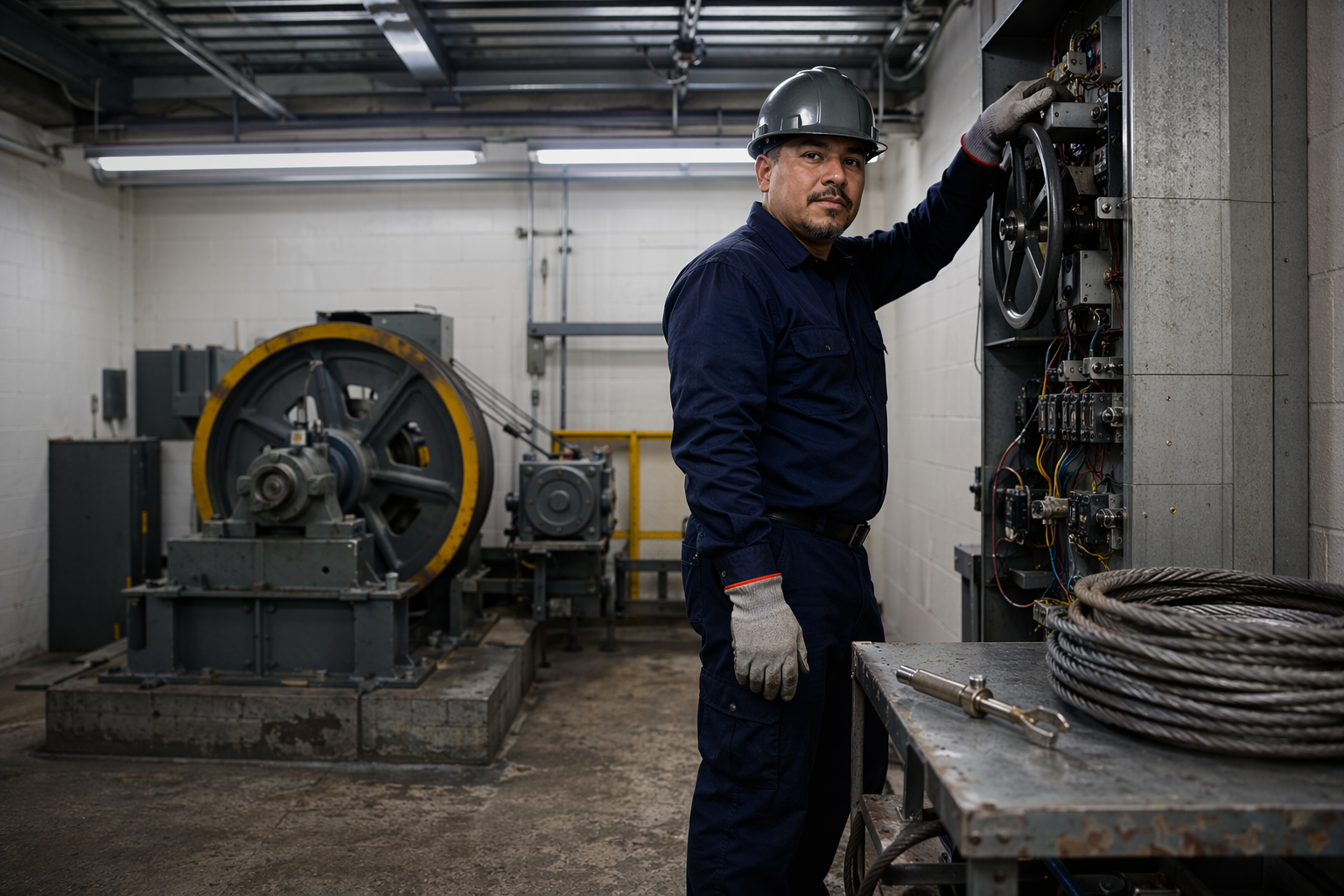
On a traction elevator, the hand-winding device allows the CCCM to manually rotate the drive sheave and move the cab to the nearest landing after power is isolated at the main disconnect. The process requires the CCCM to monitor car position continuously and stop within 1–2 inches of floor level to allow safe egress.
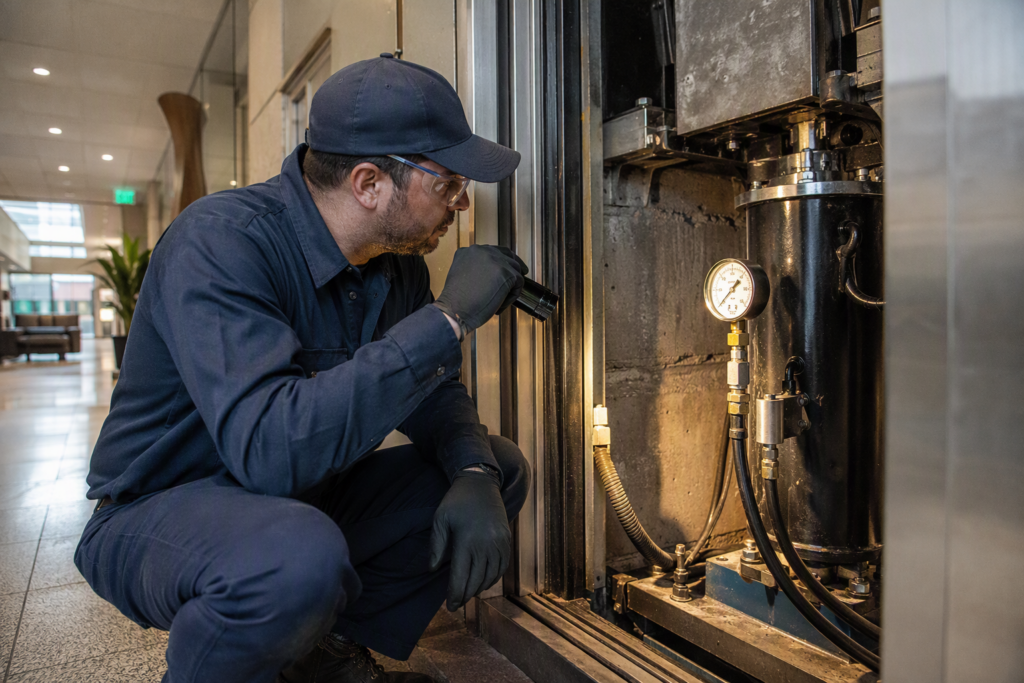
On a hydraulic elevator, the emergency lowering valve — located in the machine room or pump unit — releases hydraulic fluid in a controlled manner, allowing the cab to descend by gravity to the lowest available landing. Speed must be carefully managed to avoid a rough stop.
The mechanical door release key (also called a car door release tool or hoistway door release key) unlocks landing doors from the hoistway side without electrical power. These keys are held exclusively by CCCMs and, in some jurisdictions, fire department personnel. Building staff may not possess or use these keys to perform rescues.
Additional equipment that a CCCM team may bring to an entrapment call includes a portable two-way communication device, a flashlight rated for use in confined machine rooms, a voltage tester, and personal protective equipment consistent with Cal/OSHA general industry safety orders.
How Long Does an Elevator Entrapment Rescue Take in California?
In most California commercial and residential buildings under a full maintenance contract, a certified elevator mechanic can complete a standard entrapment rescue — from dispatch to passenger release — within 30 to 90 minutes, depending on technician proximity, traffic conditions, and the complexity of the mechanical situation.
Response time is the single largest variable. Buildings in dense urban areas like downtown Los Angeles or Long Beach may see faster response from a local dispatch center, while properties in suburban Orange County or more remote areas may experience longer waits. This is one of the strongest arguments for maintaining a full-service maintenance agreement with a CQCC-certified company that provides 24/7 emergency dispatch.
Once a CCCM arrives on site, the mechanical rescue itself — isolating power, moving the cab to the nearest landing, and releasing the doors — typically takes 10 to 30 minutes for a standard traction or hydraulic elevator in a well-maintained machine room. Complications that extend this timeline include a cab stopped mid-span between floors with no counterweight advantage, a flooded or obstructed machine room, or a hydraulic unit with a seized lowering valve.
Cal/OSHA requires that no elevator operate in California without a valid permit to operate. If the entrapment is caused by a condition that renders the elevator unsafe, the CCCM is required to take the unit out of service until repairs are completed and, if required, inspected. Building owners should not pressure mechanics to restore service before the unit is certified safe.
What Does an Elevator Entrapment Rescue Cost, and Who Is Responsible?
Emergency elevator entrapment rescue service calls in California typically range from $300 to $800 or more for after-hours response, depending on the service provider, time of day, elevator type, and whether the building holds a full maintenance contract — with contract buildings generally receiving priority dispatch and reduced or waived emergency call fees.
The cost responsibility rests entirely with the building owner or property management entity. California law places the obligation to maintain elevators in safe operating condition on the elevator owner, and arranging annual reinspection is explicitly the owner’s responsibility under Cal/OSHA rules. An entrapment caused by deferred maintenance or an expired permit to operate can expose the building owner to Cal/OSHA citations, civil liability, and increased insurance premiums.
Buildings covered by a full maintenance contract with a CQCC-certified company — such as Liftech Elevator — typically receive 24/7 emergency dispatch, priority response, and no separate labor charge for entrapment rescue calls that arise from covered equipment failures. Buildings on time-and-materials arrangements pay full emergency rates for after-hours calls, which can significantly exceed standard business-hours rates.
Beyond the direct service call cost, a poorly managed entrapment incident can generate indirect costs: passenger medical claims if anyone is injured during evacuation, Cal/OSHA fines if the elevator was operating with an expired permit or unresolved violations, and reputational damage in residential and commercial tenant relationships. The most cost-effective strategy is preventive maintenance and keeping permits current — not reacting to emergencies.
How Do Building Owners in California Ensure Elevator Entrapment Compliance Before an Incident?
California building owners must verify that their elevator holds a current Cal/OSHA permit to operate posted inside the car, is maintained by a CQCC-certified company staffed by CCCMs, is inspected at least annually by a State of California safety engineer or Certified Competent Conveyance Inspector (CCCI), and has an up-to-date emergency response plan with the service provider’s 24/7 contact posted at each elevator.
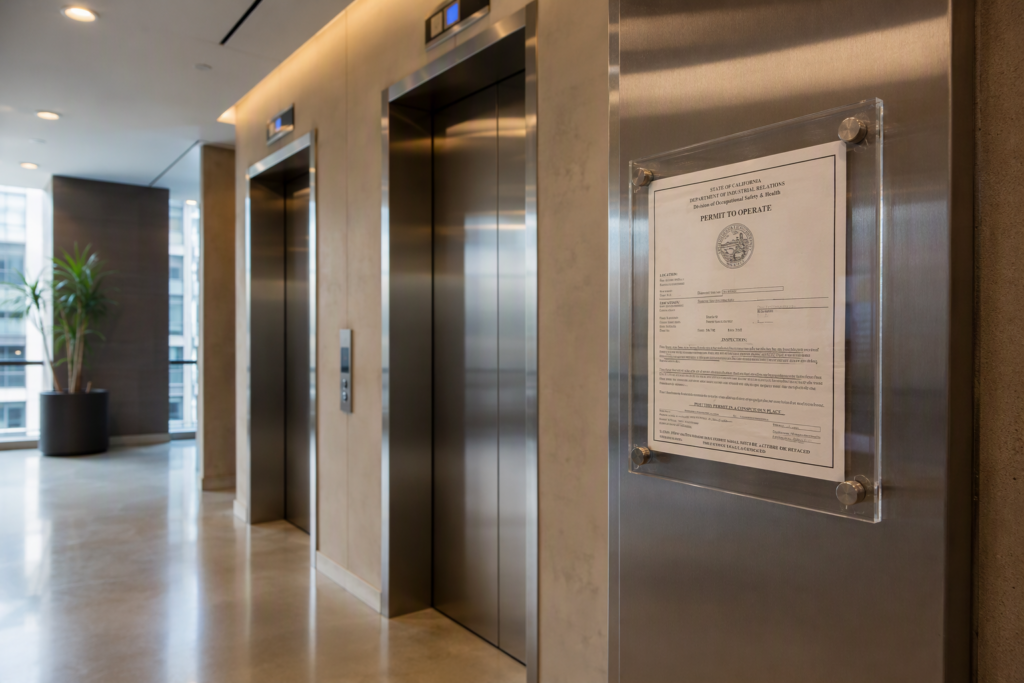
The permit to operate is the first thing Cal/OSHA and a plaintiff’s attorney will look for after an entrapment incident. Under California law, no elevator may be operated without a valid, current permit issued by Cal/OSHA, and the permit must be posted conspicuously inside the elevator car. A permit is valid for up to one year; buildings with a full maintenance contract with a C-11-licensed, CQCC-certified company may qualify for a permit valid for up to two years if the elevator is found to be in safe condition.
Only State of California safety engineers and Certified Competent Conveyance Inspectors may conduct the annual inspection that determines whether a permit is issued or renewed. Arranging that inspection is the building owner’s responsibility — it does not happen automatically.
California has proposed a Group V update to its Elevator Safety Orders that would incorporate elements of ASME A17.1-2019. The California Standards Board held a public hearing on this proposal on June 18, 2026, and no effective date has been posted as of this publication. Building owners and their service providers should monitor Cal/OSHA’s Elevator Unit page for updates, as any adopted changes may affect equipment requirements relevant to entrapment rescue procedures.
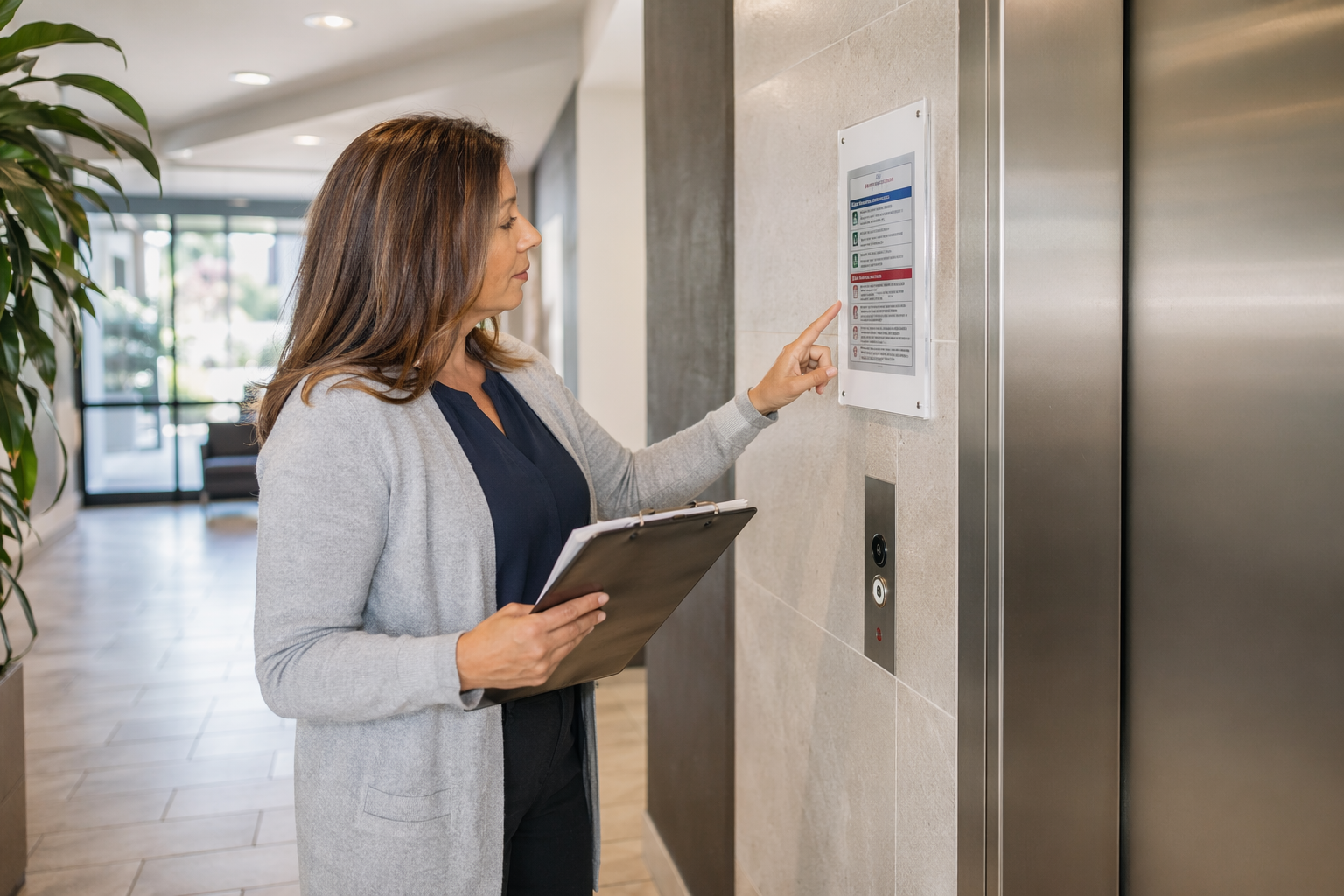
Practical preparedness steps for California building owners include: confirming your service provider holds current CQCC certification and employs CCCMs; posting the 24/7 emergency dispatch number at each elevator lobby; ensuring the machine room is accessible, unobstructed, and properly lit; and conducting a tabletop review of your entrapment response plan with building staff at least once per year. Building staff should know exactly who to call and what not to do — their role is communication and crowd control, not mechanical intervention.
If your building is located in Los Angeles, confirm requirements with the Los Angeles Department of Building and Safety (LADBS) as well, since Los Angeles operates its own elevator and conveyance inspection program. Contact Liftech Elevator at any time for a compliance review of your Southern California elevator portfolio.