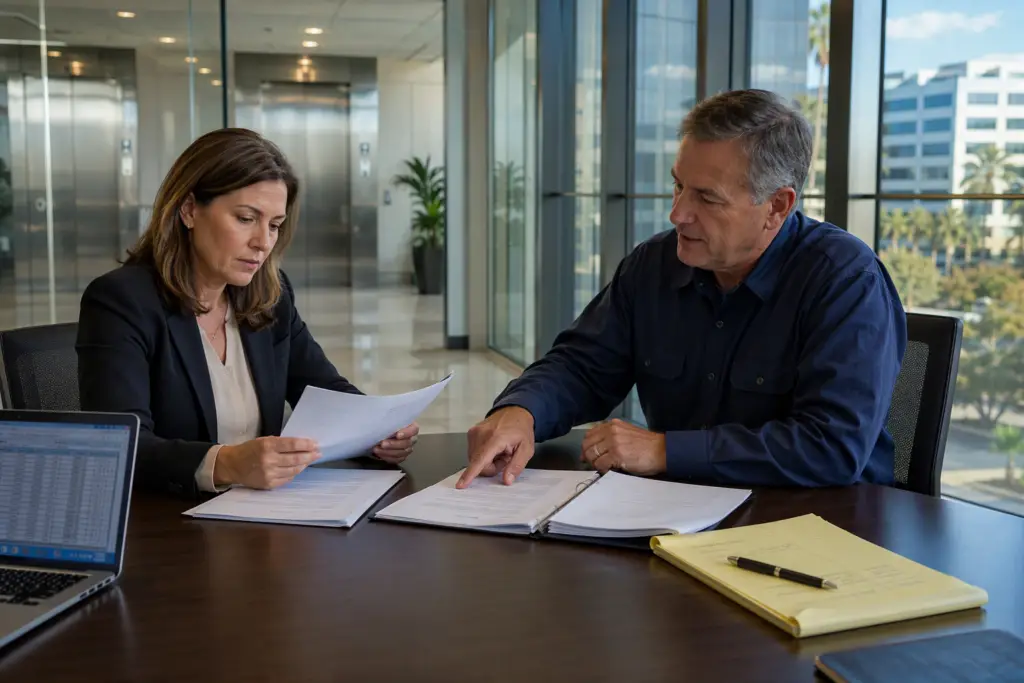

Building management can obtain a full entrapment incident report by contacting their CQCC-certified elevator service company within 24 hours of the event. The company should provide a written root-cause analysis drawing on maintenance logs, controller fault codes, safety device test records, and the elevator’s Cal/OSHA permit history. That report, combined with any Cal/OSHA enforcement documentation, gives management the complete picture needed for corrective action and liability documentation.
What Is an Elevator Entrapment and Why Does It Require a Formal Report?
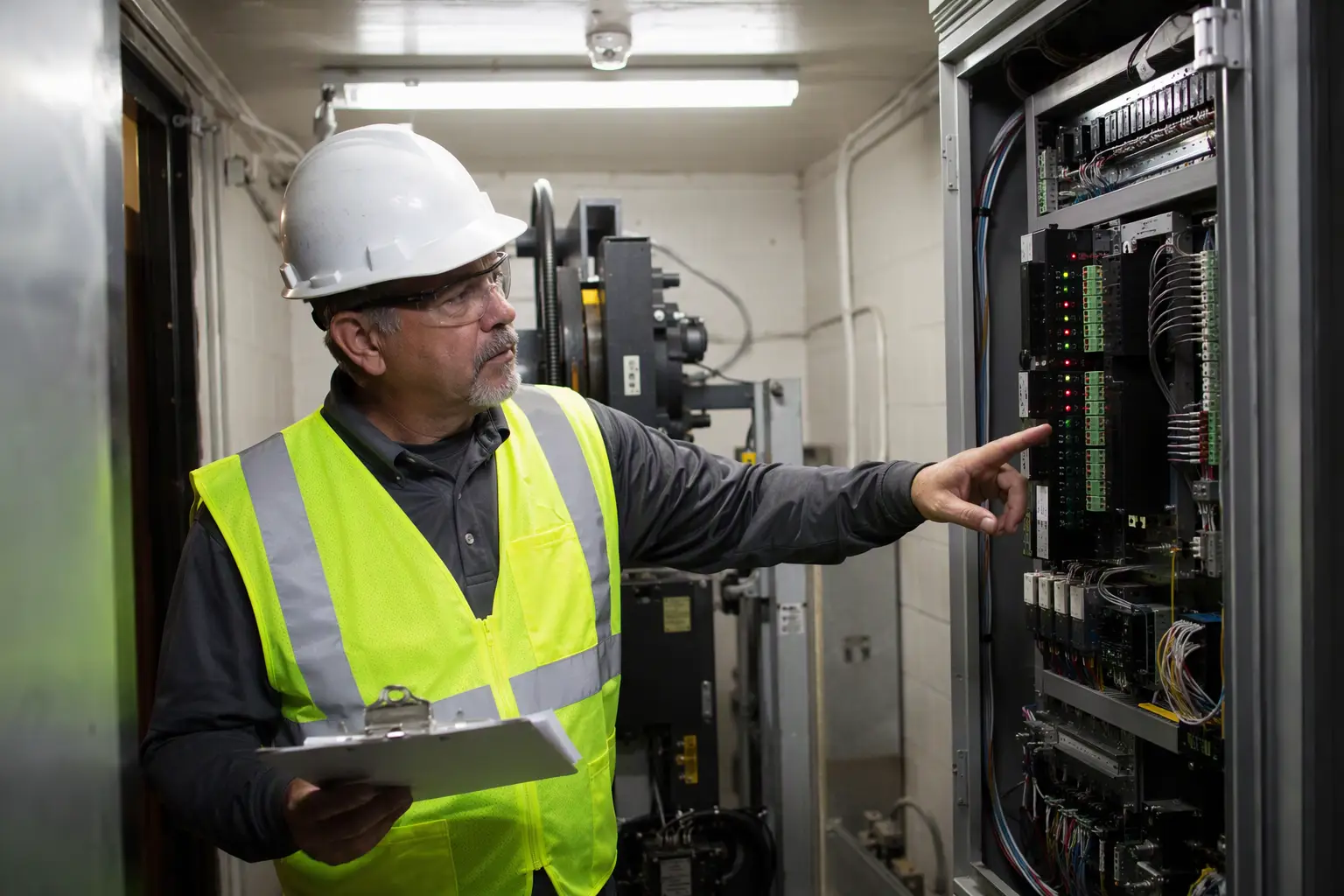
An elevator entrapment occurs when one or more passengers are unable to exit an elevator car under their own power due to a mechanical, electrical, or control-system failure that stops the car between floors or prevents door operation.
A formal report is necessary for several reasons. First, California Labor Code Sections 7300–7324.2 place ongoing safety obligations on the elevator owner, which in most commercial buildings is the property owner or building manager acting as the responsible party. Second, the root-cause analysis is the primary tool for preventing recurrence. Third, insurers, legal counsel, and occupants may all request documentation that demonstrates management acted diligently after the event. Without a written report, building management has no defensible record of corrective action.
Under California Code of Regulations, Title 8, Elevator Safety Orders (Sections 3000–3146), every conveyance in California must be maintained in safe operating condition. An entrapment is strong evidence that something in that maintenance chain failed, which makes documentation both a safety imperative and a compliance matter enforced by the Cal/OSHA Elevator Unit, California Department of Industrial Relations.
Who Is Legally Authorized to Investigate an Elevator Entrapment in California?
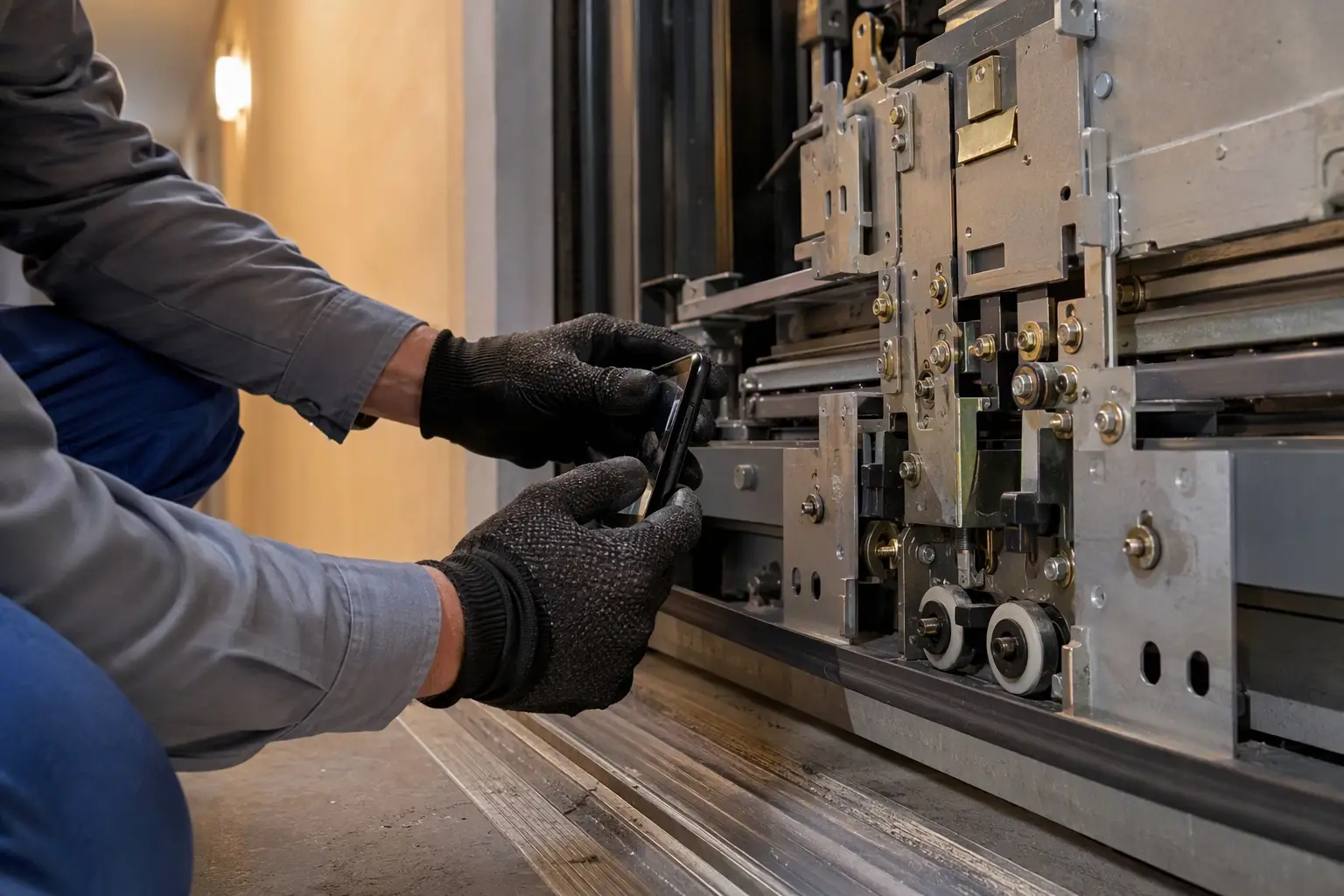
In California, only Cal/OSHA Safety Engineers and Certified Competent Conveyance Inspectors (CCCI) may perform the official regulatory inspection, while Certified Competent Conveyance Mechanics (CCCM) employed by a Certified Qualified Conveyance Company (CQCC) perform the technical diagnostic work on the equipment itself.
California law is explicit: anyone who works on an elevator without supervision must hold Cal/OSHA CCCM certification, and that mechanic must work for a company holding CQCC certification. This dual-certification requirement means building management cannot simply hire any contractor to open the machine room after an entrapment. The investigation and any resulting repair work must flow through a CQCC-certified company. Liftech Elevator holds CQCC certification and serves buildings in Signal Hill, Long Beach, Los Angeles, and Orange County, making it a qualified choice for post-entrapment diagnostics and corrective maintenance.
The California Contractors State License Board (CSLB) issues the underlying C-11 Elevator Contractor license that CQCC applicants must hold, while Cal/OSHA governs permits, inspections, and company and mechanic certifications. Both credentials should be confirmed before retaining any service company for incident investigation work.
What Are the Immediate Steps Building Management Should Take After an Entrapment?
The sequence of actions taken in the first hour after an entrapment directly determines the quality of evidence available for the root-cause report.
- Ensure passenger safety first. Contact emergency services if the entrapment cannot be quickly resolved or if any occupant reports a medical issue.
- Do not reset or restart the elevator. Powering the unit down or cycling the controller before a CCCM arrives destroys volatile fault-log data that may reside only in the controller’s active memory.
- Secure the machine room. Restrict access so that no one—including in-house maintenance staff—touches controls, circuit boards, or mechanical components before the qualified mechanic arrives.
- Call the CQCC-certified elevator service company. Report the floor location of the stalled car, the direction of travel at the time of stoppage, any unusual sounds or smells passengers reported, and the approximate number of passengers and their condition.
- Preserve all physical evidence. Do not remove safety notices, warning tags, or lockout devices placed by prior inspection or maintenance personnel. Photograph the machine room condition, the controller panel, and the hoistway access doors if accessible without entering a hazardous area.
- Collect witness statements. Record written or audio statements from entrapped passengers, building staff who responded, and security personnel who monitored the event on camera.
- Pull and preserve surveillance video. Many jurisdictions overwrite footage within 24–72 hours. Immediately save footage from elevator cab cameras, machine room cameras, and lobby cameras showing the moment of stoppage.
- Notify property ownership and legal counsel. Even if the event appears minor, internal notification creates a documented chain of custody for the investigation.
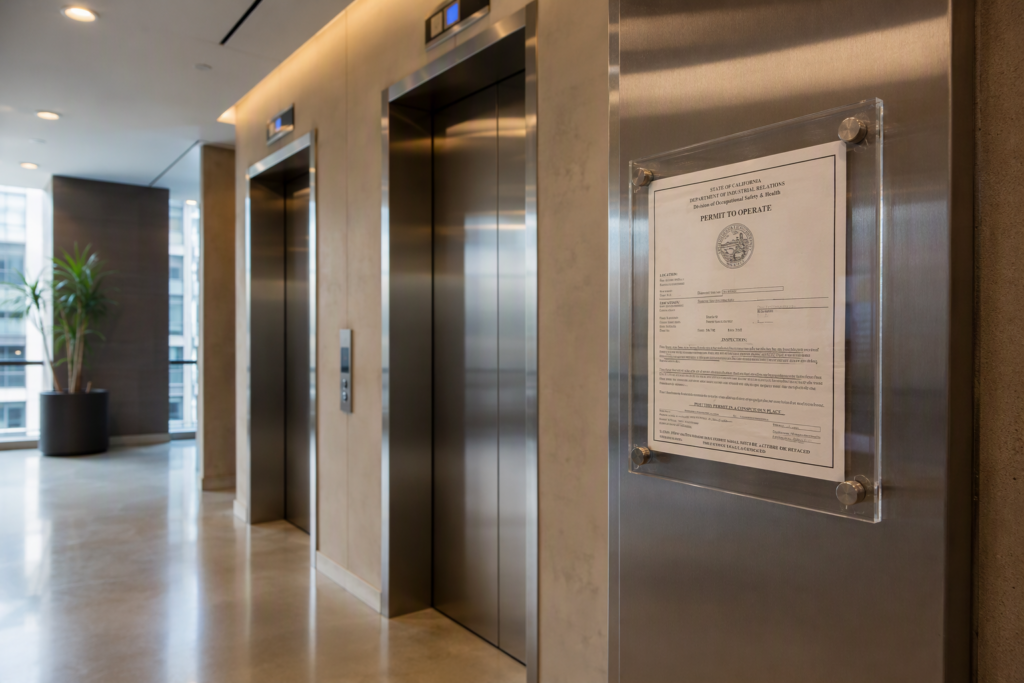
- Log the time, date, and elevator ID number. California’s permit to operate must be posted conspicuously in the elevator car; photograph it as part of the scene documentation.
- Request a written incident report from the responding CQCC company before the elevator is returned to service.
What Should a Complete Elevator Entrapment Incident Report Contain?
A complete incident report goes well beyond a brief service ticket and should provide enough technical detail that management, legal counsel, and regulators can independently evaluate what happened and why.
A thorough report from a qualified CQCC company typically includes the following elements: the exact date, time, and duration of the entrapment; the elevator identification number and its Cal/OSHA permit number; a narrative description of the failure sequence; controller fault codes extracted from the drive and controller memory; the results of safety device functional tests conducted after the event; a comparison of current component condition against the standards in ASME A17.1/CSA B44, Safety Code for Elevators and Escalators; the maintenance history for the affected components; a root-cause determination; and a corrective action plan with timelines. The report should also note the CCCM certification number of the mechanic who performed the diagnostic and the CQCC certificate number of the service company.
How Do Maintenance Logs Factor Into the Root-Cause Analysis?
Maintenance logs are the single most important document class in any entrapment investigation because they establish what was done, when, and by whom—and equally important, what was deferred or missed.
California Code of Regulations, Title 8, Elevator Safety Orders require that conveyances be maintained in safe operating condition, and that only a CCCM working for a CQCC may perform maintenance. Every maintenance visit should generate a written record showing the date, the work performed, the mechanic’s CCCM number, and any deficiencies noted. If logs are missing, incomplete, or show deferred corrective work on the component that failed, that gap becomes central to the root-cause narrative. Building management should request copies of all maintenance records from their service company before, not after, an incident—a proactive posture that Liftech Elevator encourages with every client in its service territory.
What Role Does Cal/OSHA Play After an Entrapment Incident?
Cal/OSHA’s Elevator Unit has jurisdiction over all conveyances covered by California Labor Code Sections 7300–7324.2 and may conduct its own investigation independent of the building’s service company report.
If Cal/OSHA determines that the entrapment resulted from a violation of the Elevator Safety Orders or from operation without a valid permit, the agency may issue a citation, require immediate corrective action, or suspend the elevator’s permit to operate. No elevator may legally operate in California without a valid, current permit to operate issued by Cal/OSHA. If the permit has lapsed or the unit was placed in service after a material alteration without a new Cal/OSHA permit, those facts will appear in the regulatory investigation and can significantly complicate the building’s liability position. Buildings located within the City of Los Angeles should be aware that Los Angeles runs its own elevator and conveyance inspection program through the Department of Building and Safety (LADBS) in addition to the state framework.
How Long Does It Take to Receive a Root-Cause Analysis Report?
The timeline for a complete root-cause analysis depends on the complexity of the failure, the availability of replacement parts needed to confirm the failure mode, and whether Cal/OSHA requires an independent inspection before the unit returns to service.
A preliminary verbal briefing from the responding CCCM should occur on the day of the event. A written preliminary report covering the fault codes and the initial failure hypothesis is typically available within a few business days. A comprehensive root-cause report—one that includes component teardown analysis, comparison against ASME A17.1 requirements, and a corrective action plan—may take one to two weeks for complex failures involving drive electronics, hydraulic system contamination, or safety chain faults with multiple contributing factors.
What Are the Most Common Technical Causes of Elevator Entrapments?
Understanding the common failure categories helps building management ask better questions when reviewing the incident report and evaluate whether the corrective action plan addresses the actual root cause.
| Failure Category | Example Components | Relevant ASME A17.1 System | Typical Detection Method |
|---|---|---|---|
| Drive system fault | Variable-frequency drive, motor, brake | Drive machine and brake | Controller fault code; brake gap measurement |
| Safety chain interruption | Door contacts, buffer switches, governor, safety device | Electrical protective devices | Safety circuit continuity test; contact resistance check |
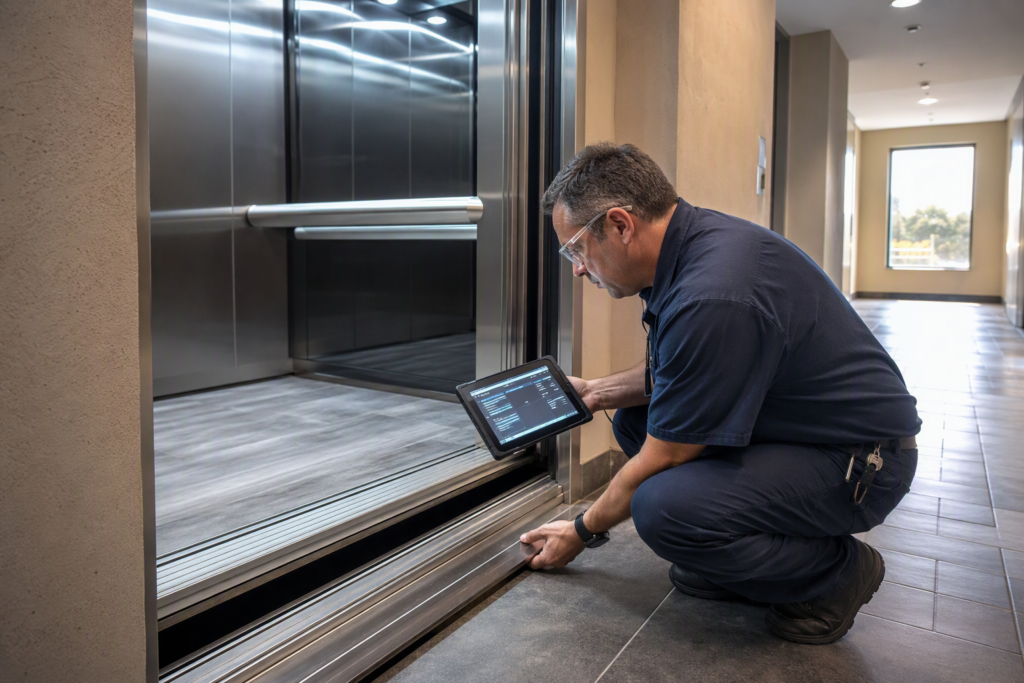
| Door system failure | Door operator, clutch, rollers, sill gap | Hoistway and car doors | Door force and speed testing; visual inspection |
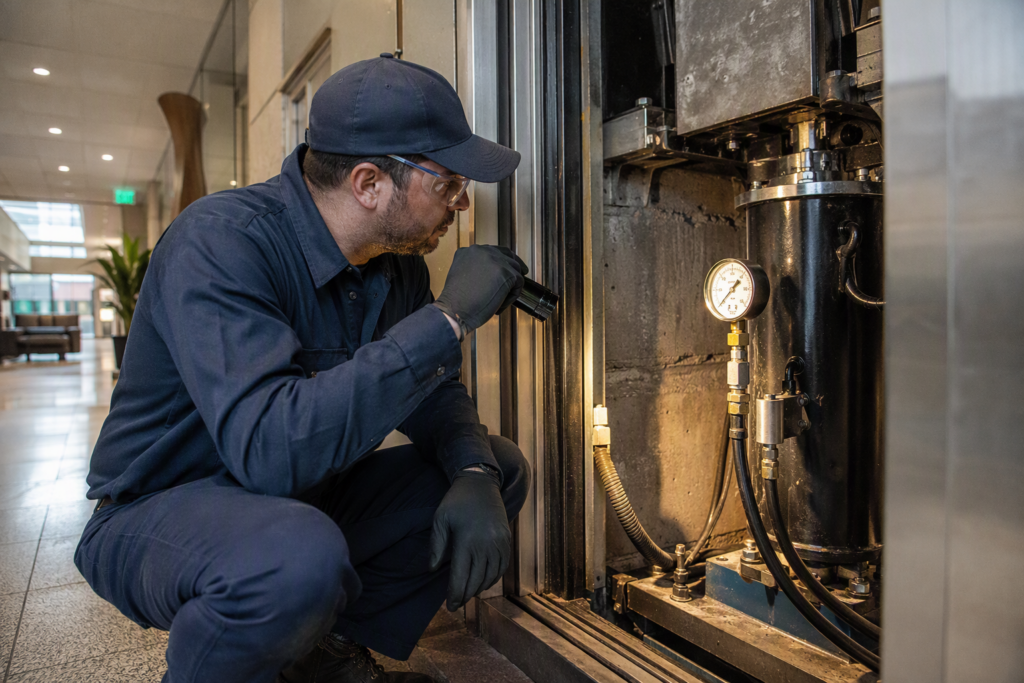
| Hydraulic system failure | Power unit, valve, jack, oil lines | Hydraulic driving machines | Pressure test; oil sample analysis; leak detection |
| Control system fault | Logic board, relay, selector, dispatcher | Operation and control | Controller diagnostics; wiring continuity test |
| Rope or chain system | Hoist ropes, governor rope, chain | Suspension and compensation | Visual wire count; rope gauge measurement |
| Power supply issue | Main line, phase monitor, UPS | Electrical equipment | Phase and voltage logging; utility records |
How Does Building Management Request Records From Their Current Elevator Service Company?
Building management has a legitimate right to request all records pertaining to their own elevator, and a reputable CQCC company will provide them promptly upon written request.
The request should be made in writing (email is sufficient) and should specifically ask for: all maintenance visit records for the past 24 months, all controller fault logs downloaded since the most recent maintenance visit, any open deficiency or recommendation items from prior visits, the most recent annual inspection certificate and Cal/OSHA permit to operate, and the CQCC and CCCM certification numbers of personnel who worked on the unit. If the current service company resists providing these records, that resistance itself is a meaningful data point about the quality of the service relationship. Liftech Elevator recommends that property managers in Signal Hill, Long Beach, Los Angeles, and Orange County maintain their own copy of all elevator records rather than relying solely on the service company’s file.
Can Building Management Hire an Independent Inspector to Review the Incident?
Yes, but the independent reviewer must hold the appropriate California credentials to conduct any hands-on examination of the equipment.
Only Cal/OSHA Safety Engineers and Certified Competent Conveyance Inspectors (CCCI) may perform elevator inspections in California. If building management wants an independent technical opinion that goes beyond reviewing documents, they must engage a CCCI-credentialed inspector rather than a generic mechanical engineer or consultant who lacks that specific California certification. An independent CCCI can review the service company’s root-cause report, inspect the repaired components, and provide a second opinion on whether the corrective action was adequate. This step is particularly valuable when the entrapment resulted in personal injury and litigation is anticipated.
What Happens If the Elevator Cannot Return to Service After the Entrapment?
If the failure is severe enough that the elevator cannot be safely returned to service without material alteration or major component replacement, California law requires Cal/OSHA approval before the unit resumes operation.
A permit from Cal/OSHA is required before a conveyance is erected, installed, or materially altered. A material alteration following an entrapment—for example, replacing a drive machine, upgrading the control system, or modifying the safety circuit—triggers a new permit requirement. The CQCC company handles the permit application, but building management should confirm that the application has been submitted and that the unit is not returned to service until Cal/OSHA has issued the appropriate permit. Operating without a valid permit is a violation of California Labor Code and can expose the building owner to regulatory citation and civil liability.
How Should Building Management Communicate the Incident to Tenants and Occupants?
Transparent, factual communication with tenants after an entrapment builds trust and reduces the risk of reputational damage that can follow from perceived evasiveness.
Management should inform tenants promptly that an entrapment occurred, that qualified personnel are conducting a thorough investigation, and that the elevator will not return to service until the root cause has been identified and corrected. It is appropriate to share general categories of information—for example, that a door system component failed—without disclosing details that may be legally sensitive. Management should not speculate about cause, liability, or timeline until the written root-cause report from the CQCC company is in hand. If the ADA accessibility of the building is compromised during the repair period, a reasonable accommodation plan for people with disabilities should be communicated in accordance with ADA obligations.
What Is the Relationship Between the Annual Inspection and Entrapment Prevention?
California law requires every conveyance to be inspected at least once a year, and a unit found safe receives a permit to operate for up to one year—but annual inspections are not a substitute for continuous preventive maintenance.
The annual inspection performed by a Cal/OSHA Safety Engineer or CCCI is a snapshot assessment of safety compliance on a specific day. It identifies code violations and items that have degraded below acceptable thresholds, but it does not capture the gradual deterioration that occurs between visits. A full maintenance contract with a CQCC-certified company fills that gap by providing periodic lubrication, adjustment, testing, and early detection of components approaching end of life. Notably, Cal/OSHA may issue a permit to operate for up to two years for an elevator in safe condition covered by a full maintenance contract with a C-11 licensed elevator company—a direct regulatory incentive for comprehensive service agreements over inspection-only arrangements.
What Documentation Should Building Management Keep Permanently After an Entrapment?
Certain records from an entrapment investigation should be retained indefinitely because the statute of limitations for personal injury claims can extend years beyond the incident date.
The permanent file should include: the original incident report from the CQCC company; all controller fault code downloads; photographs of the failed component before and after replacement; the root-cause analysis document; all Cal/OSHA correspondence, inspection certificates, and permits issued in connection with the incident; invoices for all corrective work performed; the CCCM and CQCC certification numbers of everyone who worked on the unit post-incident; any independent inspector reports; and all tenant or passenger communications related to the event. Digital storage with redundant backup is recommended, and the file should be accessible to legal counsel, the building’s insurance carrier, and senior management.
How Can Building Management Evaluate Whether the Corrective Action Was Adequate?
A corrective action plan is only adequate if it addresses the root cause—not just the immediate failure mode—and if it includes a verification step that confirms the repair was effective.
Management should ask the CQCC company to provide the results of all safety device tests performed after the repair, including the specific test protocols used and pass/fail criteria from ASME A17.1. The report should confirm that the repaired or replaced components meet the applicable edition of the code adopted in California—currently ASME A17.1/CSA B44, 2004 edition for installations covered by the Group IV Elevator Safety Orders. Management should also confirm that any open deficiency items identified during prior maintenance visits that may have contributed to the entrapment were addressed as part of the corrective action, not deferred again.
What Is the Difference Between a Service Report and a Root-Cause Analysis Report?
A service report documents what was done during a visit; a root-cause analysis explains why the failure occurred and what systemic conditions enabled it—two fundamentally different documents that building management often conflate.
A standard service report might state: “Replaced door operator motor; tested door operation; returned unit to service.” A root-cause analysis would add: why the motor failed (e.g., bearing wear accelerated by misaligned door panels creating excessive load), what maintenance steps should have detected the developing failure earlier, whether the failure mode recurs on other elevators in the portfolio with similar equipment, and what changes to the maintenance protocol will prevent recurrence. Building management should explicitly request a root-cause analysis—not just a service report—after every entrapment incident, and should ask the service company to distinguish between the two documents clearly.
How Does an Entrapment Incident Affect the Building’s Cal/OSHA Permit Status?
An entrapment itself does not automatically void the permit to operate, but if Cal/OSHA’s investigation finds that the unit was operated in an unsafe condition or without a valid permit, the agency may suspend or revoke the permit pending corrective action.
The permit to operate must be posted conspicuously in the elevator car at all times. If an investigation reveals the permit had lapsed, the building owner faces the dual exposure of operating an unpermitted conveyance and the underlying safety violation. Arranging the annual reinspection is the elevator owner’s responsibility under California law—not the service company’s, though a good CQCC partner will track expiration dates and provide advance notice. Liftech Elevator integrates permit-expiration tracking into its service agreements for clients in Long Beach, Signal Hill, Los Angeles, and Orange County to help building managers stay continuously compliant.
Are There OSHA General Industry Requirements That Apply to Elevator Entrapments in Workplaces?
Federal OSHA general industry standards may apply to elevator entrapments in workplaces where employees are regular elevator users, independent of California’s elevator safety regulatory framework.
OSHA’s general duty clause requires employers to provide a workplace free from recognized hazards that are causing or likely to cause death or serious physical harm. An elevator entrapment in an office building, warehouse, or manufacturing facility may trigger an OSHA inquiry if an employee was entrapped during the course of employment. Federal OSHA and Cal/OSHA operate under a state-plan relationship in California, meaning California’s own occupational safety program through the Department of Industrial Relations is the primary enforcement agency. Building management should ensure that any entrapment involving an employee is properly documented under both the elevator-specific regulatory framework and any applicable workplace incident reporting obligations.
How Can Building Management Prevent Future Entrapments After Receiving the Report?
The incident report is most valuable when it drives a systematic review of the entire elevator program, not just a one-time repair of the component that failed.
After receiving the root-cause analysis, building management should schedule a comprehensive portfolio review covering all elevators in the building, not just the unit that experienced the entrapment. Components with similar wear profiles across multiple units should be evaluated for proactive replacement. The maintenance contract scope should be reviewed to ensure it includes the frequency and depth of inspection that the failure history suggests is necessary. Management should also confirm that every elevator in the building has a current Cal/OSHA permit to operate posted in the car, that reinspection scheduling is tracked proactively, and that the CQCC company on contract holds current certifications. Engaging Liftech Elevator for a portfolio-wide safety assessment after an entrapment incident is a structured way to translate the lessons from one event into building-wide risk reduction.
What Questions Should Building Management Ask When Reviewing the Incident Report With Their Service Company?
A structured review meeting with the CQCC company converts the written report from a passive document into an active tool for improving the building’s elevator program.
Management should ask: What is the single primary root cause, and what is the evidence base for that conclusion? Were there secondary or contributing causes? Were any warning signs visible in prior maintenance records that, in hindsight, should have prompted earlier intervention? Does the corrective action address only this unit or are changes needed across the portfolio? What is the timeline for all corrective actions, and which items are complete versus pending? Has the unit been tested to the applicable ASME A17.1 safety device standards following the repair? Are there any items that require a Cal/OSHA permit before they can be completed? What changes to the maintenance protocol are being implemented to reduce the probability of recurrence? Documenting the answers to these questions in writing creates a record that demonstrates management’s active engagement with elevator safety—an important element of any future regulatory or litigation review.
Contact Liftech Elevator for a free elevator assessment at 562-997-3639.
Need elevator service you can rely on? Liftech Elevator is ready to help.