Elevator Contract Negotiation: A Complete Comparison and Decision Guide
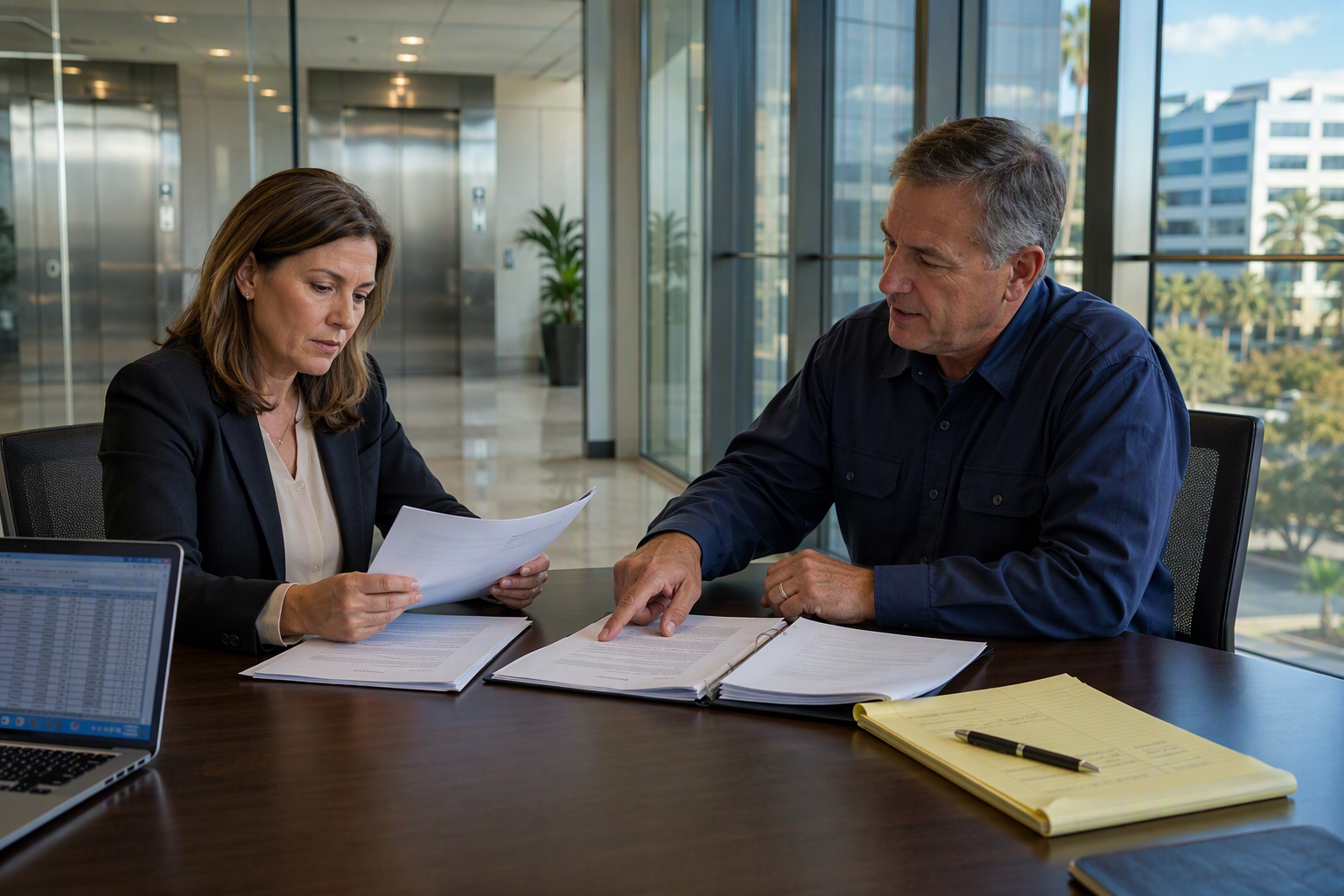
Elevator service contracts represent one of the most consequential long-term agreements a California building owner or facilities manager will sign. The wrong contract can expose a property to regulatory violations, unexpected repair bills, and extended equipment downtime. This guide breaks down every major decision point — contract types, key clauses, compliance requirements, and vendor selection — so property owners can negotiate from a position of knowledge.
What Are the Main Types of Elevator Service Contracts?
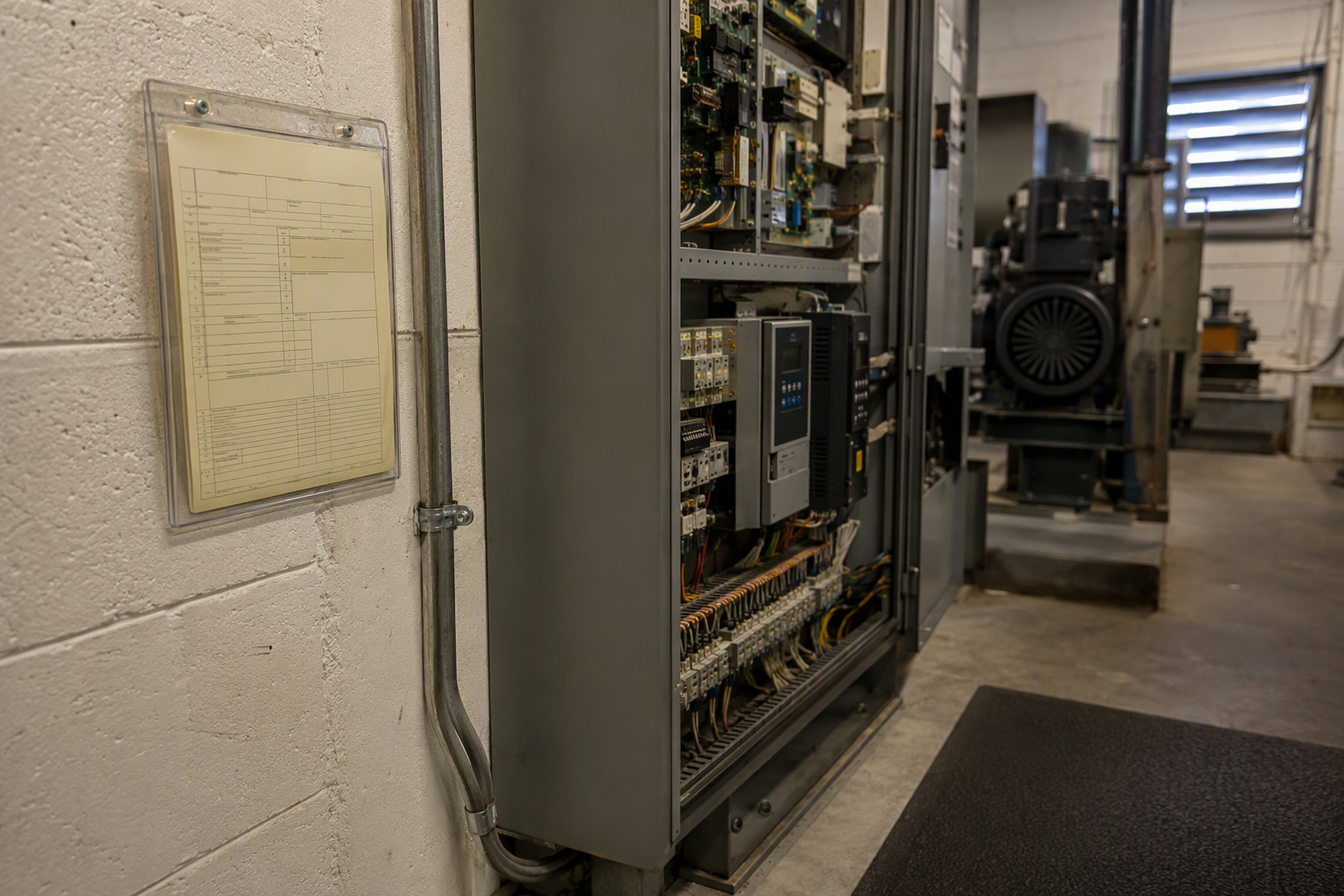
California elevator service contracts generally fall into three categories. Understanding what each covers — and what it excludes — is the foundation of any effective negotiation.
| Contract Type | What Is Typically Covered | What Is Typically Excluded | Best Suited For |
|---|---|---|---|
| Full Maintenance (Comprehensive) | Routine maintenance, lubricants, adjustments, replacement of most parts, callbacks, labor | Vandalism, misuse damage, modernization, cab interior cosmetics | High-traffic buildings, older equipment, owners who want cost predictability |
| Oil-and-Grease (Basic Maintenance) | Lubrication, minor adjustments, routine safety checks | Parts, major repairs, callbacks beyond a set number, labor beyond routine visits | Newer equipment under manufacturer warranty, low-traffic buildings |
| Parts-and-Labor (Examination) | Scheduled inspections, lubricants, labor for covered repairs, listed parts | Parts not on the approved list, major component replacements, vandalism | Mid-range buildings wanting a balance between cost and coverage |
Why Does Contract Type Affect Cal/OSHA Permit Duration?
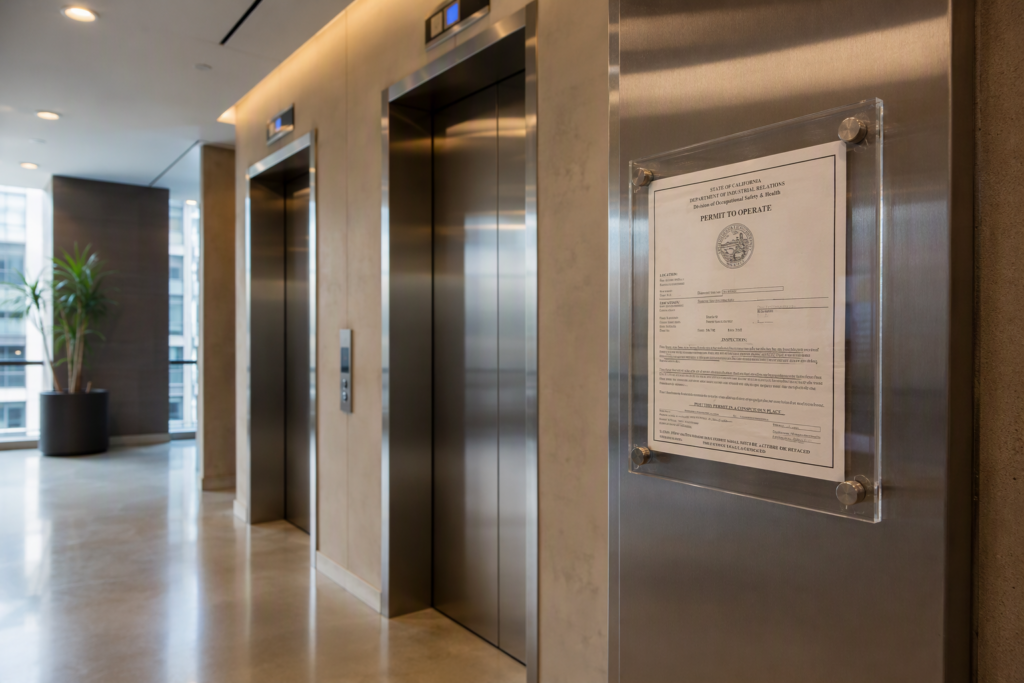
Contract type has a direct regulatory consequence in California. Under Cal/OSHA’s Elevator Unit, a standard elevator permit to operate is valid for up to one year. However, Cal/OSHA may issue a permit to operate for up to two years for an elevator that is in safe condition and covered by a full maintenance contract with a C-11 licensed elevator company. This means choosing a comprehensive maintenance agreement — when paired with a qualified contractor — can reduce the frequency of required inspections and associated costs. Building owners who negotiate a lesser contract tier forfeit this potential two-year permit window.
What California Credentials Must a Vendor Have Before Signing a Contract?
Before any contract negotiation begins, California law mandates specific credentials from any company that will maintain, repair, or service elevators. Signing with an unqualified vendor can void your permit to operate and expose the property to Cal/OSHA enforcement.
- Confirm the company holds a current Certified Qualified Conveyance Company (CQCC) certificate issued by Cal/OSHA.
- Verify the company carries an active C-11 Elevator Contractor license issued by the California Contractors State License Board (CSLB).
- Confirm all mechanics who will work unsupervised on your equipment hold a Certified Competent Conveyance Mechanic (CCCM) certificate from Cal/OSHA.
- Request proof of current workers’ compensation and general liability insurance — required for CQCC certification.
- Note that CQCC, CCCM, and conveyance inspector certificates last two years and require at least eight hours of continuing education for renewal. Ask for renewal dates.
California law under California Labor Code Sections 7300–7324.2 is clear: only a Certified Competent Conveyance Mechanic working for a Certified Qualified Conveyance Company may maintain, repair, alter, or replace components on a conveyance. No exceptions.
What Key Clauses Should Every Elevator Contract Include?
| Clause | Why It Matters | Negotiating Tip |
|---|---|---|
| Scope of Work Definition | Establishes exactly what is and is not covered; prevents billing disputes | Request an itemized parts-exclusion list in plain language |
| Callback Response Terms | Defines how quickly the contractor responds to entrapments or malfunctions | Negotiate priority callback windows in writing, especially for high-occupancy buildings |
| Parts Sourcing and Markup | Some contracts allow vendors to mark up parts significantly beyond list price | Cap parts markup at a defined percentage above manufacturer list price |
| Escalation / Price Increase Cap | Annual price increases can compound significantly over a long contract term | Tie annual increases to a published index and set a maximum cap per year |
| Record-Keeping and Reporting | Cal/OSHA requires documentation; owners need evidence of compliance | Require monthly or quarterly service logs provided in writing |
| Permit and Inspection Coordination | California law places responsibility for annual reinspection on the elevator owner | Clarify whether the contractor will coordinate with Cal/OSHA on the owner’s behalf |
| Termination for Cause | Protects owners if service quality drops or credentials lapse | Include credential lapse (CQCC/CCCM expiration) as a termination trigger |
| Transfer and Assignment | Large contractors frequently sell contracts; new owner may have different service quality | Require written owner consent before any assignment or sale of the contract |
| Modernization Carve-Out | Modernization triggers new permit requirements; it should never be bundled ambiguously | Define modernization separately and specify it requires a new Cal/OSHA permit before work begins |
How Do Full Maintenance Contracts Compare to Basic Contracts on Total Cost of Ownership?
The true cost of an elevator contract cannot be evaluated on monthly fee alone. A lower-tier contract with frequent out-of-pocket repair invoices can easily exceed the cost of a comprehensive agreement over a multi-year term. When building owners compare proposals, they should request a five-year total cost projection that includes historical callback and parts costs for similar equipment.
| Cost Factor | Full Maintenance Contract | Oil-and-Grease Contract | Parts-and-Labor Contract |
|---|---|---|---|
| Monthly base fee | Highest | Lowest | Mid-range |
| Parts replacement costs | Largely included | Owner pays all | Listed parts included |
| Callback labor costs | Typically included | Billed separately | Partially included |
| Regulatory risk exposure | Lower (supports 2-year permit eligibility) | Higher (annual permit cycle only) | Moderate |
| Budget predictability | High | Low | Moderate |
| Best for aging equipment | Yes | No | Situational |
What Compliance Obligations Must the Contract Address?
California imposes several non-negotiable compliance requirements that any service contract must support rather than contradict:
- Annual inspection: California law requires every conveyance to be inspected at least once a year. Arranging reinspection is the elevator owner’s responsibility — not automatically the contractor’s. The contract should specify which party coordinates the Cal/OSHA inspection scheduling.
- Permit posting: California law requires the permit to operate for a passenger, freight, or inclined elevator to be posted conspicuously in the elevator car. The contract should address who is responsible for posting updated permits after each inspection cycle.
- Pre-alteration permit: Under California regulation, a permit from Cal/OSHA is required before a conveyance is erected, installed, or materially altered. Any contract clause allowing the vendor to perform alterations must acknowledge this requirement explicitly.
- Adopted code standard: California has adopted the ASME A17.1/CSA B44, 2004 edition (Group IV Elevator Safety Orders), effective May 1, 2008, for installation contracts signed on or after that date. As of 2026, a proposed Group V update that would incorporate ASME A17.1-2019 in part has had its public hearing; no effective date has been posted. Contract modernization scopes should account for the potential transition.
- ADA alignment: Where equipment modifications are within scope, the contract should reference conformance with ADA accessibility requirements for public accommodations.
- Los Angeles note: Properties located in the City of Los Angeles should be aware that Los Angeles operates its own elevator and conveyance inspection program through the Department of Building and Safety (LADBS). Contracts for LA properties should clarify whether the vendor is familiar with and equipped to coordinate with the LADBS program in addition to Cal/OSHA requirements.
How Should Building Owners Evaluate Multiple Contract Proposals?
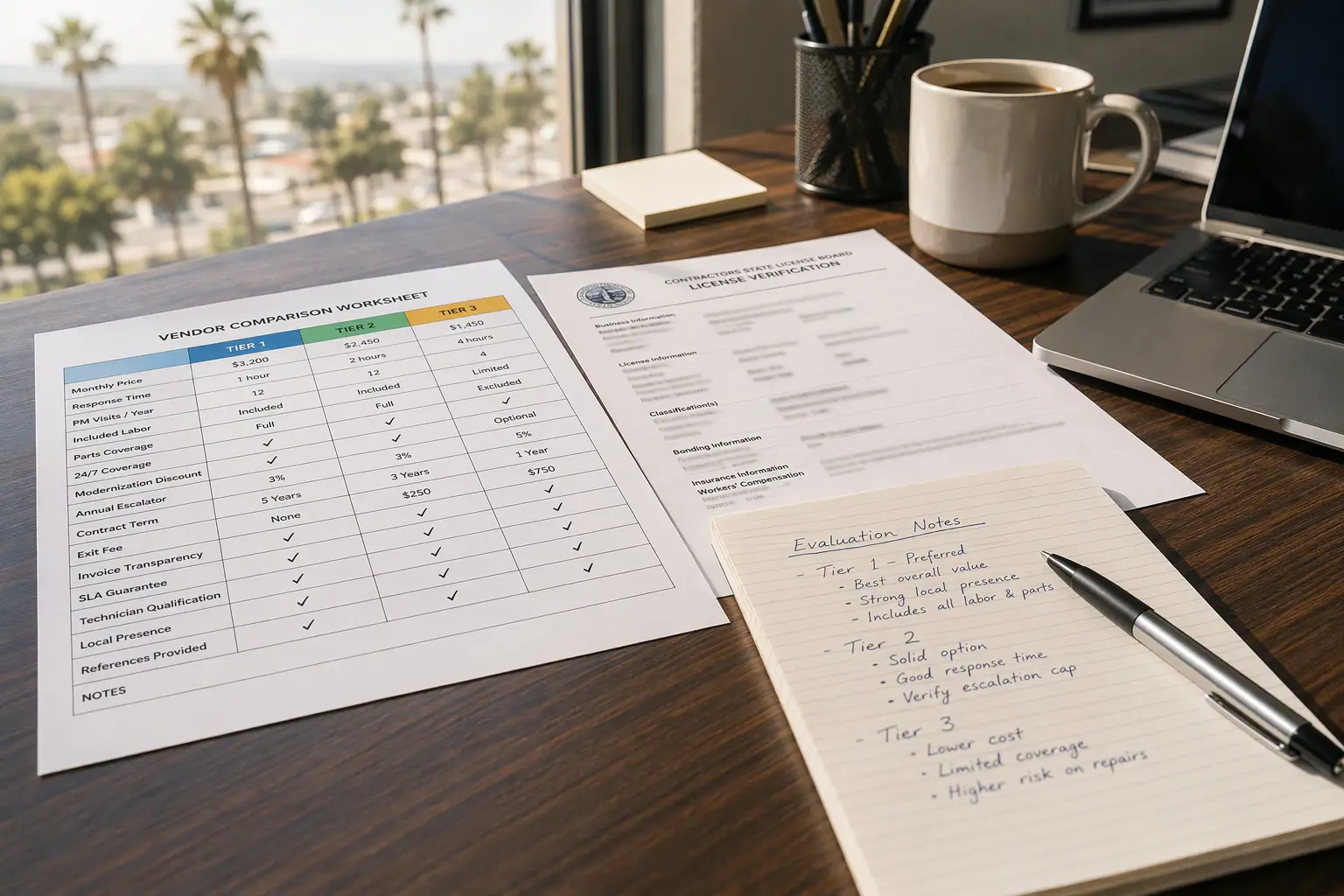
- Collect at least three proposals from CQCC-certified companies and verify credentials through Cal/OSHA’s Elevator Unit before reviewing pricing.
- Create a standardized comparison matrix that forces each vendor to itemize the same line items — do not compare proposals as submitted, which will use different terminology deliberately.
- Request the vendor’s service call log or maintenance history for at least one comparable installation they currently serve.
- Ask each vendor to identify any components on your specific equipment that they consider outside their standard coverage and to price those exclusions separately.
- Evaluate the contract term length against your equipment’s age and anticipated modernization timeline — locking into a five-year contract on equipment approaching end-of-life may limit flexibility.
- Check for automatic renewal clauses and notice periods required to cancel; many standard contracts roll over without explicit written notice sent 60–90 days before the anniversary date.
- Request references from current California clients with similar building types and equipment vintages.
What Are the Pros and Cons of Long-Term vs. Short-Term Elevator Contracts?
| Factor | Long-Term Contract (3–5 Years) | Short-Term Contract (1–2 Years) |
|---|---|---|
| Price stability | Pro: locked-in rates reduce year-over-year surprises | Con: exposed to market rate increases at renewal |
| Vendor accountability | Con: harder to exit if service quality declines | Pro: easier to switch vendors if performance falls short |
| Modernization flexibility | Con: may conflict with planned upgrades mid-term | Pro: easier to align contract end with modernization schedule |
| Negotiating leverage | Pro: vendors offer better terms for multi-year commitment | Con: less leverage at renewal; smaller discount potential |
| Regulatory adaptation | Con: a long contract may not automatically incorporate new code requirements (e.g., pending Group V update) | Pro: easier to renegotiate terms as California regulations evolve |
| Administrative burden | Pro: fewer negotiation cycles | Con: more frequent bidding and transition management |
When Is It the Right Time to Renegotiate an Existing Elevator Contract?
Several conditions signal that an existing elevator service contract deserves immediate review rather than passive renewal:
- The vendor’s CQCC or individual mechanic CCCM certifications are approaching their two-year expiration and renewal has not been confirmed.
- The property has experienced a change in occupancy, use classification, or elevator traffic that changes maintenance demands.
- Cal/OSHA has issued a notice of violation or a permit has been delayed due to service deficiencies.
- The current contract was signed before May 1, 2008, and may not reflect the adopted ASME A17.1/CSA B44 2004 edition Group IV Safety Orders.
- California’s proposed Group V update is adopted, which could change maintenance and component requirements across the state.
- Unbudgeted repair invoices have appeared consistently outside the defined contract scope, suggesting scope inadequacy.
- The vendor’s contract was acquired by a larger company and service personnel or response quality has changed.
How Does an Independent Elevator Company Compare to an OEM Service Provider?
| Comparison Factor | OEM / Manufacturer Service | Independent Certified Provider |
|---|---|---|
| California credential requirement | Must be CQCC-certified and C-11 licensed | Must be CQCC-certified and C-11 licensed |
| Parts availability | Direct access to proprietary OEM parts | Access to OEM and aftermarket parts; not locked to one brand |
| Multi-brand expertise | Typically limited to own equipment lines | Trained across multiple manufacturers |
| Contract flexibility | Often standardized contracts with limited negotiation room | Typically more open to customized contract terms |
| Pricing transparency | Parts markups can be significant on proprietary components | Competitive parts sourcing may reduce per-incident costs |
| Local accountability | Varies; large OEMs may have regional rather than local dispatch | Local independent providers typically offer direct client relationships |
Liftech Elevator is an independent elevator service provider operating in California, holding the credentials required under California law to maintain, repair, and service conveyances. As a locally focused independent company, Liftech Elevator can offer contract structures tailored to each property’s specific equipment mix, usage patterns, and compliance timeline — without the rigid standardized terms often associated with large national OEM service divisions.
What Steps Should Owners Take Before Signing Any Elevator Service Contract?
- Pull the current permit to operate from the elevator car and confirm it is valid and posted as required by California law.
- Verify the prospective vendor’s CQCC certificate and C-11 license number on the Cal/OSHA Elevator Unit and CSLB databases respectively.
- Request a full equipment inspection report from the prospective vendor before finalizing scope — the inspection findings should drive contract scope, not the other way around.
- Have legal counsel review any automatic renewal, assignment, or liquidated damages clause before execution.
- Document all verbal representations in a written addendum; oral promises are not enforceable against contract language.
- Confirm whether the property is subject to the Los Angeles LADBS program in addition to Cal/OSHA, and ensure the vendor understands both programs.
- Establish a written baseline of the elevator’s current condition, including any open deficiencies, so that responsibility for pre-existing issues is clearly allocated.
- Set a calendar reminder for the contract’s notice-to-terminate window — typically 60 to 90 days before the anniversary — so the option to renegotiate or rebid is never inadvertently lost.
What Should a Building Owner Know About Cal/OSHA’s Role in Contract Compliance?
Cal/OSHA’s Elevator Unit sits within the California Department of Industrial Relations and is the primary regulatory body governing elevator safety in California under California Labor Code Sections 7300–7324.2 and the California Code of Regulations, Title 8, Elevator Safety Orders (Sections 3000–3146). Inspections may be performed only by State of California safety engineers or Certified Competent Conveyance Inspectors (CCCI). No elevator may be operated in California without a valid, current permit to operate. These facts have contract implications:
- A service contract does not substitute for a Cal/OSHA permit — it is a separate legal requirement.
- The owner, not the contractor, bears ultimate responsibility for maintaining a valid permit.
- When selecting between contract tiers, owners should weigh the two-year permit eligibility that accompanies a full maintenance contract with a CQCC-certified, C-11 licensed company — a documented regulatory benefit with practical value.
- Federal OSHA standards may also intersect with elevator safety for workers, particularly in construction contexts, making it important that contracts address both federal and state obligations where applicable.
Contact Liftech Elevator for a free elevator assessment at 562-997-3639.
Need elevator service you can rely on? Liftech Elevator is ready to help.