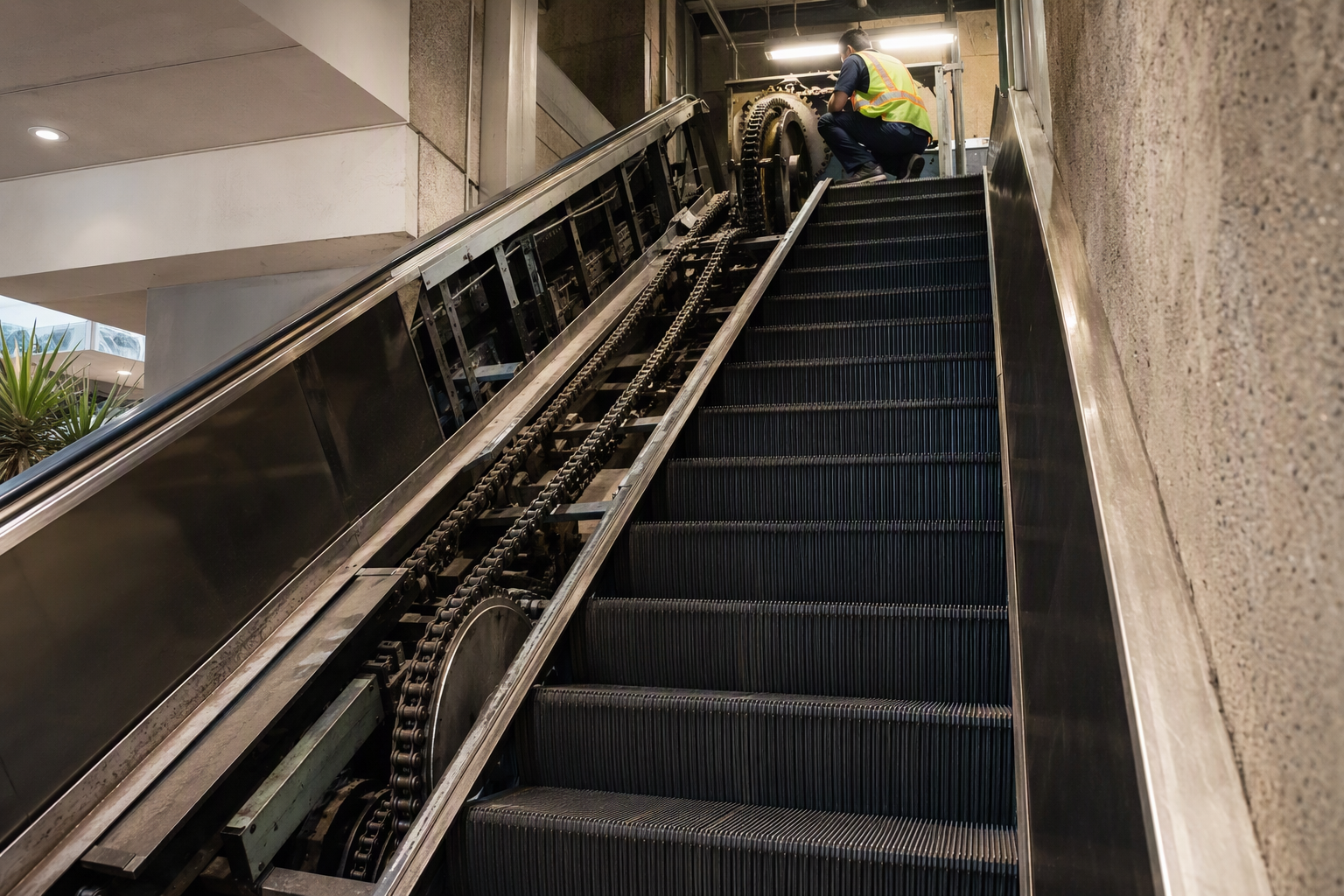
Escalator chain and sprocket replacement is one of the more significant mechanical service events an escalator will undergo in its service life. The drivetrain components that move steps continuously under load — day after day, tens of thousands of cycles — eventually wear to the point where replacement is not optional. Understanding what drives cost, what California law requires, and how to plan the project helps building owners and facility managers budget accurately and avoid compliance exposure.
What factors determine the total cost of replacing an escalator chain and sprocket?
The total cost is shaped by escalator rise height, unit manufacturer, component availability, labor scope, and California regulatory compliance requirements — no two replacement projects carry the same price.
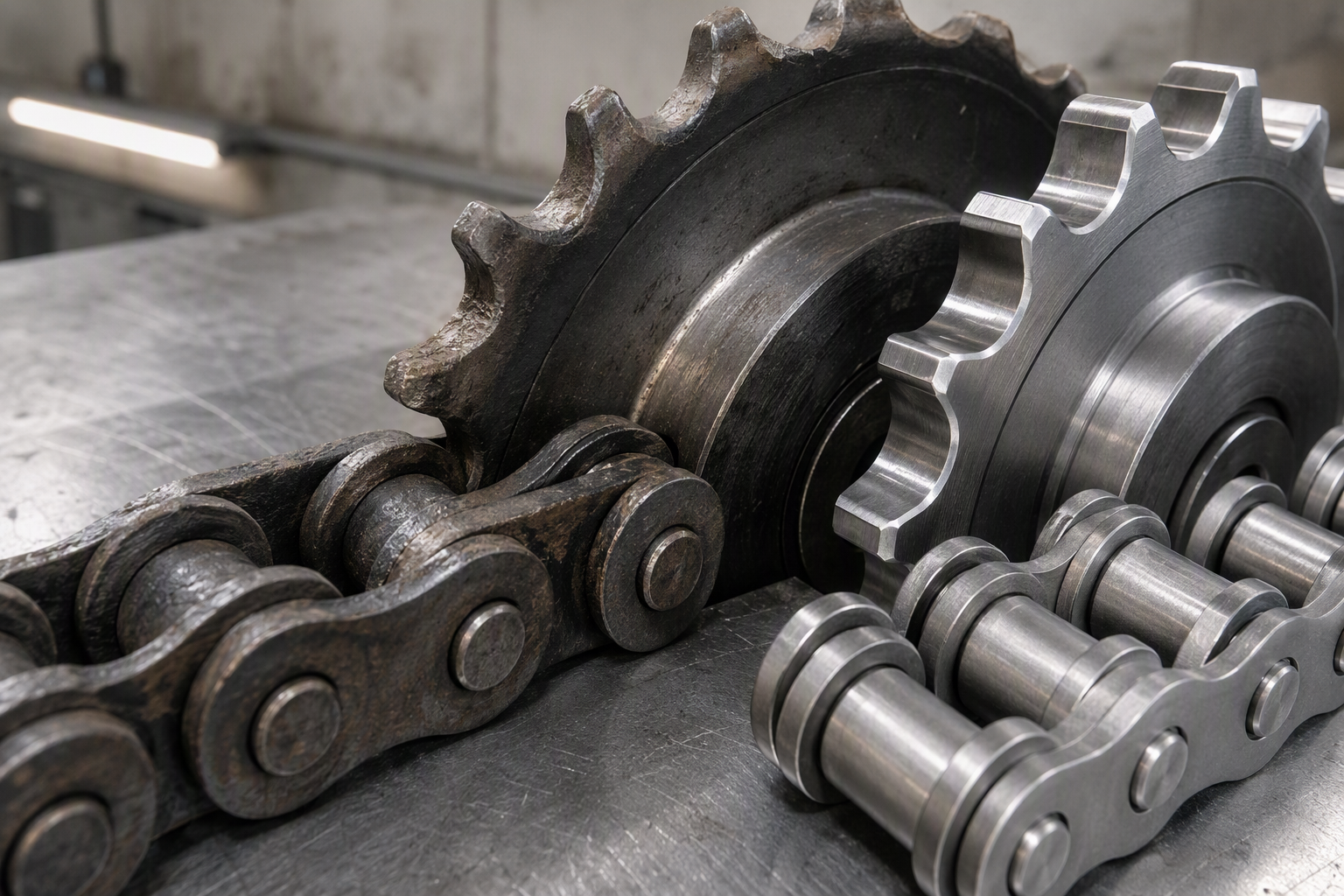
Escalator drive systems are not interchangeable across brands. A Schindler, Otis, KONE, or Thyssen unit each uses proprietary or semi-proprietary chain pitch and sprocket geometry. Step chains are specified by pitch, link plate thickness, roller diameter, and rated tensile strength. Sprocket tooth profiles are machined to match those chains exactly. When components are sourced from the original equipment manufacturer (OEM), costs are higher but fitment is guaranteed. Aftermarket components from certified suppliers can reduce parts cost but require verification that specifications meet the original design criteria.
Rise height is a primary cost driver. A short-rise escalator serving two floors moves significantly less chain than a transit-depth unit spanning a full mezzanine. Total chain length scales directly with rise, so a longer escalator requires more chain and larger-diameter sprockets, multiplying both material cost and labor hours for removal and installation.
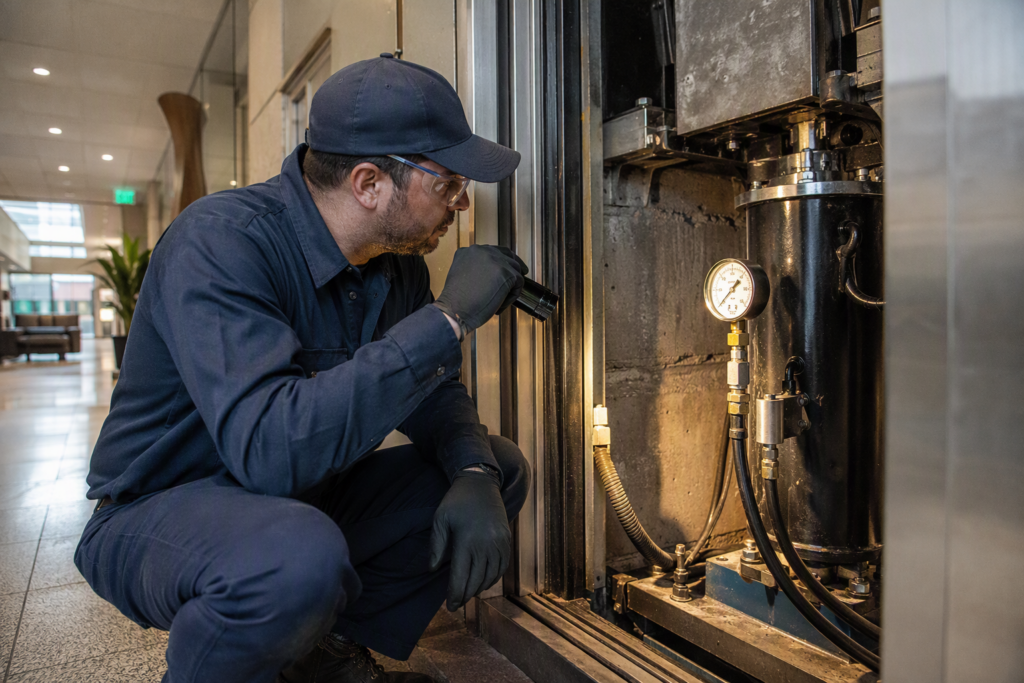
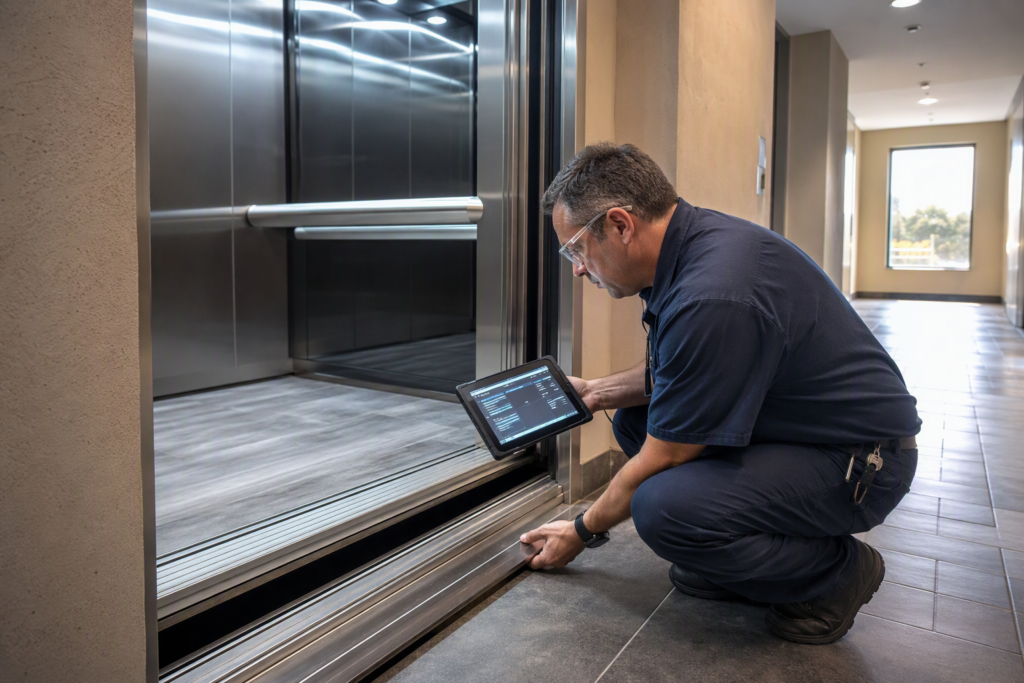
Labor scope encompasses disassembly of the step band, removal of worn chain from the upper and lower sprocket assemblies, cleaning and inspection of the machine room and pit, installation of new chain and sprockets, tensioning, lubrication, and operational test. In California, this work must be performed by a Cal/OSHA-certified Certified Competent Conveyance Mechanic (CCCM) working for a Certified Qualified Conveyance Company (CQCC). That certification requirement is not a formality — it affects which contractors can legally perform the work in Long Beach, Los Angeles, Signal Hill, and throughout Orange County.
What are the main cost components in an escalator chain and sprocket replacement project?
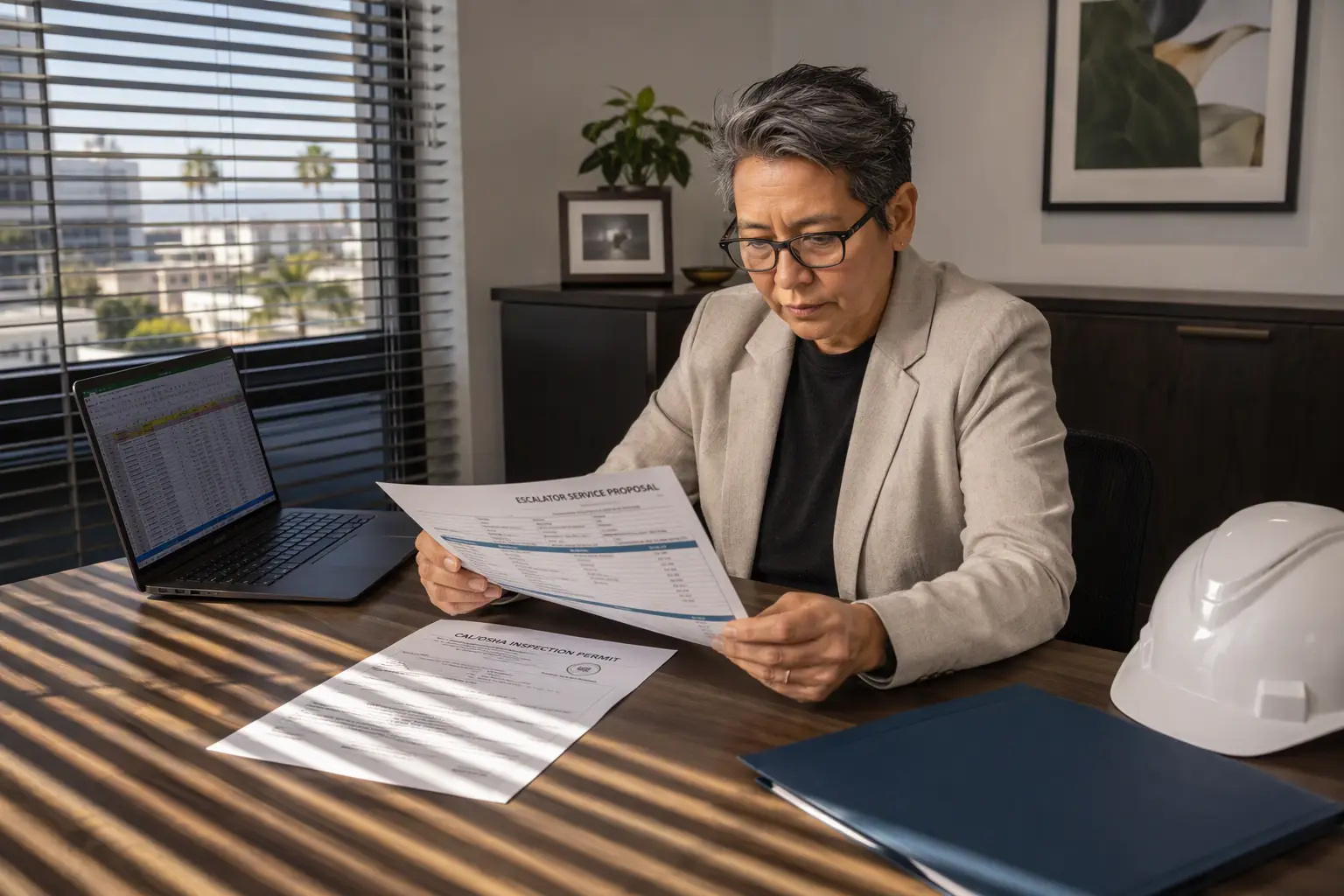
Cost components include step chain procurement, drive and return sprocket sets, shaft and bearing inspection or replacement, labor hours, crane or rigging if required, and the Cal/OSHA inspection and permit fees associated with a material alteration.
Step chain is typically the largest single parts expense. Drive chains for escalators are precision-engineered to tolerances far tighter than industrial conveyor chain, and they are often sold by the pitch length or by the complete loop set sized to the unit’s rise. Sprockets — both the drive sprocket on the main shaft and the return sprocket at the opposite end — wear in tandem with the chain. Replacing chain while leaving worn sprockets accelerates re-wear of the new chain, making paired replacement the industry-standard practice.
Bearings, shaft seals, and lubrication fittings are typically inspected during the same access window, and replacing them while the drivetrain is already disassembled avoids a costly second mobilization. Some projects also reveal worn step axles or damaged chain guides that must be addressed before the unit can return to service.
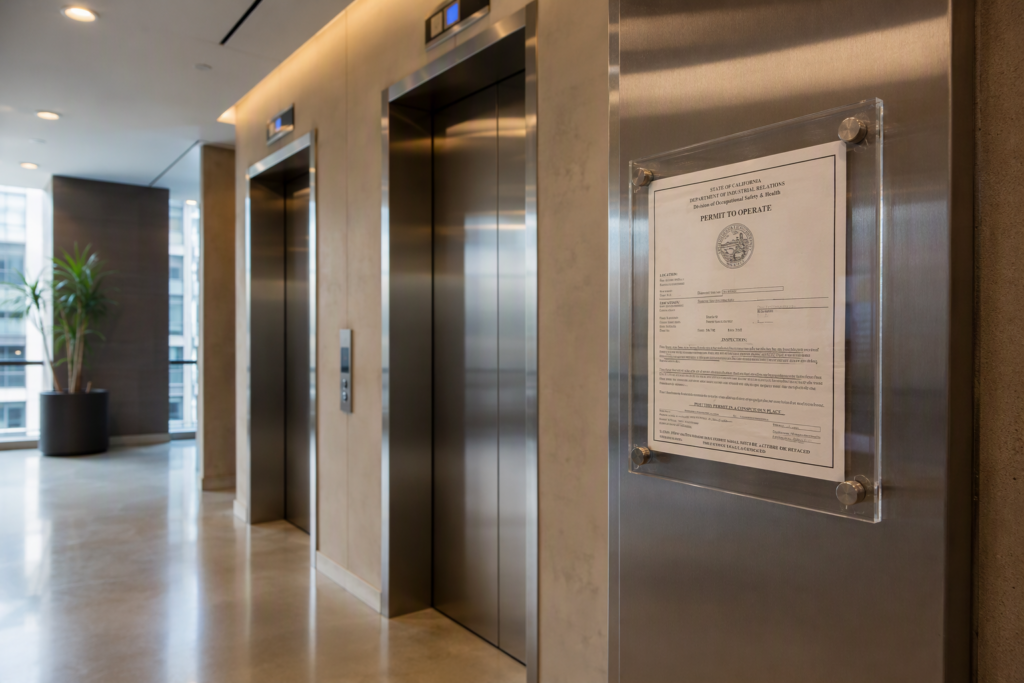
In California, a material alteration to a conveyance requires a permit from Cal/OSHA before work begins, under California Labor Code Sections 7300–7324.2 and the California Code of Regulations, Title 8, Elevator Safety Orders. Post-completion, a state safety engineer or Certified Competent Conveyance Inspector (CCCI) must inspect and approve the work before the unit is returned to public service. Those inspection and permit costs are real project line items that should appear in any complete budget estimate.
How does escalator rise height affect chain and sprocket replacement cost?
Rise height is directly proportional to step chain length and materially affects both parts cost and labor hours, making it one of the most predictable cost variables in the project budget.
A standard commercial escalator serving a single floor change carries less chain than a transit escalator descending multiple stories. Each additional meter of rise adds to the total chain loop, the number of link pins and rollers that must be inspected or replaced, and the time required for installation and tensioning. Sprocket diameter, while not directly tied to rise, is determined by design speed and step pitch — faster or steeper units often use larger sprockets and heavier chain, both of which increase material cost per unit length.
Is it cheaper to repair an escalator chain or replace it entirely?
Partial chain repair is generally not a cost-effective or code-compliant approach when a chain has reached wear limits, because mixed-wear chains introduce uneven load distribution and accelerate sprocket damage.
Chain wear is assessed by elongation — the increase in link pitch caused by pin and bushing wear. When elongation exceeds the manufacturer’s allowable tolerance, the chain no longer meshes correctly with sprocket teeth. Installing new links in a worn chain does not restore uniform pitch because the existing links are already elongated; the interface between new and old links creates high spots that concentrate load on individual sprocket teeth, accelerating both re-wear and potential fatigue failure. A complete chain replacement, timed with sprocket replacement, resets the drivetrain to like-new tolerances and maximizes the service interval before the next major service event.
What does California law require before an escalator chain and sprocket replacement begins?
California law requires a Cal/OSHA permit before any material alteration of a conveyance — replacing drivetrain components qualifies as a material alteration, and no work may commence without that permit.
Under Cal/OSHA’s Elevator Unit oversight, governed by California Labor Code Sections 7300–7324.2 and Title 8, Elevator Safety Orders, a building owner or their authorized conveyance company must apply for and receive an alteration permit before installation begins. The company performing the work must be a CQCC, and every mechanic performing hands-on work must hold a CCCM credential issued by Cal/OSHA. Upon completion, a Cal/OSHA safety engineer or CCCI must inspect and clear the unit before it is placed back in service. Operating a conveyance without a valid, current permit to operate is a violation of California law. Liftech Elevator, as a certified conveyance company serving Long Beach, Signal Hill, Los Angeles, and Orange County, manages the permit application and inspection coordination as part of its project workflow.
In Los Angeles specifically, the City of Los Angeles Department of Building and Safety (LADBS) operates its own conveyance inspection program, and projects in that jurisdiction should account for LADBS coordination alongside Cal/OSHA requirements.
How do OEM parts compare to aftermarket parts in cost and quality?
OEM parts carry a higher upfront cost but offer guaranteed specification conformance, while quality aftermarket parts from certified suppliers can reduce procurement cost when specifications are independently verified against the unit’s engineering documentation.
| Criterion | OEM Parts | Quality Aftermarket Parts |
|---|---|---|
| Specification Conformance | Guaranteed by manufacturer | Requires independent engineering verification |
| Relative Parts Cost | Higher | Potentially lower |
| Lead Time | Variable; can be long for legacy units | Often shorter for common pitch sizes |
| Warranty Coverage | OEM warranty typically applies | Supplier warranty; may not cover consequential damage |
| ASME A17.1 Compliance | Designed to meet code | Must be verified by CCCM and engineer of record |
| Availability for Legacy Units | Can be discontinued for older models | Third-party manufacturers may still produce |
| Documentation | Full OEM test data available | Requires supplier certification documentation |
How long does an escalator chain and sprocket replacement typically take?
The mechanical replacement itself commonly spans one to several days depending on unit size and parts availability, but total project duration extends when permit processing, parts procurement lead times, and post-work inspection scheduling are included.
Cal/OSHA permit processing time is a variable that building owners sometimes underestimate. Scheduling a post-completion inspection with a state safety engineer or CCCI adds additional lead time before the unit can be returned to service. Buildings in Los Angeles must also account for LADBS coordination. Experienced project management — coordinating permits, parts delivery, mechanic scheduling, and inspection appointments — compresses overall downtime materially. This is why selecting a CQCC with established relationships in the local inspection jurisdiction matters operationally, not just for compliance.
Parts lead time is frequently the longest single variable, particularly for less common escalator makes or older units where OEM supply chains may be constrained. Thorough pre-project planning, including confirming parts availability before submitting the alteration permit application, keeps the project on schedule.
What are the signs that an escalator chain and sprocket need replacement rather than adjustment?
Worn chain elongation beyond manufacturer limits, visible sprocket tooth hourglass profile, chain skipping or surging under load, and abnormal noise during operation are the primary indicators that replacement — not adjustment — is required.
Escalator step chains have defined wear limits expressed as allowable elongation from original pitch length. When measured elongation exceeds those limits, the chain is condemned for continued service regardless of visible condition. Sprocket wear follows a characteristic pattern: as chain pitch elongates, the chain rides higher on the sprocket teeth, contacting the tooth tip rather than the root. This produces the hourglass or hook shape on the leading face of each tooth that is visible during inspection. A sprocket showing this pattern will rapidly re-wear any new chain installed without sprocket replacement.
Operational symptoms — chain surging, rhythmic noise coinciding with sprocket rotation, or visible step deviation at the comb plate — should prompt an immediate out-of-service determination pending inspection. Under ASME A17.1 Safety Code for Elevators and Escalators, escalators must be maintained in safe operating condition, and known mechanical deficiencies require correction before continued public operation.
What should building owners do immediately when an escalator shows drivetrain problems?
When drivetrain problems are identified, the unit should be taken out of service immediately, the area barricaded, and a CQCC contacted to assess condition before the unit is returned to operation.
- Stop the escalator using the emergency stop button or main disconnect, following the manufacturer’s procedure.
- Lock out and tag out the unit per OSHA lockout/tagout requirements to prevent inadvertent restart.
- Barricade the escalator landings and post out-of-service signage to prevent passenger boarding.
- Notify the building’s conveyance maintenance company or a CQCC to conduct a qualified inspection.
- Document the symptoms — sounds, visible conditions, and the circumstances when the problem was first observed — to assist the inspecting mechanic.
- Do not restart the unit for testing or temporary use until a CCCM has assessed and cleared it, or until required repairs are completed and the unit has passed inspection.
- Contact Cal/OSHA’s Elevator Unit if the unit requires an alteration permit before repair work can begin.
Does the ADA affect escalator chain and sprocket replacement projects?
The ADA does not mandate escalators as accessible routes, but when an escalator serves as part of a facility’s circulation path, its extended downtime during replacement may trigger obligations to ensure alternative accessible routes remain available and functional throughout the project.
Facilities that rely on escalators as part of their path of travel between accessible entrances, parking, and program areas should confirm that elevator or ramp alternatives remain available and meet ADA requirements during the escalator’s outage period. If the facility has only a single vertical access point and the escalator serves as a de facto accessible route for users who cannot use stairs, the project plan should address alternative access proactively. Consulting with an ADA accessibility consultant alongside the conveyance contractor is advisable for complex facilities.
How does an escalator full maintenance contract affect replacement cost and compliance?
A full maintenance contract with a CQCC typically covers routine lubrication, adjustment, and minor parts — but chain and sprocket replacement, as a major capital component swap, is generally addressed separately as a repair or alteration project.
California law allows Cal/OSHA to issue a permit to operate for up to two years for an elevator or escalator in safe condition covered by a full maintenance contract with a C-11 licensed elevator company, rather than the standard annual permit cycle. This extended permit interval is a meaningful operational benefit for building owners, but it does not alter the requirement for a separate alteration permit when major drivetrain components are replaced. Full maintenance contracts typically define what component categories are included and excluded — building owners should review their contract language carefully to understand what chain and sprocket replacement costs fall within the agreement versus what constitutes a separately billable capital project.
What is the role of the ASME A17.1 code in escalator drivetrain replacement?
The ASME A17.1 Safety Code for Elevators and Escalators sets the design, maintenance, and performance standards that govern escalator drivetrain components, and its requirements inform what constitutes acceptable replacement parts and procedures.
ASME A17.1 covers escalator safety requirements including drive system design parameters, step chain specifications, and maintenance obligations. California has adopted the ASME A17.1/CSA B44, 2004 edition under the Group IV Elevator Safety Orders, effective for installation contracts on or after May 1, 2008. California has proposed a Group V update that would incorporate portions of ASME A17.1-2019, with a public hearing held in June 2026, though no effective date has been announced as of the date of this content. Replacement components must conform to the code edition applicable to the unit’s original installation, and the CCCM performing the work is responsible for ensuring conformance. Building owners should retain all documentation of parts specifications and installation records, as these may be required during the Cal/OSHA post-alteration inspection.
How does unit age affect escalator chain and sprocket replacement cost?
Older escalators present higher replacement costs due to parts obsolescence, potential need for engineering reviews when direct replacement components are unavailable, and the higher likelihood of discovering secondary worn components during the access window.
Escalator platforms that have been in service for several decades may use chain specifications or sprocket geometries that are no longer in standard production. When a direct OEM replacement is unavailable, the CQCC and potentially an engineer of record must identify a conforming substitute and document its equivalence for the Cal/OSHA alteration permit. This engineering review adds cost and project timeline. Older units also more commonly reveal deteriorated chain guides, worn step axles, degraded pit conditions, or outdated safety device configurations that current code requires to be addressed during a material alteration. A thorough pre-project condition assessment reduces the risk of encountering unexpected scope mid-project.
How should facility managers evaluate and select a contractor for this work?
The primary qualification filter in California is CQCC certification from Cal/OSHA — without it, a contractor cannot legally perform the work — followed by demonstrated experience with the specific escalator manufacturer and model involved.
Facility managers in Long Beach, Signal Hill, Los Angeles, and Orange County should verify a prospective contractor’s CQCC certification, their CSLB C-11 license, and their experience with the relevant escalator make. Requesting a detailed written scope of work that itemizes parts (including specification documentation), labor hours, permit and inspection coordination, and any allowances for secondary scope discovered during disassembly produces a more accurate basis for cost comparison than a summary quote. Lowest-cost proposals that omit permit fees, inspection costs, or secondary scope allowances often produce budget overruns when those costs surface mid-project. Liftech Elevator provides detailed project assessments for escalator drivetrain work across its service area.
What documentation should building owners retain after a chain and sprocket replacement?
Building owners should retain the Cal/OSHA alteration permit, the post-work inspection approval, parts specification certificates, the updated maintenance log, and any as-built notes documenting substitutions or secondary scope addressed during the project.
This documentation package serves multiple purposes. Cal/OSHA may request it during subsequent annual inspections. Insurance underwriters may require evidence of code-compliant repair for claims related to the escalator. Future service providers need the parts documentation to identify replacement components when the next service interval arrives. In Los Angeles, LADBS may also require documentation as part of its own conveyance inspection program. A CQCC should provide a complete documentation package as a standard project deliverable, not as an optional add-on.
How does lubrication affect escalator chain life and replacement intervals?
Proper lubrication is the single most impactful maintenance variable in extending step chain service life — inadequate or incorrect lubrication accelerates pin-and-bushing wear, which is the primary mechanism of chain elongation.
Escalator step chains operate under continuous cyclic load with tight pitch tolerances. As pins and bushings wear under load, pitch elongates, and the chain gradually loses its ability to mesh cleanly with sprockets. Correct lubricant viscosity, application method, and interval — as specified by the escalator manufacturer — maintain a protective film at the pin-bushing interface that measurably slows wear progression. Automatic chain lubrication systems, where available and properly maintained, apply lubricant at the correct interval without dependence on technician scheduling. A full maintenance contract that specifies lubrication intervals and lubricant type, performed by a CCCM, is the most reliable way to maximize chain service life and defer the cost of chain and sprocket replacement.
Can an escalator remain in partial or limited operation while awaiting chain and sprocket replacement?
Continued operation of an escalator with a drivetrain known to be at or beyond wear limits is not appropriate — the risk of mechanical failure during passenger transport and the resulting liability exposure make out-of-service the correct posture until replacement is complete.
A worn chain operating on worn sprockets does not fail predictably on a schedule. Chain skip — where the chain jumps sprocket teeth under load — can occur suddenly and without prior warning at the immediate prior cycle. Step irregularity, abrupt deceleration, or mechanical lock-up during passenger transport creates serious injury risk. California law requires conveyances to be maintained in safe operating condition. Knowingly operating an out-of-specification unit and continuing passenger service creates significant liability exposure for the building owner. The appropriate action when a CCCM identifies a drivetrain at wear limits is to take the unit out of service, complete the replacement, pass the Cal/OSHA post-alteration inspection, and return to service with a valid permit.
How often do escalator chains and sprockets typically need replacement?
Replacement intervals depend on traffic volume, lubrication quality, step load, and operational environment — there is no single calendar-based interval that applies universally, which is why periodic wear measurement by a CCCM is the appropriate guide.
High-traffic installations such as transit stations, airports, and convention centers experience chain elongation far faster than low-traffic retail or hotel escalators. Environmental factors — humidity, temperature cycling, exposure to cleaning chemicals, and airborne particulate — also affect wear rates. The correct approach is periodic elongation measurement by a qualified mechanic using the manufacturer’s measurement protocol, with replacement triggered by reaching the manufacturer’s wear limit rather than by elapsed time. Maintenance programs that include documented periodic wear measurements allow building owners to anticipate replacement before it becomes urgent, enabling better budget planning and avoiding emergency-replacement cost premiums. Liftech Elevator incorporates drivetrain wear measurement as part of its maintenance inspection protocols for escalators in its service area.
What should a complete escalator chain and sprocket replacement proposal include?
A complete proposal should itemize parts specifications and sourcing, labor scope, Cal/OSHA alteration permit and inspection coordination, secondary scope allowances, project timeline, and post-project documentation deliverables.
Proposals that present only a total project price without line-item detail make it impossible to evaluate the accuracy of the scope or to understand what is excluded. Building owners should request that proposals explicitly address: (1) chain specification and OEM vs. aftermarket sourcing; (2) sprocket replacement as included scope; (3) bearing and seal inspection with a defined allowance or cost-per-unit for replacement if needed; (4) Cal/OSHA alteration permit application and inspection scheduling as included services; (5) LADBS coordination for Los Angeles projects; (6) documentation package delivery; and (7) how unexpected secondary scope will be priced and approved. A contractor who cannot or will not provide this level of detail in a proposal is a risk indicator.
How does Liftech Elevator approach escalator chain and sprocket replacement projects in Southern California?
Liftech Elevator manages escalator drivetrain replacement projects as integrated compliance and construction events, handling permit coordination, parts procurement, certified mechanic scheduling, and post-work inspection management for building owners across Signal Hill, Long Beach, Los Angeles, and Orange County.
Operating as a CQCC serving California, Liftech Elevator employs CCCMs who perform drivetrain work in accordance with the California Code of Regulations, Title 8, Elevator Safety Orders, and the applicable edition of the ASME A17.1 Safety Code for Elevators and Escalators. Project engagements begin with a thorough on-site assessment of the escalator’s current condition, documentation review, and a detailed written proposal before any permit application is filed. This front-end investment in project definition reduces the risk of mid-project scope surprises and gives building owners the information needed to budget accurately. For facilities in Los Angeles served by LADBS oversight, Liftech Elevator coordinates with that program alongside the Cal/OSHA process.
What questions should building owners ask before approving a chain and sprocket replacement project?
Building owners should ask about contractor CQCC certification, parts sourcing and specification, whether sprockets are included in scope, how permit and inspection costs are handled, what triggers additional scope, and what documentation they will receive at project close.
These questions expose the most common sources of cost overrun and scope confusion in escalator drivetrain projects. A contractor who cannot clearly answer all of them before contract execution is likely to produce surprises during the project. Additional useful questions include: What is the estimated parts lead time, and how does that affect the project start date? Is there a defined process for identifying and pricing secondary scope discovered during disassembly? Who is responsible for scheduling the Cal/OSHA post-alteration inspection? Will the unit’s permit to operate be updated after the inspection, and how will that document be delivered? Building owners who ask these questions systematically are better positioned to evaluate competing proposals and select the contractor whose process will deliver a compliant, on-budget, fully documented project.
Contact Liftech Elevator for a free elevator assessment at 562-997-3639.
Need elevator service you can rely on? Liftech Elevator is ready to help.