Elevator Breakdown Immediate Response: Complete FAQ Guide
After 15+ years in the field responding to elevator breakdowns across Signal Hill, Long Beach, Los Angeles, and Orange County, I’ve seen every scenario imaginable — from minor sensor faults to full mechanical failures with passengers trapped inside. This comprehensive guide answers every question building owners, facility managers, and property managers ask when facing an elevator emergency.
What Is Considered an Elevator Breakdown Emergency?
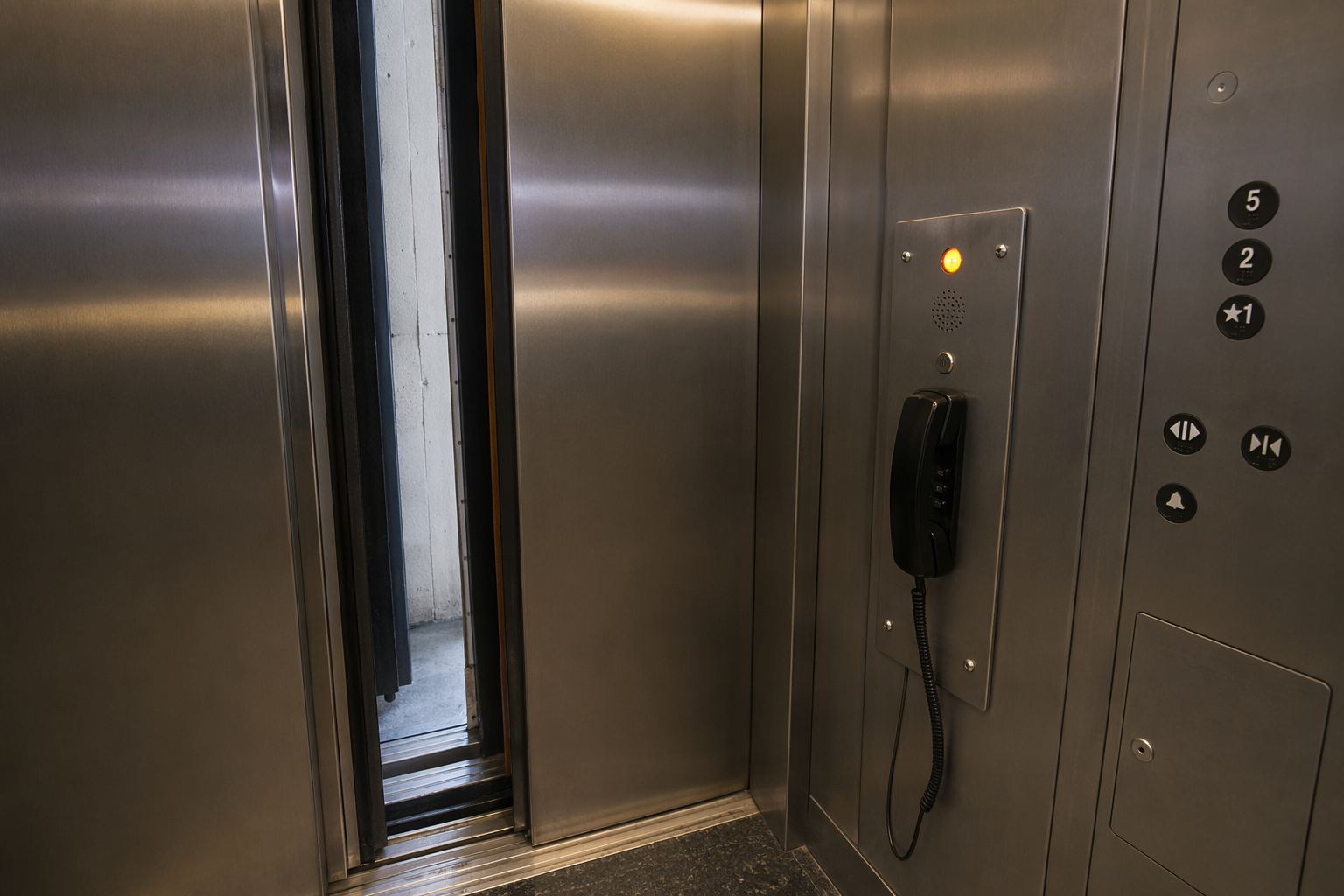
An elevator breakdown emergency is any condition that renders the elevator inoperable, traps passengers, creates a safety hazard, or violates compliance requirements under ASME A17.1/CSA B44 — the governing safety code for elevators across California.
Not every breakdown looks the same. A true emergency exists when passengers are trapped between floors, when doors fail to open or close properly, when the cab moves unexpectedly without commands, or when emergency lighting fails. In California, the Division of Occupational Safety and Health (Cal/OSHA) and the Department of Industrial Relations (DIR) both classify elevator entrapment as a life-safety event requiring immediate response. Non-emergency breakdowns — such as intermittent door hesitation or display malfunctions — still require same-day or next-business-day technician dispatch but do not constitute a 911-level situation.
As a rule I apply in the field: if a person is in the cab and the cab is not moving to a floor landing and opening its doors, that is an emergency. Period.
How Quickly Should a Technician Respond to an Elevator Breakdown?
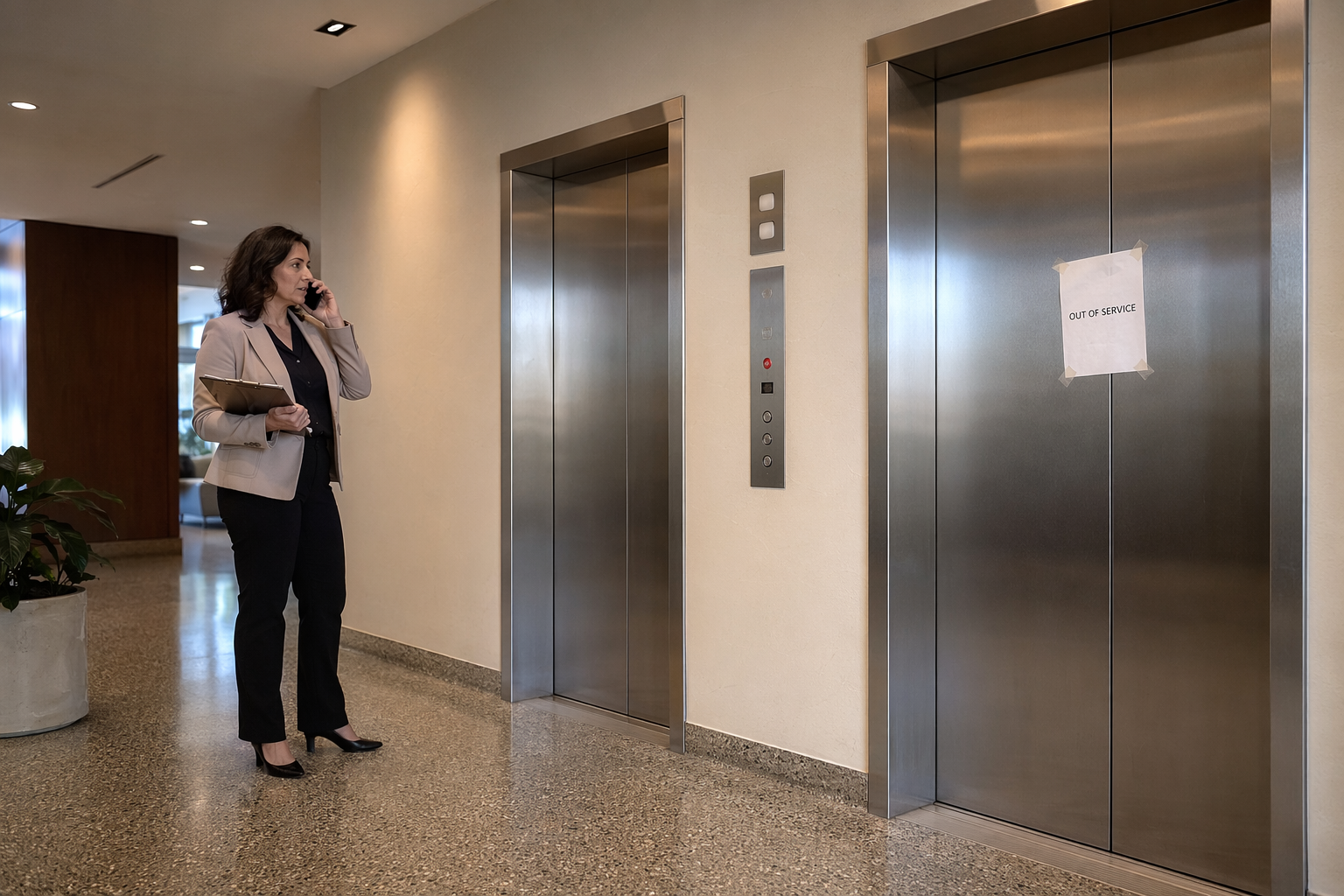
Industry best practice and most service contracts specify a 2-hour or less response time for emergency breakdowns, with 30–60 minutes being the gold standard in densely served urban markets like Los Angeles and Long Beach.
California does not mandate a specific numeric response window in statute, but ASME A17.1-2022 Section 2.27 requires that elevators with passengers trapped inside be attended to immediately, and building owners bear liability for delays. Service agreements with reputable companies typically guarantee emergency response within 1–4 hours depending on geography and time of day.
When a building in Signal Hill or Orange County calls Liftech Elevator for an emergency, our dispatch target is under 90 minutes during business hours and under 2 hours after hours — because we keep technicians stationed throughout the service region, not dispatched from a single hub 40 miles away.
What Should Building Staff Do Immediately When an Elevator Breaks Down?
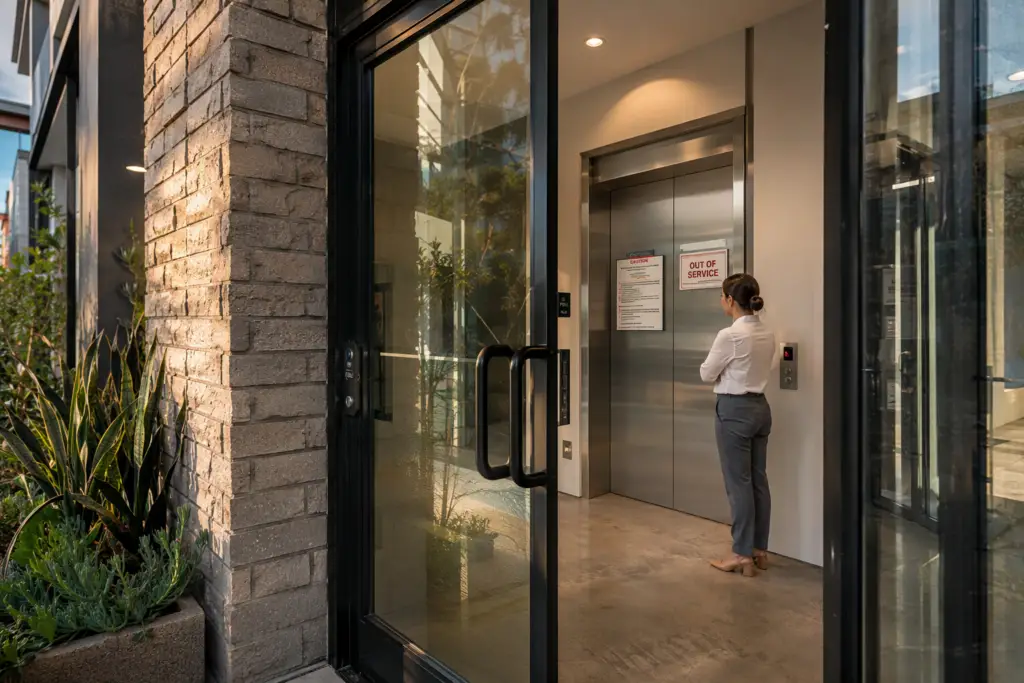
The first three actions are: communicate calmly with any trapped passengers using the emergency intercom, call your elevator service company’s emergency line, and post an “Out of Service” sign to prevent additional passengers from attempting to use the elevator.
Here is the precise action sequence I recommend to every facility manager I work with:
- Activate the intercom or two-way communication system — ASME A17.1 Section 2.27.1.5 and ADA requirements at ADA.gov mandate two-way communication in every elevator cab. Use it to reassure passengers and confirm how many people are inside.
- Do not attempt manual rescue without a licensed technician. Improper landing-level door opening can create a fall hazard of several feet.
- Call your elevator company’s 24/7 emergency line immediately. Have your elevator’s unit ID number and building address ready.
- Call 911 only if a passenger reports a medical emergency (chest pain, difficulty breathing, severe injury) or if you cannot establish intercom contact after repeated attempts.
- Log the time, symptoms, and any error codes displayed on the controller — this data shortens diagnosis time when the technician arrives.
- Notify your building’s insurance carrier of any entrapment event for liability documentation purposes.
What Are the Most Common Causes of Sudden Elevator Breakdowns?
The most common causes are door system faults (approximately 40% of all service calls), followed by drive/motor failures, control board malfunctions, safety circuit trips, and hydraulic fluid issues in low-rise buildings.
Based on 2025–2026 field data from service calls across Los Angeles and Orange County, door-related faults remain the dominant breakdown trigger. A door that doesn’t fully close activates safety circuits that halt the cab — this is by design. Other frequent culprits include worn brake linings, failed governor mechanisms, overheated motors during high-traffic periods (especially in summer in Southern California), and failed buffer switches. Older buildings in Long Beach with original 1970s–1980s relay-logic controllers experience control board failures at disproportionately high rates because replacement parts have become scarce and boards are operating far beyond their design lifespan.
How Long Does Emergency Elevator Repair Typically Take?
Most emergency elevator repairs are completed within 2–8 hours, though complex mechanical failures or parts procurement can extend repair time to 24–72 hours for specialty components.
| Breakdown Type | Typical Technician Response Time | Average Repair Duration | Parts Availability | Compliance Impact |
|---|---|---|---|---|
| Passenger Entrapment | 30–90 minutes | 1–3 hours | Usually not required | Immediate; must document per Cal/OSHA |
| Door System Fault | 1–2 hours | 1–4 hours | High availability | Out-of-service notice required |
| Drive/Motor Failure | 2–4 hours | 4–24 hours | Moderate; may need ordering | Unit remains out of service |
| Control Board Failure | 2–4 hours | 8–72 hours | Low for legacy systems | AHJ notification may be required |
| Hydraulic System Failure | 2–4 hours | 4–48 hours | Moderate | Environmental report if fluid leak |
| Safety Circuit Trip | 1–2 hours | 1–6 hours | Variable | Root-cause documentation required |
Is It Legal to Continue Operating a Building Without a Working Elevator?
Under the Americans with Disabilities Act (ADA), buildings covered by Title II or Title III must maintain accessible routes — a broken elevator in a multi-story building without an accessible alternative may constitute an ADA violation.
In California, the situation is compounded by the California Building Code (CBC) and the Unruh Civil Rights Act. If your building is required to have an elevator for accessibility compliance and that elevator is out of service, you have a legal obligation to either restore service promptly or provide an equivalent accessible accommodation. There is no fixed grace period defined in statute — courts have held that “prompt” means days, not weeks. I strongly advise any building owner facing a prolonged outage to consult their legal counsel and contact their elevator service company for expedited repair timelines.
What Is the Difference Between Emergency Repair and Preventive Maintenance?
Emergency repair is reactive — it restores a failed elevator to operation — while preventive maintenance is proactive, systematically inspecting and replacing components before they fail to avoid breakdowns entirely.
This distinction matters enormously for cost. A single emergency service call in Los Angeles or Orange County typically costs $350–$900 for labor alone, not counting parts, compared to a monthly preventive maintenance contract that averages $200–$600 per elevator per month depending on equipment type and contract terms. Buildings with comprehensive PM programs experience 60–80% fewer emergency calls based on industry data from elevator service operators. Every hour I spend on planned maintenance eliminates three to five emergency dispatches per year on a typical mid-rise traction elevator.
What Does a 24/7 Emergency Elevator Service Contract Actually Cover?
A comprehensive 24/7 emergency service contract covers after-hours dispatch, labor for emergency calls, parts covered under the contract schedule, entrapment rescue, and callback response — but coverage varies significantly between providers and contracts.
When reviewing any elevator service contract, look specifically for:
- Defined response time SLA — the contract should state a guaranteed response window (e.g., “within 2 hours of call receipt”) with a remedy clause if missed
- Parts inclusion scope — some contracts cover all parts, others exclude major components like motors, drives, or control boards
- Callback provisions — does a return visit within 24 hours for the same issue incur additional charges?
- Entrapment rescue protocol — explicitly stated in the contract language
- Exclusions list — vandalism, flooding, power outages caused by the utility company, and acts of God are commonly excluded
How Much Does Emergency Elevator Repair Cost in Los Angeles and Orange County?
Emergency elevator repair costs in Los Angeles and Orange County typically range from $350 to $3,500+ depending on fault type, time of call, parts required, and whether the unit requires regulatory inspection before returning to service.
Breaking down the cost components: after-hours labor rates in California typically run 1.5x to 2x standard hourly rates. Standard technician billing rates in 2026 range from $120–$195 per hour in the greater LA market. Add diagnostic fees ($150–$300), parts markup (20–40% above wholesale), and potential AHJ re-inspection fees ($150–$500) after certain types of repairs, and costs escalate quickly. Buildings on full-service maintenance contracts typically pay $0 or a significantly reduced emergency call rate — this is one of the strongest financial arguments for preventive maintenance contracts over time-and-materials arrangements.
When Is a Passenger Trapped in an Elevator Considered a Medical Emergency?
A trapped elevator passenger becomes a medical emergency when they report chest pain, difficulty breathing, severe anxiety attack, loss of consciousness, injury, or when the entrapment extends beyond 30 minutes in extreme temperatures.
In Southern California, elevator cab temperatures can escalate rapidly in summer months when ventilation systems are not functioning. A cab without airflow in August can exceed 95°F within 30–45 minutes — a serious heat stress risk for elderly passengers, children, or individuals with cardiovascular conditions. Always maintain intercom contact, reassure the passenger to remain calm and seated, and monitor for any change in their condition. Elevate the call to 911 without hesitation if you have any concern about the passenger’s health. First responders can perform a manual door release — though this should always be coordinated with a qualified technician if one is available.
What Compliance Reporting Is Required After an Elevator Breakdown in California?
California requires that any elevator accident, injury, or equipment failure that poses a risk to public safety be reported to the California Department of Industrial Relations Elevator Unit — serious incidents must be reported within 24 hours.
Under California Labor Code Section 7304 and Title 8 CCR, the elevator owner or their authorized representative must report accidents involving injury immediately. For non-injury breakdowns, documentation requirements apply at the unit level — your maintenance logbook (required by ASME A17.1) must record the date, nature of the breakdown, corrective action taken, and technician credentials. The Elevator Safety Inspection Certificate must remain current; a breakdown caused by deferred maintenance discovered during post-incident inspection can result in fines and mandatory shutdown pending reinspection by the Authority Having Jurisdiction (AHJ).
How Do Elevator Technicians Diagnose a Breakdown So Quickly?
Modern elevator controllers generate fault codes and event logs that allow a trained technician to pinpoint failure causes in minutes rather than hours — significantly reducing both repair time and passenger discomfort.
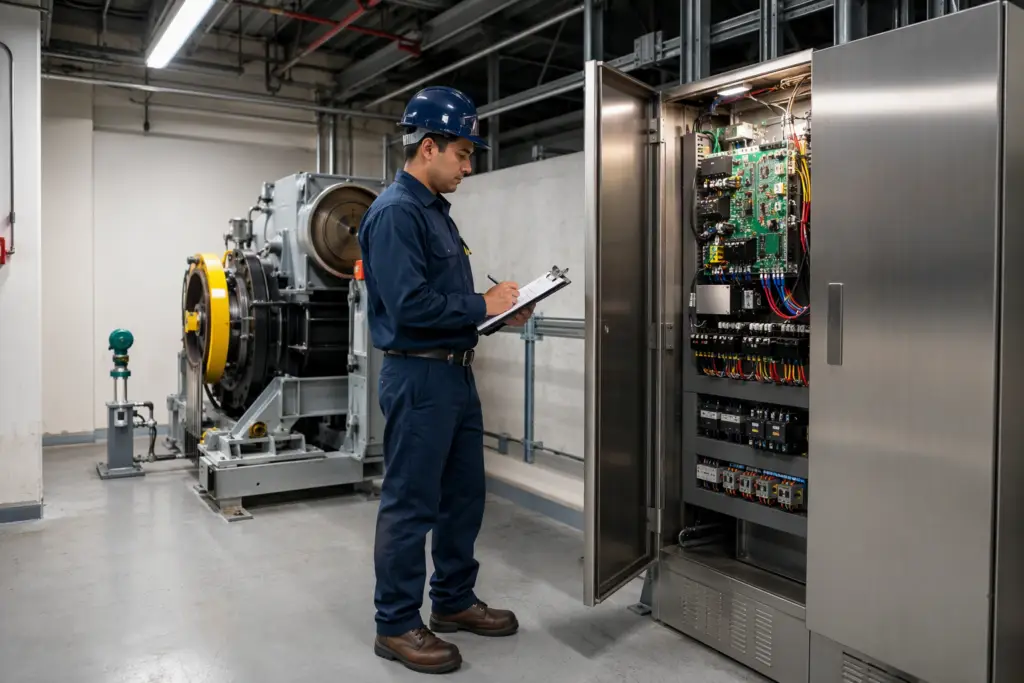
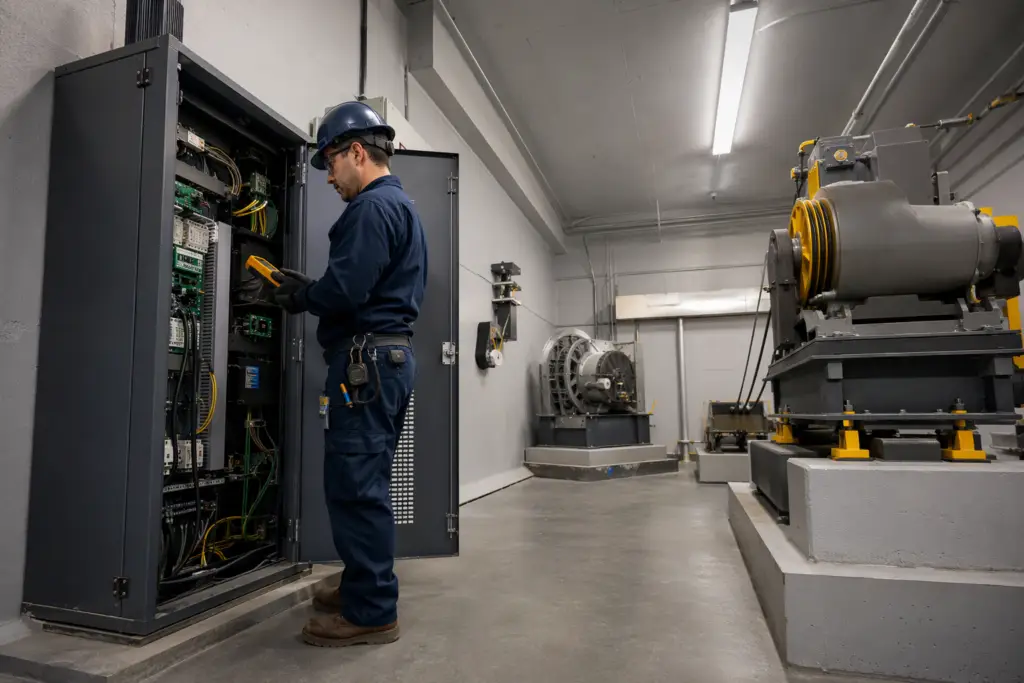
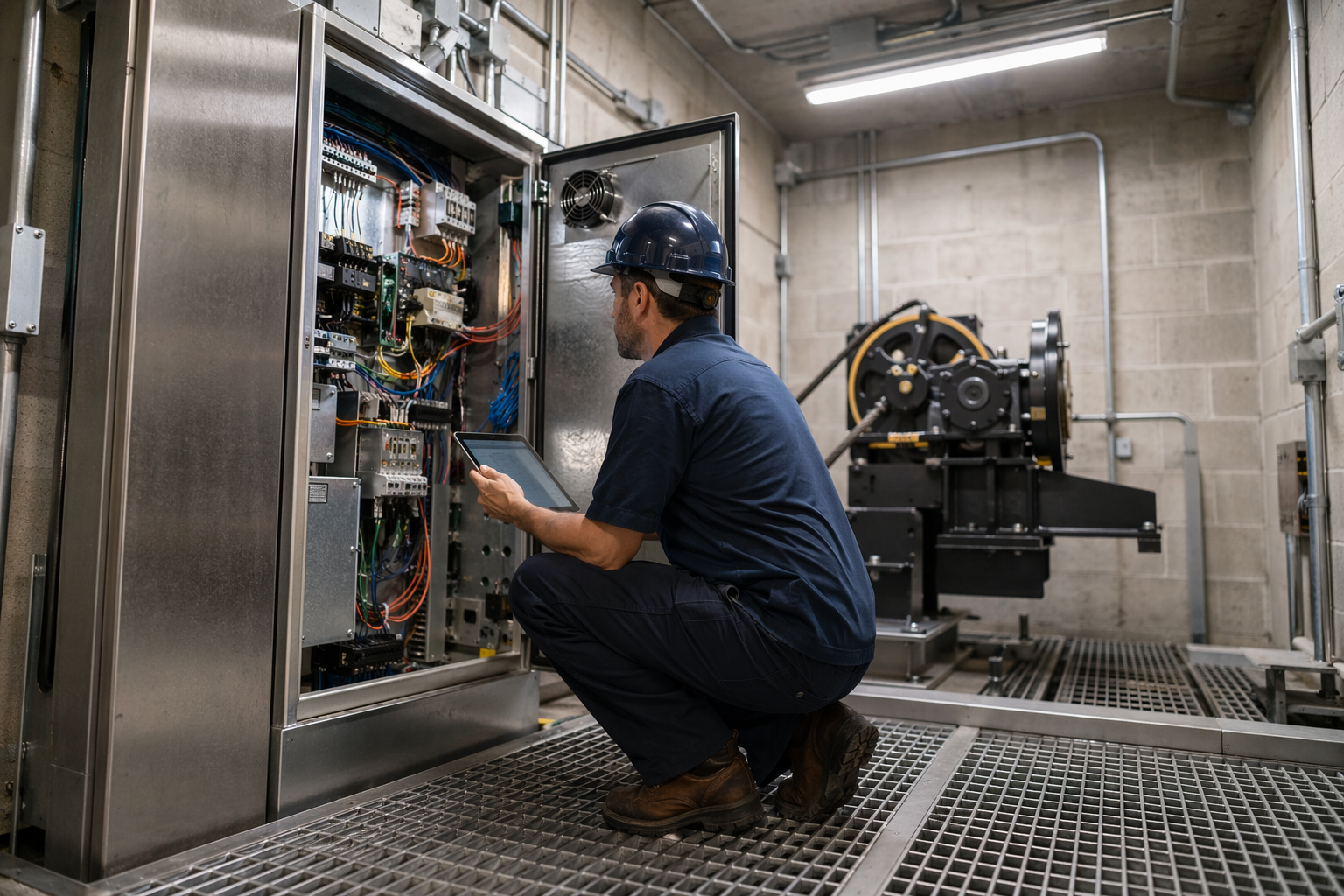
When I arrive at a breakdown call, the first thing I do is access the controller’s fault log. Current microprocessor-based controllers from manufacturers like Otis, KONE, Schindler, ThyssenKrupp, and Mitsubishi store hundreds of timestamped fault entries. Cross-referencing the most recent faults with the physical symptoms — which floor, what the car did or didn’t do, any sounds or smells reported — allows rapid diagnosis. In older relay-logic buildings common in Long Beach’s mid-century commercial stock, it’s more hands-on: I’m checking contactors, testing safeties, measuring voltage at key points. The diagnostic phase typically runs 15–45 minutes for experienced technicians.
What Safety Devices Should Prevent Elevator Breakdowns From Becoming Life-Threatening?
ASME A17.1 mandates multiple independent safety systems — including governor-triggered safeties, buffers, slack rope switches, door interlocks, and emergency lighting — specifically designed to prevent any single component failure from creating a catastrophic outcome.
The key life-safety systems required on all modern elevators include:
- Governor and Safety Gear — mechanically activated if overspeed is detected, physically clamps the guide rails to stop the car
- Door Interlocks — per ASME A17.1 Section 2.12, doors cannot open unless the car is within the landing zone
- Emergency Lighting and Power — maintains cab illumination and two-way communication during power failures (minimum 4-hour battery backup per code)
- Pit Buffer — absorbs kinetic energy if the car descends to the bottom of the hoistway beyond normal travel
- Slack Chain/Rope Device — stops hydraulic elevators if the chain or rope goes slack
- Rupture Valve — on hydraulic units, prevents uncontrolled descent if the hydraulic line ruptures
These systems are inspected annually by the AHJ and during every preventive maintenance visit — when they’re maintained properly, they work. When they’re neglected, a breakdown can escalate to a catastrophe.
How Often Should Elevators Be Inspected to Prevent Emergency Breakdowns?
California law requires annual certification inspections by a licensed inspector through the DIR, but industry best practice and ASME A17.1 recommend monthly or quarterly maintenance visits depending on equipment type and usage volume.
High-traffic elevators in commercial buildings — those making 100+ trips per day — should receive monthly maintenance visits at minimum. Lower-traffic residential units in smaller buildings may be adequately served by quarterly visits. Annual state certification inspections are mandatory and non-negotiable; operating an elevator without a valid inspection certificate is a misdemeanor under California law. The inspection certificate must be posted in the elevator cab and be visible to passengers. Buildings that attempt to stretch maintenance intervals to reduce costs consistently end up with higher emergency repair costs — this is not theoretical, it’s what I see repeatedly across Long Beach and Los Angeles every year.
What Questions Should You Ask When Hiring an Emergency Elevator Repair Company?
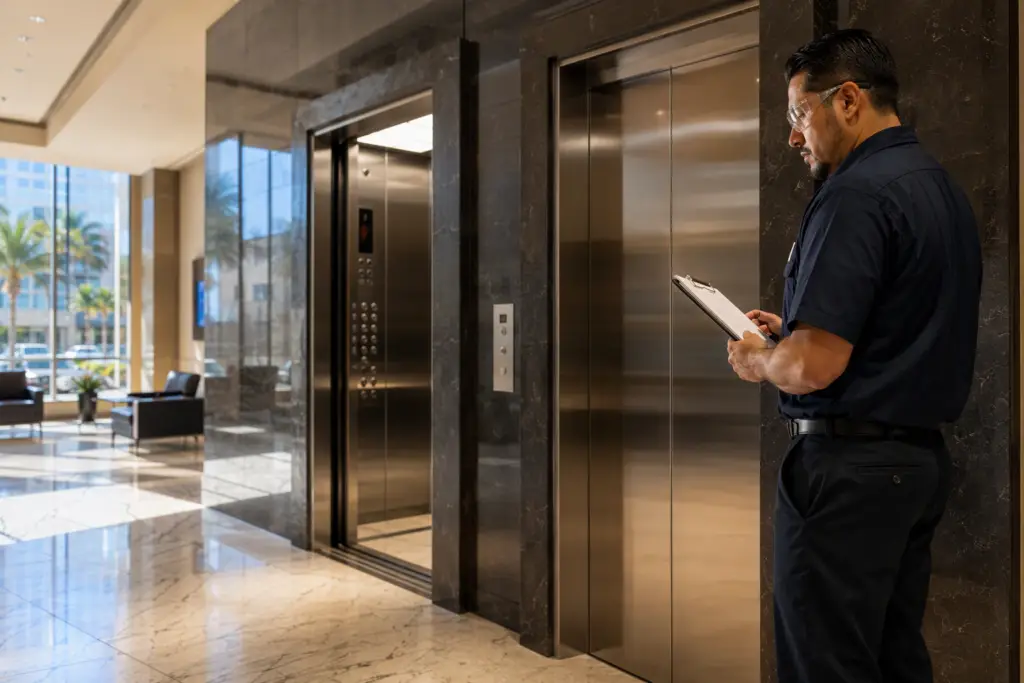
The five most important questions are: Are your technicians IUEC-certified? What is your guaranteed response time in writing? Do you carry California Contractor’s License (C-61/D-5 classification)? What does your emergency parts inventory include? And can you provide references from buildings in my area?
In California, elevator contractors must hold a valid C-61 Limited Specialty Contractor license with D-5 (Elevator Installation) classification from the California Contractors State License Board (CSLB). Any company that cannot produce this license number on demand should be disqualified immediately. Technicians should be members of the International Union of Elevator Constructors (IUEC) or hold equivalent documented certification. Ask specifically about their parts inventory for your elevator’s make and model — a company that must order basic door components from out of state is going to leave your unit down for days when a local company could fix it in hours.
What Are the Signs That an Elevator Is About to Break Down?
Warning signs include unusual noises (grinding, banging, or humming), inconsistent leveling at floors, slow or jerky door operation, unusual vibration during travel, burning smells, and intermittent control panel failures.
I tell building managers: your elevator will almost always tell you it’s struggling before it stops completely. The most actionable warning signs to report immediately to your elevator service company:
- Doors that reverse, hesitate, or require multiple attempts to close
- The cab stopping 1–3 inches above or below floor level (mis-leveling)
- Grinding or squealing during startup or travel
- Flickering interior lights (indicates power/battery issues)
- Delayed response to button commands
- Burning or ozone smell near the motor room
- Increased frequency of the elevator “resetting” itself
Any of these symptoms warrants a non-emergency service call within 24–48 hours — catching them early is the difference between a $300 parts replacement and a $3,000 emergency repair plus two days of downtime.
How Does Elevator Age Affect Breakdown Frequency and Response Complexity?
Elevators older than 20 years experience breakdown rates 2–3 times higher than newer units, and parts availability for equipment manufactured before 2000 is increasingly limited — often extending repair timelines significantly.
The Los Angeles and Long Beach building stock includes a substantial number of elevators installed in the 1960s through 1990s that are still in operation. These units, while often structurally sound, present significant challenges during emergency response: relay-logic controllers require technicians with specialized experience in older systems, OEM parts may be discontinued (requiring custom fabrication or adaptation), and hydraulic units of that era may use petroleum-based fluid with environmental disposal requirements that add cost and complexity. If your building has an elevator older than 25 years, I recommend requesting a modernization assessment alongside any routine service — in many cases, the cost of one or two emergency repairs would partially fund a controller modernization that virtually eliminates future breakdown risk.
What Is the Role of Building Management in Preventing Elevator Emergencies?
Building management is the first line of defense against elevator emergencies — their daily observations, prompt reporting of anomalies, user feedback collection, and consistent scheduling of preventive maintenance appointments directly determines breakdown frequency.
Building managers should maintain a written elevator log available in the management office. Every reported complaint from a tenant — even something as minor as “the door seems slow” — should be timestamped and reported to the elevator service company. Managers should also confirm annually that:
- The current inspection certificate is posted in the cab
- The emergency phone/intercom is tested monthly (ASME A17.1 Section 2.27.1.5 requires documented monthly tests)
- The motor room is kept clean, dry, and at appropriate temperature (typically below 90°F)
- The pit is free of water accumulation and debris
- Emergency lighting batteries are tested per manufacturer schedule
How Does Liftech Elevator Handle After-Hours Emergency Calls?
Liftech Elevator maintains a dedicated 24/7 emergency dispatch line with certified technicians stationed across Signal Hill, Long Beach, Los Angeles, and Orange County to ensure rapid on-site response at any hour.
When you call our emergency line after hours, you reach a live dispatcher — not an answering service with a callback queue. That dispatcher has real-time visibility into technician locations and immediately assigns the closest qualified technician to your call. We carry a comprehensive parts inventory in our service vehicles stocked specifically for the elevator makes and models common in our service territory. Building managers who partner with Liftech Elevator on preventive maintenance contracts receive priority emergency dispatch — their calls go to the front of the queue, not the general pool. In my experience, the buildings with the best long-term elevator reliability and lowest lifetime repair costs are those that invest in a true service partnership rather than calling whoever is cheapest when something breaks.
What Long-Term Steps Reduce Elevator Breakdown Risk After an Emergency Repair?
After any emergency repair, the most effective long-term risk reduction steps are: establishing a documented preventive maintenance program, addressing any deferred repairs identified during the emergency call, considering controller modernization for units over 20 years old, and scheduling a comprehensive safety audit within 30 days.
A breakdown is always a signal — either that a maintenance program is absent, inadequate, or that the equipment has reached an age threshold where component failure risk outpaces maintenance’s ability to prevent it. Post-emergency, I recommend a systematic review of the entire unit against the current ASME A17.1-2022 standard. Components not directly involved in the breakdown may be showing similar wear. Address them now, on your timeline and budget, rather than waiting for the next 2 AM entrapment call. In 2026, elevator management software and IoT-based monitoring systems can provide real-time fault alerts before a breakdown occurs — this technology is now accessible to buildings of all sizes and represents the future of elevator reliability management in Los Angeles and Orange County.
Get Immediate Expert Help for Your Elevator
Don’t wait until a breakdown traps passengers or exposes your building to liability. Whether you’re dealing with an active elevator emergency right now or want to prevent the next one, Liftech Elevator’s IUEC-certified technicians are ready to respond across Signal Hill, Long Beach, Los Angeles, and Orange County — 24 hours a day, 7 days a week, 365 days a year.
Contact Liftech Elevator for a free elevator assessment — call us now at 562-609-3478
Our team will evaluate your elevator’s current condition, review your maintenance history, identify deferred repairs, and provide a clear plan to maximize uptime and ensure compliance with California elevator codes and ASME A17.1-2022 requirements. Serving building owners and facility managers throughout Signal Hill CA, Long Beach CA, Los Angeles CA, and Orange County CA.
Need elevator service you can rely on? Liftech Elevator is ready to help.