Elevator Out of Service: What to Do — Complete Guide for Building Owners & Managers
An elevator going out of service is one of the most disruptive events a building manager or property owner can face. After more than 15 years working on vertical transportation systems across Los Angeles, Long Beach, Signal Hill, and Orange County, I’ve responded to hundreds of elevator outages — from simple door sensor faults to complete hydraulic failures. This guide walks you through exactly what to do, what your legal obligations are, and how to get your elevator back online safely and compliantly.
What Should I Do Immediately When My Elevator Goes Out of Service?
Your first priority is passenger safety, followed by immediate notification of building occupants, then contacting a licensed elevator service company for emergency diagnostics. Every minute of delay increases liability exposure — especially when tenants with mobility limitations are affected.
The moment an elevator goes out of service, follow this immediate response sequence:
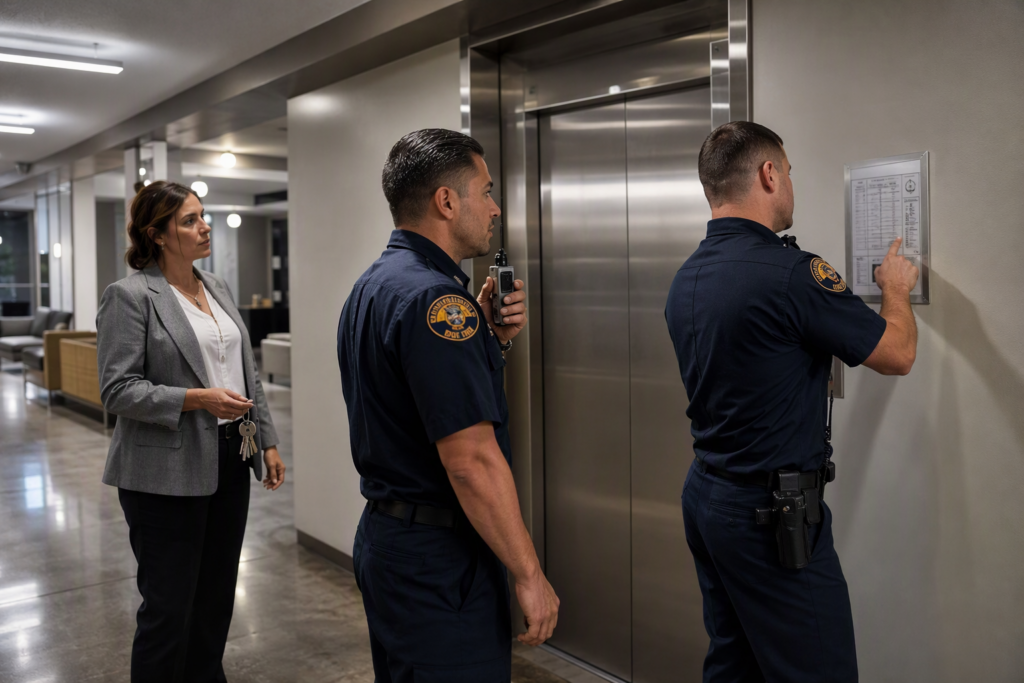
- Verify no passengers are trapped. Check the cab position visually and via intercom. If passengers are inside, call 911 immediately — do not attempt a self-rescue.
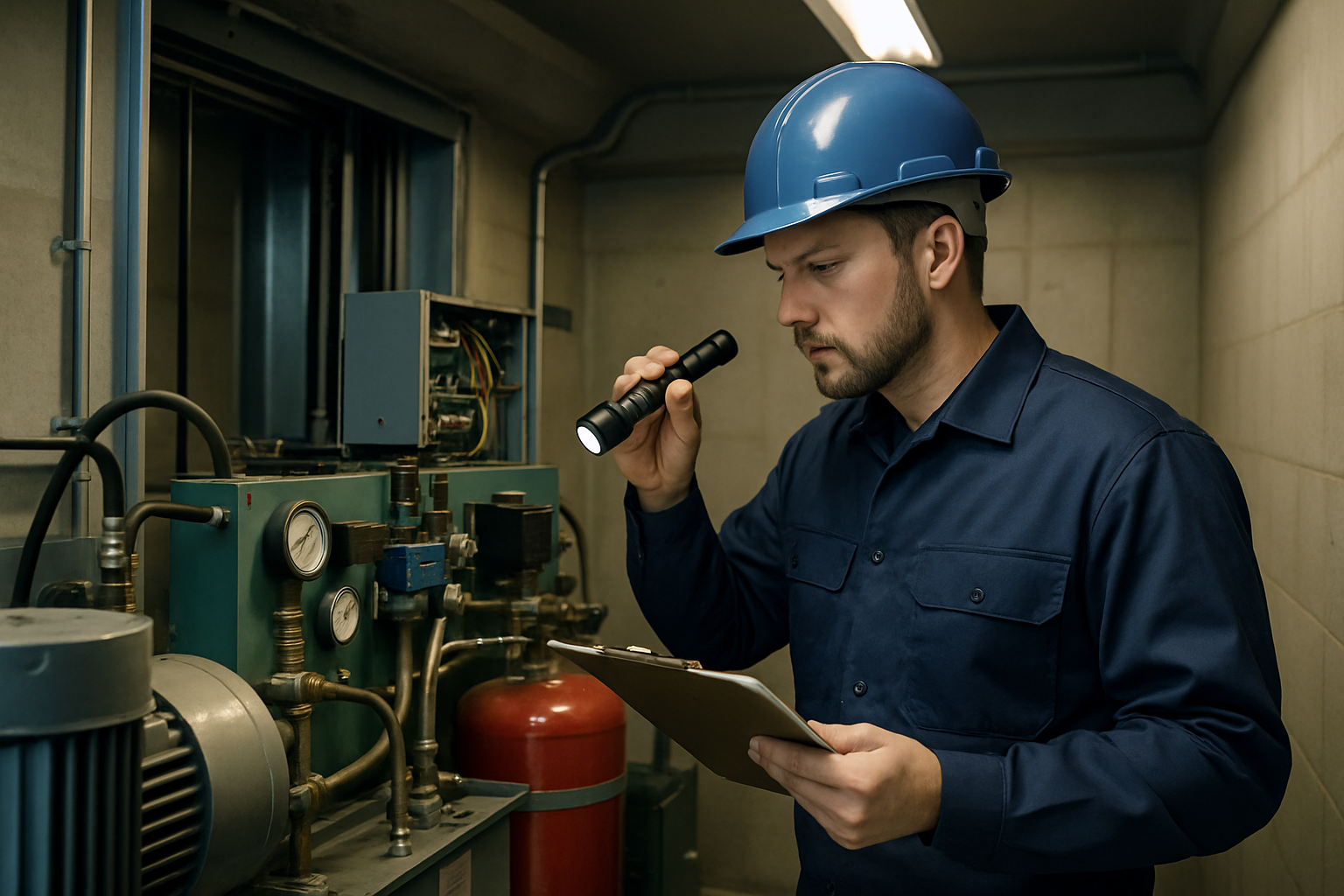
- Secure the elevator. Place the elevator in the “off” or “inspection” mode using the machine room key switch if accessible and you are trained to do so.
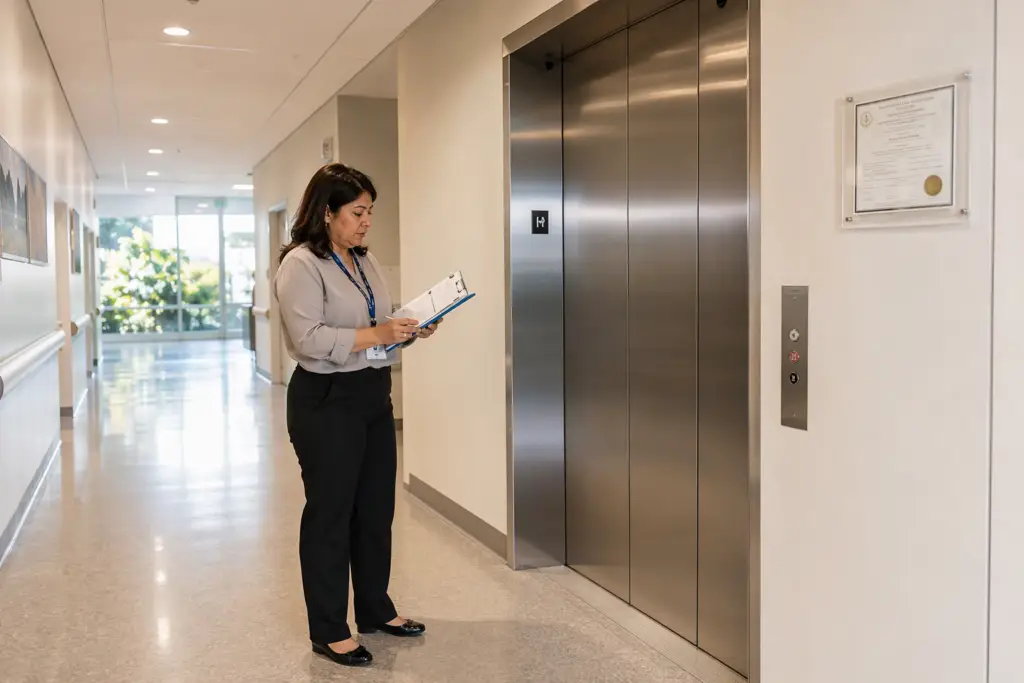
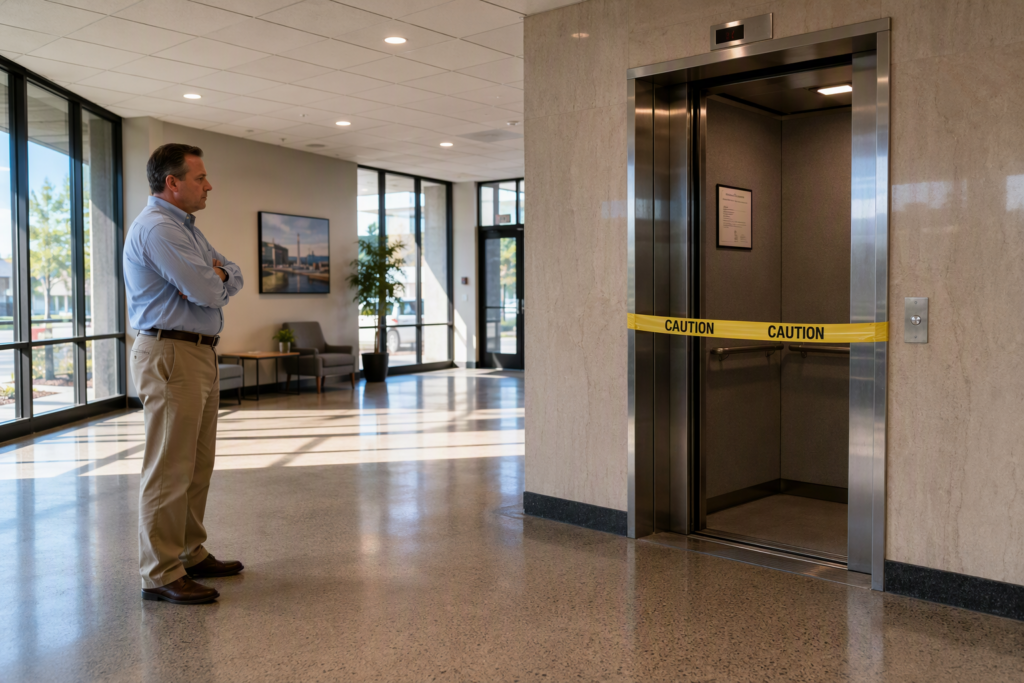
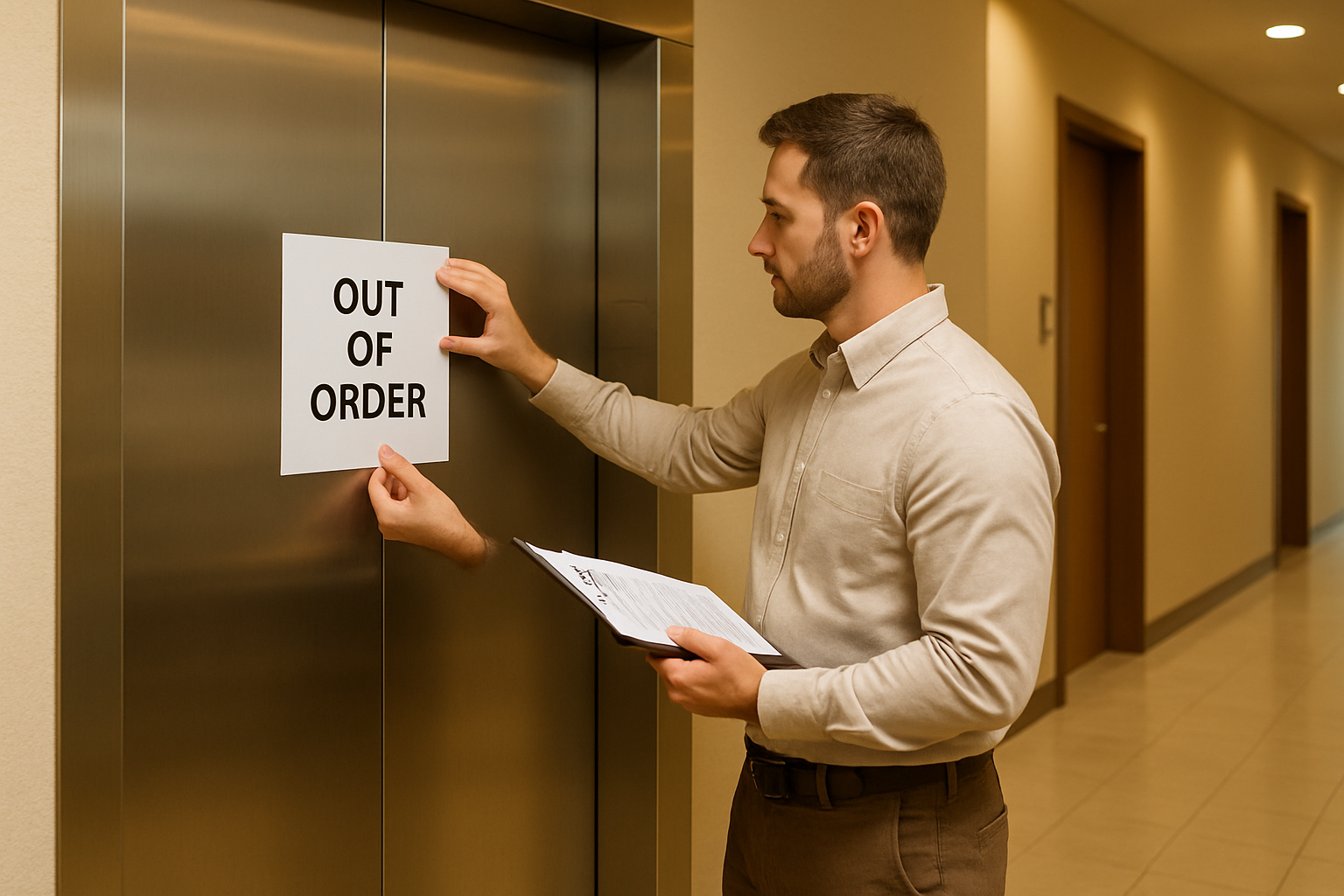
- Post out-of-order signage at every landing that serves the elevator. California Code of Regulations Title 8, Section 3002 requires this for any elevator taken out of service.
- Notify affected occupants. Email, post notices, or make announcements — especially to tenants with mobility limitations who depend on the elevator under ADA protections.
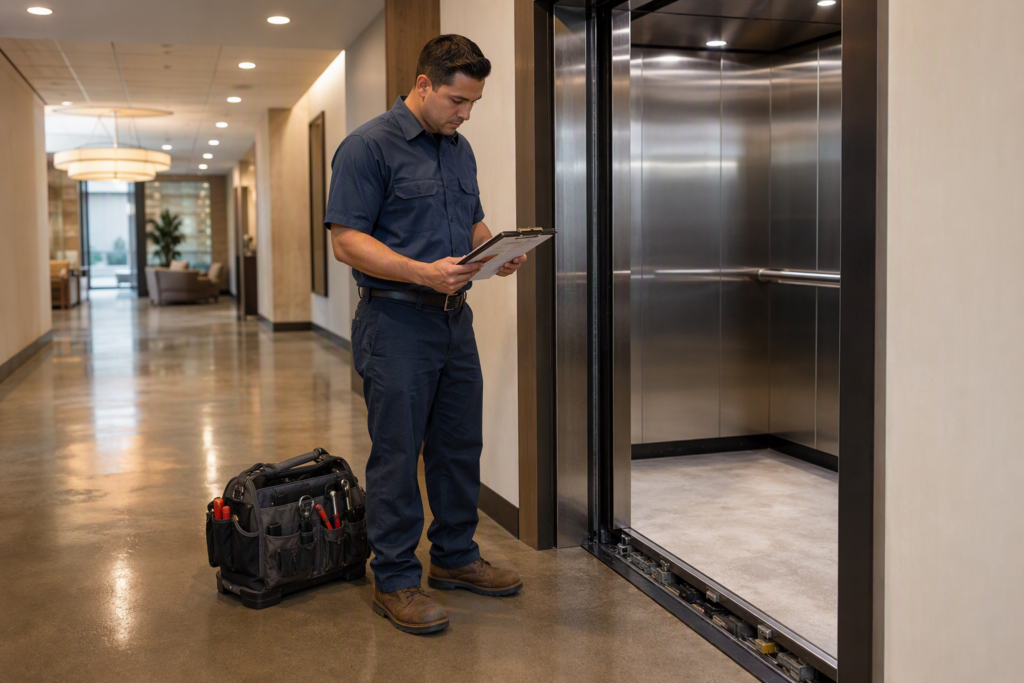
- Contact a certified elevator service company for emergency dispatch. In Southern California, Liftech Elevator offers emergency response across Signal Hill, Long Beach, Los Angeles, and Orange County at 562-609-3478.
Do not attempt to restart the elevator by cycling power unless you have received specific guidance from a licensed technician. Resetting an elevator without diagnosing the root cause can worsen the fault, create safety hazards, or void your service warranty.
Am I Legally Required to Notify Anyone When My Elevator Is Out of Service?

Yes — in California, building owners are required to notify their local Authority Having Jurisdiction (AHJ) and, in many cases, tenants, when an elevator remains out of service beyond a defined threshold, particularly when ADA accessibility is affected.
California’s Division of Occupational Safety and Health (Cal/OSHA) Elevator Unit oversees elevator compliance under the California Elevator Safety Construction Act (Labor Code Sections 7300–7324.2). Key notification obligations include:
- AHJ Notification: Many California jurisdictions — including the City of Los Angeles and Los Angeles County — require building owners to notify the local elevator inspection authority within 24 hours when an elevator is taken out of service due to a safety defect or Cal/OSHA order. Verify your specific jurisdiction’s threshold with your local AHJ, as requirements vary by city.
- ADA Notification: Under the Americans with Disabilities Act, building owners operating public accommodations or commercial facilities must provide alternative accessible means of access when elevator service is disrupted. Written notice to affected tenants is strongly recommended to document good-faith compliance efforts.
- Cal/OSHA Ordered Removal: If an elevator is taken out of service by a Cal/OSHA inspector following a failed inspection, it cannot be returned to service until a licensed elevator contractor completes required repairs and the unit passes reinspection. Operating an elevator after a Cal/OSHA removal order is a serious violation that can result in significant civil penalties.
- Tenant Lease Obligations: Many commercial and residential leases in California include elevator service as an implied or express covenant of habitability or quiet enjoyment. Review your lease agreements and consult legal counsel if an outage extends beyond 24–48 hours.
When in doubt, err toward over-notification. Documenting every communication step — timestamps, recipients, and content — creates a paper trail that protects building owners in the event of a tenant complaint or regulatory inquiry.
What Are the Most Common Reasons an Elevator Goes Out of Service?
Understanding why elevators go out of service helps building owners anticipate failures, prioritize maintenance, and communicate credibly with tenants during an outage. The most frequent causes of unplanned elevator shutdowns fall into five categories:
- Door system faults: Door sensor misalignments, worn rollers, and interlock failures are among the most common causes of elevator outages. Modern elevators are programmed to shut down rather than operate with a compromised door system — a safety feature that can trigger nuisance shutdowns when sensors are dirty or misaligned.
- Hydraulic system failures: For hydraulic elevators common in low-rise California buildings, oil leaks, pump motor failures, and valve malfunctions are frequent culprits. A hydraulic elevator that is losing fluid will typically descend slowly to the lowest floor and go out of service automatically.
- Control system and PCB faults: Printed circuit board (PCB) failures in the elevator controller can cause sudden shutdowns, erratic behavior, or complete loss of function. These faults often require component replacement and can have lead times of several days to several weeks depending on parts availability for older equipment.
- Overheating: Machine room temperatures exceeding the elevator manufacturer’s specified range — commonly above 90°F — can trigger thermal protection shutdowns. This is particularly common during Southern California heat events in buildings without adequate machine room ventilation or air conditioning.
- Power supply issues: Voltage fluctuations, phase loss, and breaker trips can take an elevator offline. After any power restoration, a licensed technician should verify the elevator’s operational parameters before returning it to full service.
Many of these failure modes are preventable with a proactive maintenance contract. Liftech Elevator offers full-coverage preventive maintenance agreements for buildings throughout Los Angeles, Long Beach, Signal Hill, and Orange County — call 562-609-3478 for a no-obligation assessment.
How Long Does It Take to Get an Out-of-Service Elevator Back Online?
Repair timelines vary significantly depending on the fault type, parts availability, and whether a Cal/OSHA reinspection is required. Here is a realistic breakdown by failure category:
- Door sensor or alignment issues: Typically resolved within 2–4 hours of technician arrival when parts are not required. One of the fastest repairs in the industry.
- Control board or PCB replacement: If the part is in the technician’s truck stock or available locally, same-day or next-day resolution is possible. For obsolete controllers on older equipment, lead times of 1–4 weeks are common. Liftech maintains an active parts inventory to minimize this delay for clients under service agreements.
- Hydraulic repairs: Minor valve and seal repairs can be completed in 4–8 hours. Pump motor replacements or major hydraulic unit overhauls may take 1–3 days including fluid refill and pressure testing.
- Cal/OSHA reinspection required: After a safety-related removal from service, the elevator cannot be returned to operation until it passes a state reinspection. Scheduling a reinspection with Cal/OSHA’s Elevator Unit in the Los Angeles area currently takes a variable number of business days depending on inspector availability — confirm current timelines directly with the Cal/OSHA Elevator Unit.
- Modernization required: If an inspection reveals that the elevator’s safety components are obsolete or no longer in compliance with current code, a partial or full modernization may be necessary before reinspection. This is a multi-week to multi-month process depending on scope.
The single most effective way to shorten repair timelines is to have a maintenance agreement in place before an outage occurs. Technicians familiar with your specific equipment resolve faults significantly faster than crews encountering the unit for the first time.
How Much Does It Cost to Repair an Out-of-Service Elevator?
Elevator repair costs in California vary widely based on fault type, equipment age, parts availability, and whether after-hours emergency service is required. The ranges below reflect general market conditions in the Los Angeles and Orange County service areas as of mid-2026 — always obtain a written estimate before authorizing work.
- Emergency service call (after-hours): Emergency dispatch fees in Southern California typically range from $250–$600 or more depending on the contractor and time of call, in addition to labor and parts costs.
- Door system repair: Minor adjustments and sensor replacements commonly run $200–$800 in parts and labor. Door operator replacements can range from $1,500–$4,500 depending on the unit.
- Hydraulic unit repairs: Valve and seal repairs may cost $500–$2,000. Full pump motor replacements or hydraulic power unit overhauls can range from $3,000–$12,000 or more depending on unit size and capacity.
- Control system / PCB replacement: Individual board replacements range from $800–$3,500 in parts alone for common units. Full controller replacements on older equipment can exceed $15,000–$30,000 and may be applied toward a full modernization.
- Full modernization: When a building’s elevator requires comprehensive upgrades to meet current code requirements, modernization costs in California typically range from $50,000–$200,000 or more depending on building height, number of stops, drive system type, and scope of work. Liftech provides free modernization assessments — contact us at 562-609-3478 to schedule.
Buildings operating under a full-coverage preventive maintenance agreement with Liftech Elevator receive priority labor rates and have many routine repair costs included in their contract scope, substantially reducing out-of-pocket expenses during an outage.
What Should I Look for When Choosing an Emergency Elevator Repair Company?
Not all elevator service companies are equally qualified to handle emergency repairs compliantly in California. When evaluating providers during an outage — or ideally before one occurs — prioritize these criteria:
- California Certified Elevator Mechanic (CEM) on staff: California requires all elevator work to be performed by or under the direct supervision of a mechanic certified by Cal/OSHA’s Elevator Unit. Verify that the technician dispatched holds a current California certification before authorizing any work.
- Licensed elevator contractor: The company itself must hold a valid California elevator contractor license. Confirm this with the Cal/OSHA Elevator Unit’s public license lookup.
- Local parts inventory: Companies that stock common replacement parts locally — rather than drop-shipping from national warehouses — can dramatically reduce repair timelines. Ask prospective vendors specifically about their local parts inventory depth.
- Documented experience with your equipment brand: Elevator mechanics vary in their experience across equipment manufacturers. A technician experienced with your specific brand (Otis, KONE, Schindler, ThyssenKrupp, Dover, Montgomery, or others) will diagnose and repair faults more efficiently.
- 24/7 emergency availability: Confirm that emergency dispatch is available around the clock, not just during business hours. Outages do not respect business hours — especially in multi-tenant residential buildings.
- Transparent written estimates: A reputable elevator contractor will provide a written scope of work and cost estimate before beginning repairs. Be cautious of verbal-only quotes or companies that begin work without documented authorization.
Liftech Elevator is a California-licensed elevator contractor serving Signal Hill, Long Beach, Los Angeles, and Orange County with certified mechanics, 24/7 emergency response, and a local parts inventory. Call 562-609-3478 to reach our emergency dispatch line at any hour.
Frequently Asked Questions: Elevator Out of Service
- Can I be fined for not reporting my elevator out of service to Cal/OSHA?
- Yes. Operating an elevator that has been ordered out of service by Cal/OSHA, or failing to comply with applicable AHJ notification requirements, can result in civil penalties under California Labor Code Section 7321. Penalties vary by jurisdiction and violation severity. When in doubt, report proactively and document all communications.
- What signage is required when an elevator is out of service in California?
- California Code of Regulations Title 8, Section 3002 requires that an elevator taken out of service display visible out-of-order notices at every landing served by that elevator. The notice must be posted before the unit is left unattended. There is no state-mandated specific format, but the notice must be clearly legible and positioned where building occupants will see it before attempting to use the elevator.
- Do I have to provide an accessible alternative when my elevator is out of service?
- For buildings subject to the ADA — including most commercial facilities and public accommodations — you are required to provide an accessible alternative or reasonable accommodation when elevator service is disrupted. This may include temporarily relocating services to an accessible floor, providing assisted access, or other measures. The specific obligation depends on building type, tenancy, and the duration of the outage. Consult ADA counsel if an outage extends beyond 24 hours in an ADA-covered building.
- Can a building owner reset or restart an elevator themselves?
- Building owners and managers should not attempt to reset, restart, or perform any mechanical intervention on an elevator unless they have been specifically trained and authorized by a licensed elevator contractor to perform that specific action on that specific unit. Cycling power, pressing reset buttons, or manually moving components without proper diagnosis can worsen the fault, create safety hazards for any occupants who subsequently use the elevator, and may create liability exposure if an injury results.
- What happens if a tenant is injured because my elevator was out of service without adequate notice?
- Failure to post required signage, notify tenants promptly, or provide ADA-compliant alternatives when an elevator is out of service can create significant premises liability exposure for building owners in California. Document all notification steps with timestamps, retain copies of all posted signage and communications, and consult your property insurance carrier and legal counsel promptly if a tenant reports an injury related to an elevator outage.
Need emergency elevator service in Southern California? Liftech Elevator provides 24/7 emergency response across Los Angeles, Long Beach, Signal Hill, and Orange County. Our California-certified mechanics carry extensive local parts inventory to minimize your building’s downtime. Call 562-609-3478 now or contact us online to reach our dispatch team.