Elevator Emergency Phone Number: Complete Guide for Building Owners & Managers
After 15+ years servicing elevators across Signal Hill, Long Beach, Los Angeles, and Orange County, I’ve responded to hundreds of entrapment calls. The single most preventable problem I see is a disconnected, untested, or improperly programmed emergency phone. This guide covers everything a building owner, property manager, or facilities director needs to know — from code requirements to costs to what happens when that phone fails at 2 a.m.
What is an elevator emergency phone number and what does it do?
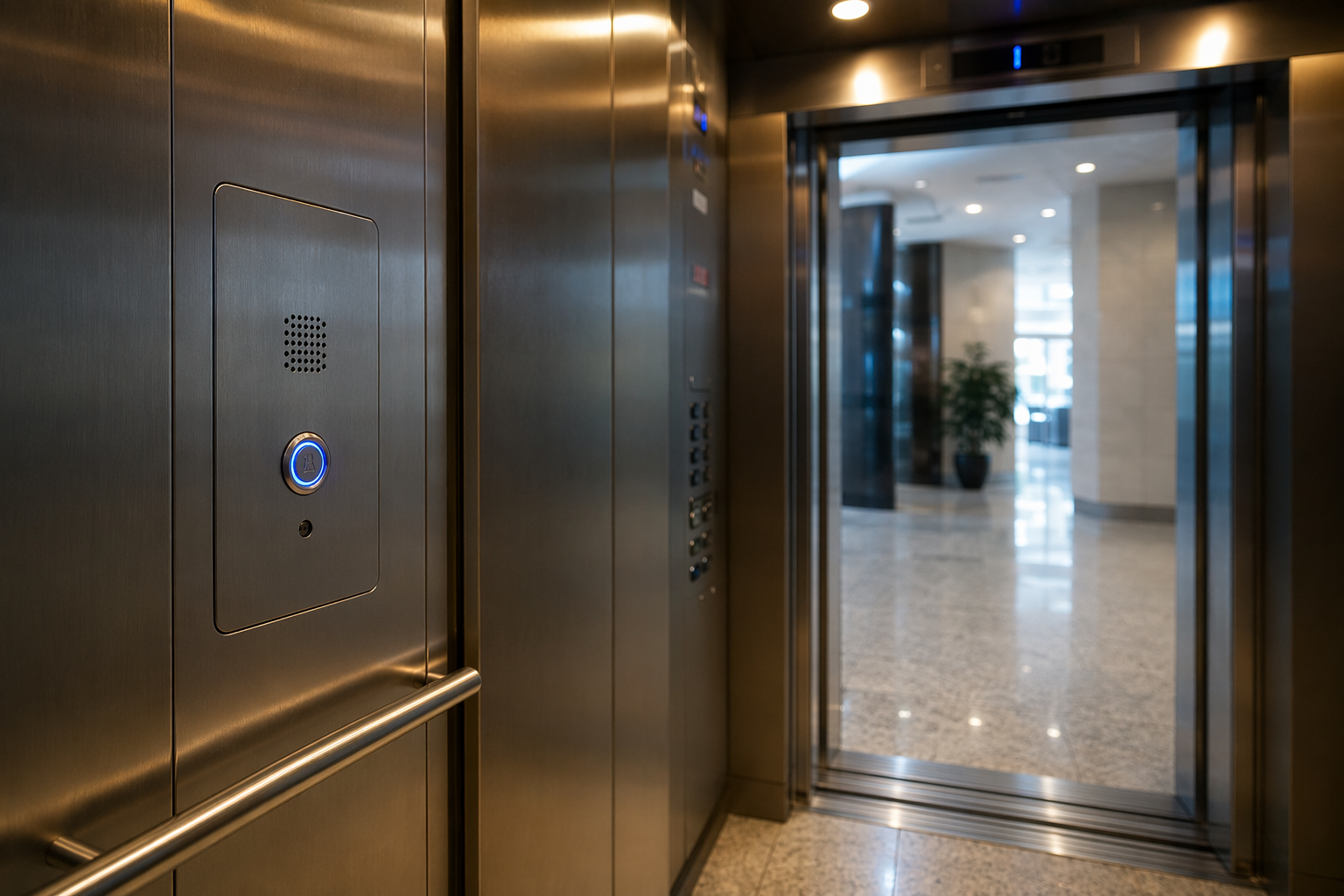
An elevator emergency phone number is a dedicated, always-active telephone line installed inside every elevator cab that connects a trapped or distressed passenger to a live emergency dispatcher or monitoring center without requiring the passenger to dial any digits.
Unlike a standard building intercom, the elevator emergency phone is a single-action device — passengers press one button and are immediately connected. The line must transmit the building address and elevator location automatically under most modern code interpretations. ASME A17.1-2022, Rule 2.27.1.4, mandates a two-way voice communication system capable of connecting to a location staffed by authorized personnel 24 hours a day, 7 days a week, 365 days a year. There are no holidays off for this requirement.
In California specifically, Title 8 of the California Code of Regulations (CCR), Section 3003, reinforces these federal and ASME standards and adds the 30-second live-answer requirement. If your monitoring service is using a voicemail or automated system, you are already out of compliance in this state.
Is an elevator emergency phone legally required in California?

Yes — every passenger elevator in California is legally required to have a functioning two-way emergency communication device, and failure to maintain it can result in immediate shutdown orders from the California Division of Occupational Safety and Health (Cal/OSHA).
The legal framework stacks three layers of authority: federal ADA requirements under 28 CFR Part 36, ASME A17.1 (the Safety Code for Elevators and Escalators, adopted by California), and California Title 8 CCR. All three must be satisfied simultaneously. The ADA layer specifically requires that the emergency communication system be accessible to individuals with hearing or speech disabilities, which in practice means the system must also support TTY/TDD capability or have a visual confirmation signal so a deaf passenger knows their call connected.
Cal/OSHA elevator inspectors check emergency phone functionality as a line-item on every annual inspection. A non-functioning phone is classified as a serious violation, and in my experience inspecting alongside state officials across Los Angeles and Orange County, it triggers an immediate Order to Repair with a reinspection deadline — typically 30 days or less.
What phone number does the elevator emergency phone call?
The elevator emergency phone dials a pre-programmed number — either a third-party 24/7 elevator monitoring center, the building’s internal security desk (if staffed around the clock), or a local emergency dispatch line — and that number must be answered by a live person at all times.
There are three common configurations used in California buildings:
- Third-party elevator monitoring centers: The most common and compliant setup. Companies like Liftech Elevator can connect your cab phone to a certified monitoring center that answers 24/7, logs all calls, and dispatches a technician when needed.
- Internal security desk: Acceptable only if the desk is genuinely staffed 24/7/365 — which is rare in smaller commercial buildings and virtually impossible in residential multifamily properties.
- Direct 911 programming: Technically functional but not recommended as the sole solution. Emergency services are not equipped to manage elevator entrapments the same way a specialized monitoring center is, and response times for non-injury entrapments can be significantly longer.
The phone number programmed into the device should also display the building address on the receiving end via automatic number identification (ANI) or a pre-recorded location announcement so the dispatcher can send help without relying on a panicked or non-verbal passenger to provide an address.
What does ASME A17.1 say specifically about elevator emergency phones?
ASME A17.1-2022, Rule 2.27.1.4.1 requires a two-way voice communication system that connects to a location outside the hoistway staffed by authorized personnel, and the system must activate with a single, clearly labeled control that does not require the user to lift a handset.
Key technical requirements from ASME A17.1-2022 include:
- The device must operate on a dedicated phone line or cellular/VoIP equivalent capable of maintaining a connection even during a power outage (battery backup required).
- The push button must be permanently labeled with the symbol of a telephone handset in a contrasting color, plus the word “HELP” or equivalent in raised characters compliant with ADA tactile signage standards.
- The system must provide a visual or audible confirmation signal to the passenger that the call has connected — critical for ADA compliance.
- Battery backup must sustain the communication system for a minimum of 4 hours during power failure per ASME A17.1 requirements.
- In jurisdictions that have adopted ASME A17.1-2019 or later (which California has), the system must be capable of providing the elevator’s location data to the receiving party.
How do analog phone lines affect elevator emergency phones in 2026?
The nationwide POTS (Plain Old Telephone Service) copper line sunset, accelerated between 2022–2025, has rendered thousands of elevator emergency phones non-functional as telecom carriers decommission legacy analog infrastructure — making this one of the most urgent compliance issues for building owners in 2026.
AT&T, Frontier, and other major carriers have been systematically discontinuing POTS lines in California markets including Los Angeles and Orange County. If your elevator emergency phone was installed more than 7–10 years ago and has not been upgraded, there is a significant chance it is running on a line that either no longer exists or is being maintained on degraded infrastructure. I have personally found dead emergency phones in buildings where the owner had no idea — they were still paying the phone bill but the line had been quietly migrated to a digital system the old phone hardware couldn’t use.
The solution is upgrading to a cellular LTE or VoIP-based emergency phone system. These modern units use the same 4G/5G networks as your smartphone, cost approximately $25–$60/month in monitoring fees, and are not subject to copper line deprecation. Liftech Elevator installs and programs these upgrades throughout Signal Hill, Long Beach, Los Angeles, and Orange County.
What happens if the elevator emergency phone doesn’t work?
If an elevator emergency phone fails, trapped passengers have no guaranteed communication lifeline, the building is in immediate violation of ASME A17.1 and California law, and the property owner faces significant liability exposure including civil suits, Cal/OSHA fines up to $25,000 per violation, and mandatory elevator shutdown.
From a human standpoint, elevator entrapments without communication are genuinely dangerous. Medical emergencies — heart attacks, panic attacks, diabetic episodes — can escalate rapidly when a trapped person cannot call for help. I have personally responded to calls where passengers were trapped for over an hour because a dead phone delayed rescue. The psychological impact alone is severe enough to generate civil litigation.
From a regulatory standpoint, a non-functioning emergency phone discovered during a Cal/OSHA inspection triggers a Serious citation under Title 8 Section 3003. Unlike General citations (which carry lower penalties), Serious citations in California carry fines of up to $25,000 per occurrence and may require immediate cessation of elevator operation until corrected and reinspected.
How often should elevator emergency phones be tested?
Elevator emergency phones must be tested monthly at minimum under ASME A17.1 maintenance standards, and a full operational test including battery backup must be documented as part of the annual state inspection in California.
Here is a practical testing schedule I recommend to every building manager I work with:
| Test Frequency | What to Test | Who Performs It | Documentation Required |
|---|---|---|---|
| Monthly | Live call connection — confirm 2-way audio, confirm dispatcher answers within 30 sec, confirm location is announced correctly | Building staff or elevator contractor | Written log with date, tester name, result |
| Quarterly | Battery backup test — disconnect primary power, confirm phone still operates for 4+ hours | Elevator contractor recommended | Written log with battery voltage reading |
| Annually | Full ASME A17.1 compliance check including button labeling, visual confirmation signal, ADA tactile signage, line quality | Licensed elevator contractor (Cal/OSHA annual inspection) | Cal/OSHA inspection certificate |
| After any phone line or carrier change | Full live test — phone number reprogramming verification, location data confirmation | Elevator contractor | Written service record |
What is the ADA requirement for elevator emergency phones?
The ADA requires elevator emergency communication systems to be accessible to people with disabilities, including those who are deaf or hard of hearing, meaning the system must provide both audible and visual confirmation that a call has connected, and the hardware must meet tactile labeling standards under ADA Standards for Accessible Design Section 407.4.9.
The specific ADA requirements that apply to elevator emergency phones include:
- Visual signal: A light or indicator must illuminate to confirm call connection — a passenger who cannot hear the dispatcher’s voice must still know help is coming.
- Tactile characters: The “HELP” label and telephone symbol must be raised characters readable by touch, compliant with ADA Section 703.
- Handsfree operation: The system must not require the passenger to hold a handset. One button press initiates and maintains the call.
- Height and reach: The emergency phone button must be within the ADA-compliant reach range of 15–48 inches above the finished floor, accessible from a wheelchair.
- TTY capability: While not universally required for every installation, ADA Technical Assistance recommends that monitoring centers receiving elevator emergency calls have TTY-compatible equipment.
How much does elevator emergency phone monitoring cost?
Elevator emergency phone monitoring typically costs between $20–$75 per month per elevator depending on the service tier, response guarantees, and whether the contract includes cellular hardware or assumes an existing VoIP/POTS line.
Here is a breakdown of typical cost ranges in the California market as of 2026:
| Service Tier | Monthly Cost (per elevator) | Includes | Best For |
|---|---|---|---|
| Basic Monitoring | $20–$35 | 24/7 answering, call logging, address read-back | Low-traffic residential buildings |
| Standard Monitoring + Cellular | $35–$55 | All above + cellular LTE unit, no POTS dependency, monthly test reports | Commercial buildings, HOAs |
| Premium Monitoring + Dispatch | $55–$75 | All above + direct technician dispatch on entrapment, SLA-backed response times, compliance reporting | High-traffic commercial, healthcare, government |
| Hardware upgrade (one-time) | $300–$800 installed | New cellular/VoIP emergency phone unit, programming, ASME compliance verification | Any building on legacy POTS lines |
These costs are negligible compared to the liability exposure of a non-functioning phone or an entrapment without communication. A single civil suit stemming from a medical emergency during an entrapment can easily reach six figures.
What is the difference between an elevator emergency phone and a regular building intercom?
An elevator emergency phone is a dedicated, single-action, 24/7 communication device hardwired to a life-safety monitoring line with battery backup, while a building intercom is a general communication system that may only reach a front desk during business hours and provides no entrapment-specific dispatch capability.
Building owners sometimes believe their intercom system satisfies the emergency phone requirement — it almost never does. An intercom that routes to a lobby station unmanned after 6 p.m. is not compliant with ASME A17.1 or California Title 8, both of which explicitly require 24-hour, every-day coverage. Additionally, intercoms typically lack the battery backup, location identification, and ADA-compliant tactile labeling required of a code-compliant elevator emergency phone.
Can a cell phone or passenger’s smartphone replace the elevator emergency phone?
No — a passenger’s personal smartphone does not satisfy the legal requirement for an in-cab emergency communication system, and cellphone signal is often unavailable inside elevator hoistways, making personal phones an unreliable backup in any case.
This question comes up frequently, especially with building owners looking to reduce costs. The code is unambiguous: ASME A17.1 Rule 2.27.1.4 requires a permanently installed two-way communication system within the elevator car itself. “Permanently installed” means it cannot be a device a passenger mayor may not be carrying. Beyond the legal issue, elevator shafts — particularly in older concrete and steel construction common in Long Beach and downtown Los Angeles — are notorious for blocking cellular signals entirely. I have personally tested cellular signal in hundreds of elevator cabs across Southern California and found dead zones in a significant percentage, particularly in sub-basement and parking structure installations.
What should I do immediately if I am trapped in an elevator?
If you are trapped in an elevator, press the “HELP” or telephone button inside the cab, wait for a dispatcher to answer, state your name and that you are trapped, then remain calm and do not attempt to force the doors open or exit through the top hatch.
Here is the step-by-step protocol I give to building tenants and staff during safety trainings:
- Press the HELP/phone button — a single press initiates the call. Hold it for 3–5 seconds if indicated by signage.
- Wait for verbal or visual confirmation — you should hear a dispatcher or see a light indicating connection within 30 seconds in California-compliant systems.
- Provide your information: Your name, building address if you know it (though it should transmit automatically), and any medical conditions relevant to your situation.
- Stay in the cab. Unless there is fire or smoke, the safest place during an entrapment is inside the cab. Attempting to exit through a partially open door or ceiling hatch without trained assistance is a leading cause of elevator fatality.
- Use the alarm bell as a supplemental signal — it alerts people in the building who may hear it and can summon additional help.
- Wait for trained personnel. A certified elevator technician, not building maintenance or fire department alone, should perform the rescue operation.
How do building managers set up or change the elevator emergency phone number?
Building managers should contact their licensed elevator service contractor to reprogram the emergency phone number — never attempt DIY reprogramming, as an incorrect programming error can leave the phone appearing functional while actually dialing a disconnected number.
The process for updating a monitored elevator emergency phone involves: verifying the new monitoring center’s contact number and ANI/ALI data configuration, accessing the phone unit’s programming mode (typically requiring a technician tool), updating the primary and backup call numbers, performing a live test call to confirm connection and location identification, and documenting the change in the elevator’s maintenance log. In California, any change to life-safety systems in a licensed elevator should be reflected in the maintenance records available for Cal/OSHA inspection. Liftech Elevator handles emergency phone reprogramming and monitoring setup for buildings throughout Long Beach, Signal Hill, Los Angeles, and Orange County.
What is the response time requirement for elevator emergency phone calls in California?
In California, the emergency phone must be answered by a live person within 30 seconds under Title 8 CCR Section 3003, and once an entrapment is confirmed, a qualified elevator mechanic must be on-site within a timeframe specified in the building’s maintenance control program — typically 1–2 hours maximum for occupied buildings.
The 30-second answer requirement is one of the strictest in the nation and is a major differentiator when selecting a monitoring service. Discount national monitoring centers operating from out-of-state call pools frequently fail this benchmark, particularly during high-volume periods. When vetting a monitoring service, always request documented average answer-time statistics and ask whether their contract includes California-specific SLA language referencing the 30-second standard. Liftech Elevator’s monitoring partnerships are specifically vetted for California Title 8 compliance, including the 30-second answer requirement.
Are there special elevator emergency phone requirements for hospitals or healthcare facilities?
Yes — hospitals and healthcare facilities in California must comply with both ASME A17.1 and the California Building Code (CBC) Title 24 healthcare occupancy requirements, which impose additional emergency communication redundancy and may require direct integration with the facility’s nurse call or security dispatch systems.
Healthcare elevators often transport non-ambulatory patients, which elevates the stakes of any entrapment situation significantly. The Joint Commission (TJC) accreditation standards for hospitals include elevator safety as part of the Environment of Care (EC) standards, requiring documented emergency response procedures and verified communication pathways. In my experience servicing hospital elevators across the Los Angeles basin, the most compliant facilities maintain both a monitored external phone line and a direct connection to internal security — a dual-path system that satisfies all three regulatory frameworks simultaneously.
What records must building owners keep regarding elevator emergency phone compliance?
California building owners must maintain a written Maintenance Control Program (MCP) that includes documented monthly emergency phone test logs, annual inspection certificates, repair records, and monitoring service contracts — all of which must be available on-site for Cal/OSHA inspection upon request.
Under California Title 8 Section 3007, the MCP is a legally required document for all elevators, and the emergency phone is specifically called out as a testable safety component. Failure to produce MCP documentation during a Cal/OSHA inspection is itself a citable violation, separate from any findings about the phone’s actual condition. Digital recordkeeping is acceptable — many building management platforms now include elevator compliance modules — but the records must be retrievable on-site without internet access in case of an inspection during a network outage.
How do VoIP and cellular elevator emergency phones compare to traditional POTS lines?
Cellular LTE elevator emergency phones are the current industry standard in 2026 and are superior to legacy POTS lines in reliability, POTS-sunset immunity, remote diagnostics capability, and long-term cost — while VoIP systems are compliant but carry some risk during internet outages without proper backup power design.
Here is a direct comparison:
| Feature | POTS (Legacy) | VoIP | Cellular LTE/4G |
|---|---|---|---|
| 2026 Availability in California | Rapidly declining — many areas discontinued | Widely available | Widely available, 5G expanding |
| Monthly Line Cost | $40–$80 (where still available) | $15–$35 | Included in monitoring contract ($25–$55) |
| Power Outage Reliability | High (copper carries own current) | Low without UPS backup | High (battery backup in unit) |
| Remote Diagnostics | No | Limited | Yes — real-time status monitoring |
| ASME A17.1-2022 Compliant | Yes (if operational) | Yes (with proper backup) | Yes |
| Future-Proof | No | Moderate | Yes |
What should building owners in Los Angeles and Orange County know about local enforcement of elevator phone requirements?
Building owners in Los Angeles and Orange County should know that California has among the most actively enforced elevator safety programs in the nation, with Cal/OSHA conducting both scheduled annual inspections and unannounced compliance checks — and emergency phone violations are a consistent enforcement priority in 2025–2026.
Los Angeles County has a particularly active elevator inspection program through Cal/OSHA’s Elevator, Ride, and Tramway Unit (ERT). In my work across the Signal Hill, Long Beach, and greater LA basin markets, I have seen a noticeable increase in enforcement activity specifically targeting emergency communication systems since 2023, coinciding with the POTS sunset leaving many phones silently non-functional. Orange County buildings, particularly older commercial stock in Anaheim, Santa Ana, and Irvine, face similar exposure. The practical advice I give every property manager: do not wait for an inspection to discover your phone is dead. A proactive audit with a licensed contractor costs a fraction of the fine — and an infinitely small fraction of the liability from a failed entrapment rescue.
How does Liftech Elevator help with elevator emergency phone compliance?
Liftech Elevator provides complete elevator emergency phone solutions for buildings in Signal Hill, Long Beach, Los Angeles, and Orange County — including compliance audits, cellular and VoIP hardware upgrades, monitoring service setup, monthly testing programs, and MCP documentation support.
Our process starts with a free elevator assessment that evaluates your current emergency phone hardware, line type, monitoring service, and documentation. We identify whether you are on a vulnerable POTS line, whether your monitoring center meets California’s 30-second answer standard, and whether your equipment satisfies the 2022 ASME A17.1 and ADA requirements currently enforced by Cal/OSHA. From there, we can handle everything from a simple phone reprogramming to a full cellular unit upgrade and monitoring contract setup. Our technicians are IUEC-certified and carry direct experience with California Title 8 compliance documentation requirements — we do not just fix the phone, we make sure your MCP paperwork reflects it correctly so you are protected at inspection.
What are the most common elevator emergency phone violations found during California inspections?
The five most common emergency phone violations California inspectors cite are: non-functional POTS lines, monitoring services that fail the 30-second answer requirement, missing or damaged ADA tactile labeling on the HELP button, no visual confirmation signal for hearing-impaired passengers, and absent or incomplete monthly test logs in the MCP.
In my experience accompanying building owners through Cal/OSHA reinspections, the documentation violations are often as damaging as the hardware violations — a phone that works but has no test logs to prove it was ever tested still generates a citation. The combination of a cellular phone upgrade plus a documented monthly testing protocol resolves four of these five violation categories in a single service visit. The fifth — ADA tactile labeling — is a hardware issue that requires a button panel replacement or an overlay kit, both of which are straightforward repairs that Liftech Elevator carries in our service vehicles for same-day resolution.
Is Your Elevator Emergency Phone Compliant in 2026?
Don’t wait for a Cal/OSHA inspection or — worse — a trapped passenger to discover your emergency phone is non-functional. Our IUEC-certified technicians serve Signal Hill, Long Beach, Los Angeles, and Orange County with same-week response times and transparent, flat-rate pricing.
Contact Liftech Elevator for a free elevator assessment today.
Call us: 562-609-3478
We will audit your emergency phone hardware, monitoring service, line type, and MCP documentation — and give you a written compliance report at no charge. Serving commercial buildings, HOAs, healthcare facilities, and government properties throughout Southern California.
Need elevator service you can rely on? Liftech Elevator is ready to help.