When an elevator is repaired and then fails again within days, most professional elevator service companies stand behind their work through a workmanship warranty, a parts guarantee, or both. Whether a callback is fully covered depends on the scope of the original repair, the type of warranty issued, and whether the new failure is causally related to the work performed. Understanding how these protections work — and what California law requires of the companies performing the work — helps building owners and facility managers make informed decisions before and after any elevator service event.
1. What exactly is an elevator repair warranty or guarantee, and how does it work?
An elevator repair warranty is a written or documented commitment by the service company to correct defective workmanship or failed parts within a defined period after the repair is completed.
Warranties in elevator service typically have two components: a labor warranty, which covers the cost of the technician returning to the site, and a parts warranty, which covers the cost of replacing a component that was newly installed and then failed prematurely. These two components may have different durations. A labor warranty might run 30 to 90 days, while a manufacturer’s parts warranty can run six months to a year or longer, depending on the component.
A guarantee is a broader commitment — it may simply mean the company will resolve a recurrence of the same problem at no charge, regardless of whether it traces to parts or labor. Building owners should always request the warranty or guarantee terms in writing before authorizing any repair.
2. Does California law require elevator repair companies to provide a warranty?
California law does not mandate a specific warranty duration for elevator repairs, but it does impose strict licensing and certification requirements on the companies allowed to perform the work — requirements that create a framework of accountability.
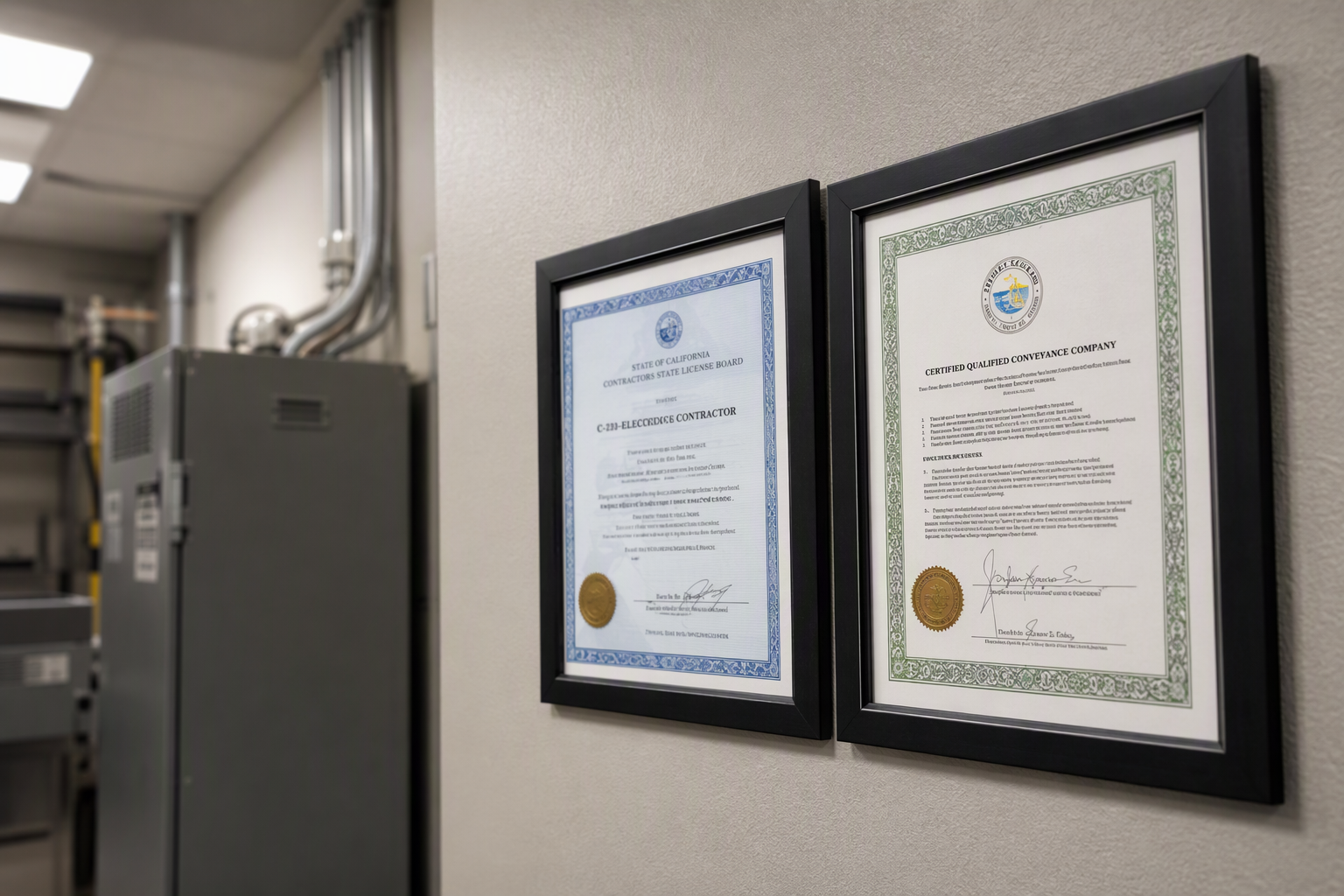
Under Cal/OSHA’s elevator regulations and the California Labor Code Sections 7300–7324.2, only a Certified Qualified Conveyance Company (CQCC) may maintain, repair, alter, or replace components on a conveyance in California. Mechanics performing the work must be individually certified as a Certified Competent Conveyance Mechanic (CCCM). These certifications are issued and enforced by the Division of Occupational Safety and Health (Cal/OSHA), Elevator Unit, California Department of Industrial Relations.
Additionally, applicants for CQCC certification must hold a current C-11 Elevator Contractor license issued by the California Contractors State License Board (CSLB), along with current certificates of workers’ compensation and liability insurance. The C-11 license itself carries implied standards of workmanship under California contractor law. Building owners who hire unlicensed or uncertified contractors have no legal recourse through the CSLB if work fails. Hiring a CQCC-certified, C-11-licensed company is therefore the foundation of any warranty protection.
3. What types of elevator failures qualify for a warranty callback?
A warranty callback is appropriate when the failure is causally connected to the repair that was just performed — meaning the same component, the same symptom, or a directly related system malfunction recurs after the technician completed and signed off on the work.
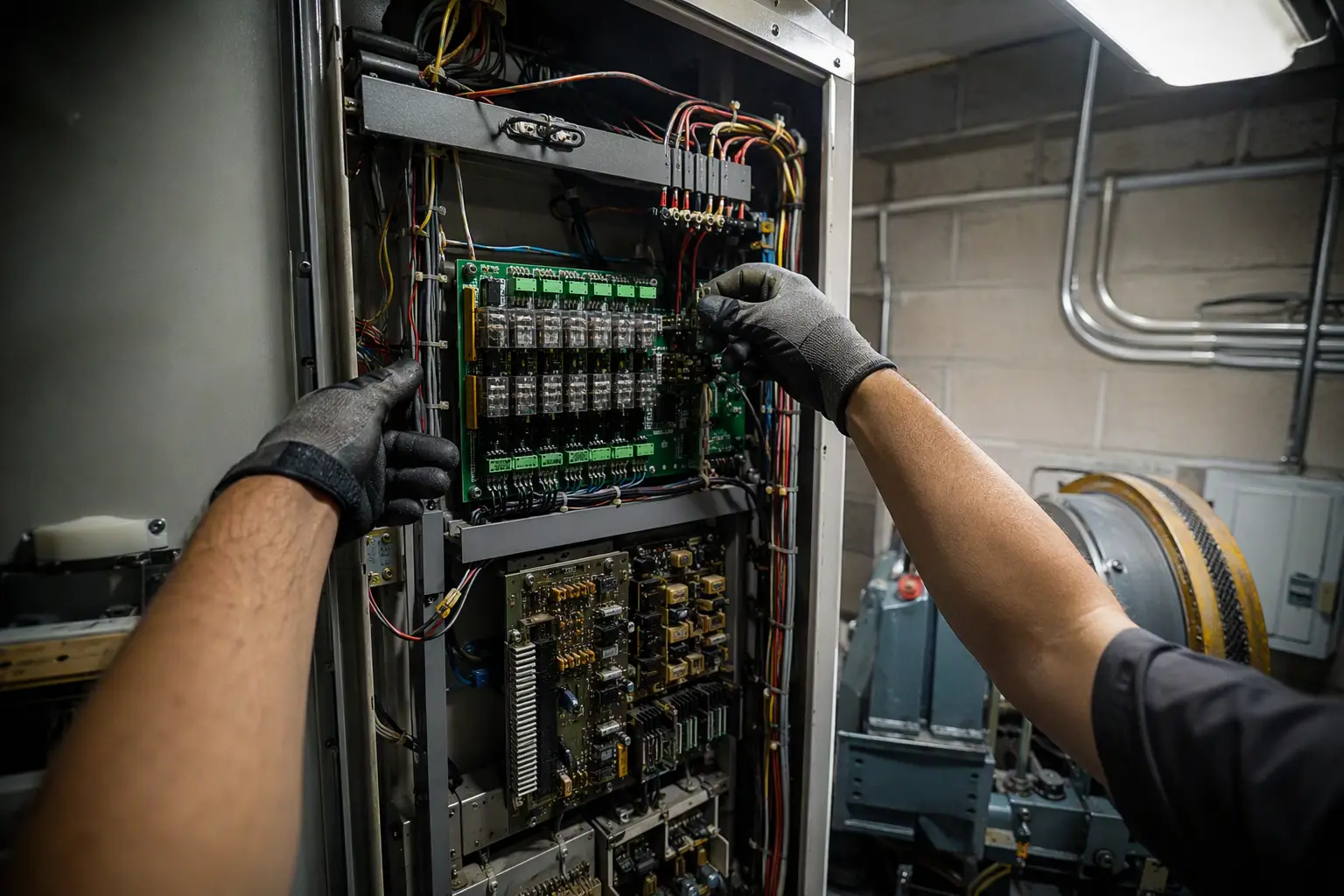
Examples of failures that typically qualify for warranty coverage include: a replaced motor that fails again within the warranty period, a controller board that was serviced and trips the same fault code days later, door rollers that were adjusted but immediately return to misalignment, or a hydraulic seal that was replaced but begins leaking again. Failures that are generally excluded from a workmanship warranty include new, unrelated faults on components that were not touched during the repair, vandalism damage, and failures caused by power surges or utility interruptions beyond the company’s control.
4. How quickly should a service company respond to a repeat failure under a warranty?
A professional elevator service company should treat a repeat failure as a priority callback, not a routine service call, and the building owner should clearly communicate that the failure is a recurrence covered under the recent repair.
Under California’s elevator regulatory framework, no elevator may be operated without a valid, current permit to operate issued by Cal/OSHA. If a repeat failure renders the elevator unsafe or out of service, the building has an independent obligation to take the unit out of service. Prompt response is therefore not only a customer service expectation — it is connected to the building owner’s compliance obligation to avoid operating an unsafe conveyance.
5. What is the difference between a repair warranty and a full maintenance contract?
A repair warranty applies only to the specific components and labor involved in a single service event, while a full maintenance contract provides ongoing coverage for the elevator system as a whole, typically including regularly scheduled preventive maintenance, priority emergency response, and repair coverage for a defined list of components.
California’s regulatory structure recognizes the distinction. Cal/OSHA may issue a permit to operate for up to two years — rather than the standard one year — for an elevator in safe condition that is covered by a full maintenance contract with a C-11 licensed elevator company. This two-year permit pathway signals that comprehensive maintenance contracts are associated with demonstrably safer equipment.
Building owners who are concerned about repeat failures and recurring repair costs often find that transitioning to a full maintenance contract provides stronger and more predictable protection than relying on individual repair warranties.
6. What should a building owner do immediately after an elevator fails again within days of a repair?
Follow these steps to protect both the safety of building occupants and the owner’s warranty rights:
- Take the elevator out of service immediately. Post clearly visible signage and prevent occupants from using the unit. Operating a known unsafe elevator is prohibited under California Labor Code Sections 7300–7324.2 and the California Code of Regulations, Title 8, Elevator Safety Orders.
- Document the failure. Record the date, time, the exact symptom observed (error code, door behavior, unusual noise, failure to level, etc.), and any witnesses. Photographs or video can be valuable.
- Locate the paperwork from the original repair. Retrieve the service invoice, work order, and any written warranty or guarantee documentation provided at the time of the repair.
- Contact the servicing company and identify the call as a warranty callback. Communicate clearly that the failure appears related to the recent repair and reference the date of service and the warranty terms.
- Request a written root cause assessment. Ask the returning technician to document in writing what caused the repeat failure and whether it falls within or outside the warranty scope.
- Confirm the elevator is safe before returning it to service. The unit should not be placed back in operation until a certified technician confirms it is safe, consistent with Cal/OSHA’s requirement that elevators be maintained in a safe operating condition.
- If the dispute over warranty coverage is unresolved, consult Cal/OSHA. The Cal/OSHA Elevator Unit has jurisdiction over conveyance safety in California and may be contacted with safety complaints.
7. How does the ASME A17.1 Safety Code relate to warranty and repair quality standards?
The ASME A17.1/CSA B44 Safety Code for Elevators and Escalators is the national technical standard that defines how elevators must be designed, installed, maintained, and tested — and it is the standard adopted into California’s elevator safety regulations.
California has adopted the ASME A17.1/CSA B44, 2004 edition (Group IV Elevator Safety Orders), effective May 1, 2008, for installation contracts signed on or after that date, under the California Code of Regulations, Title 8. When a repair is performed, the work must restore the elevator to a condition that complies with ASME A17.1 standards applicable to that installation. If a repair is performed in a manner that causes the elevator to fall below code compliance — and a repeat failure is the result — that failure has both safety and regulatory implications beyond a simple warranty dispute.
8. Are elevator parts covered by manufacturer warranties separately from labor warranties?
Yes — most elevator components installed during a repair carry a separate manufacturer’s warranty that may outlast the service company’s labor warranty.
Common elevator components such as controllers, motors, drives, door operators, and hydraulic power units are manufactured by OEMs (original equipment manufacturers) that typically warrant their products against defects in materials and workmanship for periods that vary by manufacturer and component type. The service company installing the part should provide documentation of the manufacturer’s warranty at the time of repair. If a part fails within the manufacturer’s warranty period, the service company may be able to obtain a warranty replacement at no cost to the building owner — a saving that should be passed on.
Building owners should request the manufacturer’s warranty documentation for every new major component installed during a repair, and keep this paperwork accessible for the duration of the warranty period.
9. What role does a California CQCC certification play in holding a company accountable for repeat failures?
The CQCC certification issued by Cal/OSHA is the state’s primary mechanism for ensuring that only qualified companies work on elevators — and it creates a formal accountability structure when work is deficient.
CQCC and CCCM certificates in California last two years, and renewal requires at least eight hours of continuing education, ensuring that certified mechanics and companies remain current with code updates and industry practices. A company performing substandard work that results in repeat failures risks complaints to Cal/OSHA’s Elevator Unit and potential action against its certification. Building owners in Signal Hill, Long Beach, Los Angeles, and Orange County should always verify CQCC status before authorizing any repair work.
10. Does the City of Los Angeles have additional requirements that affect repair warranties?
Los Angeles operates its own elevator and conveyance inspection program through the Los Angeles Department of Building and Safety (LADBS), distinct from the statewide Cal/OSHA program.
For buildings in the City of Los Angeles, compliance with both the statewide Cal/OSHA framework and the LADBS program may apply. Building owners should confirm with their service provider which authority has jurisdiction over their specific property, as a repair that generates a repeat failure may be subject to re-inspection requirements from both the statewide and local authority having jurisdiction (AHJ). Companies operating in Los Angeles — such as Liftech Elevator — must be familiar with both programs to ensure repairs are performed to the standards expected by all applicable authorities.
11. What warranty protections apply to ADA compliance components repaired on an elevator?
Repairs to ADA-covered elevator components — such as control panel button heights, audible or visual floor indicators, door timing, and cab dimensions — must restore the unit to full ADA compliance, and the workmanship warranty should cover a recurrence of any ADA-related deficiency caused by the repair.
The Americans with Disabilities Act requires that elevators in buildings covered by Title II or Title III remain accessible. A repair that impairs accessibility — or a repeat failure that restores an ADA deficiency — is not merely a customer service issue but a civil rights compliance matter. Building owners should document ADA-related repairs separately and confirm in writing that the servicing company certifies the repaired component meets applicable ADA standards.
12. How does a full maintenance contract affect warranty coverage compared to a time-and-materials repair?
A full maintenance contract typically provides broader and more clearly defined coverage than a time-and-materials (T&M) repair warranty because the scope of covered components and services is negotiated and documented in advance.
| Feature | Time-and-Materials Repair | Partial Maintenance Contract | Full Maintenance Contract |
|---|---|---|---|
| Workmanship warranty on completed repair | Typically yes, limited duration | Yes, per contract terms | Yes, included in contract |
| Parts coverage on newly installed components | Manufacturer warranty only | Partial — defined list | Comprehensive — broad component list |
| Callback priority for repeat failures | Standard service queue | Elevated, per contract | Priority, per contract |
| Preventive maintenance included | No | Limited | Yes — scheduled intervals |
| Eligibility for Cal/OSHA two-year permit | No | No (partial contracts typically excluded) | Yes — per Cal/OSHA rule for C-11 licensed companies |
| Regulatory documentation maintained by company | Single-event service record | Partial records | Comprehensive log maintained |
13. Can a building owner pursue a warranty claim if the repair was performed by a company that was not CQCC certified?
A building owner may attempt to pursue a warranty or contractual claim against an uncertified company, but the practical and legal position is significantly weaker than if the work had been performed by a properly certified CQCC and C-11-licensed contractor.
Under California law, only a CQCC may legally maintain, repair, alter, or replace components on a conveyance. Work performed by an uncertified company is unauthorized and may itself constitute a violation of California Labor Code Sections 7300–7324.2. Critically, a permit from Cal/OSHA is required before a conveyance is materially altered, and Cal/OSHA inspectors are empowered to take an elevator out of service if it is found in an unsafe condition. Building owners who unknowingly hired an unlicensed contractor may face compliance liability in addition to the cost of corrective work. Verifying CQCC and C-11 status before any repair is authorized is the single most important step a building owner can take to protect both safety and warranty rights.
14. What documentation should a building owner retain after any elevator repair to support a warranty claim?
Thorough documentation is the building owner’s most important tool if a warranty dispute arises over a repeat failure.
The essential documents to retain include: the signed service work order or invoice identifying the technician, date, components repaired or replaced, and parts installed; any written warranty or guarantee statement issued by the service company; the manufacturer’s warranty documentation for newly installed parts; the current Cal/OSHA permit to operate, which California law requires to be posted conspicuously in the elevator car; and any inspection reports or correction notices issued by Cal/OSHA or, for Los Angeles properties, LADBS. Maintaining a running service history log allows building owners to identify recurring failures, which is itself important evidence in a warranty dispute and in demonstrating due diligence to regulators.
15. Does the Cal/OSHA annual inspection affect warranty claims or trigger additional obligations after a repair?
The Cal/OSHA annual inspection is independent of any service warranty but can directly affect a building’s ability to operate legally after a repair, which creates practical urgency around resolving repeat failures.
California law requires every conveyance to be inspected at least once a year. Only State of California safety engineers and Certified Competent Conveyance Inspectors (CCCI) may perform these inspections. A conveyance found safe receives a permit to operate for up to one year. If a repair is performed between inspection cycles and the repaired component fails again, the building owner must ensure the elevator is safe before returning it to service — because operating without a valid permit or with known unsafe conditions violates the California Labor Code. Arranging the annual reinspection is the elevator owner’s responsibility, not the service company’s, though a proactive service partner will flag upcoming inspection deadlines.
16. What happens to a warranty claim if the building owner or a third party makes changes to the elevator after the repair?
Any modification to a repaired elevator component by the building owner, building maintenance staff, or an uncertified third party after a service event will typically void the workmanship warranty for that component — and may create broader safety and compliance risks.
California regulations are explicit: only a Certified Competent Conveyance Mechanic working for a Certified Qualified Conveyance Company may maintain, repair, alter, or replace components on a conveyance. Furthermore, a permit from Cal/OSHA is required before a conveyance is materially altered. Unauthorized adjustments or modifications made in an attempt to temporarily restore service following a repeat failure can complicate warranty claims, trigger regulatory scrutiny, and potentially create liability if the elevator is subsequently involved in an incident.
17. How do CCCM certifications and continuing education requirements relate to repair quality and warranties?
The CCCM certification and its mandatory continuing education requirement exist specifically to ensure that the mechanics performing repairs are technically current — which directly affects the quality of the work and the validity of any warranty backed by it.
California CQCC, CCCM, and conveyance inspector certificates last two years, and renewal requires at least eight hours of continuing education. As elevator technology evolves — with modern microprocessor-based controllers, variable frequency drives, and destination dispatch systems — mechanics who maintain their CCCM certification are required to stay current with emerging standards and practices. A building owner whose elevator is repaired by a CCCM-certified mechanic has the assurance that the technician’s qualifications are state-verified, providing a foundation for a meaningful warranty commitment.
18. Is there any scenario where a warranty does not cover a repeat failure that occurs within days?
Yes — certain documented scenarios can legitimately exclude a repeat failure from warranty coverage even when the timeframe is very short.
Legitimate exclusions typically include: failures caused by events entirely outside the scope of the repair, such as a power surge damaging a newly installed circuit board; physical damage caused by vandalism or misuse after the repair was completed; failures in components that were inspected and found acceptable at the time of repair but that were already at or near end of useful life; and failures caused by pre-existing conditions in related systems that the building owner was informed about and declined to address at the time of the original repair. Responsible elevator service companies document these conditions on the original work order — noting, for example, that a certain component is worn and recommended for replacement — precisely to define the limits of the warranty scope. If a technician verbally noted a related concern but did not document it in writing, that omission typically benefits the building owner in a warranty dispute.
19. Why does choosing a locally experienced elevator company in Signal Hill, Long Beach, Los Angeles, or Orange County matter for warranty support?
Local knowledge of the authority having jurisdiction (AHJ), building stock, and regional service networks allows a local elevator company to respond more effectively to warranty callbacks and regulatory requirements than a nationally dispatched service provider with no local presence.
In Southern California, the regulatory landscape includes the statewide Cal/OSHA Elevator Unit and, for properties in the City of Los Angeles, the LADBS inspection program. Building owners in Signal Hill, Long Beach, Los Angeles, and Orange County benefit from working with a company that understands both programs, maintains relationships with local inspectors, and can coordinate rapidly when a repeat failure intersects with a pending inspection or compliance deadline. Liftech Elevator is a certified elevator service company operating across these markets, bringing the CQCC certification, C-11 licensing, and local expertise that building owners in Southern California need to navigate both warranty issues and regulatory requirements effectively.
20. What proactive steps can a building owner take to reduce the likelihood of repeat failures after a repair?
Proactive maintenance practices are the most reliable way to prevent repeat failures and to ensure warranty protections are never needed.
Best practices include: enrolling in a full maintenance contract with a CQCC-certified, C-11-licensed company to ensure regular preventive maintenance visits that catch developing issues before they cause breakdowns; maintaining a complete service history for each elevator, including all repair records, inspection reports, and permit documentation; scheduling the Cal/OSHA annual reinspection proactively — remembering that arranging reinspection is the building owner’s responsibility; addressing all technician recommendations at the time of a repair rather than deferring related work; and confirming after every repair that the elevator’s permit to operate is current and posted conspicuously in the elevator car, as required by California law.
Liftech Elevator works with building owners in Signal Hill, Long Beach, Los Angeles, and Orange County to establish maintenance programs aligned with California’s regulatory framework and the ASME A17.1/CSA B44 Safety Code for Elevators and Escalators, helping reduce the frequency of unexpected breakdowns and the warranty disputes that follow them.
Get Expert Elevator Service Backed by California-Certified Professionals
If your elevator has failed again after a recent repair — or if you want to ensure your equipment is maintained by a team that stands behind its work — contact Liftech Elevator for a free elevator assessment. Liftech Elevator serves building owners throughout Signal Hill, Long Beach, Los Angeles, and Orange County with Cal/OSHA CQCC-certified service and C-11 licensed expertise.
Call Liftech Elevator today: 562-997-3639
Need elevator service you can rely on? Liftech Elevator is ready to help.