ASME A17.1 Elevator Code: Data, Compliance Facts & California Requirements (2026)
ASME A17.1 governs how elevators are designed, installed, inspected, tested, and maintained across the United States. In California, the standard carries the force of law: the Cal/OSHA Elevator Unit, California Department of Industrial Relations enforces the adopted edition through the California Code of Regulations, Title 8, Elevator Safety Orders. Understanding what the code requires — and how California administers it — is essential for every building owner, facilities manager, and elevator contractor operating in the state in 2026.
What Is ASME A17.1 and Why Does It Matter?
The ASME A17.1 Safety Code for Elevators and Escalators is published by the American Society of Mechanical Engineers and sets minimum safety requirements for the design, construction, installation, operation, inspection, testing, maintenance, alteration, and repair of elevators and related conveyances. It is updated on a regular cycle, with new editions incorporating advances in technology, updated load-testing protocols, emergency communication requirements, and machine-room-less (MRL) system standards.
Because the code is adopted at the state level rather than applied directly, the specific edition in force varies by jurisdiction. In California, the 2004 edition of ASME A17.1/CSA B44 is the governing standard for elevators installed under contracts signed on or after May 1, 2008. A proposed Group V update — which would incorporate portions of ASME A17.1-2019 — was the subject of a California Standards Board public hearing on June 18, 2026; as of this writing, no effective date has been posted for that update.
How Does California Adopt and Enforce ASME A17.1?
California enforces elevator safety through the Division of Occupational Safety and Health (Cal/OSHA), Elevator Unit, California Department of Industrial Relations, under authority granted by California Labor Code Sections 7300–7324.2. The technical requirements appear in California Code of Regulations, Title 8, Elevator Safety Orders (Sections 3000–3146), which incorporate ASME A17.1/CSA B44 2004 as their primary technical reference for newer installations.
Key enforcement facts that every California property owner should understand:
- No elevator may be operated in California without a valid, current permit to operate issued by Cal/OSHA.
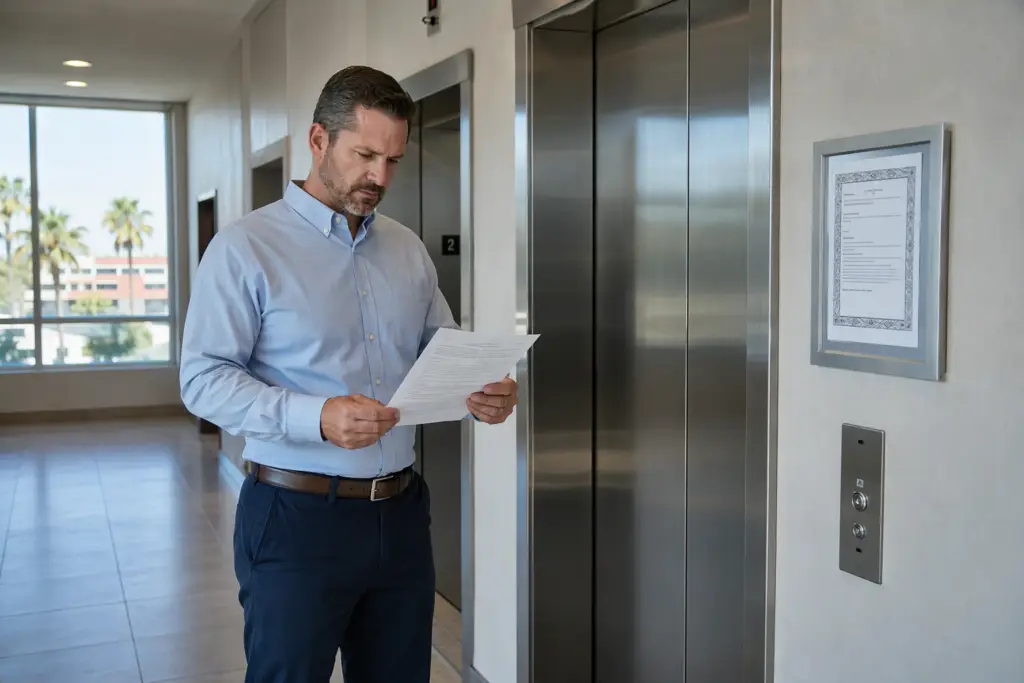
- The permit to operate for a passenger, freight, or inclined elevator must be posted conspicuously inside the elevator car at all times.
- A permit from Cal/OSHA is required before any conveyance is erected, installed, or materially altered — not just before it opens to the public.
- Each new elevator must be inspected by Cal/OSHA and receive a permit to operate before it is placed in service.
- Arranging the annual reinspection is the elevator owner’s legal responsibility, not the contractor’s.
What Are the Inspection Intervals Required Under California’s Elevator Safety Orders?
California law requires every conveyance to be inspected at least once per year. When an elevator is found to be in safe condition following inspection, Cal/OSHA issues a permit to operate for up to one year. For elevators covered by a full maintenance contract with a company holding a C-11 Elevator Contractor license, Cal/OSHA may issue a permit to operate for up to two years, provided the elevator is found to be in safe condition.
Only State of California safety engineers and Certified Competent Conveyance Inspectors (CCCI) are authorized to perform elevator inspections in California. Building owners cannot substitute a third-party private inspection as a replacement for the Cal/OSHA inspection process.
The City of Los Angeles maintains its own elevator and conveyance inspection program administered through the Los Angeles Department of Building and Safety (LADBS), separate from the statewide Cal/OSHA program. Building owners with Los Angeles properties should confirm current local requirements directly with LADBS.
Who Is Qualified to Work on Elevators in California Under ASME A17.1?
The code’s intent — that only qualified personnel perform elevator work — is given teeth in California through a specific credentialing framework:
- Certified Qualified Conveyance Company (CQCC): Any company that installs, alters, tests, maintains, repairs, or services elevators in California must be certified by Cal/OSHA as a CQCC. To obtain certification, applicants must submit a current C-11 Elevator Contractor license (issued by the California Contractors State License Board, or CSLB) along with certificates of workers’ compensation and liability insurance.
- Certified Competent Conveyance Mechanic (CCCM): Anyone who works on an elevator in California without direct supervision must hold a CCCM certificate issued by Cal/OSHA. Only a CCCM working for a CQCC may maintain, repair, alter, or replace components on a conveyance.
- Certificate Duration and Continuing Education: California CQCC, CCCM, and conveyance inspector certificates last two years. Renewal requires at least eight hours of continuing education.
Liftech Elevator operates within this credentialing framework, working exclusively with certified mechanics and maintaining the CQCC certification structure required by California law — ensuring that all code-related work is performed by qualified personnel.
What Does ASME A17.1 Require for Elevator Maintenance?
The ASME A17.1 Safety Code for Elevators and Escalators establishes that maintenance must be performed in a manner that keeps every part of the elevator in a safe operating condition. The code requires that maintenance be carried out by qualified personnel following documented procedures, that records be kept, and that any deficiency identified during maintenance be corrected before the elevator is returned to service.
In practice, a code-compliant maintenance program in California typically covers:
- Regular lubrication and adjustment of mechanical components
- Testing and verification of safety devices, including governors, safeties, and buffers
- Inspection and testing of braking systems
- Verification of door operator performance and door protection devices
- Testing of emergency lighting and communication systems
- Documentation of all work performed and any deficiencies found
What Is the Process for a New Elevator Installation in California?
- Obtain a Cal/OSHA installation permit. Before any elevator is erected, installed, or materially altered in California, the owner or contractor must obtain a permit from Cal/OSHA. Work cannot begin without this permit.
- Select a CQCC-certified contractor. The installation must be performed by a company holding valid CQCC certification and a C-11 license issued by the CSLB.
- Install to the adopted ASME A17.1 standard. For contracts signed on or after May 1, 2008, the applicable standard is ASME A17.1/CSA B44 2004 edition as adopted in California’s Elevator Safety Orders.
- Arrange the pre-operation Cal/OSHA inspection. When installation is complete, the elevator must be inspected by Cal/OSHA or a CCCI before it is placed in service.
- Receive and post the permit to operate. Once Cal/OSHA is satisfied that the elevator is safe, it issues a permit to operate, which must be posted conspicuously in the elevator car.
- Schedule annual reinspections. The elevator owner bears responsibility for arranging each subsequent annual inspection to maintain a valid permit to operate.
How Does ASME A17.1 Address Existing Elevators and Alterations?
ASME A17.1 distinguishes between new installations and existing equipment. Requirements for existing installations are addressed in the companion standard ASME A17.3, which establishes minimum safety standards for existing elevators and escalators. When an existing elevator undergoes a material alteration in California, the altered portions must comply with the requirements of the edition in force at the time of the alteration, and a new Cal/OSHA permit is required before that work begins.
What constitutes a “material alteration” under California’s Elevator Safety Orders is determined by Cal/OSHA, and building owners uncertain about whether planned work triggers the alteration permit requirement should consult with a CQCC-certified company before proceeding.
What ADA Requirements Intersect with ASME A17.1 for Elevators?
The Americans with Disabilities Act (ADA) establishes accessibility requirements for elevators in public accommodations and commercial facilities. Where ASME A17.1 addresses mechanical safety, the ADA Standards for Accessible Design address dimensions, control placement, floor identification, and communication features — areas where the two frameworks overlap. Building owners typically must satisfy both sets of requirements, and an ASME A17.1-compliant elevator is not automatically ADA-compliant.
ADA requirements that commonly affect elevator design and alteration projects include door width and timing, car size, control button height and labeling, floor designations in Braille, and emergency communication accessibility. Liftech Elevator evaluates both code dimensions when assessing existing installations and planning alterations.
What Drives the Cost of ASME A17.1 Compliance Work in California?
The cost of bringing an elevator into compliance with California’s adopted ASME A17.1 requirements — or of maintaining compliance over time — depends on several qualitative factors rather than a fixed schedule:
- Age and condition of equipment: Older elevators may require more extensive work to meet current safety device requirements, particularly those related to door protection, governor-rope systems, and buffer performance.
- Scope of alteration: A material alteration that triggers updated code requirements across multiple systems will cost more than targeted component replacement.
- Type of conveyance: Hydraulic, traction, and machine-room-less systems each carry different maintenance and testing protocols under the code.
- Building type and use: High-traffic commercial buildings experience higher wear rates and may require more frequent maintenance interventions to stay ahead of code-required performance thresholds.
- Permit and inspection fees: Cal/OSHA charges fees for installation permits and inspection services; current fee schedules are published by Cal/OSHA and are subject to change.
What Are the Industry Trends Affecting ASME A17.1 Compliance in 2025–2026?
Several trends are shaping how building owners and elevator contractors approach ASME A17.1 compliance in California heading into 2026:
- Pending code update: California’s proposed Group V Elevator Safety Orders — which would incorporate elements of the more recent ASME A17.1-2019 — remain in regulatory review following the June 2026 public hearing. When adopted, the update will impose new requirements on installations and potentially trigger alteration reviews for some existing equipment.
- Remote monitoring and predictive maintenance: The elevator industry is increasingly deploying IoT-enabled monitoring systems that track performance data in real time, helping building owners identify potential code-relevant deficiencies before they become violations or service failures. These systems do not replace the Cal/OSHA inspection but can support proactive maintenance documentation.
- Modernization activity: As the existing California elevator fleet ages, modernization projects — which often trigger material alteration permits and updated code compliance obligations — are increasing in frequency. Owners are weighing the cost of piecemeal repairs against comprehensive modernization that resets code compliance timelines.
- Workforce credentialing pressure: The two-year renewal cycle for CCCM and CQCC certificates, combined with the eight-hour continuing education requirement, is placing ongoing demands on elevator company workforce planning, particularly as new code editions introduce new technical content.
What Happens If an Elevator Fails a Cal/OSHA Inspection?
When a Cal/OSHA inspection reveals that an elevator does not meet the requirements of California’s Elevator Safety Orders, the inspector may issue a correction notice or, in cases of imminent hazard, order the elevator out of service immediately. The permit to operate may be withheld or revoked until the deficiencies are corrected and the elevator passes a follow-up inspection. Operating an elevator without a valid permit to operate is a violation of California Labor Code Sections 7300–7324.2 and can expose building owners to legal liability and civil penalties.
The practical steps following a failed inspection are:
- Obtain the inspection report documenting all cited deficiencies.
- Engage a CQCC-certified elevator company to assess the scope of corrective work required.
- Obtain any required Cal/OSHA alteration permits before beginning work on material alterations.
- Complete all corrective work using CCCM-certified mechanics.
- Contact Cal/OSHA to schedule the follow-up inspection.
- Receive and post the renewed permit to operate before returning the elevator to service.
How Does Liftech Elevator Support ASME A17.1 Compliance in California?
Liftech Elevator provides California building owners with data-driven elevator assessment, maintenance, and compliance support structured around the requirements of ASME A17.1 as adopted in California’s Elevator Safety Orders. By maintaining CQCC certification and employing CCCM-certified mechanics, Liftech Elevator ensures that all work is performed within the legal framework established by Cal/OSHA and consistent with ASME A17.1 Safety Code for Elevators and Escalators requirements.
Liftech Elevator’s approach includes systematic documentation of maintenance activities, tracking of permit to operate status and inspection due dates, and proactive identification of conditions that may affect compliance — supporting building owners in meeting their legal obligation to arrange annual reinspections and keep their equipment in safe, permitted operation.
Sourced Reference Data: California Elevator Regulatory Framework
| Regulatory Element | Detail | Source |
|---|---|---|
| Enforcing Agency | Cal/OSHA Elevator Unit, California Department of Industrial Relations | Cal/OSHA Elevator Unit |
| Governing Statute | California Labor Code Sections 7300–7324.2 | Cal/OSHA Elevator Unit |
| Adopted ASME Edition | ASME A17.1/CSA B44 2004, effective May 1, 2008 (installations contracted on or after that date) | Cal/OSHA Elevator Unit |
| Standard Inspection Interval | At least once per year; permit issued for up to one year | Cal/OSHA Elevator Unit |
| Extended Permit Interval | Up to two years for elevators under full maintenance contract with a C-11 licensed company, if found safe | Cal/OSHA Elevator Unit |
| Certificate Duration (CQCC/CCCM/Inspector) | Two years; renewal requires at least 8 hours of continuing education | Cal/OSHA Elevator Unit |
| Pending Code Update | Proposed Group V Elevator Safety Orders incorporating ASME A17.1-2019 (in part); public hearing June 18, 2026; no effective date posted | Cal/OSHA Elevator Unit |
Contact Liftech Elevator for a free elevator assessment at 562-997-3639.
Need elevator service you can rely on? Liftech Elevator is ready to help.