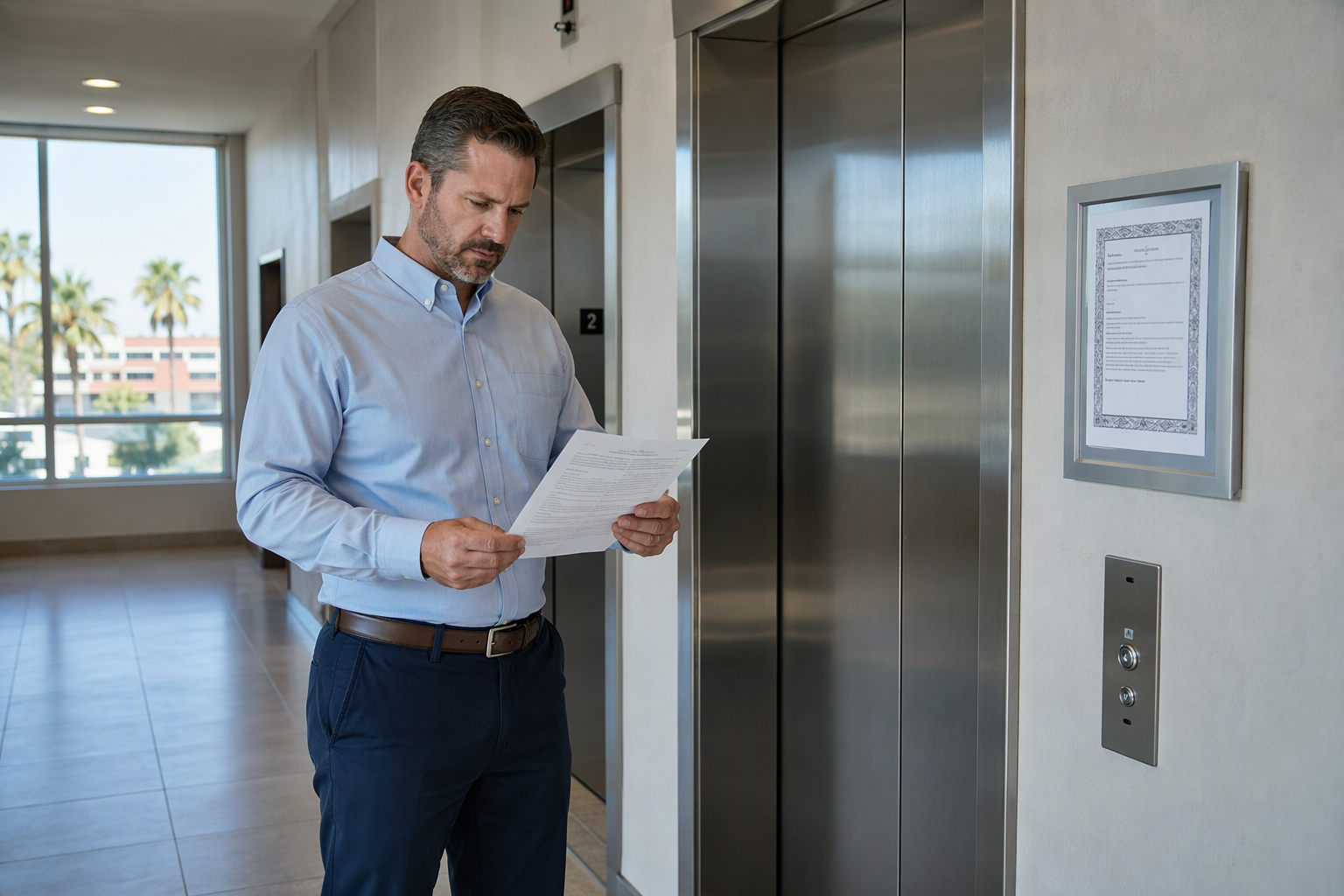
To get an estimate for an elevator inspection that satisfies a California compliance order, an elevator owner must engage a Certified Qualified Conveyance Company (CQCC) certified by Cal/OSHA’s Elevator Unit. The CQCC reviews the compliance order, assesses the unit’s condition, and delivers a written estimate covering inspection coordination, corrective repairs, and any permit reinstatement steps. Only then can the owner present Cal/OSHA with the documentation needed to restore a valid permit to operate.
What is a California elevator compliance order and why does it require a formal estimate?
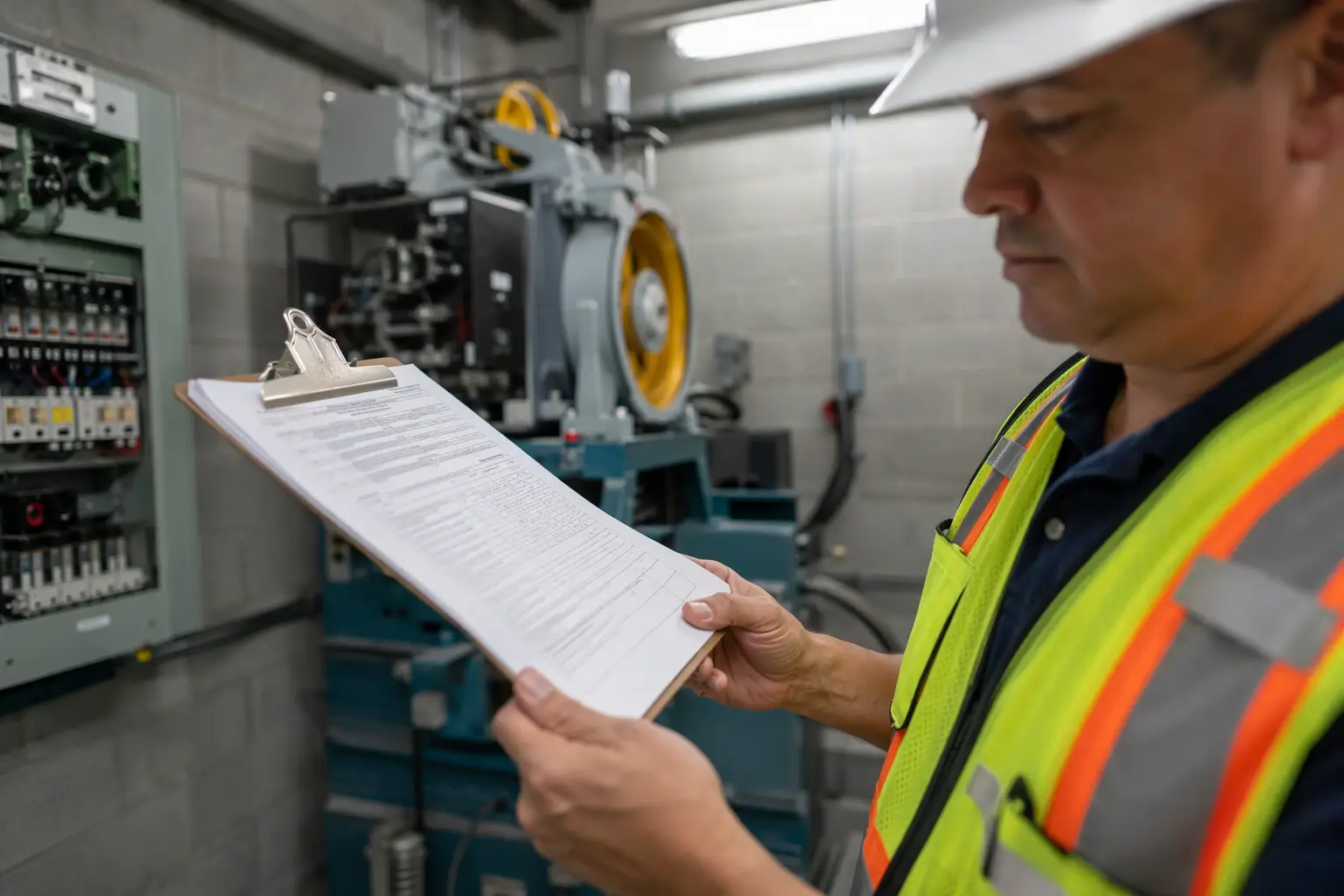
A California elevator compliance order is an official notice issued by the Cal/OSHA Elevator Unit requiring the owner to bring a conveyance into conformance with California Labor Code Sections 7300–7324.2 and the California Code of Regulations, Title 8, Elevator Safety Orders before the unit may legally operate.
Compliance orders typically arise after a periodic inspection reveals deficiencies, after a complaint, or after a unit has operated past its permit expiration. Because California law prohibits operating any elevator without a valid, current permit to operate issued by Cal/OSHA, an owner who ignores a compliance order risks not just regulatory penalties but exposure to liability for every trip the elevator makes while out of compliance. A formal written estimate from a CQCC establishes the documented repair and inspection plan that Cal/OSHA expects to see as evidence of corrective action.
Who is legally authorized to perform an elevator inspection in California?
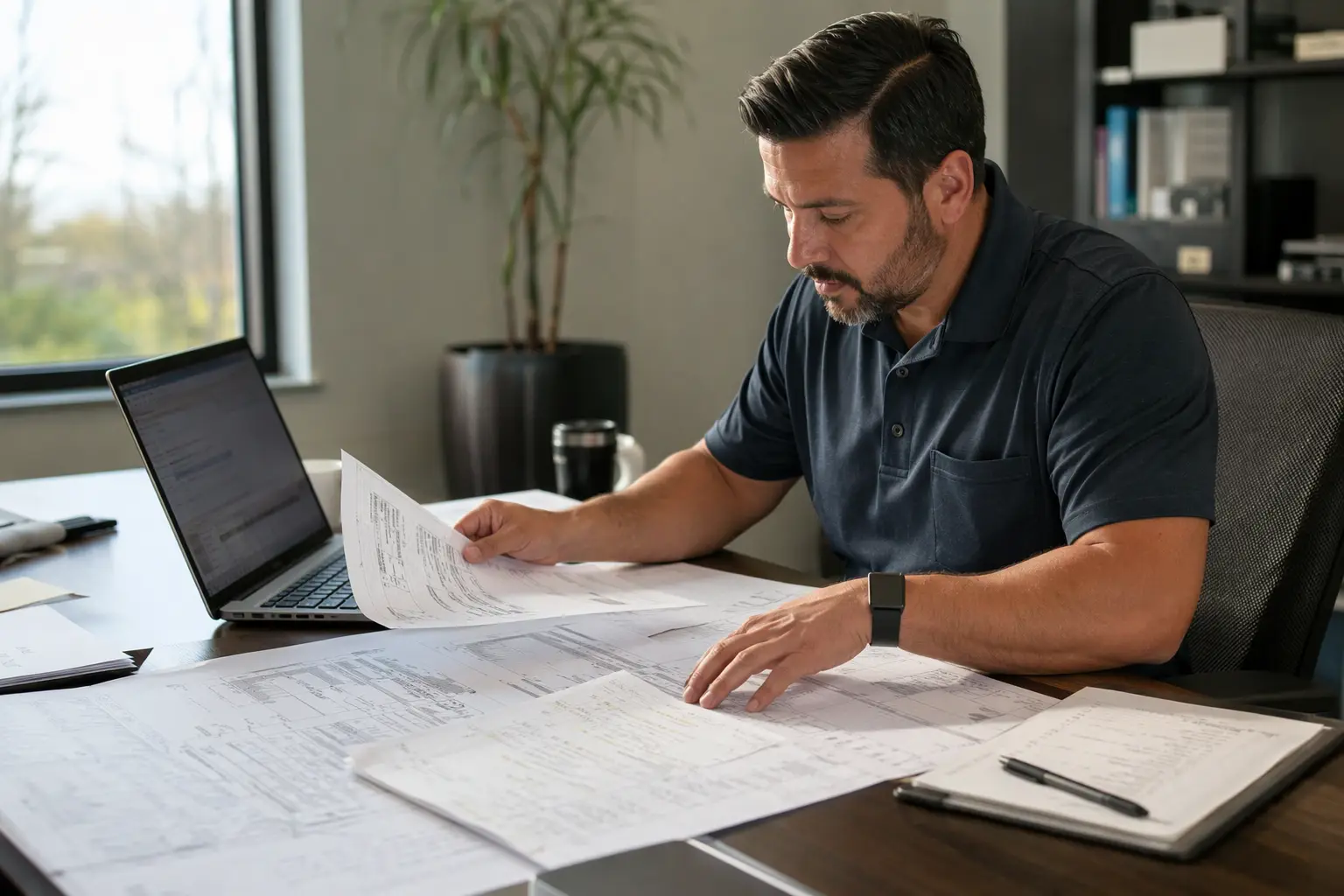
Only State of California safety engineers and Certified Competent Conveyance Inspectors (CCCI) may legally perform elevator inspections in California.
This restriction, established under California Labor Code Sections 7300–7324.2 and the Title 8 Elevator Safety Orders, means a property manager cannot satisfy a compliance order simply by having a maintenance technician walk through the machine room. The inspection must be conducted or coordinated through the proper chain: a CQCC-certified company dispatches Certified Competent Conveyance Mechanics (CCCMs) to perform any necessary corrective work, and then the Cal/OSHA Elevator Unit arranges for a state safety engineer or CCCI to conduct the formal reinspection. Understanding this two-step distinction is essential when requesting an accurate estimate, because the scope covers both the mechanical correction work and the inspection coordination process.
What information does a CQCC need before preparing a compliance-order estimate?
A CQCC needs the compliance order document, the unit’s permit history, equipment specifications, and a site visit to prepare an accurate estimate.
Specifically, the elevator company will typically request the following before quoting:
- The original Cal/OSHA compliance order, including the order number and listed violation codes
- The elevator’s current or most recent permit to operate, which California law requires to be posted conspicuously inside the elevator car
- The unit’s make, model, type (passenger, freight, inclined, etc.), and approximate year of installation
- The number of stops and the drive system (hydraulic, traction, MRL)
- Any prior inspection reports, maintenance logs, or repair records
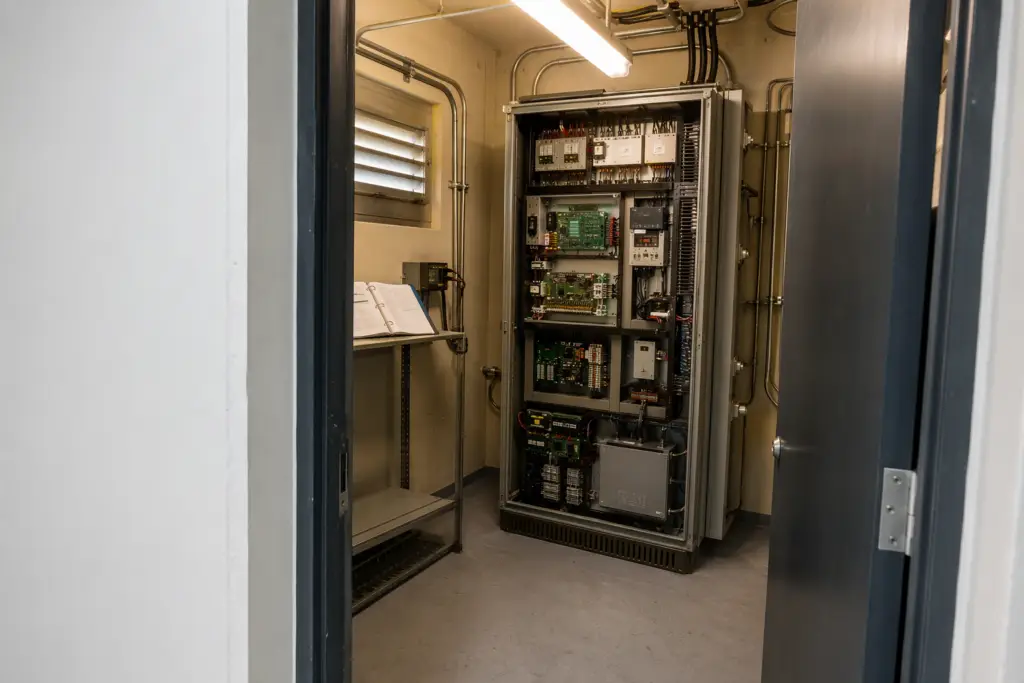
- Access to the machine room, pit, and hoistway for a physical condition assessment
Providing complete documentation upfront allows the estimating technician to match the cited deficiencies against the ASME A17.1/CSA B44 Safety Code for Elevators and Escalators — the edition adopted by California’s Title 8 Elevator Safety Orders (2004 edition, effective May 1, 2008, for contracts signed on or after that date) — and produce a scope of work that directly addresses each violation line item.
What does a compliance-order inspection estimate typically include?
A complete compliance-order estimate covers the site assessment, itemized corrective repairs tied to each cited violation, inspection-coordination fees, and permit reinstatement costs.
A well-structured estimate from a CQCC will generally break out these cost components:
- Site assessment fee: the cost of the initial walk-through and violation mapping
- Corrective repair labor and parts: itemized by each deficiency cited in the compliance order
- Testing and documentation: safety tests, load tests, governor and buffer tests where required by the ASME A17.1 Safety Code
- Inspection coordination: preparing the unit and paperwork for the Cal/OSHA Elevator Unit’s reinspection
- Permit reinstatement: applicable Cal/OSHA fees associated with issuing a new or reinstated permit to operate
- Contingency allowance: a range covering any additional deficiencies discovered during corrective work
Owners should be cautious of estimates that quote only labor without itemizing parts, or that omit the inspection-coordination step — an elevator that is repaired but never formally reinspected still cannot legally operate in California.
How long does it take to complete an inspection and restore a permit to operate?
The timeline depends on the severity of the violations, parts availability, and Cal/OSHA’s scheduling queue for reinspection.
Minor deficiencies — such as lighting, signage, or door-contact adjustments — may be corrected in a single visit, allowing the CQCC to request reinspection relatively quickly. Major deficiencies involving safety devices, control systems, or structural components of the hoistway can require weeks of parts procurement and repair work. Once corrective work is complete, the owner or CQCC submits documentation to the Cal/OSHA Elevator Unit to schedule the formal reinspection. California law specifies that an elevator found safe receives a permit to operate for up to one year; under a full maintenance contract with a C-11 licensed elevator company, Cal/OSHA may issue a permit for up to two years.
What California agencies and codes govern elevator compliance orders?
The primary governing agency is the Cal/OSHA Elevator Unit within the California Department of Industrial Relations, enforcing California Labor Code Sections 7300–7324.2 and Title 8 Elevator Safety Orders.
California’s elevator regulatory framework layers several authorities:
- Cal/OSHA Elevator Unit: issues permits to operate, conducts inspections through state safety engineers and CCCIs, and issues compliance orders statewide
- California Labor Code Sections 7300–7324.2: the statutory authority for the elevator safety program
- Title 8, California Code of Regulations, Sections 3000–3146 (Elevator Safety Orders): the technical rules, which adopt the ASME A17.1/CSA B44 2004 edition for installations contracted on or after May 1, 2008
- California Contractors State License Board (CSLB): issues the C-11 Elevator Contractor license required of any company performing elevator work
- City of Los Angeles, Department of Building and Safety (LADBS): Los Angeles operates its own elevator and conveyance inspection program; property owners in Los Angeles should confirm whether their compliance order originates with LADBS or Cal/OSHA
Note that California has proposed a Group V update to its Elevator Safety Orders that would incorporate elements of ASME A17.1-2019; a Standards Board public hearing was held June 18, 2026, but no effective date has been announced as of this writing. Property owners should ask their CQCC whether any pending code changes affect their compliance scope.
What is the difference between a CQCC and a C-11 licensed contractor, and why does it matter for my estimate?
A C-11 license is issued by the CSLB for contracting purposes, while CQCC certification is issued by Cal/OSHA and specifically authorizes a company to maintain, repair, alter, and service conveyances in California — both credentials are required.
California law requires that any company performing elevator work hold both: a current C-11 Elevator Contractor license from the California Contractors State License Board and CQCC certification from Cal/OSHA. Applicants for CQCC status must submit a current C-11 license along with certificates of workers’ compensation and liability insurance. When soliciting estimates, elevator owners should verify that every vendor presents both credentials — a company holding only a C-11 license but lacking CQCC certification is not legally authorized to perform the work, and work performed by an uncertified company will not satisfy a Cal/OSHA compliance order.
How does the annual inspection requirement affect compliance-order timing?
California law requires every conveyance to be inspected at least once a year, so a compliance order may compound if the annual reinspection deadline passes before corrective work is complete.
Because the obligation to arrange annual reinspection falls on the elevator owner — not on the building manager or the state — owners facing a compliance order are effectively managing two parallel deadlines: the compliance-order correction deadline and the annual permit renewal cycle. Missing the annual inspection while also under a compliance order can result in dual violations. A CQCC that understands California’s inspection calendar will structure the corrective work plan to consolidate both obligations into a single reinspection event wherever possible, reducing coordination costs and downtime.
What happens if an elevator operates without a valid permit to operate during the compliance period?
Operating an elevator without a valid Cal/OSHA permit to operate is a violation of California Labor Code Section 7300–7324.2, exposing the owner to enforcement action and potential civil liability.
California law is unambiguous: no elevator may be operated without a current permit to operate. The permit must be posted conspicuously inside the elevator car. During the compliance correction period, owners should work with their CQCC to determine whether the unit may remain in service under a provisional arrangement or must be taken out of service. In many cases, the safest and most defensible approach is to lock the elevator out of service until the compliance order is resolved and a new or reinstated permit is issued. Owners in Los Angeles should also confirm requirements with the Los Angeles Department of Building and Safety, as the city operates its own inspection program.
How should property owners compare estimates from multiple elevator companies?
Estimates should be compared on scope completeness, credential verification, compliance-order line-item matching, and warranty terms — not on price alone.
| Evaluation Criterion | What to Look For | Red Flag |
|---|---|---|
| CQCC Certification | Current Cal/OSHA CQCC certificate on file | Company cannot produce CQCC number |
| C-11 License | Active CSLB C-11 license, verifiable at CSLB.ca.gov | License listed as suspended or expired |
| CCCM Workforce | Mechanics hold current Cal/OSHA CCCM certification | Company cannot confirm CCCM status of field personnel |
| Violation Line-Item Match | Each compliance-order item has a corresponding repair line | Lump-sum quote with no violation breakdown |
| Inspection Coordination | Estimate includes reinspection scheduling with Cal/OSHA | Estimate ends at repair; no mention of permit reinstatement |
| Code Reference | Repairs tied to ASME A17.1 or Title 8 section numbers | No code citations; vague “industry standard” language |
| Parts Warranty | Written warranty on replaced components | No warranty or warranty limited to labor only |
| Service Territory | Company actively serves property’s city or county | Company unfamiliar with local AHJ requirements |
What role does ASME A17.1 play in a California compliance-order inspection?
The ASME A17.1/CSA B44 Safety Code for Elevators and Escalators is the technical standard adopted by California’s Title 8 Elevator Safety Orders, making it the benchmark against which inspectors measure compliance.
California adopted the 2004 edition of ASME A17.1/CSA B44 effective May 1, 2008, for elevator installation contracts signed on or after that date. The code governs safety devices, door systems, emergency operations, machine room conditions, pit requirements, governor and buffer standards, and much more. When a Cal/OSHA safety engineer cites a deficiency in a compliance order, the citation typically maps to a specific ASME A17.1 requirement or a California-specific Title 8 modification. An experienced CQCC will cross-reference each cited deficiency against the applicable ASME A17.1 section to ensure the corrective scope is both complete and technically defensible at reinspection.
Does ADA compliance factor into a California elevator compliance order?
ADA accessibility requirements may appear alongside a Cal/OSHA compliance order if the elevator serves the public, but they are enforced through a separate legal framework.
The Americans with Disabilities Act requires that elevators in facilities open to the public meet accessibility standards covering cab dimensions, control reach ranges, door timing, Braille and tactile signage, and audible floor announcements. ADA enforcement is a federal civil rights matter, not a Cal/OSHA safety enforcement matter, so an ADA deficiency will not appear in a Cal/OSHA compliance order. However, corrective work performed to satisfy a compliance order is an opportune time to address ADA gaps simultaneously, since the elevator will already be out of service and the machine room will already be open. Property owners in Los Angeles, Long Beach, Signal Hill, and Orange County should confirm ADA compliance status with legal counsel when undertaking compliance-order corrections.
What steps should a property owner take immediately after receiving a compliance order?
Upon receiving a Cal/OSHA compliance order, the property owner should follow these steps in sequence to protect building occupants, preserve legal standing, and begin the path to permit reinstatement:
- Read the order in full. Identify the specific violation codes cited, the response deadline, and whether continued operation is permitted or the elevator must be immediately removed from service.
- Post required notices. If Cal/OSHA has suspended the permit, remove the posted permit from the elevator car immediately and post any out-of-service notices required by the order.
- Secure the unit. If the order prohibits operation, lock the elevator out of service to prevent use and reduce liability exposure.
- Gather documentation. Collect the most recent permit to operate, inspection reports, maintenance logs, and any prior compliance correspondence.
- Contact a CQCC immediately. Engage a California-certified elevator company to perform a site assessment and produce a written estimate aligned to each cited violation. Liftech Elevator serves property owners in Signal Hill, Long Beach, Los Angeles, and Orange County and can coordinate this assessment.
- Request a written scope of work. Confirm that the estimate addresses every compliance-order line item and includes inspection coordination with the Cal/OSHA Elevator Unit.
- Establish a written correction timeline. Work with the CQCC to set realistic milestones for parts procurement, corrective repairs, testing, and reinspection scheduling.
- Keep records of all communications. Maintain copies of all correspondence with Cal/OSHA, the CQCC, and any tenants or occupants notified of elevator downtime.
How does a full maintenance contract affect my compliance and permit renewal options?
Under California law, an elevator covered by a full maintenance contract with a C-11 licensed elevator company may qualify for a two-year permit to operate rather than the standard one-year permit.
This provision, administered by the Cal/OSHA Elevator Unit, creates a meaningful incentive for property owners to establish ongoing maintenance relationships with qualified elevator companies. A full maintenance contract ensures that a CCCM-certified mechanic from a CQCC-certified company regularly services the unit, reducing the likelihood of future compliance orders by catching deficiencies before they become violations. When a property owner is already navigating a compliance order, the same corrective-work estimate is a logical point at which to request a full maintenance contract proposal from the CQCC, potentially consolidating compliance remediation and long-term maintenance costs.
Are there different inspection or compliance requirements for freight elevators, hydraulic elevators, or other conveyance types?
California’s Elevator Safety Orders apply broadly to passenger, freight, inclined, and other conveyances, with the technical requirements varying by conveyance type as specified in the ASME A17.1 Safety Code and Title 8 Elevator Safety Orders.
The annual inspection obligation and the permit-to-operate requirement apply to passenger elevators, freight elevators, and inclined elevators alike. The specific tests, safety devices, and compliance checkpoints differ: a hydraulic elevator has distinct requirements for the hydraulic unit, oil reservoir, and pressure relief systems; a traction elevator requires governor testing, safeties, and buffer tests at prescribed intervals under ASME A17.1; a machine-room-less (MRL) elevator introduces access and rescue considerations. When requesting a compliance-order estimate, the property owner should confirm that the CQCC’s scope covers the correct conveyance type — an estimate prepared for a traction elevator applied to a hydraulic unit will not capture the correct corrective items.
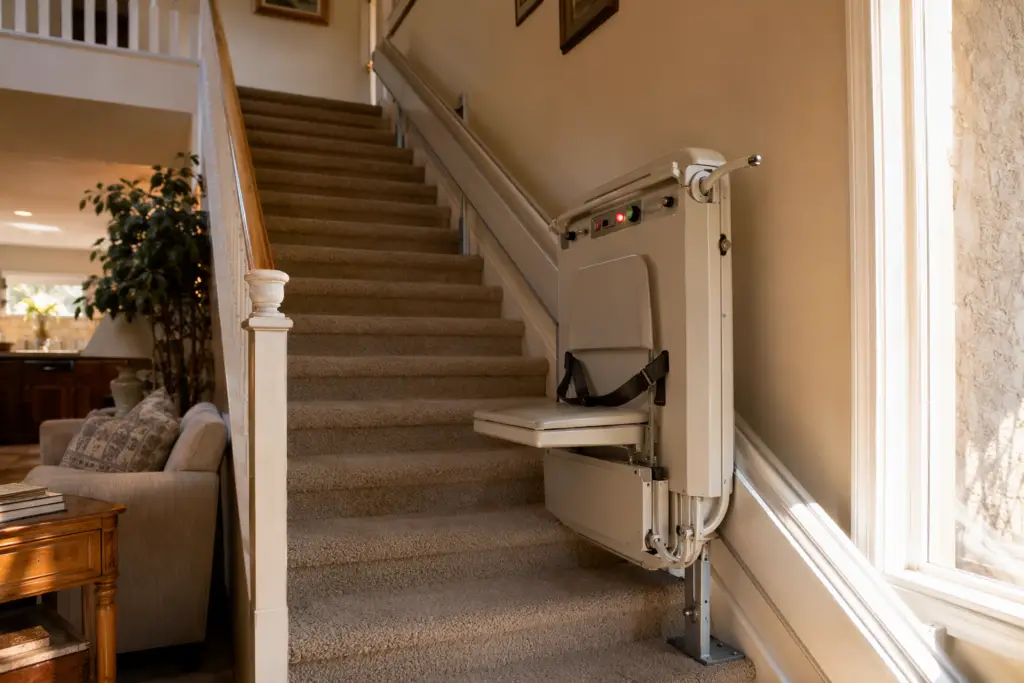
California law exempts conveyances under federal jurisdiction and conveyances in single-unit private homes that are not accessible to the public, so owners of those conveyances should confirm whether the compliance order applies before engaging a CQCC.
What should building owners in Los Angeles know about local versus state compliance orders?
Los Angeles operates its own elevator and conveyance inspection program through the Los Angeles Department of Building and Safety, so a compliance order in Los Angeles may originate from LADBS rather than Cal/OSHA.
Property owners in Los Angeles who receive a compliance order should read the order header carefully to identify whether it comes from the Cal/OSHA Elevator Unit or from LADBS, as the response procedures and reinspection scheduling may differ between the two programs. A CQCC familiar with Los Angeles’s local program — such as Liftech Elevator, which serves the Los Angeles market — will understand the procedural distinctions and ensure the estimate and corrective work satisfy the requirements of the issuing authority. Owners in Long Beach, Signal Hill, and Orange County are generally under Cal/OSHA’s statewide program.
How do CQCC and CCCM certificate renewal requirements affect service continuity?
California CQCC and CCCM certificates are valid for two years and require at least eight hours of continuing education for renewal, which means property owners should confirm that their elevator company’s certifications are current before work begins.
Certificate expiration is a compliance risk that is easy to overlook. If a CQCC’s certification lapses between the estimate and the completion of corrective work, the work performed during the lapse period may not be recognized by Cal/OSHA toward satisfying the compliance order. Property owners should request a copy of the company’s current CQCC certificate and confirm mechanic CCCM status before authorizing work. Reputable companies maintain internal renewal calendars to ensure continuous certification.
What questions should a property owner ask a CQCC during the estimating process?
Property owners should ask specific, verifiable questions to confirm the company’s qualifications, understanding of the compliance order, and plan for permit reinstatement.
Recommended questions include:
- What is your current Cal/OSHA CQCC certification number, and when does it expire?
- What is your current CSLB C-11 license number?
- Have the mechanics you will assign to this job obtained current CCCM certification from Cal/OSHA?
- Can you provide a line-by-line breakdown of how each cited violation will be corrected?
- Which ASME A17.1 or Title 8 sections are referenced by the violations in my compliance order?
- How will you coordinate the reinspection with the Cal/OSHA Elevator Unit (or LADBS, if in Los Angeles)?
- What is a realistic timeline from site assessment to permit reinstatement?
- Does the estimate include a contingency for additional deficiencies discovered during corrective work?
- Do you offer a full maintenance contract, and would it qualify this unit for a two-year permit?
Liftech Elevator, serving property owners throughout Signal Hill, Long Beach, Los Angeles, and Orange County, is prepared to answer each of these questions in writing as part of its assessment process.
What is the new elevator installation permit requirement, and how does it differ from a compliance-order inspection?
California requires a Cal/OSHA permit before a new elevator is erected, installed, or materially altered, and the new unit must pass a Cal/OSHA inspection and receive a permit to operate before it is placed in service — a distinct process from satisfying a compliance order on an existing unit.
For property owners or developers planning a new installation or a material alteration in 2026, the permitting path begins before construction rather than after a violation is found. The estimate for a new installation or alteration permit should include the design review, the installation work by a CQCC, and the final inspection by a Cal/OSHA safety engineer or CCCI before the elevator may carry passengers or freight. This is separate from — and should not be confused with — the corrective-inspection process triggered by a compliance order on an elevator already in service.
How can property owners in Signal Hill, Long Beach, Los Angeles, and Orange County get started?
Property owners in these markets should contact a locally operating CQCC that understands California’s regulatory framework, the Cal/OSHA Elevator Unit’s procedures, and — for Los Angeles properties — the LADBS local program.
Proximity matters in compliance situations because a company that regularly coordinates reinspections with the Cal/OSHA Elevator Unit’s regional offices and the Los Angeles Department of Building and Safety can often move through the scheduling queue more efficiently than an out-of-area vendor unfamiliar with local procedures. Liftech Elevator operates across Signal Hill, Long Beach, Los Angeles, and Orange County, and focuses on California-specific compliance requirements under the Labor Code, Title 8 Elevator Safety Orders, and applicable ASME A17.1 standards.
Contact Liftech Elevator for a free elevator assessment at 562-997-3639.
Need elevator service you can rely on? Liftech Elevator is ready to help.