Switching elevator maintenance contractors is a straightforward legal right for California building owners, but the process carries real compliance obligations. A poorly managed transition can interrupt a unit’s permit to operate, create gaps in maintenance documentation, or expose a property to liability. This FAQ hub walks through every aspect of the switch — from vetting credentials to protecting inspection history — so owners and property managers in Signal Hill, Long Beach, Los Angeles, and Orange County can make the change confidently and compliantly.
What Are the Legal Requirements for an Elevator Maintenance Contractor in California?

In California, any company that maintains, repairs, or services elevators must be certified by Cal/OSHA as a Certified Qualified Conveyance Company (CQCC) and hold a C-11 Elevator Contractor license issued by the California Contractors State License Board.
These two credentials are not interchangeable. The Cal/OSHA Elevator Unit, California Department of Industrial Relations issues the CQCC certification and oversees compliance with the California Code of Regulations, Title 8, Elevator Safety Orders (Sections 3000–3146). The California Contractors State License Board (CSLB) issues the C-11 license, which governs the contracting side of the business. A company presenting only one of these credentials is not legally authorized to maintain elevators in California.
Additionally, every mechanic who works on a conveyance without direct supervision must hold a Cal/OSHA Certified Competent Conveyance Mechanic (CCCM) certification. CQCC, CCCM, and conveyance inspector certificates are valid for two years and require at least eight hours of continuing education for renewal. Building owners should request copies of both company and individual mechanic credentials before signing any maintenance agreement.
Can a Building Owner Switch Elevator Contractors at Any Time?
Yes — California law does not restrict when a building owner may change elevator maintenance providers, but the owner must ensure continuous compliance with California Labor Code Sections 7300–7324.2 throughout the transition.
The critical concern is not the switch itself but the continuity of the permit to operate. Under California law, no elevator may be operated without a valid, current permit issued by Cal/OSHA. That permit is tied to the elevator unit and the building, not to the contractor. However, the permit’s validity period — which can extend to two years for units covered by a full maintenance contract with a C-11 licensed company — may be affected if the new contractor does not immediately fulfill the full-maintenance-contract requirement.
Owners should also review the existing maintenance contract for termination clauses, notice periods, and provisions covering the return of maintenance logs and equipment keys. Giving proper contractual notice protects against disputes and ensures the outgoing contractor cooperates with the handover.
What Is a Full Maintenance Contract and Why Does It Matter?
A full maintenance contract is a service agreement under which a CQCC-certified, C-11-licensed elevator company assumes comprehensive responsibility for keeping a conveyance in safe operating condition, covering routine inspections, lubrication, adjustments, and repair of worn or failed components.
The distinction matters for permit duration. California law allows Cal/OSHA to issue a permit to operate for up to two years — rather than the standard one year — for an elevator in safe condition that is covered by a full maintenance contract with a qualifying company. When a building owner switches contractors, the gap between the outgoing and incoming full maintenance contracts should be as short as possible. A period without a qualifying contract may revert the unit to annual permit cycles and, more importantly, leaves the owner without an authorized party responsible for day-to-day safety.
When evaluating a prospective contractor, owners should ask specifically whether the offered agreement qualifies as a full maintenance contract under the California Elevator Safety Orders and confirm in writing that the incoming company’s CQCC certification is current before the outgoing contractor’s agreement terminates.
How Do I Verify That a New Elevator Contractor Is Properly Certified in California?
Verification requires checking two separate government databases: Cal/OSHA’s CQCC certification roster and the CSLB license lookup for the C-11 classification.
The Cal/OSHA Elevator Unit maintains records of certified companies and mechanics. Owners can contact the unit directly to confirm a company’s CQCC status and verify that its individual mechanics hold current CCCM certifications. The CSLB license lookup is publicly available online and displays license status, expiration, and any disciplinary actions. Both checks take only a few minutes and should be completed before any contract is signed.
A properly credentialed contractor should voluntarily provide: the CQCC certificate number and expiration date, the C-11 license number, proof of current workers’ compensation insurance, proof of general liability insurance, and a list of CCCM-certified mechanics assigned to the account. If a prospective provider hesitates to supply any of these documents, that hesitancy is itself a warning sign.
What Steps Should a Building Owner Follow to Switch Elevator Contractors?
A structured transition process protects compliance status, preserves maintenance history, and reduces the risk of equipment downtime.
- Review the current maintenance contract for termination notice requirements and any automatic renewal clauses, and submit written notice to the outgoing contractor within the required window.
- Verify that candidate replacement companies hold a current Cal/OSHA CQCC certification and a CSLB C-11 license before requesting proposals.
- Request proposals from at least two or three certified contractors, comparing scope of services, response provisions, parts coverage, and pricing structure.
- Confirm with the incoming contractor that their agreement qualifies as a full maintenance contract under California Elevator Safety Orders so the two-year permit option remains available.
- Obtain all maintenance logs, inspection reports, permit-to-operate copies, equipment keys, lubrication records, and repair history from the outgoing contractor — this documentation belongs to the building owner, not the service company.
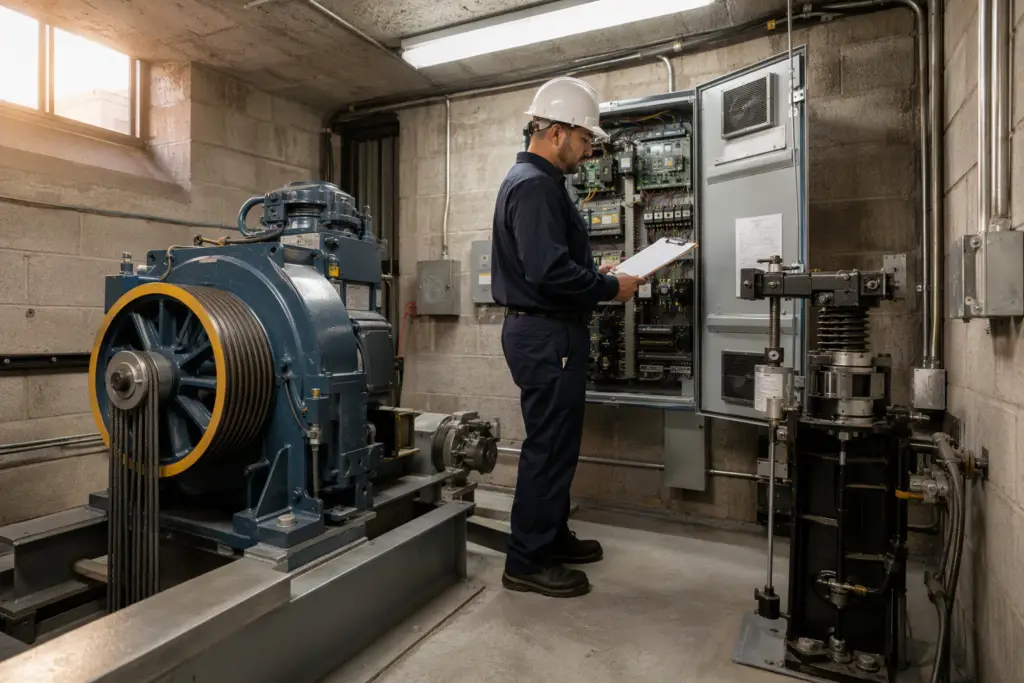
- Schedule a baseline inspection or condition assessment with the incoming contractor before the first maintenance visit, so both parties agree on the current state of the equipment.
- Notify Cal/OSHA or the relevant Authority Having Jurisdiction (AHJ) — including the Los Angeles Department of Building and Safety (LADBS) for Los Angeles properties, which runs its own elevator inspection program — of the contractor change if required by local process.
- Confirm that the permit to operate remains current and posted conspicuously in the elevator car throughout the transition, as required by California law.
- File the new contractor’s credentials and insurance certificates with building records and set calendar reminders for CQCC and CCCM certificate renewals.
What Documentation Should the Outgoing Contractor Return to the Building Owner?
The outgoing contractor must return all records that belong to the building, including the complete maintenance log, inspection reports, any Cal/OSHA correspondence, the current permit to operate, equipment drawings, and any spare parts or proprietary tools supplied under the contract.
Maintenance documentation is critical for the incoming contractor to understand the service history and for Cal/OSHA inspectors to confirm that the conveyance has been maintained in accordance with the California Code of Regulations, Title 8. Gaps in maintenance records can complicate annual reinspections, which remain the building owner’s responsibility under California law regardless of who performs the maintenance.
If the outgoing contractor delays returning records, the building owner should send a formal written demand referencing the contract terms and, if necessary, consult legal counsel. In practice, most professional contractors cooperate fully once proper notice has been given and the contract period has ended.
Does Switching Contractors Affect My Elevator’s Permit to Operate?
A change of contractor does not automatically invalidate the permit to operate, but the permit’s extended two-year term may be affected if there is a gap in full maintenance contract coverage.
The permit to operate under California Labor Code and the California Code of Regulations, Title 8 is issued to the elevator unit and must be posted in the car at all times. It remains valid through its expiration date regardless of which contractor holds the maintenance agreement at any given moment. However, the building owner is responsible for arranging the annual reinspection, and if the permit expires during a contractor transition, the elevator must be taken out of service until a new permit is issued — a costly and disruptive outcome that careful planning avoids.
Owners should track permit expiration dates independently of the maintenance contractor and ensure the incoming contractor understands the upcoming inspection timeline before the transition is finalized.
Can a Contractor Lock Me Into Proprietary Equipment That Makes Switching Difficult?
Yes — some contractors install proprietary controllers, monitoring systems, or software that require the same vendor for ongoing service, effectively creating a switching barrier even when no contractual lock-in exists.
This practice is an important factor to evaluate before any modernization or repair project. Building owners should ask prospective contractors whether proposed components use open or proprietary interfaces and whether another CQCC-certified company could service the equipment after installation. Requesting this clarification in writing before approving a modernization project can prevent years of vendor dependency.
When taking over a unit with proprietary components, a qualified incoming contractor should perform a thorough assessment to determine whether third-party servicing is technically feasible, whether the original equipment manufacturer’s support is still available, and what — if any — conversion work would be needed. Liftech Elevator performs baseline condition assessments when taking over maintenance accounts, specifically to surface these compatibility issues early.
What Should I Look for When Comparing Elevator Maintenance Proposals?
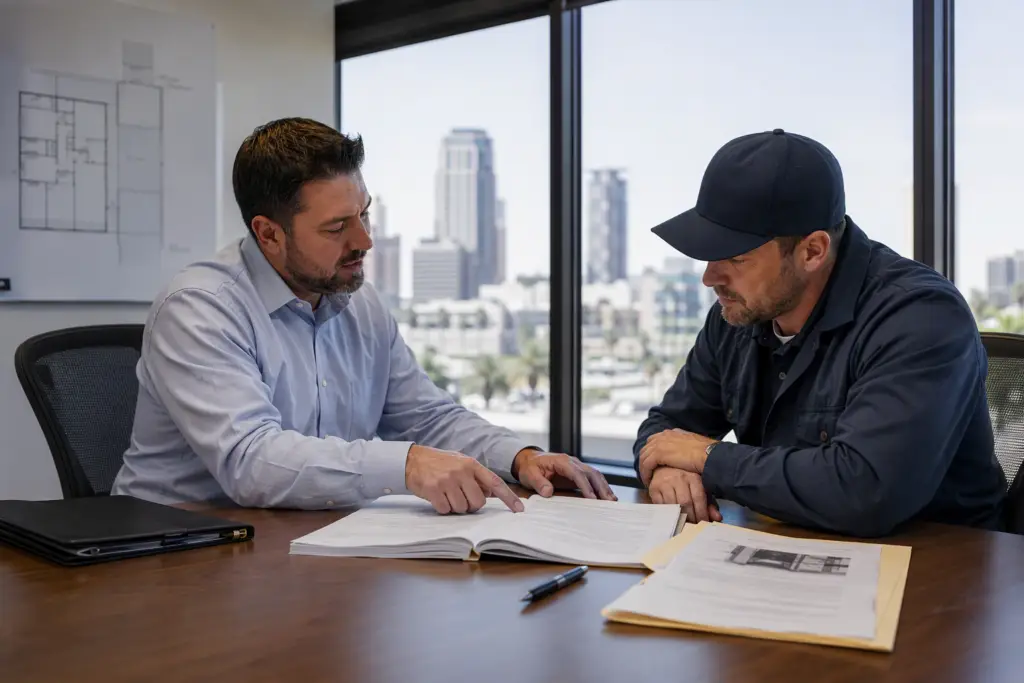
Beyond price, a well-structured maintenance proposal should clearly define the scope of covered services, the qualifications of assigned mechanics, parts coverage limits, and the process for emergency calls and permit-related inspections.
| Proposal Element | Minimum Standard | Strong Contract Language |
|---|---|---|
| Contractor credentials | CQCC certification + C-11 license provided on request | Credentials attached to contract; renewal dates specified |
| Mechanic qualifications | CCCM certification confirmed verbally | Named CCCM-certified mechanics listed; substitution policy stated |
| Scope of maintenance | Routine lubrication and adjustment only | Full maintenance per California Elevator Safety Orders; parts coverage defined |
| Inspection coordination | Owner reminded of annual inspection deadline | Contractor prepares unit and coordinates with Cal/OSHA or AHJ on owner’s behalf |
| Documentation | Logs available on request | Logs delivered to owner at contract termination; digital access during term |
| Insurance | Proof available on request | Certificates of workers’ comp and liability attached; owner named as additional insured |
| Permit continuity | Not addressed | Contractor confirms full-maintenance-contract qualification for two-year permit eligibility |
| Proprietary components | Not disclosed | Open-platform policy stated; proprietary elements disclosed with alternatives offered |
Owners in Los Angeles should also confirm whether the prospective contractor is familiar with the LADBS elevator inspection program, since Los Angeles operates its own program alongside Cal/OSHA’s statewide oversight.
How Does the Annual Inspection Requirement Interact with a Contractor Switch?
California law requires every conveyance to be inspected at least once per year, and arranging that reinspection is the elevator owner’s responsibility — meaning the obligation follows the building, not the contractor.
If a contractor switch occurs in the months before an inspection is due, the incoming contractor needs enough lead time to review maintenance records, address any outstanding deficiencies, and prepare the unit. Arriving at an inspection with deferred maintenance items identified by the previous contractor is a common and avoidable problem. Best practice is to request a condition report from the outgoing contractor as part of the termination process and share it with the incoming contractor before the first service visit.
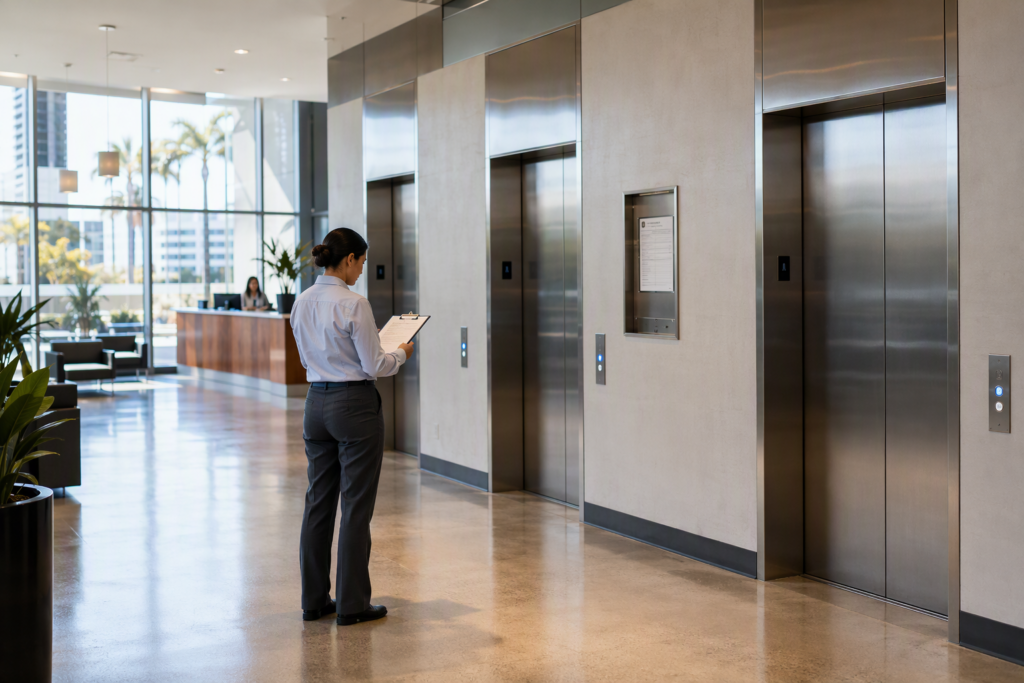
Only State of California safety engineers and Certified Competent Conveyance Inspectors (CCCI) may perform elevator inspections in California. The maintenance contractor facilitates and prepares for the inspection but does not conduct it. Building owners should clarify with the incoming contractor exactly what pre-inspection preparation is included in the maintenance agreement.
What Happens If My Elevator Has Outstanding Violations When I Switch Contractors?
Outstanding violations, correction orders, or deficiency notices from Cal/OSHA or the local AHJ remain attached to the elevator unit and must be resolved regardless of which contractor holds the maintenance agreement.
A contractor transition does not reset or suspend compliance deadlines. If the previous contractor was cited for a deficiency, the building owner — not the outgoing contractor — is ultimately responsible for correcting it within the timeframe specified by the authority. The incoming contractor should be made aware of all open items before taking over the account, and the written handover documentation should include copies of any outstanding orders.
In some cases, outstanding violations may reflect deferred work that the outgoing contractor was slow to address. One practical benefit of switching is the opportunity to bring in a contractor who will prioritize clearance of the backlog. A thorough baseline assessment at contract start is the most reliable way to identify and document the full scope of open items.
Does the ASME A17.1 Safety Code Apply When Switching Contractors?
Yes — the ASME A17.1/CSA B44 Safety Code for Elevators and Escalators establishes the technical standards that govern elevator maintenance, inspection, testing, and repair in California regardless of which contractor is performing the work.
California has adopted the ASME A17.1/CSA B44, 2004 edition as part of its Group IV Elevator Safety Orders, effective May 1, 2008, for installation contracts signed on or after that date. As of 2026, California has proposed a Group V update that would incorporate portions of ASME A17.1-2019; the Standards Board held a public hearing on June 18, 2026, and no effective date has been posted. Building owners and incoming contractors should monitor the Cal/OSHA Elevator Unit for updates on when the new edition takes effect.
The incoming contractor’s mechanics must be familiar with the applicable code edition. During a baseline assessment, Liftech Elevator reviews the unit’s compliance posture against the currently adopted ASME code and flags any conditions that may require attention before the next inspection.
Are There ADA Considerations When Switching Elevator Contractors?
Yes — ADA accessibility requirements for elevators are federal obligations that apply continuously and are not affected by a contractor change, but a contractor transition is an opportune moment to audit the unit’s ADA compliance status.
The ADA requires that elevators in places of public accommodation and commercial facilities meet specific standards covering door timing, call button height, floor indicators, cab dimensions, and tactile and audible signals, among other elements. Deferred maintenance items — such as failed floor annunciators, damaged braille signage, or improperly functioning door sensors — may constitute ADA compliance gaps that the building owner is liable for regardless of maintenance history.
A well-structured baseline assessment at the start of a new maintenance relationship should include an ADA accessibility review. Owners of multi-unit residential properties, commercial buildings, and mixed-use developments in Long Beach, Los Angeles, and Orange County should confirm that the incoming contractor is familiar with ADA vertical accessibility requirements and can identify deficiencies proactively.
What Role Does the Local Authority Having Jurisdiction Play in a Contractor Switch?
The Authority Having Jurisdiction (AHJ) is the government body with enforcement authority over elevator safety in a given location — typically Cal/OSHA statewide, but Los Angeles has its own program through the Los Angeles Department of Building and Safety (LADBS).
For most properties in California, the AHJ is the Cal/OSHA Elevator Unit. However, Los Angeles operates its own elevator and conveyance inspection program through LADBS. Property owners in Los Angeles should confirm with LADBS whether any notification or updated contractor information is required when changing elevator service providers. For properties in Signal Hill, Long Beach, and Orange County, the Cal/OSHA process governs.
Regardless of jurisdiction, the permit to operate must remain posted in the elevator car throughout the transition. Any lapse in permit validity — even brief — creates exposure for the building owner and may require the unit to be taken out of service pending reinspection.
How Long Does a Contractor Transition Typically Take?
A well-organized contractor transition — from issuing termination notice to having the new contractor fully on contract and performing their first maintenance visit — generally spans the length of the contractual notice period plus a brief onboarding phase for baseline assessment and documentation review.
The contractual notice period varies by agreement and may range from 30 to 90 days or more. Building owners should initiate the contractor search before submitting termination notice so that a qualified replacement is identified and ready to begin before the outgoing contractor’s agreement ends. Attempting to find a new contractor after issuing notice compresses the timeline and increases the risk of a gap in full maintenance contract coverage.
Liftech Elevator serves building owners in Signal Hill, Long Beach, Los Angeles, and Orange County and can typically schedule a baseline condition assessment promptly after contract execution to ensure a smooth handover with no interruption to permit status or inspection readiness.
What Questions Should I Ask a Prospective Elevator Maintenance Contractor Before Signing?
Asking the right questions before signing a maintenance contract separates credentialed, experienced providers from those who may cut corners on compliance or documentation.
Recommended questions include: Is your company currently certified as a CQCC by Cal/OSHA, and can you provide the certificate number and expiration date? Are all mechanics assigned to our account CCCM-certified? Does your maintenance agreement qualify as a full maintenance contract for purposes of Cal/OSHA’s two-year permit eligibility? How do you handle pre-inspection preparation and documentation for the annual Cal/OSHA reinspection? What is your policy on returning maintenance logs and records if we choose not to renew? Do any components you propose to install use proprietary interfaces that would restrict future service options? What insurance coverage do you carry, and will you name our building as an additional insured?
A contractor who answers these questions clearly and provides documentation promptly demonstrates the operational maturity and compliance orientation that elevator maintenance in California requires.
Is It More Complicated to Switch Contractors for Older or Modernized Elevators?
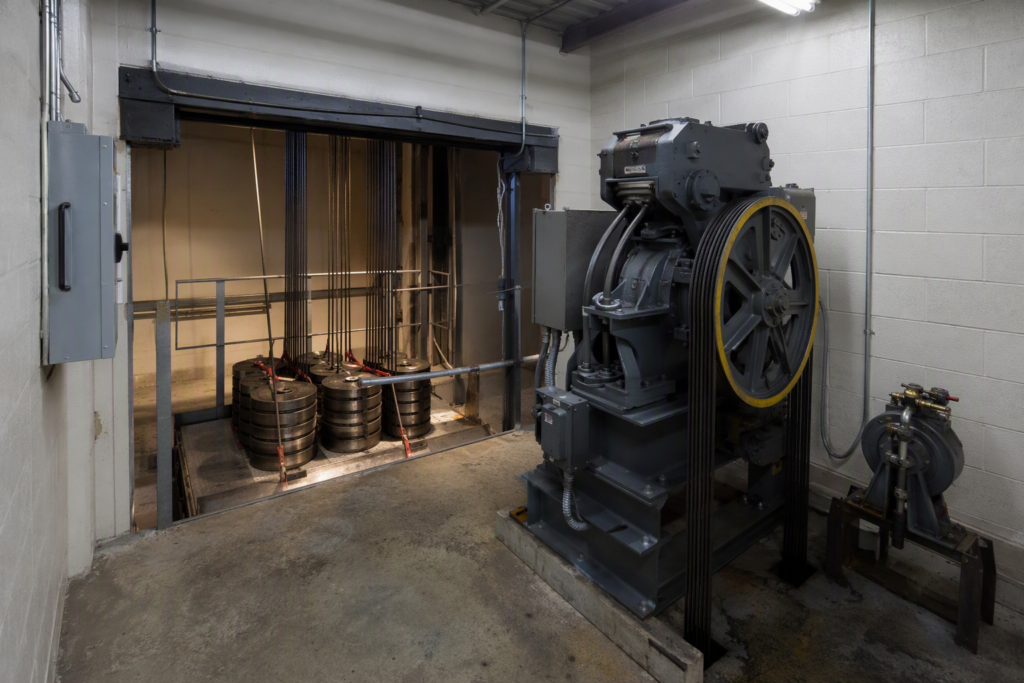
Older elevators and units that have undergone partial modernizations can present additional complexity during a contractor transition, particularly when maintenance records are incomplete or when modernization work was performed using proprietary components.
For older units originally installed under earlier code editions, the incoming contractor must understand what standards were in force at the time of installation and what subsequent alterations, if any, have brought the unit into compliance with the currently adopted ASME A17.1/CSA B44 Safety Code. California’s Elevator Safety Orders under Title 8 govern existing installations differently from new ones, and a thorough review of prior inspection reports is essential to understanding the unit’s compliance history.
For modernized elevators, the incoming contractor should obtain all modernization permits and Cal/OSHA approval documentation. Under California law, a permit from Cal/OSHA is required before a conveyance is materially altered, so verifying that prior modernization work was properly permitted is part of responsible due diligence during any ownership or contractor change.
What Are the Risks of Using an Uncertified Elevator Contractor in California?
Using a contractor that lacks Cal/OSHA CQCC certification or a CSLB C-11 license exposes the building owner to regulatory penalties, potential permit revocation, insurance coverage gaps, and liability for any injuries that occur.
Under California Labor Code Sections 7300–7324.2 and the California Code of Regulations, Title 8, only a CCCM working for a CQCC may maintain, repair, alter, or replace components on a conveyance. Work performed by an uncertified company is not legally authorized, and Cal/OSHA has authority to take enforcement action against both the contractor and the building owner. From an insurance standpoint, a carrier may dispute coverage for a claim arising from work performed by an unlicensed or uncertified contractor.
Budget-based decisions that prioritize lowest price over verified credentials carry disproportionate risk in the elevator context, where mechanical failure can result in serious injury. The two-step credential verification — CQCC through Cal/OSHA and C-11 through CSLB — takes minutes and eliminates this exposure entirely.
How Can Switching Contractors Improve My Elevator’s Performance and Compliance?
A contractor transition, when executed thoughtfully, is an opportunity to reset the maintenance relationship, address accumulated deferred work, improve documentation practices, and align the service agreement with current California regulatory requirements.
Buildings that have been with the same contractor for many years sometimes accumulate deferred maintenance items, aging lubrication schedules, or outdated inspection preparation practices. An incoming contractor approaching the account with fresh eyes and a structured baseline assessment can identify these issues before they escalate to violations or equipment failures. Reviewing the unit against the currently adopted ASME A17.1/CSA B44 code and California Elevator Safety Orders as part of onboarding sets a clear compliance baseline going forward.
Property managers in Long Beach, Signal Hill, Los Angeles, and Orange County who work with Liftech Elevator report that a structured account transition — beginning with a documented baseline assessment and a clear service scope — provides greater transparency into equipment condition and compliance status than a continuation of a poorly documented prior relationship.
What Should I Know About Elevator Maintenance Contracts in California Before Switching?
California does not mandate a specific maintenance contract form, but the structure of the agreement directly affects permit duration, cost predictability, liability allocation, and the ease of any future contractor change.
Key contract provisions to evaluate include: the definition of “full maintenance” and whether it aligns with the California Elevator Safety Orders; parts and labor coverage limits and exclusions; the process for handling emergency repairs; record-keeping obligations and data ownership; insurance requirements; termination notice periods; and any provisions that restrict the owner’s right to switch contractors or require the use of proprietary components. Owners of large portfolios or complex installations in Los Angeles or Orange County may benefit from having legal counsel review the agreement, particularly regarding intellectual property in controller software and documentation ownership at contract end.
A clear, well-structured maintenance contract is the foundation of a compliance-oriented elevator service relationship — and the single best protection against the complications that can arise during a future contractor transition.
Contact Liftech Elevator for a free elevator assessment at 562-997-3639.
Need elevator service you can rely on? Liftech Elevator is ready to help.