Elevator Servicing: Comparison and Decision Guide
Choosing the right elevator servicing approach means weighing regulatory compliance, service contract type, contractor credentials, and inspection timing — all of which directly affect safety, building liability, and permit status in California.
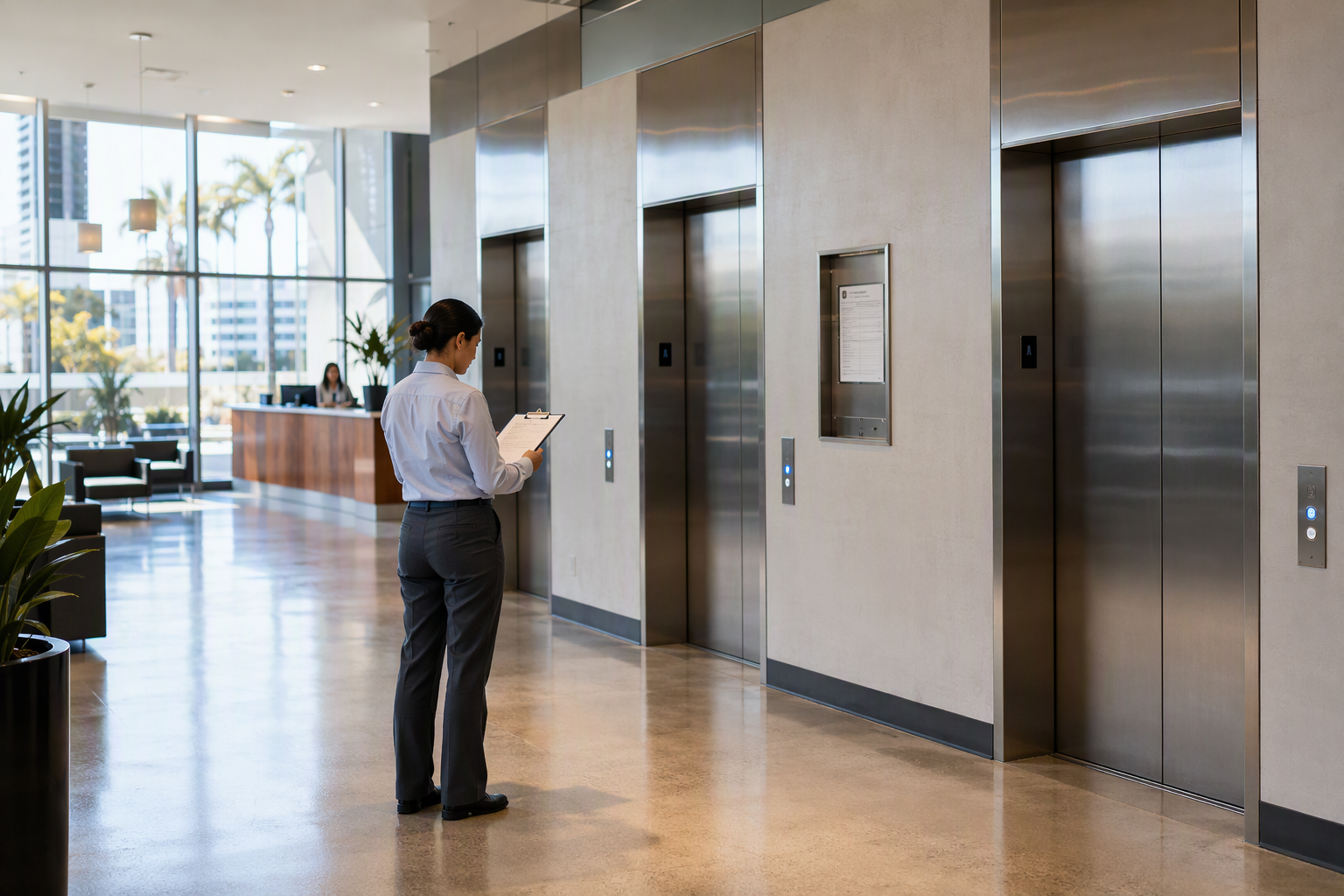
Elevator servicing is not a single task — it is an ongoing obligation that spans preventive maintenance, code-required inspections, repairs, and permit management. In California, the rules governing who may touch an elevator, how often it must be inspected, and what credentials a servicing company must hold are defined by state law and enforced by Cal/OSHA’s Elevator Unit, California Department of Industrial Relations. This guide explains every factor a building owner or facilities manager should compare before selecting a service provider or contract type.
What Does Elevator Servicing Include?
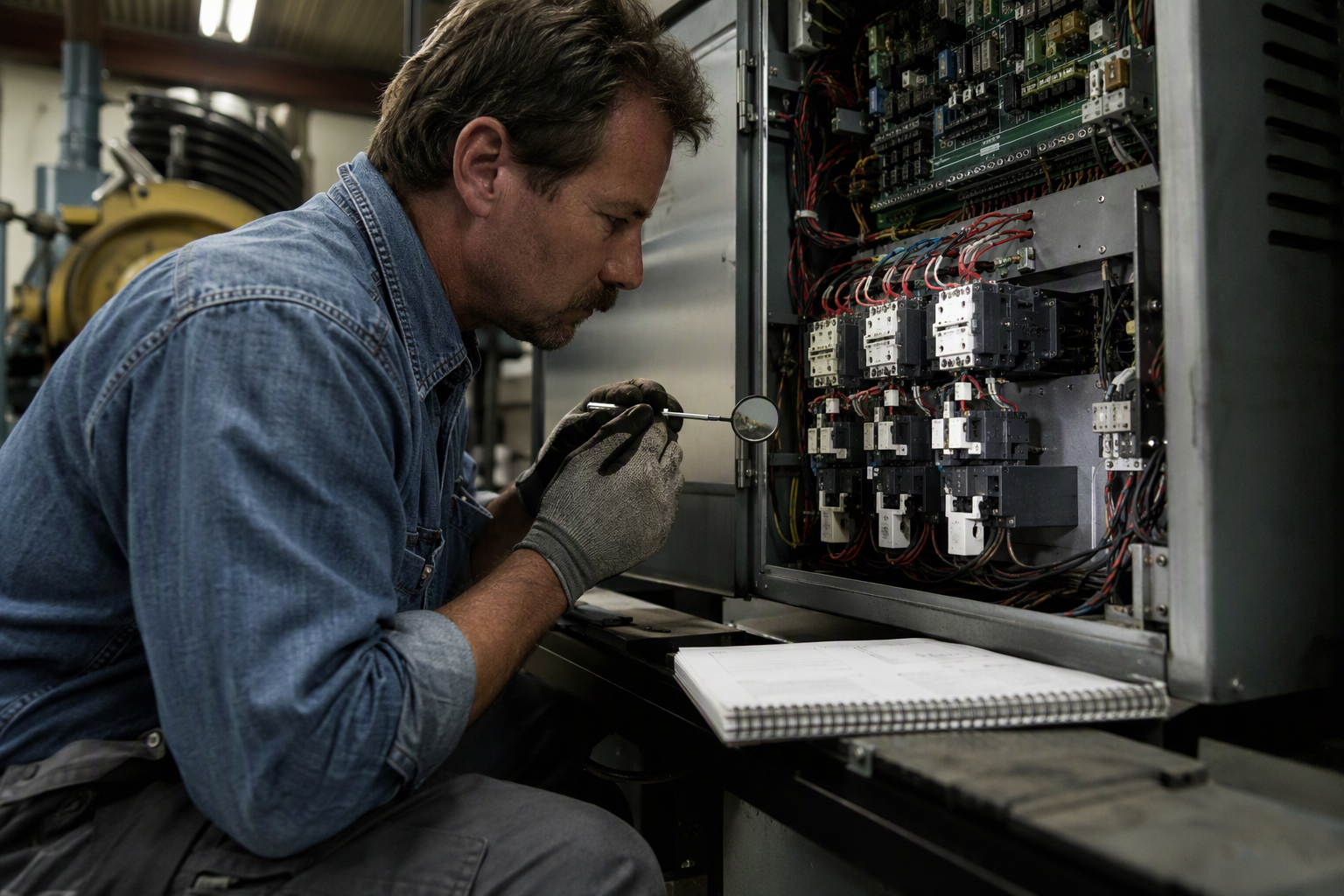
Elevator servicing covers the full lifecycle of keeping a conveyance safe, legal, and operational. At a minimum, servicing encompasses:
- Preventive maintenance — lubrication, adjustment, cleaning, and component inspection on a scheduled basis
- Corrective repairs — replacement of worn or failed parts
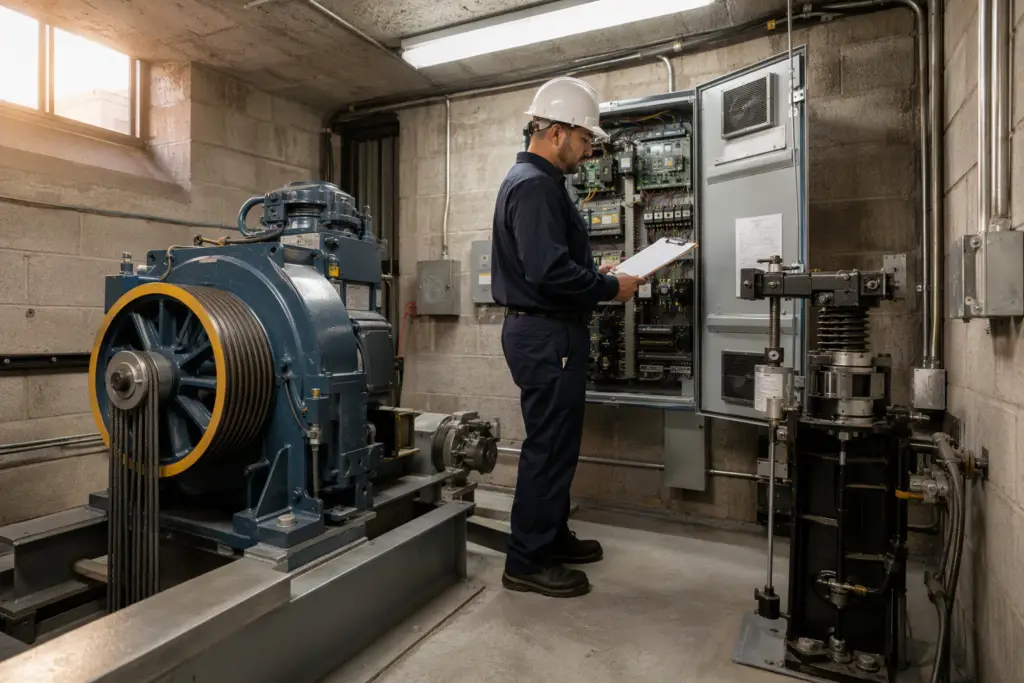
- Safety testing — load tests, governor tests, and brake tests as required by applicable codes
- Inspection coordination — scheduling the annual inspection required under California law and ensuring the conveyance is ready
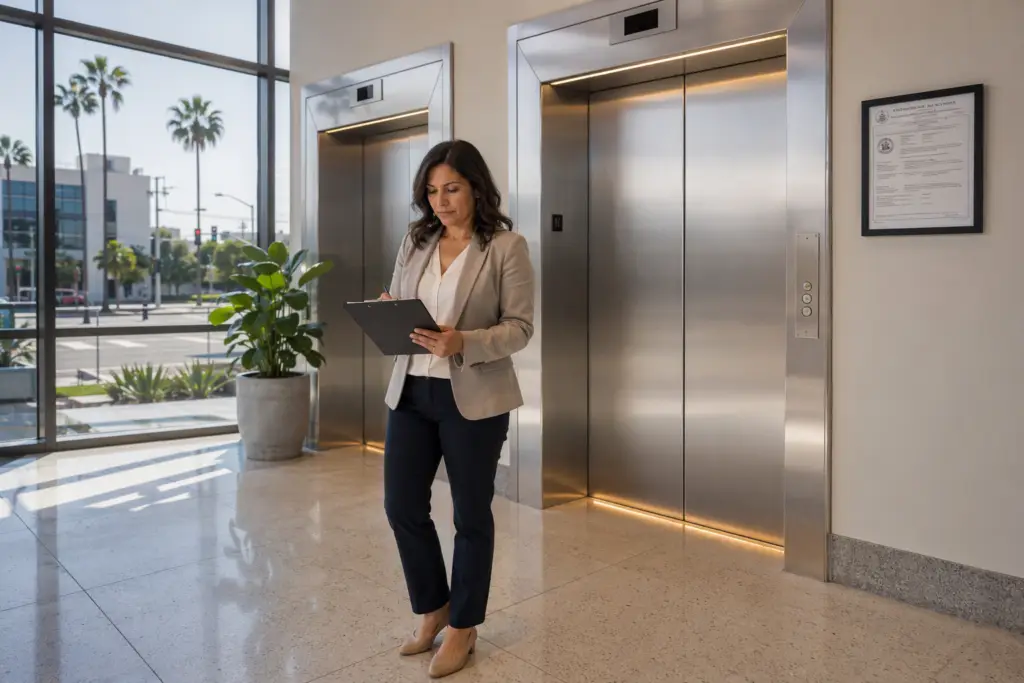
- Permit management — tracking permit expiration, renewing the permit to operate, and posting it conspicuously in the car as required by California law
- Alteration work — any material change to the conveyance, which requires a separate Cal/OSHA permit before work begins
Under California Labor Code Sections 7300–7324.2 and the California Code of Regulations, Title 8, Elevator Safety Orders (Sections 3000–3146), only a Certified Competent Conveyance Mechanic (CCCM) working for a Certified Qualified Conveyance Company (CQCC) may maintain, repair, alter, or replace components on a conveyance. Both certifications are issued by Cal/OSHA and must be renewed every two years, with at least eight hours of continuing education required at each renewal.
Full Maintenance vs. Partial Maintenance Contracts: Which Is Right for Your Building?
| Factor | Full Maintenance Contract | Partial (Preventive-Only) Contract | Time-and-Materials (No Contract) |
|---|---|---|---|
| Scope | Scheduled maintenance plus parts and labor for most repairs | Scheduled maintenance visits only; repairs billed separately | Work ordered and billed each time a problem arises |
| Budget predictability | High — fixed monthly cost | Moderate — maintenance cost is fixed, repair cost is variable | Low — all costs are variable |
| California permit benefit | Cal/OSHA may issue a permit to operate for up to two years (vs. the standard one year) when the elevator is covered by a full maintenance contract with a C-11 licensed elevator company | Standard annual permit only | Standard annual permit only |
| Downtime risk | Lower — proactive parts replacement | Moderate | Higher — repairs reactive |
| Best for | High-traffic commercial, residential, and healthcare buildings | Low-traffic or budget-constrained properties | Single-unit or seldom-used conveyances |
| Regulatory compliance support | Typically included | Often extra | Owner’s responsibility |
Key takeaway: A full maintenance contract with a CQCC-certified company is the only contract type that can unlock the two-year permit to operate under California law, reducing inspection frequency and administrative burden for building owners.
Contractor Credential Comparison: What to Verify Before Signing
| Credential | Issued by | Why It Matters | Renewal |
|---|---|---|---|
| Certified Qualified Conveyance Company (CQCC) | Cal/OSHA Elevator Unit | Legally required to perform any maintenance, repair, alteration, or installation in California | Every two years; requires C-11 license and insurance documentation |
| C-11 Elevator Contractor License | California Contractors State License Board (CSLB) | Required to apply for CQCC certification; confirms financial and trade accountability | Per CSLB schedule |
| Certified Competent Conveyance Mechanic (CCCM) | Cal/OSHA Elevator Unit | Individual mechanic authorization; unsupervised work on a California elevator is illegal without this | Every two years; 8 hours continuing education required |
| Workers’ Compensation & Liability Insurance | Private insurer; verified by Cal/OSHA at CQCC application | Protects building owner from liability for on-site injuries | Must remain current throughout CQCC certification period |
Practical step: Before awarding any service contract, ask the vendor for their current CQCC certification number and verify it with Cal/OSHA. Verify mechanics assigned to your property hold active CCCM certificates. Hiring an uncertified company or mechanic exposes the building owner to Cal/OSHA penalties and potential liability.
How Does California’s Annual Inspection Requirement Work?
California law requires every conveyance to be inspected at least once a year. Only State of California safety engineers and Certified Competent Conveyance Inspectors (CCCI) may perform these inspections. The building owner — not the service company — is legally responsible for arranging the annual reinspection. A conveyance found to be in safe condition receives a permit to operate for up to one year. As noted above, an elevator covered by a full maintenance contract with a C-11 licensed company may receive a permit valid for up to two years.
The permit to operate must be posted conspicuously inside the elevator car at all times. Operating an elevator without a valid, current permit is a violation of California law.
For properties within the City of Los Angeles, note that Los Angeles runs its own elevator and conveyance inspection program through the Department of Building and Safety (LADBS) in addition to state requirements.
What Code Standards Govern Elevator Servicing in California?
California has adopted the ASME A17.1/CSA B44 Safety Code for Elevators and Escalators (2004 edition, Group IV Elevator Safety Orders), effective May 1, 2008, for installation contracts signed on or after that date. This code establishes requirements for design, construction, installation, operation, inspection, testing, maintenance, alteration, and repair of elevators and related conveyances.
In 2026, California is in the process of proposing a Group V update to its Elevator Safety Orders that would incorporate elements of ASME A17.1-2019; the Standards Board held a public hearing on June 18, 2026, and no effective date has been posted. Building owners and service providers should monitor Cal/OSHA’s Elevator Unit page for updates.
Federal accessibility requirements under the Americans with Disabilities Act (ADA) also apply to public-facing elevators and inform accessibility-related servicing decisions such as control height, door timing, and audible signals.
Workplace safety during elevator service work falls under OSHA standards at the federal level, covering confined space entry, lockout/tagout procedures, and fall protection for service technicians.
Pros and Cons of OEM (Manufacturer) Service vs. Independent Certified Service
| Factor | OEM (Original Equipment Manufacturer) Service | Independent Certified Service (e.g., Liftech Elevator) |
|---|---|---|
| Parts availability | Proprietary parts readily available; may limit third-party options | Multi-brand parts sourcing; often broader availability for legacy equipment |
| Contract flexibility | Often standardized contract terms | Typically more negotiable scope and pricing structures |
| California compliance | Must hold CQCC and employ CCCMs — same legal requirement applies to all companies | Same legal requirement; verify CQCC status directly with Cal/OSHA |
| Multi-brand capability | Optimized for own brand; may decline older or competitor equipment | Typically services multiple brands and older equipment |
| Pricing transparency | Variable; proprietary lock-in can limit competitive bidding | Generally more competitive due to open-market parts sourcing |
| Local responsiveness | Depends on regional coverage | Often stronger local presence in specific markets |
What Should Be Included in a Compliant Elevator Service Contract?
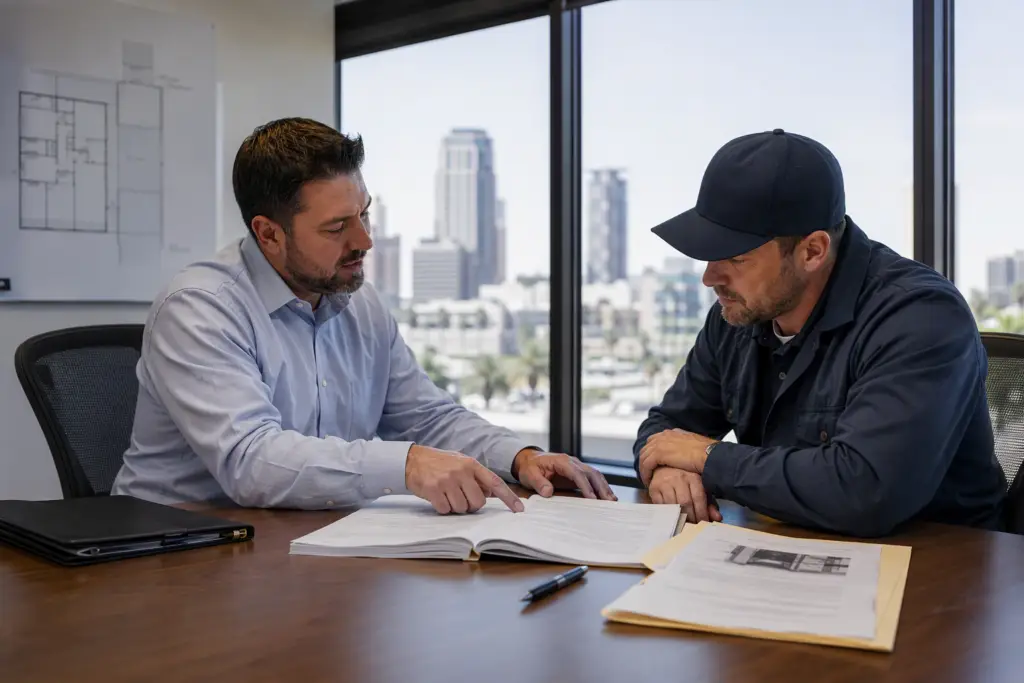
A well-structured elevator service contract in California should address the following at minimum:
- Verification of CQCC certification — the contract should identify the company’s Cal/OSHA CQCC certification and confirm that all mechanics assigned to the property are CCCM-certified.
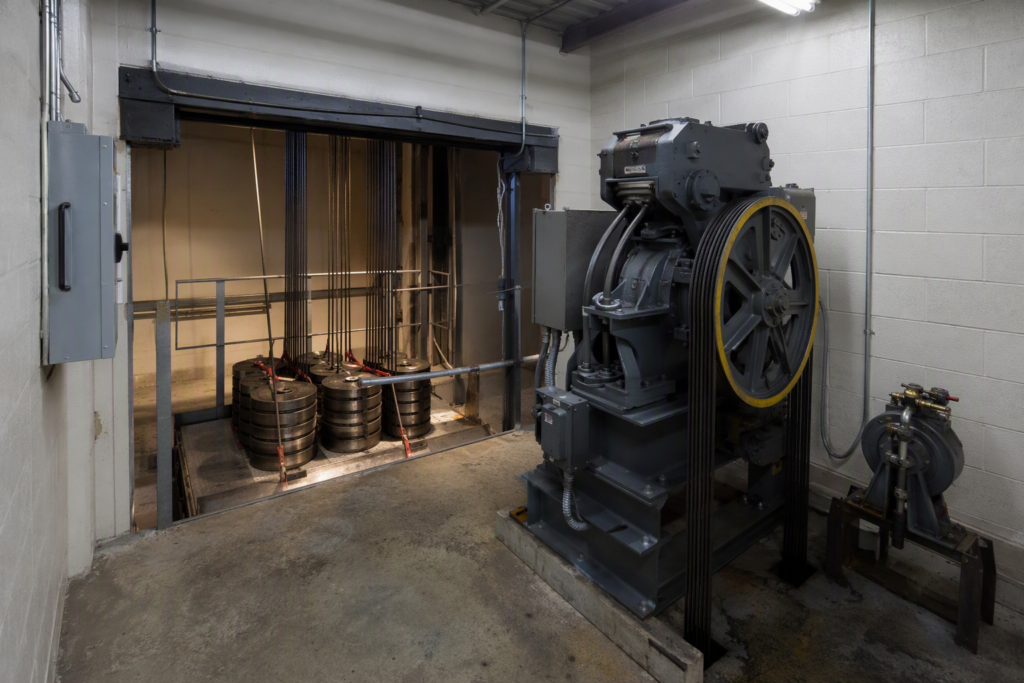
- Scope of maintenance visits — specify frequency, tasks performed at each visit, and which systems are covered (hydraulic, traction, machine room, pit, cab).
- Parts and labor terms — define what is included, excluded, and how out-of-scope repairs are authorized and priced.
- Inspection coordination clause — clarify who is responsible for scheduling the annual Cal/OSHA inspection and ensuring the unit passes.
- Permit management — address who tracks permit expiration and ensures the posted permit is current.
- Emergency callback provisions — define the process for responding to entrapments and equipment failures.
- Record-keeping obligations — maintenance logs and inspection records should be accessible to the building owner.
- Termination and transfer terms — particularly important when changing service providers; ensure access to equipment documentation and keys.
How Often Should Elevator Servicing Visits Occur?
Inspection frequency under California law is at least once annually. Maintenance visit frequency, however, is separate from inspection and depends on the type of conveyance, usage volume, equipment age, and contract type. High-traffic commercial elevators in office towers and healthcare facilities typically benefit from more frequent scheduled maintenance visits than low-traffic residential or freight units. The specific maintenance schedule should be documented in the service contract and aligned with the requirements of the ASME A17.1 Safety Code for Elevators and Escalators, which includes provisions for maintenance intervals and record-keeping.
What Happens if an Elevator Fails a California Inspection?
- Cease operation immediately — Cal/OSHA has authority to order a conveyance out of service if it poses a safety hazard. The unit must not be used until the deficiency is corrected and a new permit is issued.
- Document the deficiency notice — retain all written citations or deficiency notices from the inspector.
- Engage your CQCC-certified service company — only a CQCC company with CCCM mechanics may perform the corrective work.
- Obtain any required alteration permit — if the correction constitutes a material alteration, a Cal/OSHA permit is required before work begins.
- Request reinspection — once repairs are complete, the building owner must arrange the reinspection through Cal/OSHA or, in Los Angeles, through LADBS.
- Post the new permit — once issued, the updated permit to operate must be posted conspicuously in the car before the elevator returns to service.
Is ADA Compliance Part of Elevator Servicing?
The Americans with Disabilities Act (ADA) establishes accessibility requirements for elevators in public accommodations and commercial facilities. While ADA compliance is primarily addressed during installation or alteration, ongoing servicing plays a role in maintaining compliant operation. Service visits should confirm that door timing, call button height, floor indicators, and leveling accuracy remain within accessible standards. When material alterations are performed, California’s adopted code and applicable ADA standards both govern the scope of accessibility upgrades required. Building owners should discuss ADA implications with their certified service provider whenever considering alteration work.
How Do Building Owners Change Elevator Service Providers in California?
- Review the existing contract’s termination clause — identify notice periods and any equipment release requirements.
- Verify the new provider’s credentials — confirm CQCC certification and C-11 license before signing a new contract.
- Request all documentation from the outgoing provider — maintenance logs, inspection records, permit history, wiring diagrams, and proprietary codes for any controlled equipment.
- Schedule a condition assessment — the new provider should perform a documented evaluation of the equipment before assuming responsibility.
- Confirm permit status — ensure the current permit to operate is valid and posted; a provider transition does not extend or renew permit validity.
- Notify Cal/OSHA if required — check with your new provider whether any notifications to Cal/OSHA’s Elevator Unit are required based on the circumstances of the transition.
Why Choose an Independent Certified Elevator Service Company in California?
Liftech Elevator is a certified independent elevator service company operating in California. As a CQCC-certified company holding the C-11 Elevator Contractor license, Liftech Elevator’s mechanics are CCCM-certified under Cal/OSHA requirements, meaning every technician assigned to a property is legally authorized to perform maintenance, repair, and alteration work on California conveyances.
Independent providers like Liftech Elevator offer multi-brand service capability, which is particularly valuable for buildings with mixed equipment inventory or legacy systems that OEM providers may decline. Contract terms with independent companies tend to be more flexible, allowing building owners to negotiate scope, visit frequency, and parts coverage to match their actual operational needs rather than a standardized package.
Liftech Elevator supports building owners through the full compliance cycle: coordinating with inspectors for annual inspections, tracking permit expiration, preparing equipment for Cal/OSHA review, and advising on alteration permits before any material work begins.
Elevator Servicing Decision Checklist for California Building Owners
| Action Item | Responsible Party | Frequency |
|---|---|---|
| Confirm service company holds active CQCC certification | Building owner / facilities manager | At contract signing; re-verify at each two-year renewal |
| Confirm assigned mechanics hold active CCCM certification | Building owner / facilities manager | At contract signing; re-verify at each two-year renewal |
| Arrange annual Cal/OSHA inspection | Building owner (legally required) | At least annually (or up to every two years with qualifying full maintenance contract) |
| Post valid permit to operate in elevator car | Building owner | At all times; update immediately upon permit renewal |
| Obtain Cal/OSHA permit before any material alteration | Building owner / CQCC company | Before any qualifying alteration work begins |
| Review maintenance logs | Building owner / facilities manager | At each service visit or quarterly at minimum |
| Assess ADA compliance during any alteration | Building owner / CQCC company | At any material alteration; consult ADA.gov |
| Monitor proposed California Group V code update | Building owner / service company | Ongoing in 2026; check Cal/OSHA Elevator Unit for effective date |
Contact Liftech Elevator for a free elevator assessment at 562-997-3639.
Need elevator service you can rely on? Liftech Elevator is ready to help.