How to Get Compliance Tracking Logs Fulfilled When Requests Have Gone Unanswered for Months
Compliance tracking logs are not optional paperwork — under California Labor Code Sections 7300–7324.2 and the California Code of Regulations, Title 8, Elevator Safety Orders, an elevator owner bears direct legal responsibility for maintaining a complete inspection and maintenance record. When a service provider fails to deliver those records, the building owner remains the liable party in the eyes of Cal/OSHA’s Elevator Unit. The guidance below walks property managers, building owners, and facility directors through every angle of this problem: what logs are legally required, how to recover missing records, how to escalate effectively, and how to protect the property from enforcement action while the dispute is ongoing.
What exactly are elevator compliance tracking logs and why are they legally required in California?
Elevator compliance tracking logs are the documented chain of evidence — inspection reports, permit-to-operate records, maintenance work orders, test certifications, and violation clearance notices — that prove an elevator is being maintained in accordance with California law.
Under California Labor Code Sections 7300–7324.2 and Title 8, California Code of Regulations Elevator Safety Orders (Sections 3000–3146), every conveyance operating in California must hold a valid permit to operate issued by Cal/OSHA’s Elevator Unit, California Department of Industrial Relations. That permit is renewed through an annual inspection conducted by a State of California safety engineer or a Certified Competent Conveyance Inspector (CCCI). The inspection, the permit, and all maintenance activity together constitute the compliance tracking record. Without that record, a building owner cannot demonstrate to a regulator, an insurer, or a court that the elevator was safely maintained.
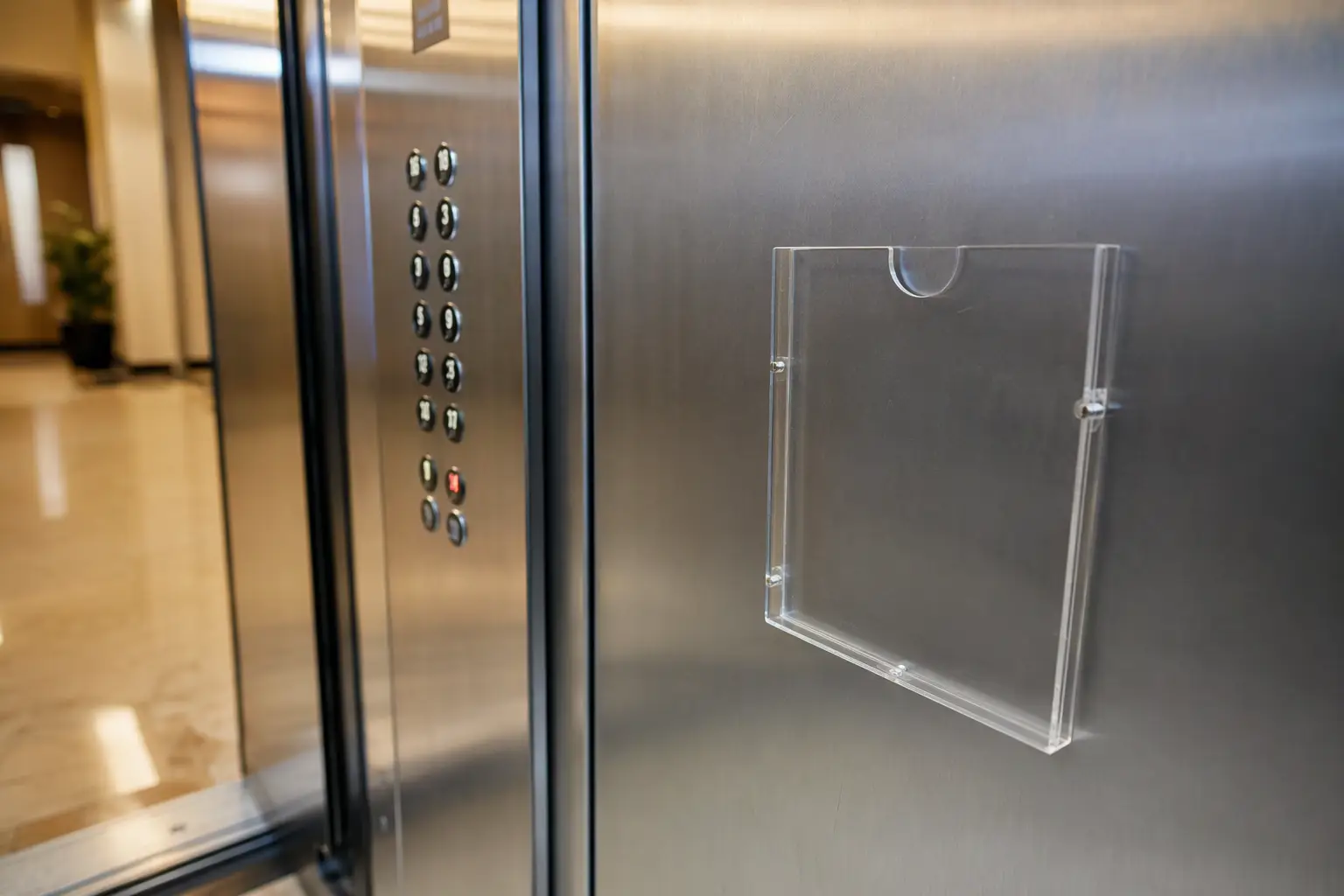
The permit to operate must be posted conspicuously inside the elevator car at all times. If the permit has lapsed because the annual reinspection was never scheduled — which is the owner’s legal responsibility, not the contractor’s — the elevator is operating unlawfully regardless of its mechanical condition.
Who is legally responsible for ensuring compliance logs exist and are current in California?
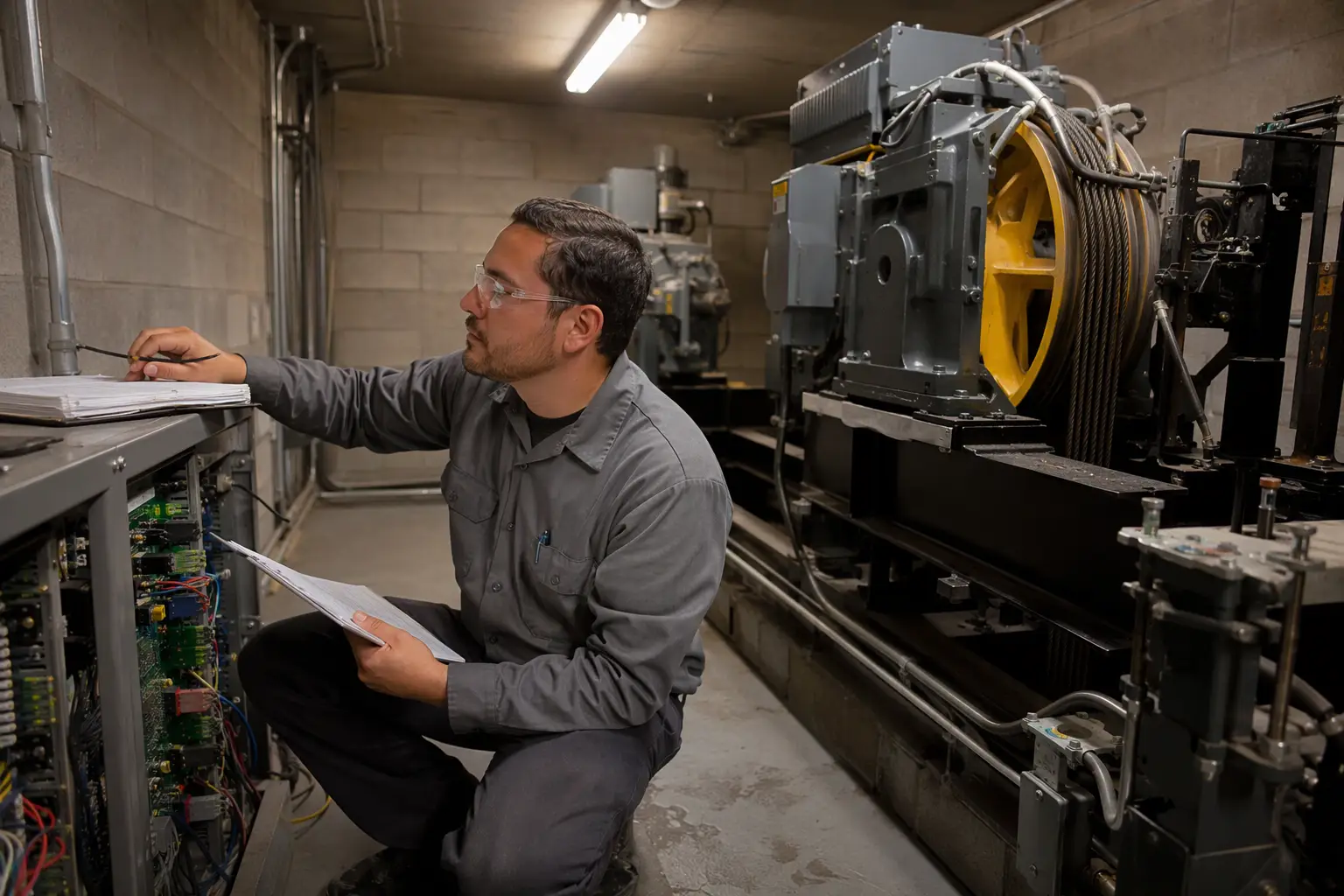
Under California law, the building owner or the entity that controls the conveyance bears ultimate responsibility for arranging annual reinspection and maintaining a current permit to operate.
Many building owners contractually delegate scheduling, recordkeeping, and maintenance coordination to their elevator service company. That delegation creates a contractual obligation on the contractor, but it does not transfer the statutory obligation. If the contractor fails to deliver logs and the owner cannot produce them during a Cal/OSHA inspection, the enforcement action lands on the owner. This is precisely why an unanswered recordkeeping request must be escalated quickly rather than left in an email thread.
Service companies operating in California must hold Cal/OSHA certification as a Certified Qualified Conveyance Company (CQCC). Only a CQCC employing Certified Competent Conveyance Mechanics (CCCM) may legally maintain, repair, alter, or replace components on a California elevator. Part of that certified status carries an implicit expectation of professional recordkeeping. A CQCC that refuses or neglects to deliver maintenance records is acting contrary to the professional obligations attached to its certification.
What should a building owner do immediately when log requests have been ignored for months?
When a service provider has gone silent on compliance log requests, the owner must act systematically and document every step, because that documentation becomes evidence in any subsequent regulatory or legal proceeding.
- Send a formal written demand letter via certified mail and email to the elevator contractor’s registered business address, citing the specific logs requested, the dates the requests were made, and a clear deadline for response — typically seven to fourteen business days.
- Pull your own permit records by contacting Cal/OSHA’s Elevator Unit directly. Cal/OSHA maintains permit-to-operate records tied to each conveyance, and owners may request information about the status of their own permit.
- Verify the contractor’s CQCC certification status through the Cal/OSHA Elevator Unit to confirm whether the company is currently certified. An expired or revoked CQCC certificate is itself a regulatory violation.
- Commission an independent compliance audit by engaging a separate CQCC-certified company to review what records exist, identify gaps, and produce a written gap analysis. Liftech Elevator, serving Signal Hill, Long Beach, Los Angeles, and Orange County, can perform this type of compliance audit for California property owners.
- File a complaint with Cal/OSHA if the contractor is a CQCC and is withholding records it was contractually obligated to maintain. Cal/OSHA’s Elevator Unit has authority over certified companies operating in California.
- Post the most recent valid permit to operate inside the elevator car and confirm it has not lapsed. If it has lapsed, initiate reinspection immediately through a new CQCC.
- Notify your property insurer in writing of the gap in records so the insurer cannot later argue the owner concealed a known compliance deficiency.
- Consult legal counsel if the contractor’s inaction has caused an expired permit or a documented safety deficiency, since breach-of-contract and professional negligence claims may be available.
What specific logs and documents make up a complete California elevator compliance record?
A complete California elevator compliance record encompasses the full lifecycle of the conveyance from installation permit through each annual inspection cycle.
The table below outlines the core document categories, their regulatory basis, and the typical custodian responsible for producing them.
| Document / Log Type | Regulatory Basis | Typical Custodian | Minimum Retention Guidance |
|---|---|---|---|
| Permit to Operate (current) | California Labor Code §§ 7300–7324.2; Cal/OSHA Elevator Unit | Cal/OSHA issues; owner posts in car | Must be current and posted at all times |
| Annual Inspection Report (Cal/OSHA or CCCI) | Title 8 CCR, Elevator Safety Orders §§ 3000–3146 | Inspecting engineer / CCCI; copy to owner | Retain through next inspection cycle plus reasonable buffer |
| Installation / Alteration Permit | California Labor Code; Cal/OSHA permit required before installation or material alteration | CQCC contractor; copy to owner | Life of the installation |
| Maintenance Work Orders | ASME A17.1/CSA B44 (2004 edition adopted in California) — ASME Codes & Standards | CQCC maintenance contractor | Minimum of the full maintenance contract term |
| Periodic Test / Category Test Records | ASME A17.1 periodic test requirements | CQCC contractor; copies to owner | Through next scheduled test cycle |
| Violation / Deficiency Clearance Notices | Cal/OSHA enforcement; Title 8 CCR | Cal/OSHA issues; CQCC and owner retain | Minimum five years recommended |
| ADA Compliance Documentation (where applicable) | ADA Title III / Title II | Owner / facility manager | Life of the facility |
| Full Maintenance Contract | Referenced in Cal/OSHA two-year permit eligibility | CQCC contractor and owner | Term of contract plus reasonable buffer |
How does a full maintenance contract affect the permit-to-operate renewal cycle in California?
California law allows Cal/OSHA to issue a permit to operate for up to two years — rather than the standard maximum of one year — when an elevator in safe condition is covered by a full maintenance contract with a C-11 licensed elevator company.
This two-year permit pathway is a significant operational benefit, reducing the frequency of reinspection and the associated scheduling burden on building owners. However, it also means that the full maintenance contract itself becomes a compliance document: if the contract lapses, is cancelled, or is disputed — including a situation where the contractor is unresponsive — the two-year permit basis may be undermined. Building owners relying on a two-year permit should confirm annually that the underlying full maintenance contract remains active and that the CQCC’s certification has not lapsed.
The C-11 Elevator Contractor license is issued by the California Contractors State License Board (CSLB); permits to operate and CQCC certification are administered separately by Cal/OSHA. When a service relationship breaks down, the owner must verify the status of both the C-11 license and the CQCC certification through their respective agencies.
How should a building owner formally escalate to Cal/OSHA when a contractor is unresponsive?
Escalation to Cal/OSHA’s Elevator Unit requires a written, documented complaint that presents the specific unresolved compliance issue rather than a general grievance.
The Cal/OSHA Elevator Unit, part of the California Department of Industrial Relations, oversees certification of CQCC companies and enforcement of the Elevator Safety Orders. A complaint should include: the name and CQCC certification number of the unresponsive contractor, the conveyance identification number or permit number, a chronological summary of requests made and ignored, copies of all written communications, and a description of any known safety or compliance deficiency that resulted from the inaction. A well-documented complaint is more likely to trigger timely investigative action than a vague allegation.
Separately, if the elevator is located within the City of Los Angeles, the Los Angeles Department of Building and Safety (LADBS) runs its own elevator and conveyance inspection program. Building owners in Los Angeles may need to engage both Cal/OSHA and LADBS depending on the nature of the compliance gap.
Can a building owner switch elevator service companies mid-contract to recover compliance records?
Yes, and in many cases switching to a new CQCC-certified company is the most practical path to restoring compliance when the existing contractor is unresponsive.
Maintenance contracts typically contain termination provisions, and a material breach — such as a contractor’s failure to deliver records it was contractually obligated to maintain — often gives the owner grounds for termination without penalty. Legal counsel should review the specific contract language. Once notice of termination is served, the incoming CQCC should conduct a comprehensive condition and records audit. The new contractor can often reconstruct a partial compliance history from the Cal/OSHA permit database, prior inspection reports in the owner’s possession, and a fresh physical inspection of the conveyance. Liftech Elevator regularly assists property owners in Signal Hill, Long Beach, Los Angeles, and Orange County who are transitioning from non-responsive service providers and need an immediate compliance baseline established.
What happens to the elevator’s operating status while compliance logs are being recovered?
An elevator with an expired permit to operate is operating unlawfully in California regardless of its physical condition, and Cal/OSHA has authority to order it out of service.
Under California Labor Code Sections 7300–7324.2, no elevator may be operated in California without a valid, current permit to operate. If the annual reinspection was missed because the contractor was unresponsive, the permit may have expired without the owner’s direct knowledge. During the period of log recovery, the building owner should take three parallel actions: confirm the permit’s expiration date with Cal/OSHA, engage a new CQCC to schedule reinspection as quickly as possible, and assess whether the elevator should be voluntarily taken out of service pending reinspection. Voluntarily removing an elevator from service while actively pursuing reinspection demonstrates good faith and is viewed more favorably by regulators than continuing to operate on an expired permit.
What role does ASME A17.1 play in defining what maintenance records must be kept?
The ASME A17.1 Safety Code for Elevators and Escalators establishes the technical requirements for maintenance, testing, and inspection that underpin California’s Elevator Safety Orders, including what tests must be performed and therefore what records must exist to prove those tests occurred.
California adopted ASME A17.1/CSA B44, 2004 edition, for elevators installed under contracts signed on or after May 1, 2008. The ASME code defines categories of periodic tests — including no-load safety tests, full-load tests, and governor and safeties tests — each of which must be documented. When compliance tracking logs go missing, ASME A17.1’s test schedule is the technical benchmark that determines which specific test records must be reconstructed or repeated. A CQCC performing a compliance audit will reference the ASME standard to identify every test interval that should have been met and flag which ones cannot be verified from existing documentation.
As of 2026, California has proposed a Group V update to its Elevator Safety Orders that would incorporate portions of ASME A17.1-2019. A public hearing was held on June 18, 2026, but no effective date has been posted. Building owners should monitor the Cal/OSHA Elevator Unit page for updates that may affect future record-keeping obligations.
How does ADA compliance recordkeeping intersect with elevator compliance tracking logs?
ADA documentation is a parallel compliance obligation that sits alongside Cal/OSHA’s safety records, and gaps in one set of records often signal gaps in the other.
Under the Americans with Disabilities Act, building owners subject to Title II (public entities) or Title III (places of public accommodation) must ensure that elevators providing access to program areas or facilities are maintained in operable working condition. While the ADA does not prescribe a specific log format, elevator downtime, recurring failures, and deferred maintenance that affects accessibility can expose a building owner to civil rights complaints. A compliance audit that is recovering Cal/OSHA maintenance logs should simultaneously review whether documented outages or deficiencies created periods of ADA non-compliance, particularly for elevators that serve as the accessible route to upper floors. Property owners in Los Angeles and Orange County who are auditing their compliance history should address both regulatory frameworks simultaneously.
What should a compliance audit by a new CQCC company typically include?
A thorough compliance audit by an incoming CQCC should produce a written gap analysis that maps every required record against what actually exists, identifies which deficiencies require corrective action, and provides a remediation timeline.
Specifically, the audit should cover: verification of current permit-to-operate status with Cal/OSHA; physical inspection of the conveyance against the requirements of the California Elevator Safety Orders; identification of all ASME A17.1 periodic tests that were due during the unresponsive period; review of any open violation notices or deficiency orders on record with Cal/OSHA or, in Los Angeles, with LADBS; and confirmation that the elevator car is properly displaying a current permit. The audit report becomes the foundation for a remediation plan submitted to Cal/OSHA if reinspection and new permit issuance are required. Liftech Elevator provides structured compliance audits for building owners in Signal Hill, Long Beach, Los Angeles, and Orange County who need to re-establish a defensible compliance baseline.
How long does it typically take to restore a compliant operating status after recovering lost logs?
The timeline depends on the severity of the compliance gap, Cal/OSHA’s scheduling availability, and whether physical repairs are needed before the elevator can pass reinspection.
If the elevator is mechanically sound and the only issue is an expired permit caused by a missed annual inspection, the path forward is relatively straightforward: engage a CQCC, schedule the reinspection with a State safety engineer or CCCI, pass the inspection, and receive a new permit. If the reinspection reveals deferred maintenance deficiencies — which is common when a contractor has been unresponsive for months — the CQCC must complete the required repairs, and a follow-up inspection must be scheduled before the permit is issued. Each step adds time. Building owners should not assume the process is complete until the new permit is physically posted inside the elevator car.
Can a building owner be fined or penalized for compliance log gaps caused by a contractor’s inaction?
Yes — Cal/OSHA’s enforcement authority runs against the building owner as the responsible party for the conveyance, and the owner generally cannot deflect a penalty by citing contractor inaction alone.
California Labor Code Sections 7300–7324.2 place the obligation to maintain a compliant elevator on the owner. When Cal/OSHA inspectors find an expired permit, missing test records, or unresolved deficiencies, the enforcement action is directed at the entity that controls the conveyance. The owner may subsequently pursue a breach-of-contract claim against the unresponsive contractor, but that civil remedy does not eliminate the regulatory liability already incurred. Proactive steps — filing a Cal/OSHA complaint against the contractor, commissioning an independent audit, and scheduling reinspection promptly — demonstrate good faith that regulators consider when determining enforcement responses.
What contractual protections should a new elevator maintenance agreement include to prevent this problem in the future?
A well-drafted elevator maintenance contract should explicitly define the contractor’s recordkeeping obligations, delivery timelines, and the owner’s right to access records at any time.
Key contractual provisions to require include: a commitment by the CQCC to deliver copies of all maintenance work orders within a defined period after each service visit; delivery of inspection reports and permit renewal notices no later than a specified number of days after the inspection; a provision granting the owner unrestricted access to all compliance records upon request; a clear termination clause that treats failure to deliver records as a material breach; and an agreement that all records produced under the contract remain the property of the building owner rather than the contractor. Building owners in California should also confirm that the contract specifies the contractor’s CQCC certification number and C-11 license number, so the owner can independently verify those credentials remain active throughout the contract term.
How does the inspection responsibility differ for elevators in the City of Los Angeles versus the rest of California?
Los Angeles has its own elevator and conveyance inspection program administered by the Los Angeles Department of Building and Safety (LADBS), which operates alongside Cal/OSHA’s statewide program.
Building owners with elevators in the City of Los Angeles should be aware that compliance tracking for their conveyances may involve coordination with LADBS in addition to — or in some cases instead of — the standard Cal/OSHA Elevator Unit process. When compliance logs have gone unanswered and the property is in Los Angeles, the owner should contact both LADBS and Cal/OSHA to understand which agency holds the relevant inspection records and enforcement authority for their specific conveyance. For properties in Signal Hill, Long Beach, and Orange County, the standard Cal/OSHA Elevator Unit process applies. Liftech Elevator is familiar with the regulatory landscape across all of these markets and can help property managers navigate the correct escalation pathway for their jurisdiction.
What should building owners know about CQCC and CCCM certification when evaluating a replacement elevator company?
Before engaging any replacement elevator service company in California, the building owner must verify that the company holds a current CQCC certification from Cal/OSHA and that its mechanics hold current CCCM certification.
California law is unambiguous: only a CCCM working for a CQCC may maintain, repair, alter, or replace components on a California conveyance. CQCC and CCCM certificates last two years and require at least eight hours of continuing education for renewal. An elevator company whose certifications have lapsed is operating outside California law. Additionally, applicants for CQCC certification must hold a current C-11 Elevator Contractor license issued by the California Contractors State License Board (CSLB), along with current certificates of workers’ compensation and liability insurance. Building owners should request documentation of all three credentials — CQCC certificate, C-11 license, and insurance certificates — before signing any new maintenance agreement.
What is the difference between an annual inspection and a periodic test, and are both tracked in the compliance log?
Annual inspections are the regulatory event that determines permit-to-operate eligibility; periodic tests are technically-specified safety tests required by ASME A17.1 at defined intervals, and both types of events must appear in a complete compliance record.
The annual inspection is conducted by a State of California safety engineer or a CCCI and results in either a permit to operate or a deficiency notice. Periodic tests under ASME A17.1 — including tests of safety devices, governors, buffers, and door systems — are performed by the CQCC maintenance contractor at intervals set by the code, which may be annual, every five years, or at other specified frequencies depending on the component and the elevator type. Both inspection reports and periodic test records are required documentation. A compliance log that shows only annual inspection permits but lacks periodic test records is incomplete. When auditing a gap period caused by contractor inaction, both categories of records must be accounted for.
How should building owners document their own efforts to obtain logs, in case the matter goes to arbitration or litigation?
Building owners should maintain a contemporaneous written record of every request made, every response received, and every escalation step taken, organized chronologically and preserved in a format that can be produced as evidence.
Practical documentation steps include: saving all email correspondence with timestamps and delivery receipts; sending formal requests via certified mail and retaining the return receipts; keeping a dated written log of any phone conversations, including who was spoken to and what was said; documenting the date and content of each escalation — to Cal/OSHA, to legal counsel, to LADBS if applicable; and preserving copies of any existing compliance documents already in the owner’s possession. This contemporaneous record serves multiple purposes: it supports a breach-of-contract claim against the contractor, it demonstrates good faith to Cal/OSHA if enforcement action is initiated, and it establishes a timeline that may be critical in any civil or regulatory proceeding.
What is the fastest legitimate path to getting an elevator back into full regulatory compliance in California?
The fastest legitimate path is engaging a CQCC-certified company immediately to perform an independent compliance audit, complete any required maintenance or repairs, and schedule reinspection with Cal/OSHA as early as possible.
Speed depends on three factors: how quickly a qualified CQCC can assess the elevator’s current condition, whether any physical deficiencies require repair before the elevator will pass inspection, and Cal/OSHA’s scheduling availability for the reinspection. Property owners who take simultaneous action — engaging the new CQCC, pulling permit records directly from Cal/OSHA, and providing the new contractor with all existing documentation to minimize redundant work — compress the timeline significantly. Waiting for a resolution with the unresponsive contractor before engaging a replacement company typically extends the period of non-compliance and increases regulatory exposure. Liftech Elevator serves building owners across Signal Hill, Long Beach, Los Angeles, and Orange County who need to restore compliant operating status efficiently and in full accordance with California law.
Are there upcoming California regulatory changes that could affect elevator compliance recordkeeping requirements?
California is in the process of proposing a Group V update to its Elevator Safety Orders that would incorporate portions of ASME A17.1-2019, which may introduce updated maintenance and testing requirements that affect recordkeeping obligations.
As of 2026, the California Standards Board held a public hearing on the proposed Group V update on June 18, 2026, but no effective date has been announced. Building owners and facility managers should monitor the Cal/OSHA Elevator Unit page for any rulemaking updates. When a new code edition is adopted, compliance records may need to reflect new test categories, revised intervals, or updated documentation standards. Engaging a CQCC that actively tracks California regulatory developments ensures that a building’s compliance log program evolves with the law rather than lagging behind it. Property owners whose service contracts were drafted years ago should also review whether those contracts reference the current applicable edition of ASME A17.1.
Contact Liftech Elevator for a free elevator assessment at 562-997-3639.
Need elevator service you can rely on? Liftech Elevator is ready to help.