California Elevator Inspection: Comparison and Decision Guide (2026)
Navigating California elevator inspection requirements involves understanding which agency governs your conveyance, what credentials inspectors and service companies must hold, and how your maintenance contract affects permit duration. This guide compares every key decision point — from annual versus two-year permits to choosing an independent service provider — so building owners, property managers, and facilities teams can make confident, code-compliant decisions in 2026.
Who Regulates Elevator Inspections in California?
The primary regulatory authority is the Cal/OSHA Elevator Unit, California Department of Industrial Relations. California elevator law is codified in California Labor Code Sections 7300–7324.2 and implemented through the California Code of Regulations, Title 8, Elevator Safety Orders (Sections 3000–3146). The adopted installation code is the ASME A17.1/CSA B44, 2004 edition (Group IV Elevator Safety Orders), effective for installation contracts signed on or after May 1, 2008.
One important local exception: the City of Los Angeles operates its own elevator and conveyance inspection program through the Los Angeles Department of Building and Safety (LADBS). Building owners with elevators in Los Angeles should confirm current requirements directly with LADBS in addition to Cal/OSHA obligations.
As of 2026, California has proposed a Group V update to its Elevator Safety Orders that would incorporate portions of ASME A17.1-2019. A public hearing was held on June 18, 2026; no effective date has been posted. Owners and service providers should monitor the Cal/OSHA Elevator Unit for updates.
What Are the Key California Elevator Inspection Requirements?

The following requirements apply to most passenger, freight, and inclined elevators covered under California Labor Code Sections 7300–7324.2. Conveyances under federal jurisdiction and those in single-unit private homes not accessible to the public are exempt.
| Requirement | Detail | Authority |
|---|---|---|
| Inspection frequency | At least once per year | Cal/OSHA |
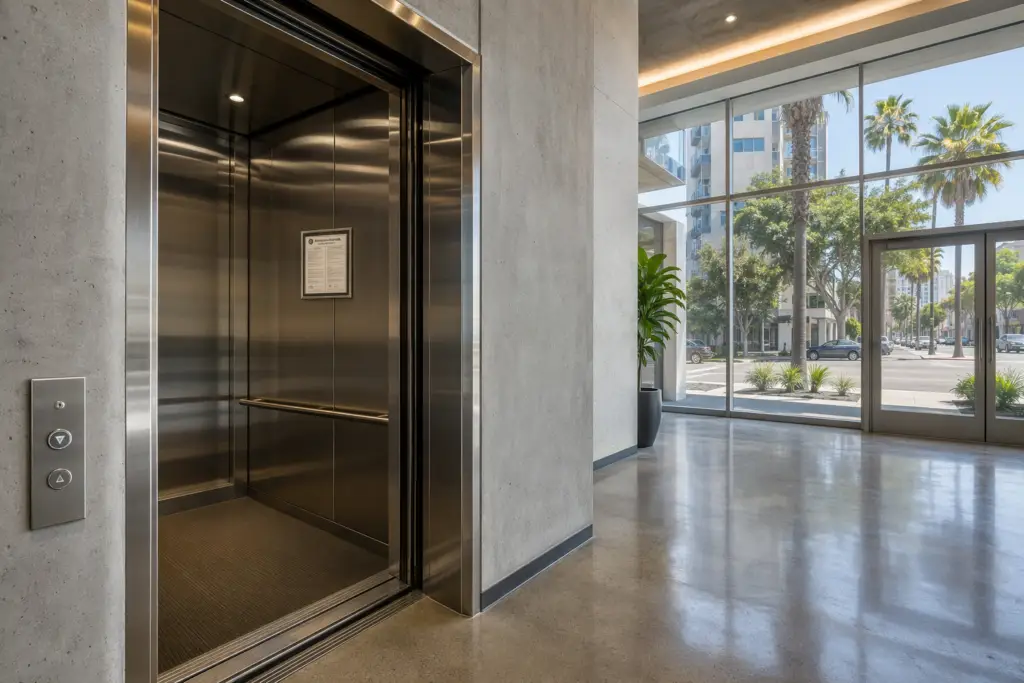
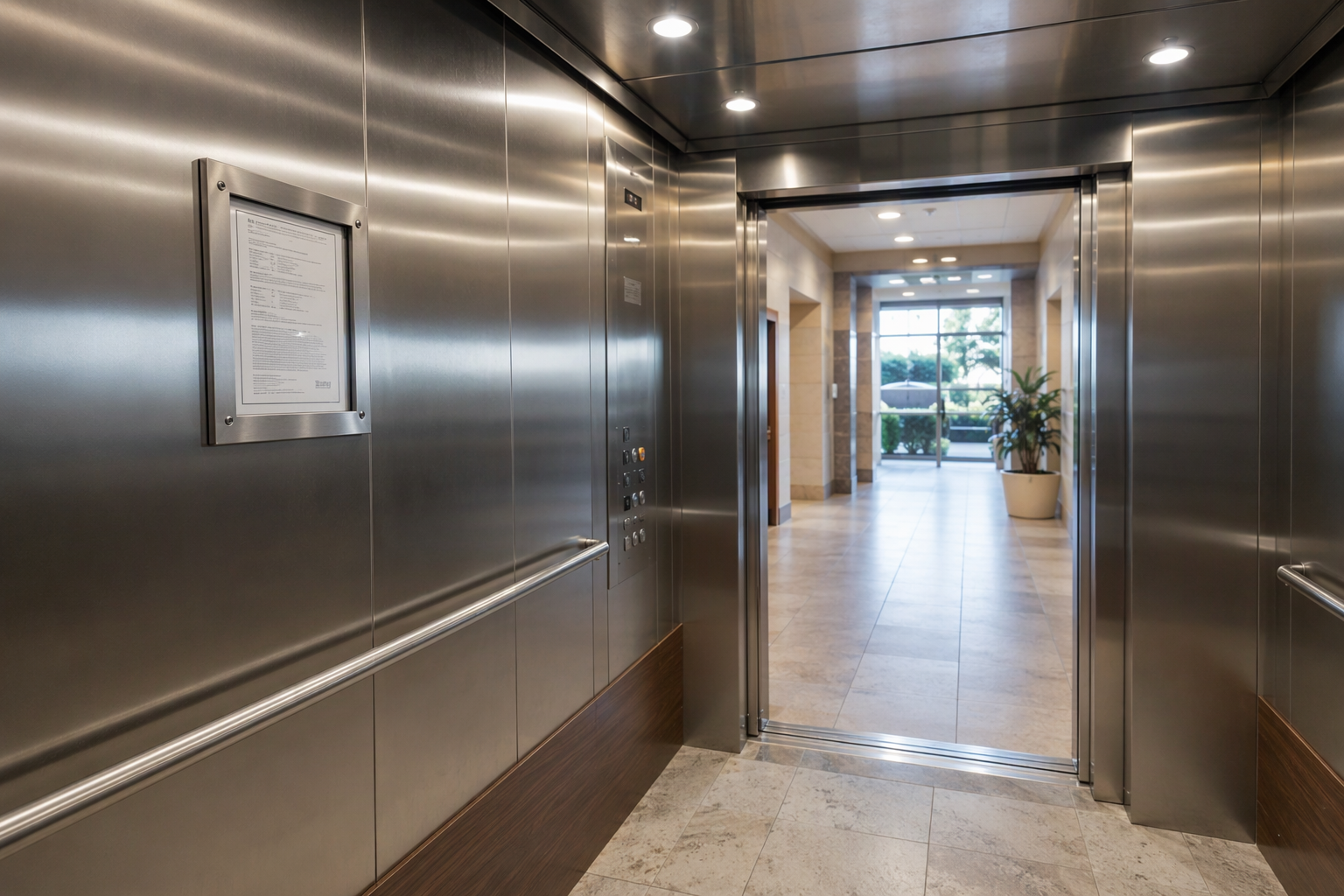
| Permit to operate | Required; must be posted conspicuously in the elevator car | Cal/OSHA |
| Standard permit duration | Up to one year for a conveyance found safe | Cal/OSHA |
| Extended permit duration | Up to two years for elevators under a full maintenance contract with a C-11 / CQCC company | Cal/OSHA |
| Who may inspect | State of California safety engineers or Certified Competent Conveyance Inspectors (CCCI) only | Cal/OSHA |
| Who may perform maintenance/repair | Only a Certified Competent Conveyance Mechanic (CCCM) working for a Certified Qualified Conveyance Company (CQCC) | Cal/OSHA |
| New installation permit | Cal/OSHA permit required before erection, installation, or material alteration | Cal/OSHA |
| Who arranges reinspection | The elevator owner | Cal/OSHA |
| Contractor licensing | C-11 Elevator Contractor license issued by CSLB; CQCC certification issued by Cal/OSHA | CSLB / Cal/OSHA |
| Certificate renewal | CQCC, CCCM, and inspector certificates last two years; renewal requires at least eight hours of continuing education | Cal/OSHA |
Annual Permit vs. Two-Year Permit: Which Is Right for Your Building?
California gives elevator owners two permit pathways. Understanding the trade-offs helps owners decide where to invest in their maintenance program.
| Factor | Standard Annual Permit | Two-Year Permit (Full Maintenance) |
|---|---|---|
| Permit duration | Up to one year | Up to two years |
| Maintenance contract required? | No | Yes — full maintenance contract with a CQCC-certified, C-11 licensed company |
| Administrative burden | Owner arranges reinspection every year | Owner arranges reinspection every two years (reduces scheduling frequency) |
| Compliance risk | Higher if maintenance is inconsistent; deficiencies found annually | Lower — regular professional maintenance reduces deficiency risk |
| Best suited for | Low-use or owner-managed properties with strong internal maintenance tracking | Multi-tenant commercial, residential high-rise, healthcare, or high-traffic buildings |
| Regulatory authority | Cal/OSHA Elevator Unit | Cal/OSHA Elevator Unit |
For most commercial and multi-family building owners, the two-year permit pathway offers a meaningful reduction in annual administrative coordination. The prerequisite — a full maintenance contract with a CQCC-certified company — also provides ongoing safety oversight between inspection cycles.
How to Prepare for a California Elevator Inspection: Step-by-Step
- Verify current permit status. Confirm the existing Cal/OSHA permit to operate is posted conspicuously inside the elevator car and check its expiration date.
- Confirm your service company’s credentials. Ensure the company maintaining your elevator holds both a current C-11 license from the California Contractors State License Board and a current CQCC certification from Cal/OSHA. Verify that all mechanics working on your equipment hold current CCCM certification.
- Schedule a pre-inspection maintenance visit. Have your CQCC-certified company conduct a thorough mechanical and safety review before the official inspection to identify and correct any deficiencies in advance.
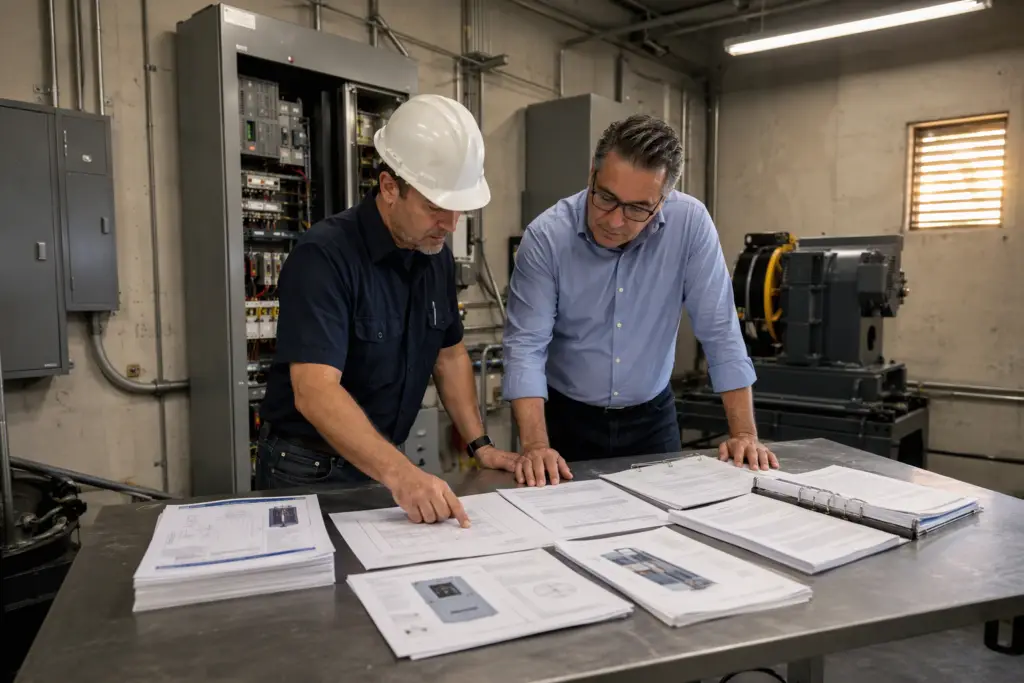
- Gather documentation. Compile maintenance logs, previous inspection reports, records of any alterations or repairs, and original installation documentation.
- Check ADA accessibility compliance. Review door timing, floor leveling, emergency communication, and control panel reach ranges against ADA standards, as inspectors may note accessibility deficiencies.
- Arrange the inspection through the correct authority. Contact Cal/OSHA’s Elevator Unit to schedule the annual reinspection — this is the owner’s legal responsibility. If the elevator is in the City of Los Angeles, also coordinate with LADBS.
- Be present or designate a representative. Ensure a knowledgeable property or facilities contact is on-site during the inspection to provide access and answer questions.
- Address any deficiencies promptly. If the inspector identifies items requiring correction, have your CQCC-certified company complete repairs before the follow-up inspection or before the elevator is returned to service.
What Credentials Must a California Elevator Inspection Company Hold?
California sets explicit credential requirements for every party involved in elevator work. Only a State of California safety engineer or a Certified Competent Conveyance Inspector (CCCI) may perform an elevator inspection. No elevator inspection performed by an uncertified inspector satisfies California law.
Companies that install, alter, test, maintain, repair, or service elevators must be certified by Cal/OSHA as a Certified Qualified Conveyance Company (CQCC). To qualify, the company must hold a current C-11 Elevator Contractor license issued by the California Contractors State License Board and carry current certificates of workers’ compensation and liability insurance. Any mechanic who works on a California elevator without direct supervision must hold a Certified Competent Conveyance Mechanic (CCCM) certification from Cal/OSHA.
All three credential types — CQCC, CCCM, and inspector certificates — are valid for two years and require at least eight hours of continuing education for renewal. Owners should ask for credential verification before engaging any elevator service provider.
Comparing Elevator Service Provider Types in California
| Provider Type | Regulatory Credentials Required | Typical Scope | Key Consideration |
|---|---|---|---|
| OEM-affiliated company | CQCC + C-11 + CCCM mechanics | Maintenance, repair, modernization of brand-specific equipment | May prioritize proprietary parts; pricing may be less competitive for older equipment |
| Large national independent | CQCC + C-11 + CCCM mechanics | Multi-brand maintenance, repair, modernization | Can service diverse building portfolios; response coordination may vary |
| California-based independent (e.g., Liftech Elevator) | CQCC + C-11 + CCCM mechanics | Multi-brand maintenance, repair, inspection coordination, modernization | Local regulatory familiarity, flexibility, California-specific code expertise |
| Building in-house staff | Each individual must hold CCCM; company must hold CQCC and C-11 | Minor maintenance only if credentials are met | Rarely cost-effective; most buildings cannot meet CQCC requirements internally |
Liftech Elevator is a California-based independent elevator service company that works with building owners and property managers across the state to coordinate Cal/OSHA inspection scheduling, pre-inspection maintenance, deficiency correction, and ongoing compliance under California Labor Code and Title 8 Elevator Safety Orders.
What Happens if a California Elevator Operates Without a Valid Permit?
California Labor Code Sections 7300–7324.2 prohibit operating an elevator without a current, valid permit to operate issued by Cal/OSHA. Operating without a valid permit exposes building owners to enforcement action, potential shutdown orders, and liability for any incidents that occur during the period of non-compliance. The permit must be posted conspicuously inside the elevator car at all times — not stored in an office file. If Cal/OSHA determines an elevator is unsafe or operating without a permit, the agency has authority to order the conveyance taken out of service until compliance is achieved.
Does ADA Apply to California Elevator Inspections?
Yes, in a parallel compliance track. The Americans with Disabilities Act imposes accessibility requirements on elevators in public accommodations and commercial facilities. While Cal/OSHA’s inspection focuses on mechanical safety and the Elevator Safety Orders, ADA compliance — covering items such as control button height and reach range, door reopening devices, floor designations, and emergency communication — is enforced separately and can be triggered by complaints or new construction review. Building owners should address ADA requirements as part of any elevator modernization or pre-inspection review, not assume that a Cal/OSHA permit to operate indicates full ADA compliance.
What Is the ASME A17.1 Code and How Does It Apply in California?
The ASME A17.1/CSA B44 Safety Code for Elevators and Escalators is the foundational national standard governing elevator design, construction, operation, inspection, testing, and maintenance in the United States and Canada. California has adopted the 2004 edition of this standard as part of its Group IV Elevator Safety Orders under Title 8, Sections 3000–3146, effective for installation contracts signed on or after May 1, 2008.
California has proposed a Group V update that would incorporate portions of ASME A17.1-2019; a public hearing occurred on June 18, 2026, and no effective date has been announced. Until a new edition is formally adopted and effective, California installations and inspections are governed by the 2004 edition under the Group IV Safety Orders.
How Does a Full Maintenance Contract Affect California Elevator Compliance?
A full maintenance contract with a Certified Qualified Conveyance Company that also holds a C-11 license is the qualifying condition for Cal/OSHA to issue a permit to operate for up to two years, rather than the standard one-year maximum. Beyond the permit duration benefit, a full maintenance contract ensures that all work on the conveyance is performed by CCCM-certified mechanics — which is independently required by California law. Regular professional maintenance also reduces the likelihood of deficiencies being found during inspection, which can delay permit issuance and require the elevator to be taken out of service.
When evaluating maintenance contracts, building owners should confirm that the provider:
- Holds a current Cal/OSHA CQCC certification
- Holds a current C-11 license from the California Contractors State License Board
- Employs or deploys only CCCM-certified mechanics for unsupervised work
- Maintains current workers’ compensation and liability insurance
- Provides documentation suitable for Cal/OSHA permit applications
Liftech Elevator provides full maintenance services in California designed to meet these requirements and to support building owners in qualifying for the two-year permit pathway.
What Should Building Owners Know About New Elevator Installation Inspections in California?
California law requires that a permit from Cal/OSHA be obtained before a conveyance is erected, installed, or materially altered. After installation is complete, the elevator must be inspected by Cal/OSHA and receive a permit to operate before it is placed in service. No new elevator may be used by occupants until this initial inspection is passed and the permit is issued and posted. The installing company must hold both a C-11 license and CQCC certification, and all mechanics must hold CCCM certification.
Pros and Cons of California’s Elevator Inspection Regulatory Framework
| Dimension | Advantage | Challenge |
|---|---|---|
| Safety outcomes | Mandatory annual inspections by credentialed inspectors create a consistent safety baseline | Scheduling delays can extend the period between permit expiration and reinspection |
| Credential requirements | CQCC, CCCM, and inspector certifications raise the floor on workforce competency | Owner must independently verify credentials — there is no automatic notification of lapses |
| Two-year permit pathway | Reduces administrative burden for owners with full maintenance contracts | Requires upfront commitment to a qualifying maintenance relationship |
| Local program variation | Los Angeles’s own program may allow more localized enforcement coordination | Dual-jurisdiction properties (e.g., LA buildings) must track two sets of requirements |
| Code modernization | Proposed Group V update to incorporate ASME A17.1-2019 would align California with current national standards | No effective date posted as of mid-2026; planning for future compliance is uncertain |
How Do I Choose the Right Elevator Service Company for California Compliance?
The decision should be based on verified regulatory credentials, familiarity with California-specific requirements, and the company’s ability to support the owner’s permit pathway of choice. Use this checklist:
- ✔ Current Cal/OSHA CQCC certification (ask for the certificate number and expiration date)
- ✔ Current C-11 Elevator Contractor license from the California Contractors State License Board
- ✔ CCCM-certified mechanics assigned to your property
- ✔ Active workers’ compensation and liability insurance
- ✔ Experience coordinating Cal/OSHA annual reinspection scheduling
- ✔ Ability to provide full maintenance contract documentation suitable for two-year permit applications
- ✔ Familiarity with ASME A17.1 as adopted in California’s Title 8 Elevator Safety Orders
- ✔ Track record with the specific conveyance type (passenger, freight, inclined, etc.) in your building
Liftech Elevator is an independent California elevator service provider that assists building owners and property managers in meeting all of these criteria — from credential verification and pre-inspection maintenance through Cal/OSHA permit coordination and ongoing compliance management.
Contact Liftech Elevator for a free elevator assessment at 562-997-3639.
Need elevator service you can rely on? Liftech Elevator is ready to help.