Repeated elevator malfunctions over a short period are rarely coincidental. When a single unit generates multiple service calls within a few months, the underlying cause is almost always a systemic mechanical, electrical, or hydraulic condition that isolated patch repairs have failed to address. Understanding what drives chronic failure — and knowing when California law requires action — helps building owners protect tenants, avoid liability, and control long-term maintenance costs.
What are the most common root causes of chronic elevator malfunctions?
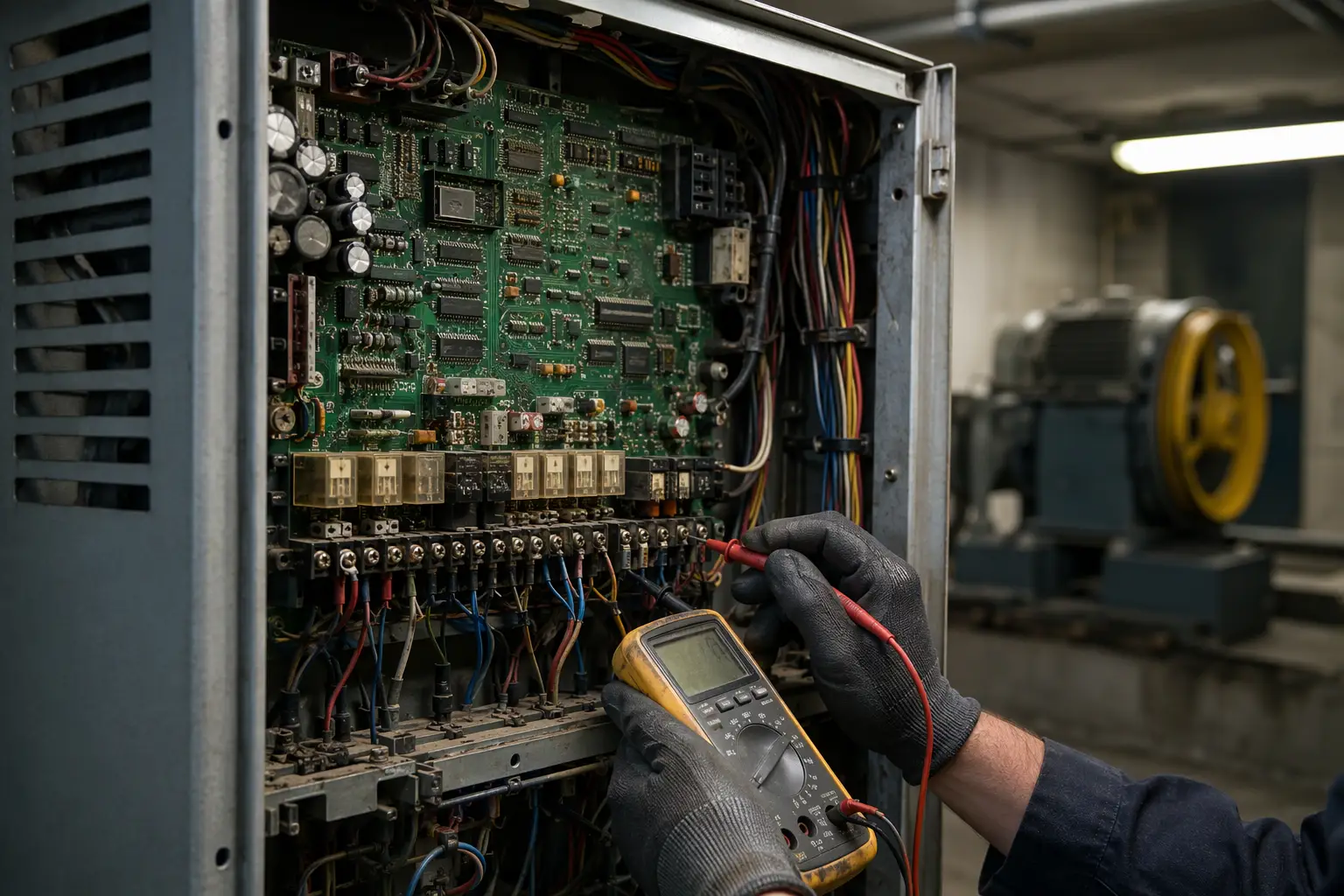
Chronic elevator malfunctions most often stem from deferred maintenance, aging components, deteriorating control systems, or contaminated hydraulic fluid — problems that worsen progressively rather than resolving on their own.
Elevator systems are electromechanical assemblies in which dozens of interdependent components must perform within tight tolerances. When one part degrades, the stress it places on adjacent components accelerates their failure in a cycle that produces seemingly unrelated callbacks. The most frequently identified systemic causes include:
- Worn or misaligned door operator components — Door systems account for a large proportion of service calls across all elevator types. Worn gibs, rollers, door tracks, cams, and vanes can produce nuisance trips, door-reversal faults, and false safety-circuit openings that multiply over time.
- Aging or degraded control boards and software — Solid-state controllers manufactured before the mid-2000s are increasingly susceptible to capacitor failure, relay contact erosion, and software corruption, particularly in environments with voltage fluctuations.
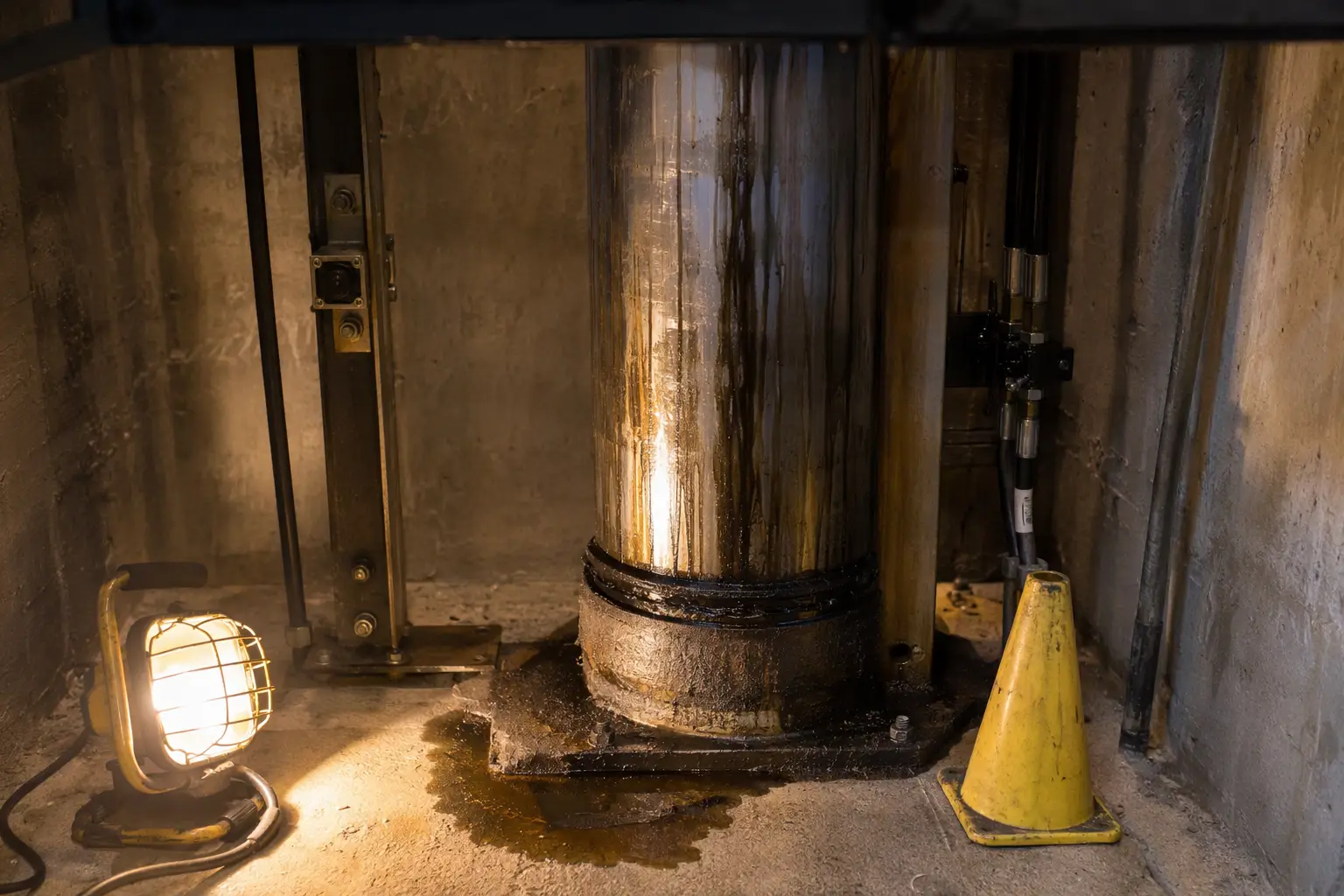
- Hydraulic fluid contamination or jack seal deterioration — In hydraulic elevators, water infiltration, oxidized fluid, or a leaking cylinder jack causes erratic leveling, slow response, and eventual safety shutdowns.
- Worn hoist ropes, sheaves, or brake linings — Traction elevator components subject to constant friction wear can reach end-of-life at similar times when a unit has not been on a consistent maintenance schedule.
- Building-side electrical issues — Unstable incoming power, undersized circuits, or failing machine-room climate control can trigger fault codes that appear to be elevator problems but originate in the building’s infrastructure.
How does deferred maintenance lead to a cascade of elevator failures?
Deferred maintenance creates a failure cascade because a minor issue left unaddressed applies abnormal stress to connected components, compressing what would have been years of service life into a matter of months.
Under the ASME A17.1 Safety Code for Elevators and Escalators, elevators must be maintained in a safe operating condition at all times. When maintenance intervals are stretched or recommended replacements are deferred to reduce short-term costs, the cumulative mechanical wear accelerates dramatically. For example, a door clutch showing early wear may still function but will cause the door operator motor to draw excessive current, overheating the motor windings and eventually causing an electrical fault that presents as a completely separate problem. Technicians called out for each individual symptom rather than the systemic cause will continue to generate service calls without resolution until the root condition is identified and corrected.
At what age does an elevator become prone to recurring failures?
Elevators generally enter a higher-risk phase for recurring failures as they approach or exceed approximately 20 years of service, though the actual threshold depends heavily on maintenance history, usage intensity, and the availability of replacement parts.
Major subsystems — controllers, hydraulic jacks, hoist machines — have manufacturer-rated service lives that vary by component and duty cycle. When an elevator’s control system is no longer supported by the original manufacturer, replacement parts may be unavailable, forcing technicians to use refurbished components or workarounds that introduce new failure modes. Building owners in Los Angeles, Long Beach, Signal Hill, and Orange County who operate elevators installed in the 1980s or 1990s should treat recurring malfunctions as a signal to commission a comprehensive modernization assessment rather than continuing reactive repairs.
What California regulations apply when an elevator malfunctions repeatedly?
In California, elevator owners are legally required under California Labor Code Sections 7300–7324.2 and the California Code of Regulations, Title 8, Elevator Safety Orders (Sections 3000–3146) to keep every conveyance in safe operating condition and to maintain a valid Cal/OSHA permit to operate at all times.
The California elevator regulator — the Cal/OSHA Elevator Unit, Division of Occupational Safety and Health, California Department of Industrial Relations — may inspect any conveyance, issue correction orders, and suspend or revoke a permit to operate if a unit presents a safety hazard. California law requires every conveyance to be inspected at least once a year by a State of California safety engineer or a Certified Competent Conveyance Inspector (CCCI); a unit found safe receives a permit for up to one year. Cal/OSHA may issue a permit for up to two years for an elevator in safe condition that is covered by a full maintenance contract with a C-11 licensed elevator company. Because arranging the annual reinspection is the elevator owner’s responsibility, persistent malfunctions between inspections do not automatically trigger a state inspection — owners must be proactive.
In Los Angeles specifically, the Los Angeles Department of Building and Safety (LADBS) operates its own elevator and conveyance inspection program, so building owners in that jurisdiction have an additional layer of local authority to satisfy.
Who is legally authorized to repair a malfunctioning elevator in California?
Only a Certified Competent Conveyance Mechanic (CCCM) working for a Certified Qualified Conveyance Company (CQCC) — both certified by Cal/OSHA — may legally maintain, repair, alter, or replace components on an elevator in California.
This distinction matters enormously when an elevator is malfunctioning repeatedly. Using an uncertified contractor may void the permit to operate, expose the building owner to liability, and introduce repairs that do not meet the requirements of the California Code of Regulations, Title 8, Elevator Safety Orders. A CQCC must also hold a current C-11 Elevator Contractor license issued by the California Contractors State License Board (CSLB) and carry workers’ compensation and liability insurance. California CQCC, CCCM, and inspector certificates are renewed every two years and require at least eight hours of continuing education at each renewal cycle, ensuring technicians stay current with applicable standards.
What should a building owner do immediately when an elevator malfunctions repeatedly?
When an elevator begins generating repeated service calls, the following steps should be taken in order to protect occupants, preserve legal compliance, and establish a documented record:
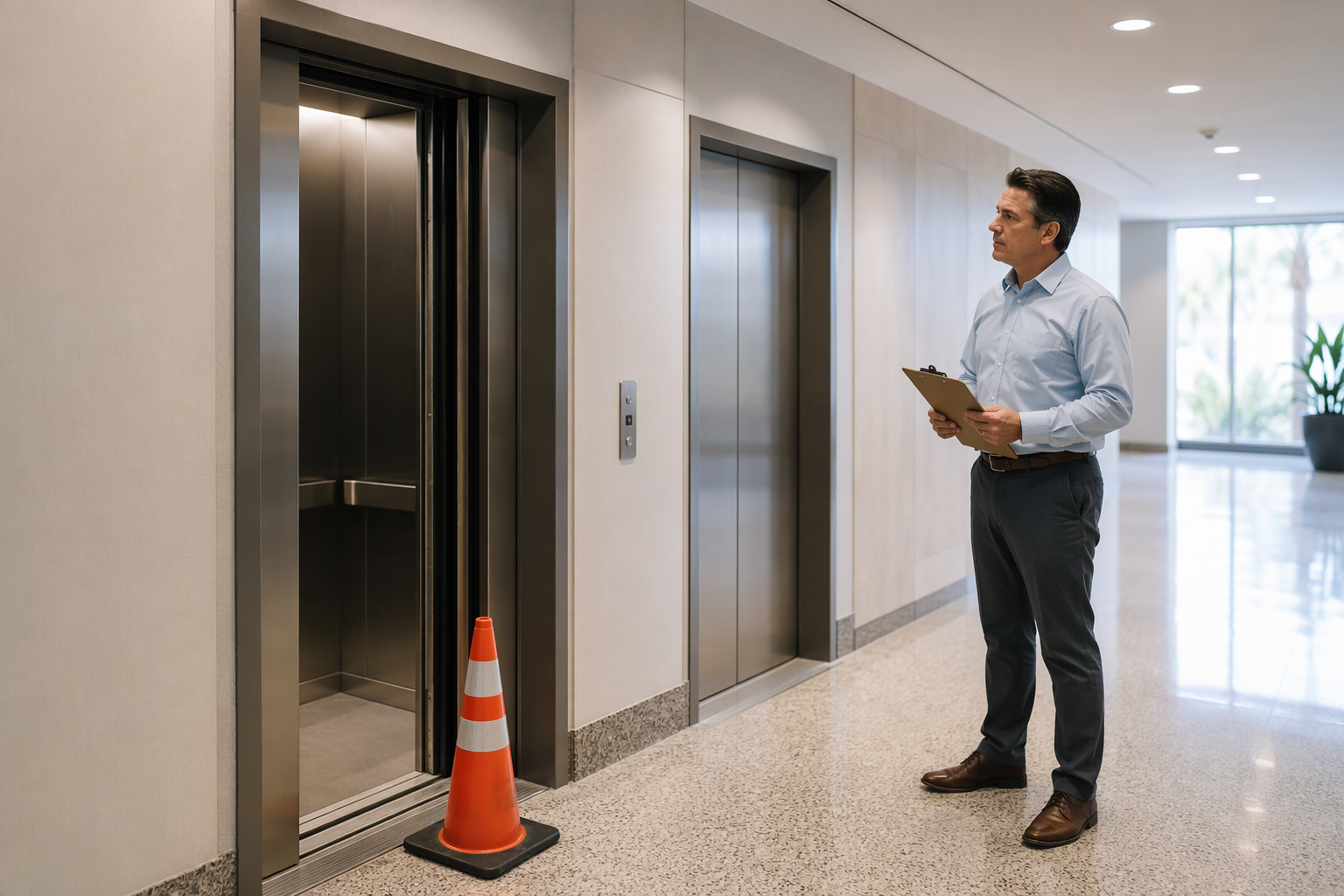
- Remove the elevator from service if it poses a safety risk. Do not keep a unit running solely to avoid tenant inconvenience if it is producing safety faults, abnormal leveling errors, or uncontrolled movements.
- Notify the current maintenance contractor in writing. Document every service call, the reported symptom, the technician’s diagnosis, and any parts replaced. This log is critical for identifying patterns.
- Request a root-cause diagnostic inspection, not just another repair visit. Ask the contractor to deliver a written assessment identifying whether the malfunctions are linked to a common systemic cause.
- Verify that the elevator’s Cal/OSHA permit to operate is current and posted conspicuously in the car, as required by California law.
- Confirm the contractor’s CQCC status with the Cal/OSHA Elevator Unit before authorizing further work.
- Consult with an independent elevator service company if the existing contractor cannot identify the root cause after multiple visits. A fresh technical assessment often identifies conditions the original contractor overlooked or normalized.
- Evaluate whether a full modernization assessment is warranted, particularly if the unit is more than 15–20 years old or if replacement parts for the existing controller are on extended lead times.
How do door system problems cause the majority of repeat elevator callbacks?
Door system defects are responsible for a disproportionate share of repeat elevator service calls because the door mechanism undergoes thousands of open-and-close cycles each week, wearing multiple interdependent components simultaneously.
The door operator, gibs, rollers, sills, clutch vanes, door locks, and safety edges all degrade at different rates depending on traffic volume and maintenance history. When one component is replaced without inspecting the others, the remaining worn parts continue to cause nuisance trips and safety-circuit faults. A comprehensive door-system overhaul — replacing the full set of wear items as a system rather than piecemeal — typically resolves recurring door-related callbacks far more effectively than sequential single-component repairs. Technicians from certified companies like Liftech Elevator are trained to assess the entire door system rather than addressing only the most visible symptom.
Can building electrical problems cause an elevator to malfunction repeatedly?
Yes — voltage irregularities, undersized feeders, poor grounding, or machine-room heat problems originating in the building’s electrical infrastructure can trigger persistent elevator fault codes that appear mechanical in nature but will recur until the building-side issue is corrected.
Modern solid-state elevator controllers are sensitive to voltage sags, spikes, and harmonic distortion. A building experiencing HVAC-driven voltage drops during peak demand hours may cause the elevator controller to register safety faults and initiate shutdowns on a cyclical basis. Elevator technicians investigating chronic malfunctions should include a power-quality review as part of their diagnostic protocol — measuring incoming voltage, ground resistance, and machine-room temperature — before concluding the fault is internal to the elevator.
What is the difference between a repair and a modernization, and when is modernization the right answer?
A repair restores a specific failed component to working order, while a modernization replaces an entire subsystem — typically the controller, hoist machine, door operator, or hydraulic unit — with current technology that meets applicable code requirements and eliminates the class of failures associated with the obsolete system.
When an elevator is generating multiple callbacks per month and the root cause traces back to an obsolete controller or a hydraulic jack approaching end-of-life, continued repair spending is rarely cost-effective. The table below illustrates benchmark decision factors that an experienced elevator service company typically evaluates:
| Factor | Repair-First Appropriate | Modernization Warranted |
|---|---|---|
| Unit age | Under 15 years | 15–20+ years |
| Callbacks per year | Fewer than 4–6 isolated incidents | Recurring pattern, same or related cause |
| Parts availability | OEM parts readily available | Discontinued or long lead-time parts |
| Control system status | Manufacturer-supported, current firmware | Obsolete, unsupported, or no tech documentation |
| Hydraulic jack condition | Sealed, no seepage, within rated service life | Single-bottom jack, evidence of leakage or corrosion |
| Annual maintenance cost trend | Stable or declining | Increasing year-over-year |
| Code compliance status | Fully compliant | Retroactive requirements outstanding |
| ADA compliance | Meets ADA requirements | Non-compliant fixtures, controls, or communication |
How do hydraulic elevator problems specifically lead to chronic malfunctions?
Hydraulic elevators are particularly susceptible to chronic malfunctions when the cylinder jack develops internal or external seal leakage, the hydraulic fluid becomes contaminated with water or oxidation byproducts, or the power unit’s valve assembly begins to wear, because all three conditions cause erratic leveling, slow or inconsistent travel speed, and automatic safety shutdowns that recur until the fluid system is corrected.
Contaminated hydraulic fluid is a frequent and underdiagnosed cause of recurring faults in older hydraulic units. Water infiltration — often entering through a deteriorating cylinder casing or through condensation in the reservoir — causes the fluid to become compressible and thermally unstable, producing erratic behavior that changes with ambient temperature. Flushing and replacing hydraulic fluid, testing the jack for internal bypass, and inspecting the relief valve and lowering valve are all components of a thorough hydraulic diagnostic. Buildings throughout Long Beach and Orange County that rely on older hydraulic units should ensure their maintenance contractor performs a hydraulic fluid analysis as part of annual service.
What role does a full maintenance contract play in preventing chronic malfunctions?
A full maintenance contract — covering lubrication, adjustment, parts replacement, and scheduled inspections of all major components — is the single most effective tool for preventing the deferred maintenance cascade that leads to chronic malfunctions, and it is the contract type that enables Cal/OSHA to issue a two-year operating permit in California.
Under a comprehensive maintenance agreement, certified technicians perform scheduled visits on a fixed interval rather than responding only when a fault occurs. This allows them to identify worn parts, adjust clearances back to specification, and replace components before they fail in service. The alternative — an oil-and-grease or callback-only agreement — reduces short-term costs but typically results in significantly higher cumulative expenditure when repeated service calls, emergency labor premiums, and tenant-impact costs are factored in. Liftech Elevator provides full maintenance contracts to building owners in Signal Hill, Long Beach, Los Angeles, and Orange County, with all work performed by CCCM-certified mechanics employed by a Cal/OSHA-certified CQCC.
Can a malfunctioning elevator result in an ADA compliance violation?
Yes — when a building relies on an elevator as an accessible route required under the Americans with Disabilities Act, repeated malfunctions that keep the unit out of service can constitute an ADA accessibility barrier, exposing the property owner to civil complaints and legal action.
The ADA requires that accessible routes, including elevators in multi-story buildings that are required to be accessible, remain operational and usable by people with disabilities. Extended or frequent downtime on an elevator that serves as the only accessible route to upper floors creates a documentation trail that plaintiffs can use in demand letters and litigation. Building owners should treat elevator reliability not only as a maintenance matter but as a compliance obligation under the ADA, and should maintain a service log that demonstrates prompt, good-faith response to every malfunction.
How can building owners distinguish between a contractor performance problem and a true end-of-life equipment issue?
Building owners can distinguish between these two causes by requesting a written root-cause analysis, comparing the contractor’s diagnosis against an independent technical assessment, and reviewing whether the documented repairs have addressed or merely masked the underlying mechanical or electrical condition.
Some recurring elevator malfunctions persist not because the equipment is irreparable but because the maintenance contractor is performing reactive symptom repairs rather than systematic diagnostics. Conversely, some contractors recommend costly modernization when targeted component replacement would resolve the issue. An independent assessment from a separate certified company — such as a comprehensive inspection performed by Liftech Elevator — can provide an objective second opinion that separates legitimate end-of-life conditions from addressable maintenance deficiencies. The key diagnostic questions are: Has the same fault code or symptom recurred after repair? Have multiple technicians documented different root causes for similar symptoms? Are parts being replaced repeatedly within short intervals?
What ASME A17.1 requirements are most relevant to chronic malfunction investigations?
The ASME A17.1 Safety Code for Elevators and Escalators establishes requirements for safety devices, maintenance practices, and testing protocols that are directly relevant when diagnosing why an elevator is malfunctioning repeatedly.
ASME A17.1 requires that all safety devices — including safeties, governors, buffers, interlocks, and car and counterweight guarding — be maintained in a safe and proper operating condition. It also mandates periodic tests of these safety components at defined intervals, with records kept by the maintenance contractor. When an elevator is generating chronic faults, a review of the maintenance test records against the ASME A17.1 schedule is a logical starting point: missing or overdue safety tests are frequently found alongside a pattern of recurring callbacks. California adopts the ASME A17.1/CSA B44 2004 edition as the baseline standard under Title 8, Elevator Safety Orders, with a proposed Group V update that would incorporate elements of ASME A17.1-2019 currently under review by the California Standards Board as of 2026.
How should building owners document recurring elevator malfunctions for regulatory and legal purposes?
Building owners should maintain a written malfunction log for every service call, capturing the date, time, reported symptom, the name of the responding company and mechanic certification number, the diagnosis, parts replaced, and the date the unit returned to service.
This documentation serves multiple purposes: it establishes a pattern that supports a root-cause diagnosis, it demonstrates due diligence to Cal/OSHA if the agency conducts an inspection, it provides evidence of reasonable response in ADA accessibility complaints, and it creates a basis for evaluating whether the current maintenance contractor is meeting contractual obligations. California Labor Code Sections 7300–7324.2 place the responsibility for safe elevator operation on the owner, making a thorough maintenance record an essential risk-management tool. Some building managers also retain copies of the contractor’s test and inspection certifications to confirm that all work is being performed by a currently certified CCCM from a currently certified CQCC.
What questions should a building owner ask when evaluating a new elevator service company after recurring problems?
Building owners should ask prospective contractors to provide their current Cal/OSHA CQCC certification number, their C-11 license number from the CSLB, proof of workers’ compensation and liability insurance, a description of their diagnostic protocol for chronic-malfunction investigations, and references from comparable buildings in the same geographic area.
Beyond credentials, the technical interview should cover how the contractor documents root-cause findings, whether they provide written reports after every service call, what their parts sourcing strategy is for the specific elevator make and model in question, and whether the full maintenance contract they offer covers the components most relevant to the reported malfunctions. Building owners in Los Angeles, Long Beach, Signal Hill, and Orange County should also confirm that the contractor has direct familiarity with local authority requirements, including LADBS elevator program requirements in Los Angeles.
Can environmental factors inside the building cause an elevator to malfunction repeatedly?
Yes — machine room temperature extremes, humidity, water infiltration into the pit, and exposure to airborne construction dust or chemicals can all degrade elevator components and produce a pattern of recurring faults that persists until the environmental condition is corrected alongside any component repairs.
Machine room heat is a particularly common and overlooked contributor to controller and drive faults. Solid-state components have operating temperature limits; when machine room cooling fails or was never adequate, the controller’s thermal protection circuits trip the elevator during peak heat hours in a pattern that technicians may misdiagnose as a component failure. Elevator pits that flood during rain events or that have ongoing water seepage will corrode wiring, degrade buffer oil, and cause pit-switch trips that generate service calls each time the pit accumulates water. A thorough chronic-malfunction investigation always includes a physical inspection of the machine room environment and the pit condition.
How long does a thorough root-cause diagnostic inspection take, and what does it cover?
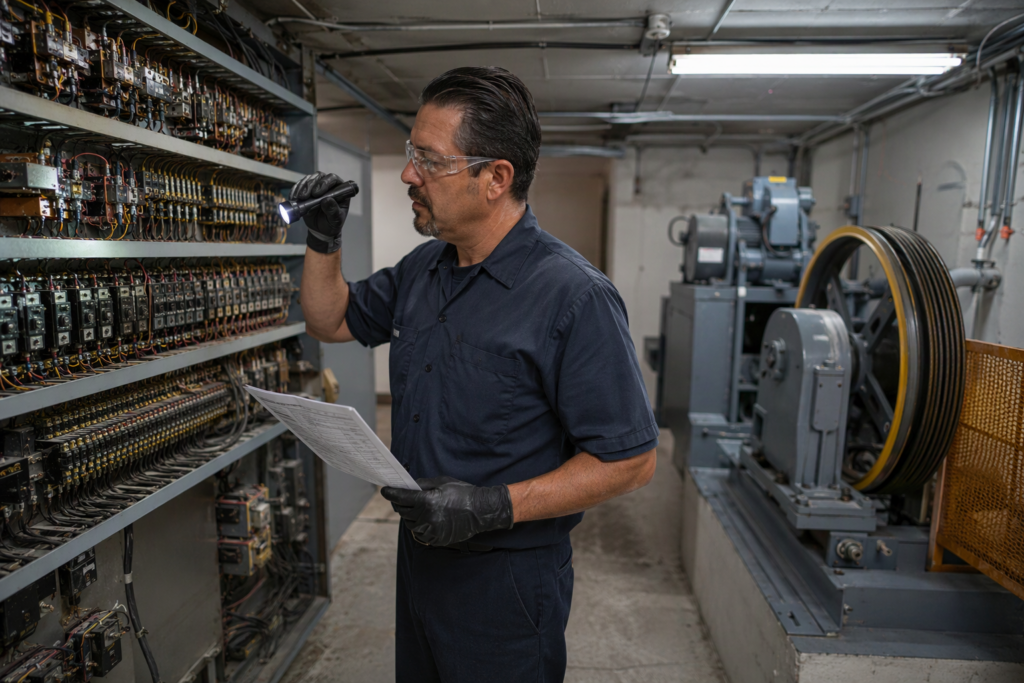
A thorough root-cause diagnostic inspection for a chronically malfunctioning elevator typically requires a dedicated site visit of several hours — separate from a routine maintenance call — and covers the controller, drive, hoist machine or hydraulic power unit, door systems, safety devices, wiring condition, machine room environment, and pit condition.
The inspection should include a review of fault logs stored in the controller memory, as modern controllers retain a history of fault codes with timestamps that can reveal whether malfunctions follow a time-of-day pattern (suggesting a heat or power-quality issue) or a cycle-count pattern (suggesting a wear or adjustment issue). Reviewing the maintenance history and comparing it against the ASME A17.1 test schedule rounds out the diagnostic picture. Liftech Elevator performs comprehensive diagnostic assessments for building owners throughout Southern California whose elevators have been generating repeated service calls without a satisfactory resolution from their current provider.
Does the age of the elevator affect the availability of replacement parts, and how does that contribute to recurring malfunctions?
Parts obsolescence is a significant driver of recurring malfunctions in older elevators because discontinued components force technicians to use refurbished, adapted, or cross-brand substitutes that may not perform to the original specification, increasing the likelihood of further failures.
When a controller manufacturer discontinues a product line, field-replaceable components such as circuit boards, relay modules, and proprietary software become unavailable through normal supply channels. Technicians may source refurbished boards, which carry unknown service histories and no manufacturer warranty, or they may adapt components from compatible platforms — both strategies that can resolve the immediate fault while introducing a new failure mode. Building owners experiencing this dynamic are often best served by a full controller modernization that replaces the obsolete system with a currently supported platform for which parts and technical support remain available. A certified company such as Liftech Elevator can assess whether the parts availability picture for a specific unit justifies continued repair or warrants a modernization investment.
What is the financial impact of chronic elevator malfunctions on building owners and tenants?
Chronic elevator malfunctions impose direct costs through repeated service call charges and emergency labor premiums, indirect costs through tenant dissatisfaction and potential lease or lease-renewal losses, and legal exposure through ADA accessibility complaints and Cal/OSHA compliance actions — all of which typically exceed the cost of a systematic repair or modernization program.
Beyond the direct repair line items, building owners should consider the cost of management time spent coordinating service calls, the reputational impact on the property, and the accelerating nature of deferred-maintenance costs. Each month that a systemic condition goes unaddressed tends to cause additional component wear, raising the eventual repair or modernization cost. Requesting a comprehensive written assessment — including a comparison of cumulative reactive repair costs against the cost of a targeted modernization — gives building owners a defensible financial basis for the investment decision. This type of lifecycle cost analysis is a standard part of the evaluation process that Liftech Elevator conducts for building owners across Signal Hill, Long Beach, Los Angeles, and Orange County.
Contact Liftech Elevator for a free elevator assessment at 562-997-3639.
Need elevator service you can rely on? Liftech Elevator is ready to help.