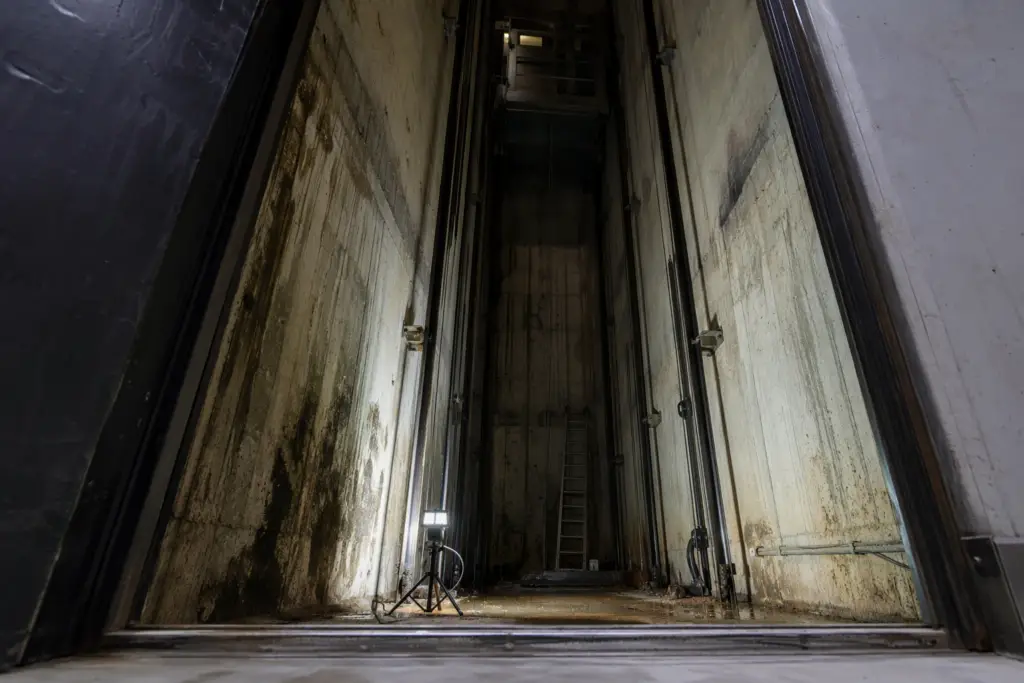
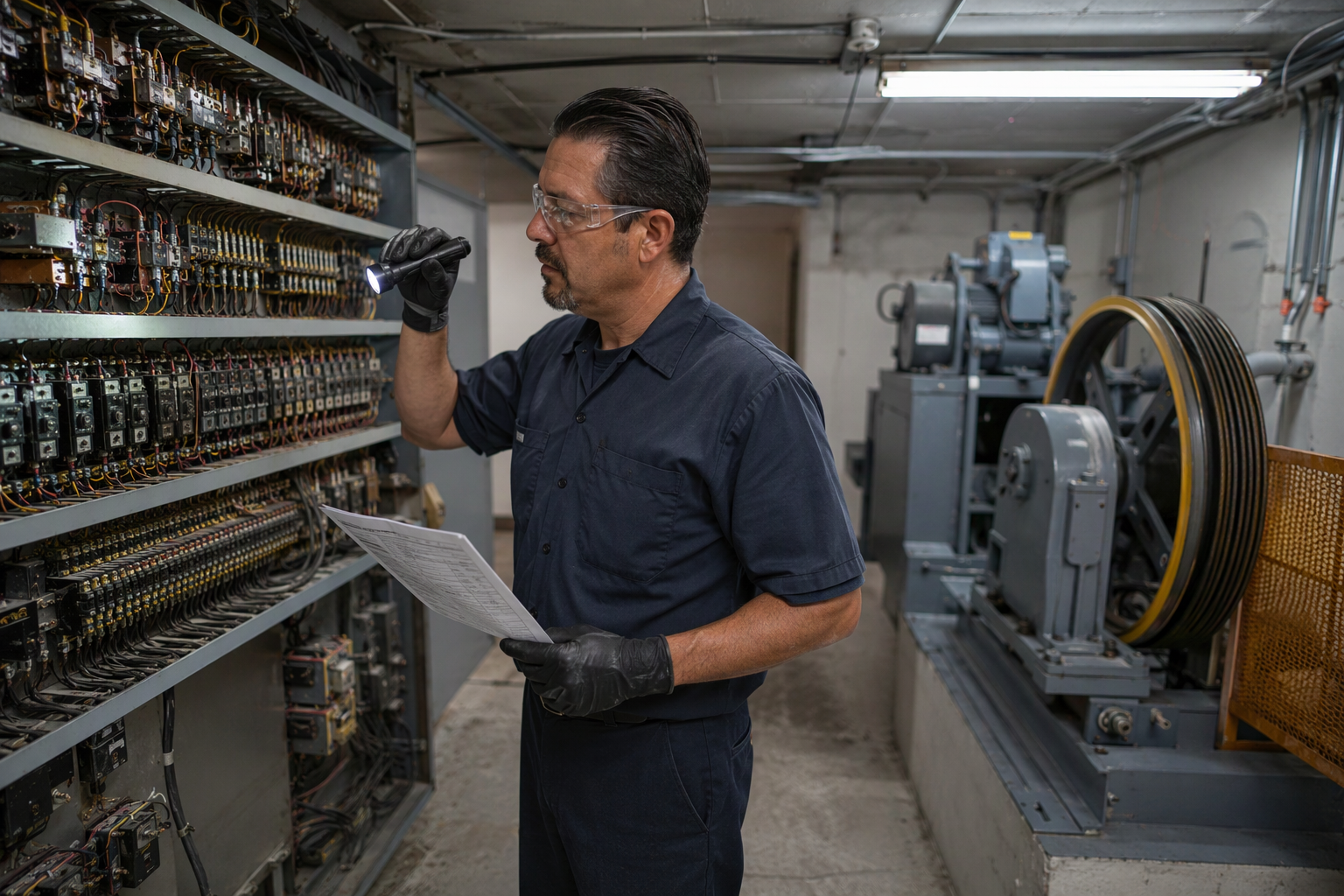
Liftech Elevator provides service estimates for elevators that require hard-to-source parts across Signal Hill, Long Beach, Los Angeles, and Orange County. The estimate process begins with an on-site diagnostic to identify the exact component, followed by a sourcing assessment that covers OEM availability, aftermarket alternatives, remanufactured options, and lead times — all reflected in a written scope of work before any commitment is made.
What Makes Elevator Parts “Hard to Source” in the First Place?
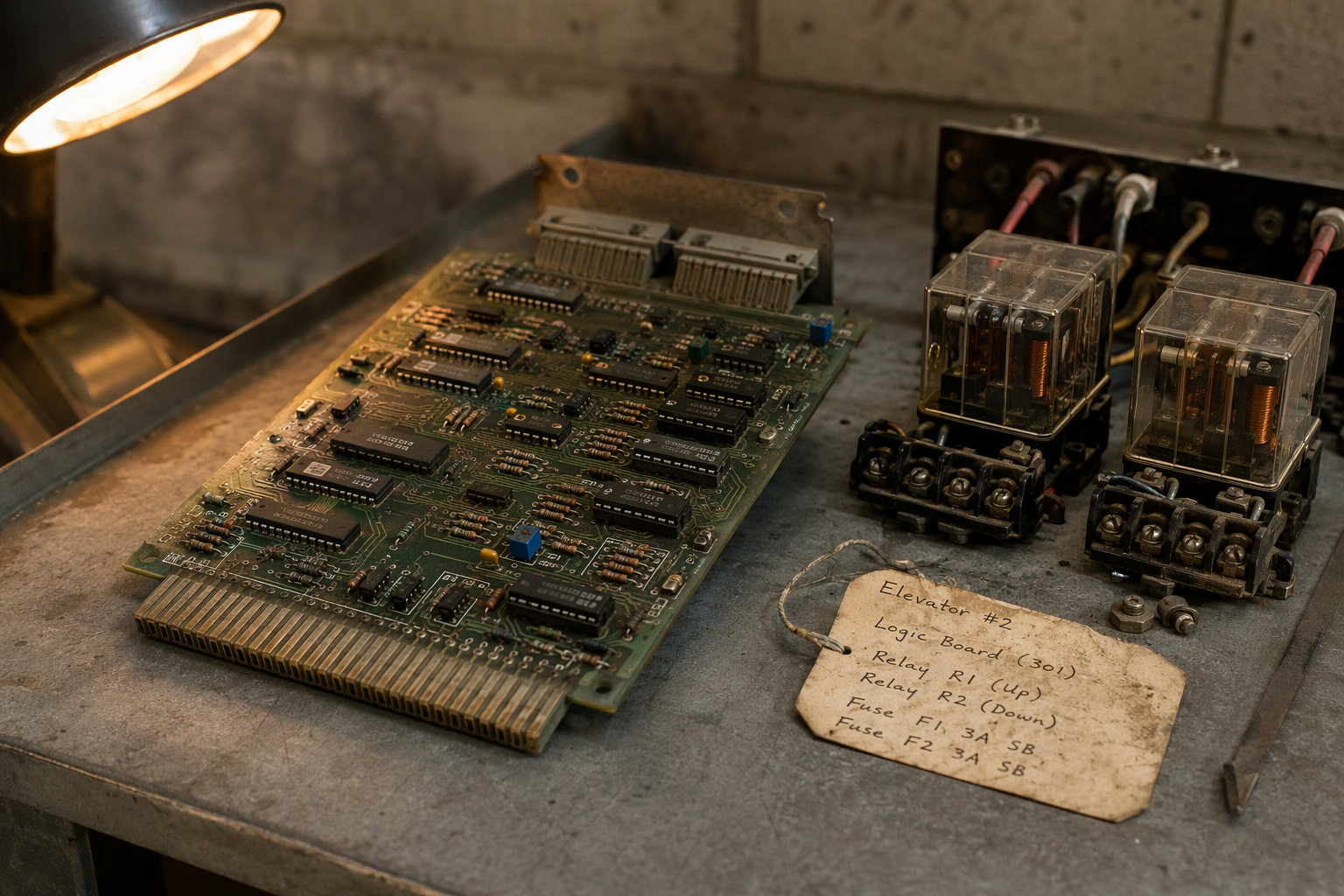
Elevator components become hard to source when the original equipment manufacturer has discontinued the product line, been acquired, or when the installed unit predates current manufacturing standards by several decades.
Older traction elevators, hydraulic units, and dumbwaiters frequently rely on proprietary solid-state controllers, relay logic panels, selectors, and motor-generator sets that have not been produced for years. When a component fails on equipment of this age, standard distributor networks rarely carry it. The part must be located through specialty surplus vendors, salvage networks, or remanufacturing shops — each path carrying its own lead time and cost profile.
Additional scarcity factors include: equipment installed under long-discontinued brands that were absorbed into larger corporations, imported units whose domestic parts support ended, and bespoke installations designed for a single building’s architectural constraints. In every case, the sourcing complexity feeds directly into how an accurate estimate must be structured.
How Does Liftech Elevator Structure an Estimate for Hard-to-Source Components?

A properly structured estimate for hard-to-source parts separates the diagnostic phase, the sourcing phase, and the installation phase into distinct line items so building owners understand exactly what drives cost.
The estimate typically includes: (1) a diagnostic labor charge for the site visit and component identification; (2) a parts cost range that reflects the best available sourcing option — OEM, aftermarket, or remanufactured — along with the anticipated procurement lead time; (3) installation and testing labor; and (4) any permit or inspection fees required by the California Division of Occupational Safety and Health (Cal/OSHA) Elevator Unit, California Department of Industrial Relations, whose official requirements are posted at Cal/OSHA Elevator Unit.
Because parts costs can fluctuate between the date of estimate and the date of procurement, reputable service companies document an expiration date on price quotations and define the conditions under which a revised estimate would be issued. Liftech Elevator follows this practice so that building owners and facility managers are never presented with a final invoice that differs materially from the written scope they approved.
What Information Is Needed Before an Estimate Can Be Prepared?
Accurate estimation requires the elevator’s make, model, serial number, installation date, and a clear description of the symptom or failed component — without this baseline, any figure provided is a rough placeholder rather than a binding scope of work.
Specifically, a technician will typically need access to:
- The machine room (or machine space for machine-room-less units) to inspect the controller, motor, drive, and brake assembly
- The pit to assess buffer condition, compensation equipment, and hydraulic components where applicable
- The car operating panel and door operator to evaluate secondary component condition
- Existing maintenance records and the current permit to operate, which must be posted conspicuously in the elevator car under California Labor Code Sections 7300–7324.2 and the California Code of Regulations, Title 8, Elevator Safety Orders
Maintenance records are particularly useful when sourcing obsolete parts because they may reveal previous substitutions, the original part numbers from commissioning documentation, or prior vendor relationships that can shorten the search process.
How Long Does Parts Sourcing Typically Take for Obsolete Elevator Components?
Lead times for obsolete elevator components vary widely depending on the sourcing path — a surplus distributor may deliver within days, while a remanufactured relay logic board or a custom-wound motor may require several weeks or longer.
The table below summarizes the general sourcing pathways and their relative characteristics. Lead time ranges are illustrative benchmarks based on common industry sourcing patterns and are not guarantees for any specific component.
| Sourcing Pathway | Typical Availability | Relative Cost | Compatibility Certainty | Best Suited For |
|---|---|---|---|---|
| OEM — Active Product | Days to 2 weeks | Moderate to High | Highest | Equipment under 15 years old |
| OEM — Discontinued (New Old Stock) | Weeks to months (if found) | High to Very High | Highest | Specific branded legacy systems |
| Aftermarket / Third-Party OEM | 1–4 weeks | Moderate | High (with spec verification) | Controllers, door operators, drives |
| Remanufactured / Rebuilt | 2–8 weeks | Moderate | High (rebuild to original spec) | Motors, relay panels, selectors |
| Salvage / Surplus Exchange | Highly variable | Lower | Moderate (requires inspection) | Discontinued mechanical hardware |
| Custom Fabrication | 4–12+ weeks | Highest | Engineered to spec | Unique structural or rail components |
Building owners should factor lead time into their overall service planning, particularly when an out-of-service elevator affects ADA accessibility obligations. Under the Americans with Disabilities Act (ADA), building owners have ongoing obligations to maintain accessible routes, and an extended elevator outage in a multi-story building can create compliance exposure.
Does Replacing an Obsolete Part Trigger a Permit or Inspection in California?
Yes — in California, any material alteration to a conveyance requires a permit from Cal/OSHA before work begins, and the repaired or altered elevator must pass inspection before it returns to service.
Under California Code of Regulations, Title 8, Elevator Safety Orders, the replacement of a major component — such as a controller, drive, motor, or structural element — is typically classified as a material alteration rather than a routine repair. This classification triggers the permit requirement under California Labor Code Sections 7300–7324.2. The authority having jurisdiction (AHJ) in most of California is Cal/OSHA’s Elevator Unit; in the City of Los Angeles, the Los Angeles Department of Building and Safety (LADBS) runs its own elevator inspection program.
A service estimate that ignores permit and inspection fees is an incomplete estimate. Building owners should ensure that any written scope of work from their elevator service provider addresses permit procurement as an explicit line item.
What California Licensing Requirements Must an Elevator Company Meet to Perform This Work?
In California, any company that maintains, repairs, alters, or replaces elevator components must hold a Certified Qualified Conveyance Company (CQCC) certification issued by Cal/OSHA and a C-11 Elevator Contractor license issued by the California Contractors State License Board (CSLB).
Individual mechanics working on California elevators must hold a Certified Competent Conveyance Mechanic (CCCM) certification from Cal/OSHA. Only a CCCM working for a CQCC may legally perform maintenance, repair, alteration, or component replacement on a conveyance in California. Both CQCC company certifications and CCCM individual certifications are valid for two years and require at least eight hours of continuing education for renewal, as established under California’s elevator licensing framework administered through Cal/OSHA’s Elevator Unit.
Building owners should verify these credentials before authorizing any repair work, particularly for jobs involving hard-to-source parts where the repair scope may be more involved than a standard maintenance call.
How Are Estimates Affected When a Replacement Part Requires Code Compliance Upgrades?
When a material alteration is performed on an older elevator, California’s Elevator Safety Orders may require that adjacent or interdependent systems be brought into compliance with currently adopted standards — expanding the scope and cost beyond the original failed component.
California currently operates under ASME A17.1/CSA B44, 2004 edition (Group IV Elevator Safety Orders), effective for installation contracts signed on or after May 1, 2008. The ASME A17.1 Safety Code for Elevators and Escalators defines the technical requirements governing elevator design, installation, inspection, testing, and maintenance. When an alteration is made, Cal/OSHA evaluates whether the scope of work triggers broader upgrade requirements under these safety orders.
A common example: replacing a relay logic controller with a solid-state replacement may prompt review of the door protection system, the safety circuit, or the emergency lighting and communication system to verify compliance. A thorough service estimate should identify these potential compliance triggers upfront so the building owner can budget accordingly rather than encounter surprise additions mid-project.
What Is the Process for Getting a Service Estimate from Liftech Elevator?
The process for obtaining a service estimate follows a defined sequence to ensure the written scope of work is accurate and actionable before any work is authorized.
- Initial inquiry: Contact Liftech Elevator with the building address, elevator make and model (if known), a description of the symptom or failed component, and the date of the last permitted inspection.
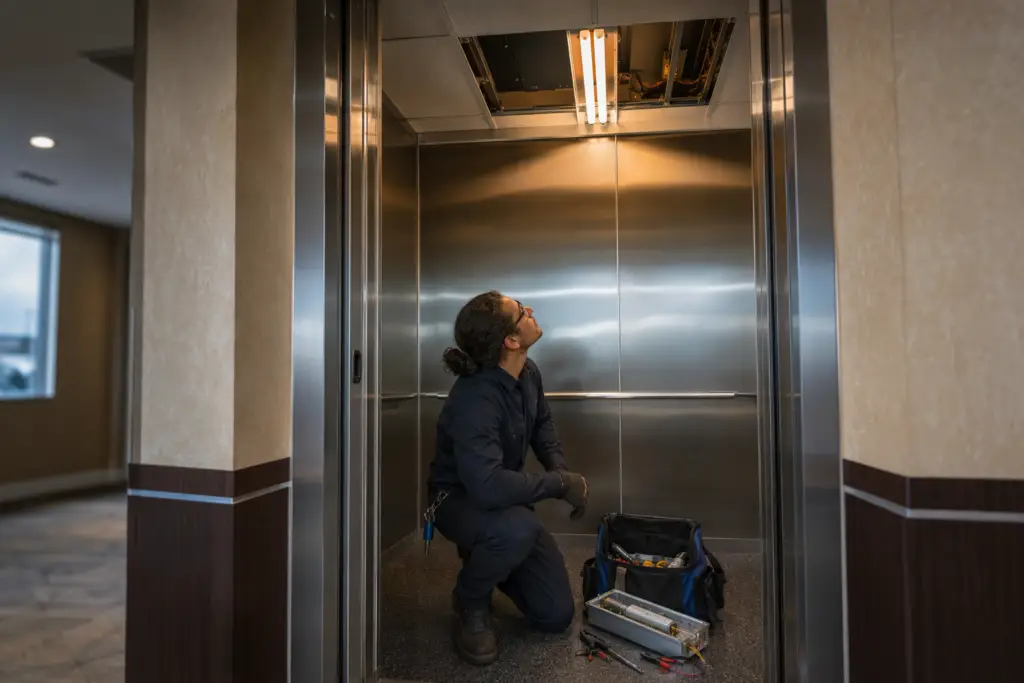
- Scheduling the diagnostic visit: A certified technician visits the site to conduct a hands-on inspection of the affected elevator, reviewing the machine room, pit, car, and controller.
- Component identification: The technician identifies the exact part number, manufacturer, and specification required, cross-referencing available sourcing channels.
- Sourcing assessment: The parts team researches OEM, aftermarket, remanufactured, and surplus availability, documenting lead times and cost ranges for each viable option.
- Permit review: The scope is reviewed against California’s Elevator Safety Orders to determine whether the repair constitutes a material alteration requiring a Cal/OSHA permit prior to work commencement.
- Written estimate delivery: A written estimate is delivered to the building owner or facility manager, itemizing diagnostic labor, parts cost range, procurement lead time, installation labor, testing, and applicable permit fees.
- Owner authorization: Work proceeds only upon signed authorization, ensuring no ambiguity about scope, cost, or timeline.
Can a Building Owner Legally Source Their Own Replacement Parts?
A building owner may purchase elevator parts, but under California law, those parts may only be installed by a Certified Competent Conveyance Mechanic (CCCM) working for a Certified Qualified Conveyance Company (CQCC) — the owner cannot legally install components themselves.
As a practical matter, independent parts sourcing by building owners carries meaningful risk. Without technical knowledge of the exact specification, a part that appears identical may have different electrical ratings, dimensional tolerances, or safety characteristics that render it non-compliant or incompatible. Most established elevator service companies, including Liftech Elevator, prefer to source parts themselves so that compatibility, warranty, and liability are clearly defined within the service agreement.
How Does the Estimate Account for the Possibility That a Part Cannot Be Found?
A complete estimate for hard-to-source components should include a contingency pathway — typically a modernization option — in the event that the specific part cannot be located within an acceptable timeframe or at a reasonable cost.
Partial or full elevator modernization is often the most cost-effective long-term resolution for equipment whose parts are no longer commercially available. A modernization replaces the controller, drive, door operator, and sometimes the cab and fixtures with current-generation equipment, eliminating future obsolescence risk and aligning the installation with currently adopted safety standards. Liftech Elevator evaluates both the repair and modernization pathways in complex cases so building owners can make an informed decision rather than committing to a repair only to face the same sourcing challenge months later.
What ASME A17.1 Requirements Are Relevant to Repairs Involving Obsolete Parts?
ASME A17.1 establishes the technical safety requirements that govern elevator repairs and alterations, including requirements for safeties, buffers, interlocks, emergency operation, and testing protocols that apply regardless of whether the components involved are current or legacy.
Under the ASME A17.1 Safety Code for Elevators and Escalators, any replacement component must meet the performance requirements of the code edition applicable to the installation or alteration. When an obsolete part is replaced with an aftermarket or remanufactured equivalent, the technician must verify that the replacement meets those performance standards — not simply that it fits physically. This verification step is part of the testing and acceptance procedure that precedes the Cal/OSHA inspection for a permitted alteration.
How Do ADA Accessibility Requirements Factor Into a Parts Replacement Estimate?
ADA requirements are relevant to any repair or alteration that affects the accessible features of an elevator — including car controls, door timing, leveling accuracy, and emergency communication systems.
Under the Americans with Disabilities Act (ADA), elevators in public accommodations and commercial facilities must maintain accessible features. When a repair involves components that directly affect ADA-covered functions — for example, a door operator replacement that changes door dwell time, or a controller replacement that affects floor leveling precision — the estimate should address whether the replacement component will maintain or restore ADA compliance. Failure to address this during the scoping phase can result in a repaired elevator that passes Cal/OSHA inspection but still exposes the building owner to ADA complaints.
What Should a Building Owner Ask Before Accepting a Service Estimate?
Before accepting any estimate for an elevator repair involving hard-to-source parts, building owners should ask a defined set of questions to protect their interests and avoid cost surprises.
- Is the company a Cal/OSHA-certified CQCC with a current C-11 license from the CSLB?
- Does the estimate cover the diagnostic visit, parts, installation labor, testing, and permit fees as separate line items?
- What is the parts sourcing pathway — OEM, aftermarket, remanufactured, or surplus — and what warranty applies to the sourced component?
- What is the estimated procurement lead time, and what happens if the part cannot be sourced at the estimated price?
- Does the repair scope constitute a material alteration under California’s Elevator Safety Orders, and if so, is the permit procurement included?
- Is there a modernization alternative, and if so, what is the comparative cost and benefit analysis?
- How long will the elevator be out of service during parts procurement and installation, and does this affect ADA compliance obligations?
How Does Elevator Age Affect the Feasibility and Cost of Parts Procurement?
Elevator age is the single most predictive factor in parts scarcity — the older the installation, the narrower the sourcing options and the greater the potential for extended lead times and elevated costs.
Equipment installed before the widespread adoption of solid-state controls — generally prior to the mid-1980s — relies on electromechanical relay logic, drum switches, and motor-generator sets that are no longer in production. Sourcing for this era requires specialist knowledge of obsolete part numbers and established relationships with surplus and salvage vendors. Equipment from the late 1980s through early 2000s often uses first-generation solid-state controllers that were proprietary to specific manufacturers; some of these platforms are supported by aftermarket suppliers, while others have no active support ecosystem. Equipment installed after the widespread adoption of open-architecture control systems generally offers the broadest sourcing options.
What Happens to the Elevator’s Annual Inspection and Operating Permit During a Parts Repair?
California law requires that no elevator be operated without a valid permit to operate issued by Cal/OSHA — if an elevator is taken out of service for a repair, the permit status and re-inspection requirements must be managed carefully to avoid operating the unit unlawfully upon restoration of service.
Under California Labor Code Sections 7300–7324.2, arranging the annual reinspection is the building owner’s responsibility. When a material alteration has been performed, a new inspection and permit issuance precede return to service. Only State of California safety engineers and Certified Competent Conveyance Inspectors (CCCI) may perform these inspections. Cal/OSHA may issue a permit to operate for up to two years for an elevator that is in safe condition and covered by a full maintenance contract with a C-11 licensed elevator company — a potential cost and administrative benefit for building owners who establish ongoing service agreements. Full details are available through the Cal/OSHA Elevator Unit.
Are There Cost Differences Between Remanufactured and New Aftermarket Parts?
Remanufactured and new aftermarket parts occupy different positions in the cost and reliability spectrum — neither is universally superior, and the right choice depends on the component type, the criticality of the application, and the available sourcing options.
Remanufactured components — such as rebuilt relay panels or rewound motors — are restored to original specification by specialists and typically carry a warranty on the rebuild work. Their cost is generally lower than new OEM equivalents but may be higher than new aftermarket parts if the remanufacturing process is labor-intensive. New aftermarket parts are manufactured to meet or exceed original specifications and are often available at lower cost than OEM equivalents; their quality varies by manufacturer, making vendor selection critical. A thorough estimate should document which option is recommended and why, allowing the building owner to understand the tradeoff between upfront cost, expected service life, and warranty coverage.
How Should Facility Managers Plan Maintenance Contracts Around Hard-to-Source Equipment?
Facility managers operating older elevators with known parts scarcity issues should negotiate full maintenance contracts that explicitly address obsolete parts procurement, including provisions for how sourcing costs and delays are handled.
A full maintenance contract with a qualified elevator company offers administrative benefits under California law — including the possibility of a two-year operating permit rather than the standard one-year term — and provides a defined framework for responding to parts failures before they become emergencies. Preventive maintenance programs also allow technicians to identify components that are approaching end of life before they fail, creating an opportunity to source replacements proactively rather than under emergency conditions when sourcing options are fewer and costs are higher. Liftech Elevator serves building owners and facility managers across Signal Hill, Long Beach, Los Angeles, and Orange County with this type of service planning.
What Role Does the City of Los Angeles Play in Elevator Permits for Buildings in LA?
The City of Los Angeles operates its own elevator and conveyance inspection program through the Los Angeles Department of Building and Safety (LADBS), separate from Cal/OSHA’s statewide program, which means building owners in Los Angeles must coordinate with LADBS on permits and inspections for elevator repairs and alterations.
Building owners in Los Angeles should confirm with LADBS whether a planned repair or parts replacement triggers local permit requirements in addition to — or in lieu of — Cal/OSHA filings. This distinction is important for scoping estimates accurately: a repair that requires a single permit in Orange County may require coordination with a different authority having jurisdiction in the City of Los Angeles. Liftech Elevator’s service area includes both jurisdictions, and estimates prepared for Los Angeles buildings account for the LADBS permitting process.
What Are the Risks of Delaying a Repair Because of Parts Sourcing Difficulty?
Delaying a repair on a known failed or degraded component creates compounding risk — the failed component can damage adjacent systems, the elevator may become unavailable for extended periods, and operating a unit with known deficiencies may expose the building owner to liability under California law and federal ADA requirements.
California’s Elevator Safety Orders require that elevators be maintained in safe operating condition. An elevator with a known deficiency that has not been addressed is not in safe operating condition, and Cal/OSHA has authority to revoke or refuse to renew an operating permit for unsafe equipment. Beyond regulatory exposure, an unexpected full failure — particularly of a safety-critical component such as a brake, governor, or door interlock — creates safety risk for passengers and significant liability for property owners. Engaging a certified service provider early in the parts sourcing process, rather than waiting for a complete failure, preserves more options and generally results in lower total repair cost.
How Can Building Owners Prepare Documentation to Accelerate the Estimate Process?
Building owners who assemble key documentation before requesting an estimate can significantly reduce the time required to produce an accurate written scope of work and may shorten parts procurement time as well.
Useful documentation includes: the original installation contract and equipment specifications; the nameplate data from the controller, motor, and machine; prior inspection reports and Cal/OSHA permits to operate; any existing maintenance records noting previous repairs or part substitutions; and the contact information for any previous service companies that worked on the unit. Original commissioning documentation is particularly valuable for obsolete equipment because it may contain part numbers and wiring diagrams that are no longer publicly available and that specialist vendors require to source or remanufacture a component accurately.
Contact Liftech Elevator for a free elevator assessment at 562-997-3639.
Need elevator service you can rely on? Liftech Elevator is ready to help.