Flooding transforms an elevator from a convenience into a potential life-safety hazard. Water infiltrates control panels, saturates wiring harnesses, corrodes rope and sheave assemblies, and can destroy pit equipment entirely. Before a single passenger steps into the cab, California law requires that a certified technician assess every affected component and that the elevator receive regulatory clearance. Understanding the cost drivers — overtime labor, compliance fees, and restoration parts — helps building owners make faster decisions during a stressful situation.
What Factors Drive the Cost of Overtime Elevator Service After a Flood?
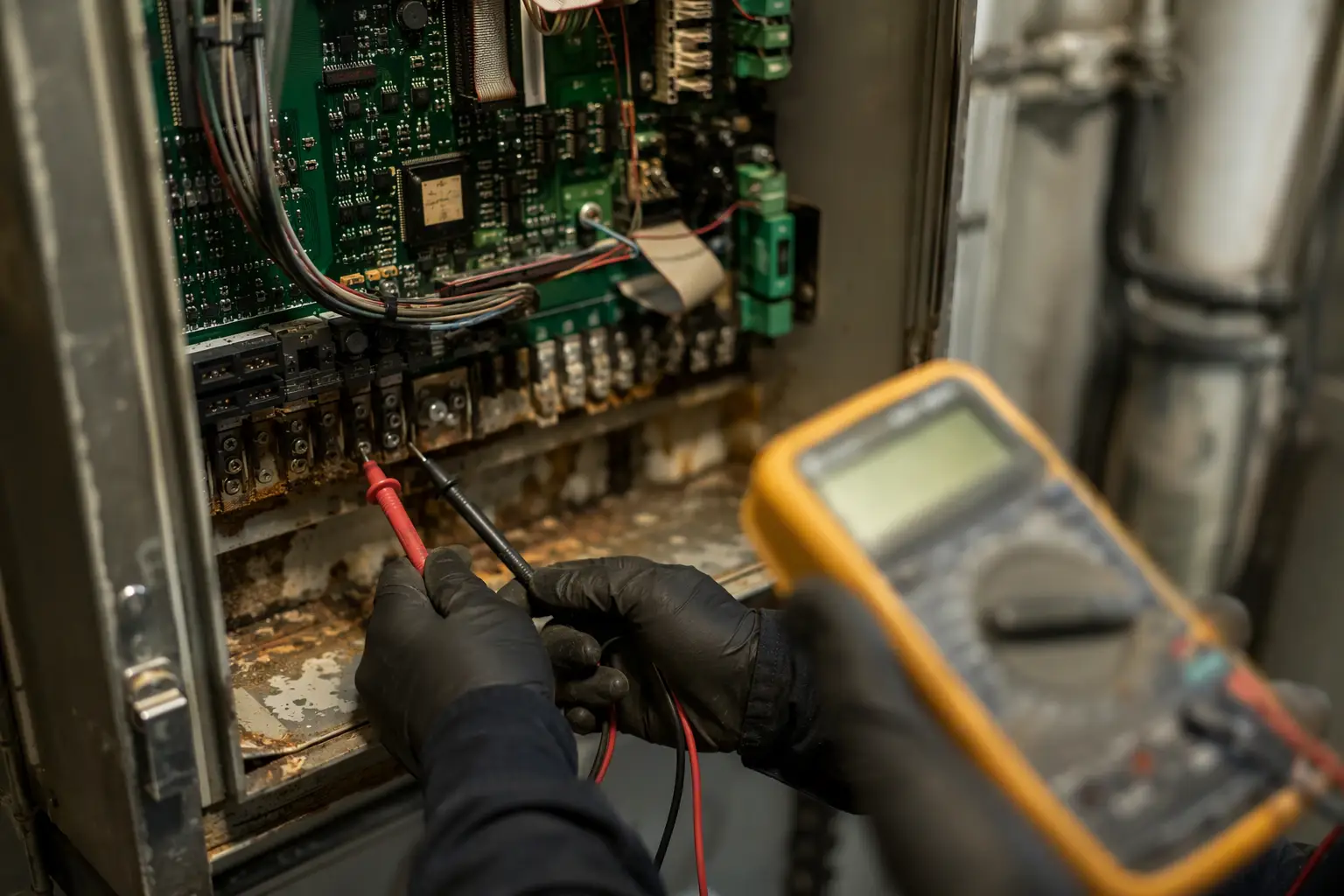
No single published tariff covers all overtime elevator work in California. The final invoice reflects several independent cost layers stacked on top of one another.
- Labor classification: Elevator mechanics in California must hold a Cal/OSHA Certified Competent Conveyance Mechanic (CCCM) credential. Because of that specialized certification, their base wages are higher than general trades, and overtime multipliers apply on top of that elevated base.
- Time of call: Industry overtime structures typically tier by when the call occurs — evening weekday hours, weekend daytime, weekend evenings, and holidays each carry a different multiplier. Emergency calls placed outside normal business hours almost always fall into the highest tier.
- Labor agreements: Many California elevator companies operate under collective-bargaining agreements with the International Union of Elevator Constructors (IUEC). Those contracts set specific overtime multipliers that the employer must pass through to the client.
- Scope of restoration: A technician’s hourly rate is separate from material costs. Flood events often require controller board replacements, motor insulation testing, pit pump systems, and new wiring — all billed at cost-plus or flat rates on top of labor hours.
- Permit and inspection fees: Cal/OSHA charges a reinspection fee before issuing a new permit to operate. That fee is set by state regulation and is not negotiable with the service company.
- Travel and mobilization: Emergency after-hours dispatches frequently include a minimum call-out charge or travel fee billed before any wrench turns.
Because Liftech Elevator is an independent, California-based elevator service provider, its pricing is not tied to a national corporate rate card — quotes are issued based on the actual scope of work after an on-site evaluation.
Why Can’t a Flood-Damaged Elevator Simply Be Reset and Restarted?

California law expressly prohibits operating an elevator without a valid, current permit to operate issued by Cal/OSHA’s Elevator Unit, California Department of Industrial Relations. When flood damage constitutes a material alteration or when the elevator is shut down for safety reasons, the existing permit is effectively voided until the unit is inspected and found safe. Restarting without that clearance exposes building owners to Cal/OSHA citations, civil liability, and — most critically — passenger injury.
Under California Labor Code Sections 7300–7324.2 and the California Code of Regulations, Title 8, Elevator Safety Orders (Sections 3000–3146), only a State of California safety engineer or a Certified Competent Conveyance Inspector (CCCI) may perform the inspection that results in a permit to operate. The service technician who performs the mechanical restoration and the inspector who certifies the elevator safe are distinct roles with distinct credentials.
What Does the Post-Flood Inspection and Restart Process Look Like?
The following steps represent the standard sequence a California elevator company and Cal/OSHA follow after flooding. Building owners who understand the sequence can coordinate vendors and inspectors faster, reducing overall downtime.
- Secure the elevator. Lock out the elevator at the main power disconnect immediately after flooding is detected. Place “Out of Service” notices at every landing to prevent unauthorized entry.
- Engage a Certified Qualified Conveyance Company (CQCC). Under California law, only a company holding Cal/OSHA CQCC certification and a C-11 Elevator Contractor license from the California Contractors State License Board (CSLB) may perform restoration work on a conveyance.
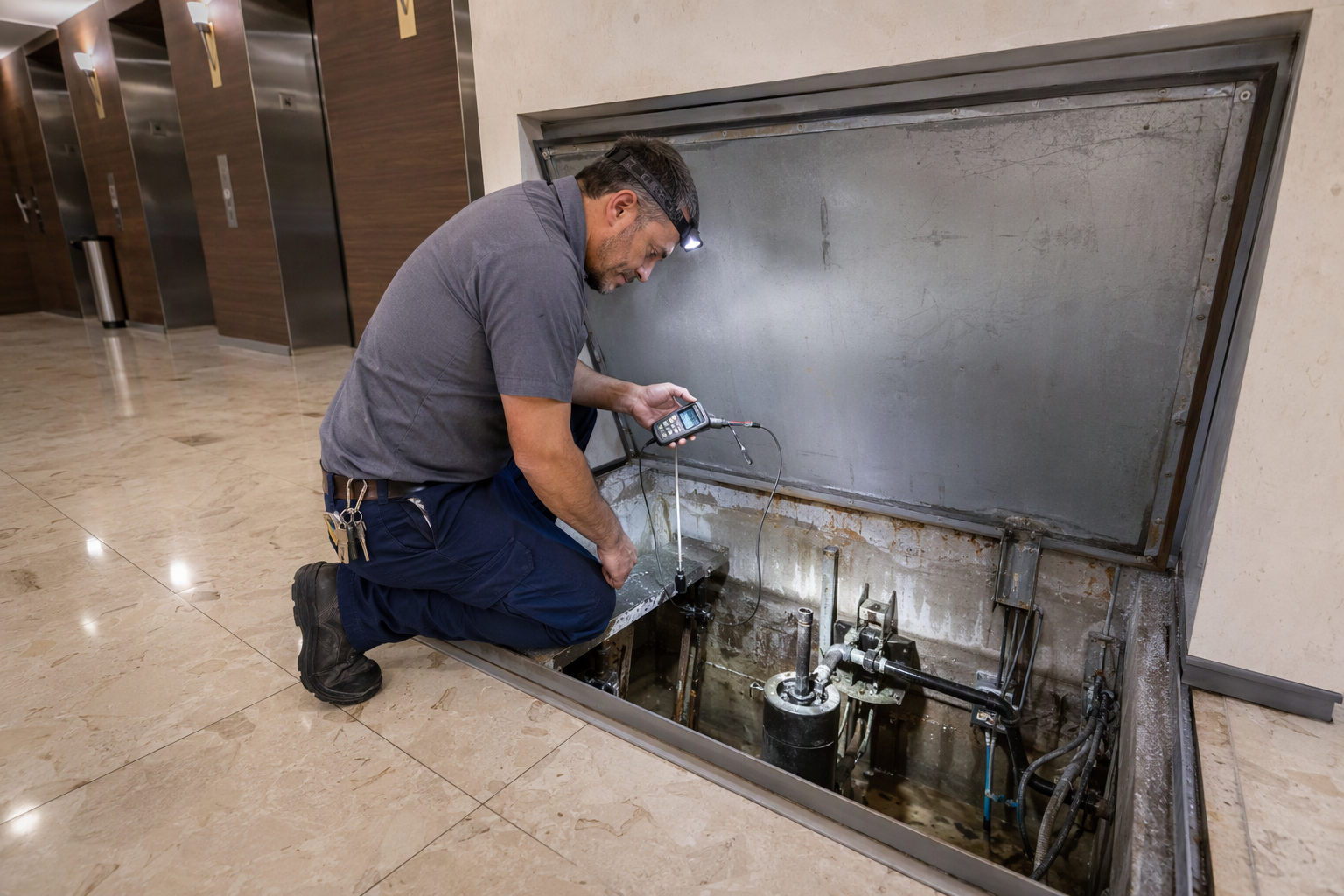
- Commission a damage assessment. The CQCC dispatches a CCCM-credentialed technician to perform a comprehensive flood-damage evaluation: pit condition, controller integrity, wiring insulation resistance, motor megohm readings, rope condition, brake function, and safety device integrity.
- Obtain a material-alteration permit if required. If restoration involves replacing or significantly modifying regulated components, California requires a Cal/OSHA permit before work begins. The CQCC typically handles this filing on the owner’s behalf.
- Complete restoration work. CCCM-credentialed mechanics perform all repairs. Work must conform to the ASME A17.1/CSA B44 Safety Code for Elevators and Escalators, the edition adopted under California’s Elevator Safety Orders (2004 edition, effective May 1, 2008, for applicable installations).
- Request Cal/OSHA reinspection. The building owner — not the service company — is responsible for arranging the annual or reinspection appointment with Cal/OSHA’s Elevator Unit. In practice, the CQCC coordinates the scheduling on the owner’s behalf.
- Pass the official inspection. A California State safety engineer or CCCI performs the inspection. The elevator must pass all functional tests before a permit to operate is issued.
- Post the permit to operate. Once issued, the permit must be posted conspicuously inside the elevator car before the unit returns to service.
How Does Overtime Billing Compare to Standard-Hours Billing?
| Billing Category | Typical Trigger | Rate Structure | Notes for California |
|---|---|---|---|
| Straight Time | Regular weekday business hours | Base hourly rate × 1.0 | Rarely available for emergency flood calls |
| Overtime (1.5×) | Early morning, evening weekdays, Saturday | Base hourly rate × 1.5 | Common first tier after hours |
| Double Time (2×) | Sunday, recognized holidays, extended overnight | Base hourly rate × 2.0 | Applies under most IUEC-pattern agreements |
| Minimum Call-Out | Any emergency dispatch | Minimum hours billed regardless of actual time on-site | Often two to four hours minimum; varies by contract |
| Travel / Mobilization | Any dispatch beyond included radius | Flat fee or portal-to-portal time billing | Independent companies may waive within service territory |
Note: Specific dollar amounts are not published here because certified elevator mechanic wage rates in California are set by collective-bargaining agreements and individual company rate cards that change periodically. Request a written quote from a CQCC-certified company before authorizing work.
What Are the Pros and Cons of Calling an Independent Service Provider vs. a National Elevator Company for Emergency Flood Work?
| Factor | Independent California Provider (e.g., Liftech Elevator) | Large National OEM or Franchise |
|---|---|---|
| Pricing flexibility | Can negotiate scope and rate card directly | Often locked to national pricing tiers |
| California regulatory knowledge | Focused exclusively on Cal/OSHA requirements and CQCC/CCCM framework | Multi-state operations; California specialists may or may not be dispatched |
| Parts sourcing | Multi-brand parts capability; not restricted to proprietary components | May prioritize OEM-branded parts at premium pricing |
| Permit coordination | Direct relationship with local Cal/OSHA Elevator Unit offices | Varies; regional offices may manage filings differently |
| Contract lock-in | Typically no forced long-term maintenance contract tied to emergency work | Emergency work sometimes used to convert owners to proprietary maintenance agreements |
| Local AHJ knowledge | Familiar with Los Angeles LADBS program and other California local authorities | Variable by dispatch technician |
Does Flood Damage Require a New Cal/OSHA Permit to Operate?
Yes, in virtually all practical scenarios. When flooding disables an elevator, the unit must be taken out of service. Returning it to service requires a satisfactory inspection and a new or renewed permit to operate from Cal/OSHA’s Elevator Unit. If the restoration involves replacing or altering regulated components — which is typical in flood events — a material-alteration permit is also required before the work begins. California Labor Code Sections 7300–7324.2 make operating without a valid permit a legal violation regardless of whether the elevator appears to function normally.
What Equipment Is Typically Inspected and Tested After Elevator Flooding?
| Component | Flood Risk | Typical Test | Replacement Likelihood |
|---|---|---|---|
| Pit equipment (buffers, limit switches, governor tensioner) | Very high — pit floods first | Visual inspection, functional test | High if submerged |
| Traveling cables (hoist and control) | High — absorb water wicking | Insulation resistance (megohm) test | Moderate to high |
| Controller / drive unit | High if machine room floods | Board-level inspection, functional diagnostics | High if water-contacted |
| Hoist motor | Moderate to high | Megohm (insulation resistance) test | Moderate |
| Brake assembly | Moderate | Functional test, friction surface inspection | Low unless immersed |
| Door operator and interlock wiring | Moderate | Continuity test, functional cycling | Low to moderate |
| Safety devices (governor, safeties) | Low to moderate | Governor trip test, safety jaw inspection | Low unless corroded |
| Sump pump and drainage system | High | Operational test | Often damaged if flood source was pit drain failure |
Under the ASME A17.1/CSA B44 Safety Code for Elevators and Escalators, insulation resistance testing and functional safety-device tests are required elements before returning a unit to service after maintenance that affects electrical components. California’s adopted Elevator Safety Orders incorporate these testing requirements.
How Long Does It Take to Restart an Elevator After Flooding?
Timeline varies widely based on the depth of flooding, parts availability, and Cal/OSHA inspection scheduling. The qualitative ranges below reflect the general sequence rather than guaranteed durations:
| Scenario | Approximate Timeline | Primary Rate-Limiting Factor |
|---|---|---|
| Minor pit flooding, no component damage | Days to roughly one to two weeks | Cal/OSHA inspection scheduling |
| Moderate flooding, controller and cable damage | Several weeks | Parts lead time, material-alteration permit, inspection |
| Severe flooding, full controller and motor replacement | Four to twelve weeks or longer | Parts manufacturing or procurement, permit, inspection backlog |
Engaging a CQCC-certified company such as Liftech Elevator promptly after a flood event reduces timeline because permit applications and inspection requests can be filed while restoration work proceeds in the correct sequence.
Does Building Insurance or FEMA Flood Assistance Cover Elevator Restoration Costs?
Commercial property insurance policies with flood riders typically cover elevator restoration as part of building mechanical systems, but coverage depends on policy exclusions, deductibles, and whether the flood event qualifies under policy terms. FEMA’s National Flood Insurance Program (NFIP) is primarily designed for residential policyholders; commercial building owners generally obtain flood coverage through private markets. Building owners should document all flood damage with photographs and a written damage report from a CQCC-certified company before making any repairs, as insurers require documentation prior to claim approval. For authoritative guidance on workplace safety obligations during and after flooding, refer to OSHA’s official resources.
What Should Building Owners Ask When Getting a Quote for Post-Flood Elevator Work?
- Is your company CQCC-certified by Cal/OSHA, and does your company hold a current C-11 license from the CSLB?
- Are your mechanics CCCM-credentialed under Cal/OSHA?
- What is the minimum call-out charge, and how many hours does it cover?
- What is the overtime multiplier for work performed outside standard business hours?
- Is travel time billed separately, and at what rate?
- Will a material-alteration permit be required, and who handles the filing?
- Can you coordinate Cal/OSHA reinspection scheduling on behalf of the building owner?
- Are parts billed at cost-plus or at a fixed rate, and is an itemized parts quote provided before work begins?
- Does the quote separate the emergency assessment from the full restoration scope?
How Does Los Angeles Handle Elevator Permits Differently From the Rest of California?
Most California jurisdictions fall under the statewide Cal/OSHA Elevator Unit program described above. However, the City of Los Angeles maintains its own elevator and conveyance inspection program administered by the Los Angeles Department of Building and Safety (LADBS). Building owners with elevators in Los Angeles should confirm with LADBS whether local program requirements affect the restoration permitting timeline, in addition to any applicable Cal/OSHA requirements. Liftech Elevator is familiar with the Los Angeles program and can advise building owners on coordinating between LADBS and Cal/OSHA obligations.
What Ongoing Compliance Steps Are Required After an Elevator Returns to Service?
California law requires every elevator to be inspected at least once per year, with the permit to operate valid for up to one year. If the elevator is covered by a full maintenance contract with a CQCC-certified company holding a C-11 license, Cal/OSHA may issue a permit valid for up to two years. Arranging the annual reinspection remains the building owner’s legal responsibility. The permit to operate must be posted conspicuously inside the elevator car at all times. CQCC and CCCM certificates must be renewed every two years, with at least eight hours of continuing education required at renewal — a credential verification step building owners should confirm before retaining any service company.
As of 2026, California has proposed a Group V update to its Elevator Safety Orders that would incorporate elements of the more recent ASME A17.1 Safety Code for Elevators and Escalators. The Standards Board held a public hearing on June 18, 2026, and no effective date has been posted. Building owners and service companies should monitor the California Code of Regulations, Title 8, for updates.
Contact Liftech Elevator for a free elevator assessment at 562-997-3639.
Need elevator service you can rely on? Liftech Elevator is ready to help.