Elevator Interior Updates vs. Full Modernization: A Comparison and Decision Guide

Deciding between a cosmetic interior refresh and a full elevator modernization is one of the most consequential choices a California building owner or property manager faces. The right answer depends on the age and condition of existing equipment, Cal/OSHA permit status, ADA compliance obligations, and the building’s long-term plan. This guide walks through every dimension of that decision — cost considerations, timelines, regulatory triggers, and vendor selection — so you can move forward with confidence.
What Is the Difference Between an Elevator Interior Update and a Full Modernization?

An elevator interior update focuses on the cab enclosure — walls, flooring, handrails, ceiling panels, lighting fixtures, and door finishes. No mechanical, electrical, or control components are replaced. The goal is aesthetic improvement and passenger experience without triggering a major permit process.
A full modernization replaces core mechanical and electrical systems: the controller, drive, motor, door operator, safety devices, and often the cab itself. Modernization extends the elevator’s operational lifespan, improves energy efficiency, and brings the unit closer to current code requirements under the ASME A17.1/CSA B44 Safety Code for Elevators and Escalators.
Some projects fall in between — a partial modernization that replaces, for example, the controller and door operator while retaining the existing cab and machine room equipment. Understanding where a specific elevator falls on this spectrum is the first step in project planning.
What Does a California Interior Update Typically Include?

An interior update package in California commonly encompasses:
- Cab wall panel replacement (laminate, stainless steel, wood veneer, or decorative finish)
- Flooring replacement (tile, carpet, luxury vinyl, or stone)
- Ceiling and lighting upgrades, including LED conversion
- Handrail replacement or refinishing
- Door panel resurfacing or replacement
- Button and fixture panel refinishing or replacement
- Emergency signage updates to meet current posting requirements
Because an interior update does not alter the mechanical or electrical systems, it generally does not constitute a “material alteration” under California Code of Regulations, Title 8, Elevator Safety Orders. However, any work that does trigger a material alteration requires a Cal/OSHA permit before work begins. Liftech Elevator evaluates each project scope before work starts to confirm permit requirements with the Authority Having Jurisdiction (AHJ).
What Does a Full Elevator Modernization Include?
A full modernization typically replaces:
- Elevator controller and logic system
- Traction drive or hydraulic power unit
- Electric motor or pump
- Door operators and safety edges
- Car and counterweight safeties
- Buffers, governor, and other safety devices
- Wiring and traveling cable
- Cab enclosure (often upgraded simultaneously)
- Emergency lighting and communication systems
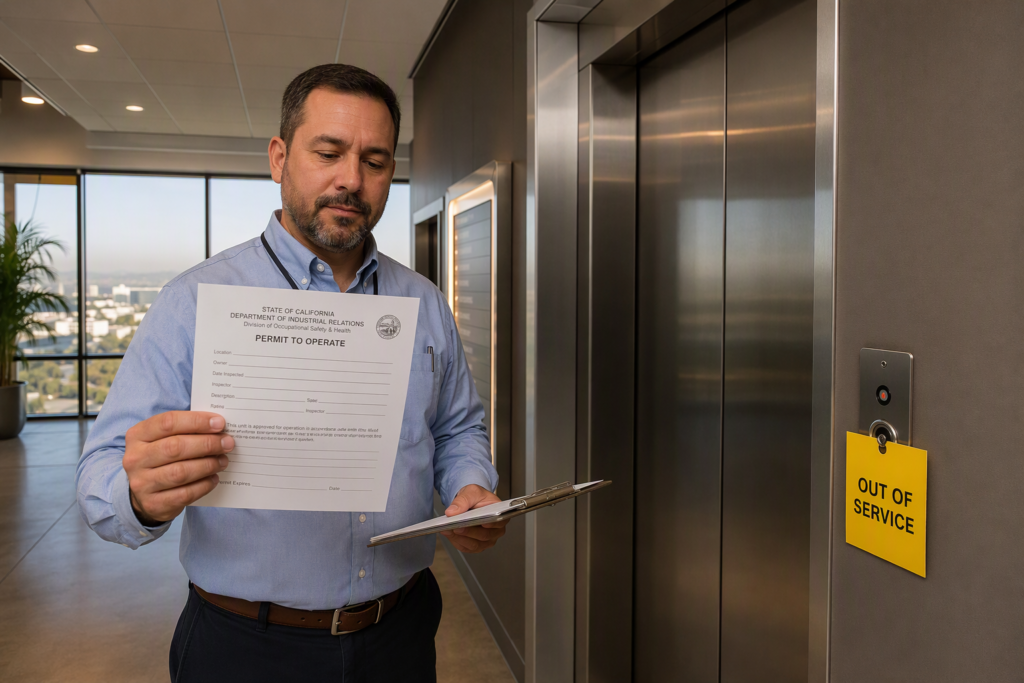
A full modernization is a material alteration under California law, which means a Cal/OSHA permit is required before the conveyance is altered. After completion, the elevator must be inspected by a State of California safety engineer or a Certified Competent Conveyance Inspector (CCCI), and a new permit to operate must be issued before the elevator is returned to service.
Interior Update vs. Modernization: Side-by-Side Comparison
| Factor | Interior Update | Partial Modernization | Full Modernization |
|---|---|---|---|
| Primary Goal | Aesthetics & passenger experience | Targeted system performance | Full system performance & compliance |
| Mechanical Work? | No | Selective (e.g., controller only) | Yes — all major systems |
| Cal/OSHA Alteration Permit Required? | Typically no | Yes, if material alteration | Yes |
| Post-Work Inspection Required? | Not typically | Yes | Yes |
| Downtime | Days to 1–2 weeks | Weeks to 1–2 months | Several weeks to months |
| Equipment Life Extension | None (cosmetic) | Moderate | Significant |
| Energy Efficiency Improvement | Minimal (LED lighting only) | Moderate | Substantial |
| Code Compliance Impact | Low (no new code triggers) | Medium | High — brings systems closer to current ASME standards |
| ROI Type | Tenant satisfaction, property value | Reliability, reduced service calls | Long-term lifecycle cost reduction |
| Best Suited For | Newer elevators in good mechanical condition | Equipment with one failing system | Aging equipment with multiple system issues |
Pros and Cons: Interior Update
| Pros | Cons |
|---|---|
| Minimal downtime and disruption | Does not address mechanical reliability |
| Lower upfront investment | No energy efficiency gains (except LED) |
| Immediate visual impact for tenants | Does not extend equipment lifespan |
| Generally avoids material alteration permit | May not resolve ADA accessibility concerns |
| Can be phased or staged easily | Underlying system problems persist |
Pros and Cons: Full Modernization
| Pros | Cons |
|---|---|
| Extends operational life significantly | Higher upfront cost |
| Improves reliability and reduces breakdown frequency | Extended downtime during construction |
| Can improve ADA compliance and accessibility | Requires Cal/OSHA alteration permit and post-work inspection |
| Modern controls improve ride quality and leveling | Requires detailed project planning and coordination |
| Energy-efficient drives reduce operating costs | May reveal additional shaft or hoistway issues during work |
| Positions building for long-term code compliance | Building must arrange temporary vertical transportation if only one elevator |
When Does California Law Require Modernization Rather Than Allow a Simple Update?
California does not mandate modernization on a fixed schedule based solely on age. However, several circumstances can make modernization the only compliant path forward:
- Failed inspection: If a Cal/OSHA annual inspection identifies safety deficiencies that cannot be corrected through repair, the unit may not receive a permit to operate until deficient components are replaced or upgraded.
- Permit to operate expiration: Under California Labor Code Sections 7300–7324.2, no elevator may be operated without a valid, current permit to operate. If the unit cannot pass inspection, operation is prohibited until corrections are made.
- ADA barrier removal: If a building triggers an ADA barrier removal obligation (for example, during a renovation project), accessibility improvements to the elevator may require more than cosmetic changes.
- Obsolete parts no longer available: When safety-critical parts for legacy controllers or drives are no longer manufactured, repair is no longer possible, and modernization becomes necessary to maintain safe operation.
- Accumulated safety orders: Cal/OSHA safety engineers can issue safety orders for identified violations. Accumulated orders on aging equipment often make modernization more cost-effective than piecemeal repairs.
Liftech Elevator reviews inspection history, existing permit status, and equipment condition before recommending any scope of work.
What Are the California Regulatory Requirements for Modernization Work?
In California, any company that installs, alters, maintains, repairs, or services elevators must be certified by Cal/OSHA as a Certified Qualified Conveyance Company (CQCC). Additionally, any mechanic who performs work on a California elevator without direct supervision must hold a Certified Competent Conveyance Mechanic (CCCM) certification issued by Cal/OSHA.
To obtain CQCC certification, a company must hold a current C-11 Elevator Contractor license issued by the California Contractors State License Board (CSLB), along with valid workers’ compensation and liability insurance. CQCC and CCCM certificates are renewed every two years, and renewal requires at least eight hours of continuing education per renewal cycle.
Before any modernization begins, the elevator owner must obtain a Cal/OSHA permit to alter. After work is complete, only a State of California safety engineer or a CCCI may perform the required inspection. A new permit to operate is issued only after the elevator is found to be in safe condition. In Los Angeles, building owners should also be aware that the City of Los Angeles runs its own elevator and conveyance inspection program through the Department of Building and Safety (LADBS), which may have additional local requirements.
California’s adopted elevator code is the ASME A17.1/CSA B44, 2004 edition (Group IV Elevator Safety Orders), effective May 1, 2008 for installation contracts signed on or after that date. A proposed Group V update incorporating portions of ASME A17.1-2019 had a public hearing on June 18, 2026; no effective date has been posted as of the time of this publication.
How Does ADA Compliance Factor Into Elevator Interior Updates?
The Americans with Disabilities Act sets accessibility requirements for elevators in buildings open to the public. An interior update project offers a practical opportunity to address ADA elements such as:
- Cab interior dimensions and clear floor area
- Door width and timing (door dwell time settings may require controller access)
- Control button height, Braille, and raised character requirements
- Handrail height and graspability
- Floor surface slip resistance
- Lighting levels within the cab
Some ADA corrective actions — such as adjusting door timing — require changes to the controller and fall outside the scope of a pure interior update. Liftech Elevator’s technicians identify which ADA items can be addressed cosmetically and which require mechanical intervention, helping owners prioritize work and avoid compliance gaps.
What Is the Typical Timeline for Each Type of Project?
Timelines vary based on building type, cab size, parts availability, and permit processing by Cal/OSHA. General ranges based on standard industry project types are:
| Project Type | Planning & Permitting | Active Construction | Inspection & Return to Service |
|---|---|---|---|
| Interior Update (cosmetic only) | 1–3 weeks | 3–10 business days | Not typically required |
| Partial Modernization | 4–8 weeks (includes alteration permit) | 2–6 weeks | Cal/OSHA inspection before return to service |
| Full Modernization | 8–16 weeks (design, permit, equipment lead time) | 6–16 weeks | Cal/OSHA inspection before return to service |
Equipment lead times have varied significantly in recent years due to supply chain conditions. Early planning and parts procurement are critical, particularly for full modernizations involving custom cab dimensions or specialty equipment.
How Should Building Owners Evaluate and Choose a Service Provider?
When selecting a California elevator contractor for interior updates or modernization, owners should verify:
- CQCC certification: Confirm the company holds a current Cal/OSHA Certified Qualified Conveyance Company certificate before any work begins.
- C-11 license: Verify the company holds an active C-11 Elevator Contractor license from the CSLB.
- CCCM-certified mechanics: Ask whether the mechanics who will perform the work hold current CCCM certifications from Cal/OSHA.
- Permit management: Confirm the contractor will manage alteration permit applications to Cal/OSHA on the owner’s behalf.
- Scope documentation: Request a written scope of work that clearly distinguishes cosmetic from mechanical changes and identifies any items that trigger material alteration status.
- References and project history: Ask for references from comparable California projects — similar building type, elevator age, and local AHJ.
- Independent vs. OEM: Independent certified companies are not contractually tied to a single equipment manufacturer, allowing broader parts sourcing and objective modernization recommendations.
Liftech Elevator is an independent California elevator service company with CQCC certification and C-11-licensed operations, serving building owners seeking objective, manufacturer-neutral modernization guidance throughout California.
What Questions Should Owners Ask Before Committing to a Scope?
Before signing a contract for either an interior update or modernization, owners benefit from asking their elevator contractor:
- Will this scope constitute a “material alteration” under California Title 8 Elevator Safety Orders, and if so, has the alteration permit been factored into the timeline and budget?
- What is the current inspection status and remaining validity of the elevator’s permit to operate?
- Are there any outstanding Cal/OSHA safety orders on this unit?
- What parts are being replaced, and are those parts currently available or subject to lead time delays?
- Will the modernization bring the unit into compliance with the adopted ASME A17.1/CSA B44 code edition currently enforced in California?
- What ADA-related improvements can be bundled into this project scope?
- What are the post-project maintenance requirements, and does the building qualify for a two-year permit to operate under a full maintenance contract?
Does an Interior Update Affect the Elevator’s Permit to Operate?
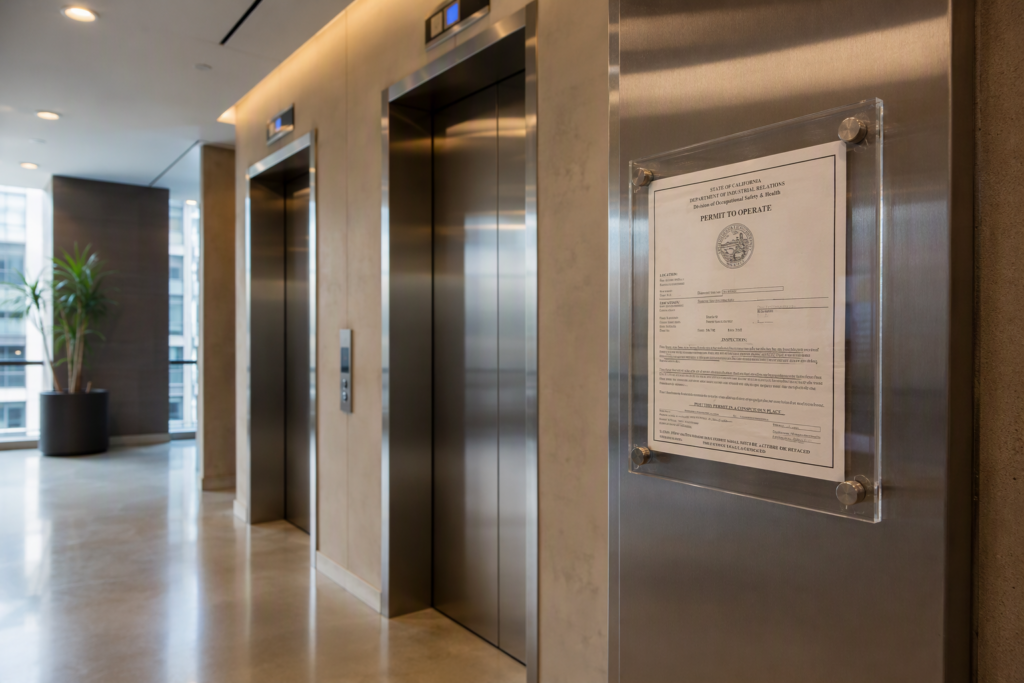
A purely cosmetic interior update — replacing wall panels, flooring, lighting, and finishes without touching mechanical or electrical systems — does not typically constitute a material alteration under California’s Elevator Safety Orders and therefore does not require a Cal/OSHA alteration permit. The existing annual permit to operate remains in effect.
However, if any aspect of the interior update involves changes to the control panel fixtures in a way that affects the control system, or if emergency communication or lighting equipment is replaced with a different type, the scope may cross into material alteration territory. Liftech Elevator’s project managers assess each scope item individually to prevent inadvertent permit violations.
Regardless of project type, California law requires the elevator owner to arrange the annual reinspection. A Cal/OSHA permit to operate may be issued for up to one year following a satisfactory inspection, or up to two years if the elevator is in safe condition and covered by a full maintenance contract with a CQCC-certified company.
What Are the Long-Term Cost and Value Considerations?
Budget-focused decision-making that looks only at upfront costs often overlooks total lifecycle value. Key factors to weigh include:
| Consideration | Interior Update | Full Modernization |
|---|---|---|
| Upfront investment | Lower | Higher |
| Ongoing maintenance cost impact | Unchanged (existing systems continue aging) | Typically reduced (new systems require less reactive maintenance) |
| Energy cost impact | Minimal (LED lighting only) | Modern drives and motors reduce energy consumption |
| Tenant/occupant satisfaction | Improved appearance immediately | Improved appearance and ride quality |
| Building marketability | Moderate improvement | Stronger improvement — modern equipment is a leasing asset |
| Risk of unplanned shutdown | Unchanged | Reduced — new components carry manufacturer warranty |
| Capital planning horizon | Short-term deferral of larger investment | Long-term solution — modernization resets the lifecycle clock |
Building owners planning to hold a property for many years typically find full modernization more cost-effective over the full ownership period. Owners with a shorter planning horizon may find that a well-executed interior update preserves tenant experience while deferring capital expenditure responsibly — provided the mechanical systems are in sound condition.
Summary: Which Option Is Right for Your Building?
The clearest guidance is this: if the elevator’s mechanical and electrical systems are in good working order, passing annual Cal/OSHA inspections without outstanding safety orders, and parts availability is not a concern, an interior update is a sound investment in tenant experience. If the equipment is aging, generating frequent service calls, carrying unresolved safety orders, or approaching the end of serviceable parts availability, full or partial modernization delivers stronger long-term value and reduces compliance risk.
In either case, the work must be performed by a Cal/OSHA-certified CQCC using CCCM-certified mechanics, with appropriate permits obtained before any material alteration begins. Liftech Elevator provides free assessments to help California property owners determine the right scope, confirm current permit and inspection status, and build a project plan that meets Cal/OSHA, ASME, and ADA requirements.
Contact Liftech Elevator for a free elevator assessment at 562-997-3639.
Need elevator service you can rely on? Liftech Elevator is ready to help.