
Liftech Elevator Business Hours & Service Availability: Complete FAQ
Liftech Elevator serves building owners, property managers, and facility directors across Signal Hill CA, Long Beach CA, Los Angeles CA, and Orange County CA. This FAQ hub answers the most common questions about scheduling service, understanding California elevator compliance requirements, and knowing what to expect when contacting an elevator company in Southern California.
What are Liftech Elevator’s business hours?

To confirm current business hours, scheduling windows, and how to reach Liftech Elevator for routine or urgent elevator service in Signal Hill, Long Beach, Los Angeles, and Orange County, contact the company directly by phone or through the online inquiry form.
Elevator service needs do not always occur on a convenient schedule. Equipment issues, inspection deadlines, and permit renewal timelines can all create time-sensitive demands for building owners and property managers. Knowing how and when to reach a qualified elevator service company is an essential part of responsible building management in California. Liftech Elevator encourages property owners and facility managers to keep the company’s contact information accessible so that scheduling, compliance questions, and repair requests can be handled promptly.
Why does it matter that an elevator company is available when I need them?

Elevator downtime directly affects tenant satisfaction, ADA accessibility obligations, and regulatory compliance under California law, making timely access to a certified service provider a practical and legal necessity.
Under ADA regulations, elevators in multi-story facilities that are not exempt must remain accessible to individuals with disabilities. An out-of-service elevator in a covered facility can create immediate compliance exposure. Additionally, under California Labor Code Sections 7300–7324.2, no elevator may be operated in California without a valid, current permit to operate issued by Cal/OSHA. If an elevator is shut down due to a violation or mechanical failure, building owners need to reach a Certified Qualified Conveyance Company (CQCC) as quickly as possible to initiate repairs and reinspection.
Because arranging annual reinspection is the elevator owner’s legal responsibility in California, understanding your service company’s scheduling process is a foundational part of building compliance planning.
What geographic areas does Liftech Elevator service?
Liftech Elevator provides elevator installation, maintenance, repair, and inspection coordination services throughout Signal Hill CA, Long Beach CA, Los Angeles CA, and Orange County CA.
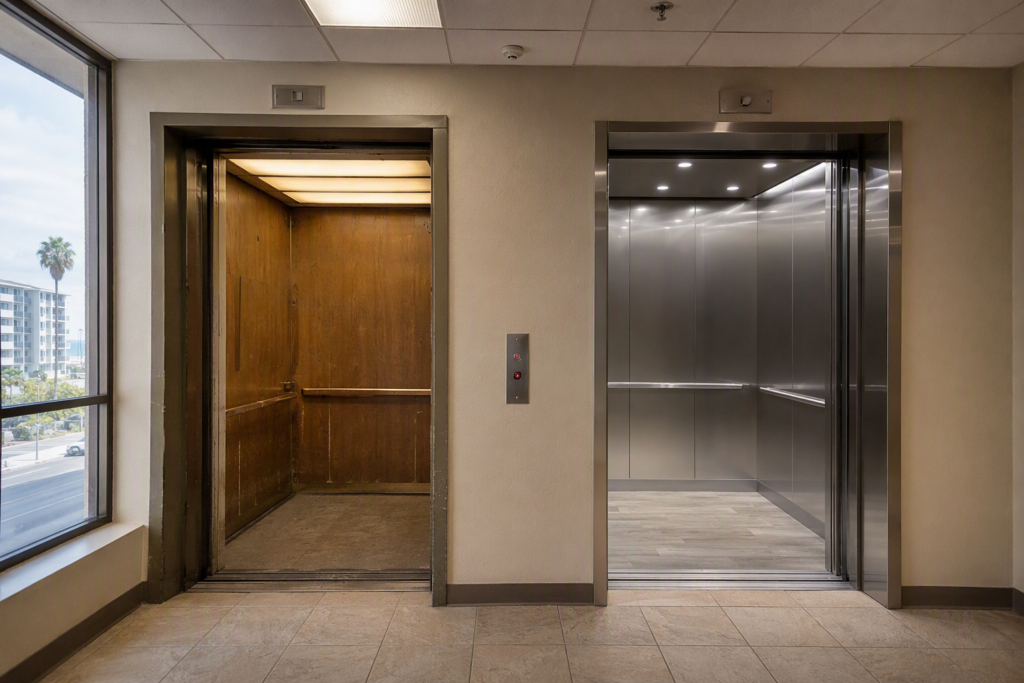
Southern California presents a uniquely dense and varied elevator landscape. Commercial towers in downtown Los Angeles, mid-rise residential buildings in Long Beach, mixed-use developments in Orange County, and industrial properties in Signal Hill all have distinct elevator configurations and compliance requirements. A service company with direct familiarity in these markets understands local Authority Having Jurisdiction (AHJ) nuances, including the fact that the City of Los Angeles runs its own elevator and conveyance inspection program through the Los Angeles Department of Building and Safety (LADBS), separate from the state Cal/OSHA program.
What California regulatory body governs elevator operations, and how does it affect scheduling service?
The Division of Occupational Safety and Health (Cal/OSHA), Elevator Unit, California Department of Industrial Relations regulates elevator safety in California, and its permit and inspection timelines directly determine when service must be scheduled.
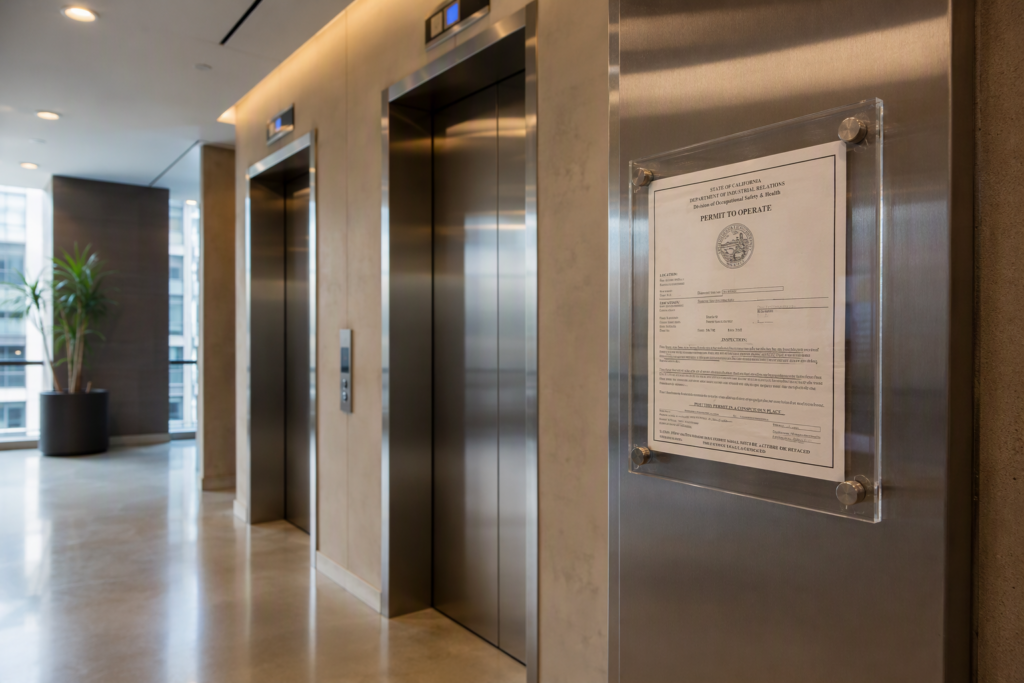
Cal/OSHA administers the elevator safety program under California elevator regulations, enforcing California Labor Code Sections 7300–7324.2 and the California Code of Regulations, Title 8, Elevator Safety Orders (Sections 3000–3146). California law requires every conveyance to be inspected at least once a year. A conveyance found safe receives a permit to operate for up to one year. For elevators under a full maintenance contract with a C-11 licensed elevator company, Cal/OSHA may extend the permit to operate for up to two years, making maintenance contract timing a significant factor in annual service scheduling.
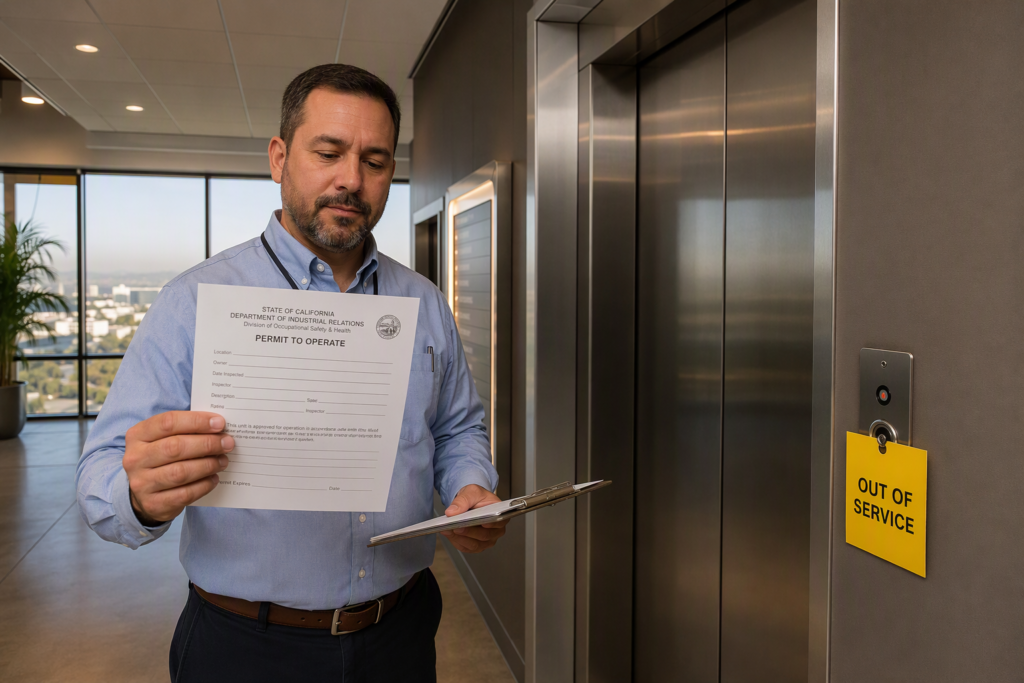
Because the permit to operate must be posted conspicuously inside the elevator car, and because arranging the annual reinspection is the building owner’s legal responsibility, owners should plan service scheduling well in advance of permit expiration dates.
Who is legally authorized to work on elevators in California?
Only a Certified Competent Conveyance Mechanic (CCCM) working for a Certified Qualified Conveyance Company (CQCC) may legally maintain, repair, alter, or replace components on a conveyance in California.
This certification structure is administered by Cal/OSHA under California’s elevator regulatory framework. Companies that install, alter, test, maintain, repair, or service elevators in California must be certified as a CQCC. To obtain CQCC certification, applicants must hold a current C-11 Elevator Contractor license issued by the California Contractors State License Board (CSLB), along with certificates of workers’ compensation and liability insurance. All mechanics who work on elevators without direct supervision must hold individual CCCM certification. California CQCC, CCCM, and conveyance inspector certificates last two years, and renewal requires at least eight hours of continuing education per renewal cycle.
Liftech Elevator operates in full compliance with California’s CQCC and CCCM certification requirements, providing building owners with legally authorized service across its Southern California service area.
How often must elevators be inspected in California?
California law requires every conveyance to be inspected at least once per year, with a permit to operate issued for up to one year, or up to two years if the elevator is under a qualifying full maintenance contract.
Only State of California safety engineers and Certified Competent Conveyance Inspectors (CCCI) may perform elevator inspections in California. This means inspections cannot be performed by just any technician or contractor — the inspector must hold the appropriate state certification. Because the building owner is responsible for arranging reinspection, proactively scheduling maintenance reviews well before the permit expiration date reduces the risk of a permit lapse, which would legally prohibit elevator operation.
| Requirement | Standard Permit | With Full Maintenance Contract (C-11 Company) |
|---|---|---|
| Inspection Frequency | At least once per year | At least once per year |
| Permit to Operate Duration | Up to 1 year | Up to 2 years |
| Who Arranges Reinspection | Building owner | Building owner |
| Who May Perform Inspection | CA Safety Engineer or CCCI only | CA Safety Engineer or CCCI only |
| Permit Posting Requirement | Conspicuously in elevator car | Conspicuously in elevator car |
| Work Authorization Requirement | CQCC company + CCCM mechanic | CQCC company + CCCM mechanic |
| Regulating Authority | Cal/OSHA Elevator Unit, CA DIR | Cal/OSHA Elevator Unit, CA DIR |
What code standards apply to elevator equipment in California?
California has adopted the ASME A17.1/CSA B44 Safety Code for Elevators and Escalators, 2004 edition, under its Group IV Elevator Safety Orders, effective for installation contracts signed on or after May 1, 2008.
The ASME A17.1 Safety Code for Elevators and Escalators, maintained by the American Society of Mechanical Engineers, is the foundational technical standard covering elevator design, installation, operation, inspection, testing, and maintenance across North America. California’s adoption of the 2004 edition through its Elevator Safety Orders establishes the technical baseline for equipment installed under that regulatory period. California has proposed a Group V update to its Elevator Safety Orders that would incorporate ASME A17.1-2019 in part; the Standards Board held a public hearing on June 18, 2026, and no effective date has been posted as of the time of this writing.
Building owners and property managers should consult with a qualified elevator service company such as Liftech Elevator to understand how the applicable edition of ASME A17.1 affects their specific equipment and compliance obligations.
What happens if a new elevator is installed in California before receiving a permit?
California law prohibits placing a new elevator into service without Cal/OSHA first inspecting it and issuing a permit to operate, and a separate Cal/OSHA permit is also required before erection, installation, or material alteration begins.
This two-stage permit requirement — one before work begins and one before the elevator enters service — applies to all new installations and material alterations. Building developers, general contractors, and property owners planning elevator projects in Signal Hill, Long Beach, Los Angeles, or Orange County must factor these permit timelines into project schedules to avoid construction delays and legal exposure. Coordinating with a CQCC-certified company early in the project timeline helps ensure that permit applications, inspections, and compliance documentation are managed correctly from the outset.
Does Los Angeles have its own elevator inspection program separate from Cal/OSHA?
Yes, the City of Los Angeles runs its own elevator and conveyance inspection program through the Los Angeles Department of Building and Safety (LADBS), which operates separately from the state Cal/OSHA program.
Building owners and property managers with elevator assets in the City of Los Angeles should be aware that compliance in Los Angeles may involve a local AHJ process in addition to state-level requirements. The practical implications of this dual-jurisdiction structure — including scheduling inspections, obtaining permits, and coordinating repairs — can differ from the process followed in other California cities served by Cal/OSHA directly. Liftech Elevator’s familiarity with the Los Angeles market provides building stakeholders with guidance on navigating both the local and state regulatory environments.
What should a building owner do if an elevator fails or shuts down unexpectedly?
When an elevator fails or is shut down unexpectedly, the building owner should follow a structured response to protect occupant safety, preserve ADA accessibility options, and initiate the repair and reinspection process without unnecessary delay.
- Immediately secure the elevator car and restrict access to prevent unauthorized use of a potentially unsafe conveyance.
- Post visible out-of-service signage at all landings to inform building occupants and visitors.
- Identify and implement alternative accessible routes where required under ADA requirements to maintain accessibility during the outage period.
- Contact a Cal/OSHA Certified Qualified Conveyance Company (CQCC) to dispatch a Certified Competent Conveyance Mechanic (CCCM) for assessment and repair.
- Document the failure, the time of shutdown, and all communications with your service company for compliance recordkeeping purposes.
- Once repairs are complete, coordinate with the appropriate authority — Cal/OSHA or LADBS for Los Angeles properties — to schedule the required reinspection before returning the elevator to service.
- Confirm that a new or renewed permit to operate is issued and posted conspicuously in the elevator car before resuming normal operation.
Are there ADA compliance requirements that affect elevator service scheduling?
Yes, ADA regulations impose accessibility requirements on elevators in covered facilities, which creates legal obligations to maintain elevator availability and address equipment failures promptly.
The ADA applies to public accommodations and commercial facilities and requires that accessible features, including elevators in multi-story covered buildings, remain operational and available. Extended elevator downtime in a building where the elevator is the primary means of accessible vertical travel can create exposure to ADA complaints and enforcement actions. Proactive maintenance scheduling — rather than reactive repair — is the most effective strategy for managing ADA compliance risk related to elevator availability. Liftech Elevator assists property owners across its service area in establishing maintenance programs designed to reduce unplanned downtime.
What types of elevator maintenance services should property managers schedule regularly?
Regular elevator maintenance should include safety system testing, mechanical and electrical component inspection, lubrication of moving parts, cab and landing door function verification, and review of code compliance status under the applicable edition of ASME A17.1 Safety Code for Elevators and Escalators.
A comprehensive maintenance program goes beyond the minimum required for a Cal/OSHA inspection. Routine service visits allow a CCCM-certified mechanic to identify wear patterns, address minor deficiencies before they escalate into major repairs, and maintain documentation that supports permit renewals. Property managers in Signal Hill, Long Beach, Los Angeles, and Orange County who maintain a full maintenance contract with a C-11 licensed elevator company may also be eligible for Cal/OSHA to issue a permit to operate for up to two years, reducing the administrative burden of annual reinspection coordination.
What is a full maintenance contract, and how does it differ from a basic service agreement?
A full maintenance contract covers all labor and parts for routine upkeep, safety testing, and repairs within the scope of the agreement, and in California it is the qualifying contract type that may allow Cal/OSHA to extend a permit to operate for up to two years.
Basic or oil-and-grease service agreements, by contrast, typically cover only lubrication and minor adjustments, leaving repair labor and parts as additional billable items. For building owners evaluating service agreements, the distinction matters both for budget predictability and for permit duration eligibility. Understanding what a contract includes and excludes — and confirming that the service company holds active CQCC certification and a C-11 license from the CSLB — are the essential due diligence steps before signing any elevator service agreement in California.
What certifications should I verify before hiring an elevator company in California?
Before engaging any elevator service company in California, building owners should verify active CQCC certification from Cal/OSHA, a current C-11 Elevator Contractor license from the California Contractors State License Board, and CCCM certification for the mechanics who will perform work.
California’s elevator laws are explicit: only a CQCC-certified company may maintain, repair, alter, or install elevators in the state, and only a CCCM-certified mechanic may perform that work unsupervised. Certificates last two years and require renewal with continuing education. Asking for documentation of these credentials before work begins is both prudent and consistent with what California law requires of the parties involved in elevator work. Liftech Elevator maintains the certifications required to legally service elevators throughout its Southern California markets.
How does elevator permit status affect property transactions and leasing in California?
A lapsed or missing Cal/OSHA permit to operate can create significant complications during property sales, lease negotiations, and due diligence reviews, since operating an elevator without a valid permit is prohibited under California law.
Commercial real estate transactions involving properties with elevator assets routinely include requests for current permits to operate as part of due diligence documentation. A permit that has expired, been suspended, or was never issued for an existing elevator can delay closings, affect property valuations, and require emergency remediation at unfavorable timelines and costs. For building owners preparing for transactions or lease renewals, verifying current permit status and scheduling any overdue maintenance or inspection well in advance is a straightforward risk management step.
What is the significance of the California Code of Regulations Title 8 Elevator Safety Orders for my building?
The California Code of Regulations, Title 8, Elevator Safety Orders (Sections 3000–3146) establish the detailed technical and administrative rules that govern every aspect of elevator operation, maintenance, alteration, and inspection for conveyances within Cal/OSHA’s jurisdiction.
These regulations, enforced by the Cal/OSHA Elevator Unit, California Department of Industrial Relations, define what constitutes a material alteration requiring a permit, how inspections must be conducted, and what equipment standards apply based on the installation date of the conveyance. Building owners with elevators of varying ages in their portfolio may find that different equipment is subject to different editions of ASME A17.1 depending on when installation contracts were signed. California has also proposed a Group V update that would incorporate ASME A17.1-2019 in part, with a public hearing held June 18, 2026, though no effective date has been announced.
Are there elevator-related OSHA requirements that apply to workplaces in California?
Federal OSHA standards address elevator-related worker safety requirements in workplaces, while California’s state elevator safety program through Cal/OSHA governs the equipment itself under the Elevator Safety Orders.
In California, Cal/OSHA administers both the state plan equivalent of federal OSHA worker safety rules and the separate elevator equipment safety program under the California Labor Code. Building owners and employers should be aware that workplace safety obligations related to elevators — including safe access for maintenance workers — can involve both bodies of regulation. A qualified elevator service company operating in California will be familiar with the applicable requirements for protecting workers during maintenance and repair activities.
What elevators are exempt from California’s elevator safety laws?
California’s elevator law exempts conveyances under federal jurisdiction and conveyances in single-unit private homes that are not accessible to the public.
For the vast majority of commercial, multi-family residential, industrial, and mixed-use properties in Signal Hill, Long Beach, Los Angeles, and Orange County, California’s elevator safety requirements apply in full. Building owners who believe their conveyance may qualify for an exemption should confirm that determination with Cal/OSHA or a qualified legal advisor rather than assuming exemption status, since operating an elevator that requires a permit without one is a violation of California law.
How should property managers prepare for a Cal/OSHA elevator inspection?
Preparing for a Cal/OSHA elevator inspection involves confirming current permit status, ensuring maintenance records are complete and accessible, verifying that the permit to operate is posted in the elevator car, and coordinating with the elevator service company to address any known deficiencies before the inspection date.
- Locate the current permit to operate and confirm it is posted conspicuously inside the elevator car as required by California law.
- Gather all maintenance logs, repair records, and prior inspection reports to present to the inspector upon request.
- Contact the CQCC-certified elevator service company to perform a pre-inspection review and address any identified deficiencies.
- Confirm the inspection appointment with the inspector and ensure building access is arranged for the scheduled date and time.
- After the inspection, review any citations or deficiency notices carefully and coordinate with the service company to schedule required corrections within any stated timeframes.
- Upon receiving the renewed permit to operate, post it immediately in the elevator car and retain a copy in property records.
How can building owners in Signal Hill, Long Beach, Los Angeles, and Orange County contact Liftech Elevator for service?
Building owners and property managers in Liftech Elevator’s service area can reach the company by phone to schedule maintenance, request assessments, ask compliance questions, or initiate service requests for elevators of any type.
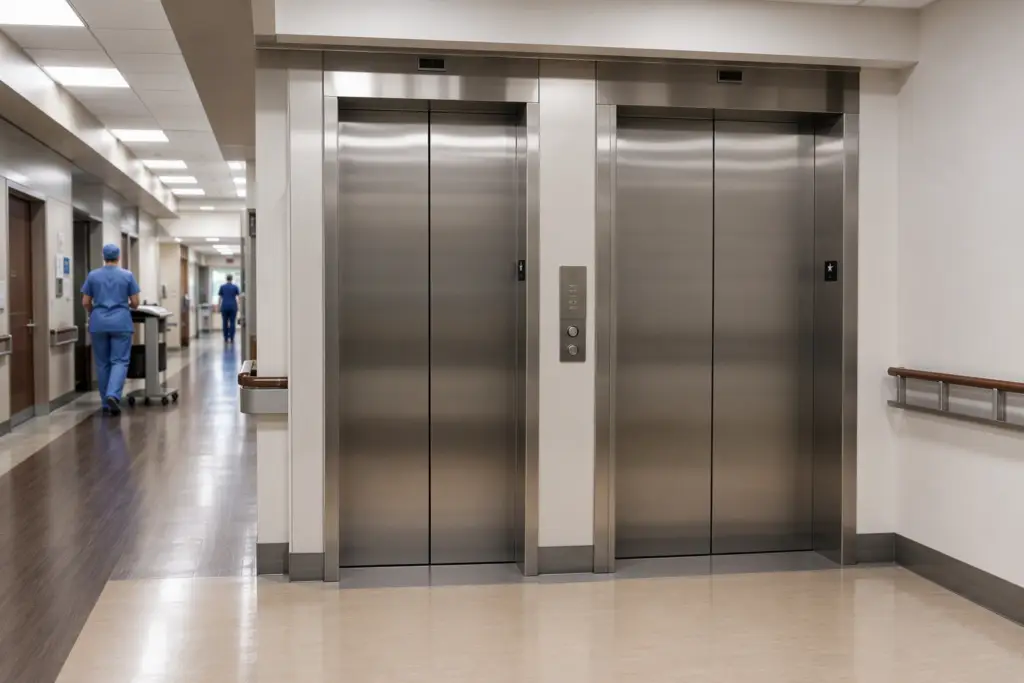
Proactive communication with a certified elevator service company is one of the most effective ways to stay ahead of permit deadlines, avoid unplanned downtime, and maintain ADA accessibility compliance. Liftech Elevator serves the full Southern California market across Signal Hill, Long Beach, Los Angeles, and Orange County, working with a range of property types including commercial office buildings, multi-family residential properties, healthcare facilities, industrial sites, and public buildings. Reaching out early in the inspection cycle — rather than waiting for a permit to lapse or equipment to fail — gives property managers the scheduling flexibility to plan maintenance without disruption to building operations.
Contact Liftech Elevator for a free elevator assessment at 562-997-3639.
Need elevator service you can rely on? Liftech Elevator is ready to help.