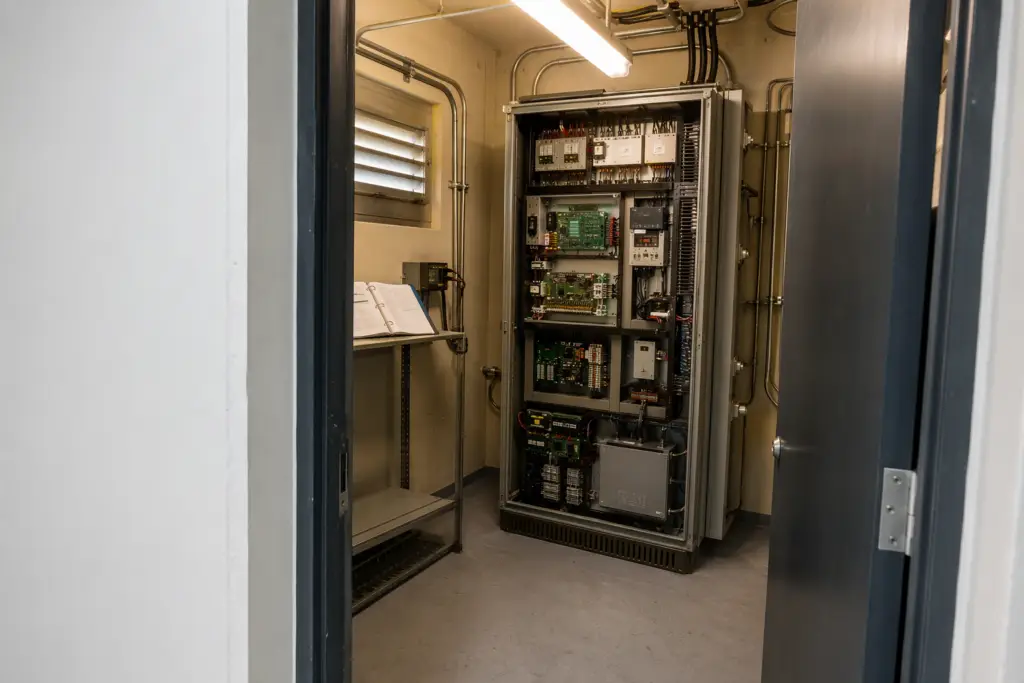
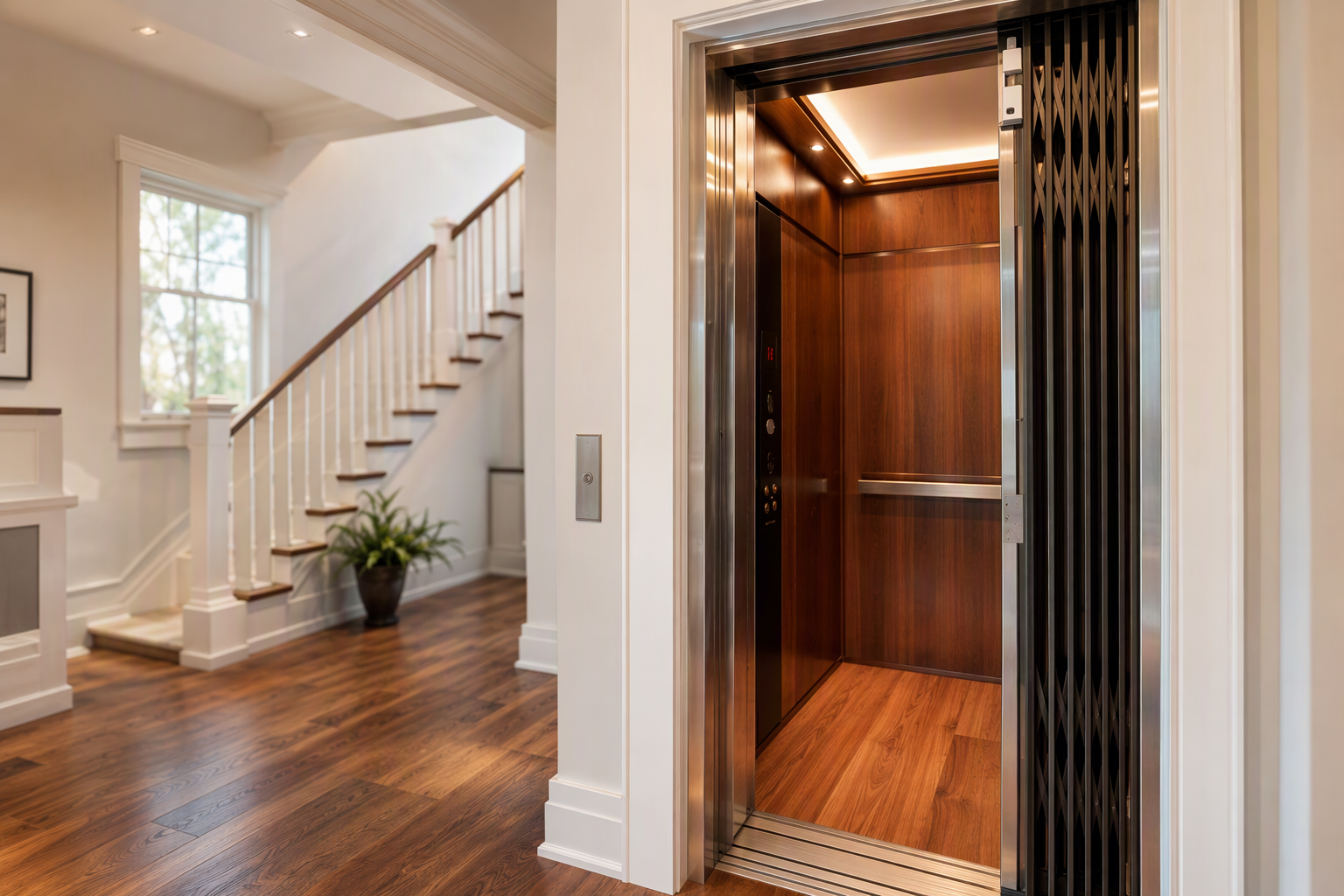
Residential elevators have become an increasingly common feature in multi-story homes, providing accessibility, convenience, and long-term property value for homeowners across Southern California. Whether a home has a hydraulic lift, a cable-driven traction unit, or a pneumatic vacuum elevator, keeping it safe, code-compliant, and mechanically sound requires specialized service from a qualified conveyance company. The questions below address everything a California homeowner needs to know before scheduling service, from annual inspection requirements to modernization options.
What types of residential elevators does Liftech Elevator service?

Liftech Elevator services all major residential elevator drive types found in Southern California homes, including hydraulic, winding-drum, cable-driven traction, and pneumatic vacuum systems.
Each drive type carries its own mechanical characteristics, lubrication schedule, and failure modes. Hydraulic residential elevators use a fluid-driven piston and are common in homes built before 2005; they require periodic fluid checks, cylinder integrity assessments, and valve maintenance. Winding-drum machines, while less common today, remain in older homes and require drum and cable inspections at regular intervals. Pneumatic (air-driven) elevators use a sealed polycarbonate tube and turbine system that demands different diagnostic procedures than traditional mechanical systems. A qualified technician needs to be familiar with all of these configurations to service them safely.
Regardless of drive type, every residential elevator in California that is accessible to the public — for example, in a home used as a licensed care facility or rental — falls under the oversight of the Cal/OSHA Elevator Unit, California Department of Industrial Relations. Purely private single-family homes that are not accessible to the public are specifically exempted under California’s elevator law, but many homeowners still choose to maintain their units to the same safety standards outlined in the ASME A17.1/CSA B44 Safety Code for Elevators and Escalators.
Are residential elevators in California required to be inspected?
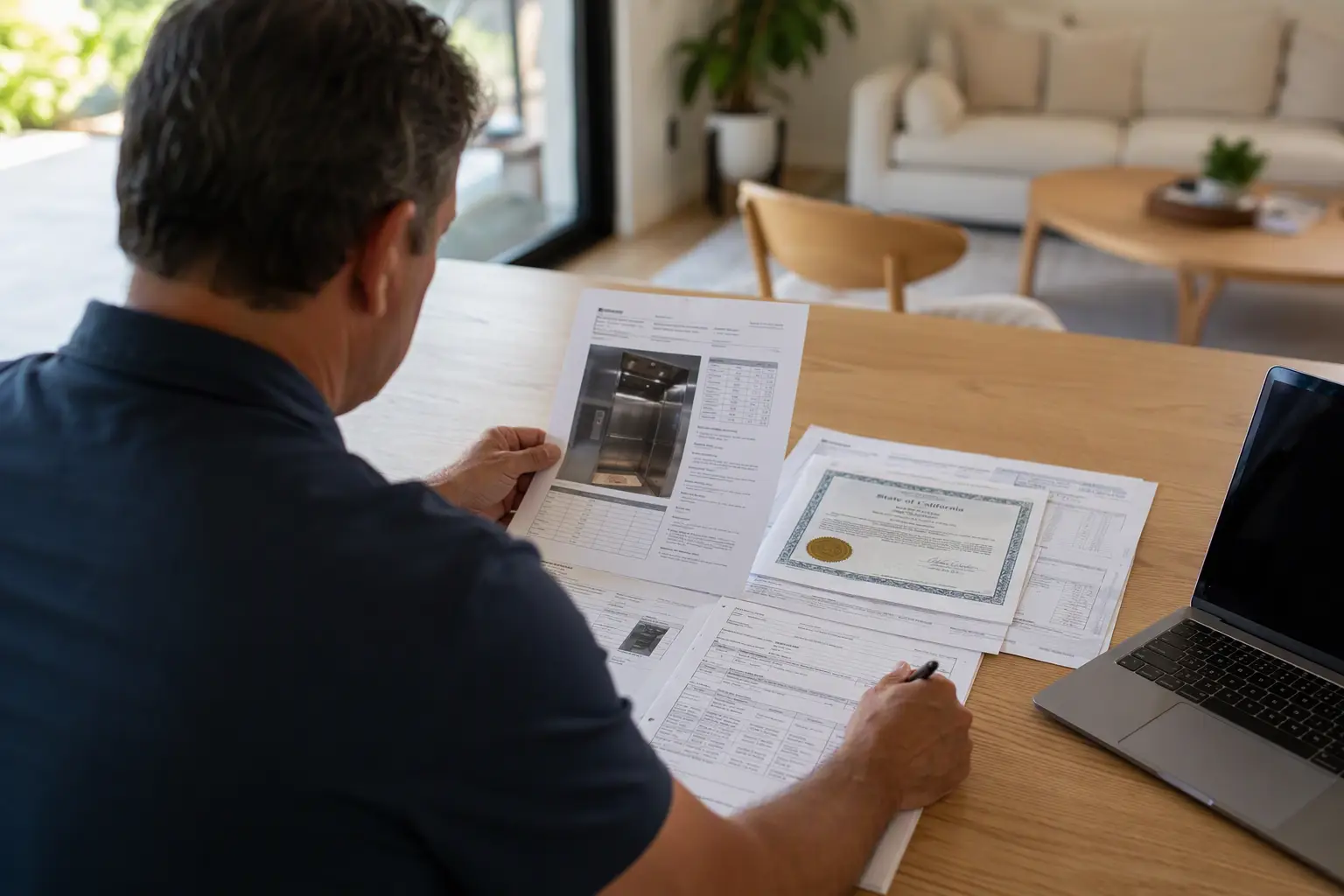
California law requires annual inspections for elevators accessible to the public, while purely private home elevators — those in single-unit private residences not accessible to the public — are legally exempt, though professional annual service is still strongly recommended.
Under California Labor Code Sections 7300–7324.2 and the California Code of Regulations, Title 8, Elevator Safety Orders, every conveyance that falls within the law’s scope must be inspected at least once per year by a State of California safety engineer or a Certified Competent Conveyance Inspector (CCCI). A conveyance found to be in safe condition receives a permit to operate for up to one year. Where an elevator is covered by a full maintenance contract with a C-11 licensed elevator company, Cal/OSHA may extend that permit for up to two years.
Even for exempt private home elevators, skipping periodic professional service creates genuine risk. Component wear, hydraulic fluid degradation, safety device drift, and rope or belt fatigue do not pause because a unit is privately owned. A structured annual maintenance visit catches these issues before they result in a costly emergency repair or, more seriously, a safety incident.
Homeowners in Los Angeles should note that the City of Los Angeles runs its own elevator and conveyance inspection program through the Department of Building and Safety (LADBS), which may apply different scheduling or permitting procedures. Homeowners in that jurisdiction should confirm current requirements directly with LADBS.
What California certifications must an elevator company hold before servicing a residential elevator?
Any company that maintains, repairs, alters, or services elevators in California — including residential units — must be certified by Cal/OSHA as a Certified Qualified Conveyance Company (CQCC) and must employ mechanics certified as Certified Competent Conveyance Mechanics (CCCM).
To obtain CQCC certification, a company must hold a current C-11 Elevator Contractor license issued by the California Contractors State License Board (CSLB), as well as current workers’ compensation and liability insurance. Under California law, only a CCCM working for a CQCC may maintain, repair, alter, or replace components on any conveyance covered by the state’s elevator law. CQCC and CCCM certificates are valid for two years, and renewal requires at least eight hours of continuing education per certificate cycle.
Hiring an uncertified individual or unlicensed company to work on an elevator in California is a violation of the Elevator Safety Orders and exposes the homeowner to liability. Before scheduling any service, homeowners should confirm that the company holds an active CQCC certification with Cal/OSHA and that its mechanics hold valid CCCM credentials. Liftech Elevator operates as a Certified Qualified Conveyance Company, with mechanics holding active CCCM certification, as required under California law.
What does a routine residential elevator maintenance visit include?
A comprehensive maintenance visit for a residential elevator typically covers mechanical, electrical, hydraulic or drive-system, and safety-device inspections, along with lubrication, adjustment, and documentation.
The following sequence reflects industry-standard practice aligned with ASME A17.1 maintenance guidelines:
- Visual inspection of the hoistway, pit, and machine room for water intrusion, debris, lighting adequacy, and structural concerns.
- Inspection and lubrication of guide rails, roller guides or guide shoes, and car sling components.
- Assessment of the drive system — hydraulic fluid level and condition, cylinder integrity, and valve function for hydraulic units; rope or belt condition, sheave wear, and machine brake function for traction or winding-drum units; turbine and seal condition for pneumatic units.
- Testing of all safety devices including the governor, safeties, buffers, pit stop switch, door interlocks, and hoistway access switches.
- Electrical panel inspection — contactor condition, relay function, wiring integrity, and ground continuity.
- Door operator test — checking door open and close force, reversal response, and threshold clearances.
- Car leveling check to confirm accurate floor-to-floor stopping position.
- Emergency lowering or retrieval system test to confirm proper function during a power loss event.
- Lighting, ventilation, and emergency communication device check inside the car.
- Documentation of findings, any adjustments made, and recommended follow-up work.
How often should a residential elevator be serviced?
Most residential elevators benefit from a professional maintenance visit at least once a year, and units with higher usage cycles or aging components may warrant more frequent inspections.
California law establishes a minimum annual inspection interval for conveyances within its scope. For private home elevators outside that statutory scope, industry best practice — consistent with the maintenance provisions of ASME A17.1 — still points to an annual maintenance cycle as a reasonable baseline. Drive-system age, the number of daily trips, and the mechanical condition of safety devices all influence whether a more frequent schedule is appropriate. A qualified technician can assess a specific unit and recommend an interval suited to its actual usage and condition.
What is the difference between elevator maintenance and elevator repair?
Maintenance is scheduled, proactive work to preserve an elevator’s safe operating condition, while repair is corrective work performed in response to a component failure, malfunction, or unsafe condition.
Routine maintenance includes lubrication, adjustment, cleaning, and periodic safety-device testing. Repair work addresses failed components — for example, a burned controller board, a worn hydraulic valve, a seized door operator, or a broken rope or belt. In California, both activities require a CCCM working for a CQCC; the distinction matters primarily for planning and budgeting purposes. Proactive maintenance programs generally reduce the frequency and severity of repairs by identifying component wear before it reaches the point of failure.
Can a residential elevator be modernized or upgraded rather than replaced?
Yes — many residential elevator systems can be modernized with updated controls, drive components, or safety devices, often extending service life significantly without the cost or disruption of full replacement.
Common modernization scopes for residential elevators include controller replacement (upgrading from relay-logic panels to solid-state or microprocessor-based controls), hydraulic power unit replacement, door operator upgrades, and cab interior refurbishment. Under California law, any material alteration to a conveyance requires a permit from Cal/OSHA before work begins, and the modernized elevator must pass a Cal/OSHA inspection and receive a new permit to operate before being returned to service. This applies to elevators within the statutory scope; for private home units, the same permitting logic applies if the work is material in nature — Liftech Elevator can advise homeowners on the specific permit requirements for any planned scope of work.
What residential elevator safety devices are required under ASME A17.1?
The ASME A17.1 Safety Code for Elevators and Escalators requires residential elevators to be equipped with a defined set of safety devices, including car safeties or equivalent arresting means, buffers, door or gate interlocks, pit stop switches, and an emergency lowering or retrieval provision.
California’s elevator law adopts the ASME A17.1/CSA B44, 2004 edition (Group IV Elevator Safety Orders) for installation contracts signed on or after May 1, 2008. For older residential units installed under prior code editions, the applicable safety requirements depend on the installation date. California has a pending Group V update that would incorporate elements of ASME A17.1-2019; a public hearing was held on June 18, 2026, but no effective date has been announced as of mid-2026. Homeowners planning a modernization or alteration should consult a qualified conveyance company about which code edition governs their specific unit and what — if any — upgrades are required or recommended to bring the system to a higher safety standard.
Does the Americans with Disabilities Act apply to residential elevators?
The Americans with Disabilities Act (ADA) applies to places of public accommodation and commercial facilities, not to privately owned single-family residences used solely as private homes.
However, if a residential property is used for any purpose that qualifies as a place of public accommodation — such as a licensed adult residential care facility, a vacation rental subject to public accommodation rules, or a mixed-use property — ADA accessibility requirements may apply to the elevator serving that use. In those situations, ADA Standards for Accessible Design govern car dimensions, control panel height and Braille labeling, door timing, and floor-designation signage. Homeowners who are adapting a residence for a family member with a disability and want to meet ADA-equivalent standards voluntarily can use those guidelines as a design benchmark even where legal compliance is not strictly required.
What should a homeowner do immediately if a residential elevator malfunctions?
If a residential elevator malfunctions, the immediate priority is occupant safety, followed by taking the unit out of service and contacting a certified elevator company for emergency assessment.
- If someone is trapped in the car, use the emergency communication device or phone to contact emergency services — do not attempt to force open doors or climb out without professional guidance.
- Once the car is confirmed empty and all occupants are safe, place the elevator out of service by using the key switch or main disconnect, and post a clear notice that the unit is not to be used.
- Do not attempt to diagnose or repair any component without a certified CCCM present — this is both a safety requirement and a California legal requirement.
- Document any unusual sounds, smells (burning, hydraulic fluid), visible damage, or the sequence of events that preceded the malfunction, as this information assists the technician during diagnosis.
- Contact a CQCC-certified elevator service company — such as Liftech Elevator — to schedule an emergency inspection and determine whether any Cal/OSHA notification or permitting obligations are triggered by the nature of the malfunction.
- Do not return the elevator to service until a CCCM has cleared it as safe and any required permits or inspection sign-offs are in place.
How does a homeowner arrange the annual Cal/OSHA inspection for a residential elevator?
Under California law, arranging the annual reinspection of a covered conveyance is the elevator owner’s responsibility, not the inspector’s or the service company’s.
For residential elevators that fall within Cal/OSHA’s scope, the homeowner must coordinate with the Cal/OSHA Elevator Unit to schedule an inspection by a State of California safety engineer or a CCCI. Maintaining a full maintenance contract with a C-11 licensed CQCC, such as Liftech Elevator, can support the homeowner’s effort to qualify for a two-year permit to operate, reducing the frequency of formal Cal/OSHA inspections. Homeowners in Los Angeles should also confirm whether any separate scheduling requirement applies under the LADBS conveyance inspection program.
What is the permit to operate and where must it be displayed?
A permit to operate is a Cal/OSHA-issued authorization that confirms an elevator has passed inspection and is legally cleared to run; for covered passenger elevators, California law requires it to be posted conspicuously inside the elevator car.
No elevator within Cal/OSHA’s jurisdiction may be operated without a valid, current permit to operate. The permit is issued after a passing inspection by a State of California safety engineer or CCCI and is valid for up to one year in standard cases, or up to two years for units under a full maintenance contract with a C-11 licensed company. An expired or missing permit is a violation of California Labor Code Sections 7300–7324.2 and the Title 8 Elevator Safety Orders, and it can trigger an order to shut down the conveyance until a compliant permit is posted.
How does residential elevator service in Los Angeles differ from other Southern California markets?
Los Angeles runs its own elevator and conveyance inspection program through the Department of Building and Safety (LADBS), which operates independently of — though in parallel with — the statewide Cal/OSHA Elevator Unit program.
Homeowners and property managers in the City of Los Angeles should verify current inspection scheduling, permit, and fee requirements directly with LADBS, as the city’s program may have procedures that differ from the Cal/OSHA statewide process. Properties in unincorporated Los Angeles County, Long Beach, Signal Hill, and Orange County jurisdictions fall under the standard Cal/OSHA Elevator Unit framework unless a local authority having jurisdiction (AHJ) has established its own program. Liftech Elevator serves all of these markets and can help homeowners navigate the applicable inspection and permitting pathway for their specific location.
What are the most common residential elevator problems that require repair?
The most frequently encountered residential elevator repair needs involve door operator failures, controller or relay malfunctions, hydraulic system issues, and worn or misadjusted safety devices.
| Problem Category | Typical Symptom | Common Cause | Service Response |
|---|---|---|---|
| Door / Gate Operator | Doors fail to open, close slowly, or reverse unexpectedly | Worn motor, misaligned rollers, failed interlock | Operator adjustment, component replacement, interlock test |
| Controller / Electrical | Car does not respond to calls, intermittent operation | Failed relay, contactor wear, wiring fault, board failure | Electrical diagnostic, relay or board replacement |
| Hydraulic System | Car drifts downward between floors, slow travel, fluid odor | Valve leakage, seal degradation, low fluid level | Valve service or replacement, fluid top-off or change |
| Drive Rope or Belt | Vibration, unusual noise, uneven leveling | Rope stretch, belt wear, sheave wear | Rope or belt replacement, sheave inspection |
| Safety Devices | Unit shuts down unexpectedly, governor trips | Safety device adjustment drift, governor overspeed calibration | Safety device test and recalibration |
| Car Leveling | Car stops above or below floor level | Selector drift, worn floor vanes, controller tuning | Leveling adjustment, selector service |
| Emergency Lowering | Manual lowering device fails to function during test | Solenoid failure, valve blockage, battery backup failure | Component replacement, battery test and replacement |
How long does a residential elevator typically last, and when should replacement be considered?
A well-maintained residential elevator can remain in safe, functional service for several decades, though aging mechanical and electrical components eventually reach a point where modernization or replacement becomes more cost-effective than continued repair.
There is no single federally mandated service life for residential elevators under ASME A17.1. Practical service life depends heavily on usage intensity, the quality of original installation, and the consistency of maintenance. Key indicators that replacement or comprehensive modernization should be considered include repeated controller failures, obsolete parts that are no longer manufactured, persistent hydraulic cylinder corrosion, structural fatigue in the car sling or guide rails, and a pattern of safety-device failures that suggest systemic component degradation. A thorough condition assessment by a qualified CCCM can provide homeowners with an objective picture of remaining service life and a cost comparison between continued maintenance, targeted modernization, and full replacement.
What should homeowners in Orange County know about residential elevator compliance?
Residential elevators in Orange County that fall within Cal/OSHA’s statutory scope are subject to the same statewide inspection, permitting, and CQCC/CCCM requirements as any other covered California conveyance.
Orange County does not operate its own separate elevator inspection program equivalent to the one Los Angeles runs through LADBS; properties in Orange County therefore work directly with the Cal/OSHA Elevator Unit for inspection scheduling and permit issuance. As with all California jurisdictions, any material alteration to a conveyance requires a Cal/OSHA permit before work begins, and the elevator must pass inspection and receive a new permit to operate before returning to service. Homeowners who are unsure whether their specific residential elevator falls within the statutory scope — particularly those in mixed-use or care-facility settings — should seek a compliance review from a CQCC-certified company.
Can a new residential elevator be installed in an existing home, and what permits are required?
A residential elevator can be retrofitted into an existing home, and any new installation in California requires a Cal/OSHA permit before the conveyance is erected or installed, followed by a Cal/OSHA inspection and permit to operate before the unit is placed in service.
The permitting process begins with a California-licensed elevator contractor (C-11 license from the CSLB) submitting plans and an installation permit application to Cal/OSHA. The installation must be performed by a CQCC using CCCM-certified mechanics. Upon completion, Cal/OSHA conducts an acceptance inspection; if the elevator passes, it receives its initial permit to operate. For projects in the City of Los Angeles, coordination with LADBS may be required in addition to the Cal/OSHA process. Structural modifications to accommodate the hoistway — framing, pit construction, machine room or overhead space — also require separate building permits from the local jurisdiction, typically handled in parallel with the elevator permitting process.
Homeowners in Signal Hill, Long Beach, Los Angeles, and Orange County considering a new residential elevator installation can consult with Liftech Elevator to understand the full permitting pathway and expected timeline before committing to a specific installation scope.
What questions should a homeowner ask before hiring a residential elevator service company?
Before engaging any elevator service company for residential work in California, homeowners should verify the company’s CQCC certification, its mechanics’ CCCM credentials, its C-11 contractor license status, and its approach to inspection coordination and permit management.
Specific questions worth asking include:
- Is the company currently certified by Cal/OSHA as a Certified Qualified Conveyance Company (CQCC)?
- Do all mechanics who will work on the unit hold active Certified Competent Conveyance Mechanic (CCCM) credentials?
- Does the company hold a current C-11 Elevator Contractor license from the California Contractors State License Board (CSLB)?
- Will the company manage the Cal/OSHA inspection and permit coordination, or is that left to the homeowner?
- How does the company document its maintenance visits, and will it provide written records suitable for Cal/OSHA permit renewal?
- Does the company have experience with the specific drive type and manufacturer of the unit in question?
- For any proposed alteration or modernization, will the company handle the pre-work Cal/OSHA permit and the post-work acceptance inspection?
Does a residential elevator service contract differ from a commercial elevator maintenance contract?
Residential elevator service contracts are typically scoped differently from commercial contracts in terms of visit frequency, included labor scope, and parts coverage, reflecting the lower usage cycles and different mechanical configurations typical of home elevators.
Commercial elevator maintenance contracts are often structured around monthly or quarterly visits because of high daily trip counts, while residential agreements commonly use annual or semi-annual visit schedules. Parts coverage provisions also differ — commercial contracts frequently include hydraulic fluid, lubricants, and certain replacement parts in a flat-rate structure, whereas residential contracts may be structured as time-and-material arrangements with separate parts billing. The underlying California legal requirements — CQCC certification, CCCM mechanics, Cal/OSHA permit coordination for covered units — apply equally regardless of whether the contract is labeled residential or commercial. Homeowners should review contract language carefully to confirm what is and is not included in the base agreement before signing.
How does Liftech Elevator approach residential elevator service in Signal Hill and Long Beach?
Liftech Elevator provides residential elevator maintenance, repair, modernization, and new-installation support throughout Signal Hill and Long Beach, operating as a Cal/OSHA-certified CQCC with CCCM-credentialed mechanics who service all major residential drive systems.
Homeowners in Signal Hill and Long Beach have access to the full range of Liftech Elevator’s conveyance services, from routine annual maintenance visits designed to keep residential units running reliably, to emergency repair response when a unit goes out of service unexpectedly. The company’s familiarity with the Cal/OSHA Elevator Unit permitting process means homeowners do not need to navigate the inspection and permit renewal process on their own. For units in the City of Long Beach, which falls under Cal/OSHA’s statewide program rather than a separate municipal program, the standard CQCC-managed inspection coordination pathway applies.
Contact Liftech Elevator for a free elevator assessment at 562-997-3639.
Need elevator service you can rely on? Liftech Elevator is ready to help.