Choosing the wrong elevator service contract can mean unexpected five-figure repair bills, compliance gaps, and elevator downtime that frustrates tenants or guests. This guide breaks down every meaningful difference between full maintenance and parts and labor contracts, explains what California building owners need to know about compliance obligations, and helps property managers make a confident, informed decision.
What Is a Full Maintenance Elevator Contract?
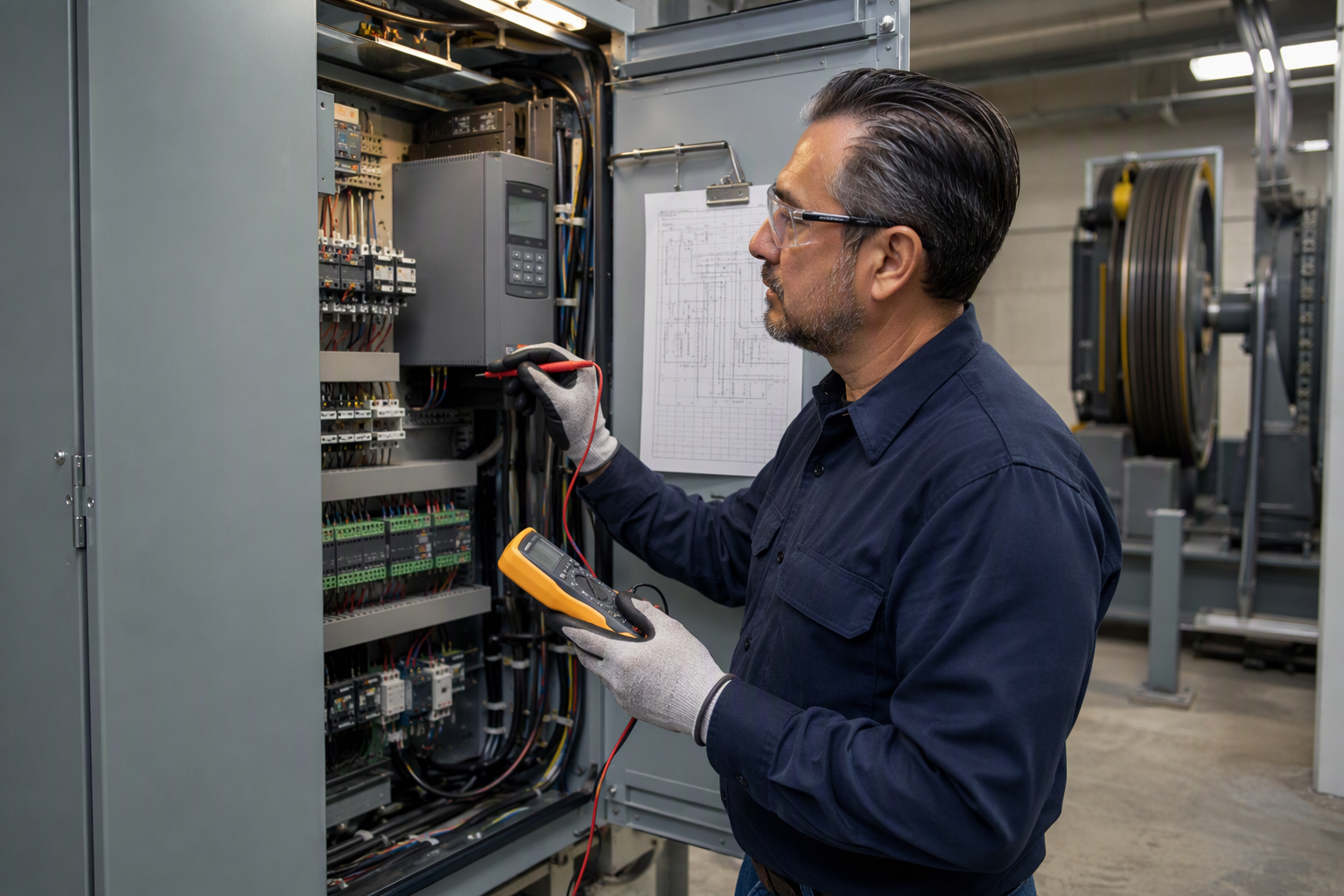
A full maintenance contract — sometimes called a comprehensive or all-inclusive contract — is an agreement in which the elevator service company assumes responsibility for routine preventive maintenance, inspections, lubrication, adjustments, and the cost of most replacement parts and labor needed to keep the elevator in safe, code-compliant operation. The building owner pays a fixed monthly or annual fee, and the service provider absorbs the variable cost of covered repairs.
Full maintenance contracts typically include:
- Scheduled preventive maintenance visits
- Lubrication of all moving components
- Adjustment of controls, leveling, and door operation
- Coverage of most wear-and-tear parts (motors, relays, door operators, buffers, etc.)
- Emergency callback service
- Assistance preparing for annual California Department of Industrial Relations inspections
- Documentation and logbook maintenance
Exclusions vary by provider and contract, but commonly excluded items include vandalism damage, cosmetic components (cab interiors, flooring), and major modernization work. Always read exclusion language carefully before signing.
What Is a Parts and Labor Elevator Contract?

A parts and labor contract — also called a time and materials or basic service contract — covers the cost of labor and parts consumed during a specific repair or service call. The building owner pays for preventive maintenance visits at an agreed schedule, but pays separately — often at a standard hourly rate plus parts cost — whenever a component fails or a repair is needed outside routine maintenance.
Parts and labor contracts typically include:
- Scheduled preventive maintenance visits
- Lubrication and adjustments during those scheduled visits
- Labor time charged per repair call
- Parts billed at market cost plus applicable markup
Parts and labor contracts shift financial risk to the building owner. If the elevator experiences a major component failure, the repair invoice arrives as an unbudgeted expense.
Full Maintenance vs. Parts and Labor: Side-by-Side Comparison
| Feature | Full Maintenance Contract | Parts & Labor Contract |
|---|---|---|
| Preventive Maintenance Visits | Included | Included |
| Lubrication & Adjustments | Included | Included |
| Replacement Parts (wear & tear) | Included (subject to exclusions) | Billed separately at market cost |
| Labor for Repairs | Included | Billed at hourly rate |
| Emergency Callback Coverage | Typically included | Billed per call |
| Budget Predictability | High — fixed monthly fee | Low — variable repair costs |
| Best For | Older elevators, high-traffic buildings, budget-sensitive owners | New elevators under warranty, low-use buildings |
| Financial Risk | Shared with service provider | Borne entirely by building owner |
| Typical Contract Length | 1–5 years | 1–3 years |
| Modernization Coverage | Generally excluded | Generally excluded |
Pros and Cons: Full Maintenance Contract
| Pros | Cons |
|---|---|
| Predictable, budgetable annual cost | Higher baseline monthly fee than parts & labor |
| Service provider is incentivized to maintain equipment proactively | Some providers may exclude high-cost components in fine print |
| Protects against large unexpected repair bills | May not be cost-effective for brand-new equipment rarely needing repairs |
| Single point of accountability for equipment reliability | Contract lock-in can limit switching providers mid-term |
| Supports compliance documentation for California inspections | Exclusions for vandalism or cosmetic damage can surprise owners |
Pros and Cons: Parts and Labor Contract
| Pros | Cons |
|---|---|
| Lower fixed monthly cost | Repair costs are unpredictable and can be substantial |
| Practical for newer elevators with low repair frequency | Building owner absorbs full financial risk of component failures |
| Flexibility to shop parts pricing independently (in some contracts) | Emergency repairs may be delayed if billing disputes arise |
| Can complement a manufacturer’s parts warranty during early equipment life | No incentive for provider to invest in proactive component replacement |
What Does California Law Require for Elevator Maintenance?
In California, elevators are regulated under the jurisdiction of the California Department of Industrial Relations (DIR), Division of Occupational Safety and Health (Cal/OSHA), Elevator, Ride, and Tramway Unit. Elevators must be inspected periodically by a Qualified Elevator Inspector (QEI) and must comply with the ASME A17.1 Safety Code for Elevators and Escalators for new installations and the ASME A17.3 Safety Code for Existing Elevators and Escalators for equipment already in service.
Regardless of which contract type a building owner selects, the obligation to maintain elevators in a safe and code-compliant condition rests with the property owner or their designated representative. Neither a parts and labor contract nor a full maintenance contract eliminates that legal responsibility — the contract type determines only how repair costs are distributed between owner and provider.
Buildings subject to the Americans with Disabilities Act (ADA) also have ongoing obligations to maintain accessible elevator features — including door timing, leveling accuracy, and accessible controls — in working order. A lapse in maintenance that renders ADA-required features inoperable creates legal exposure beyond a simple repair bill.
How Do You Evaluate What a Full Maintenance Contract Actually Covers?
Not all full maintenance contracts are equal. Before signing, building owners and property managers should request clear written answers to the following questions:
- Request the complete list of excluded components in writing — ask specifically about motors, controllers, hydraulic cylinders (for hydraulic elevators), and door operator systems.
- Confirm whether the contract covers callback response at all hours or only during standard business hours, and whether after-hours calls are billed separately.
- Ask for the escalation clause — most multi-year contracts include annual price increase provisions tied to labor cost indices or CPI. Understand the cap before committing.
- Verify what documentation the provider will supply to support California periodic inspection requirements.
- Confirm whether the contract transfers if the building is sold, or whether it terminates and requires renegotiation.
- Ask whether the contract includes entrapment rescue service and confirm response protocol.
- Request a sample of the maintenance log or service report format to ensure records are suitable for inspection documentation.
Which Contract Type Is Better for Older Elevators?
For elevators that are aging or approaching the point where major component replacement becomes likely, a full maintenance contract generally delivers superior financial protection. As mechanical and electrical components age, the frequency and cost of repairs increases. A parts and labor contract in this scenario exposes the building owner to compounding repair invoices that can cumulatively exceed the cost of a full maintenance agreement many times over in a single year.
Under the ASME A17.3 Safety Code for Existing Elevators and Escalators, older equipment may also face periodic retroactive safety requirements, meaning that deferred maintenance on aging systems carries compliance risk in addition to operational risk. A full maintenance provider has contractual and reputational incentive to keep the equipment current with applicable requirements.
Which Contract Type Is Better for Newer Elevators?
For elevators installed recently — particularly those still within a manufacturer’s parts warranty period — a parts and labor contract may represent a reasonable short-term approach. During the initial years of operation, component failure rates are typically lower, and manufacturer warranties may cover certain parts costs that would otherwise fall under a full maintenance agreement.
However, building owners should be aware that manufacturer parts warranties often require warranty claims to be processed through the original equipment manufacturer (OEM) or authorized dealers. An independent service provider operating under a parts and labor agreement should be able to assist in warranty claim documentation, but this process should be clarified before signing the contract.
How Does Contract Type Affect Elevator Downtime?
Elevator downtime has real costs — reduced tenant satisfaction, potential ADA compliance concerns, and operational disruption. The financial structure of a full maintenance contract creates a natural incentive alignment: the service provider absorbs the cost of repairs, so proactive maintenance that prevents failures is economically beneficial to them. This tends to result in more thorough preventive visits and faster response to developing issues before they become full failures.
Under a parts and labor model, each repair generates billable revenue for the service provider. While reputable providers will always prioritize safety and code compliance, the financial incentive structure does not reward proactive investment in the same way.
What Questions Should You Ask When Comparing Elevator Service Providers?
When evaluating providers for either contract type, building owners in California should ask:
- Is the provider’s elevator mechanic workforce members of the International Union of Elevator Constructors (IUEC), or are they otherwise qualified and licensed under California requirements?
- Does the provider carry adequate general liability and workers’ compensation insurance for California operations?
- Can the provider supply references from comparable California buildings — similar occupancy type, elevator age, and traffic volume?
- How does the provider handle parts sourcing — OEM parts, aftermarket parts, or a combination? What is their policy on part quality?
- What is the provider’s process for managing California DIR/Cal/OSHA inspection coordination?
- Is the provider independent of any major OEM, and does that independence affect their ability to source parts across multiple elevator brands?
Can You Switch Between Contract Types Mid-Term?
Most elevator service contracts include early termination clauses with financial penalties. Switching from a parts and labor contract to a full maintenance contract — or vice versa — before the contract term expires typically requires either paying out the remaining term value or negotiating an amendment. Building owners should factor contract flexibility into their evaluation, particularly if the building is anticipated to change ownership, undergo renovation, or have significant changes in occupancy that would affect elevator use patterns.
What Are the Key Decision Factors When Choosing Between Full Maintenance and Parts and Labor?
Use the following framework to guide the decision:
| Factor | Lean Toward Full Maintenance | Lean Toward Parts & Labor |
|---|---|---|
| Elevator Age | 10+ years old | Recently installed, within warranty |
| Building Traffic | High daily use (commercial, residential high-rise) | Low use (small office, low-occupancy building) |
| Budget Type | Fixed operating budget, HOA, or institutional | Flexible capital budget with repair reserves |
| Repair History | Frequent recent repairs | No significant repair history |
| Ownership Duration | Long-term hold | Short-term hold or pending sale |
| Risk Tolerance | Low — prefer cost certainty | Higher — comfortable with variable costs |
| Compliance Sensitivity | High-profile property, ADA-regulated use | Lower-risk occupancy classification |
How Does Working with an Independent Elevator Service Provider Affect Your Contract Options?
Large OEM-affiliated elevator companies sometimes structure full maintenance contracts to encourage equipment replacement or modernization using their own proprietary components. Independent elevator service providers — companies not tied to a single manufacturer — can typically service multiple equipment brands, source parts from a broader supply chain, and offer contract terms that are not influenced by OEM sales objectives.
Liftech Elevator is an independent, California-based elevator service company serving building owners, property managers, HOAs, and commercial properties throughout California. As an independent provider, Liftech Elevator offers both full maintenance and parts and labor contracts across a wide range of elevator makes and models, without the manufacturer alignment that can influence the contract terms and repair recommendations offered by OEM-affiliated companies. Liftech Elevator’s team works with building owners to evaluate equipment condition, review existing contract coverage, and recommend the contract structure that best aligns with the building’s operational needs and budget requirements.
What Happens During an Elevator Assessment Before Signing a Contract?
A professional elevator assessment — conducted before committing to a new service contract — provides critical information that informs which contract type is appropriate and what pricing is reasonable. A thorough assessment typically follows this process:
- Review existing documentation: The inspector reviews any available maintenance logs, prior inspection reports, and current permit status with the California DIR.
- Visual and operational inspection: The elevator is run through its full operating range. Door timing, leveling accuracy, cab condition, machine room condition, and pit condition are all evaluated.
- Component condition assessment: Key mechanical and electrical components — motor, controller, sheaves, ropes or hydraulic cylinders, safety devices — are evaluated for wear and remaining service life.
- Code compliance review: The assessor identifies any open compliance items under ASME A17.1 or ASME A17.3 or ADA requirements.
- Risk and cost projection: Based on the assessment, the provider outlines anticipated near-term repair needs and recommends a contract structure that reflects the equipment’s actual condition.
- Contract recommendation: The provider presents a specific proposal — full maintenance, parts and labor, or a hybrid — with written scope, exclusions, and pricing for the building owner’s review.
Summary: Which Elevator Contract Is Right for Your Building?
For most California building owners managing elevators that are more than a few years old, subject to moderate-to-heavy daily use, or in buildings where budget predictability is a priority, a full maintenance contract offers the most comprehensive protection and the clearest alignment of incentives between the service provider and the building owner.
A parts and labor contract can be a rational choice for newer equipment, low-traffic installations, or buildings where a robust repair reserve fund makes variable costs manageable — but it should always be entered with a clear understanding of the financial exposure it creates.
In all cases, the specific terms of any contract matter as much as the contract type. Exclusion lists, escalation clauses, callback coverage, and documentation obligations should be reviewed carefully before signing, regardless of whether the agreement is labeled full maintenance or parts and labor.
Get Expert Guidance for Your California Building
Liftech Elevator provides free elevator assessments for California building owners and property managers evaluating their service contract options. Whether the current contract is up for renewal, a building is changing management, or the elevator has a recent repair history that warrants a closer look, Liftech Elevator’s team can evaluate the equipment, review existing coverage, and recommend the right contract structure — without manufacturer bias.
Contact Liftech Elevator for a free elevator assessment: 562-997-3639
Need elevator service you can rely on? Liftech Elevator is ready to help.