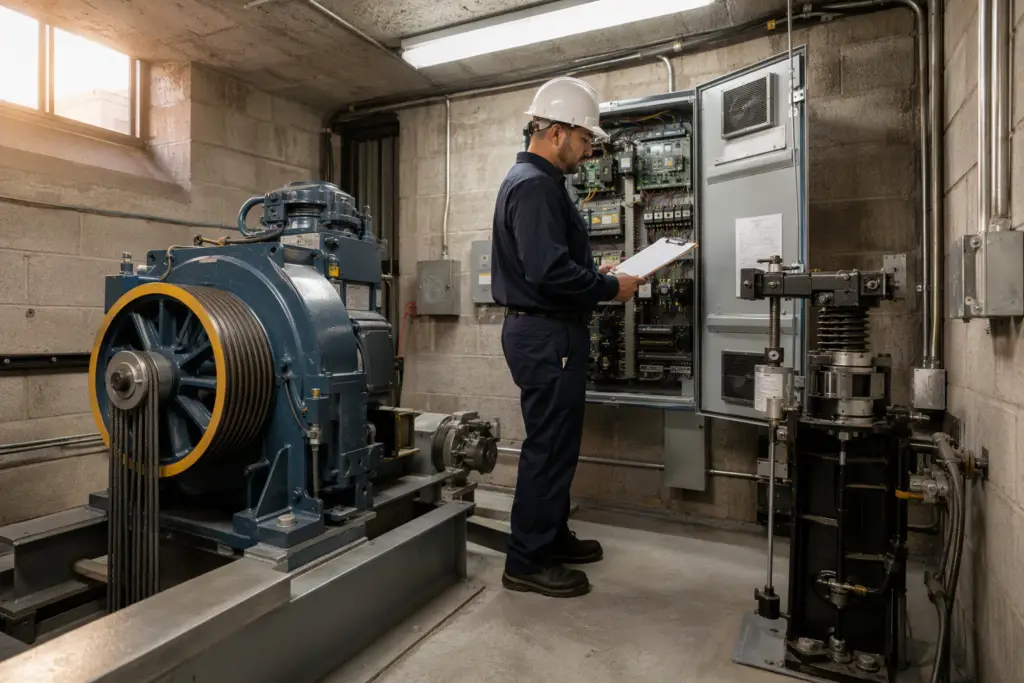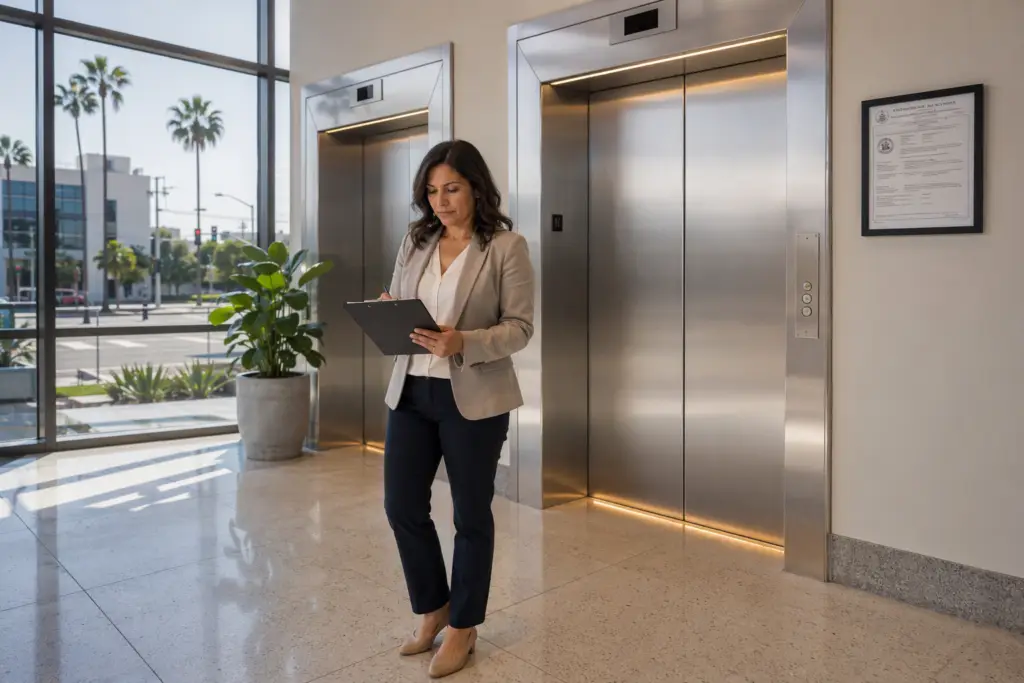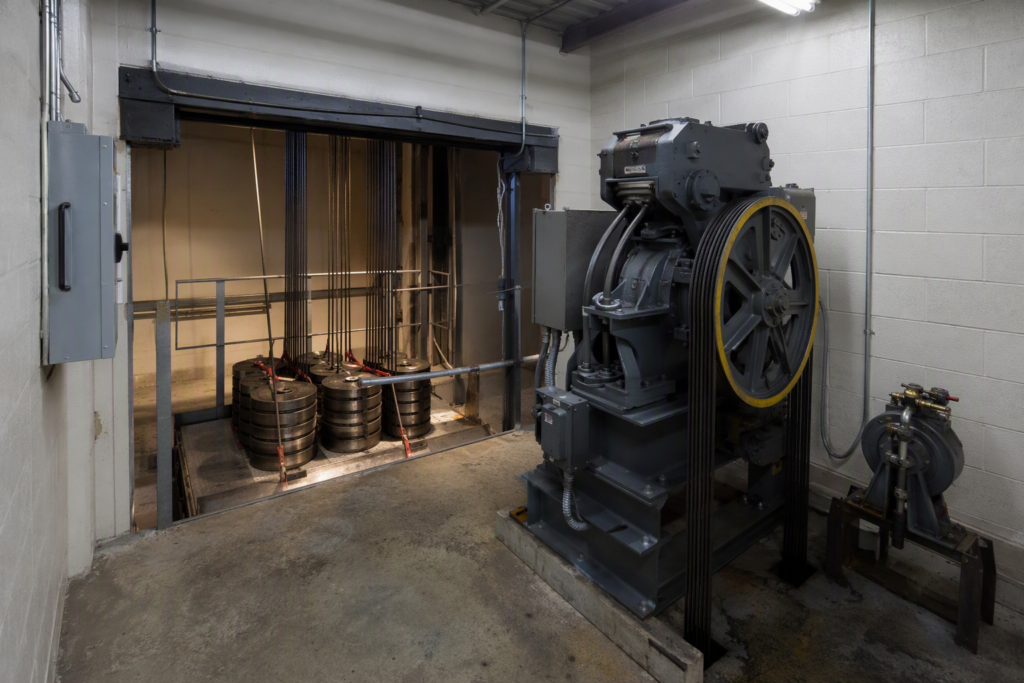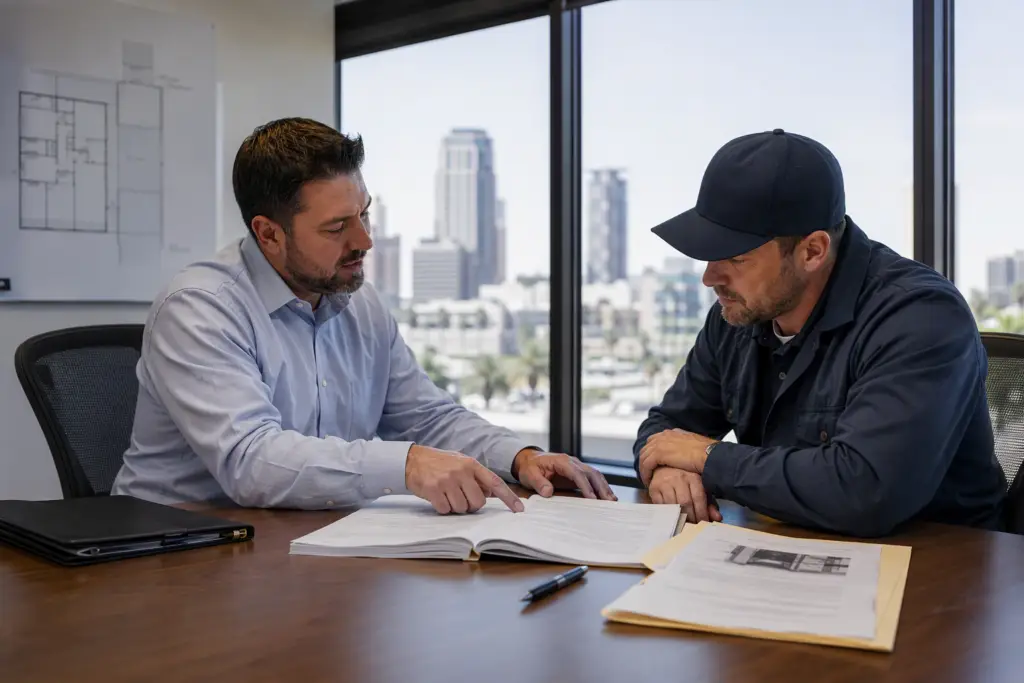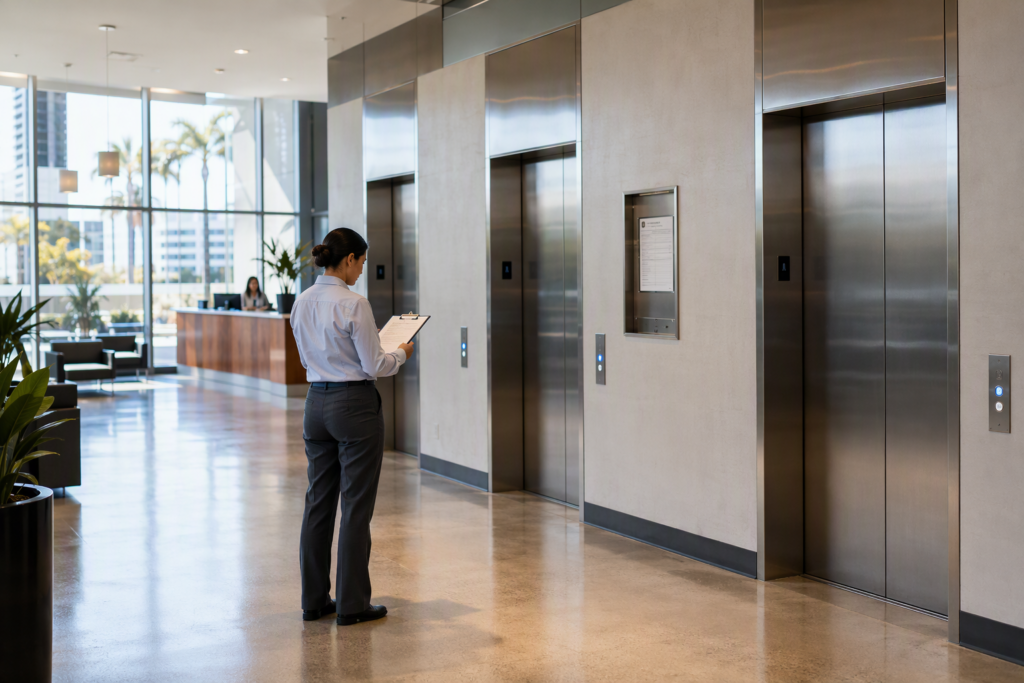
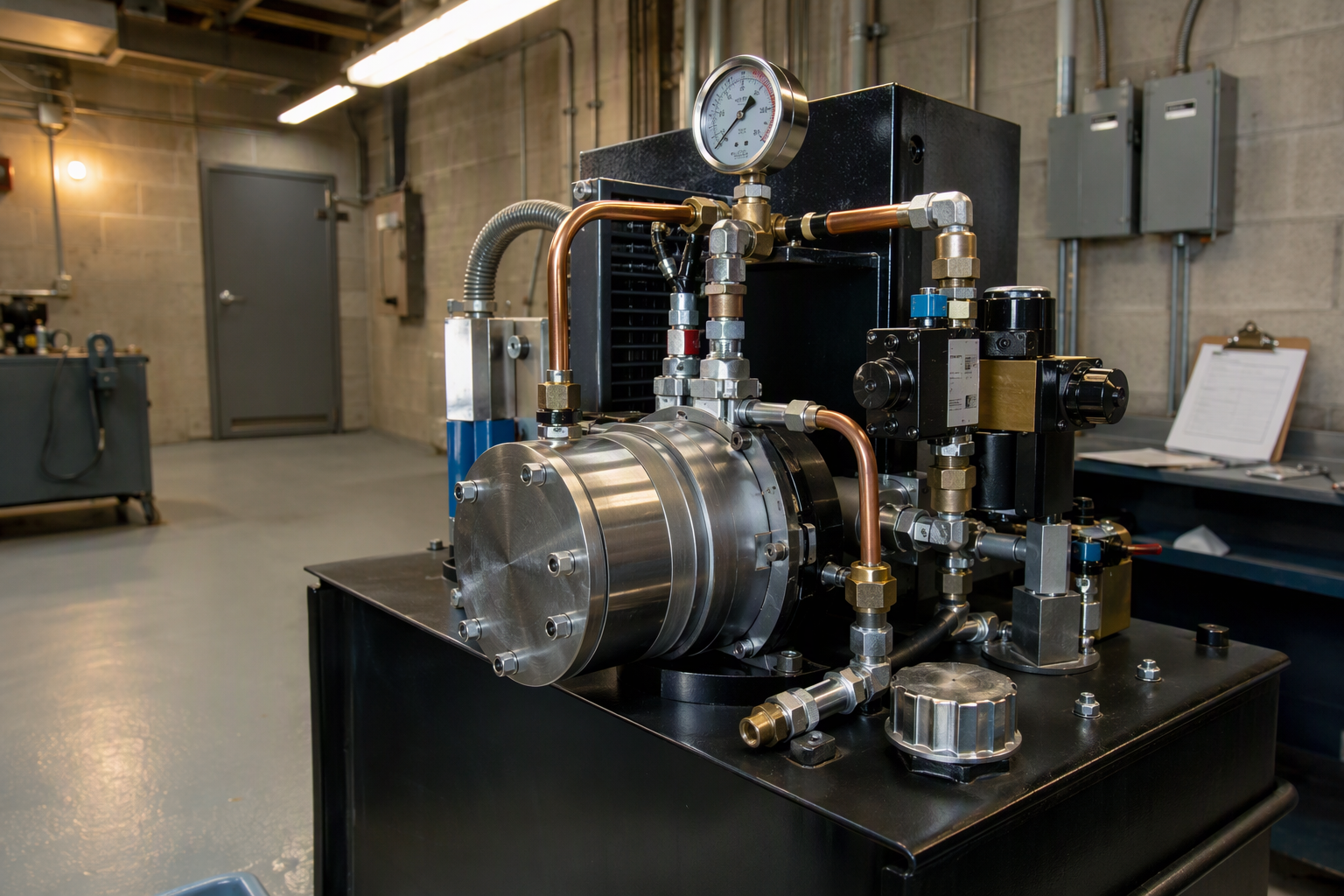
Replacing an elevator rope gripper pump is one of the more consequential hydraulic safety component repairs an elevator owner can face. The rope gripper is a critical emergency braking device that stops a hydraulic elevator car if a hose ruptures or the hydraulic system loses pressure unexpectedly. Its pump and valve assembly must function flawlessly every time it is called upon. Because the rope gripper pump sits at the intersection of mechanical, hydraulic, and electrical systems, the total replacement cost encompasses far more than a single part price. This page breaks down every factor that drives the final invoice, from equipment specifications to California compliance costs, so building owners and facility managers in Signal Hill, Long Beach, Los Angeles, and Orange County can plan their budgets intelligently.
What is an elevator rope gripper pump and why does it matter for safety?
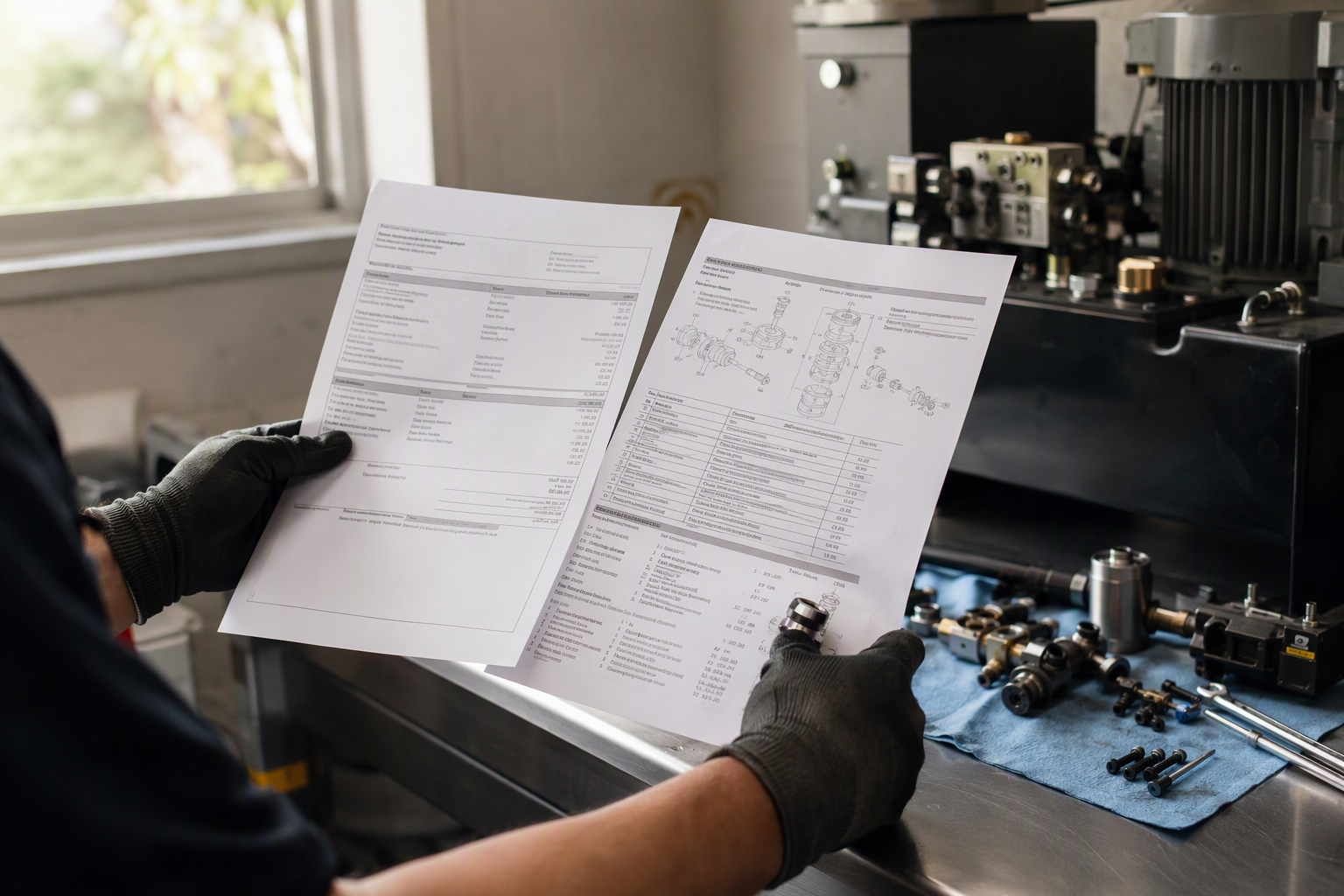
An elevator rope gripper pump is the hydraulic power unit that maintains the pressurized fluid circuit controlling the rope gripper mechanism on a hydraulic elevator, and when that pump fails the gripper can no longer release or reset, rendering the elevator inoperable or unsafe.
On a hydraulic elevator, the rope gripper acts as a secondary arresting device. When a pipe or hose ruptures, the sudden pressure drop signals the gripper to clamp onto the hoist ropes or guide rails and halt the car. The pump assembly is responsible for resetting the gripper after a triggered stop and for sustaining the hydraulic pressure that keeps the gripper in its normal, released position during routine travel.
Because this component is part of the elevator’s safety circuit, it falls under the scope of the ASME A17.1/CSA B44 Safety Code for Elevators and Escalators. Any replacement or alteration of a safety device must conform to the edition of that code in effect for the installation and must comply with California’s Elevator Safety Orders under the California Code of Regulations, Title 8, Sections 3000–3146, administered by Cal/OSHA’s Elevator Unit.
What are the main cost categories involved in replacing a rope gripper pump?
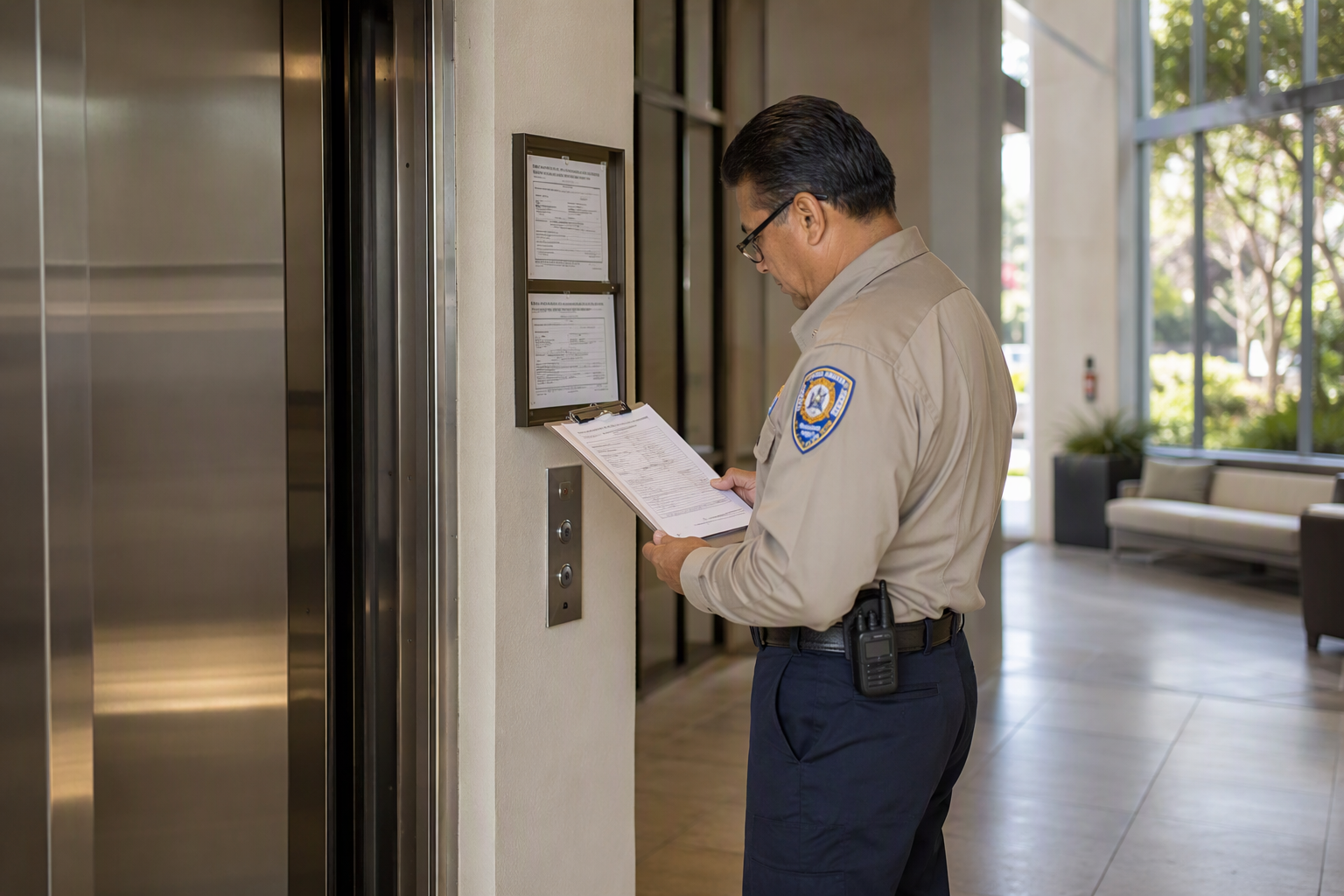
The total replacement cost divides into four primary categories: the pump and valve assembly parts, hydraulic fluid and ancillary materials, certified labor hours, and California regulatory compliance costs including permit fees, inspection, and re-commissioning.
Each category carries its own variables. Parts costs depend on the elevator’s manufacturer, model age, and whether OEM or compatible aftermarket components are available. Labor costs reflect the complexity of accessing the pump unit, draining and recharging the hydraulic system, and calibrating the gripper’s release and set pressures. Regulatory costs in California are non-negotiable and must be budgeted alongside parts and labor — skipping them is not legal.
A thorough cost estimate cannot be produced from a phone call alone. A qualified technician must physically inspect the existing pump assembly, review the elevator’s maintenance and alteration history, confirm the hydraulic system’s operating pressure range, and determine whether adjacent components such as the power unit, solenoid valves, or pressure switches have been compromised. Companies providing estimates without an on-site evaluation should be treated with caution.
How do parts specifications affect the cost of the pump replacement?
Parts specifications directly control cost because rope gripper pump assemblies are not universal — pressure ratings, flow rates, port configurations, and electrical interface requirements vary by elevator model, and mismatched components can void safety compliance or cause immediate failure.
Key specification factors that drive parts pricing include:
- System operating pressure: Higher-pressure hydraulic systems require pump units with correspondingly rated housings and seals, which cost more than standard-duty units.
- OEM versus compatible aftermarket: Original equipment manufacturer assemblies are typically more expensive but guarantee dimensional and pressure-rating compatibility. Aftermarket units sourced from reputable hydraulic component suppliers can offer cost savings when the supplier can certify compatibility with the elevator’s safety circuit.
- Solenoid valve integration: Some rope gripper pump assemblies include integrated solenoid valves and pressure relief circuits; replacing the pump may require replacing the entire integrated manifold block rather than the pump head alone.
- Lead time and availability: Components for older elevator models may require special ordering or remanufacturing, adding both cost and time to the project.
- Hydraulic fluid compatibility: The replacement pump may require a specific hydraulic fluid grade; if the existing fluid is incompatible, the entire system must be flushed and recharged, adding material costs.
How many labor hours does a rope gripper pump replacement typically require?
Labor hours for a rope gripper pump replacement typically span the full work scope of draining the hydraulic system, removing and replacing the pump assembly, recharging and bleeding the circuit, recalibrating the gripper’s set and release pressures, and conducting a witnessed operational test — a scope that in California must be performed by a Certified Competent Conveyance Mechanic (CCCM) working for a Certified Qualified Conveyance Company (CQCC).
The actual hour count varies based on machine room accessibility, the age and configuration of the power unit, whether the pump is an integrated or standalone assembly, and how much hydraulic fluid must be managed. Confined machine rooms, aged piping with corroded fittings, and non-standard mounting configurations all extend labor time. An accurate labor estimate requires the technician to review the machine room layout and the elevator’s maintenance records before quoting.
Under California Labor Code Sections 7300–7324.2 and the California Code of Regulations, Title 8 Elevator Safety Orders, only a CCCM certified by Cal/OSHA may perform this work unsupervised, and that mechanic must work for a CQCC. The CQCC must hold a current C-11 Elevator Contractor license issued by the California Contractors State License Board. Hiring unlicensed labor to reduce cost is not only illegal but exposes the building owner to liability and can void the elevator’s permit to operate.
What California regulatory costs must be included in the project budget?
Replacing a rope gripper pump constitutes a material alteration of an elevator safety device under California’s Elevator Safety Orders, which means the building owner must obtain a Cal/OSHA permit before the work begins, pay associated permit fees, and arrange a post-alteration inspection before the elevator can return to service.
Specifically, under the California Code of Regulations, Title 8, a permit from Cal/OSHA’s Elevator Unit is required before a conveyance is materially altered. After the alteration is complete, the elevator must be inspected by a State of California safety engineer or a Certified Competent Conveyance Inspector (CCCI) and must receive a new or updated permit to operate before it is placed back in service. The elevator may not be returned to service without that permit.
For elevators located in the City of Los Angeles, building owners should also be aware that Los Angeles maintains its own elevator and conveyance inspection program through the Los Angeles Department of Building and Safety (LADBS). Coordination between the CQCC, Cal/OSHA, and LADBS may affect project scheduling and add administrative costs. Buildings in Long Beach, Signal Hill, and Orange County jurisdictions follow the standard Cal/OSHA process.
These regulatory costs — permit fees, inspection scheduling, and potential re-inspection if issues are found — should be itemized in the contractor’s proposal rather than treated as unexpected add-ons after the fact.
How does the age and maintenance history of the elevator affect replacement cost?
An elevator with a well-documented maintenance history and regularly serviced hydraulic system typically yields a lower total replacement cost because fewer ancillary components require repair or replacement during the pump swap, whereas a neglected system often reveals hydraulic seal failures, contaminated fluid, or corroded piping that must be addressed simultaneously.
Technicians performing the pump replacement will inevitably inspect the condition of adjacent hydraulic components. If the system’s fluid shows oxidation, water contamination, or excessive particulate, a full system flush and new fluid charge become necessary. If flexible hydraulic hoses are beyond their service life — a condition evaluated against the criteria in the ASME A17.1/CSA B44 Safety Code — those must also be replaced before the elevator can pass inspection. Each of these discoveries adds to parts and labor costs but is non-negotiable from a safety and compliance standpoint.
Maintaining current service records and having a full maintenance contract in place can actually reduce long-term costs. Under California regulations, an elevator covered by a full maintenance contract with a CQCC holding a C-11 license may receive a permit to operate for up to two years from Cal/OSHA, reducing the frequency of inspection fees and administrative overhead.
What is the step-by-step process for a rope gripper pump replacement?
A professional rope gripper pump replacement follows a structured protocol to ensure safety, code compliance, and operational reliability from start to finish.
- Pre-work documentation review: The CCCM reviews the elevator’s maintenance logs, the existing permit to operate, and the hydraulic system specifications to confirm the correct replacement pump and identify any known system deficiencies.
- Cal/OSHA alteration permit application: The CQCC submits the required permit application and supporting documentation to Cal/OSHA (and LADBS if the unit is in the City of Los Angeles) before any physical work begins.
- Equipment and materials procurement: The correct pump assembly, compatible hydraulic fluid, seals, and any required ancillary hardware are sourced and verified against the elevator’s specifications.
- System shutdown and lockout/tagout: The elevator is taken out of service and locked out per OSHA hazardous energy control procedures to protect workers during the repair.
- Hydraulic system drain and fluid disposal: The hydraulic fluid is drained into appropriate containers for proper disposal or recycling in compliance with applicable environmental regulations.
- Pump assembly removal: The failed pump unit is disconnected from its hydraulic ports, electrical connections, and mounting hardware and removed from the machine room.
- Inspection of adjacent components: The power unit, solenoid valves, pressure switches, and hydraulic lines are inspected; any deficient components are documented and addressed.
- New pump installation and connection: The replacement pump is mounted, hydraulic port connections are made and torqued to specification, and electrical wiring is connected per the manufacturer’s wiring diagram.
- System recharge and bleeding: The hydraulic system is filled with the specified fluid grade, and air is bled from the circuit to ensure consistent pressure delivery.
- Pressure calibration and gripper function test: The gripper’s set pressure and release pressure are calibrated to the values specified for the elevator model; the gripper is triggered and reset multiple times to verify consistent operation.
- Full operational test: The elevator is run through a complete operational cycle, including emergency stop scenarios, to confirm all systems function correctly.
- Cal/OSHA inspection and permit issuance: The CCCI or Cal/OSHA safety engineer performs the post-alteration inspection, and if the elevator is found safe, a new or updated permit to operate is issued before the elevator is returned to service.
- Documentation and recordkeeping: All work performed, parts used, calibration values, and inspection results are documented and retained in the elevator’s maintenance file.
How do you compare contractor proposals for this type of repair?
Comparing contractor proposals for a rope gripper pump replacement requires looking beyond the bottom-line price to evaluate parts quality, labor scope, California licensing credentials, regulatory cost inclusion, and warranty terms — because the lowest bid that omits permit fees or uses non-specified components can result in a failed inspection and higher total cost.
The table below outlines the key line items that a complete, compliant proposal for a California rope gripper pump replacement should include, along with evaluation criteria for each.
| Proposal Line Item | What to Look For | Red Flag |
|---|---|---|
| Pump assembly (parts) | OEM or certified-compatible unit with specified pressure rating and port configuration | Generic unit with no compatibility documentation |
| Hydraulic fluid and materials | Specified fluid grade, seals, fittings itemized | Lump “materials” line with no specification |
| Labor hours and CCCM credentials | Performed by CCCM employed by a CQCC with C-11 license | No mention of California licensing requirements |
| Cal/OSHA alteration permit fee | Explicitly included or clearly noted as owner responsibility | Permit fees absent from proposal entirely |
| Post-alteration inspection coordination | Contractor coordinates inspection scheduling with Cal/OSHA or CCCI | Owner left to arrange inspection independently |
| LADBS coordination (LA units only) | Included if unit is in City of Los Angeles jurisdiction | No mention of local authority having jurisdiction |
| Ancillary component inspection | Adjacent hydraulic components inspected and findings reported | Scope limited strictly to pump unit with no system check |
| Warranty on parts and labor | Clear warranty terms for both pump assembly and labor | No warranty stated or warranty limited to parts only |
| Out-of-service duration estimate | Realistic timeline including permit and inspection lead times | Timeline quoted without accounting for regulatory steps |
| Documentation and recordkeeping | Work records provided to owner upon completion | No mention of documentation delivery |
Why can’t a building owner get an accurate cost estimate over the phone?
A reliable cost estimate for a rope gripper pump replacement cannot be produced without an on-site inspection because the pump model, system pressure rating, hydraulic fluid condition, machine room accessibility, and the status of adjacent components are all unknowns that materially affect both parts selection and labor scope.
Contractors who quote a firm price before inspecting the elevator are either estimating based on a best-case scenario or building significant contingency into their number. Either approach disadvantages the building owner. A proper pre-repair assessment by a CCCM examines the pump assembly, reviews the maintenance records, tests the hydraulic system’s operating pressure, checks the condition of hoses and seals, and identifies whether the alteration permit application will require any additional engineering documentation.
Liftech Elevator provides on-site assessments for building owners in Signal Hill, Long Beach, Los Angeles, and Orange County so that cost proposals reflect actual site conditions rather than assumptions.
How does the rope gripper pump relate to other hydraulic elevator components that might need concurrent replacement?
The rope gripper pump sits within a larger hydraulic circuit, and its failure often signals degraded conditions in related components — including flexible hydraulic hoses, pressure relief valves, solenoid valves, and the main power unit’s pump and motor — meaning a complete system evaluation during the replacement can prevent a second service interruption shortly after the pump is restored.
The ASME A17.1/CSA B44 Safety Code for Elevators and Escalators establishes requirements for hydraulic elevator components as a system, not as isolated parts. A Cal/OSHA inspector reviewing the post-alteration elevator will evaluate the safety of the overall hydraulic system, not just the newly installed pump. If adjacent components are found deficient during that inspection, the permit to operate will not be issued until those items are corrected. Identifying and addressing deficient adjacent components before the inspection avoids delays and second mobilization costs.
What happens if a rope gripper pump failure causes the elevator to go out of service unexpectedly?
When a rope gripper pump failure causes an unplanned out-of-service condition, the building owner must immediately notify the elevator maintenance contractor, ensure the elevator is properly taken out of service with appropriate signage and barricading, and initiate the Cal/OSHA alteration permit process as quickly as possible to minimize downtime.
Under California Labor Code Sections 7300–7324.2, no elevator may be operated without a valid permit to operate. If the pump failure triggered a safety device and the elevator is in a faulted state, it cannot be returned to service by simply resetting the fault — the underlying cause must be repaired by a CCCM, the repair must be documented, and the elevator must pass inspection before resuming operation.
Building owners should also consider their obligations under the Americans with Disabilities Act when an elevator is out of service. Where the elevator is the primary accessible means of vertical access for individuals with disabilities, the building owner has a responsibility to provide alternate accommodation or promptly restore service. This ADA consideration adds urgency to the repair timeline and reinforces the importance of maintaining a service relationship with a qualified CQCC before an emergency occurs.
How does the alteration permit process affect the project timeline?
The Cal/OSHA alteration permit process adds a required pre-work administrative step and a mandatory post-work inspection to the project timeline, meaning the total out-of-service duration includes not just repair time but also permit processing and inspection scheduling lead times.
California regulations are explicit: a permit from Cal/OSHA’s Elevator Unit is required before a conveyance is materially altered, and the elevator cannot be returned to service until it has passed post-alteration inspection and a new permit to operate has been issued. Project timelines that do not account for these administrative intervals will produce inaccurate out-of-service estimates. A CQCC with established relationships and familiarity with Cal/OSHA’s permit submission process can often manage this efficiently, but no contractor can guarantee regulatory processing times.
In the City of Los Angeles, the additional involvement of the Los Angeles Department of Building and Safety may introduce further scheduling considerations. Building owners in Los Angeles should confirm with their CQCC how LADBS coordination is handled within the project timeline.
What should building owners ask a contractor before hiring them for this repair?
Before engaging any contractor for a rope gripper pump replacement in California, building owners should verify that the company holds current CQCC certification from Cal/OSHA and a C-11 Elevator Contractor license from the California Contractors State License Board, confirm that the assigned mechanic holds a current CCCM certificate, and ensure that the proposal explicitly addresses the alteration permit and post-alteration inspection requirements.
Additional questions worth asking include:
- Can you provide your current CQCC certificate number and C-11 license number for verification?
- Will the assigned mechanic’s CCCM certificate be available for review before work begins?
- Does your proposal include the Cal/OSHA alteration permit application and associated fees?
- How do you handle the post-alteration inspection — do you coordinate directly with Cal/OSHA?
- What is your process if the inspection reveals deficiencies in adjacent hydraulic components?
- What warranty do you provide on the pump assembly and on labor?
- Will I receive complete documentation of all work performed, parts installed, and calibration values recorded?
Liftech Elevator is a Certified Qualified Conveyance Company serving Signal Hill, Long Beach, Los Angeles, and Orange County, and its technicians hold current CCCM certification as required by California law. Building owners can request documentation of these credentials before authorizing any work.
How does a full maintenance contract affect the long-term cost of rope gripper pump and related repairs?
A full maintenance contract with a CQCC holding a C-11 license reduces long-term repair costs by enabling proactive detection of hydraulic system degradation before a pump failure occurs, and it also qualifies the elevator for a two-year permit to operate under California regulations, reducing annual inspection and administrative expenses.
Under California’s Elevator Safety Orders, Cal/OSHA may issue a permit to operate for up to two years for an elevator in safe condition that is covered by a full maintenance contract with a C-11 licensed elevator company. This extended permit interval directly reduces recurring inspection costs. More importantly, a full maintenance contract ensures that a CCCM is routinely servicing the elevator and monitoring hydraulic system health, which means pump degradation — evidenced by pressure fluctuations, unusual noise, or slow gripper reset times — is identified before it becomes a full failure requiring emergency replacement.
Reactive repairs after an unexpected failure typically cost more than planned replacements because of emergency mobilization, expedited parts sourcing, and the potential for collateral hydraulic system damage caused by operating with a compromised pump. Building owners who view maintenance contracts as a cost center rather than a cost-reduction strategy often find that a single emergency repair exceeds the annual cost of comprehensive maintenance coverage.
Are there code requirements that specifically govern rope gripper devices and their components?
Yes — the ASME A17.1/CSA B44 Safety Code for Elevators and Escalators contains specific requirements for rope gripper devices on hydraulic elevators, and California’s adopted edition of that code (the 2004 edition under the Group IV Elevator Safety Orders, effective for installation contracts signed on or after May 1, 2008) governs the performance and maintenance requirements applicable to California elevators under that code edition.
California has proposed a Group V update that would incorporate portions of ASME A17.1-2019; as of the public hearing held on June 18, 2026, no effective date for that update has been posted. Building owners and contractors should monitor the Cal/OSHA Elevator Unit for updates, as a code edition change can affect requirements for replacement components and testing protocols on altered elevators.
The ASME A17.1 code requires that rope grippers be designed, installed, and maintained to arrest and hold the elevator car under specified loading and speed conditions. Any replacement pump assembly must be capable of supporting those performance parameters. This is why component specification verification — not simply sourcing the physically compatible pump — is a critical step in the replacement process.
How does elevator location within a building affect replacement cost?
Elevator location affects replacement cost primarily through machine room accessibility — a machine room that requires extensive disassembly to access, is located in a remote or confined area of the building, or lacks adequate clearance for hydraulic component work will extend labor hours and potentially require additional equipment or personnel.
High-rise buildings in Los Angeles, commercial properties in Long Beach, and older mixed-use structures throughout Orange County often have machine rooms that were designed to the dimensional standards of an earlier era and may present access challenges for modern service equipment. If the machine room does not meet current ASME A17.1 working clearance requirements, the alteration project may also trigger a discussion with Cal/OSHA about whether those conditions need to be addressed as part of the alteration permit scope.
What documentation should a building owner retain after the repair is complete?
After a rope gripper pump replacement, the building owner should retain the Cal/OSHA alteration permit, the post-alteration inspection report, the new or updated permit to operate, the parts documentation for the installed pump assembly (including model number, pressure rating, and compatibility certification), the hydraulic calibration records, and the technician’s work order with CCCM certificate details.
This documentation package serves multiple purposes: it satisfies California’s recordkeeping requirements, provides the basis for the next annual inspection, supports warranty claims if the pump assembly fails prematurely, and demonstrates due diligence in the event of a liability claim. Under California law, the permit to operate must be posted conspicuously in the elevator car. The building owner is responsible for ensuring that a current permit is posted at all times.
Liftech Elevator provides complete documentation packages to building owners upon project completion, ensuring that the regulatory file is organized and inspection-ready from day one.
How does the cost of rope gripper pump replacement compare to other major hydraulic elevator repairs?
Rope gripper pump replacement is a mid-to-upper tier hydraulic repair in terms of cost and complexity — more involved than replacing a solenoid valve or a pressure switch, but typically less extensive than a full hydraulic power unit overhaul or a complete hose and piping replacement — though the boundary between these scopes can blur when a failing pump has caused downstream hydraulic system damage.
The table below provides a qualitative framework for comparing the relative complexity and cost drivers of common hydraulic elevator repairs in California. Actual costs depend on site-specific variables and must be determined through on-site assessment.
| Repair Type | Relative Complexity | Key Cost Drivers | Alteration Permit Required (CA)? |
|---|---|---|---|
| Solenoid valve replacement | Lower | Valve compatibility, fluid management | Depends on scope — consult Cal/OSHA |
| Pressure switch replacement | Lower | Calibration, electrical interface | Depends on scope — consult Cal/OSHA |
| Rope gripper pump replacement | Moderate-High | Pump specs, system flush, gripper calibration, permit and inspection | Yes — material alteration of safety device |
| Flexible hydraulic hose replacement | Moderate | Hose routing, fluid management, pressure testing | Yes — material alteration |
| Hydraulic cylinder replacement | High | Excavation, cylinder fabrication, environmental compliance | Yes — major alteration |
| Full hydraulic power unit overhaul | High | Motor, pump, tank, controls — full system scope | Yes — major alteration |
What are the consequences of delaying a rope gripper pump replacement?
Delaying a rope gripper pump replacement when the pump is known to be deficient creates documented safety risk, exposes the building owner to Cal/OSHA enforcement action, jeopardizes the elevator’s permit to operate, and can result in a more extensive and costly repair if the degraded pump causes collateral hydraulic system damage before it is replaced.
A rope gripper that cannot reset reliably or that operates at incorrect pressure renders the elevator’s emergency arresting system unreliable. This is a direct safety hazard to passengers. Under California Labor Code Sections 7300–7324.2, operating an elevator that presents a safety hazard can result in Cal/OSHA ordering the elevator out of service, issuing citations, and requiring immediate repair before a new permit to operate will be issued.
Beyond regulatory risk, a pump that is delivering degraded performance is often placing abnormal stress on the gripper mechanism itself, on the solenoid control circuit, and on hydraulic seals throughout the system. What begins as a pump replacement can become a more comprehensive system repair if deterioration is allowed to progress. Prompt action by a qualified CQCC is consistently the lower-cost path when compared to emergency repair after a complete failure.
How can building owners in Signal Hill, Long Beach, Los Angeles, and Orange County get an accurate cost assessment?
Building owners in Signal Hill, Long Beach, Los Angeles, and Orange County can obtain an accurate cost assessment for a rope gripper pump replacement by scheduling an on-site inspection with a California-licensed CQCC, who will evaluate the pump assembly, hydraulic system condition, machine room access, and regulatory requirements before producing an itemized proposal.
Liftech Elevator serves all four of these markets and provides on-site assessments that cover the full scope of the replacement project, from parts specification through California alteration permit and post-inspection coordination. An assessment conducted before a failure occurs allows for planned procurement, permit preparation, and scheduling of the out-of-service window at a time that minimizes disruption to building occupants. Waiting until the pump fails introduces emergency conditions that compress every part of this process.
Building owners who already have an out-of-service elevator due to a rope gripper pump failure should contact a CQCC immediately to initiate the Cal/OSHA permit process alongside the repair, since both must proceed in sequence and neither can be bypassed without violating California law.
Contact Liftech Elevator for a free elevator assessment at 562-997-3639.
Need elevator service you can rely on? Liftech Elevator is ready to help.