Elevator Maintenance Contracts When Switching Providers: What to Expect and How to Ensure Reliable Emergency Response
Switching elevator service providers is a significant operational decision for any building owner or facilities manager in Signal Hill, Long Beach, Los Angeles, or Orange County. The contract you sign with a new provider will govern your legal compliance, the safety of your passengers, and your exposure in the event of a breakdown or entrapment. The sections below address the most common and most critical questions facilities teams ask when evaluating a new maintenance agreement and vetting emergency response capabilities.
What core services should a California elevator maintenance contract include?
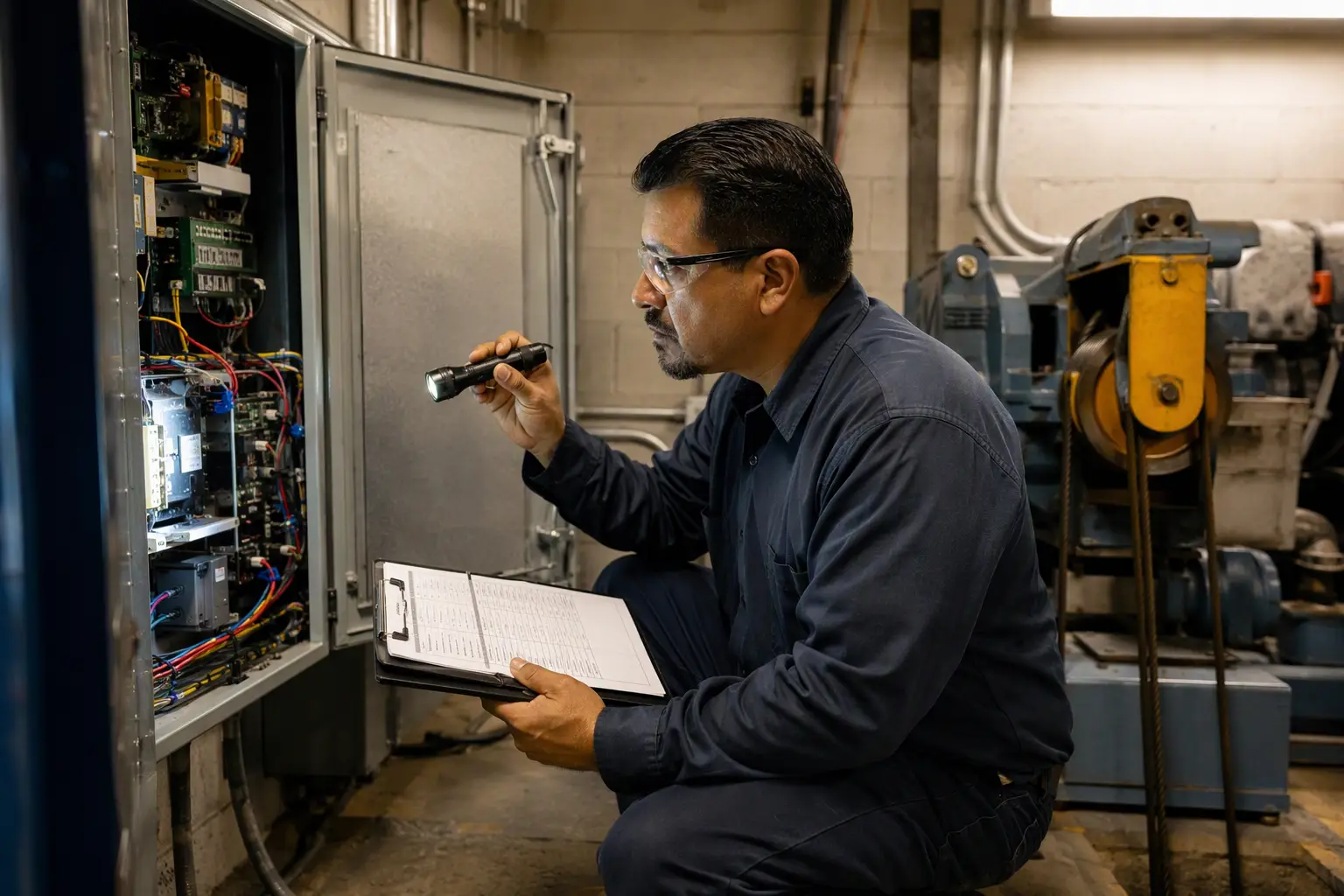
A compliant maintenance contract must cover preventive lubrication, adjustments, parts inspection, and safety tests required under California’s Elevator Safety Orders, along with a documented emergency call protocol.
Under the California Division of Occupational Safety and Health (Cal/OSHA), Elevator Unit, every operating conveyance must be kept in safe condition. A well-structured contract addresses this through scheduled preventive maintenance visits, systematic inspection of mechanical and electrical components, lubrication of moving parts, adjustment of door operators and safety devices, and documentary records of every service visit. The contract should also specify which parts are included at no additional cost and which require separate authorization, so building owners are not surprised by unanticipated invoices.
Beyond routine work, the agreement must describe how emergency calls are received and dispatched. A vague “24-hour service” statement is insufficient; the contract should define escalation steps, callback protocols, and what constitutes a qualifying emergency entrapment versus a non-urgent callback.
What credentials must an elevator company hold before it can legally maintain elevators in California?
In California, a company must be certified by Cal/OSHA as a Certified Qualified Conveyance Company (CQCC) and hold an active C-11 Elevator Contractor license from the California Contractors State License Board (CSLB) before it may maintain, repair, or alter any conveyance.
The CQCC certification requirement exists under California Code of Regulations, Title 8, Elevator Safety Orders. To obtain CQCC status, the applicant must submit a current C-11 license along with certificates of workers’ compensation and liability insurance. This dual-credential structure—state contractor licensing through CSLB plus Cal/OSHA safety certification—is unique to California and distinguishes it from many other states.
Every mechanic performing unsupervised work on a California elevator must additionally hold individual Cal/OSHA certification as a Certified Competent Conveyance Mechanic (CCCM). Both CQCC and CCCM certificates require renewal every two years, and each renewal cycle demands at least eight hours of continuing education. Before executing any maintenance contract, building owners should request current copies of the prospective company’s CQCC certificate, the C-11 license, and evidence that field technicians hold valid CCCM credentials.
Liftech Elevator holds the required California certifications and licensing that allow it to legally service elevators throughout Signal Hill, Long Beach, Los Angeles, and Orange County.
How does the permit to operate factor into a provider switch?
California law prohibits operating any elevator without a valid permit to operate issued by Cal/OSHA, and switching providers creates a window of administrative risk if the transfer is not managed carefully.
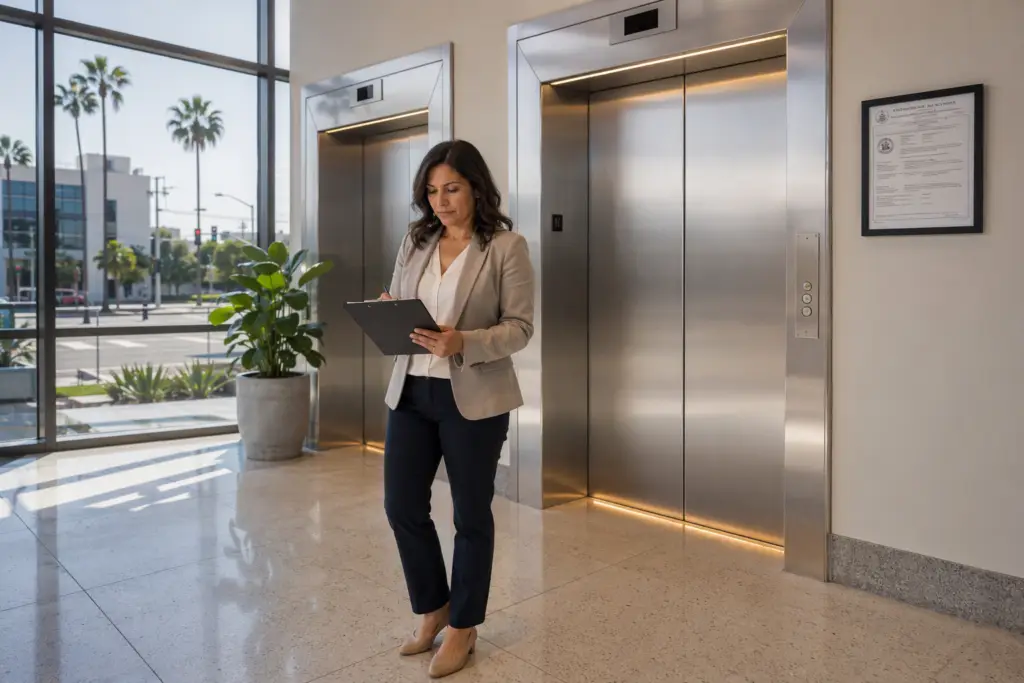
The permit to operate must be posted conspicuously inside the elevator car, and it is the elevator owner’s responsibility—not the contractor’s—to ensure reinspection is arranged before each permit expires. When a building transitions from one service company to another, the new company should audit the current permit expiration dates on day one and flag any units whose permits are approaching renewal. A lapse in the permit exposes the property owner to stop-use orders from Cal/OSHA and potential liability if an incident occurs while the unit is operating without a valid permit.
Notably, Cal/OSHA may issue a permit to operate for up to two years—rather than the standard one-year cycle—for an elevator in safe condition that is covered by a full maintenance contract with a C-11 licensed elevator company. This two-year permit option is a concrete financial and administrative benefit of maintaining a comprehensive service agreement and is one reason why a full-coverage contract often makes more economic sense than a basic oil-and-grease arrangement.
What is the difference between a full maintenance contract and a parts-and-labor contract?
A full maintenance contract covers all preventive visits, labor, and most replacement parts, while a parts-and-labor or oil-and-grease contract covers only scheduled visits with additional costs billed separately for parts and repairs.
| Contract Type | Preventive Visits Included | Labor for Repairs | Parts Coverage | Eligible for Cal/OSHA 2-Year Permit | Typical Best Fit |
|---|---|---|---|---|---|
| Full Maintenance (Comprehensive) | Yes | Yes | Yes (most parts) | Yes | High-use commercial, multi-unit residential, healthcare |
| Parts & Labor | Yes | Yes | No (billed separately) | Generally No | Low-rise, low-use buildings with newer equipment |
| Oil & Grease (Lubrication Only) | Yes (lubrication only) | No | No | No | Very low-use, owner manages repairs independently |
| Modernization + Maintenance Bundle | Yes | Yes | Yes (post-modernization) | Yes (if comprehensive) | Buildings undergoing upgrades seeking unified accountability |
Building owners considering a switch should compare not just the monthly fee but the total cost of ownership across contract types. A lower-tier contract that excludes parts can result in unbudgeted expenses that exceed the premium of a full maintenance agreement, particularly on aging equipment where component failures are more frequent.
What should the emergency response section of a maintenance contract specifically address?
The emergency response section must define entrapment procedures, dispatch protocols, callback verification steps, and the escalation path when the first technician cannot resolve the issue.
An entrapment—a situation where a passenger is unable to exit the elevator car—is the most time-sensitive elevator emergency a building will face. The contract should identify the dedicated emergency line, describe how calls are received after business hours, explain how a technician is dispatched, and clarify what the building’s duty personnel should communicate to trapped passengers while assistance is en route. Procedures consistent with life-safety guidance from OSHA recommend that trapped passengers be instructed to remain calm, avoid forcing doors, and use the in-car emergency communication device.
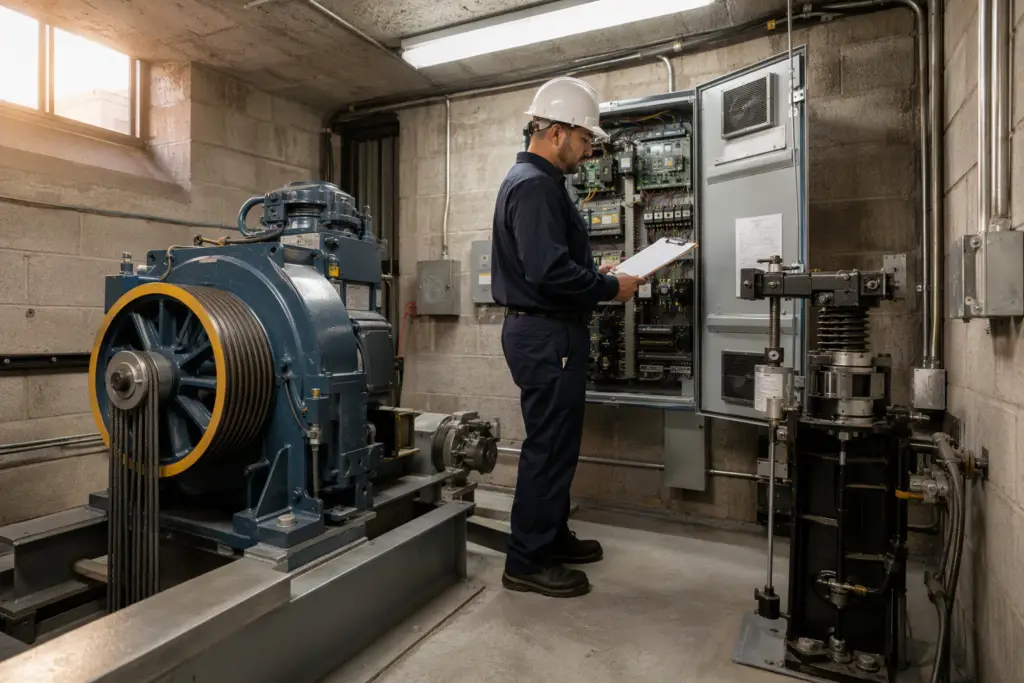
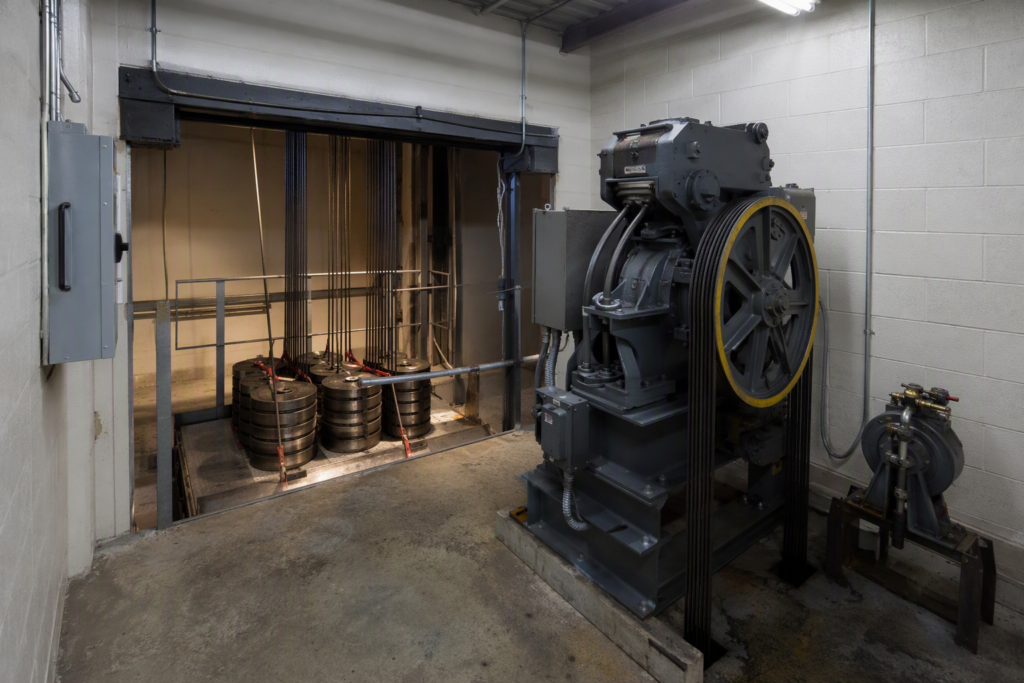
Beyond entrapment, the emergency section should address procedures for electrical failures causing the elevator to stop between floors, door malfunctions preventing exit, and situations involving medical emergencies where fire department or EMS access to the machine room may be required. The contract should specify how the service company coordinates with first responders in these scenarios.
How should a building owner evaluate emergency communication compliance in the contract?
The contract should confirm that the elevator’s in-car emergency communication system is maintained in operable condition in accordance with the applicable edition of ASME A17.1 adopted in California.
California’s Elevator Safety Orders adopt the ASME A17.1/CSA B44 Safety Code for Elevators and Escalators (2004 edition for installations covered under Group IV Elevator Safety Orders, effective for installation contracts signed on or after May 1, 2008). ASME A17.1 includes requirements for two-way emergency communication within elevator cars. As of 2026, California has proposed a Group V update to its Elevator Safety Orders that would incorporate provisions from ASME A17.1-2019, but no effective date has been posted following the Standards Board public hearing held on June 18, 2026. Building owners and their service providers should monitor Cal/OSHA communications for updates to emergency communication requirements as that rulemaking progresses.
The maintenance contract should require that the service company test and document the operability of the in-car communication device at every scheduled visit and flag any deficiency in the written service report delivered to the building owner.
What ADA obligations affect elevator maintenance, and how should a contract address them?
The Americans with Disabilities Act requires that elevators providing accessible access remain operational, and a maintenance contract should prioritize restoration of ADA-covered units and address accessibility hardware as part of standard scope.
Under the Americans with Disabilities Act, elevators serving facilities subject to ADA requirements must be kept in working order so that individuals with disabilities are not denied access. While the ADA does not establish specific maintenance intervals, it does establish that inaccessible conditions resulting from elevator outages must be addressed promptly, and that temporary alternatives must be provided where the building configuration permits. Maintenance contracts should explicitly include door reopening devices, Braille and tactile floor indicators, audible floor signals, and accessible controls as maintained components—not as extras billed outside the base scope.
Building owners in Los Angeles should note that the City of Los Angeles Department of Building and Safety (LADBS) operates its own elevator and conveyance inspection program. Facilities managers should confirm with their service provider how LADBS requirements interact with the Cal/OSHA permit process for properties within the City of Los Angeles.
What documentation should a new maintenance provider deliver at contract commencement?
At contract start, the new provider should deliver copies of its CQCC certificate, C-11 license, mechanic CCCM credentials, a baseline condition assessment for each unit, and a schedule of all upcoming permit renewal dates.
A thorough baseline assessment documents the current mechanical and electrical condition of each conveyance before the new provider assumes responsibility. This protects both parties: the owner has evidence of pre-existing conditions, and the contractor has a documented starting point that prevents inherited deficiencies from becoming disputed claims. The assessment should reference applicable sections of California Code of Regulations, Title 8, Elevator Safety Orders (Sections 3000–3146), and note any items that require correction to achieve or maintain a Cal/OSHA permit to operate.
In addition to the baseline report, the service company should deliver a maintenance log template or access to a digital record system that captures every visit, every part replaced, every test performed, and every deficiency noted. These records are essential when Cal/OSHA conducts an inspection and when the building changes ownership or management.
How does switching providers affect the Cal/OSHA annual inspection and permit renewal process?
Switching providers does not transfer inspection responsibility—the elevator owner remains legally obligated to arrange the annual reinspection—but the new contractor should proactively support the owner through the process.
California law is explicit: arranging the annual reinspection is the elevator owner’s responsibility, and the inspecting party must be either a State of California safety engineer or a Certified Competent Conveyance Inspector (CCCI). The new maintenance contractor should provide the owner with all service records needed to support the inspection, coordinate access to the machine room and pit, and ensure that safety tests required prior to reinspection are completed on schedule.
A well-drafted maintenance contract will include a clause specifying that the contractor will notify the owner no less than a defined number of days before each permit expiration date and will prepare the unit for inspection. Building owners in Signal Hill, Long Beach, and throughout Orange County should verify that this notification and preparation obligation is written explicitly into the agreement—not merely implied by a general “compliance support” statement.
What are the steps to formally transition from one elevator service provider to another?
Transitioning providers involves reviewing the termination terms of the existing contract, conducting a unit-by-unit condition audit, executing the new agreement, and transferring all regulatory documentation before the first service visit occurs.
- Review the termination and notice provisions in the current maintenance contract, including any liquidated damages clauses or equipment lien provisions that could complicate the transition.
- Issue the required written notice of termination to the incumbent provider per the contract’s specified notice period.
- Request complete service history records, current permit to operate copies, and any open deficiency reports from the incumbent provider before their final service date.
- Have the prospective new provider conduct a pre-contract baseline inspection of every unit to document current condition and identify any items needing immediate attention.
- Verify the new provider’s CQCC certificate, C-11 license, and individual mechanic CCCM credentials before executing the new agreement.
- Execute the new maintenance contract and confirm the effective date aligns with or precedes the incumbent’s final service date to avoid a gap in coverage.
- Update the on-site equipment logbooks and machine room emergency contact information to reflect the new provider.
- Confirm that all Cal/OSHA permit to operate expiration dates have been entered into the building’s maintenance calendar and that the new contractor’s notification obligation is activated.
- Conduct a post-transition review meeting with the new provider’s account representative thirty days after commencement to address any open items from the baseline assessment.
What questions should a building owner ask a prospective elevator maintenance company before signing?
A building owner should ask about CQCC certification status, mechanic CCCM credential currency, emergency dispatch procedures, parts sourcing, subcontractor use, and how the company manages permit renewal coordination.
Key questions to include in a vendor evaluation include: Is the company currently certified as a CQCC by Cal/OSHA, and can documentation be provided? Do all technicians assigned to this property hold valid CCCM certification? How are emergency calls received outside business hours, and what is the escalation path if the first technician cannot resolve the issue? Does the company use in-house technicians or subcontractors for emergency calls? How are parts sourced—OEM or aftermarket—and what is the policy on substitutions? How does the company handle permit renewal coordination, and who is the designated contact for regulatory documentation requests?
Building owners evaluating providers in the greater Los Angeles area and Orange County should also ask how the company coordinates with LADBS for properties within City of Los Angeles jurisdiction, given that Los Angeles operates its own elevator inspection program.
How does contract length affect leverage and service quality?
Long-term contracts can secure pricing stability but may reduce the building owner’s ability to change providers if service quality declines, so contract terms should include measurable performance standards and defined exit conditions.
Multi-year maintenance agreements are common in the elevator industry. While they can provide budget predictability, they must include performance benchmarks and clear exit provisions to protect the owner. A contract with no exit clause tied to performance leaves the owner bound even if service response becomes unreliable. Negotiate for provisions that allow termination for cause—defined specifically as repeated failure to meet documented response or maintenance standards—without liquidated damages.
Conversely, very short-term or month-to-month arrangements may create instability for both parties and can result in inadequate parts inventory allocation for the property. A balanced approach for most commercial buildings involves a multi-year term with annual performance reviews and defined cure periods before termination rights are triggered.
What does a maintenance contract need to say about parts and equipment modernization?
The contract should specify whether replacement parts must be OEM-sourced, define the authorization threshold for unbudgeted parts expenditures, and address what happens when a unit’s age makes parts difficult to source.
Aging elevator equipment is a significant issue throughout the building stock in Los Angeles, Long Beach, Signal Hill, and Orange County. As equipment approaches or exceeds the typical design lifespan of its major components, a maintenance contract that excludes parts coverage can expose the owner to substantial unplanned capital expenses. The agreement should specify the process for recommending modernization, including what triggers a modernization recommendation, whether the contractor has a conflict of interest in making that recommendation, and how modernization work is priced and authorized.
Any installation, alteration, or material change to a California elevator requires a permit from Cal/OSHA before the work begins, in addition to the new unit receiving an inspection and permit to operate before being placed back in service. The maintenance contract should reflect this regulatory framework by requiring the contractor to obtain all required permits before commencing alteration work.
How should a contract address multi-unit or multi-building portfolios?
Portfolio contracts should specify per-unit service frequencies, identify which units are highest priority for emergency response, and include consolidated reporting that allows the owner to track compliance across all locations.
Property management companies and institutional owners operating multiple buildings across Long Beach, Los Angeles, and Orange County benefit from agreements that centralize compliance tracking. Each individual unit in the portfolio should be listed by address, unit ID, equipment type, and permit expiration date in a schedule attached to the master agreement. The contract should clarify whether emergency response prioritization is uniform across all units or whether certain high-occupancy or hospital-adjacent locations receive elevated dispatch priority.
Consolidated monthly or quarterly reporting covering all units in the portfolio allows facilities directors to identify patterns—recurring faults on a specific unit, a location with frequent entrapments—and make informed capital planning decisions about modernization before a unit becomes unreliable or non-compliant.
What role does ASME A17.1 play in defining what a maintenance contract must cover?
The ASME A17.1 Safety Code for Elevators and Escalators establishes the technical baseline for maintenance tasks, testing intervals, and safety device inspections that a California-compliant maintenance contract must incorporate.
The ASME A17.1/CSA B44 Safety Code for Elevators and Escalators is adopted into California’s regulatory framework through the Elevator Safety Orders. The code defines required maintenance tasks such as governor and safety tests, brake tests, and door force and speed tests. A maintenance contract that does not reference these code-required tests or that schedules them at intervals inconsistent with the code provides substandard coverage regardless of how it is marketed.
When reviewing a prospective contract, building owners should ask the provider to identify which ASME A17.1 required tests are included within the base contract scope and which, if any, are performed only upon request or billed as separate events. Code-required tests that are excluded from the base scope create both compliance risk and unanticipated cost.
What happens if an elevator fails inspection in California?
If a Cal/OSHA inspection reveals that an elevator is not in safe condition, the permit to operate may be withheld or revoked, and the unit cannot legally be operated until deficiencies are corrected and a new permit is issued.
The California Labor Code is unambiguous: no elevator may be operated in California without a valid, current permit to operate issued by Cal/OSHA. If the annual inspection results in a finding of unsafe condition, the unit must be taken out of service until corrections are made and reinspection confirms safe condition. The maintenance contract should define the contractor’s obligation to respond to inspection deficiency notices, perform corrective work within a specified timeframe, and coordinate the reinspection with Cal/OSHA or the applicable local authority.
Building owners should avoid contracts that treat inspection preparation and deficiency correction as billable add-ons rather than core services. The cost of responding to a deficiency notice is far lower than the liability exposure of operating a unit without a valid permit or the reputational damage of a protracted out-of-service period in a high-occupancy building.
How should the contract address new elevator installations in California?
For new installations, the contract must reflect that a Cal/OSHA permit is required before the elevator is erected or installed, and that no new elevator may be placed in service until Cal/OSHA has inspected it and issued a permit to operate.
New construction projects in Signal Hill, Long Beach, Los Angeles, and Orange County must incorporate these permit requirements into project timelines. Delays in obtaining the installation permit or the pre-service inspection can postpone a building’s certificate of occupancy. A maintenance contract that takes effect at project completion should be drafted in parallel with the installation agreement so there is no gap between the installation contractor’s warranty period and the long-term maintenance coverage.
Liftech Elevator works with development teams and property managers to plan maintenance contract commencement dates that align with projected Cal/OSHA inspection timelines, avoiding the administrative gap that sometimes occurs between project completion and the first permit to operate.
What should building owners in Los Angeles specifically know about elevator oversight?
Los Angeles operates its own elevator and conveyance inspection program through the City of Los Angeles Department of Building and Safety, which operates alongside the Cal/OSHA statewide framework.
Building owners and facilities managers with properties within the City of Los Angeles should confirm with their maintenance provider how the LADBS program interacts with Cal/OSHA’s permitting requirements for their specific units. A maintenance contract for a Los Angeles property should identify both the Cal/OSHA Elevator Unit and LADBS as relevant authorities and describe how the contractor coordinates with each agency during inspection, permitting, and deficiency correction processes. This dual-authority environment is a practical consideration that distinguishes Los Angeles from other markets in Southern California, and it underscores the value of working with a provider that has direct experience operating in the city.
How can a building owner verify that a maintenance contractor is legitimate in California?
Building owners can verify a contractor’s legal standing by checking their CQCC certification status with Cal/OSHA and their C-11 license status with the California Contractors State License Board.
The Cal/OSHA Elevator Unit maintains records of certified companies and individuals. The California Contractors State License Board maintains a publicly searchable license database where the C-11 license status, expiration, and any disciplinary history can be reviewed. Building owners should run both checks before executing any maintenance agreement. If a company cannot provide its CQCC certificate number or its C-11 license number for independent verification, that is a significant disqualifying indicator.
Individual mechanic credentials can also be verified: all CCCM certifications are issued by Cal/OSHA, and the certificate should identify the holder by name and include an expiration date. Requesting copies from the prospective provider and confirming that the expiration dates are current is a straightforward due diligence step that is often overlooked.
Why is local knowledge important when selecting an elevator maintenance provider?
Local knowledge of the building stock, authority having jurisdiction (AHJ) relationships, and regional parts availability directly affects how reliably a provider can respond to emergencies and support compliance in any given market.
In markets such as Long Beach, Signal Hill, and Orange County—which encompass a mix of mid-century commercial buildings, modern high-rises, healthcare facilities, and residential towers—the variety of elevator equipment in service is substantial. A provider that operates primarily in a single equipment category or that must source parts from distant distributors will be less effective in a multi-brand, multi-vintage portfolio than one with established local supply chains and direct familiarity with the regional building stock.
Liftech Elevator focuses its service operations in Signal Hill, Long Beach, Los Angeles, and Orange County, which means its technicians are familiar with the equipment types, building configurations, and AHJ requirements specific to these markets. That local focus supports more reliable emergency response and more accurate compliance guidance than a national provider managing Southern California as a peripheral territory.
Contact Liftech Elevator for a free elevator assessment at 562-997-3639.
Need elevator service you can rely on? Liftech Elevator is ready to help.