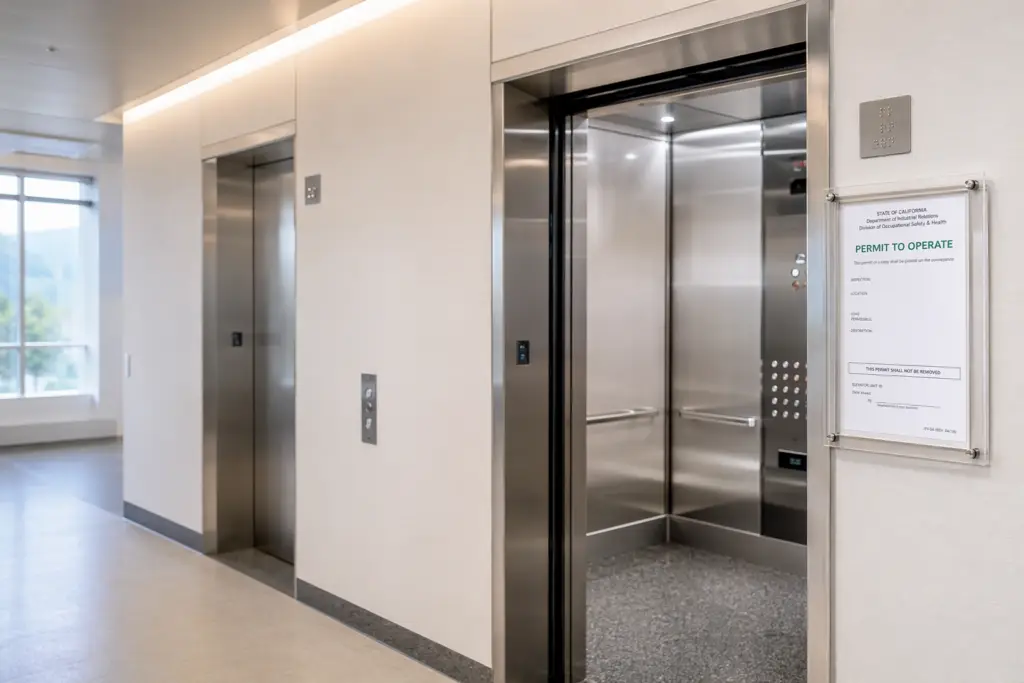
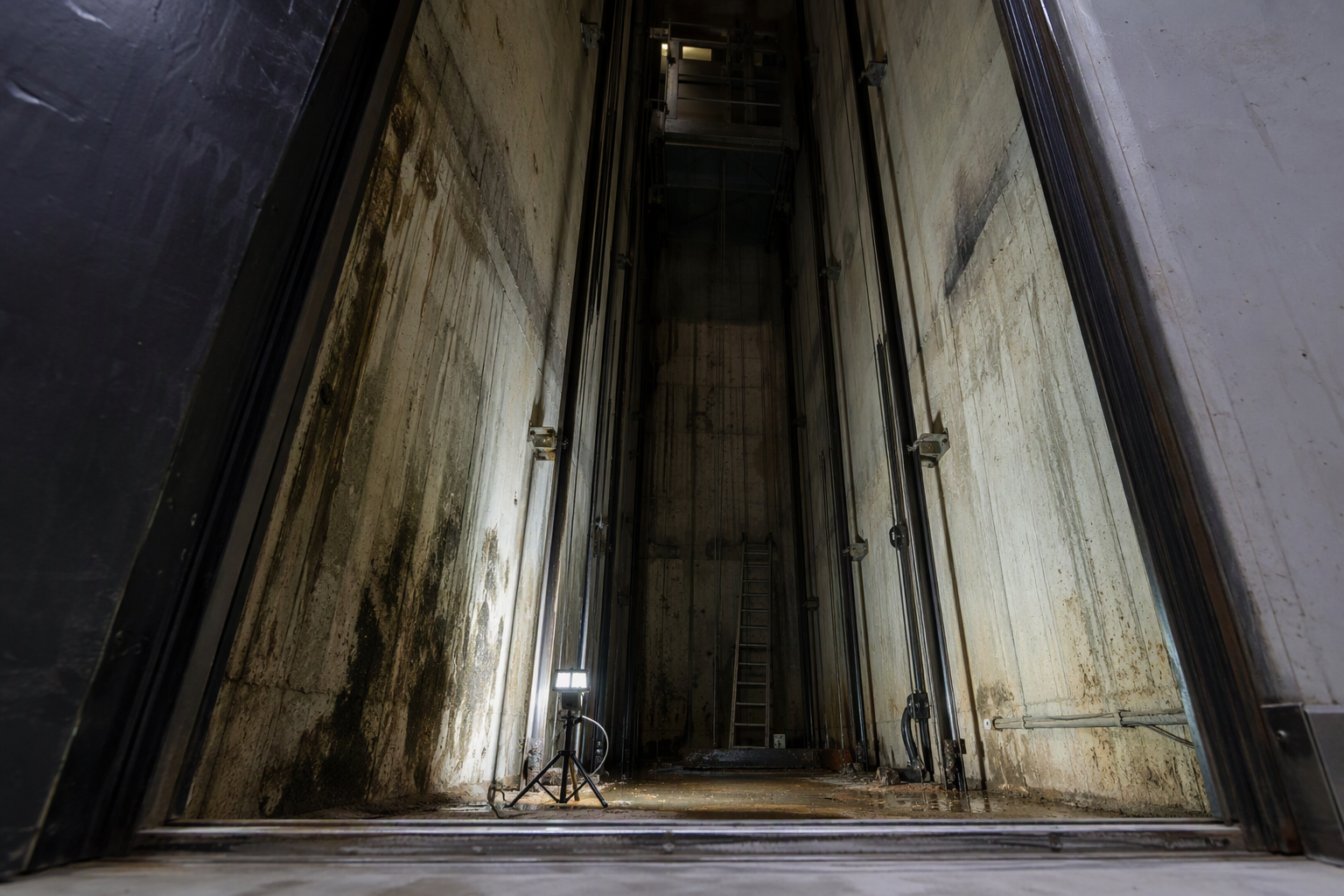
In California, no elevator may be placed in service without a valid permit to operate issued by the Cal/OSHA Elevator Unit, California Department of Industrial Relations. When mold colonizes a hoistway, it introduces biological hazards, potential structural deterioration of wood or metal surfaces, and air-quality concerns that can interfere with that inspection outcome. Understanding when remediation is required, what it involves, and how it interacts with California’s elevator inspection timeline is essential for any building owner or property manager facing this situation in 2026.
Why Mold in an Elevator Hoistway Is Treated as a Safety Issue, Not Just a Cosmetic One
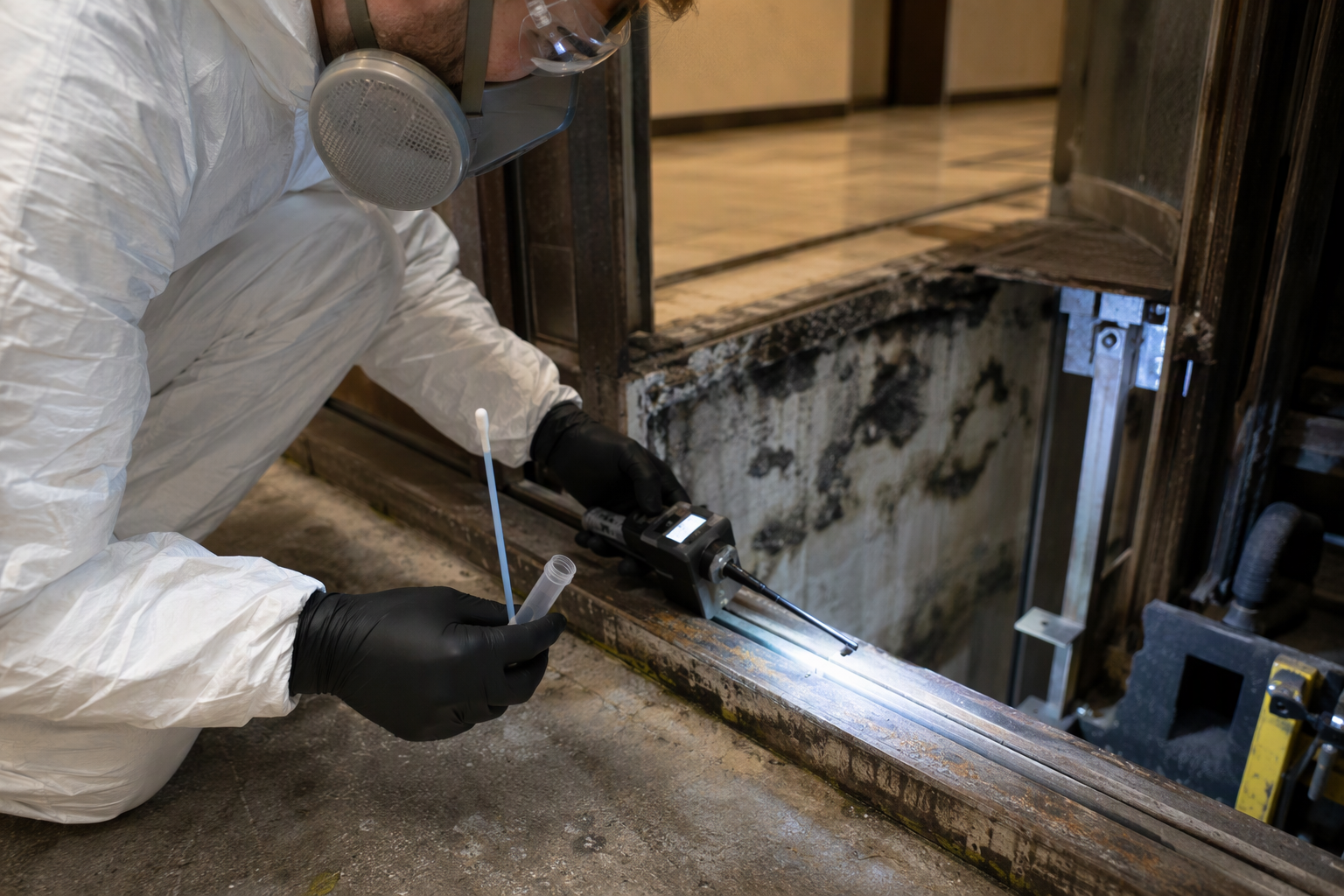
A hoistway is a confined, enclosed space with limited airflow. Mold colonies in this environment can release spores that affect the respiratory health of elevator mechanics, inspectors, and — through elevator door gaps — building occupants. Under OSHA general industry standards, employers and building owners have a duty to provide a workplace free from recognized hazards. A mold-contaminated hoistway qualifies as a recognized hazard, particularly for the Certified Competent Conveyance Mechanics (CCCMs) who must enter the pit and ride the top of the car during maintenance and inspection work.
Beyond air quality, mold growth indicates persistent moisture intrusion. That moisture can corrode guide rails, degrade wire rope lubrication, attack wood sill components, compromise electrical conduit integrity, and accelerate pit floor deterioration — all of which are items evaluated during a Cal/OSHA conveyance inspection under the California Code of Regulations, Title 8, Elevator Safety Orders.
What Does California Law Actually Require for a Final Elevator Inspection?

Under California Labor Code Sections 7300–7324.2 and the California Code of Regulations, Title 8, Elevator Safety Orders (Sections 3000–3146), every new or materially altered elevator must be inspected by Cal/OSHA and receive a permit to operate before it is placed in service. The inspection is conducted by a State of California safety engineer or a Certified Competent Conveyance Inspector (CCCI). These inspectors evaluate whether the conveyance meets the applicable edition of the ASME A17.1/CSA B44 Safety Code for Elevators and Escalators — the 2004 edition governs installation contracts signed on or after May 1, 2008, in California.
The Elevator Safety Orders do not contain a standalone clause that reads “mold must be absent.” However, inspectors assess the overall safe condition of the installation. A hoistway with visible mold growth, water pooling in the pit, or evidence of organic material degradation on structural components can lead an inspector to identify deficiencies that must be corrected before a permit to operate is issued. Practically, this means remediation must be completed before — not after — the final inspection if the owner wants to pass on the first attempt.
In Los Angeles specifically, the Los Angeles Department of Building and Safety (LADBS) runs its own elevator and conveyance inspection program, which may layer additional requirements on top of the state baseline. Building owners in Los Angeles should confirm current LADBS expectations directly with that office.
How Does Mold Develop in an Elevator Hoistway?
Moisture enters hoistways through several pathways:
- Pit flooding or groundwater intrusion — particularly in below-grade pits in California coastal or hillside properties
- Roof or slab leaks — water tracking down hoistway walls from above
- HVAC condensation — improperly routed mechanical systems depositing moisture inside the shaft
- Construction defects — inadequate waterproofing during the original build or during a material alteration
- Deferred maintenance — drain lines blocked, sump pumps non-functional, or pit ladders and sill areas allowing water ingress
Once moisture is present and organic material (wood blocking, drywall backing, construction debris) is available as a food source, mold can establish within days under California’s warm climate conditions.
What Is the Recommended Step-by-Step Protocol When Mold Is Discovered in a Hoistway?
- Stop non-emergency access to the hoistway immediately. Notify building management and any active elevator contractor of the contamination so that worker exposure is controlled per OSHA guidance on biological hazards in confined spaces.
- Commission a professional mold assessment. A California-licensed industrial hygienist or certified mold assessor should inspect the hoistway, collect air and surface samples, identify the mold species present, and document the extent of contamination before any remediation work begins.
- Identify and correct the moisture source. Remediation without moisture control will result in mold recurrence. This step may involve waterproofing the pit, repairing roof penetrations, or rerouting condensate lines — work that must be coordinated with the building’s general contractor or plumber.
- Engage a licensed mold remediation contractor. In California, mold remediation contractors must comply with California Health and Safety Code requirements governing contractors who perform remediation work. The remediation scope should follow the written protocol produced by the assessor in Step 2.
- Notify your Certified Qualified Conveyance Company (CQCC). The elevator contractor — who must hold both a C-11 Elevator Contractor license from the California Contractors State License Board (CSLB) and Cal/OSHA CQCC certification — needs to inspect all elevator components inside the hoistway for corrosion, water damage, or degradation caused by the moisture event. Only a CCCM working for a CQCC may perform this inspection and any resulting repairs.
- Obtain post-remediation clearance testing. After remediation is complete, the industrial hygienist returns to perform clearance sampling. The hoistway must pass clearance criteria before it is considered safe for inspectors and mechanics to re-enter for extended work.
- Document everything for the AHJ package. Compile the initial assessment report, the remediation contractor’s work completion certificate, the clearance test results, and the elevator contractor’s component inspection findings into a single file. This documentation supports the permit application and demonstrates due diligence to Cal/OSHA.
- Schedule the final Cal/OSHA inspection. With moisture corrected, mold remediated, components inspected and repaired, and clearance testing passed, contact Cal/OSHA’s Elevator Unit to schedule the final inspection. Arranging this inspection is the elevator owner’s responsibility under California law.
Comparison Table: Attempting Inspection With Mold Present vs. Remediating First
| Factor | Inspect With Mold Present | Remediate First, Then Inspect |
|---|---|---|
| Likelihood of passing inspection | Low — inspector may cite unsafe conditions and withhold permit | High — hoistway presents no biological hazard |
| Worker health risk | Elevated for CCCM and CCCI entering the hoistway | Minimal after clearance testing passes |
| Risk of component damage going undetected | High — moisture damage may be obscured by mold growth | Low — thorough component inspection performed post-remediation |
| Re-inspection fees and scheduling delays | Likely — failed inspection requires correction and reinspection | Avoided — single inspection cycle typical |
| Liability exposure | High — OSHA citation risk; permit denial on record | Low — documented remediation provides defensible record |
| Total project timeline | Longer — inspection failure adds correction cycle | Shorter overall despite upfront remediation time |
| Permit to operate outcome | Permit withheld until deficiencies corrected | Permit issued upon satisfactory inspection |
Comparison Table: DIY Mold Cleanup vs. Professional Hoistway Remediation
| Factor | DIY / Maintenance Staff Cleanup | Licensed Mold Remediation Contractor |
|---|---|---|
| Clearance documentation for Cal/OSHA | Not available — no certified testing | Industrial hygienist clearance report provided |
| Containment of spores during cleanup | Minimal — spreads contamination risk | Negative-pressure containment standard protocol |
| Worker safety compliance | High OSHA exposure risk without proper PPE protocols | Contractor responsible for worker protection |
| Root-cause moisture correction | Rarely addressed — mold returns | Coordinated with waterproofing trades |
| Defensibility if inspector questions remediation | None — no third-party documentation | Full paper trail from assessment through clearance |
| Recurrence risk | High without moisture source correction | Low when moisture control is included in scope |
Does ASME A17.1 Address Hoistway Cleanliness or Mold?
The ASME A17.1/CSA B44 Safety Code for Elevators and Escalators — the edition adopted by California’s Elevator Safety Orders — establishes detailed requirements for hoistway construction, clearances, lighting, drainage, and pit conditions. The code requires that hoistway pits be kept free of water accumulation and debris, and it mandates proper drainage or sump pump provisions. While the code does not contain a provision that explicitly references “mold,” persistent water accumulation — which the code prohibits — is the precondition that generates mold. An inspector citing non-compliant pit drainage or evidence of standing water is therefore addressing a code violation that is directly connected to mold risk.
How Long Does Hoistway Mold Remediation Typically Take?
The timeline varies depending on the extent of contamination, the size of the hoistway, and scheduling availability of the assessment and remediation contractors. In general terms:
- Initial mold assessment: Typically scheduled and completed within days of engagement, depending on contractor availability.
- Moisture correction: Timeline depends on the nature of the defect — a simple drain repair may be completed quickly, while a waterproofing membrane installation or slab repair can take considerably longer.
- Active remediation work: Scope-dependent; small localized contamination areas clear faster than widespread hoistway wall or pit floor colonization.
- Post-remediation clearance testing and reporting: Lab turnaround for air and surface samples typically adds several business days.
- Cal/OSHA inspection scheduling: Dependent on inspector availability through the Cal/OSHA Elevator Unit; building owners should factor in potential wait times when planning project completion dates.
Building owners should build hoistway mold remediation time into the overall elevator project schedule from the outset rather than treating it as an afterthought discovered during punch-list walkthroughs.
Who Is Responsible for Coordinating Remediation With the Elevator Contractor?
Under California law, arranging the annual reinspection — and by extension, ensuring the elevator is in an inspectable and safe condition — is the elevator owner’s responsibility. This means the building owner or property manager must coordinate among the mold assessor, the remediation contractor, and the CQCC-certified elevator company to ensure that all three scopes of work are sequenced correctly. The elevator contractor cannot proceed with component inspections or repairs inside a contaminated hoistway without exposing its CCCMs to biological hazards. Conversely, the mold contractor cannot assess damage to elevator components — that requires the elevator contractor’s involvement post-remediation.
Liftech Elevator, a Certified Qualified Conveyance Company serving California building owners, can help coordinate the sequencing of this work and perform the post-remediation component inspection and any required repairs, ensuring the elevator is ready for Cal/OSHA’s final review.
Can a Temporary or Conditional Permit Be Issued While Remediation Is Pending?
California’s elevator permit framework does not provide for a formal “conditional permit to operate” that allows a contaminated elevator to remain in service while remediation is in progress. The permit to operate is issued when the conveyance is found to be in a safe condition. If an elevator is already in service under an existing permit and mold is discovered during a periodic inspection, Cal/OSHA has authority to order corrective action and, if conditions warrant, to withdraw or suspend the permit to operate. Building owners should not assume that an in-service elevator with a valid permit is exempt from correction orders if a safety hazard is identified between inspection cycles.
What Happens if the Elevator Is Already in Service When Mold Is Discovered?
If mold is found in the hoistway of an elevator currently operating under an existing permit to operate, the building owner should take the following steps promptly:
- Engage a mold assessor to quantify the hazard immediately.
- Consult with the CQCC-certified elevator contractor to evaluate whether elevator operation can safely continue while remediation is arranged, or whether the elevator must be temporarily taken out of service.
- Notify Cal/OSHA’s Elevator Unit if there is any question about the safety of continued operation — proactive disclosure is preferable to a complaint-driven inspection.
- Document all steps taken and timelines in writing.
Attempting to conceal mold from an inspector or continuing to operate a known unsafe elevator creates significantly greater regulatory and liability exposure than the cost and inconvenience of temporary shutdown and remediation.
Does the Type of Mold Species Found Affect the Remediation Requirement?
From a California elevator inspection standpoint, the operative concern is whether the hoistway presents a hazardous condition — not specifically which mold species is present. That said, the industrial hygienist’s assessment will typically identify species present because certain species (commonly described in the remediation industry as toxigenic types) may require more aggressive containment and personal protective equipment protocols under applicable occupational health guidance. The species identification informs the scope of remediation rather than the requirement to remediate, which exists regardless of species when visible mold growth is confirmed in a confined workspace like a hoistway.
Pros and Cons of Addressing Hoistway Mold During New Construction vs. After Project Completion
| Factor | Addressing During Construction | Addressing After Project Completion |
|---|---|---|
| Access to hoistway | Open — scaffolding and construction access in place | Restricted — scaffolding removed, finished interiors at risk |
| Cost | Lower — integrated with waterproofing and construction scope | Higher — standalone mobilization, containment, and restoration required |
| Project schedule impact | Minimal if detected early | Significant — delays certificate of occupancy and elevator permit |
| Risk of component damage | Low — components may not yet be installed | High — guide rails, wiring, and mechanical components potentially affected |
| Coordination complexity | Managed within general contractor’s project | Requires separate contractor coordination by building owner |
How Should Building Owners Prevent Hoistway Mold From Recurring After Remediation?
Prevention is fundamentally a moisture management problem. Recommended ongoing practices include:
- Maintaining pit sump pumps in operational condition and testing them on a documented schedule.
- Ensuring hoistway ventilation meets the requirements of the applicable ASME A17.1/CSA B44 code edition and is free of blockages.
- Including hoistway interior visual inspection as part of every periodic maintenance visit by the CQCC-certified elevator contractor.
- Addressing roof or façade water intrusion promptly — do not defer building envelope repairs that could allow moisture to track into the elevator shaft.
- Ensuring the annual reinspection by Cal/OSHA proceeds on schedule; the inspector’s annual visit provides an independent check on hoistway conditions.
- For elevators covered by a full maintenance contract with a C-11 licensed elevator company — which may qualify for a two-year Cal/OSHA permit under California law — ensure the maintenance contract scope explicitly includes pit and hoistway condition monitoring.
Why Choose Liftech Elevator to Support Hoistway Mold Remediation and Inspection Readiness?
Liftech Elevator is a certified elevator service company operating in California. As a Certified Qualified Conveyance Company, Liftech Elevator employs Certified Competent Conveyance Mechanics — the only individuals legally authorized under California law to inspect, maintain, repair, and alter elevator components inside a California hoistway. When building owners face a mold-related delay on a new installation or a mid-cycle discovery on an operating elevator, Liftech Elevator can coordinate the post-remediation component inspection, identify and repair any moisture-related damage to elevator equipment, prepare the elevator for Cal/OSHA’s final review, and assist with the permit to operate application process.
Working with a single, California-qualified elevator contractor throughout the process — rather than attempting to manage elevator component issues separately from the remediation contractor — reduces coordination risk and helps ensure that nothing is missed before the inspector arrives.
Contact Liftech Elevator for a free elevator assessment at 562-997-3639.
Need elevator service you can rely on? Liftech Elevator is ready to help.