Can elevator door closing speed be adjusted if residents find it closes too quickly?
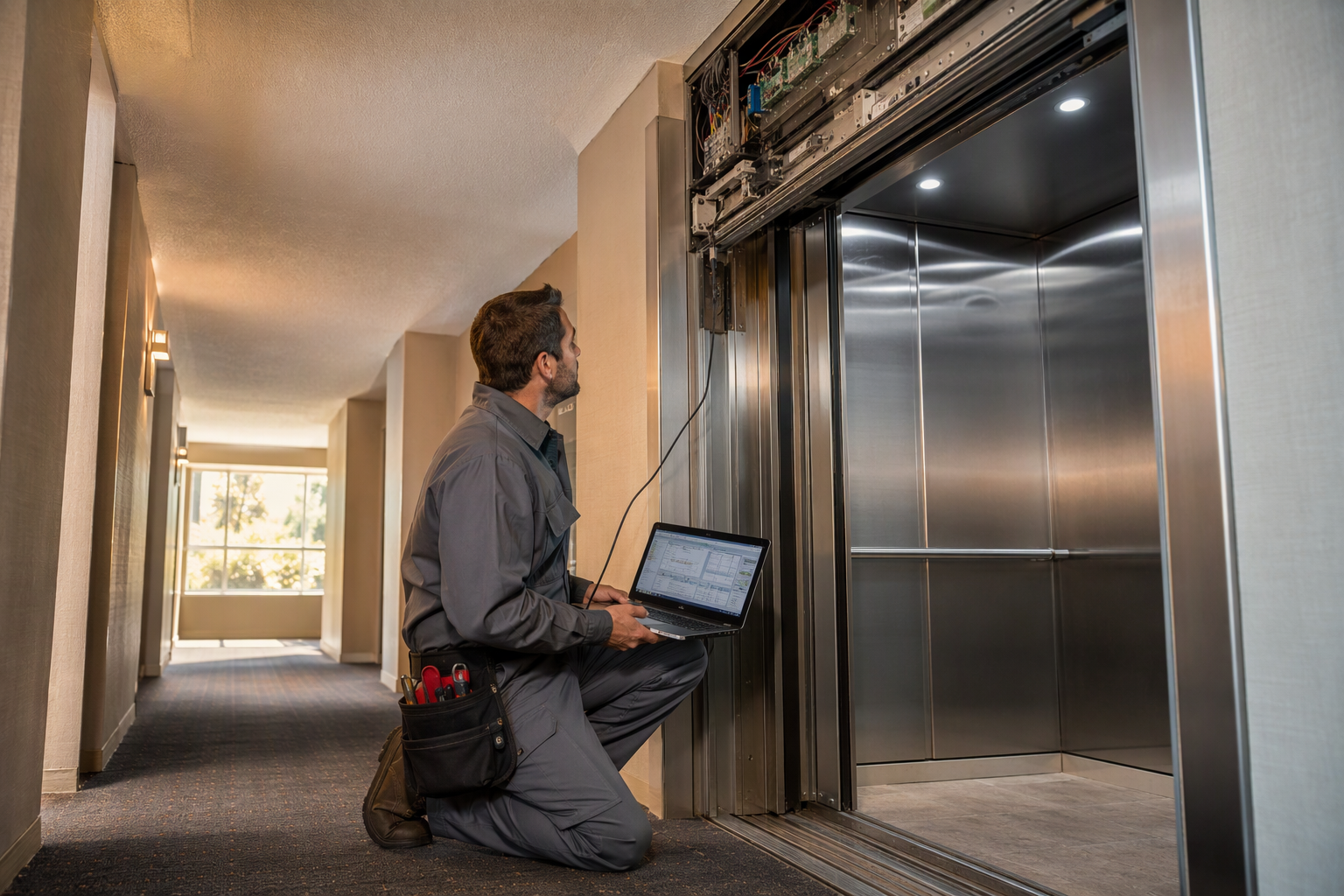
Yes. Elevator door closing speed is a programmable parameter controlled by the door operator — an electromechanical drive mounted above the car that governs how fast the doors open, how fast they close, and how much force they exert. A Certified Competent Conveyance Mechanic (CCCM) can reduce the closing speed, extend the door-open dwell time, and lower the closing kinetic energy to levels that feel comfortable to residents while remaining within the minimum safety thresholds required by ASME A17.1 and the ADA. Any adjustment must be tested and documented to confirm it still meets code limits before the elevator is returned to service.
The sections below answer the most common follow-up questions building managers and residents ask about door speed, force, timing, compliance, and who to call in Signal Hill, Long Beach, Los Angeles, and Orange County.
What codes govern elevator door closing speed in California?
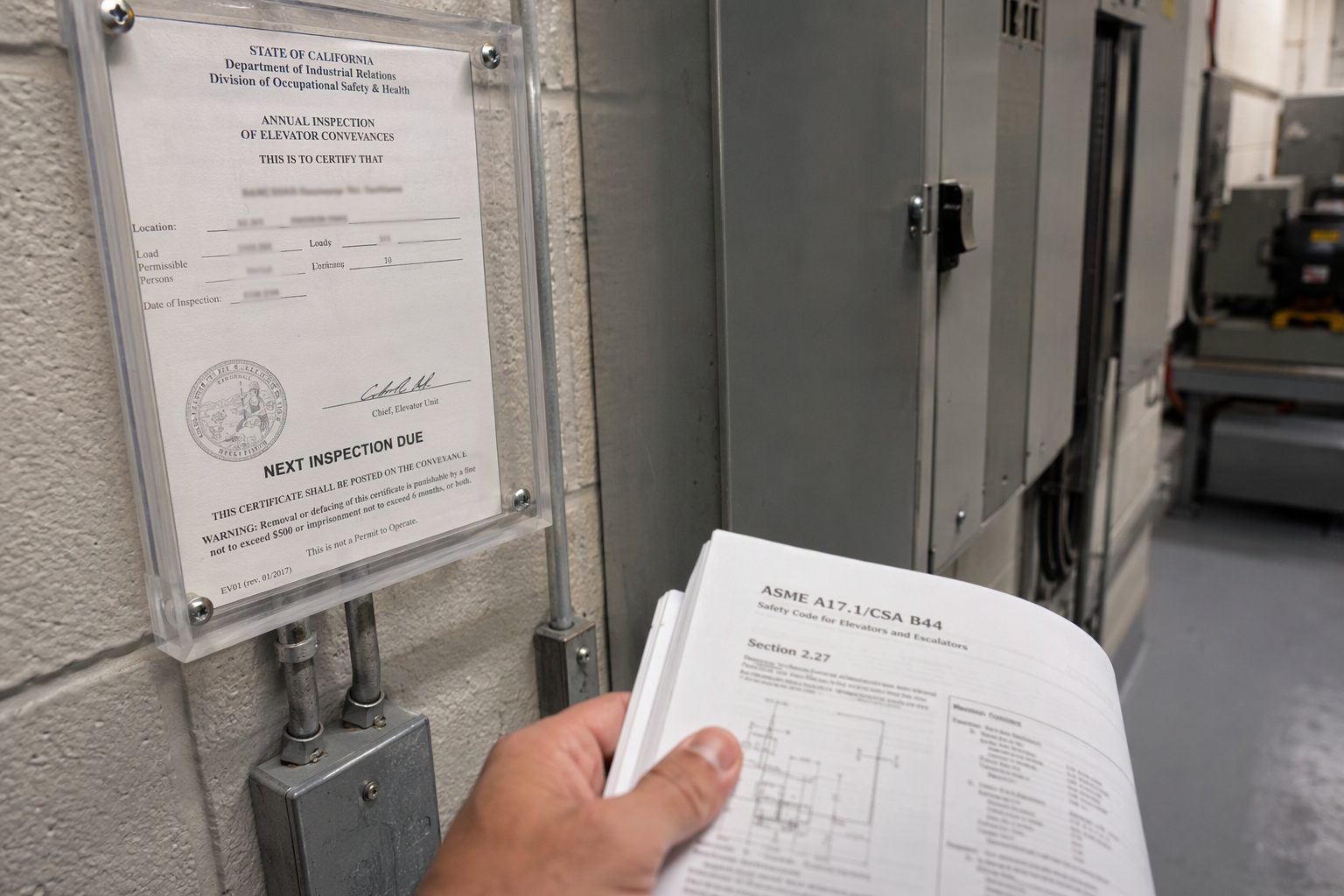
California adopts the ASME A17.1/CSA B44 2004 edition as the basis for its Elevator Safety Orders, administered by the Cal/OSHA Elevator Unit under the California Department of Industrial Relations.
Three overlapping regulatory frameworks set the boundaries for door operation in California:
- ASME A17.1 Safety Code for Elevators and Escalators: Establishes maximum closing kinetic energy, minimum door protection requirements, and power-open/power-close rules for automatic doors.
- ADA Standards for Accessible Design: Requires that elevator doors remain fully open for at least three seconds and sets the maximum door-closing force at five pounds when measured on the leading edge of the door.
- California Code of Regulations, Title 8, Elevator Safety Orders (Sections 3000–3146): Incorporates ASME A17.1-2004 requirements and places enforcement authority with the Cal/OSHA Elevator Unit. California Labor Code Sections 7300–7324.2 authorize Cal/OSHA to issue permits, conduct inspections, and penalize non-compliant operators.
Los Angeles additionally runs its own elevator and conveyance inspection program through the Department of Building and Safety (LADBS), so properties in the City of Los Angeles may be subject to that program as well.
What is the maximum allowed kinetic energy for a closing elevator door?
Under ASME A17.1, the maximum kinetic energy of a horizontally sliding power-operated door or gate in the closing direction is strictly capped to prevent injury on contact.
Kinetic energy (KE) is calculated as one-half the mass of the door panel multiplied by the square of its velocity (KE = ½mv²). Because kinetic energy rises with the square of speed, even a modest reduction in door speed produces a meaningful drop in impact force. This is why mechanics often reduce door speed as the first adjustment when residents report doors closing too aggressively.
The door operator’s controller stores closing speed as a programmable value — typically expressed in feet per second or as a percentage of motor output. Lowering that value reduces average panel speed and therefore reduces kinetic energy without altering the door’s weight or mechanical components.
What is the ADA minimum door-open time and how does it affect residents?
The ADA Standards for Accessible Design require elevator car doors to remain fully open for a minimum of three seconds before beginning to close.
Three seconds is a floor, not a ceiling. A building manager can instruct the elevator contractor to extend the dwell time — the period between the door reaching full open position and the door-close sequence beginning — to four, five, or more seconds to accommodate wheelchair users, elderly residents, or anyone who moves slowly. Extended dwell time is one of the simplest and least expensive adjustments available, because it involves a software or timer change rather than any mechanical work. It does reduce overall elevator throughput in high-traffic situations, so facilities with busy lobbies may prefer adding a door-hold button or proximity sensor upgrade instead.
What door protection devices can slow or reverse a closing door?
Modern elevator door operators support multiple layers of protection designed to detect obstructions and reverse or halt the closing cycle before injury occurs.
- Safety edge (contact strip): A mechanical rubber or foam-filled strip on the leading edge of the door. Contact with any object triggers door reversal. These are common on older equipment and are reliable but require the door to physically touch the obstruction.
- Light curtain / multi-beam infrared detector: Projects an invisible grid of infrared beams across the door opening. Any beam interruption — a hand, cane, stroller wheel — triggers reversal before physical contact. This is the preferred device on modern installations.
- Proximity detector: Uses ultrasonic or microwave technology to detect passengers approaching the threshold and can delay the close cycle proactively.
- Door reopening device (nudging override): ASME A17.1 allows a nudging mode where, after a prolonged obstruction, the door closes slowly with an audible signal — but the kinetic energy during nudging is still capped by code.
Upgrading or recalibrating protective devices is often recommended alongside a speed adjustment to provide comprehensive protection rather than relying on slower closing speed alone.
How is elevator door closing speed actually adjusted by a mechanic?
Adjusting door closing speed is a structured procedure that must be performed by a Certified Competent Conveyance Mechanic employed by a Certified Qualified Conveyance Company (CQCC) certified by Cal/OSHA.
- Access the door operator controller. The mechanic opens the car top inspection panel or machine room controller to access the door operator’s drive board or programmable controller (PLC/microprocessor).
- Record baseline settings. Current closing speed, dwell time, reopening device sensitivity, and nudging parameters are documented before any changes are made.
- Adjust the closing speed parameter. On modern variable-frequency drive (VFD) door operators, closing speed is set digitally. On older cam-and-relay systems, adjustment may involve changing resistance values or cam profiles.
- Test door operation. The mechanic runs the door through multiple cycles, measuring peak velocity with a tachometer or the operator’s onboard diagnostics.
- Verify kinetic energy compliance. Using the measured speed and the door panel’s known mass, the mechanic confirms kinetic energy remains within ASME A17.1 limits.
- Test door protection devices. Safety edge or light curtain reversal is verified at the adjusted speed to confirm protective response time is still within code tolerance.
- Verify ADA dwell time. A stopwatch test confirms doors remain fully open for the required minimum period.
- Document and report. All adjusted parameters are recorded in the maintenance log and reported to the building manager. If the adjustment constitutes a material alteration under California law, a permit from Cal/OSHA is required before the elevator is returned to service.
Does adjusting door speed require a Cal/OSHA permit in California?
It depends on whether the adjustment constitutes a “material alteration” under California’s Elevator Safety Orders — routine speed calibration within the door operator’s existing design range typically does not, but replacing or upgrading the door operator itself generally does require a Cal/OSHA permit before work begins.
Under California Labor Code Sections 7300–7324.2 and the California Code of Regulations Title 8 Elevator Safety Orders, a permit from Cal/OSHA is required before a conveyance is materially altered. Replacing a door operator with a different model, upgrading from a safety edge to a full light curtain array, or changing the door type would each likely trigger the permit requirement. Reprogramming an existing operator’s speed parameters within the manufacturer’s design envelope is generally treated as maintenance rather than alteration, but building owners should confirm the classification with their CQCC before proceeding.
What door closing speed and timing benchmarks should building managers know?
The table below summarizes key performance benchmarks drawn from ASME A17.1, the ADA, and established maintenance practice as of 2026.
| Parameter | Code / Standard | Requirement / Limit | Notes for Residential Buildings |
|---|---|---|---|
| Minimum door-open dwell time | ADA Standards for Accessible Design | 3 seconds (minimum) | Extend to 5–7 s for senior or assisted-living communities |
| Maximum door-closing force (leading edge) | ADA Standards for Accessible Design | 5 lbf maximum | Measured with a force gauge on the door’s leading edge |
| Maximum kinetic energy (power-close) | ASME A17.1 | Capped by code (varies by door type/mass) | Mechanics calculate KE = ½mv²; speed reduction lowers KE rapidly |
| Door reopening device | ASME A17.1 | Required on all automatic horizontal sliding doors | Light curtains preferred over contact-only safety edges |
| Nudging mode closing speed | ASME A17.1 | Reduced speed with audible signal | KE limit still applies during nudging cycle |
| Annual inspection interval | California Labor Code §7300–7324.2 / Cal/OSHA | At least once per year | Up to 2-year permit available with full maintenance contract through a CQCC |
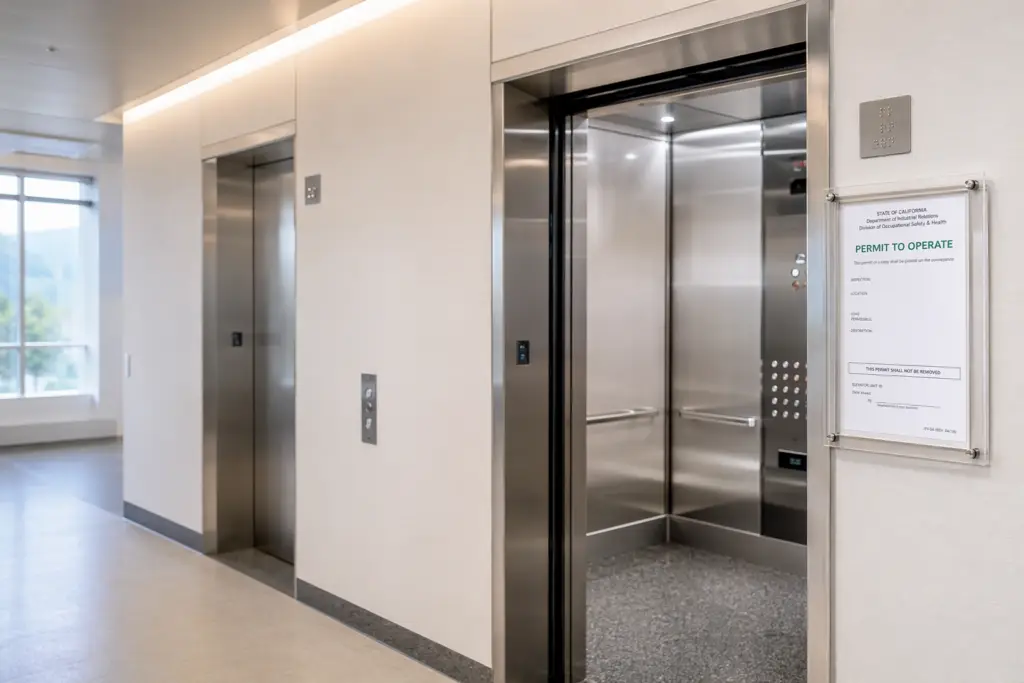
| Permit to operate posting | California Elevator Safety Orders | Must be posted conspicuously in car | Confirm permit is current before any door adjustment work |
Who is authorized to adjust elevator doors in California?
In California, only a Certified Competent Conveyance Mechanic (CCCM) working for a Certified Qualified Conveyance Company (CQCC) may maintain, repair, alter, or replace components on a conveyance — including adjusting door operator settings.
The Cal/OSHA Elevator Unit issues CCCM and CQCC certifications, which last two years and require at least eight hours of continuing education for renewal. The California Contractors State License Board (CSLB) issues the C-11 Elevator Contractor license that CQCC applicants must hold. Building managers who allow unlicensed personnel — including general maintenance staff — to adjust door settings expose themselves to regulatory penalties, liability for injuries, and potential invalidation of their permit to operate. Liftech Elevator holds the required California certifications to perform door adjustment work across Signal Hill, Long Beach, Los Angeles, and Orange County.
What symptoms indicate door closing speed needs adjustment?
Several observable signs suggest a door operator is out of optimal calibration and should be evaluated by a qualified mechanic.
- Resident complaints about being struck or startled: The most direct signal that closing speed or kinetic energy is too high, or that the door protection device is not responding correctly.
- Doors closing before passengers fully exit: Suggests dwell time is too short or the door-open button is not functioning reliably.
- Loud slam or impact noise at door closure: Indicates the closing speed is too high as the panels reach the closed position, or that the door operator’s deceleration profile needs adjustment.
- Safety edge or light curtain not reversing reliably: A protection device issue that must be addressed before or alongside any speed change.
- Doors closing slowly enough to impede throughput: Over-correction from a previous adjustment; the closing speed may have been set too conservatively.
- Inconsistent closing behavior between floors: May indicate a worn door operator, failing motor drive, or a building-level power quality issue rather than a simple calibration problem.
How long does a door speed adjustment take?
A straightforward door speed calibration on a modern variable-frequency drive door operator typically takes less than two hours, including baseline documentation, parameter adjustment, testing, and verification.
More complex work — such as replacing a door operator, upgrading a safety edge to a light curtain system, or addressing underlying mechanical wear — requires additional time and may require scheduling around building occupancy. For multi-unit residential buildings in Long Beach or Los Angeles with a single elevator serving all floors, mechanics and building managers should coordinate a maintenance window that minimizes disruption, particularly for residents with mobility needs.
Can door closing speed be adjusted differently for each floor?
On most modern microprocessor-controlled door operators, closing speed parameters apply uniformly to all floors served by that car’s door operator — the speed is a property of the car door, not an individual landing.
However, some advanced controllers allow different dwell times or open speeds at designated floors, such as a lobby floor where traffic volume is higher. If a building wants the lobby to have a longer dwell time while upper residential floors use a shorter dwell, that feature must be supported by the installed door operator’s firmware. A CCCM can review the specific controller model to determine what floor-selective adjustments are possible.
Does a slower closing door affect elevator energy consumption?
A marginally slower door cycle does increase the total time each trip takes, which can modestly reduce the number of trips per hour in a high-traffic scenario — but the direct energy consumption of the door operator motor is small relative to the hoist motor and control systems.
Extending dwell time by two or three seconds per trip is unlikely to have a measurable effect on energy bills in a residential mid-rise. Where energy efficiency is a building priority, the more impactful strategies involve hoist motor modernization, regenerative drives, or LED cab lighting upgrades rather than door timing adjustments.
What happens if a building ignores resident complaints about door speed?
Ignoring door speed complaints creates compounding risks: regulatory, liability, and practical.
From a regulatory standpoint, a door that closes with kinetic energy exceeding ASME A17.1 limits or with less than the ADA-required dwell time is a code violation. The Cal/OSHA Elevator Unit can suspend a building’s permit to operate, which legally prohibits the elevator from being used until the deficiency is corrected. In a multi-story residential building, that outcome significantly impacts tenant quality of life and can create legal exposure for the property owner.
From a liability standpoint, documented resident complaints about door speed that are not addressed create a paper trail establishing that the building owner had notice of a potential hazard. If a resident is subsequently struck and injured by a door, that notice record is relevant to negligence claims.
Practically, door speed issues often reflect underlying mechanical wear — worn door rollers, failing operator drives, deteriorating safety edges — that will worsen over time if not addressed.
How does door speed relate to the annual Cal/OSHA inspection?
California law requires every conveyance to be inspected at least once a year by a State of California safety engineer or a Certified Competent Conveyance Inspector (CCCI), with the building owner responsible for arranging that inspection.
Door operation — including closing speed, kinetic energy, dwell time, and door protection device function — is a standard component of the annual inspection. An inspector who finds door parameters outside code limits can note deficiencies that must be corrected before or as a condition of issuing a renewed permit to operate. Proactively having door speed evaluated and adjusted by a CQCC before the annual inspection reduces the risk of a failed inspection and the delays that come with remediation under a deadline.
Cal/OSHA may issue a permit to operate for up to two years — rather than the standard one year — for an elevator in safe condition that is covered by a full maintenance contract with a C-11 licensed elevator company. Buildings that maintain a full maintenance contract with Liftech Elevator as their CQCC have a structured mechanism for catching and correcting door speed issues between annual inspections.
What is the difference between door closing speed and door closing force?
Speed and force are related but distinct parameters, and both must be within code limits independently.
Closing speed refers to how fast the door panel travels from fully open to fully closed, typically measured in feet per second. Closing force refers to the static force the door exerts when it meets an obstruction on its leading edge, measured in pounds-force (lbf). The ADA limits leading-edge closing force to five pounds maximum. ASME A17.1 caps kinetic energy, which is a function of speed and mass. A door can be traveling at an acceptable average speed but still exert excessive leading-edge force if the door operator’s torque settings are too high — meaning both parameters must be measured and verified independently during any calibration procedure.
Are older elevators in Long Beach and Los Angeles subject to the same door standards?
Existing elevators in California are subject to the edition of ASME A17.1 that was adopted at the time of their installation or last material alteration, administered through Cal/OSHA’s Elevator Safety Orders.
California adopted the ASME A17.1/CSA B44 2004 edition as its Group IV Elevator Safety Orders, effective May 1, 2008, for installation contracts signed on or after that date. Older elevators may be governed by an earlier edition under ASME A17.3 Safety Code for Existing Elevators and Escalators, which establishes retrofit standards. The ADA requirements for door dwell time and closing force apply regardless of the elevator’s age if the building is subject to ADA accessibility obligations. Building owners with pre-2008 equipment in Long Beach, Los Angeles, or Orange County should have a CQCC evaluate which edition governs their specific installation and what door-related retrofit requirements may apply.
As of 2026, California has proposed a Group V update to its Elevator Safety Orders that would incorporate elements of ASME A17.1-2019; a public hearing was held on June 18, 2026, but no effective date has been posted. Building owners should monitor Cal/OSHA for updates.
What should a building manager do when residents report elevator door problems?
A structured response protects residents, documents the building’s diligence, and ensures corrective work is performed by authorized personnel.
- Log the complaint in writing. Record the date, resident name, floor, time of incident, and description of the door behavior. Written documentation establishes the building’s response timeline.
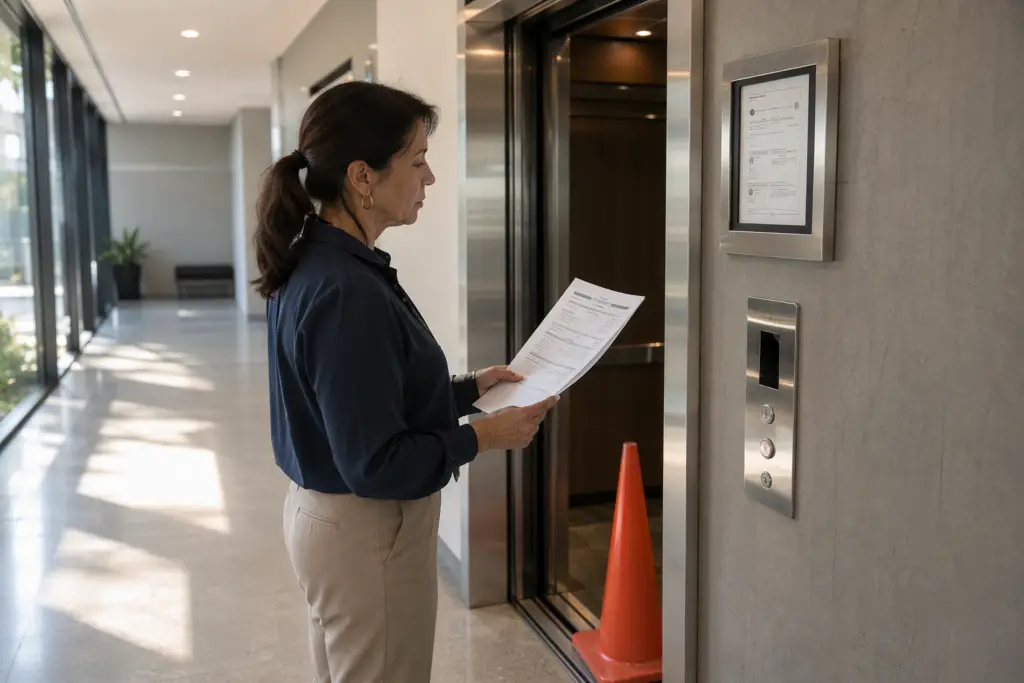
- Conduct an immediate visual check. Building staff can observe the door’s behavior without touching any mechanical components — note whether the door protection device appears to function (reversal on obstruction), whether the door slams closed, and whether the dwell time appears shorter than three seconds.
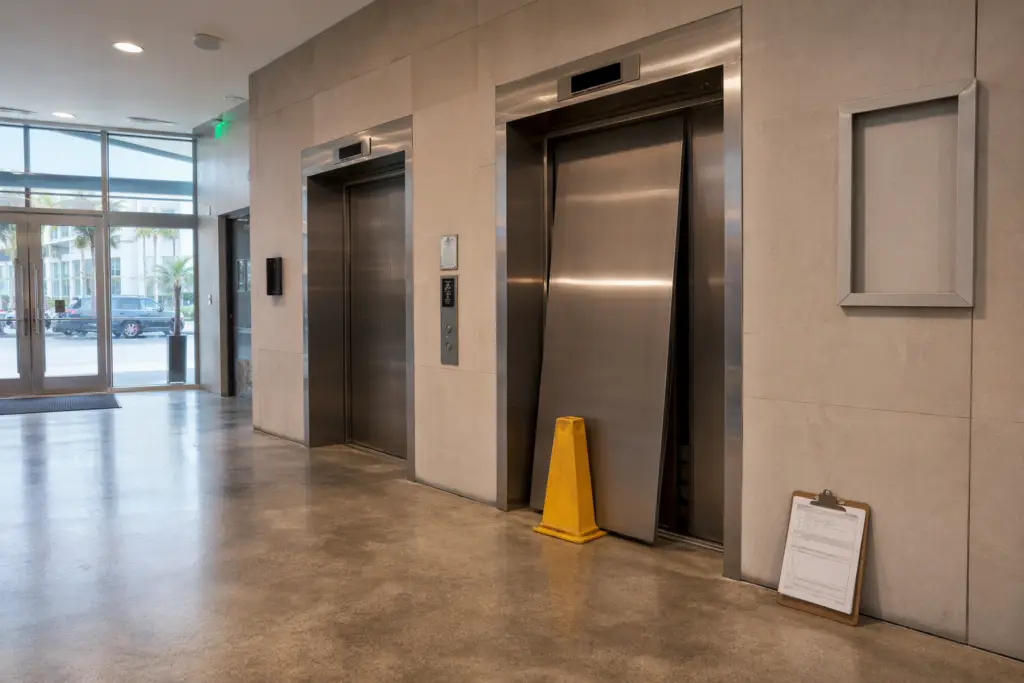
- Post a notice if the door appears unsafe. If the door is striking passengers or the protection device appears non-functional, the safest response is to post an out-of-service notice and contact a CQCC immediately. Operating an unsafe elevator risks injury and regulatory action.
- Contact a California-certified CQCC. Request a service call specifically for door calibration and safety device inspection. Provide the complaint log to the mechanic.
- Obtain a written adjustment report. After service, the CQCC should provide documentation of adjusted parameters, test results, and confirmation of ASME and ADA compliance.
- Notify residents of the correction. A brief notice to the building confirms the issue was taken seriously and resolved, which supports resident trust and reduces repeat complaints.
- File documentation with your maintenance records. Retain the service report alongside the elevator’s permit to operate, inspection certificates, and maintenance log for Cal/OSHA inspection purposes.
How often should door speed and timing be checked as part of routine maintenance?
Door operator calibration should be verified at every scheduled preventive maintenance visit, not only when residents report problems.
Door systems are among the most mechanically active components in an elevator — every trip involves a full open-and-close cycle, meaning door operator components accumulate wear faster than most other elevator parts. Door rollers, operator belts or chains, safety edge seals, and motor drive components all degrade over time, and degraded components can cause closing speed to drift outside calibrated settings even without any change to the controller’s programmed parameters. Regular verification by a CCCM catches drift before it rises to the level of a resident complaint or a code violation at annual inspection. Liftech Elevator includes door operation verification as a standard component of its preventive maintenance visits across Signal Hill, Long Beach, Los Angeles, and Orange County.
When is it time to replace the door operator rather than adjust it?
Recalibration addresses software and minor mechanical drift; it cannot compensate for a door operator that is mechanically worn out or technologically obsolete.
Signs that replacement rather than adjustment is warranted include:
- Closing speed that cannot be held within calibrated limits between maintenance visits, indicating worn mechanical components rather than a parameter issue.
- A door operator model for which replacement parts are no longer manufactured or available, making reliable repair impossible.
- A contact-only safety edge system on an older unit where upgrading to a light curtain would require a new door operator to support the device.
- Repeated nuisance trips of door protection devices caused by an operator that cannot maintain consistent speed profiles, triggering false reversals on every cycle.
- A door operator predating modern VFD technology, where energy efficiency and ride quality improvements from a modern unit justify replacement ahead of end-of-life failure.
Liftech Elevator can evaluate whether door operator replacement is necessary and, if so, manage the Cal/OSHA permit process and inspection coordination required for that material alteration in California.
What questions should building managers ask a prospective elevator service company about door adjustments?
Selecting a qualified service provider for door calibration work in California requires asking the right verification questions before authorizing any work.
- Are you certified by Cal/OSHA as a Certified Qualified Conveyance Company (CQCC)? This certification is legally required to perform any maintenance or adjustment work on California elevators.
- Do your mechanics hold current CCCM certification? Individual mechanics must be certified by Cal/OSHA, with certificates renewed every two years including continuing education.
- Do you hold a current C-11 Elevator Contractor license from the CSLB? This license is a prerequisite for CQCC certification.
- Will you provide a written report of adjusted parameters and compliance verification after the service? Documentation is essential for maintenance records and Cal/OSHA inspections.
- If the work constitutes a material alteration, will you manage the Cal/OSHA permit application? The building owner is responsible for ensuring permits are in place before material alterations begin.
- Do you service my equipment brand and door operator model? Door operator calibration procedures vary by manufacturer; experience with the specific equipment matters.
Liftech Elevator serves building owners and property managers across Signal Hill, Long Beach, Los Angeles, and Orange County with the California certifications required by law to perform door speed adjustment and all related elevator maintenance work.
Contact Liftech Elevator for a free elevator assessment at 562-997-3639.
Need elevator service you can rely on? Liftech Elevator is ready to help.