Building owners and facility managers in Signal Hill, Long Beach, Los Angeles, and Orange County frequently discover this distinction only after receiving an unexpected invoice. Understanding exactly what a maintenance contract covers — and what it does not — before an urgent situation arises is essential to budgeting accurately and keeping a newly installed elevator running without interruption. The 20 questions below cover every dimension of this topic, from contract language and California regulatory requirements to practical steps building owners should take the moment a new elevator develops a problem.
What does a standard elevator maintenance contract typically cover for a newly installed elevator?
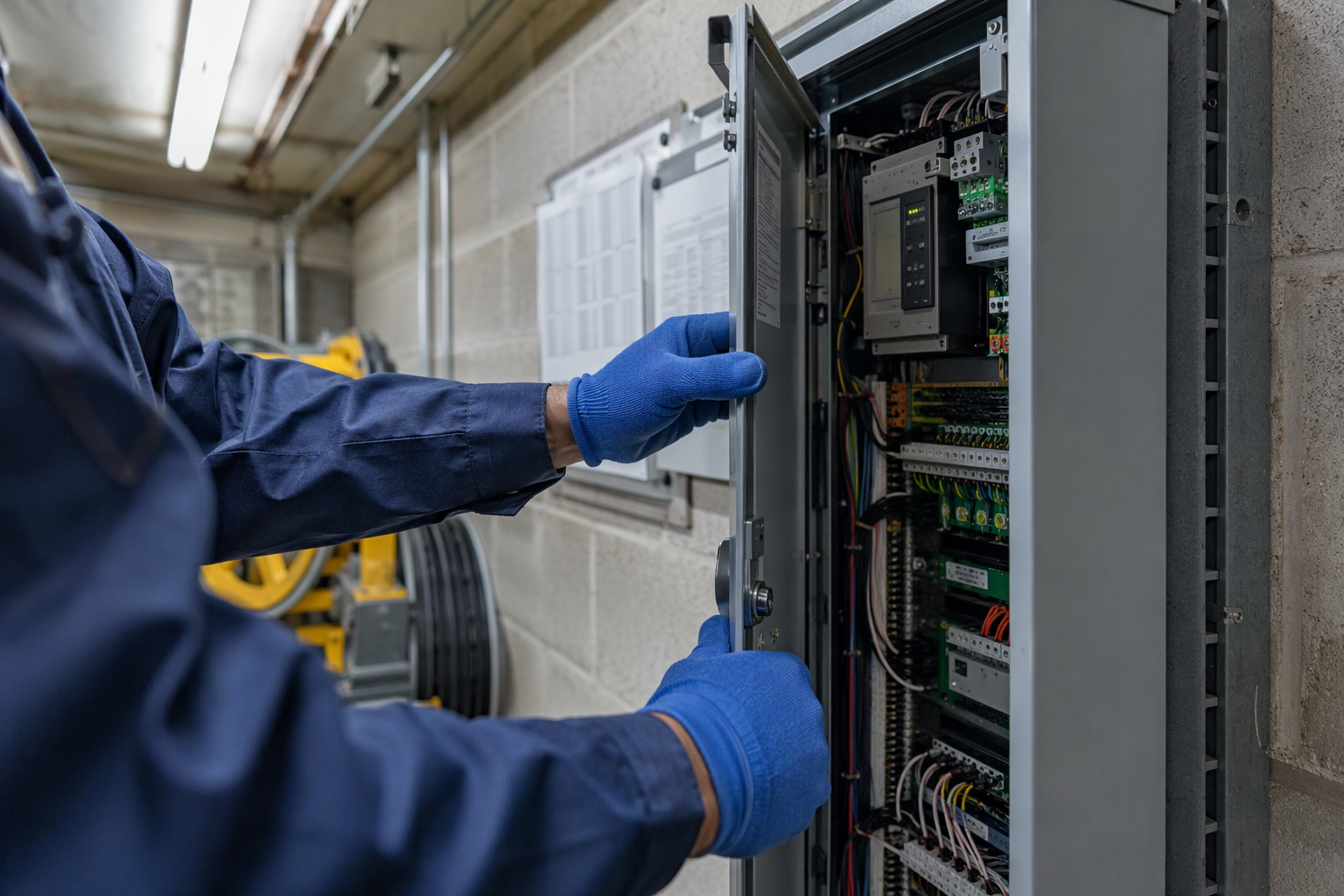
A standard full-maintenance elevator contract generally covers routine lubrication, adjustment, parts replacement due to normal wear, and scheduled periodic callbacks — but it does not automatically cover every urgent or after-hours service visit.
Most elevator maintenance agreements are structured around predictable, scheduled labor. A technician visits the equipment on a defined schedule — commonly monthly or quarterly — to lubricate moving parts, test safety devices, adjust door operators, and verify that the elevator continues to meet the requirements of the ASME A17.1/CSA B44 Safety Code for Elevators and Escalators. Within those visits, any adjustments or minor part replacements discovered during the inspection are usually included in the flat monthly fee.
Urgent or unscheduled visits — meaning a technician dispatched outside the normal scheduled cycle because the elevator has stopped working or trapped a passenger — may fall into a separate category labeled “callback” or “emergency call” service. Whether those callbacks are included in the monthly rate or billed at a separate hourly rate is determined by how the contract was drafted, not by any default industry standard.
Why does the billing distinction matter more for newly installed elevators than for older ones?
A newly installed elevator is simultaneously covered by multiple overlapping documents — the installation warranty, the manufacturer’s parts warranty, and the maintenance agreement — and each document controls different costs, so a service visit may be chargeable under one document even when it appears to be “covered” under another.
When an older elevator requires an urgent visit, the question is usually simple: is the work inside or outside the maintenance contract? For a new elevator, a third variable appears: the installation warranty. If a component fails because of an installation defect, the installing contractor may be obligated to correct it at no charge — but that obligation runs between the building owner and the installing contractor, not between the building owner and the ongoing maintenance company. If the maintenance company dispatches a technician and performs repairs, that work may still be invoiced, leaving the building owner to seek reimbursement from the installing contractor separately.
California law requires that any company maintaining an elevator hold both a C-11 Elevator Contractor license from the California Department of Industrial Relations, Cal/OSHA Elevator Unit, and certification as a Certified Qualified Conveyance Company (CQCC). Confirming that the maintenance company and the installing contractor are legally distinct entities — or the same entity — clarifies which warranty or contract governs any given urgent visit.
What contract language should building owners look for before signing a maintenance agreement on a new elevator?
Building owners should look specifically for the definitions of “callback,” “emergency service,” “after-hours labor,” and “exclusions” — these four clauses determine whether an urgent visit is free or billable.
The callback clause defines what triggers a covered return visit. Some contracts limit covered callbacks to failures that result from defective maintenance work performed by the contractor. Others include any unscheduled visit during normal business hours but exclude evenings, weekends, and holidays. A well-negotiated contract will specify a number of included callbacks per year and define exactly what hours are considered standard versus premium.
Exclusions matter equally. Common exclusions include damage caused by vandalism, flooding, power surges, misuse by building occupants, or acts outside the contractor’s control. If a newly installed elevator door is damaged by a delivery dolly on day 10 of operation, the emergency visit to restore service is almost certainly billed separately regardless of what the maintenance agreement says about covered callbacks.
Liftech Elevator recommends that building managers in Long Beach, Los Angeles, Signal Hill, and Orange County request a written summary of callback coverage as a standalone exhibit to any maintenance contract, separate from the main agreement body, so the terms are unambiguous and easy to reference when an urgent situation occurs.
Does California law require any specific coverage terms in elevator maintenance contracts?
California law does not mandate specific coverage terms within private maintenance contracts, but it does impose strict requirements on who may perform maintenance work and what credentials they must hold.
Under California Labor Code Sections 7300–7324.2 and the California Code of Regulations, Title 8, Elevator Safety Orders, every company that installs, alters, maintains, or repairs an elevator in California must be certified by Cal/OSHA as a Certified Qualified Conveyance Company (CQCC). Every individual technician performing unsupervised work must be certified as a Certified Competent Conveyance Mechanic (CCCM). These credentials must be renewed every two years and require at least eight hours of continuing education per renewal cycle.
These requirements mean that if an elevator owner hires a non-credentialed contractor to handle an urgent service visit in order to avoid a billable charge from the primary maintenance company, that work is illegal under California law, may void the elevator’s permit to operate, and could expose the building owner to liability. The only legal path for urgent elevator work in California is a CQCC-certified company dispatching CCCM-certified mechanics.
Additionally, Cal/OSHA may issue a permit to operate for up to two years — rather than the standard one year — when an elevator is covered by a full maintenance contract with a C-11 licensed elevator company. This two-year permit benefit is a tangible financial and administrative incentive for building owners to maintain a qualified full-service maintenance relationship rather than relying on ad-hoc, separately billed service calls.
What happens to the Cal/OSHA permit to operate if an urgent repair is performed by an uncertified technician?
An elevator’s permit to operate can be invalidated if maintenance or repair work is performed by a person or company that is not certified under California’s elevator laws, potentially forcing the elevator out of service until Cal/OSHA re-inspects and re-issues the permit.
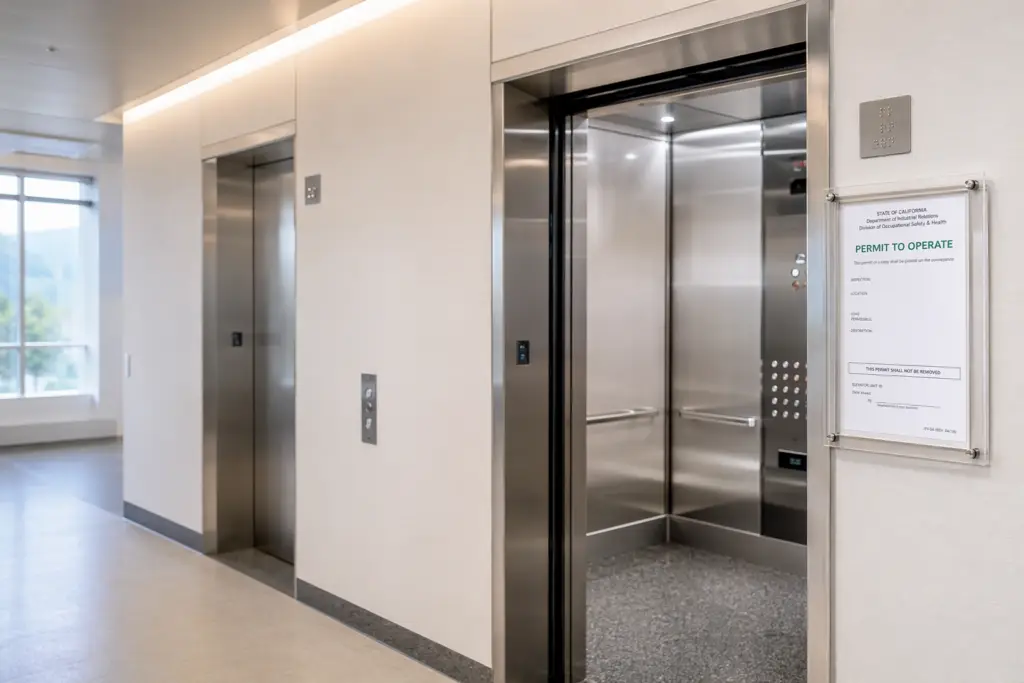
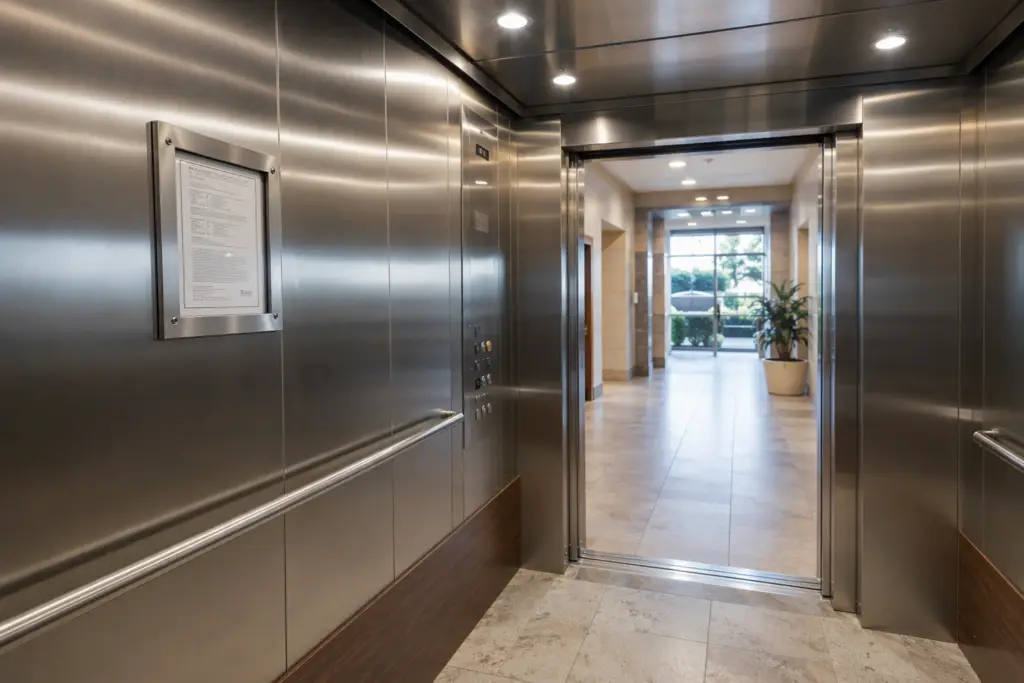
California requires that no elevator may be operated without a valid, current permit to operate issued by Cal/OSHA. That permit must be posted conspicuously inside the elevator car. Each new elevator must be inspected by Cal/OSHA and receive a permit before it is placed in service. When a material alteration or significant repair is made, a new permit may be required before the elevator resumes operation.
For building owners managing newly installed elevators in Los Angeles, it is important to note that Los Angeles operates its own elevator and conveyance inspection program through the Los Angeles Department of Building and Safety (LADBS), which may impose additional local requirements. Building managers should confirm with LADBS whether a post-repair inspection is required locally in addition to Cal/OSHA’s state-level process.
How does the installer’s warranty interact with the maintenance contract during an urgent service call on a new elevator?
The installer’s warranty and the maintenance contract are separate legal documents with separate obligations, and an urgent service call may trigger cost-sharing disputes between the installing contractor and the maintenance company unless both roles are held by the same entity.
A new elevator installation typically carries a workmanship warranty from the installing contractor covering defects in labor and materials for a defined period — often one year from commissioning, though the specific term is negotiated. A separate manufacturer’s warranty covers the elevator components themselves. The monthly maintenance contract, meanwhile, covers ongoing preventive care and certain types of unscheduled service.
If an urgent service visit is required because a component failed due to an installation defect, the building owner is entitled to pursue the installer under the workmanship warranty. However, if the maintenance company performs the emergency repair, it will typically invoice for that work and expect the building owner to seek reimbursement from the installer. Building owners should obtain written confirmation from the installing contractor about the warranty claims process before an urgent event occurs, not after.
What is the difference between a “full maintenance” contract and a “lubrication and examination” contract, and does it affect urgent service billing?
A full maintenance contract includes parts and labor for covered repairs, while a lubrication and examination (L&E) contract covers only routine servicing — meaning any urgent service visit under an L&E contract will almost always be billed separately at time-and-materials rates.
| Contract Type | Routine Scheduled Visits | Callbacks During Business Hours | After-Hours Emergency Visits | Parts Replacement | Major Component Repair |
|---|---|---|---|---|---|
| Full Maintenance | Included | Often included (up to a defined limit) | Varies — often extra charge or limited hours | Included (wear parts) | Often included with exclusions |
| Lubrication & Examination (L&E) | Included | Billed separately | Billed separately | Billed separately | Billed separately |
| Parts & Labor (Partial) | Included | Included during standard hours | Billed separately or at premium rate | Covered up to defined value | Often excluded or capped |
| Inspection-Only | Inspection only | Not covered | Not covered | Not covered | Not covered |
Building owners with newly installed elevators who sign an L&E contract to reduce monthly costs should understand that every urgent service call will generate a separate invoice. Over the life of a new elevator — which typically experiences a “settling in” period during which minor adjustments are frequently needed — those separate billings can exceed the premium cost of a full maintenance contract.
Liftech Elevator advises building owners in Signal Hill and Orange County to evaluate the total expected cost of service over the first two years of elevator operation, not just the monthly maintenance line item, when choosing between contract types.
What typically triggers an urgent service visit on a newly installed elevator?
Newly installed elevators most commonly require urgent service visits due to door operator calibration issues, leveling irregularities, control system parameter adjustments, and component commissioning errors — all of which are often addressed under warranty rather than the maintenance contract.
No matter how carefully an elevator is commissioned before the Cal/OSHA permit is issued, real-world traffic patterns, building settling, temperature variation, and load cycling can expose adjustment needs within the first weeks of operation. Door operators that functioned correctly during low-traffic commissioning testing may drift out of calibration under sustained daily use. Drive control parameters set during installation may need fine-tuning once actual load profiles are established.
These “early life” service needs are distinct from failures caused by component defects or maintenance lapses. The key billing question is whether the maintenance contract treats early-life adjustment calls as covered callbacks or as billable time-and-materials work. In well-drafted contracts, an initial “settling in” period — sometimes 90 days — is explicitly addressed, with callbacks during that window either covered by the installing contractor or by a reduced-rate provision in the maintenance agreement.
What should a building owner do immediately when a newly installed elevator requires urgent service?
A building owner should follow a structured sequence of steps to protect safety, preserve warranty rights, and avoid being billed for work that should be covered under the installation warranty or the maintenance contract.
- Secure the elevator and notify occupants. If the elevator has stopped or poses a safety concern, place the elevator out of service by locking the access panel or posting signage. Never attempt to free trapped passengers personally — contact the elevator service company immediately.
- Contact the maintenance company and document the call. Report the malfunction in writing (email or text) in addition to calling, so there is a timestamped record of when the issue was reported and what was described.
- Reference your contract before authorizing work. Ask the dispatcher explicitly whether the visit will be covered under the monthly maintenance charge or billed as an extra. Request written confirmation of the billing classification before the technician arrives.
- Notify the installing contractor simultaneously if the elevator is under warranty. Send a written notice describing the malfunction to the installer so the warranty claim clock is preserved. Do not wait for the maintenance company to attribute fault.
- Confirm that the responding technician holds CCCM certification. Under California law, only a Certified Competent Conveyance Mechanic employed by a CQCC-certified company may perform the repair. Ask for credentials if there is any uncertainty.
- Obtain a written service report after the visit. The report should describe the cause of the malfunction, the corrective action taken, and whether any parts were replaced. This record is essential if a warranty dispute arises later.
- Confirm the elevator’s permit to operate remains valid after any repair, particularly if components were replaced. If Cal/OSHA determines that a material alteration was made, a new inspection may be required before the elevator can be returned to service.
Are after-hours emergency calls ever included in a standard monthly maintenance fee?
After-hours emergency calls are rarely included as standard in a base monthly maintenance fee; they are more commonly addressed through a premium callback provision, an annual callback allowance, or a separately negotiated after-hours rate rider.
Elevator maintenance contracts frequently distinguish between “standard business hours” callbacks and “emergency” or “after-hours” callbacks. Some contracts include a fixed number of covered callbacks per year at no additional charge, then bill beyond that threshold. Others include callbacks during weekday business hours but charge a premium multiplier for evenings, weekends, and holidays.
For building owners of newly installed elevators where urgent visits may be more frequent during the settling-in period, negotiating an explicit after-hours callback provision upfront is advisable. The alternative — discovering after the fact that a Saturday night callback billed at premium rates is not covered by the monthly fee — creates friction, delays, and budget surprises.
How does the Cal/OSHA permit to operate for a new elevator affect the timeline for urgent repairs?
California law requires that each new elevator receive a Cal/OSHA permit to operate before it is placed in service, and certain urgent repairs may require a follow-up inspection before the elevator can legally resume operation, adding time to the resolution.
Under the California Code of Regulations, Title 8, Elevator Safety Orders, a permit from Cal/OSHA is required before a conveyance is erected, installed, or materially altered. If an urgent service visit involves the replacement of a major component or a modification that Cal/OSHA classifies as a material alteration, the elevator may not legally resume operation until a state safety engineer or a Certified Competent Conveyance Inspector (CCCI) performs a new inspection and issues an updated permit.
This regulatory timeline is separate from the contractual billing question but is directly relevant to how quickly a building owner can restore service. Working with a CQCC-certified maintenance company that has established relationships with Cal/OSHA inspectors helps streamline the inspection scheduling process.
What should building owners in Los Angeles specifically know about urgent elevator service on new installations?
Building owners in Los Angeles should be aware that the City of Los Angeles operates its own elevator and conveyance inspection program through the Los Angeles Department of Building and Safety (LADBS), which may impose requirements beyond the state-level Cal/OSHA process.
Because Los Angeles has its own program, building owners should confirm directly with LADBS whether local permits, inspections, or notifications are required when a newly installed elevator undergoes urgent repair. Maintenance contracts that are silent on local AHJ (Authority Having Jurisdiction) requirements may leave building owners responsible for local compliance steps even when the statewide Cal/OSHA requirements are fully met.
Liftech Elevator serves the Los Angeles market and is familiar with the local regulatory environment, which helps building owners navigate both the Cal/OSHA state process and any applicable LADBS local requirements when urgent service situations arise.
Can a building owner negotiate a “new elevator period” in the maintenance contract to address the higher likelihood of early service calls?
Yes — building owners can and should negotiate a “new installation period” or “commissioning period” clause that explicitly addresses callback coverage, billing rates, and coordination with the installing contractor for the first three to twelve months of elevator operation.
This type of clause acknowledges that newly installed elevators statistically require more adjustments and callbacks than fully run-in equipment. By defining how those early visits are handled — including who bears the cost when the root cause is an installation deficiency versus a maintenance issue — the clause prevents disputes and ensures that the building owner is not absorbing costs that rightfully belong to the installing contractor.
Key elements to negotiate in a new installation period clause include: the duration of the period, the number of included callbacks, the process for attributing a callback to the installation warranty versus normal maintenance, and the documentation required to support a warranty reimbursement claim. Building owners should have legal counsel review this language alongside the installation contract to ensure the two documents are consistent.
How does ASME A17.1 inform what constitutes an “urgent” elevator condition requiring immediate service?
The ASME A17.1/CSA B44 Safety Code for Elevators and Escalators defines safety requirements and test standards that implicitly identify conditions under which an elevator must be taken out of service immediately and cannot be returned to operation without corrective action.
California’s elevator safety orders have adopted the ASME A17.1/CSA B44, 2004 edition, for installations with contracts signed on or after May 1, 2008. Under these standards, certain conditions — such as failure of door interlock systems, abnormal leveling deviation beyond defined tolerances, or safety circuit faults — represent conditions under which continued elevator operation poses a hazard. When a newly installed elevator develops any such condition, the maintenance contractor is both technically and legally obligated to respond urgently, regardless of whether the billing terms classify that visit as covered or separate.
California is currently in the process of proposing a Group V update to its Elevator Safety Orders that would incorporate elements of ASME A17.1-2019. As of 2026, the Standards Board held a public hearing on this proposed update on June 18, 2026, and no effective date has been posted. Building owners and maintenance companies should monitor the Cal/OSHA Elevator Unit for updates.
What documentation should be maintained after every urgent service visit on a new elevator?
Building owners should maintain a complete file for each urgent service visit that includes the initial trouble report, the technician’s service report, parts replaced, labor time, the billing classification, and any communication with the installing contractor about warranty attribution.
This documentation serves multiple purposes. First, it creates the evidence trail needed if a warranty dispute escalates to mediation or litigation. Second, it supports the building owner’s position in any Cal/OSHA inspection that the elevator has been properly maintained by a qualified company. Third, it provides the maintenance company with a service history that helps identify patterns — repeated urgent calls for the same type of issue on a new elevator are a strong indicator of an installation deficiency that should be charged back to the installer rather than absorbed by the maintenance budget.
California law requires that arranging annual reinspection is the elevator owner’s responsibility. Maintaining accurate service records helps building owners demonstrate to Cal/OSHA that the elevator has been kept in compliance between inspection cycles.
How do ADA requirements affect the urgency of restoring a newly installed elevator to service?
Under the Americans with Disabilities Act (ADA), elevators are frequently a primary means of accessible vertical access in multi-story buildings, and an extended outage may constitute a failure to maintain accessible features in operable condition, creating compliance exposure for the building owner.
The ADA requires that covered entities maintain accessible features in working condition. When a newly installed elevator — which is likely the designated accessible route in the building — goes out of service, the building owner faces both a practical disruption for occupants who depend on that access and a potential compliance issue. While the ADA does not set a specific maximum outage duration, regulators and courts have held that prompt action to restore service is required.
This ADA dimension adds urgency to the billing question: even if a building owner disputes whether an urgent visit is covered by the maintenance contract, the cost of delay — both in human impact and compliance risk — typically outweighs the disputed invoice amount. Engaging a maintenance company with the capacity to respond promptly is therefore a compliance consideration, not just a convenience.
What are common exclusions in elevator maintenance contracts that affect urgent service billing on new equipment?
The most common exclusions in elevator maintenance contracts that result in separate billing for urgent service visits include vandalism damage, power quality issues, flooding, misuse by building occupants, structural building defects, and repairs to components still covered by the manufacturer’s warranty.
Each of these exclusions reflects a category of damage or failure that the maintenance contractor considers outside the scope of normal wear and tear. For newly installed elevators, the manufacturer’s warranty exclusion deserves particular attention: if a component fails and the maintenance contractor determines it is a manufacturing defect, the contractor may decline to replace it under the maintenance contract and instead direct the building owner to file a manufacturer’s warranty claim — leaving the elevator out of service while that claim is processed.
Building owners can protect themselves by ensuring that the maintenance contract and the manufacturer’s warranty contain compatible language about how defective components are identified, who bears the cost of labor to replace a defective part under warranty, and what the process is for disputed attributions. A maintenance company may cover labor to remove and reinstall a defective part while the manufacturer covers the part itself — but this arrangement must be explicitly stated in the contract.
Should building owners consider a separate elevator breakdown insurance policy alongside a maintenance contract?
Elevator breakdown insurance — also called equipment breakdown or boiler and machinery insurance — can cover costs that fall outside both the maintenance contract and the installation warranty, including emergency repair labor, temporary lift rental, and consequential business interruption losses from an extended outage.
For newly installed elevators in commercial or multi-unit residential buildings in Los Angeles, Long Beach, Signal Hill, and Orange County, the financial exposure from an extended elevator outage can be significant. Property insurers increasingly offer equipment breakdown endorsements that cover sudden and accidental breakdown of mechanical and electrical equipment, including elevator drive systems, control panels, and hydraulic components.
This coverage is separate from the maintenance contract and does not replace it. Rather, it fills the financial gap created by urgent service events that fall into the billing “gray area” — visits that the maintenance company bills as separate but that the building owner believes should be covered. Building owners should consult their property insurance broker to understand whether elevator breakdown coverage is available as an endorsement to their existing commercial property policy.
How should building owners evaluate whether an elevator maintenance company’s contract terms are reasonable for new installations?
Building owners should evaluate maintenance contract terms for new elevator installations by comparing the callback coverage definition, the after-hours policy, the parts coverage scope, the warranty coordination clause, and the termination provisions — not just the monthly fee.
A common mistake is selecting a maintenance contractor based primarily on the lowest monthly fee without analyzing how urgent service events will be billed. A contract with a low monthly fee but no included callbacks, premium after-hours rates, and narrow parts coverage can cost substantially more over the first two years of operation on a new elevator that is still being adjusted and tuned.
Liftech Elevator works with building owners across Signal Hill, Long Beach, Los Angeles, and Orange County to structure maintenance agreements that account for the realistic service needs of newly commissioned elevator equipment, with clear contract language about callback coverage, warranty coordination, and emergency response billing so that building owners are never surprised by an unexpected invoice after an urgent service event.
What steps should a building owner take before the new elevator’s first annual Cal/OSHA reinspection to ensure compliance and minimize urgent service risk?
Before the first annual reinspection, building owners should verify that all urgent service visits have been documented, that any permit-triggering repairs have been properly inspected and cleared, and that the elevator’s maintenance log is current and accessible to the Cal/OSHA inspector.
- Confirm the permit to operate is current and posted. California law requires the permit to be displayed conspicuously inside the elevator car. Verify the permit has not been superseded by any post-repair inspection requirement.
- Review all service reports from urgent visits. Confirm that each report documents the corrective action taken and that no open deficiencies remain unresolved.
- Verify that all urgent repairs were performed by CCCM-certified mechanics. If any work was performed by uncertified personnel — including building maintenance staff — this must be disclosed and corrected before the reinspection.
- Check whether any urgent repair constituted a material alteration. If Cal/OSHA classifies a repair as a material alteration, a permit from Cal/OSHA was required before the elevator was returned to service. Confirm that this was obtained.
- Confirm the annual reinspection is scheduled. Under California law, arranging the annual reinspection is the elevator owner’s responsibility — the state does not automatically schedule it. Contact the maintenance company to confirm the inspection is on the calendar.
- Evaluate whether the maintenance contract qualifies the elevator for a two-year permit. Cal/OSHA may issue a two-year permit to operate when the elevator is covered by a full maintenance contract with a C-11 licensed elevator company. Confirm whether the current contract meets this standard.
- Engage the maintenance company for a pre-inspection walkthrough. A thorough pre-inspection check by the maintenance contractor can identify any adjustment needs before the state inspector arrives, reducing the likelihood of a deficiency citation that triggers additional urgent service work and billing.
Proper preparation for the annual reinspection is not just a compliance exercise — it is the most effective way to identify and resolve conditions that would otherwise generate urgent service calls, with their associated billing uncertainty, during the coming year of operation.
Contact Liftech Elevator for a free elevator assessment at 562-997-3639.
Need elevator service you can rely on? Liftech Elevator is ready to help.