Elevator Service in Signal, CA | Liftech Elevator
Commercial building owners in Signal, CA must navigate both federal ADA accessibility mandates and California’s elevator safety regulations to keep their elevators compliant, safe, and legally operational. Liftech Elevator helps property owners, facility managers, and commercial tenants throughout the Signal Hill and greater Los Angeles region understand what compliance requires and how to achieve it.
What Does the ADA Require for Elevators in Commercial Buildings?

The Americans with Disabilities Act (ADA) requires that elevators in commercial buildings provide accessible routes between floors when a building has more than one story. Key requirements include:
- Minimum elevator car dimensions that allow wheelchair users to enter, turn, and exit safely
- Door clear width requirements to accommodate mobility devices
- Accessible call buttons positioned at reachable heights for people who use wheelchairs
- Audible and visual floor indicators inside the car
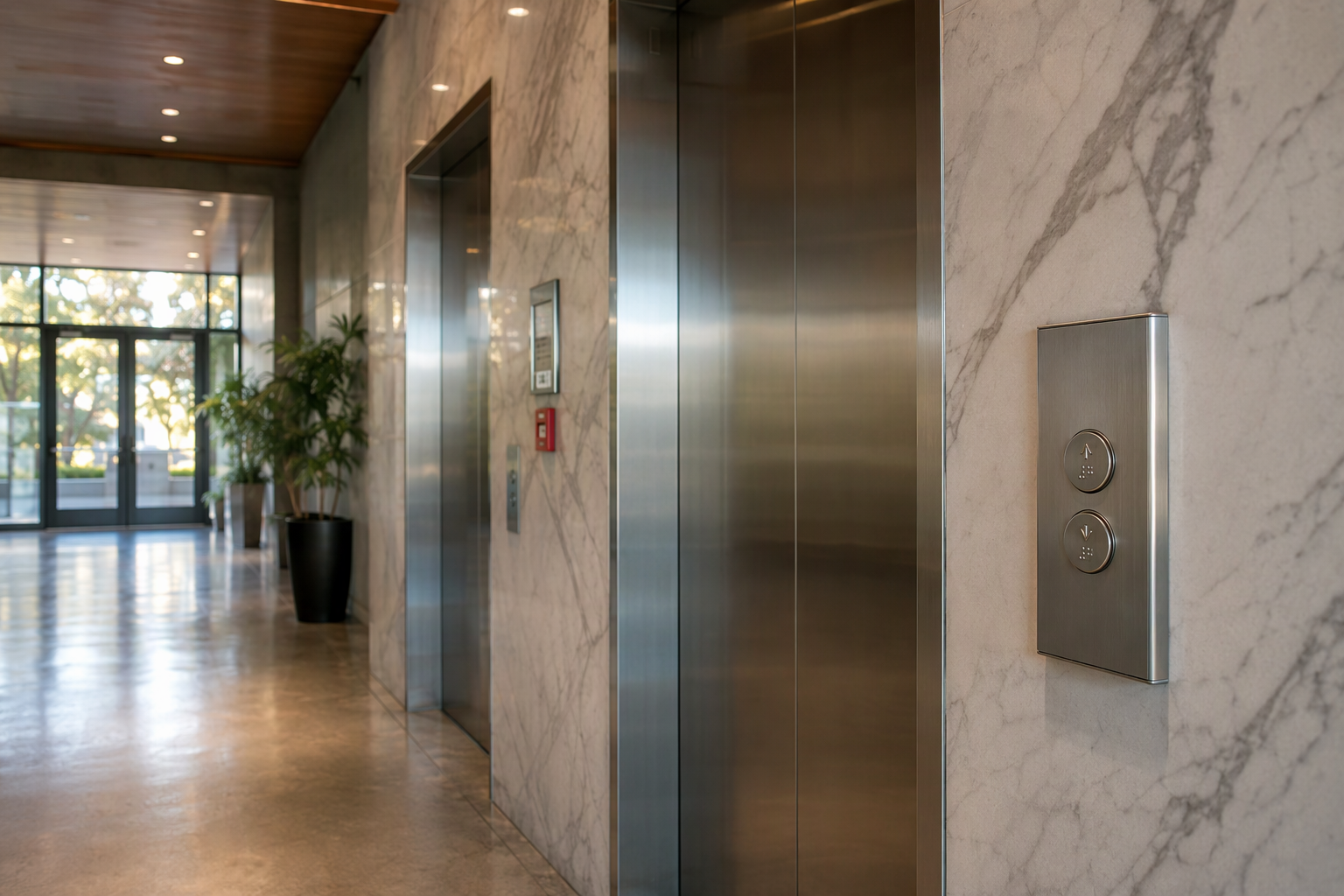
- Braille and raised character markings on control panels and landing stations
- Two-way emergency communication systems accessible to individuals with hearing or speech disabilities
- Leveling accuracy so that the elevator floor aligns with the building floor within an acceptable tolerance
The ADA Standards for Accessible Design, enforceable since 2012, provide the technical specifications that architects, contractors, and building owners must follow for new construction and alterations. Buildings undergoing renovation or alteration that affect access to a primary function area trigger path-of-travel requirements, which frequently include elevator upgrades.
Are There ADA Exemptions for Commercial Elevators?

Yes. The ADA does include limited exemptions for elevators in commercial buildings. Buildings that are fewer than three stories or have fewer than three thousand square feet per story are generally not required to install an elevator, unless the building is a shopping center, shopping mall, professional office of a healthcare provider, or a transit facility. Building owners should consult legal counsel and a qualified accessibility consultant to determine whether an exemption applies to their specific property in Signal, CA, as the exemptions are narrowly written and frequently misunderstood.
How Do California’s Elevator Safety Rules Interact with ADA Requirements?
California’s elevator safety program operates separately from federal ADA accessibility law but runs alongside it. The elevator regulator in California is the Division of Occupational Safety and Health (Cal/OSHA), Elevator Unit, California Department of Industrial Relations. Cal/OSHA administers the program under California Labor Code Sections 7300–7324.2 and the California Code of Regulations, Title 8, Elevator Safety Orders (Sections 3000–3146).
Under California law, no elevator may be operated without a valid, current permit to operate issued by Cal/OSHA. That permit must be posted conspicuously inside the elevator car. California requires every conveyance to be inspected at least once per year. When an elevator is covered by a full maintenance contract with a company holding a C-11 contractor license, Cal/OSHA may issue a permit to operate for up to two years for an elevator found to be in safe condition.
Arranging the annual reinspection is the elevator owner’s responsibility — not the service company’s. Only State of California safety engineers and Certified Competent Conveyance Inspectors (CCCI) may perform these inspections.
The technical code adopted by California is the ASME A17.1/CSA B44, 2004 edition (Group IV Elevator Safety Orders), effective May 1, 2008, for installation contracts signed on or after that date. California has proposed a Group V update that would incorporate elements of ASME A17.1-2019; the Standards Board held a public hearing on June 18, 2026, and no effective date has been posted as of 2026.
ADA compliance is enforced separately through federal civil rights law, the Department of Justice, and private litigation — not through Cal/OSHA inspections. Building owners must satisfy both frameworks independently.
What Credentials Must an Elevator Company Have to Work on Commercial Elevators in California?
California imposes strict credentialing requirements on elevator companies and the mechanics they employ. Any company that installs, alters, tests, maintains, repairs, or services elevators in California must be certified by Cal/OSHA as a Certified Qualified Conveyance Company (CQCC). To obtain CQCC certification, the company must hold a current C-11 Elevator Contractor license issued by the California Contractors State License Board (CSLB), along with certificates of workers’ compensation and liability insurance.
Individual mechanics who work on elevators without direct supervision must hold a Certified Competent Conveyance Mechanic (CCCM) credential issued by Cal/OSHA. Only a CCCM working for a CQCC-certified company may legally maintain, repair, alter, or replace components on a conveyance in California. CQCC, CCCM, and conveyance inspector certificates are valid for two years; renewal requires at least eight hours of continuing education.
Liftech Elevator operates as a Certified Qualified Conveyance Company, meeting the credential requirements California law demands for commercial elevator work in Signal and throughout the region.
What Steps Should a Commercial Building Owner Take to Achieve ADA and California Compliance?
- Conduct an accessibility audit of all vertical transportation in the building against the ADA Standards for Accessible Design to identify gaps in cab dimensions, control heights, signage, and communication systems.
- Review any planned alterations with a licensed architect or accessibility consultant to determine whether path-of-travel obligations are triggered.
- Confirm the elevator’s current permit to operate is valid and posted inside the car, as required by Cal/OSHA.
- Verify that your elevator service company holds an active CQCC certification and that the mechanics assigned to your equipment hold CCCM credentials.
- Schedule any required annual reinspection by contacting a Cal/OSHA-authorized inspector or your certified elevator service provider.
- Obtain all required Cal/OSHA permits before any installation, material alteration, or new equipment is placed in service.
- Document all maintenance, inspections, and corrective actions to demonstrate compliance during regulatory reviews or legal audits.
Does the City of Signal Have Its Own Elevator Inspection Program?
Signal Hill is a small incorporated city surrounded by the City of Los Angeles. Cal/OSHA’s Elevator Unit holds statewide jurisdiction over elevator inspections and permits to operate for most California jurisdictions. It is worth noting that the City of Los Angeles runs its own elevator and conveyance inspection program through the Los Angeles Department of Building and Safety (LADBS). Building owners with properties near or within Los Angeles should confirm which jurisdiction’s program applies to their specific address. Liftech Elevator is familiar with both the Cal/OSHA statewide process and the Los Angeles local program as they affect commercial clients in the Signal Hill area.
What Happens When an Elevator Fails an Inspection or Is Found Out of ADA Compliance?
When Cal/OSHA inspects an elevator and finds unsafe conditions, the unit may issue a correction order and withhold or revoke the permit to operate. An elevator operating without a valid permit is in violation of California law. For ADA violations, building owners may face complaints filed with the Department of Justice, private civil rights lawsuits, or demands for barrier removal. Courts and regulatory bodies look at whether the owner has a documented plan for achieving compliance and whether good-faith efforts have been made. Prompt action — including engaging a CQCC-certified service company for needed repairs and scheduling reinspection — is the most effective response to either type of finding.
How Can Liftech Elevator Help Commercial Property Owners in Signal, CA Stay Compliant?
Liftech Elevator provides commercial elevator maintenance, inspection preparation, ADA modification assessments, and repair services for properties throughout Signal Hill and the surrounding Los Angeles metropolitan area. The company serves a broad range of commercial markets including office buildings, retail centers, healthcare facilities, hospitality properties, and multi-family residential buildings. Because California’s regulatory environment is specific and consequential — wrong credentials, missed inspections, or unapproved alterations can result in permit revocation — working with a company that understands Cal/OSHA’s requirements and maintains the required CQCC certification matters significantly for commercial building owners.
Emergency elevator service is available for commercial clients who experience unexpected equipment failures, helping minimize downtime and liability exposure when elevators go out of service unexpectedly.
Schedule a free consultation with Liftech Elevator at 562-997-3639.
Need elevator service you can rely on? Liftech Elevator is ready to help.