Elevator Preventive Maintenance vs. Condition-Based Maintenance: What Each Approach Costs, How They Compare, and Which One Fits Your Commercial Building
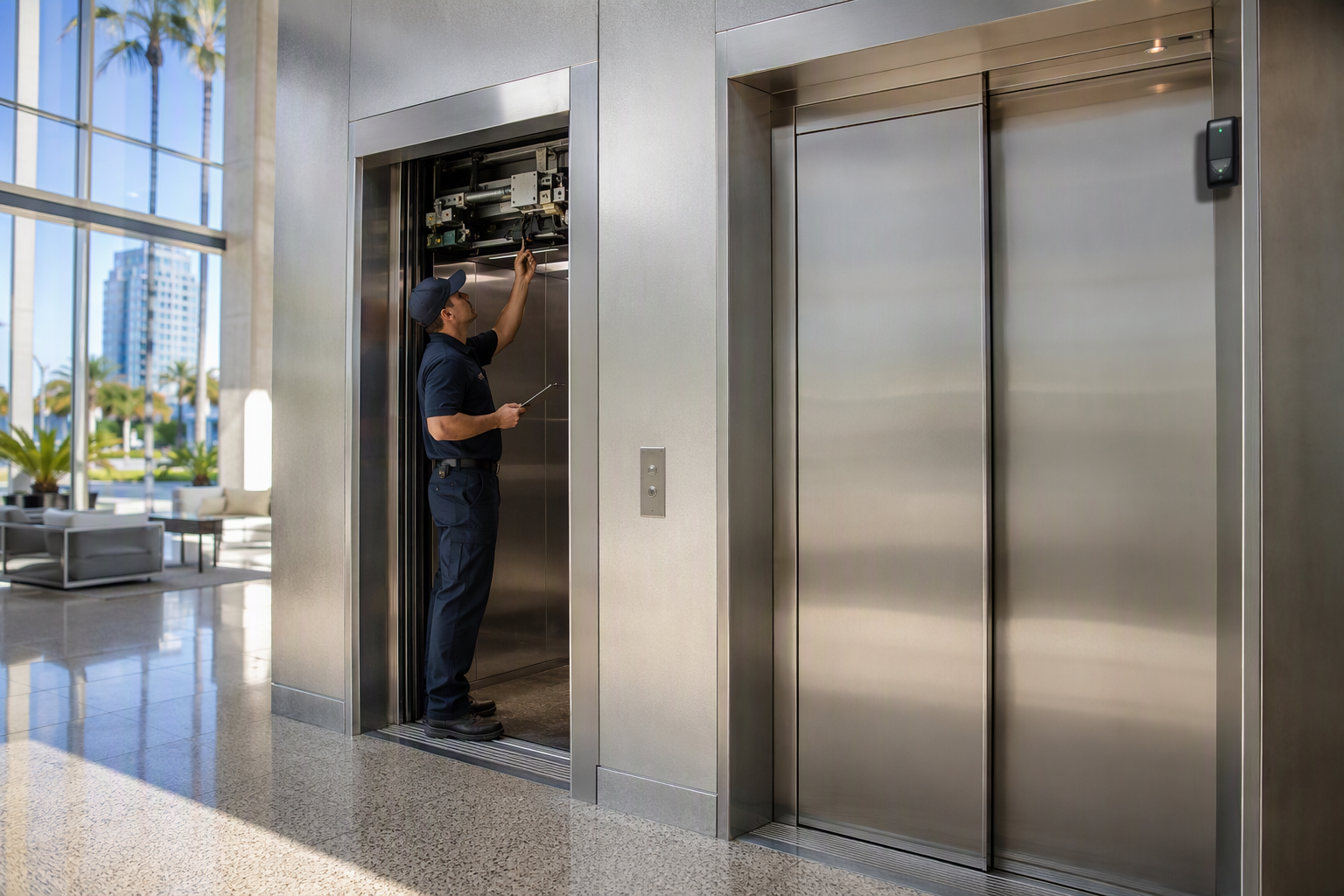
Choosing the right elevator maintenance strategy affects operational uptime, compliance with California elevator law, long-term capital costs, and passenger safety. This guide breaks down both approaches in detail, compares them side by side, and provides a clear framework for deciding which model — or which combination — is right for your commercial property in California in 2026.
What Is Elevator Preventive Maintenance?
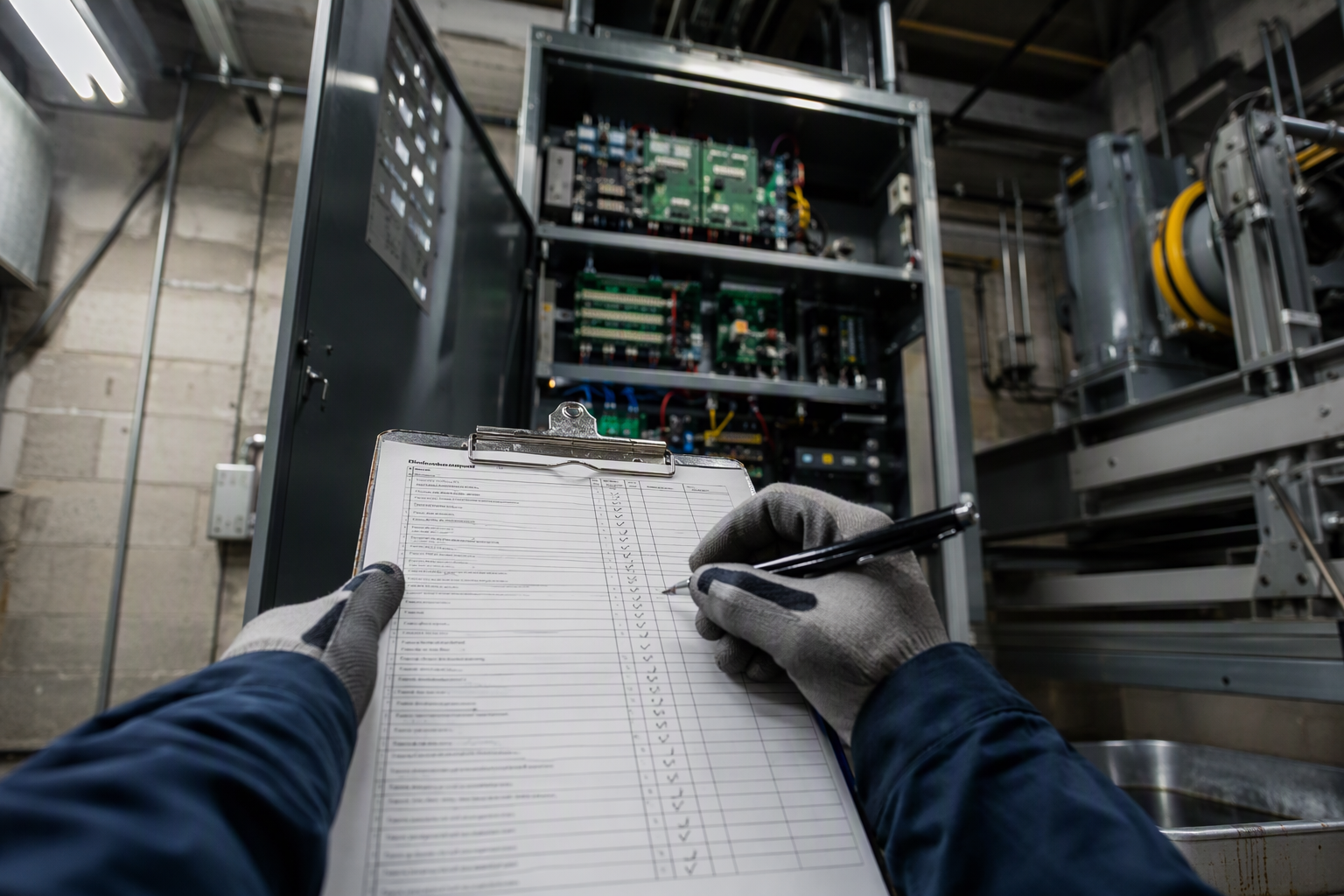
Preventive maintenance (PM) is a scheduled, time-based service approach. A certified technician visits the elevator at regular intervals — typically monthly, quarterly, or semi-annually — and performs a defined checklist of inspections, lubrication, adjustments, and parts replacements regardless of whether any problem has been detected.
Under a full preventive maintenance contract in California, the service provider takes responsibility for keeping the elevator in safe operating condition and responds to service calls between scheduled visits. This contract structure is directly recognized under California law: Cal/OSHA’s Elevator Unit may issue a permit to operate for up to two years — rather than the standard one year — for an elevator covered by a full maintenance contract with a C-11 licensed elevator company certified as a Certified Qualified Conveyance Company (CQCC).
Typical PM tasks include:
- Lubrication of guide rails, bearings, and moving parts
- Inspection and adjustment of door operators, safeties, and buffers
- Testing of brake systems and emergency devices
- Examination of ropes, cables, and sheaves
- Review of control systems and electrical connections
- Documentation of findings for compliance records
What Is Condition-Based Elevator Maintenance?
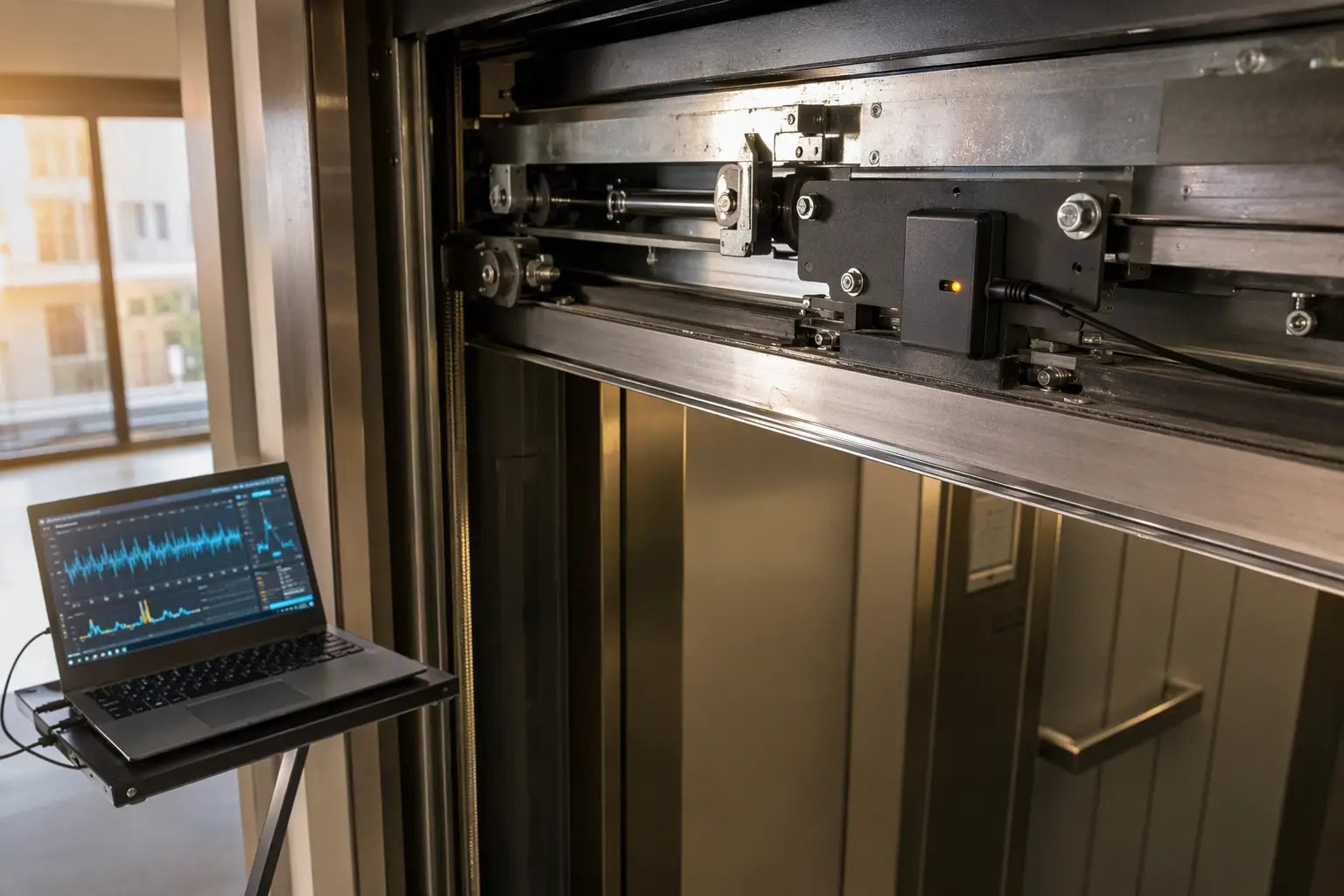
Condition-based maintenance (CBM), sometimes called predictive maintenance, uses real-time or continuous sensor data — vibration analysis, temperature monitoring, door cycle counts, motor current draw — to determine when maintenance is actually needed. Service is triggered by measured equipment condition rather than a calendar date.
Modern CBM platforms typically involve IoT sensors installed on key elevator components, cloud-based dashboards, and automated alerts sent to technicians when readings deviate from established baselines. The goal is to replace or adjust components just before they fail, rather than on a fixed schedule that may be too early (wasteful) or too late (risky).
Typical CBM capabilities include:
- Continuous monitoring of motor and drive performance
- Door operation cycle tracking and anomaly detection
- Vibration and acoustic analysis for wear detection
- Remote diagnostics and fault code logging
- Automated work-order generation based on threshold alerts
Side-by-Side Comparison: Preventive Maintenance vs. Condition-Based Maintenance
| Factor | Preventive Maintenance (PM) | Condition-Based Maintenance (CBM) |
|---|---|---|
| Service Trigger | Fixed schedule (time or usage interval) | Real-time equipment condition data |
| Upfront Investment | Low to moderate (no sensor hardware required) | Higher (sensor installation and monitoring platform) |
| Ongoing Contract Cost | Predictable monthly or annual fee | Variable; may be lower per-visit but includes software subscription |
| Parts Replacement Logic | Replaced on schedule, sometimes before failure | Replaced when condition data indicates wear |
| Unplanned Downtime Risk | Moderate — schedule may miss emerging issues | Lower — anomalies detected earlier |
| California Compliance Fit | Excellent — full PM contracts qualify for 2-year Cal/OSHA permit | Not yet specifically recognized for extended permit eligibility |
| Documentation for Cal/OSHA | Well-established paper and digital records | Rich data logs; format must be adapted for inspection requirements |
| Best For | High-traffic buildings, older equipment, strict compliance environments | Newer equipment, large portfolios, buildings with strong IT infrastructure |
| Technician Skill Requirements | CCCM-certified mechanic; standard elevator expertise | CCCM-certified mechanic plus data interpretation skills |
| Equipment Compatibility | All elevator types and ages | Best with newer microprocessor-controlled systems |
Pros and Cons Breakdown
| Preventive Maintenance | Condition-Based Maintenance | |
|---|---|---|
| Pros |
|
|
| Cons |
|
|
How Does California Law Affect Which Maintenance Model You Choose?
California’s elevator regulatory framework creates a meaningful compliance incentive for preventive maintenance contracts. Under California Labor Code Sections 7300–7324.2 and the California Code of Regulations, Title 8, Elevator Safety Orders (Sections 3000–3146), every conveyance must be inspected at least once a year by either a State of California safety engineer or a Certified Competent Conveyance Inspector (CCCI), and the owner holds responsibility for arranging that reinspection.
When an elevator is covered by a full maintenance contract with a CQCC-certified, C-11-licensed company, Cal/OSHA may extend the permit to operate for up to two years — a tangible administrative and cost benefit for building owners. As of 2026, this regulatory recognition applies specifically to full maintenance contracts; condition-based monitoring programs do not yet have an equivalent statutory pathway for extended permit eligibility under California’s current Elevator Safety Orders, which adopt ASME A17.1/CSA B44, 2004 edition.
Additionally, any company that maintains, repairs, or alters an elevator in California must be certified by Cal/OSHA as a Certified Qualified Conveyance Company (CQCC), and every mechanic working unsupervised must hold Certified Competent Conveyance Mechanic (CCCM) certification — requirements that apply equally under both maintenance models.
Note for Los Angeles property owners: The City of Los Angeles runs its own elevator and conveyance inspection program through the Los Angeles Department of Building and Safety (LADBS). Property managers in Los Angeles should confirm current program requirements directly with LADBS in addition to Cal/OSHA obligations.
Which Maintenance Model Is Better for a Commercial Building?
There is no universally superior answer — the right approach depends on building type, elevator age, portfolio size, and risk tolerance. However, several decision factors consistently point in clear directions:
Preventive maintenance is typically the stronger choice when:
- The elevator serves high passenger volumes (hospitals, office towers, hotels, retail centers)
- Equipment is older or uses relay-logic controllers not easily retrofitted with sensors
- The building owner prioritizes regulatory simplicity and the potential for a two-year Cal/OSHA permit
- Budget predictability is a priority
- The property has a single elevator or a small number of units
Condition-based maintenance adds the most value when:
- The building has a large elevator portfolio (multiple units, multiple properties)
- Elevators are newer, microprocessor-controlled systems with available sensor integration points
- The facilities team has strong IT and data management capabilities
- Long-term capital expenditure planning is a board-level priority
For most California commercial buildings in 2026, a hybrid approach is most practical: a full preventive maintenance contract forms the compliance and reliability foundation, while condition-based monitoring tools are layered on top to provide early-warning data and inform capital replacement schedules. This structure preserves the Cal/OSHA compliance benefits of a full maintenance contract while capturing the diagnostic advantages of sensor data.
What Does a Full Elevator Maintenance Contract Typically Cover?
Full maintenance contracts in California generally cover:
- All scheduled preventive maintenance visits
- Emergency and callback service
- Labor for covered repairs
- Parts replacement within defined categories
- Maintenance of records required for Cal/OSHA inspections
- Coordination support for annual or biennial inspections
Oil and grease, minor adjustments, and safety device testing are almost universally included. Coverage for major modernization components, vandalism damage, and certain proprietary parts varies by contract and provider. Building owners should review contract exclusions carefully before signing.
How Do You Switch From Preventive to Condition-Based Maintenance (or Vice Versa)?
- Audit your current equipment. Confirm the make, model, age, and controller type for every elevator. Older relay-logic systems may require sensor retrofit kits or may not be cost-effective candidates for CBM.
- Review your existing maintenance contract. Check notice-period requirements, coverage exclusions, and whether your current provider is a Cal/OSHA-certified CQCC — this is non-negotiable under California law.
- Obtain a condition assessment. Have a CCCM-certified technician inspect each unit to establish a current baseline, identify deferred maintenance items, and document any existing faults before transitioning.
- Define your monitoring scope. Decide which components will be sensor-monitored, what alert thresholds will trigger a service call, and how data will be stored and presented for Cal/OSHA documentation purposes.
- Negotiate the new contract structure. Ensure any CBM provider is a CQCC-certified company whose mechanics hold CCCM certification. Clarify how the contract addresses Cal/OSHA permit renewal obligations.
- Establish a parallel documentation system. Run both traditional maintenance logs and CBM data records during a transition period to confirm completeness before eliminating any legacy documentation.
- Notify the authority having jurisdiction (AHJ). Confirm with Cal/OSHA’s Elevator Unit — and with LADBS if the property is in Los Angeles — whether any changes to maintenance contract structure affect pending or active permits to operate.
Does Condition-Based Maintenance Eliminate the Need for Annual Cal/OSHA Inspections?
No. California law requires every conveyance to be inspected at least once a year by a State of California safety engineer or a Certified Competent Conveyance Inspector (CCCI), and these inspections are independent of whatever internal maintenance program the building owner uses. Condition-based monitoring data may support inspection readiness and help surface issues before a CCCI visit, but it does not replace the statutory inspection requirement or the Cal/OSHA permit to operate.
What Role Does ASME A17.1 Play in Both Maintenance Approaches?
The ASME A17.1/CSA B44 Safety Code for Elevators and Escalators is the foundational technical standard governing elevator design, installation, and maintenance practice across North America. California has adopted the 2004 edition of ASME A17.1 for elevators installed under contracts signed on or after May 1, 2008. Maintenance procedures — whether scheduled or condition-triggered — must conform to the applicable requirements of this standard. California has proposed a Group V update that would incorporate portions of the ASME A17.1-2019 edition; the Standards Board held a public hearing on June 18, 2026, and no effective date has been posted as of this writing.
Is Condition-Based Maintenance Recognized by ADA or OSHA at the Federal Level?
Neither the Americans with Disabilities Act (ADA) nor federal OSHA prescribes a specific maintenance model for elevators in commercial buildings. The ADA requires that elevators be maintained in operable working condition — both PM and CBM programs can satisfy this obligation when implemented correctly. OSHA’s general duty requirements focus on hazard prevention; a well-executed CBM program with appropriate response protocols is consistent with that obligation. However, neither agency grants a permitting benefit equivalent to California’s extended permit for full maintenance contracts.
What Questions Should Building Owners Ask a Maintenance Provider Before Signing a Contract?
Before committing to any elevator maintenance contract in California, building owners should ask prospective providers the following:
- Is your company certified by Cal/OSHA as a Certified Qualified Conveyance Company (CQCC)?
- Do all mechanics working on our elevators hold Certified Competent Conveyance Mechanic (CCCM) certification?
- Does your company hold a current C-11 Elevator Contractor license issued by the California Contractors State License Board (CSLB)?
- Does this contract qualify as a “full maintenance contract” for the purpose of Cal/OSHA’s two-year permit eligibility?
- What components and repairs are explicitly excluded from coverage?
- How are maintenance records formatted and retained for Cal/OSHA inspections?
- If you offer condition-based monitoring, how is that data integrated with compliance documentation?
- What is your process for coordinating the annual or biennial CCCI inspection on our behalf?
How Does Equipment Age Affect the Maintenance Model Decision?
Equipment age is one of the strongest practical determinants of which maintenance approach delivers value. Older elevators — particularly those with relay-logic controllers, hydraulic systems approaching end-of-design-life, or components that pre-date modern sensor integration points — are generally not strong candidates for standalone condition-based maintenance programs. The cost of retrofit sensors may approach or exceed the value of the information gained, and data from aging analog systems is often less reliable than data from modern variable-frequency drives and microprocessor controllers.
Conversely, elevators installed under contracts signed after May 1, 2008 — which fall under California’s ASME A17.1-2004-based Elevator Safety Orders — are more likely to have compatible control systems, and those installed in the last several years increasingly ship with native connectivity for remote monitoring. For portfolios that include a mix of old and new equipment, a split strategy is common: full PM contracts on aging units, layered CBM monitoring on newer ones.
Why Choose Liftech Elevator for Your California Commercial Building?
Liftech Elevator is an independent elevator service company operating in California, serving commercial building owners and property managers who need compliant, reliable elevator maintenance without being locked into a single manufacturer’s proprietary service program. As an independent provider, Liftech Elevator works across multiple elevator brands and models, giving building owners flexibility in contract terms and service approach.
Liftech Elevator’s team holds the certifications required under California law — CQCC status with Cal/OSHA and C-11 licensure through the CSLB — to legally maintain, repair, and alter conveyances in California. Whether a building owner is evaluating a preventive maintenance contract, exploring condition-based monitoring integration, or preparing for a Cal/OSHA inspection, Liftech Elevator provides assessments grounded in California regulatory requirements and ASME A17.1 standards.
For commercial buildings in California seeking to maximize uptime, maintain permit compliance, and make informed capital decisions, Liftech Elevator offers the independent expertise to help evaluate both maintenance models without a manufacturer’s bias toward proprietary solutions.
Summary: Key Decision Factors at a Glance
| Building Profile | Recommended Approach |
|---|---|
| Single elevator, older equipment, high traffic | Full preventive maintenance contract |
| Multiple elevators, newer systems, large portfolio | PM contract foundation + CBM monitoring layer |
| New construction, microprocessor-controlled systems | PM contract with native CBM integration |
| Building approaching Cal/OSHA inspection | Full PM contract (qualifies for 2-year permit) |
| Budget-constrained, compliance-first priority | Full preventive maintenance contract |
| Capital planning–focused ownership group | Hybrid PM + CBM for data-driven lifecycle analysis |
Ready to Find the Right Maintenance Strategy for Your Building?
Every California commercial building has a different elevator profile, compliance timeline, and budget reality. Liftech Elevator will assess your equipment, review your current maintenance contract, and provide a clear recommendation — at no cost.
Contact Liftech Elevator for a free elevator assessment: 562-609-3478
Need elevator service you can rely on? Liftech Elevator is ready to help.