What Are the ADA Elevator Requirements for Commercial Buildings in California?
Commercial elevators in California must comply with the Americans with Disabilities Act (ADA) Standards for Accessible Design, which mandate minimum cab dimensions, door clear widths, control panel heights, floor indicators, Braille signage, and two-way emergency communication. Buildings with four or more stories are generally required to have at least one accessible elevator, and that elevator must serve every floor of the building.
The ADA’s elevator provisions apply to places of public accommodation and commercial facilities during new construction and during alterations that could affect the usability of a facility. In California, these federal requirements layer on top of state-level safety obligations governed by California Labor Code Sections 7300–7324.2 and the California Code of Regulations, Title 8, Elevator Safety Orders (Sections 3000–3146), enforced by the Division of Occupational Safety and Health (Cal/OSHA), Elevator Unit, California Department of Industrial Relations.
The practical result is that a California commercial building owner faces two compliance tracks simultaneously: ADA accessibility compliance and Cal/OSHA safety and permit compliance. Failing either one exposes the building to liability, loss of permit to operate, and potential shutdown of the elevator.
Which Buildings Are Required to Have an Accessible Elevator Under the ADA?
Most commercial buildings with more than one story and more than 3,000 square feet per floor must provide at least one accessible elevator serving all floors, with limited exceptions for small professional office buildings and shopping centers that meet specific criteria.
The ADA elevator exemption applies only to buildings with fewer than three stories or fewer than 3,000 square feet per floor, and only when the building is not a shopping center, shopping mall, professional office of a health care provider, terminal or station used for specified public transportation, or an airport passenger terminal. In practice, the vast majority of California commercial buildings — office towers, retail centers, medical buildings, hotels, government facilities — fall outside the exemption and must provide elevator access.
When a building is altered in a way that affects the primary function area, a path of travel to that area — including an elevator where one is required — must be made accessible to the extent that the cost of accessibility improvements does not exceed 20 percent of the cost of the primary alteration. Building owners planning renovations should assess elevator accessibility as part of the project scoping phase, not as an afterthought.
What Are the Minimum ADA Cab Dimensions and Door Width Requirements?
The ADA Standards for Accessible Design require elevator car interiors to provide a minimum clear floor area of 51 inches wide by 51 inches deep for most elevator configurations, and the clear door width must be at least 36 inches.
There are multiple acceptable car configurations under the ADA standards. A centered door with a 51-inch by 51-inch minimum interior is the most common requirement, but certain configurations allow for different depth-to-width ratios. The critical point for California commercial building owners is that these are minimums — older elevators with smaller cabs or narrower door openings may require cab expansion or replacement to achieve compliance.
Door timing is equally important. ADA standards require that elevator doors remain open long enough for a person using a mobility device to board. The reopening device must be capable of detecting an obstruction and must not require contact to reopen. The door must remain open for a minimum time before beginning to close.
What Are the ADA Requirements for Elevator Control Panels and Buttons?
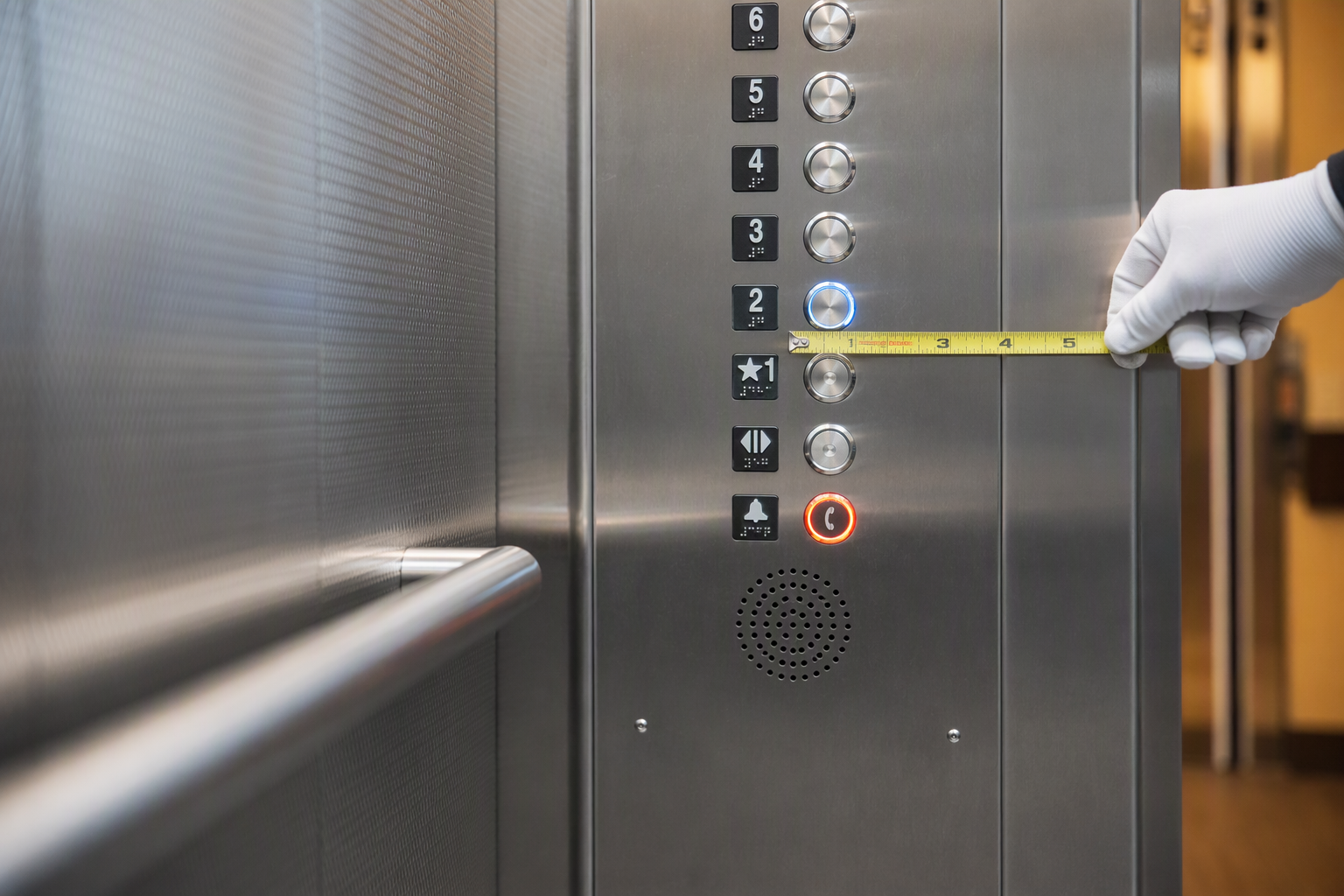
ADA Standards require that floor controls be mounted with the highest operable control no more than 48 inches above the floor for a forward approach or 54 inches for a side approach, buttons must be raised or flush, and each control must have a corresponding raised character and Braille designation.
Specifically, floor designation buttons must be at least three-quarters of an inch in their smallest dimension, must illuminate or otherwise indicate when activated, and must be located within reach range. The main entry floor designation must be identified by a raised star. Emergency controls — including the emergency stop switch, alarm button, and door open and close buttons — must be grouped at the bottom of the panel, with the lowest control no lower than 35 inches above the floor.
Many older California commercial buildings have elevator panels that were installed before modern ADA standards were adopted or updated. Buttons that require excessive force, that are recessed flush with the panel surface (making them difficult for users with limited dexterity to activate), or that lack Braille are common compliance deficiencies identified during ADA assessments.
What Signage and Floor Indicators Does the ADA Require Inside and Outside the Elevator?
The ADA requires raised and Braille floor designations on both jambs of the elevator hoistway entrance at 60 inches above the finished floor, and a visual and audible signal system must indicate the car’s direction of travel and each floor served.
On the car interior, the ADA requires a visual car position indicator — a display that shows the floor the car is passing or stopped at — with numerals at least half an inch high. An audible signal must also announce the floor. On the hoistway entrance (landing side), each floor must have raised characters and Braille on both door jambs, centered at 60 inches AFF, so a person with a visual impairment can identify the floor without entering the cab.
Hall call buttons must be at least three-quarters of an inch in their smallest dimension, located between 35 and 48 inches AFF, and must illuminate when activated. Many buildings are deficient in Braille signage quality — Braille cells that have worn smooth over time, or that were incorrectly formatted originally, are a common finding in ADA elevator audits.
What Emergency Communication Requirements Apply to Elevators Under the ADA?
The ADA requires a two-way emergency communication system in the elevator cab that does not require voice communication, so that individuals who are deaf or hard of hearing can summon assistance.
The system must connect to a point within the building or to an outside location where assistance is available. It must not require voice, meaning it must provide a visual indication that the emergency signal has been received and a visual or tactile indication that help is on the way. Many older elevator emergency phone systems are voice-only and do not satisfy this ADA requirement.
An important note regarding California-specific requirements: the Elevator Safety Orders adopted by Cal/OSHA incorporate ASME A17.1/CSA B44, 2004 edition for installation contracts signed on or after May 1, 2008. Building owners should consult with a Certified Qualified Conveyance Company about how the adopted ASME edition and current California Building Code provisions interact regarding visual and audible two-way communication requirements, as this is an area where California requirements may exceed the federal ADA baseline. Liftech Elevator recommends that owners treat non-voice emergency communication as a compliance priority regardless of the specific code edition that applies.
What Cal/OSHA Permit and Inspection Requirements Apply to California Commercial Elevators?
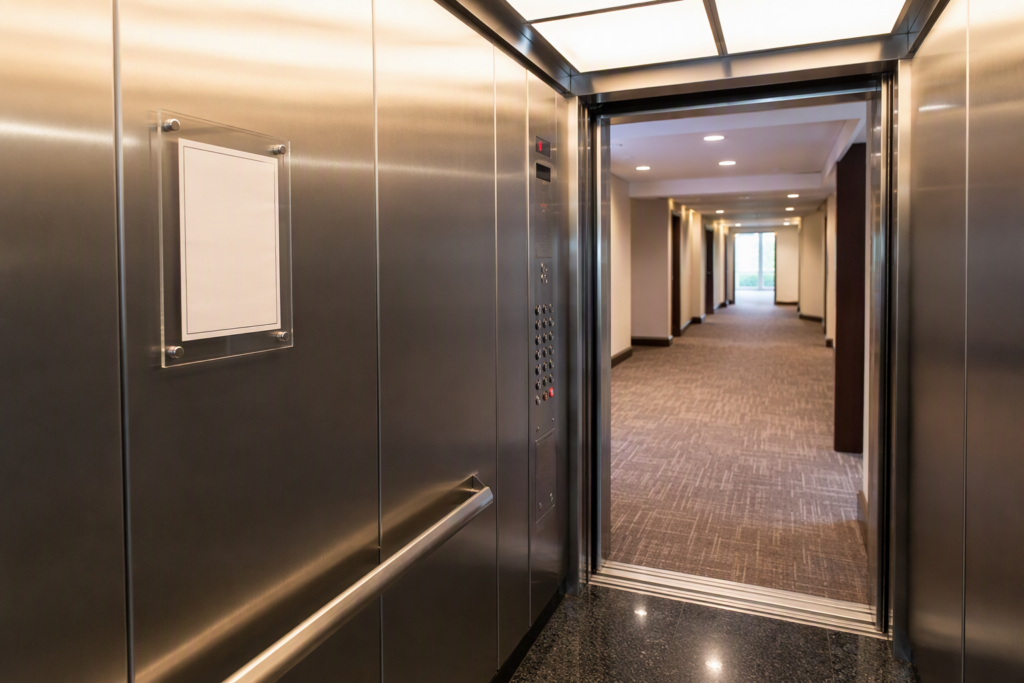
No elevator may legally operate in California without a valid, current permit to operate issued by Cal/OSHA, and that permit must be posted conspicuously inside the elevator car at all times.
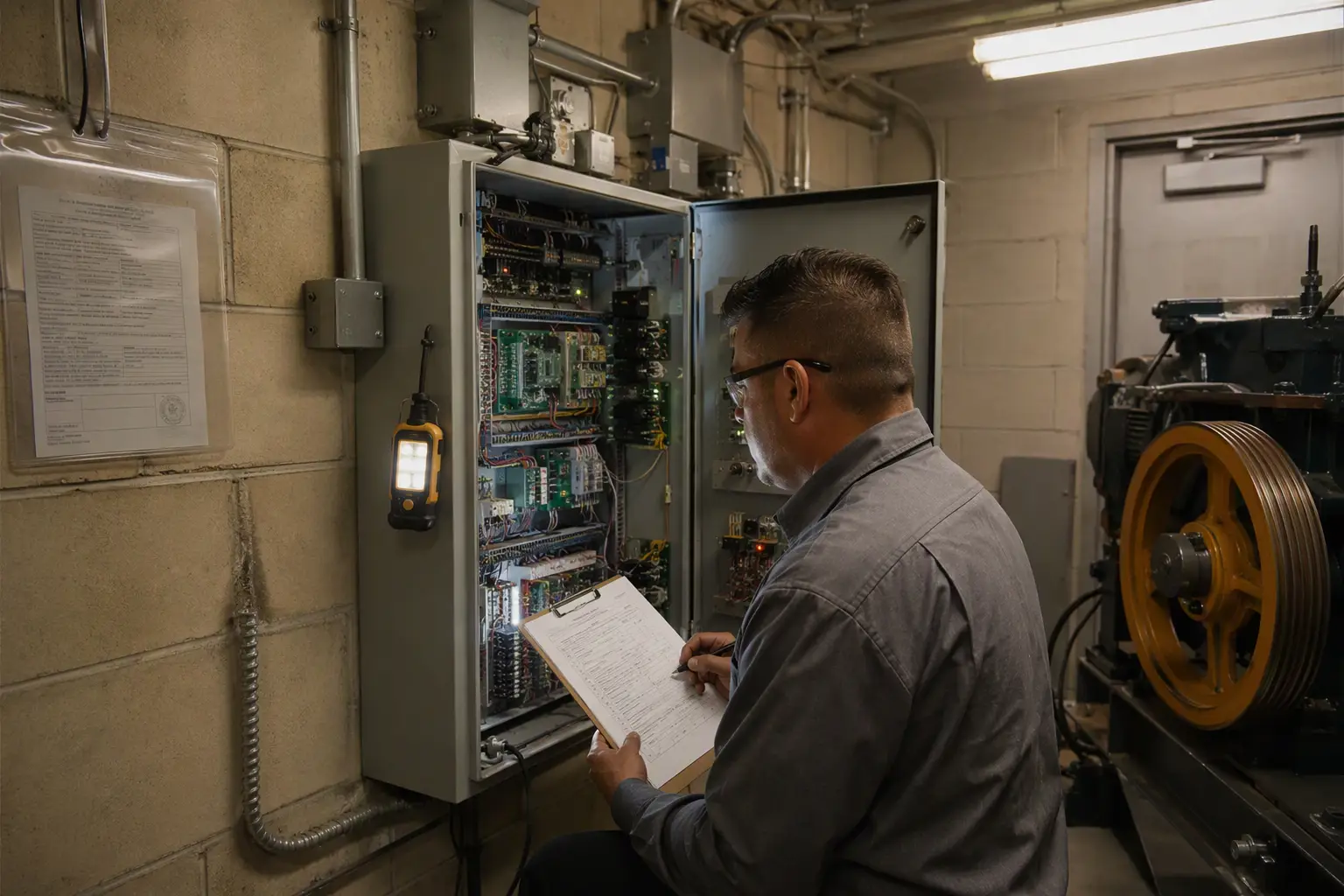
California law requires every conveyance to be inspected at least once per year. After a successful inspection confirming the elevator is in safe condition, Cal/OSHA issues a permit to operate valid for up to one year. Buildings covered by a full maintenance contract with a company holding a C-11 Elevator Contractor license may be eligible for a permit valid for up to two years.
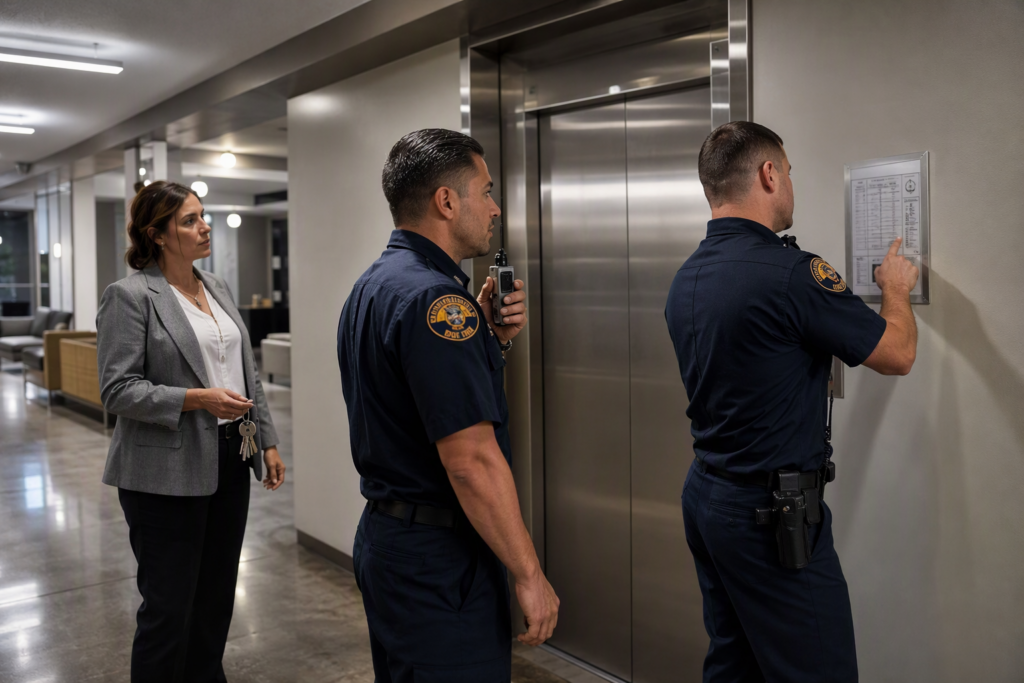
Responsibility for arranging the annual reinspection rests with the elevator owner, not the service company. Only State of California safety engineers and Certified Competent Conveyance Inspectors (CCCI) may perform these inspections. Before a new elevator is placed in service, and before any material alteration to an existing elevator, a Cal/OSHA permit is required. Owners who allow elevators to operate without a valid permit are in violation of California Labor Code Sections 7300–7324.2.
In Los Angeles specifically, the Los Angeles Department of Building and Safety (LADBS) runs its own elevator and conveyance inspection program — building owners in Los Angeles should coordinate with both Cal/OSHA and LADBS regarding inspection and permit requirements.
Who Is Legally Authorized to Maintain and Repair Elevators in California?
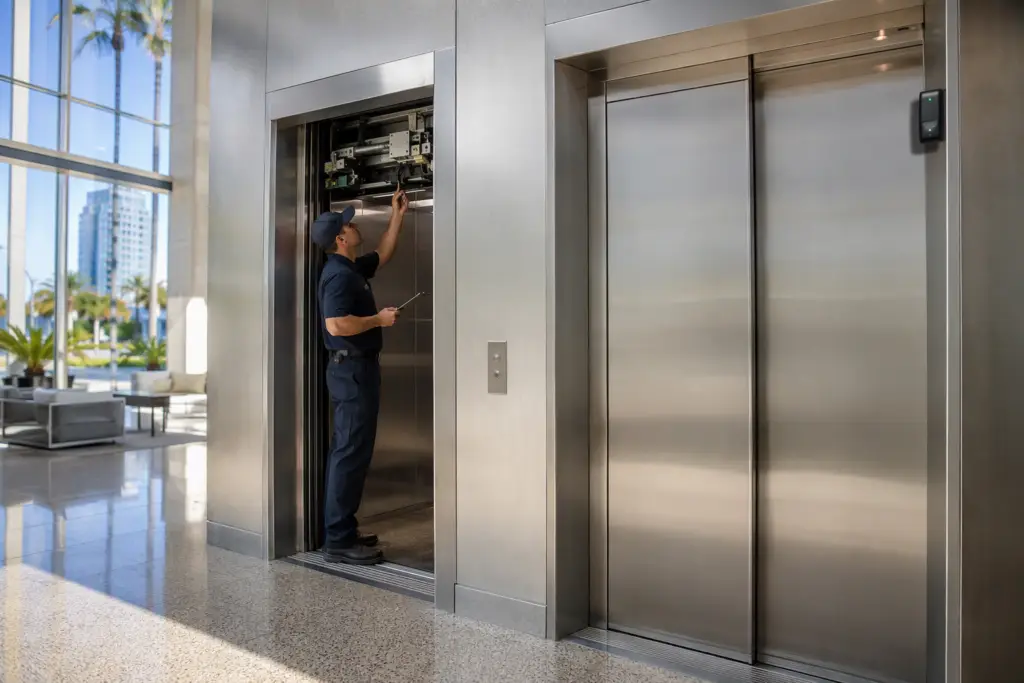
Only a Certified Competent Conveyance Mechanic (CCCM) working for a Certified Qualified Conveyance Company (CQCC) may maintain, repair, alter, or replace components on a conveyance in California.
Cal/OSHA issues CQCC certification to companies that hold a C-11 Elevator Contractor license from the California Contractors State License Board (CSLB) and that carry required workers’ compensation and liability insurance. Individual mechanics must hold CCCM certification from Cal/OSHA. Both company and individual certifications are valid for two years and require at least eight hours of continuing education for renewal.
Building owners who hire unlicensed or uncertified contractors to work on their elevators risk voiding their permit to operate, exposing themselves to Cal/OSHA enforcement action, and creating significant liability exposure. When evaluating elevator service providers, owners should verify current CQCC status and confirm that technicians hold active CCCM certification. Liftech Elevator operates as a Certified Qualified Conveyance Company serving commercial properties throughout Long Beach, Signal Hill, Los Angeles, and Orange County.
How Do I Conduct an ADA Elevator Compliance Audit for My Building?
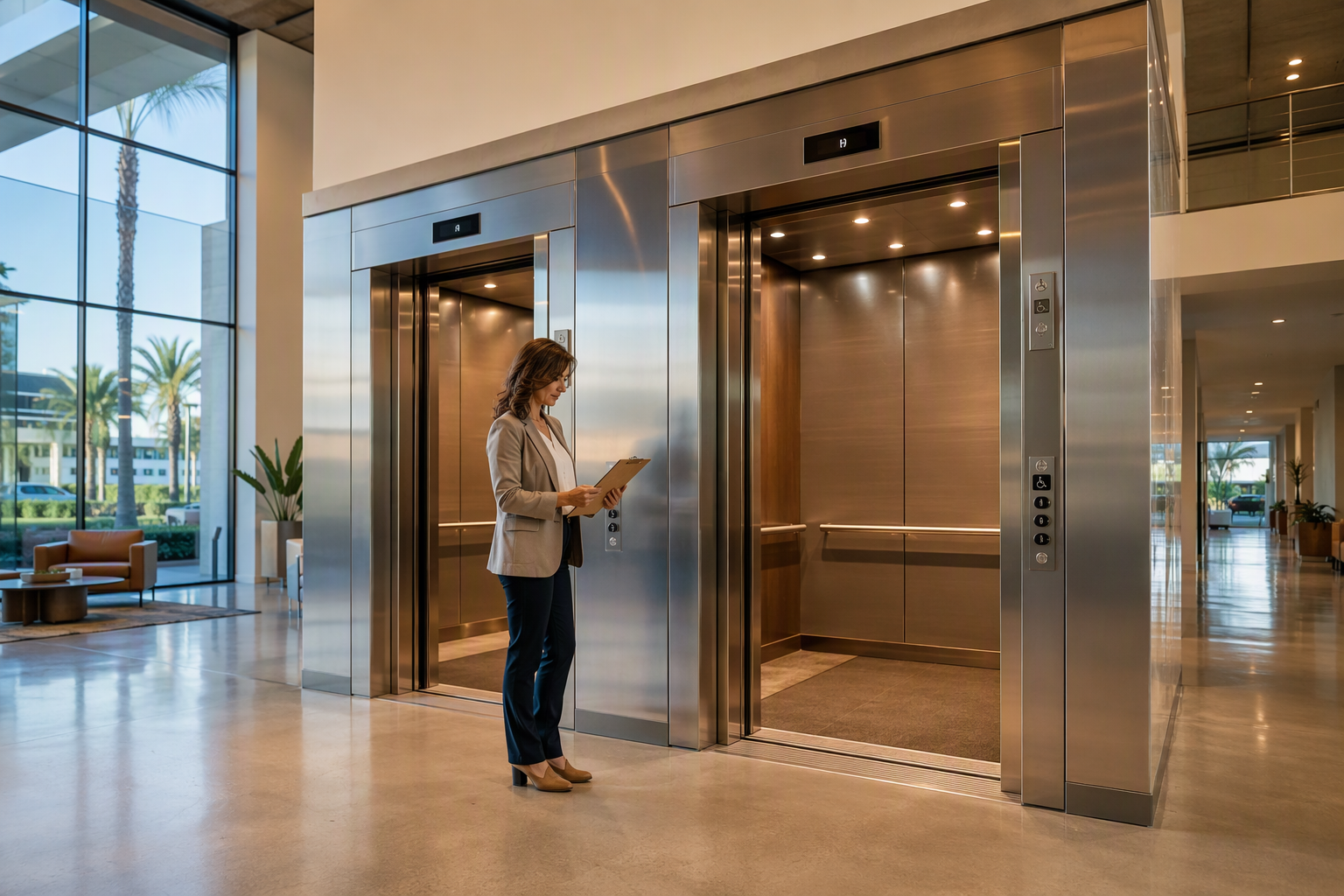
An ADA elevator compliance audit should systematically evaluate every element of the elevator against ADA Standards for Accessible Design, including cab dimensions, door clear width and timing, control panel layout and heights, Braille and raised character accuracy, signage on hoistway jambs, floor indicators, and emergency communication.
The recommended process for a California commercial building owner is as follows:
- Gather existing elevator documentation, including the original installation permit, current Cal/OSHA permit to operate, and any prior inspection reports or violation notices.
- Measure all physical elements against ADA Standards: cab interior dimensions, door clear width (minimum 36 inches), control heights (highest operable control at or below 48 inches AFF forward approach), and emergency control grouping at the bottom of the panel.
- Inspect all Braille designations on control buttons and hoistway jambs for accuracy, legibility, and proper cell sizing — worn or incorrect Braille is a common deficiency.
- Test the door reopening device to confirm it responds to obstruction without contact and holds doors open for the required time.
- Test the two-way emergency communication system for non-voice functionality, including visual confirmation that the call has been received.
- Review all floor indicator signals (visual and audible) inside the cab and at each landing.
- Document all deficiencies with photographs and measurements and prioritize them by severity and corrective cost.
- Engage a CQCC-certified elevator company to provide repair or modification quotes for each deficiency.
- Confirm that any alterations or repairs are permitted by Cal/OSHA before work begins, as material alterations require a permit.
What Are the Most Common ADA Elevator Deficiencies Found in California Commercial Buildings?
The most frequently cited ADA elevator deficiencies in California commercial buildings include non-compliant control panel heights, worn or incorrect Braille, voice-only emergency phones, doors that close too quickly, and floor indicator systems that lack audible signals.
Older buildings — particularly those constructed before the ADA was enacted in 1990 or before major amendments to the ADA Standards took effect — often have control panels that were retrofitted without full compliance analysis. Braille degradation is a consistent finding in high-traffic buildings; the tactile cells wear smooth over years of use and must be replaced. Emergency telephone systems installed in the 1990s and early 2000s are frequently voice-only and do not meet the non-voice communication requirement. Door timing is another area of frequent non-compliance, particularly where the door-close timer has been adjusted for operational convenience rather than accessibility.
What Is the Difference Between ADA Compliance and ASME A17.1 Safety Code Compliance?
ADA compliance governs accessibility for people with disabilities and is enforced through civil rights law, while ASME A17.1 Safety Code for Elevators and Escalators governs mechanical safety, structural integrity, and operational performance, enforced through Cal/OSHA’s permit and inspection process in California.
A building can be ADA compliant but fail Cal/OSHA safety inspection — for example, an elevator with properly dimensioned cabs and correct Braille but a malfunctioning governor or worn brake components. Conversely, an elevator can pass Cal/OSHA safety inspection while still violating ADA requirements — for example, an elevator in sound mechanical condition but with a control panel mounted too high or lacking non-voice emergency communication. Both compliance tracks must be maintained simultaneously, and each has different enforcement mechanisms and consequences for non-compliance.
What Happens If My California Commercial Elevator Is Found Non-Compliant?
Cal/OSHA can order an elevator shut down immediately if it presents a safety hazard, issue citations and penalties for operating without a valid permit, and require corrective action before reinspection — while ADA non-compliance can result in private lawsuits, Department of Justice enforcement, and mandatory corrective action plans.
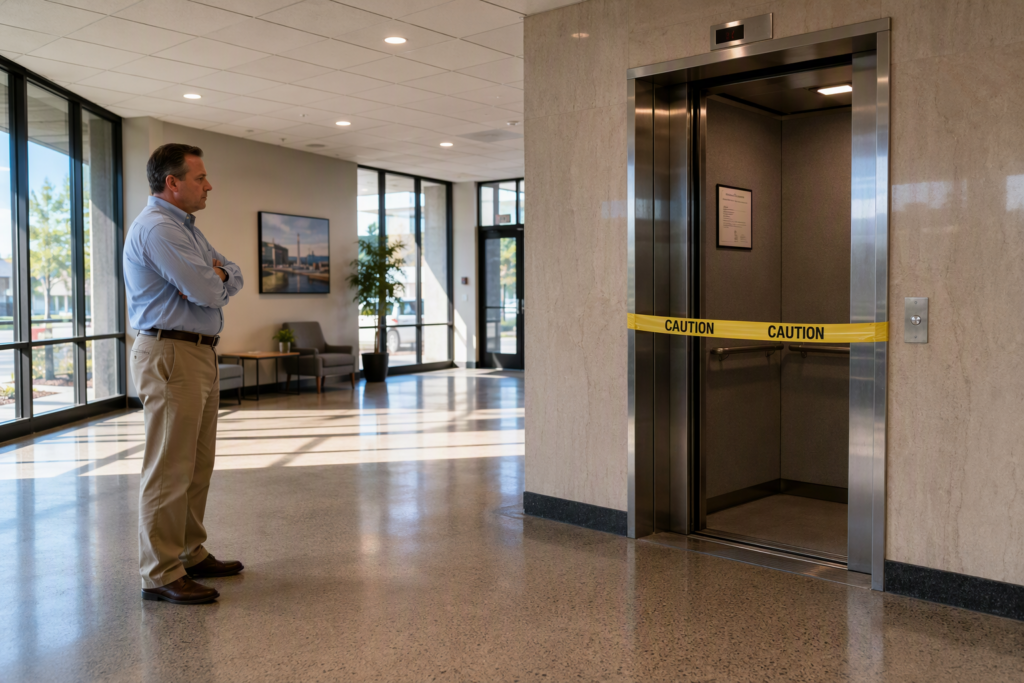
From a Cal/OSHA perspective, operating an elevator without a current permit to operate is a violation of California Labor Code Sections 7300–7324.2. Safety violations discovered during inspection can result in the elevator being taken out of service immediately, leaving building tenants and visitors without vertical access — a particularly serious consequence in buildings where elevator access is the only accessible route to upper floors for people with mobility impairments.
From an ADA perspective, California has a well-established plaintiffs’ bar specializing in accessibility litigation, and commercial building owners with non-compliant elevators are frequently targeted. Beyond litigation costs, ADA enforcement by the Department of Justice can require comprehensive remediation, monitoring, and reporting. Proactive compliance is substantially less expensive than reactive remediation under litigation or enforcement pressure.
How Much Does ADA Elevator Compliance Work Typically Cost?
The cost of ADA elevator compliance work varies significantly depending on the nature and extent of the deficiencies — minor corrections such as Braille replacement or signage updates may involve modest costs, while cab expansion, door replacement, or full control panel modernization represent more substantial investments.
Building owners should obtain itemized assessments from a CQCC-certified elevator company before budgeting for compliance work. An accurate assessment identifies which deficiencies are addressable through component replacement or adjustment versus which require more extensive modification or modernization. For buildings planning renovations that trigger the ADA’s path-of-travel requirements, the 20 percent cost cap provides a framework for phasing accessibility improvements — but that cap applies only to alterations-triggered path-of-travel work, not to new construction or voluntary remediation programs.
Liftech Elevator provides free elevator assessments for commercial property owners in Long Beach, Signal Hill, Los Angeles, and Orange County to help identify compliance gaps and develop a prioritized remediation plan.
What Is the ADA Elevator Modernization and Alteration Trigger Rule?
When an elevator is altered — meaning a change is made to an existing element that affects usability — the altered element must comply with ADA Standards for Accessible Design to the maximum extent feasible, and the alteration may trigger path-of-travel obligations for the primary function area served by the elevator.
This is a critical planning consideration for California building owners undertaking elevator modernization projects. Replacing a control panel, upgrading door operators, or modifying cab interiors can all constitute alterations that trigger ADA compliance requirements for the modified elements. Building owners who modernize elevators solely for mechanical reasons without conducting an ADA review of the new components frequently discover post-installation that the new installation introduces or perpetuates accessibility deficiencies.
Any material alteration also requires a Cal/OSHA permit before work begins under California’s elevator safety regulations, so the compliance planning process for modernization should address both regulatory tracks simultaneously.
What Is the ADA Exemption for Historic Buildings, and Does It Apply in California?
Historic buildings listed on or eligible for the National Register of Historic Places or designated under state or local historic preservation laws may qualify for modified ADA requirements if full compliance would threaten or destroy historically significant features — but the exemption is narrow and does not eliminate all accessibility obligations.
In California, many older commercial buildings — particularly in downtown Los Angeles and historic districts in Long Beach and Orange County — have some form of historic designation. The ADA permits alternative designs or technologies (such as platform lifts in lieu of elevators) where elevator installation would threaten historic character, but only after a determination that compliance methods that do not threaten historic significance have been exhausted. Building owners should not assume that a historic designation eliminates elevator accessibility requirements and should consult with accessibility specialists and preservation authorities before concluding that an exemption applies.
Are Platform Lifts an ADA-Compliant Alternative to Elevators in California Commercial Buildings?
The ADA permits platform lifts as an accessible means of vertical access in specific limited circumstances, including alterations to existing buildings, qualified historic facilities, and areas of sport or recreation that have technical infeasibility issues — but platform lifts are not a general substitute for elevators in multi-story commercial buildings.
In California, platform lifts are also subject to Cal/OSHA regulation under the Elevator Safety Orders, require a permit to operate, and must be maintained by a CCCM working for a CQCC-certified company. Building owners sometimes assume that platform lifts are a simpler regulatory pathway than elevators — in California’s regulatory environment, the permit, inspection, and maintenance certification requirements apply to conveyances broadly, not only to traditional elevator equipment. Any platform lift installation or alteration requires Cal/OSHA approval before the work begins.
What Is the ADA Requirements Compliance Table for California Commercial Elevators?
The following table summarizes key ADA elevator requirements alongside the governing standard, common deficiency patterns, and notes for California commercial building owners as of 2026:
| ADA Requirement | Standard / Source | Minimum Specification | Common Deficiency in Existing Buildings |
|---|---|---|---|
| Elevator provision (when required) | ADA Standards | Buildings 3+ stories or 3,000+ sq ft/floor (with exceptions) | No elevator or inaccessible elevator in qualifying building |
| Minimum cab floor area (centered door) | ADA Standards | 51 in. wide × 51 in. deep (minimum) | Undersized cabs in pre-ADA buildings |
| Minimum door clear width | ADA Standards | 36 inches clear | Narrow doors in older installations |
| Highest operable control (forward approach) | ADA Standards | 48 inches AFF maximum | Panels mounted too high, especially in freight-style cabs |
| Emergency controls (grouping) | ADA Standards | Grouped at bottom, lowest no less than 35 in. AFF | Emergency controls scattered across panel |
| Floor button size | ADA Standards | ¾ inch minimum in smallest dimension | Small or flush buttons without raised profile |
| Braille and raised characters on buttons | ADA Standards | Required on all floor and function controls | Worn Braille cells, incorrect formatting |
| Hoistway entrance floor designations | ADA Standards | Raised + Braille, both jambs, 60 in. AFF centered | Missing, worn, or single-jamb signage |
| Car position indicator (visual) | ADA Standards | Numerals ½ in. high minimum, visible from inside cab | Non-functional or absent floor display |
| Floor announcement (audible) | ADA Standards | Audible signal at each floor | System disabled, inaudible, or never installed |
| Hall call button height | ADA Standards | 35–48 in. AFF | Buttons mounted above or below reach range |
| Door reopening device | ADA Standards | Detects obstruction without contact | Contact-only or malfunctioning sensors |
| Two-way emergency communication | ADA Standards | Non-voice system with visual confirmation | Voice-only telephone systems |
| Permit to operate posted in cab | Cal/OSHA (California) | Current permit, posted conspicuously in car | Expired permit, permit not posted |
| Annual inspection | Cal/OSHA (California) | At least once per year (up to 2 years with full maintenance contract + C-11 company) | Overdue inspections, owner unaware of responsibility |
How Often Do California Commercial Elevators Need to Be Inspected?
California law requires every conveyance to be inspected at least once per year, with a permit to operate issued for up to one year — or up to two years if the elevator is in safe condition and covered by a full maintenance contract with a C-11 licensed elevator company.
It is the elevator owner’s responsibility to arrange the annual reinspection — this obligation does not fall to the service contractor. Only State of California safety engineers and Certified Competent Conveyance Inspectors (CCCI) may conduct these inspections. Building owners who are uncertain about their inspection status can verify their current permit to operate by reviewing the certificate posted inside the elevator cab. If the permit has lapsed or is missing, the building owner should contact Cal/OSHA and a CQCC-certified service company immediately.
Liftech Elevator assists commercial property owners throughout Long Beach, Signal Hill, Los Angeles, and Orange County in preparing their elevators for Cal/OSHA inspection, identifying and correcting deficiencies before the inspection date to minimize the risk of permit denial or elevator shutdown.
What Steps Should a California Commercial Building Owner Take Right Now to Achieve and Maintain Compliance?
A California commercial building owner should immediately verify that a valid Cal/OSHA permit to operate is posted in each elevator cab, then systematically audit each elevator against ADA Standards and engage a Certified Qualified Conveyance Company to remediate any deficiencies.
Follow these steps in order:
- Check the Cal/OSHA permit to operate posted in each elevator cab — confirm it is current and not expired. If it is expired or missing, contact Cal/OSHA and a CQCC-certified elevator company immediately.
- Confirm that the elevator service company currently maintaining the building’s elevators holds active CQCC certification from Cal/OSHA and that technicians hold CCCM certification.
- Schedule a comprehensive ADA elevator audit with a qualified accessibility consultant or a knowledgeable CQCC elevator company to evaluate all cab and landing elements against ADA Standards.
- Document every deficiency identified, including cab dimensions, door width, control panel heights, Braille condition, emergency communication capability, floor indicators, and hall call button placement.
- Prioritize deficiencies by risk level — voice-only emergency phones, non-functional door reopening devices, and severely undersized cab dimensions represent the highest liability exposure.
- Obtain written quotes for all required corrective work and confirm that any material alteration will be permitted by Cal/OSHA before work begins.
- Implement corrections and schedule a Cal/OSHA inspection to confirm safe condition and renew the permit to operate.
- Establish a written maintenance schedule with a CQCC-certified company, and track the inspection due date to ensure timely reinspection each year.
How Can Building Owners in Long Beach, Signal Hill, Los Angeles, and Orange County Get Expert Help?
Building owners in Southern California can work with Liftech Elevator, a Certified Qualified Conveyance Company serving commercial and residential properties throughout Long Beach, Signal Hill, Los Angeles, and Orange County, to assess ADA compliance gaps, identify Cal/OSHA permit issues, and develop a prioritized plan for corrective work.
Navigating the intersection of federal ADA requirements and California’s Cal/OSHA elevator safety regime requires familiarity with both regulatory frameworks and the practical realities of existing building stock in Southern California. Liftech Elevator’s team of Certified Competent Conveyance Mechanics is trained in current ASME A17.1 Safety Code for Elevators and Escalators standards and ADA accessibility requirements, and can assist property owners in understanding what their specific elevators require to achieve and maintain full compliance in 2026 and beyond.
Get a Free Elevator Compliance Assessment
If your commercial elevator’s ADA compliance or Cal/OSHA permit status is uncertain, do not wait for a complaint or citation to force the issue. Contact Liftech Elevator for a free elevator assessment. Liftech Elevator serves commercial property owners in Long Beach, Signal Hill, Los Angeles, and Orange County, California.
Call today: 562-609-3478
Liftech Elevator — Certified Qualified Conveyance Company. C-11 Licensed. Serving Southern California commercial buildings with Cal/OSHA compliant maintenance, inspection preparation, ADA compliance work, and elevator modernization.
Need elevator service you can rely on? Liftech Elevator is ready to help.