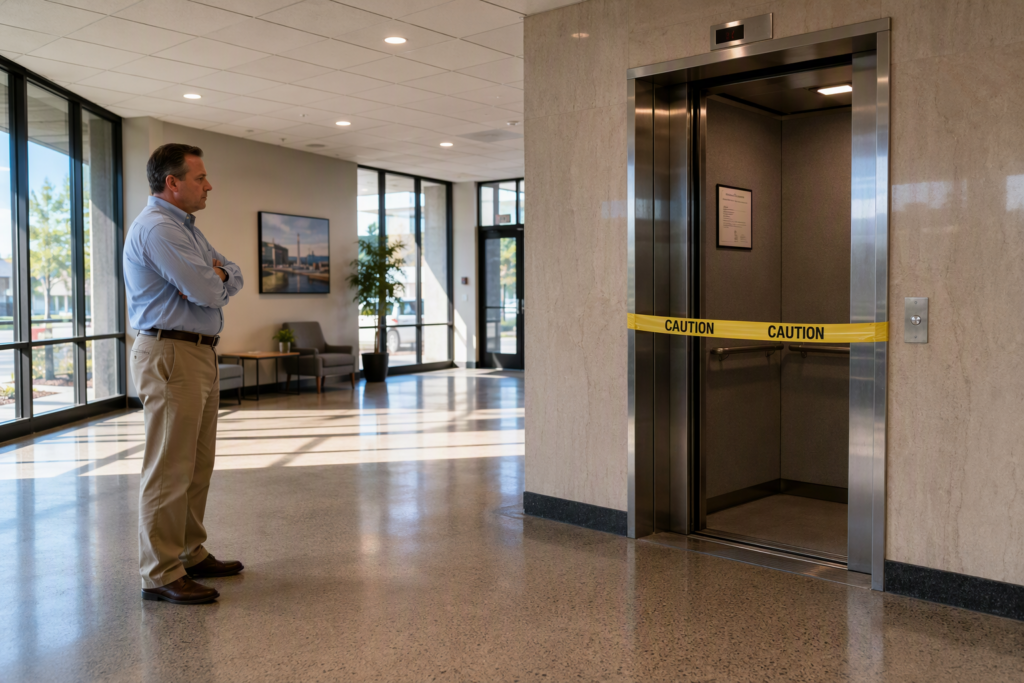
What Happens If My Building Elevator Breaks Down and a Tenant or Resident Is Trapped Inside?
When a building elevator breaks down and traps an occupant, the situation unfolds in three overlapping phases: an emergency response phase, a mechanical restoration phase, and a compliance phase. Building owners and property managers in Signal Hill, Long Beach, Los Angeles, and Orange County who understand all three phases can protect residents, limit liability, and get their elevator back into legal operation as quickly as possible. This FAQ hub covers every aspect of that process, from the moment a passenger is trapped to the final Cal/OSHA permit reinstatement.
What should building management do the instant they learn a passenger is trapped in an elevator?
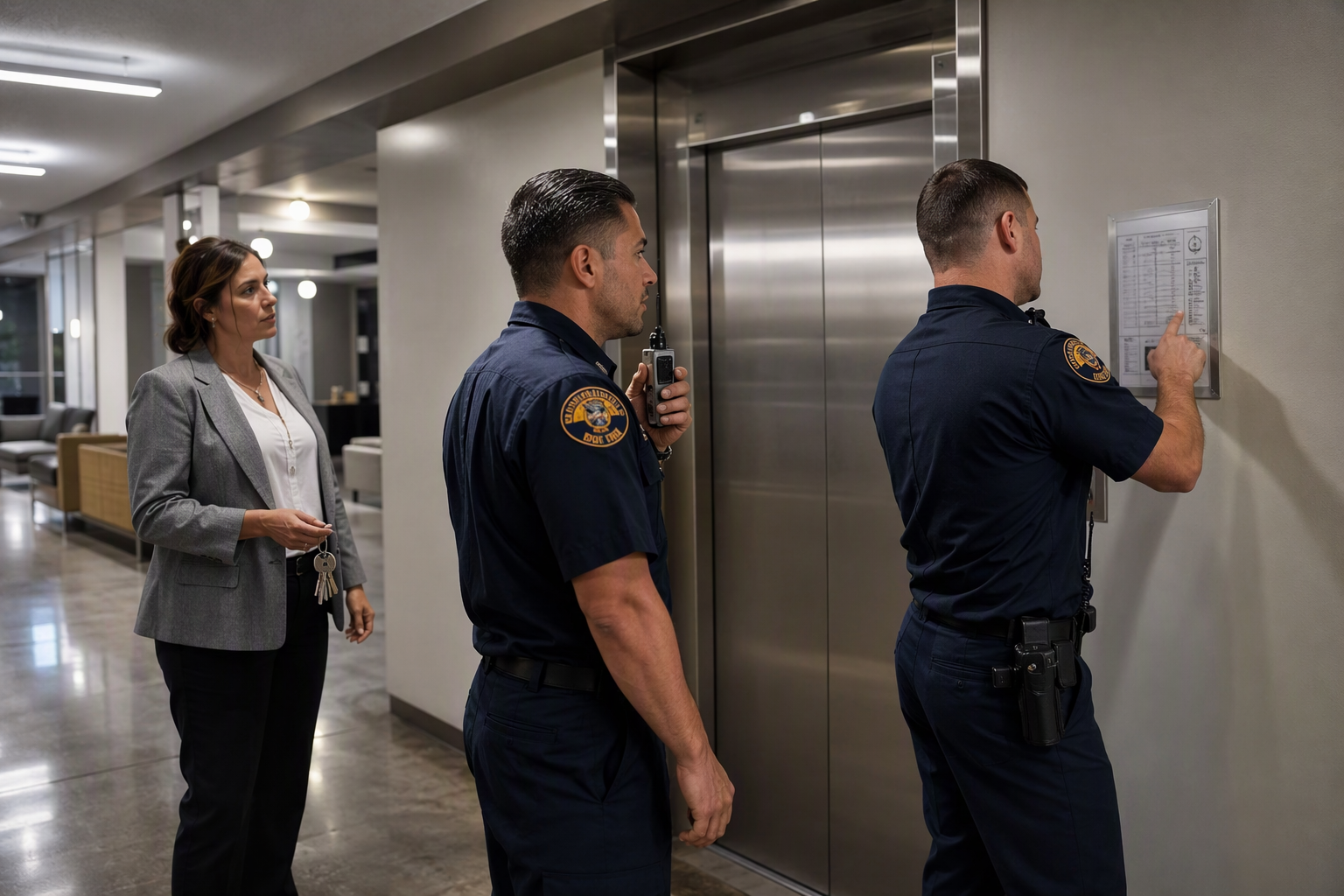
Call 911 immediately and then use the elevator’s two-way emergency communication system to reassure the trapped occupant that help is on the way.
Time matters in an entrapment. Building managers should resist the impulse to open doors manually or instruct the passenger to force the doors — both actions can turn a mechanical inconvenience into a serious fall or crush injury. The correct sequence is:
- Call 911 and give the exact building address and floor location of the stalled car.
- Activate or confirm the elevator’s two-way communication system is connecting the trapped passenger to a monitoring station or building personnel.
- Post a staff member or building manager at the landing closest to the stalled car to communicate with emergency responders when they arrive.
- Locate and have ready the elevator’s machine room key so the fire department can access the hoistway controls.
- Notify the elevator service company on record for the building so a certified technician can be dispatched in parallel with the emergency response.
- Document the time of the breakdown, the floor where the car stopped, the number of trapped occupants, and any communications with the passenger.
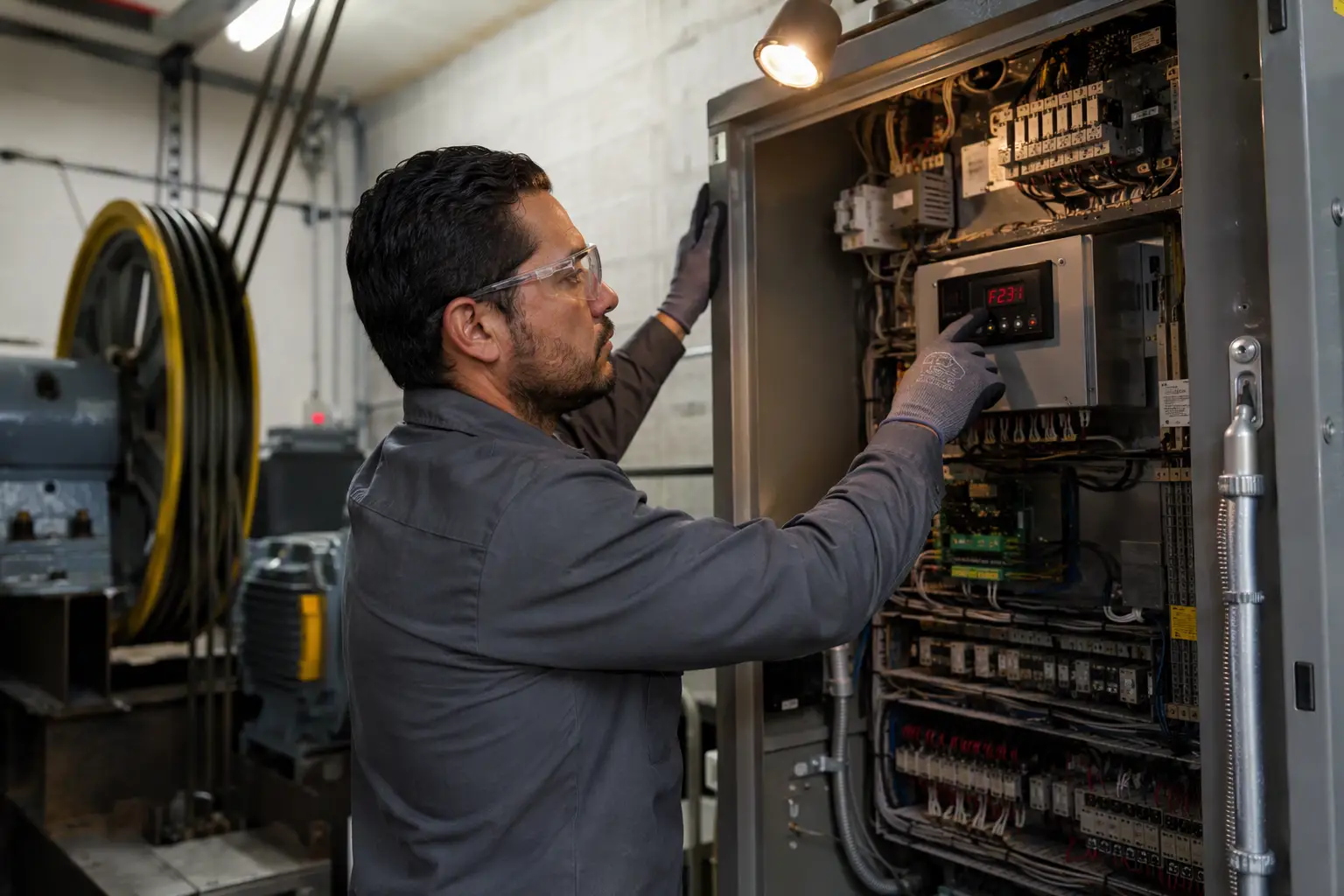
- Preserve any error codes or fault indicators on the controller panel for the responding mechanic.
Under ASME A17.1 Safety Code for Elevators and Escalators, elevators are required to be equipped with a means of two-way communication so trapped passengers can summon help. Building owners should verify during routine maintenance that the alarm bell, intercom, or phone system is fully functional at every inspection cycle.
Is it safe for a trapped passenger to try to exit the elevator on their own?

No — a passenger should stay inside the car, remain calm, and wait for trained emergency responders because self-rescue attempts carry a significant risk of a fatal fall into the hoistway.
A stalled elevator car may not be level with the nearest landing. The gap between a car floor and a landing floor can be several feet, especially if the car stopped mid-travel. Passengers who attempt to pry open doors and climb out can slip and fall into the pit or become caught between the car and the hoistway wall. Building managers should communicate clearly through the intercom that the passenger should stay seated or standing inside the car, away from the doors, and that professional help is minutes away.
Who is legally authorized to perform the actual rescue of a trapped elevator passenger in California?
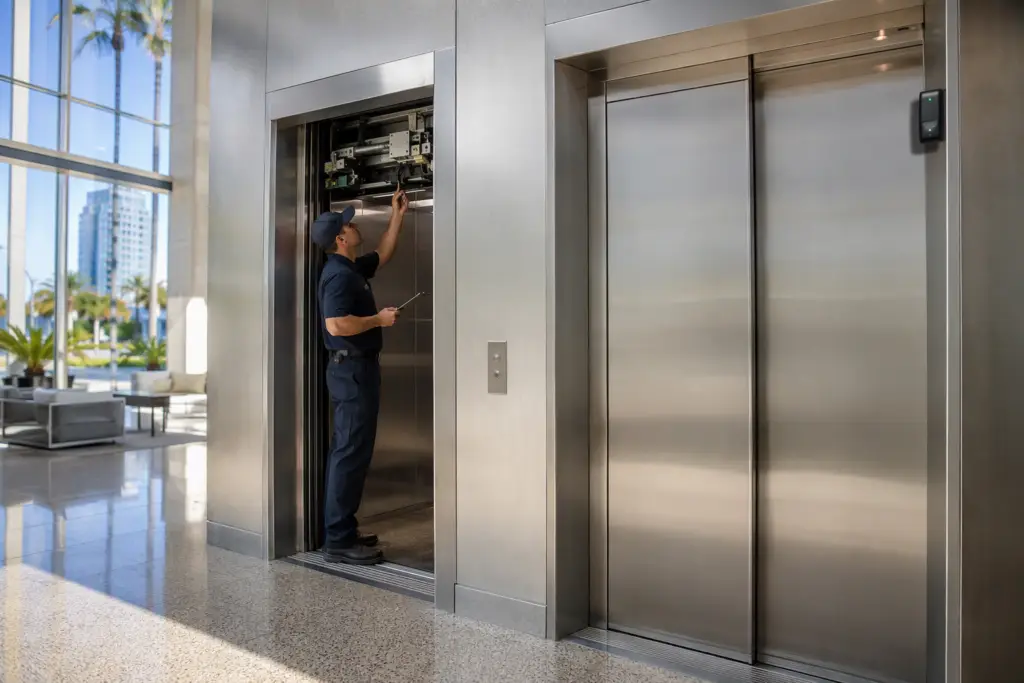
In California, the physical rescue of a trapped passenger is performed by fire department personnel, while the mechanical restoration of the elevator is performed only by a Cal/OSHA-certified elevator mechanic.
Fire departments across Los Angeles, Long Beach, Signal Hill, and Orange County are trained in elevator rescue procedures, including manual lowering, door release, and hoistway entry. Once the passenger is safely out, the building owner must engage a company holding both a C-11 Elevator Contractor license from the California Contractors State License Board (CSLB) and Cal/OSHA certification as a Certified Qualified Conveyance Company (CQCC). Under California Labor Code Sections 7300–7324.2, only a Certified Competent Conveyance Mechanic (CCCM) working for a CQCC may maintain, repair, alter, or replace components on a conveyance. Engaging an uncertified contractor exposes a building owner to Cal/OSHA enforcement action and potential personal liability.
What are the most common mechanical reasons an elevator stalls and traps a passenger?
The most frequent causes include drive motor or controller failures, door mechanism malfunctions, broken or slipped drive ropes, safety device trips, and power interruptions.
Each cause has a different repair pathway and timeline:
| Failure Type | Typical Cause | Repair Complexity | Parts Lead Time Risk | Return-to-Service Timeline (General) |
|---|---|---|---|---|
| Door operator / door contact fault | Worn rollers, broken clutch, dirty safety edge | Low–Moderate | Low | Hours to 1 day |
| Controller board / software fault | Power surge, component aging | Moderate–High | Moderate | 1–5 days |
| Drive motor failure | Overheating, worn bearings, insulation breakdown | High | Moderate–High | 3–10 days |
| Hoist rope slip or breakage | Worn ropes, improper tensioning | High | Low–Moderate | 1–3 days |
| Safety device trip (governor, buffer) | Overspeed, obstruction, maintenance gap | Moderate–High | Low | Hours to 2 days (after reset inspection) |
| Power supply interruption | Utility outage, blown fuse, tripped breaker | Low | None | Hours |
| Hydraulic system failure (hydraulic units) | Fluid leak, pump failure, valve malfunction | Moderate–High | Moderate | 1–7 days |
Timelines above are general industry ranges and will vary based on parts availability, building access, and Cal/OSHA inspection scheduling. A thorough post-entrapment inspection by a certified technician is required before any elevator is returned to service, regardless of how simple the apparent fault appears.
Can a building legally put the elevator back in service immediately after the trapped passenger is rescued?
No — after a breakdown significant enough to trap a passenger, the elevator must be inspected and cleared by a certified mechanic before it is returned to service, and depending on the nature of the fault, a Cal/OSHA inspection may be required before operation resumes.
California Code of Regulations, Title 8, Elevator Safety Orders (Sections 3000–3146) prohibit operating a conveyance without a valid, current permit issued by Cal/OSHA’s Elevator Unit, Division of Occupational Safety and Health, California Department of Industrial Relations. If a repair constitutes a material alteration, a new permit is required before operation. Even for non-alteration repairs, the building owner bears responsibility for ensuring the unit is safe. Placing an elevator back in service before a certified mechanic has cleared it creates direct liability exposure if a subsequent incident occurs.
What California agency regulates elevator safety and entrapment incidents?
Cal/OSHA’s Elevator Unit, under the California Department of Industrial Relations, is the primary state regulator for elevator safety in California.
Cal/OSHA enforces California Labor Code Sections 7300–7324.2 and the California Code of Regulations, Title 8, Elevator Safety Orders. The agency issues permits to operate, certifies inspection personnel (Certified Competent Conveyance Inspectors, or CCCIs), and certifies companies (CQCCs) and mechanics (CCCMs) who work on conveyances. Building owners who experience an entrapment may receive a Cal/OSHA inquiry, particularly if the incident results in injury or if the elevator’s permit to operate was not current. The official Cal/OSHA elevator program page is at dir.ca.gov/dosh/Elevator.html.
Separately, the City of Los Angeles operates its own elevator and conveyance inspection program through the Department of Building and Safety (LADBS). Building owners in Los Angeles should be aware that both LADBS and Cal/OSHA may have jurisdiction over their equipment depending on the circumstances.
What permits and certifications must an elevator company hold before responding to a breakdown in California?
Any company performing elevator repair in California must hold a C-11 Elevator Contractor license from the CSLB and be certified by Cal/OSHA as a Certified Qualified Conveyance Company (CQCC), and each mechanic on site must hold a Cal/OSHA Certified Competent Conveyance Mechanic (CCCM) credential.
CQCC applicants must submit a current C-11 contractor license along with certificates of workers’ compensation and liability insurance. CCCM certification applies to any individual who works on an elevator without supervision. Both the CQCC and CCCM certificates last two years and require at least eight hours of continuing education for renewal. Building managers who engage a contractor without verifying these credentials are not merely taking a business risk — they may be in violation of California law. Liftech Elevator holds the certifications required under California law to perform elevator maintenance, repair, and alteration services in Signal Hill, Long Beach, Los Angeles, and Orange County.
What are the building owner’s legal obligations after an elevator entrapment incident?
Building owners must ensure the elevator is repaired by certified personnel, the permit to operate is valid and posted in the car, and any required Cal/OSHA inspections are completed before the unit returns to service.
Under California law, the permit to operate for a passenger elevator must be posted conspicuously in the elevator car. The responsibility for arranging the annual reinspection rests with the elevator owner, not the service company. If the breakdown was caused by deferred maintenance or an expired maintenance contract, the owner may face Cal/OSHA enforcement. Beyond regulatory obligations, building owners should document the entrapment incident thoroughly — including the timeline, communications with the trapped passenger, the responding emergency services, and all repair work — as this documentation is critical in the event of a personal injury claim.
Does ADA have requirements relevant to elevator breakdowns or entrapment situations?
Yes — the Americans with Disabilities Act (ADA) requires that buildings covered by the law maintain accessible routes, which means a prolonged elevator outage in a multi-story building can create an ADA compliance issue for residents or visitors who depend on the elevator to access their unit or the building’s amenities.
The ADA does not directly regulate elevator maintenance intervals or rescue procedures, but it does require that covered facilities maintain accessible features in working order. An elevator that is out of service for an extended period without an accessible alternative route may put a building in violation of ADA requirements. Building managers should have a documented plan for providing accessible alternatives — such as temporary relocation assistance for residents who cannot use stairs — while an elevator is under repair. Liftech Elevator can help building managers in Long Beach, Los Angeles, Signal Hill, and Orange County assess the ADA implications of an extended outage as part of a comprehensive elevator service plan.
How often must elevators be inspected in California to help prevent entrapments?
California law requires every conveyance to be inspected at least once per year, with a permit to operate valid for up to one year — or up to two years if the elevator is covered by a full maintenance contract with a C-11 licensed elevator company.
The annual inspection must be performed by a State of California safety engineer or a Certified Competent Conveyance Inspector (CCCI). Only these credentialed individuals may perform elevator inspections in California. The two-year permit interval is available when a full maintenance contract with a qualified CQCC is in place, reflecting the legislature’s recognition that continuous professional maintenance significantly reduces the risk of unexpected failures and entrapments. Building owners who allow their permit to lapse or who skip maintenance cycles create conditions where mechanical failures — and the entrapments they cause — become far more likely. A full maintenance contract with a certified company such as Liftech Elevator is one of the most practical risk-reduction tools available to California building owners.
What role does ASME A17.1 play in elevator entrapment prevention and rescue?
The ASME A17.1 Safety Code for Elevators and Escalators establishes the design, construction, operation, inspection, testing, and maintenance standards that minimize entrapment risk and define the safety devices required to protect passengers when a failure occurs.
California has adopted the ASME A17.1/CSA B44, 2004 edition (Group IV Elevator Safety Orders), effective May 1, 2008, for installation contracts signed on or after that date. Key ASME A17.1 provisions relevant to entrapment include requirements for two-way emergency communication, safety governors that arrest overspeed descent, interlocked hoistway doors that prevent door opening unless the car is at the landing, and emergency lighting within the car. When these systems are properly maintained and tested, entrapments — though they still occur — are far less dangerous and far shorter in duration. As of 2026, California has a proposed Group V update under consideration that would incorporate portions of ASME A17.1-2019, though no effective date has been published.
What documentation should a building manager collect after an elevator entrapment incident?
Building managers should collect a written incident report, the elevator’s maintenance and inspection records, the service technician’s repair report, any fault codes retrieved from the controller, and statements from the trapped passenger and any witnesses.
This documentation serves multiple purposes: it supports a Cal/OSHA inquiry if one is initiated, it provides the factual basis for any insurance claim, and it demonstrates due diligence if the trapped occupant pursues a personal injury claim. The permit to operate, which California law requires to be posted conspicuously in the elevator car, should also be documented — its expiration date may be relevant to determining whether the building was in compliance at the time of the incident. Maintenance logs kept by the service company are often the most detailed record of the elevator’s mechanical history and should be requested from the CQCC following any significant incident.
How long can a passenger safely remain trapped in a stalled elevator?
Modern elevators are designed to provide ventilation and emergency lighting for a reasonable period, but the priority is always rapid professional rescue — the safety of a trapped passenger depends on the speed and competence of the emergency response, not the elevator’s passive survival features.
ASME A17.1 requires emergency lighting in elevator cars capable of operating on backup power. Most cars also have ventilation openings that allow air circulation even when the car is stationary. However, passengers with medical conditions, extreme temperatures, or anxiety-related episodes may experience distress within minutes. The two-way communication system is critical during this period — it allows building personnel or monitoring stations to assess the passenger’s condition, provide reassurance, and relay real-time status updates to emergency responders. Building managers should never underestimate the psychological impact of an entrapment on a resident, particularly elderly residents or those with disabilities.
What is a full maintenance contract and how does it reduce entrapment risk?
A full maintenance contract is an agreement in which a Certified Qualified Conveyance Company assumes responsibility for all scheduled maintenance, routine adjustments, lubrication, parts replacement, and callback service for a covered elevator — and in California, it is one of the two conditions that can qualify a building for a two-year permit to operate.
Under a full maintenance arrangement, certified technicians service the elevator on a regular cycle, inspecting safety devices, door mechanisms, ropes, controllers, and all moving components before they fail rather than after. This proactive approach directly reduces the frequency of unexpected mechanical failures — the root cause of most entrapments. Building owners who rely on reactive, call-only service arrangements typically experience more frequent and more severe breakdowns because developing faults go undetected between service visits. Liftech Elevator provides full maintenance contract services to building owners throughout Signal Hill, Long Beach, Los Angeles, and Orange County.
Can a building owner be held liable if a tenant is injured during an elevator entrapment?
Yes — California courts have consistently recognized that building owners owe tenants and visitors a duty of care for common areas including elevators, and a failure to maintain the elevator properly or respond adequately to an entrapment can result in significant civil liability.
Liability exposure is highest when the entrapment is linked to deferred maintenance, an expired permit to operate, or the use of an uncertified repair company. An expired Cal/OSHA permit is particularly damaging in litigation because it is direct documentary evidence that the building was operating an elevator outside the bounds of California law. Building owners who maintain current permits, document all maintenance activity, and engage only CQCC-certified companies are in a substantially better position to defend a claim — or to avoid one altogether through the injury-prevention effect of proper maintenance. Building managers are encouraged to review their elevator service agreements and permit status before an incident occurs rather than after.
What happens to the elevator’s permit to operate after a major repair or breakdown?
If a repair constitutes a material alteration of the conveyance, California law requires a new Cal/OSHA permit to operate before the elevator can be returned to service.
Under California Code of Regulations, Title 8, Elevator Safety Orders, a permit from Cal/OSHA is required before a conveyance is erected, installed, or materially altered. The determination of whether a repair crosses the threshold into a material alteration requires judgment from the CQCC and may involve coordination with Cal/OSHA’s Elevator Unit. For non-alteration repairs, the existing permit remains in effect once a certified mechanic clears the unit as safe, but the building owner retains responsibility for ensuring the unit’s operational safety. Building managers should work with their certified elevator service company to understand which repairs trigger a new permit requirement so they are not caught off guard by an inspection timeline that delays return to service.
What should building managers communicate to tenants and residents when an elevator is out of service?
Building managers should notify residents promptly with accurate information about the outage, the estimated timeline for repairs, alternative access options, and any special accommodations for residents who cannot use stairs.
Transparent communication reduces tenant anxiety and demonstrates that management takes the situation seriously. Notices should be posted at every elevator landing and sent directly to residents who have registered accessibility needs. For multi-story residential buildings, an extended elevator outage may trigger fair housing obligations for tenants with disabilities — building managers should consult with their legal counsel if the outage extends beyond a short repair window. Documenting all communications about the outage, including when notices were posted and what accommodations were offered, strengthens the building’s position if a tenant files a complaint with a regulatory agency or pursues legal action.
How does OSHA apply to elevator entrapment situations in California?
Federal OSHA standards may apply to elevator work performed by technicians during a rescue or repair, particularly requirements governing confined space entry, fall protection, and lockout/tagout procedures.
When a certified elevator mechanic enters a hoistway or machine room to respond to an entrapment or perform repairs, federal OSHA standards governing worker safety — including lockout/tagout (LOTO) procedures for energy control — govern how that work must be conducted. These requirements protect the technician performing the rescue or repair, not the trapped passenger directly. Building owners do not typically have direct OSHA obligations related to elevator passenger rescues, but they do have obligations to ensure that the machine room and surrounding areas are accessible and safe for service personnel. A CQCC-certified company will have documented safety procedures that comply with applicable OSHA requirements.
What questions should a building owner ask when hiring an elevator service company to handle breakdowns and maintenance?
Building owners should verify that any prospective elevator service company holds a current CQCC certification from Cal/OSHA and a C-11 Elevator Contractor license from the CSLB, and that all mechanics dispatched to the building hold current CCCM certification.
Beyond mandatory credentials, building owners should ask:
- Can you provide documentation of your CQCC certification and C-11 license?
- Are all mechanics dispatched to our building CCCM-certified?
- What does your full maintenance contract include, and does it qualify our building for a two-year Cal/OSHA permit?
- How do you coordinate with Cal/OSHA when a repair may constitute a material alteration?
- What is your post-entrapment inspection protocol before a unit is returned to service?
- How do you document maintenance activity and fault history for our records?
- Do you have experience servicing the specific make and model of elevator installed in our building?
A company that cannot answer these questions clearly and with supporting documentation should not be trusted with the life-safety systems of a residential or commercial building. Liftech Elevator works with building owners across Signal Hill, Long Beach, Los Angeles, and Orange County to ensure that every aspect of elevator service — from emergency breakdown response to annual permit compliance — meets the standards set by Cal/OSHA and the ASME A17.1 code.
What preventive measures can building owners take to reduce the likelihood of future elevator entrapments?
The most effective preventive measures are a current full maintenance contract with a CQCC-certified company, annual or biennial Cal/OSHA-compliant inspections, and documented testing of all safety devices including the two-way communication system and emergency lighting.
Beyond formal maintenance, building managers should train staff on the correct entrapment response protocol so no time is lost in an actual event. Machine rooms should be kept clean, dry, and accessible. Elevator loads should not routinely approach rated capacity. Door mechanisms — the most common source of entrapment-causing faults — should be visually checked by building personnel during routine walkthroughs and any irregular behavior reported to the service company immediately. Early intervention on developing faults is almost always faster and less expensive than emergency breakdown response, and it eliminates the safety risk to occupants entirely. Regular maintenance by a certified company such as Liftech Elevator is the single most impactful action a building owner can take to prevent elevator entrapments.
Protect Your Residents — Schedule a Free Elevator Assessment Today
A stalled elevator and a trapped tenant is a preventable crisis. Whether a building has just experienced an entrapment or management wants to get ahead of the next breakdown, Liftech Elevator provides comprehensive elevator assessments, full maintenance contracts, and certified breakdown response services throughout Signal Hill, Long Beach, Los Angeles, and Orange County, California.
Liftech Elevator is certified to operate as a Certified Qualified Conveyance Company (CQCC) under California law, and every mechanic dispatched holds current CCCM certification from Cal/OSHA — the credentials California requires before any work on a conveyance can legally begin.
Contact Liftech Elevator for a free elevator assessment: 562-609-3478
Need elevator service you can rely on? Liftech Elevator is ready to help.