ADA Elevator Requirements for Commercial Buildings in California: What Triggers a Compliance Upgrade
California commercial building owners face a layered compliance landscape: federal ADA accessibility mandates apply alongside state elevator safety regulation enforced by the Cal/OSHA Elevator Unit. Understanding where these frameworks overlap — and what construction or alteration activities trigger an upgrade obligation — is critical to avoiding enforcement action, permit denial, and liability exposure.
What Does the ADA Require for Elevators in Commercial Buildings?
The ADA establishes accessibility requirements for places of public accommodation and commercial facilities. Under the ADA Standards for Accessible Design, an elevator is required when a building has three or more stories above grade, or when any single floor above or below grade exceeds 3,000 square feet — unless a recognized exemption applies. Where an elevator is required, it must serve each level of the building and meet specific dimensional, operational, and signage standards.
Key ADA elevator specifications include:
- A minimum clear floor area inside the cab to accommodate a wheelchair and its user
- Door clear opening width and door timing controls that allow safe passage
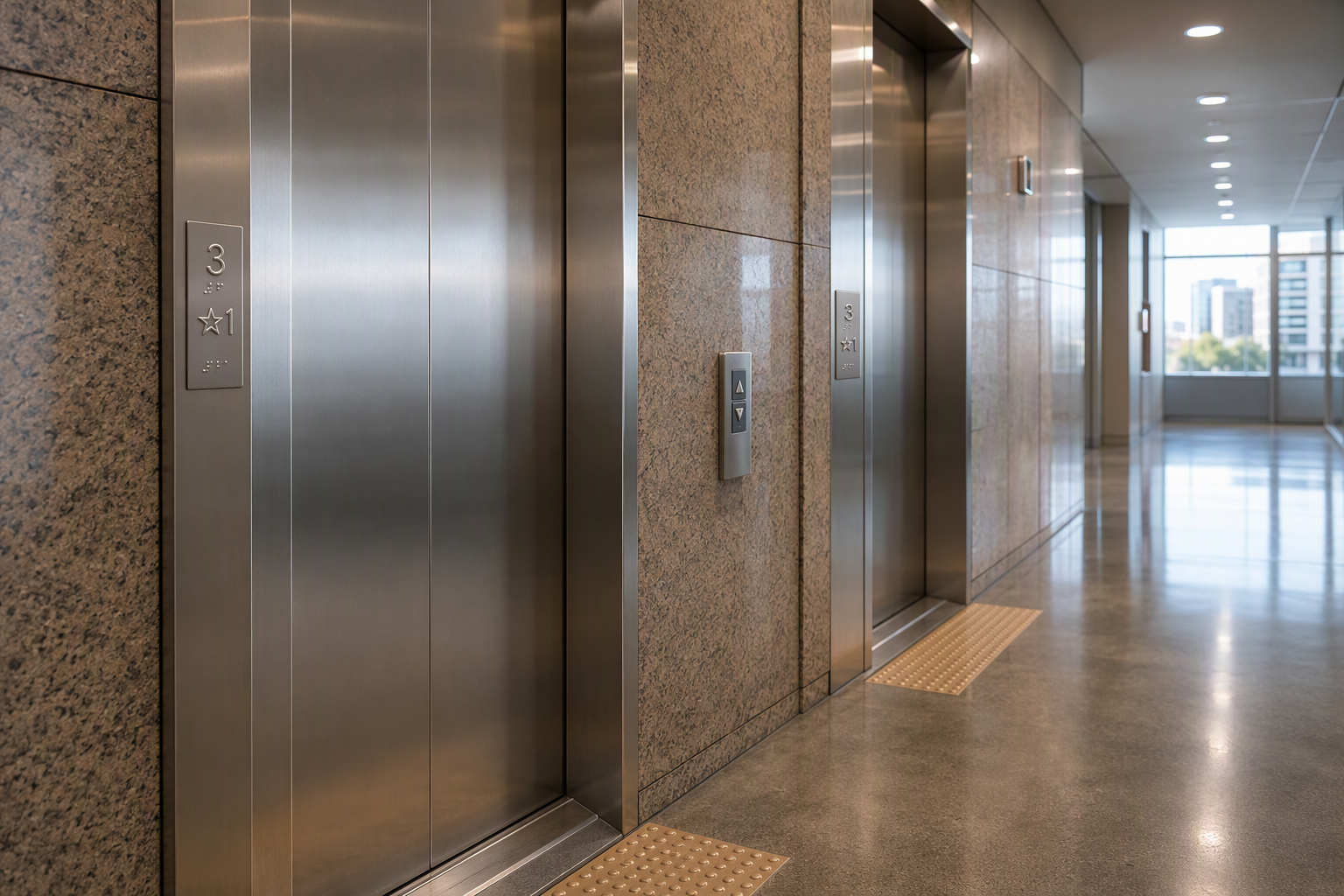
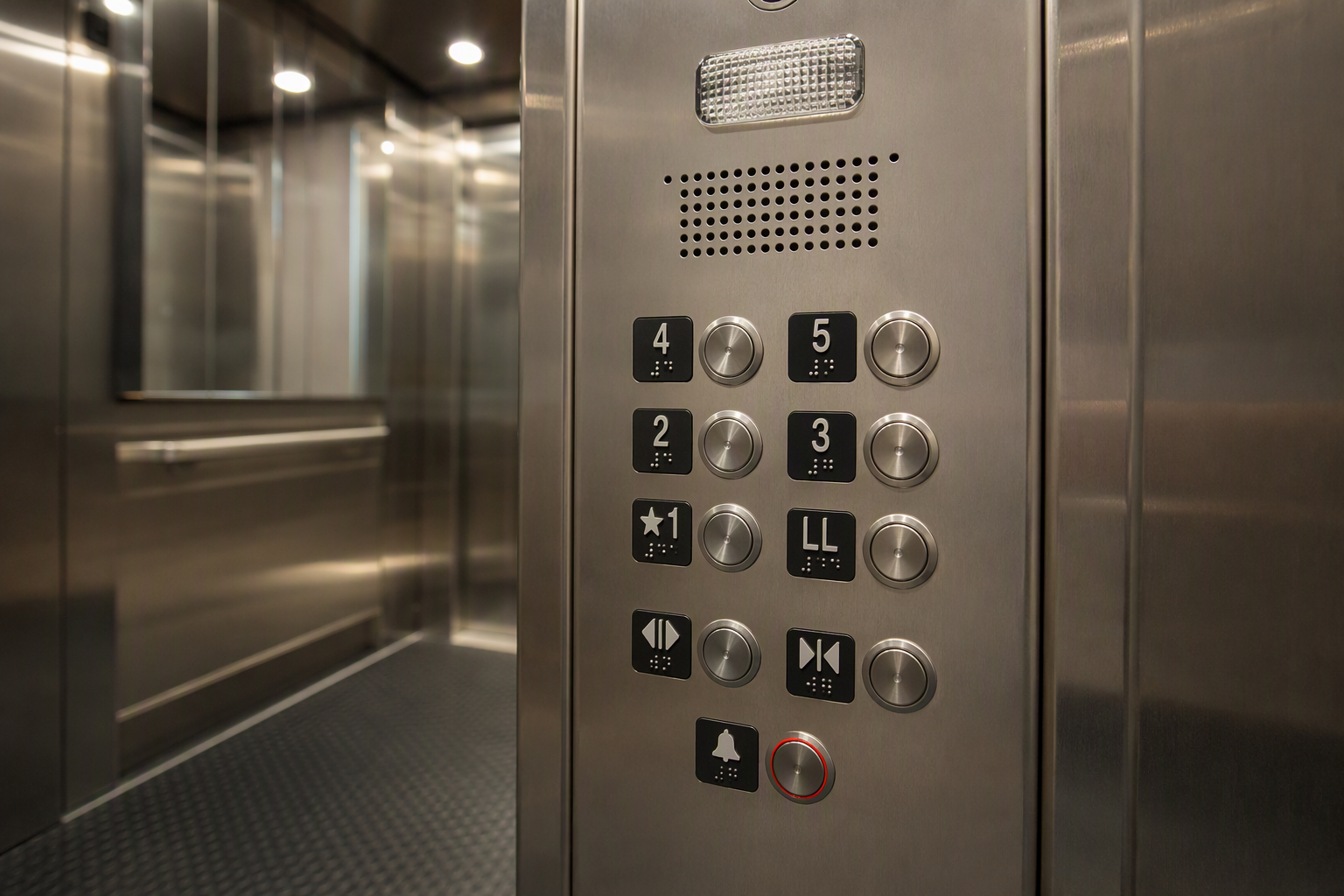
- Raised and Braille floor designations on hoistway entrances and car control panels
- Audible and visual floor indicators
- Two-way emergency communication systems accessible to people with hearing or vision disabilities
- Controls at a height reachable from a wheelchair
- Leveling accuracy sufficient to align the cab floor with the landing floor
These requirements are drawn from the ADA Standards for Accessible Design, which are published and maintained at ada.gov. Building owners should consult those standards directly and work with a licensed design professional to map requirements to a specific project.
Which California Commercial Buildings Are Exempt from the Elevator Requirement?

The ADA provides a limited “elevator exemption” that applies to buildings with fewer than three stories above grade and with no floor above or below grade exceeding 3,000 square feet. Buildings that qualify for this exemption are not required to install an elevator solely because of the ADA — though they may still need to provide accessible routes on the ground floor.
Important limitations apply:
- The exemption does not apply to shopping centers, shopping malls, or the professional offices of a healthcare provider — these building types must provide elevator access regardless of size or number of stories.
- The exemption does not apply to terminals, depots, or other stations used for public transportation.
- If a building voluntarily installs an elevator, that elevator must comply with ADA accessibility standards.
- California’s own accessibility codes, enforced through the California Building Code, may impose requirements beyond the federal ADA floor — building owners should verify compliance with both frameworks.
What Triggers an ADA Elevator Compliance Upgrade?
This is the question that most frequently catches California building owners off guard. Compliance obligations are not static — they can be activated by construction activity, change of occupancy, or change in building use even if the elevator itself is not being touched.
The following categories of activity commonly trigger an upgrade obligation:
1. Alterations to the Elevator Itself
Any alteration to an existing elevator that affects usability or accessibility must be brought into conformance with ADA Standards to the maximum extent feasible. Replacing a cab interior, modernizing a control panel, changing door operators, or upgrading communication systems can each trigger this obligation.
2. Alterations to the Path of Travel
Under the ADA, when a primary function area of a building is altered, the path of travel to that area — including restrooms, telephones, and the elevator — must be made accessible. The cost of this “path of travel” remediation is required up to a threshold defined in the ADA Standards; consult ada.gov for current path-of-travel cost provisions.
3. Change of Occupancy or Use
Converting a building or floor from one occupancy type to another — for example, converting storage space into office or retail use — can trigger building permit requirements that in turn require accessibility upgrades.
4. New Construction
All new commercial construction subject to the ADA must comply fully with current ADA Standards, including all elevator requirements applicable to the building type.
5. Cal/OSHA Material Alteration Permits
In California, a permit from the Cal/OSHA Elevator Unit is required before a conveyance is materially altered. A material alteration in the elevator’s mechanical or safety systems may simultaneously require accessibility upgrades to comply with ADA Standards. The two permit tracks — state safety and federal accessibility — run in parallel.
How Does California State Law Interact with Federal ADA Requirements?
California elevator safety regulation operates independently from — and in addition to — the ADA’s accessibility mandate. The Cal/OSHA Elevator Unit, part of the California Department of Industrial Relations, enforces elevator safety under California Labor Code Sections 7300–7324.2 and the California Code of Regulations, Title 8, Elevator Safety Orders (Sections 3000–3146).
California has adopted the ASME A17.1/CSA B44 Safety Code for Elevators and Escalators, 2004 edition (Group IV Elevator Safety Orders), for installation contracts signed on or after May 1, 2008. This code governs the mechanical safety, structural integrity, and operational performance of elevators — it does not replace ADA accessibility requirements, which are a separate legal obligation.
As of 2026, California has proposed a Group V update to its Elevator Safety Orders that would incorporate elements of ASME A17.1-2019. The California Standards Board held a public hearing on this update on June 18, 2026. No effective date has been posted. Building owners planning major elevator projects in 2026 and beyond should monitor the Cal/OSHA Elevator Unit for updates.
What Are the Cal/OSHA Permit Requirements for California Elevator Work?
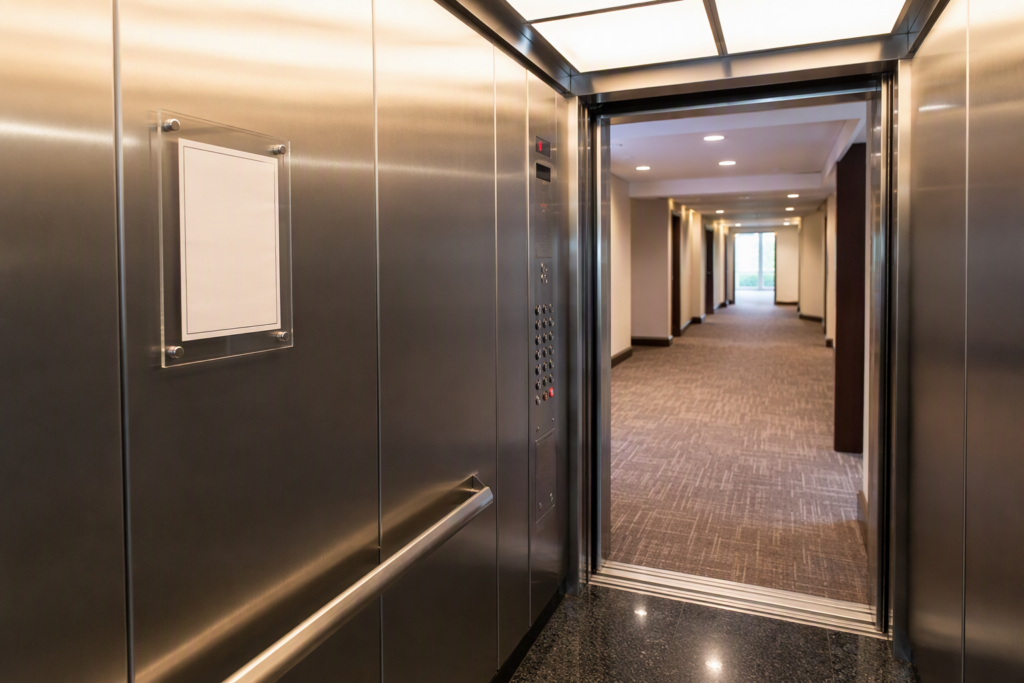
No elevator may be operated in California without a valid, current permit to operate issued by the Cal/OSHA Elevator Unit. That permit must be posted conspicuously in the elevator car. Specific requirements include:
- A Cal/OSHA permit is required before a conveyance is erected, installed, or materially altered.
- Every elevator in California must be inspected at least once a year; a conveyance found safe receives a permit to operate for up to one year.
- Cal/OSHA may issue a permit for up to two years for an elevator in safe condition covered by a full maintenance contract with a C-11 licensed elevator company.
- Arranging the annual reinspection is the elevator owner’s responsibility.
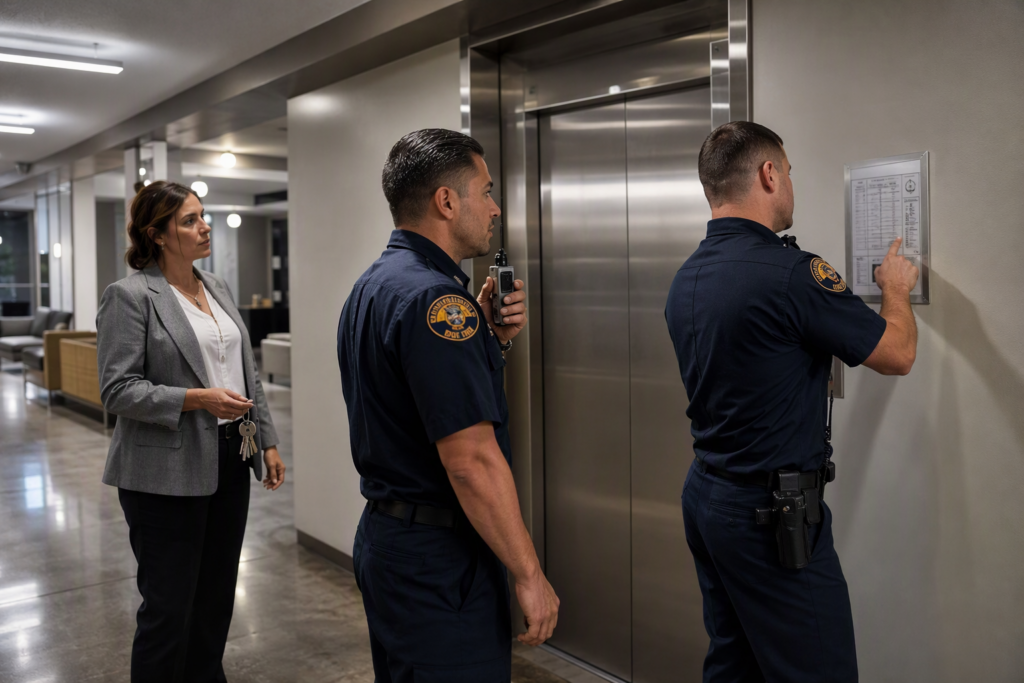
- Only State of California safety engineers and Certified Competent Conveyance Inspectors (CCCI) may perform elevator inspections in California.
- Each new elevator must be inspected by Cal/OSHA and receive a permit to operate before it is placed in service.
Companies performing elevator work in California must hold Certified Qualified Conveyance Company (CQCC) certification from Cal/OSHA, which requires a current C-11 Elevator Contractor license issued by the California Contractors State License Board (CSLB), along with certificates of workers’ compensation and liability insurance. Individual mechanics must hold Certified Competent Conveyance Mechanic (CCCM) certification. Both CQCC and CCCM certifications last two years and require at least eight hours of continuing education for renewal.
What Are the Specific ADA Dimensional and Operational Standards for Elevator Cabs?
The ADA Standards for Accessible Design specify dimensional and operational requirements for elevator cabs. While the full specifications are detailed in the standards published at ada.gov, the categories of requirements include:
- Floor area: The cab must provide a minimum clear floor area sufficient for a wheelchair user to enter, maneuver, and exit without assistance.
- Door clear width: Doors must provide a minimum clear opening width when open.
- Door timing: Doors must remain open long enough for a person with a disability to enter or exit; a reopening device must prevent door closure when a person or object is detected.
- Control panel height: Operable controls must be within reach ranges defined in the standards for both forward and side approaches from a wheelchair.
- Raised and Braille characters: Floor designation characters must appear both on hoistway entrance jambs and on the car control panel, using raised characters and Braille.
- Visual and audible signals: Elevator halls and cars must provide audible and visible signals indicating car arrival and direction of travel.
- Emergency two-way communication: The cab must contain a two-way communication system that does not require voice communication to activate (to serve individuals who are deaf or hard of hearing).
- Floor leveling: The cab must automatically level within a defined tolerance at each floor landing.
Building owners should obtain the full text of the ADA Standards at ada.gov and engage a qualified accessibility consultant or licensed architect for project-specific guidance.
What Is the Difference Between New Construction and Existing Building (Barrier Removal) Obligations?
The ADA creates two different tiers of obligation depending on whether a building is new construction or an existing facility.
New construction: All new commercial buildings designed or constructed for first occupancy must comply fully with ADA Standards, with no cost limitation. Elevator requirements apply to all new buildings that meet the story or square footage thresholds, regardless of the cost of compliance.
Existing buildings — barrier removal: Places of public accommodation operating in existing buildings must remove architectural barriers when doing so is “readily achievable” — meaning accomplishable without much difficulty or expense. The readily achievable standard is explicitly tied to the financial resources of the business. There is no bright-line dollar figure in the ADA itself; the standard is applied on a case-by-case basis.
Existing buildings — alterations: When alterations are made to an existing building, the altered elements and the path of travel to the altered primary function area must comply with ADA Standards to the maximum extent feasible. The “maximum extent feasible” standard is higher than “readily achievable” and applies regardless of cost when a triggering alteration occurs.
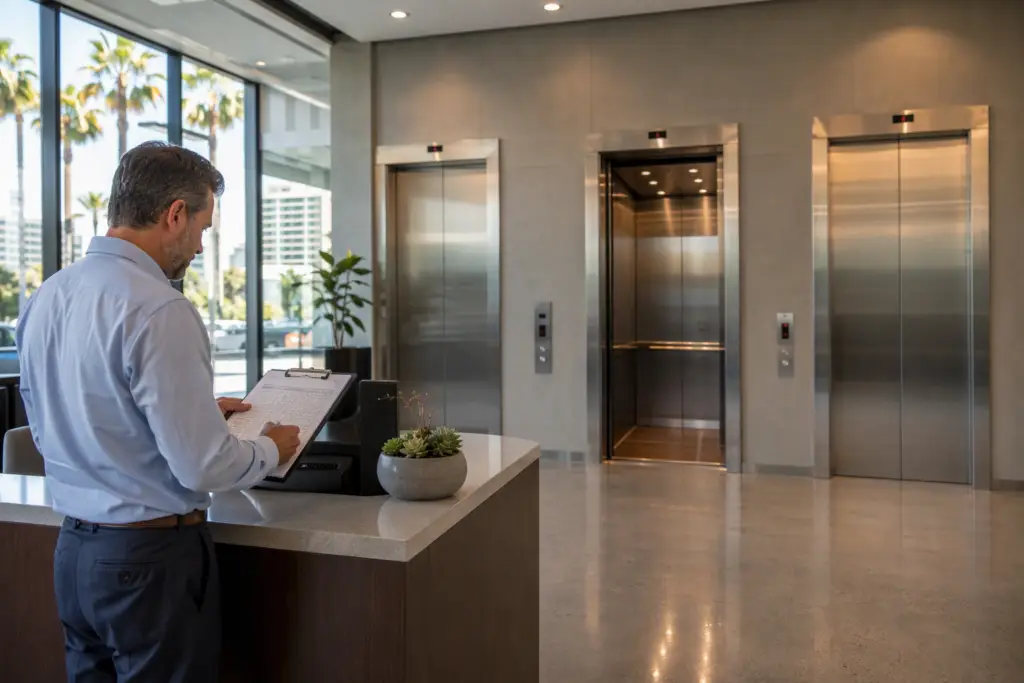
What Does an ADA Elevator Compliance Assessment Typically Include?
A professional compliance assessment for an existing elevator typically covers the following areas:
- Review of the current permit to operate and Cal/OSHA inspection history.
- Physical measurement of cab interior dimensions and door clear opening width against ADA Standards.
- Testing of door timing, reopening device function, and door force.
- Inspection of car control panel layout, control heights, and raised/Braille character signage.
- Evaluation of hall signals, floor indicators, and audible signals at each landing.
- Testing of the two-way emergency communication system for accessibility to people with sensory disabilities.
- Measurement of cab leveling accuracy at each floor landing.
- Review of any planned construction activity that may trigger a path-of-travel obligation.
- Documentation of findings and prioritization of remediation items.
Liftech Elevator provides data-driven elevator assessments for commercial building owners across California, documenting existing conditions against applicable ADA Standards and Cal/OSHA requirements to give owners a clear picture of their compliance position before undertaking any construction or modernization work.
What Are the 2025–2026 Trends Affecting ADA Elevator Compliance in California?
Several developments are shaping the elevator compliance landscape for California commercial buildings in 2025 and 2026:
Pending code update: California’s proposed Group V Elevator Safety Orders, which incorporate elements of ASME A17.1-2019, are progressing through the rulemaking process following the June 2026 public hearing. Once adopted, the updated safety orders may affect modernization scope for installations predating the new standard. Building owners planning major projects should monitor the Cal/OSHA Elevator Unit for any posted effective date.
Emergency communication technology: The shift from analog telephone infrastructure to digital and Voice over IP (VoIP) systems is prompting building owners to evaluate whether existing cab emergency phones continue to function reliably. This technology transition frequently surfaces as a compliance consideration during ADA assessments, particularly for the two-way communication requirement.
Increased enforcement activity: Building owners and property managers across California report heightened attention to ADA compliance during building permit review, driven in part by expanded use of digital plan check processes that flag accessibility deficiencies earlier in the construction approval workflow.
Aging equipment modernization: A significant portion of California’s commercial elevator inventory was installed before the current ADA Standards took effect. As equipment ages and modernization becomes operationally necessary, building owners are discovering that cab enlargement, control panel replacement, and door system upgrades simultaneously trigger ADA compliance obligations — making comprehensive planning essential.
Does Los Angeles Have Its Own Elevator Compliance Program?
Yes. The City of Los Angeles operates its own elevator and conveyance inspection program through the Los Angeles Department of Building and Safety (LADBS). Building owners with elevators in the City of Los Angeles should contact LADBS directly to understand local permit and inspection requirements, which operate alongside — not instead of — Cal/OSHA’s statewide authority and the federal ADA.
What Happens if an Elevator Fails an ADA or Cal/OSHA Inspection?
The consequences of noncompliance differ depending on which authority is involved:
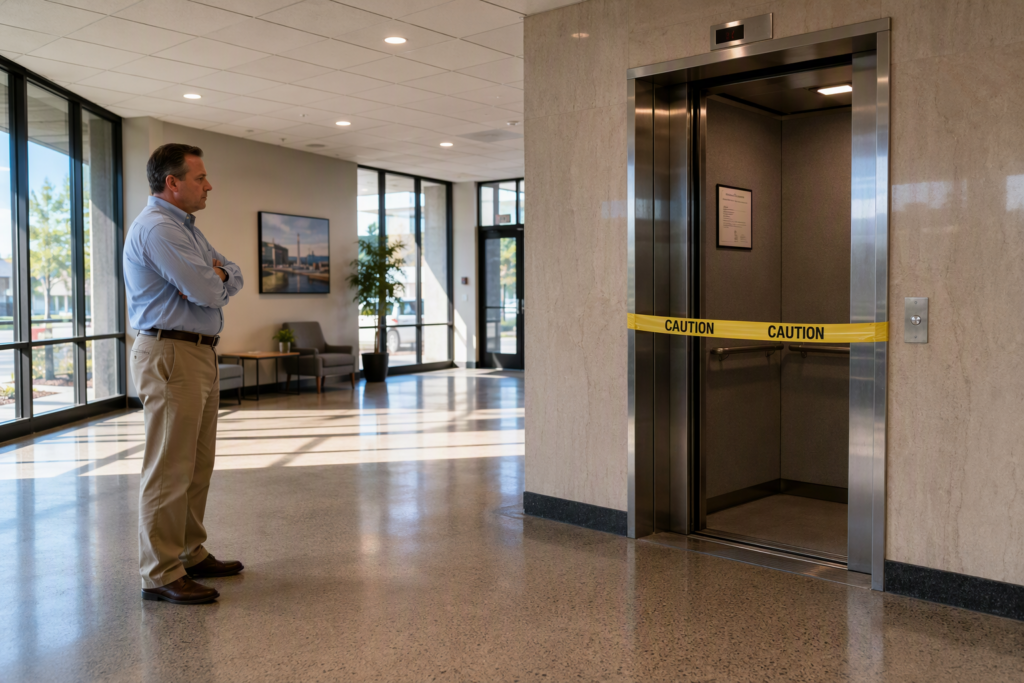
Cal/OSHA noncompliance: If a California elevator fails its annual safety inspection or a material alteration is performed without a permit, the Cal/OSHA Elevator Unit has authority to order the elevator taken out of service until violations are corrected. Operating an elevator without a valid permit to operate violates California Labor Code requirements.
ADA noncompliance: The ADA is enforced through the U.S. Department of Justice, which may initiate compliance reviews or respond to complaints. Private parties may also bring civil actions alleging ADA violations. Remedies can include injunctive relief (requiring specific barrier removal), civil penalties in DOJ-initiated cases, and attorneys’ fees.
The combination of potential loss of operating permit and civil liability makes proactive compliance assessment the lowest-risk path for California commercial building owners.
How Should a Building Owner Prioritize ADA Elevator Upgrades?
When a building has multiple accessibility deficiencies and limited near-term capital, the ADA provides guidance on prioritization. In general, the ADA’s implementing regulations suggest a priority order that places accessible entrance routes — including elevator access — ahead of other interior accessibility features. However, no single prioritization formula applies to every building, and the interaction between triggered alteration obligations and voluntary barrier removal means that projects should be planned with input from a qualified accessibility consultant.
Practically speaking, items that pose the greatest barrier to independent use — a non-functioning two-way emergency communication system, door reopening devices that fail to detect occupants, or significant leveling errors that create tripping hazards — should be addressed before cosmetic or signage deficiencies.
What Are the Most Common ADA Elevator Deficiencies Found in California Commercial Buildings?
Based on the types of issues California commercial elevator assessments routinely surface, common deficiencies include:
- Control panels that were original equipment and do not meet current reach range requirements
- Missing or worn Braille designations on hoistway jambs or cab control panels
- Door timing that does not provide sufficient time for a wheelchair user to enter or exit
- Outdated emergency telephone systems that have been disconnected from analog phone service
- Floor leveling tolerances that exceed ADA Standards due to worn components
- Hall lantern signals that do not provide both audible and visible notification
- Cab interiors that were renovated without updating accessibility features
None of these deficiencies is inherently complex to remediate in isolation, but discovering them for the first time during a building permit review — when a triggered alteration has already created a compliance obligation — compresses timelines and increases costs. Early identification through a proactive assessment gives owners the time to plan and budget remediation strategically.
How Can a Building Owner Verify That an Elevator Contractor Is Qualified to Perform ADA and Safety Compliance Work in California?
California law establishes specific certification requirements for elevator contractors. Before engaging any elevator company for compliance work, building owners should verify:
- The company holds an active Certified Qualified Conveyance Company (CQCC) certificate issued by the Cal/OSHA Elevator Unit.
- The company holds a current C-11 Elevator Contractor license issued by the California Contractors State License Board (CSLB).
- The mechanics assigned to the project hold Certified Competent Conveyance Mechanic (CCCM) certification.
- The company carries current certificates of workers’ compensation and liability insurance.
Only a Certified Competent Conveyance Mechanic working for a Certified Qualified Conveyance Company may legally maintain, repair, alter, or replace components on a California elevator. Certifications are valid for two years and require at least eight hours of continuing education for renewal.
Liftech Elevator operates as a data-driven service provider for California commercial properties, helping building owners document existing elevator conditions, identify ADA and Cal/OSHA compliance gaps, and plan remediation work performed by properly certified personnel.
Sourced Reference Table
| Requirement | Authority | Source |
|---|---|---|
| Elevators required in buildings with 3+ stories or floors >3,000 sq ft | ADA Standards for Accessible Design | ada.gov |
| Annual inspection required; permit to operate issued for up to one year | Cal/OSHA Elevator Unit, California Labor Code §§ 7300–7324.2 | dir.ca.gov/dosh/Elevator |
| Up to two-year permit for elevators under full maintenance contract with C-11 licensed company | Cal/OSHA Elevator Unit | dir.ca.gov/dosh/Elevator |
| Adopted safety code: ASME A17.1/CSA B44, 2004 edition, effective May 1, 2008 | Cal/OSHA, Title 8 CCR §§ 3000–3146 | asme.org/codes-standards / dir.ca.gov/dosh/Elevator |
| CQCC and CCCM certifications valid two years; renewal requires 8 hours continuing education | Cal/OSHA Elevator Unit | dir.ca.gov/dosh/Elevator |
| Cal/OSHA permit required before material alteration of any conveyance | California Labor Code §§ 7300–7324.2 | dir.ca.gov/dosh/Elevator |
Summary: Key Triggers for ADA Elevator Compliance Upgrades in California
- New construction meeting the story or square footage threshold under the ADA
- Any alteration to the elevator that affects usability
- Any alteration to a primary function area that triggers a path-of-travel obligation
- Change of occupancy or use requiring a building permit
- A material alteration requiring a Cal/OSHA permit
- Technology changes (e.g., analog phone disconnection) that render existing emergency communication non-functional
California commercial building owners who understand these triggers can plan compliance investments proactively rather than reactively — avoiding permit delays, enforcement action, and civil liability exposure.
Get a Free Elevator Compliance Assessment
Liftech Elevator helps California commercial building owners identify ADA accessibility gaps and Cal/OSHA compliance issues before they become enforcement problems. Whether you are planning a renovation, facing a permit review, or simply unsure of your elevator’s current compliance status, Liftech Elevator provides a data-driven assessment against applicable ADA Standards and California elevator safety requirements.
Contact Liftech Elevator for a free elevator assessment: 562-609-3478
Need elevator service you can rely on? Liftech Elevator is ready to help.