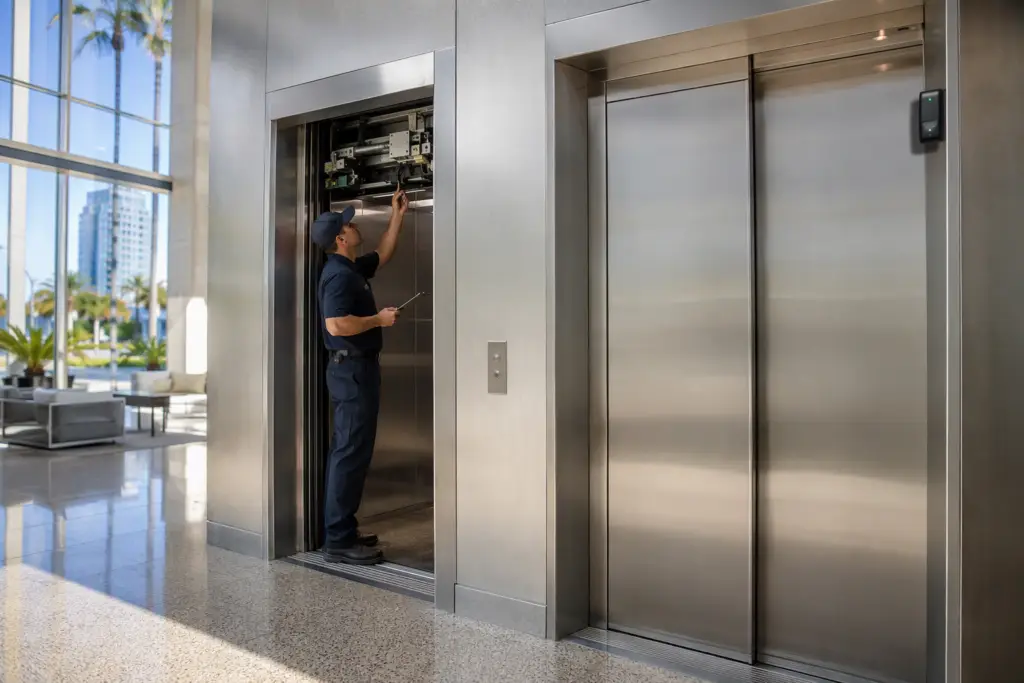
Hydraulic vs. Traction Elevators for Mid-Rise Commercial Buildings: A Complete Comparison and Decision Guide
Quick Answer: For a mid-rise commercial building (typically four to ten stories), a traction elevator is generally the stronger choice because it offers greater travel height, lower long-term energy consumption, and no underground hydraulic cylinder — while hydraulic elevators remain a practical, lower-upfront-cost option for low-rise applications of three to five floors where machine-room space is limited.
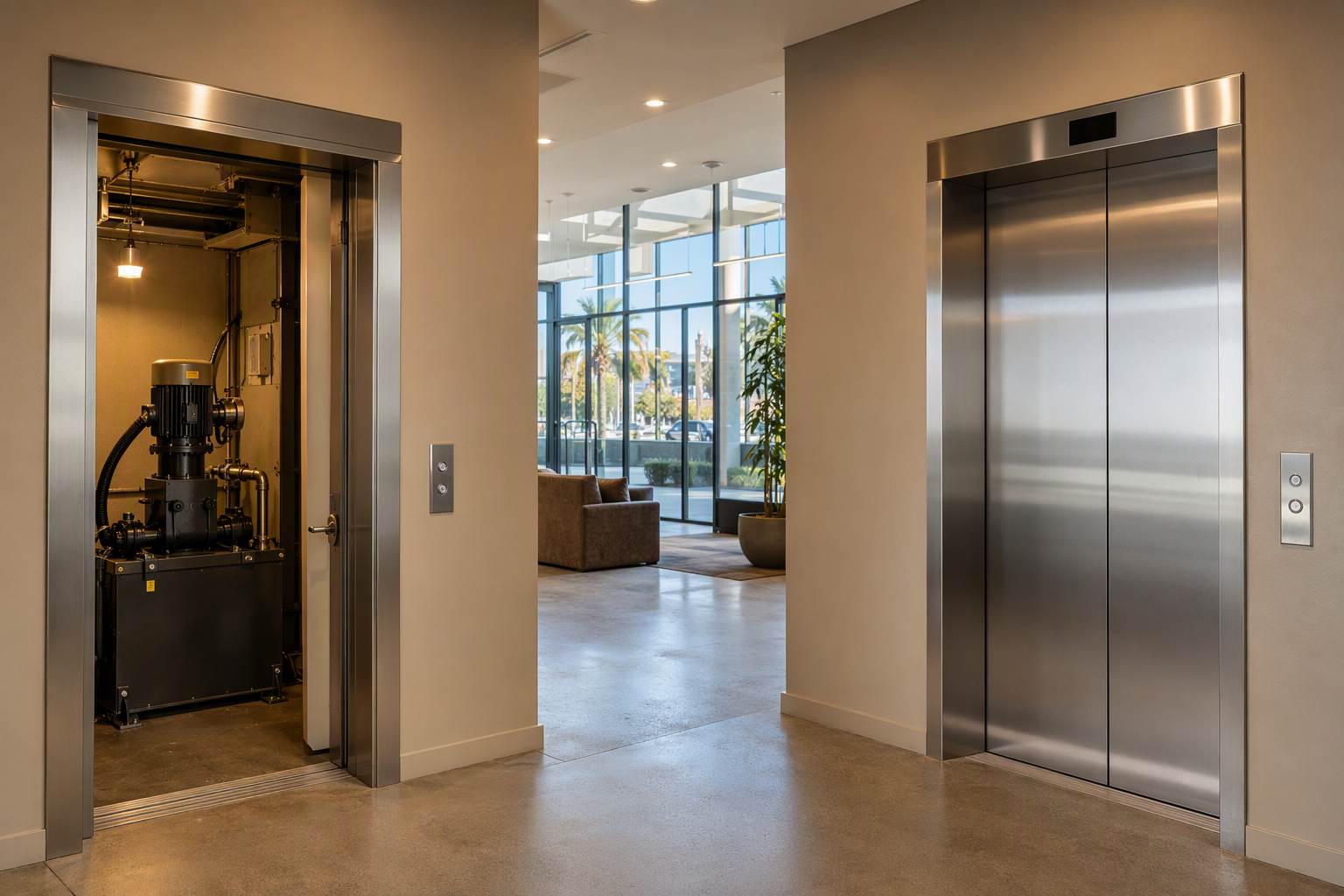
Choosing between a hydraulic and a traction elevator is one of the most consequential decisions a California commercial building owner or developer will make. The wrong system can mean higher operating costs, premature obsolescence, or compliance complications under Cal/OSHA’s Elevator Unit and the ASME A17.1/CSA B44 Safety Code for Elevators and Escalators. This guide walks through every major factor — how each system works, total cost of ownership, energy use, compliance, and the specific building conditions that favor one technology over the other — so that property owners, general contractors, and facilities managers can make a well-supported decision.
How Does a Hydraulic Elevator Work?
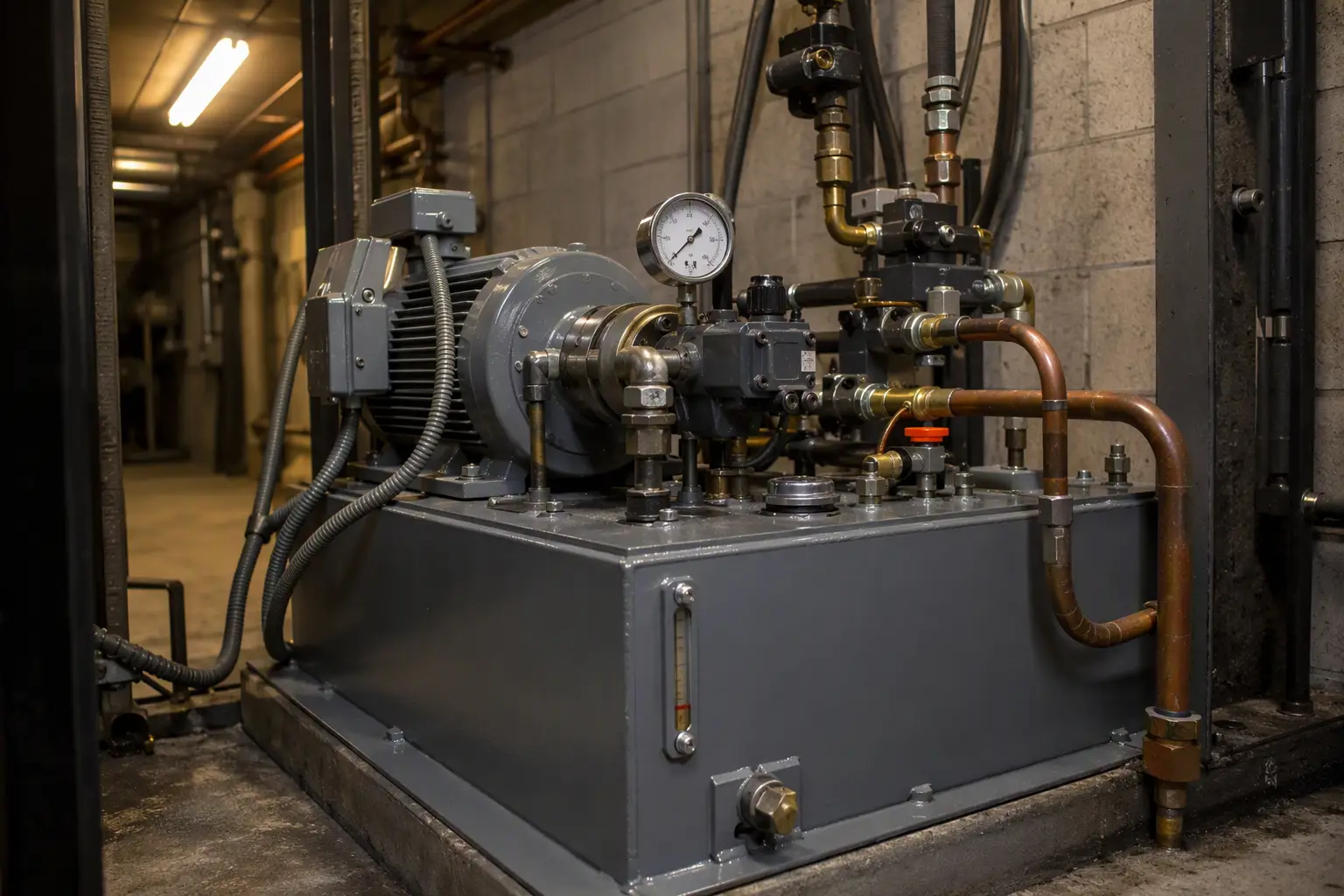
A hydraulic elevator uses a fluid-driven piston or ram to push the elevator cab upward. An electric pump forces hydraulic oil into a cylinder, extending the piston and raising the car. To descend, a valve releases oil back into a reservoir tank, allowing gravity to lower the cab. The pump unit and oil reservoir are housed in a machine room, which can be located adjacent to — rather than directly above — the hoistway.
There are two main hydraulic configurations used in commercial buildings:
- Hole-less (above-ground) hydraulic: Uses telescoping cylinders mounted beside or beneath the cab without an underground borehole. Preferred in California due to environmental concerns about in-ground cylinders and potential soil contamination from hydraulic fluid leaks.
- In-ground hydraulic: Uses a single cylinder sunk into a borehole below the pit. Still permitted in some applications but subject to additional scrutiny regarding underground encasement requirements under California environmental regulations.
Hydraulic systems are inherently speed-limited. They are best suited to travel distances of up to approximately five stories and lower traffic volumes, making them a common choice for low-rise office buildings, small medical facilities, and parking structures.
How Does a Traction Elevator Work?
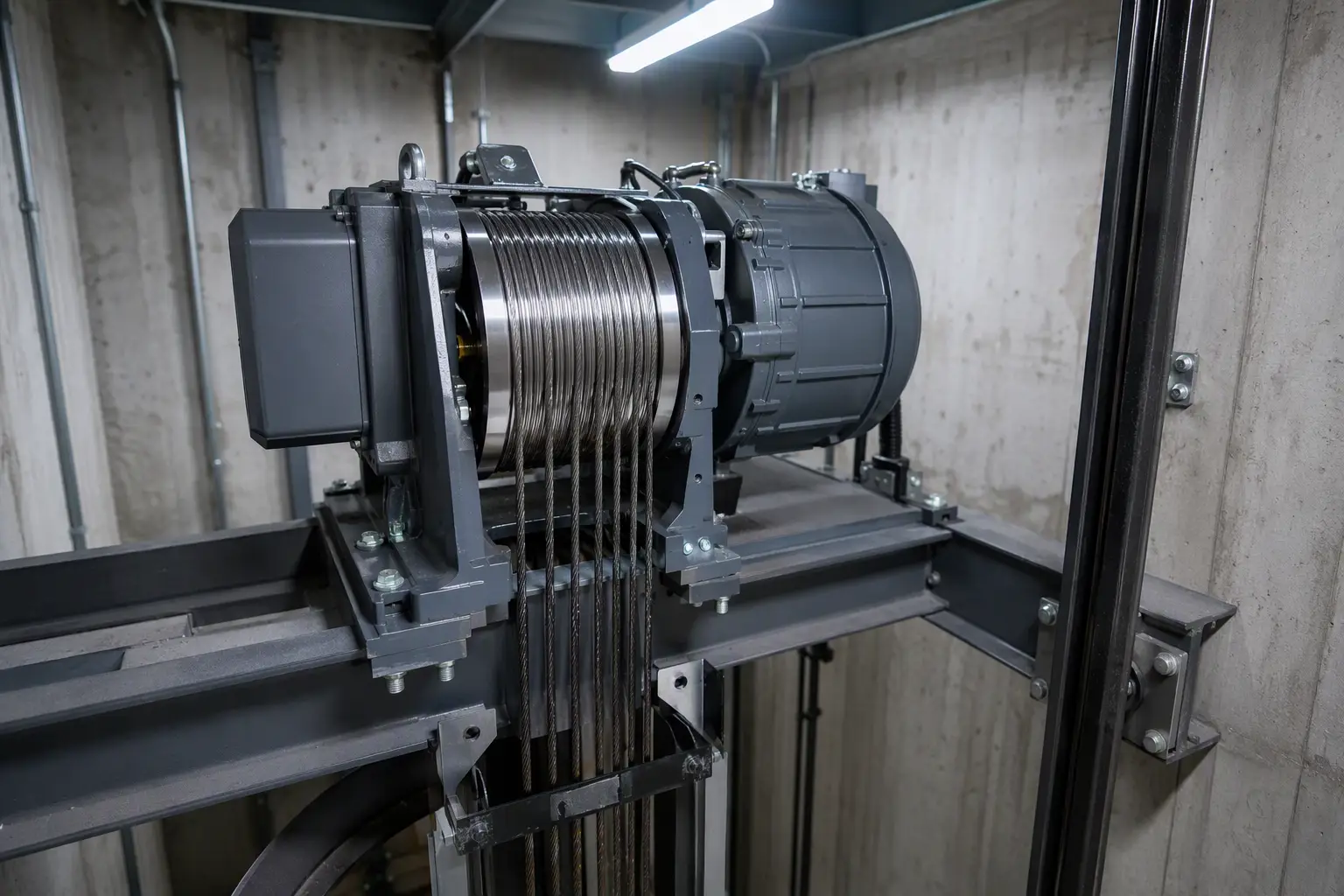
A traction elevator uses steel hoist ropes or flat belts wrapped around a grooved drive sheave, powered by an electric motor. As the sheave rotates, it moves the ropes, raising or lowering the cab. A counterweight — typically equal to the cab weight plus a portion of the rated load — travels on the opposite side of the ropes, reducing the net load the motor must move and significantly improving energy efficiency.
Two primary traction configurations exist:
- Geared traction: A gearbox connects the motor to the drive sheave, reducing speed. Common in mid-rise applications where speeds are moderate.
- Gearless traction (including MRL — Machine-Room-Less): The motor drives the sheave directly without a gearbox, enabling higher speeds and smoother rides. Machine-room-less (MRL) gearless traction systems position the drive machine in the hoistway overhead or pit, eliminating a dedicated machine room and making this configuration increasingly popular for mid-rise commercial retrofits and new construction.
Traction elevators are well suited to buildings of five stories and above, high-traffic commercial environments, and projects where long-term operating cost and energy efficiency are priorities.
What Are the Core Differences Between Hydraulic and Traction Elevators?
| Factor | Hydraulic Elevator | Traction Elevator |
|---|---|---|
| Drive mechanism | Hydraulic fluid and piston | Steel ropes or belts on a motor-driven sheave |
| Typical travel height | Up to approximately 5 stories (hole-less); more with specialty systems | 5 stories and above; suited to mid- and high-rise |
| Travel speed | Lower speeds typical | Higher speeds available; MRL gearless reaches fast travel rates |
| Energy efficiency | Lower — motor runs continuously while ascending; no regeneration | Higher — counterweight offsets load; regenerative drives available |
| Machine room | Required (but can be remote from hoistway) | Required for geared; eliminated with MRL gearless |
| Environmental risk | Hydraulic fluid spill potential; in-ground cylinders add soil contamination risk | No hydraulic fluid; lower environmental risk |
| Ride quality | Smooth but slower; can experience leveling drift | Generally smoother at speed; MRL gearless widely regarded as superior |
| Upfront installation complexity | Lower for short-rise; no overhead load-bearing structure needed | Requires overhead structure to support machine and ropes |
| Maintenance considerations | Hydraulic fluid changes, seal inspections, cylinder corrosion checks | Rope/belt inspection, sheave wear, machine lubrication |
| Best application | Low-rise (2–5 stories), lower traffic, limited overhead space | Mid-rise (5–20+ stories), high traffic, energy-conscious projects |
What Do Hydraulic and Traction Elevators Cost to Own Over Time?
Cost comparisons between hydraulic and traction systems must account for upfront installation, ongoing energy use, maintenance, and eventual modernization. Because actual pricing varies widely by building specifics, local labor market conditions, and selected equipment manufacturer, no specific dollar figures are presented here — doing so without a verified source for California commercial projects would be misleading. Instead, the qualitative cost relationship is well established in the industry:
| Cost Category | Hydraulic | Traction (Geared or MRL Gearless) |
|---|---|---|
| Initial equipment and installation | Generally lower for short-rise buildings | Generally higher upfront, especially MRL gearless |
| Annual energy cost | Higher — continuous motor load during ascent; no regeneration | Lower — counterweight reduces net load; regenerative options available |
| Routine maintenance | Moderate — fluid changes, seal and cylinder inspection | Moderate — rope/belt and sheave inspection, machine service |
| Modernization timeline | Hydraulic systems in older buildings may require fluid upgrades or cylinder replacement sooner | Traction systems, especially gearless, tend to have longer service life potential |
| Long-term ROI for mid-rise | Lower — energy and maintenance costs erode savings on initial installation | Higher — energy savings and longevity offset higher upfront cost over time |
| Environmental compliance costs | Potentially higher — in-ground cylinders may require encasement or replacement under state environmental guidance | Lower — no hydraulic fluid storage or disposal requirements |
Note: A qualified elevator contractor performing a site-specific assessment — such as the free assessment offered by Liftech Elevator — is the most reliable way to obtain accurate cost estimates for a specific California project.
What Are the Pros and Cons of Each System for a Mid-Rise Commercial Building?
| Hydraulic | Traction (MRL Gearless) | |
|---|---|---|
| Pros |
|
|
| Cons |
|
|
What California Regulations Apply to Both Elevator Types?
In California, both hydraulic and traction elevators are regulated under California Labor Code Sections 7300–7324.2 and the California Code of Regulations, Title 8, Elevator Safety Orders (Sections 3000–3146), enforced by the Cal/OSHA Elevator Unit, California Department of Industrial Relations. The adopted safety standard for installations covered by installation contracts signed on or after May 1, 2008 is the ASME A17.1/CSA B44, 2004 edition (Group IV Elevator Safety Orders).
Key California regulatory requirements that apply regardless of elevator type include:
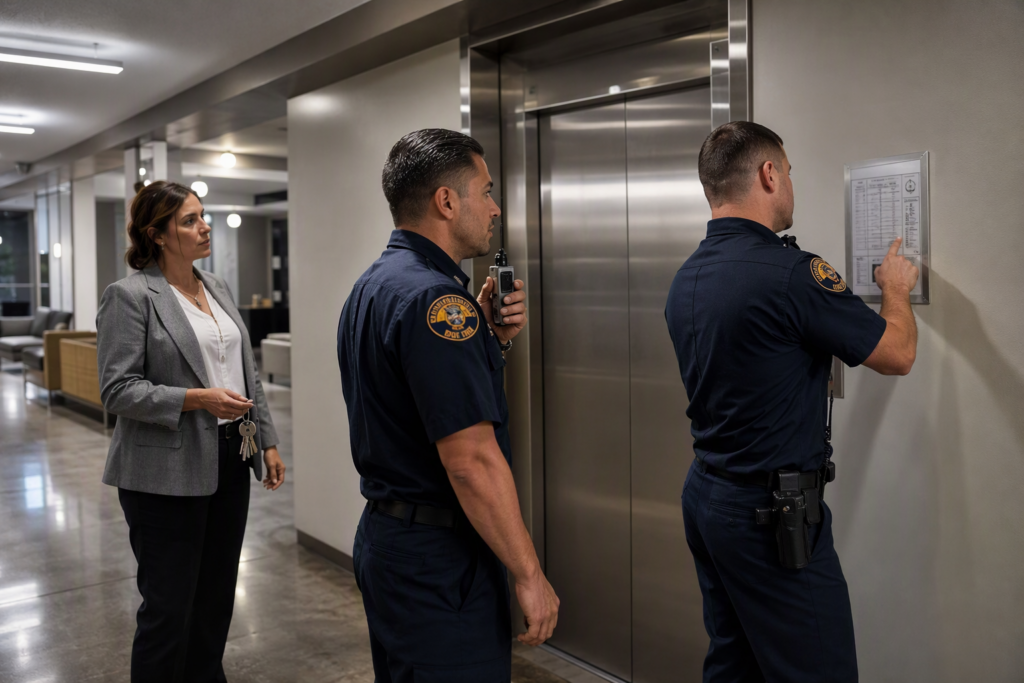
- No elevator may operate without a valid, current permit to operate issued by Cal/OSHA. The permit must be posted conspicuously in the elevator car.
- Every conveyance must be inspected at least once per year. A conveyance found safe receives a permit to operate for up to one year. Cal/OSHA may issue a permit for up to two years for an elevator in safe condition that is covered by a full maintenance contract with a C-11 licensed elevator company.
- Arranging the annual reinspection is the elevator owner’s responsibility.
- Only State of California safety engineers and Certified Competent Conveyance Inspectors (CCCI) may perform elevator inspections in California.
- A Cal/OSHA permit is required before a conveyance is erected, installed, or materially altered.
- Each new elevator must be inspected by Cal/OSHA and receive a permit to operate before it is placed in service.
- Companies that install, maintain, or repair elevators must be certified by Cal/OSHA as a Certified Qualified Conveyance Company (CQCC) and hold a C-11 Elevator Contractor license issued by the California Contractors State License Board (CSLB).
- Anyone who works on an elevator without supervision must be certified by Cal/OSHA as a Certified Competent Conveyance Mechanic (CCCM).
- CQCC, CCCM, and conveyance inspector certificates last two years and require at least eight hours of continuing education for renewal.
California is also evaluating a proposed Group V update to its Elevator Safety Orders that would incorporate portions of ASME A17.1-2019. A public hearing was held on June 18, 2026; no effective date has been posted as of publication. Building owners planning new installations or major alterations in 2026 should monitor the Cal/OSHA Elevator Unit for updates.
Buildings in the City of Los Angeles should be aware that Los Angeles operates its own elevator and conveyance inspection program through the Los Angeles Department of Building and Safety (LADBS). Owners with Los Angeles properties should confirm current requirements directly with LADBS in addition to Cal/OSHA requirements.
For ADA compliance, both hydraulic and traction elevators must meet accessibility requirements when installed in commercial buildings covered by the Americans with Disabilities Act. The ADA Standards for Accessible Design apply to new construction and alterations regardless of elevator drive type.
How Do You Choose the Right Elevator Type for a Mid-Rise Commercial Building?
The decision framework for a four-to-ten-story commercial building in California can be summarized around five key factors:
- Determine building height and travel distance. If the building is five stories or taller, traction is typically the technically appropriate choice. Hydraulic systems are generally viable only for up to approximately five stories with standard hole-less configurations.
- Assess traffic demand. A medical office building or a multi-tenant commercial tower with high peak-hour traffic requires a higher-speed, higher-capacity system — pointing toward traction. A low-traffic four-story office with minimal daily trips may be adequately served by hydraulic.
- Evaluate machine room availability and structural overhead. If existing or planned construction cannot accommodate overhead structural support for a traction machine, a hole-less hydraulic with a remote machine room may be more feasible — though an MRL gearless traction system can often address this concern with careful hoistway planning.
- Model total cost of ownership, not only installation cost. For a building expected to operate for twenty or more years, the energy savings associated with a traction system — particularly one with regenerative drive capability — can offset the higher initial investment over the building’s service life.
- Confirm California compliance pathway. Verify that the selected system can be permitted under the current ASME A17.1/CSA B44, 2004 edition (Group IV Elevator Safety Orders) or whatever edition Cal/OSHA requires at the time of permit application. Work only with a Cal/OSHA-certified CQCC and C-11-licensed contractor.
What Is the Typical Installation Timeline for Each System?
Installation timelines vary significantly based on building complexity, contractor scheduling, equipment lead times, and Cal/OSHA permitting. A general qualitative comparison:
- Hydraulic systems for low-rise applications tend to have shorter on-site installation times due to less complex rigging requirements, though hole-less cylinder installation and machine room plumbing add time compared to simple rope-and-sheave systems.
- Traction systems, especially MRL gearless installations in existing buildings, may require more detailed coordination for overhead structural modifications or hoistway reinforcement, potentially extending the overall project timeline.
- Both system types require a Cal/OSHA inspection and issuance of a permit to operate before the elevator can be placed in service. Factor permit processing time into the project schedule.
Liftech Elevator recommends beginning the permitting and equipment specification process well in advance of planned construction completion to avoid project delays caused by inspection scheduling or equipment lead times.
Is a Traction Elevator Always Better Than Hydraulic for Commercial Use?
Not always. While traction is the technically preferred solution for mid-rise and high-rise commercial buildings, there are specific scenarios where hydraulic remains a sound choice:
- Buildings of two to four stories with low traffic volume and modest budget constraints
- Renovation projects where the existing hoistway and structural system are configured for hydraulic and the cost of structural modification for traction is prohibitive
- Applications such as parking structures or freight service where speed is not a primary requirement
- Projects where a remote machine room is more architecturally practical than any overhead machine space
A properly designed, maintained, and Cal/OSHA-compliant hydraulic elevator in a suitable application will serve a building reliably. The problem arises when hydraulic is selected for a building where traction is clearly the better technical fit — typically at five stories and above, or in high-traffic environments — based primarily on lower upfront cost, without accounting for lifecycle costs.
What Maintenance Does Each Elevator Type Require Under California Law?
Both hydraulic and traction elevators must be maintained in accordance with the ASME A17.1/CSA B44 Safety Code for Elevators and Escalators as adopted by California, and must pass annual inspections under Cal/OSHA’s Elevator Safety Orders. Key maintenance distinctions include:
- Hydraulic-specific: Hydraulic fluid condition and level monitoring, pump and valve inspection, seal integrity, and — for in-ground systems — cylinder corrosion and encasement condition. Fluid changes and environmental compliance with California regulations governing hydraulic fluid disposal are also required.
- Traction-specific: Hoist rope or flat belt inspection for wear and elongation, sheave groove condition, governor and safety gear testing, lubrication of guide rails, and drive machine service.
- Both systems: Safety device testing, door operator and interlock inspection, controller functionality, pit and hoistway condition, and emergency communication system function (refer to the applicable ASME A17.1 requirements for details on emergency communication; California’s specific requirements in this area are currently unsettled as the Group V rulemaking proceeds).
California law places responsibility for arranging annual reinspection on the elevator owner. Owners who maintain a full maintenance contract with a C-11-licensed CQCC may be eligible for Cal/OSHA to issue a permit to operate for up to two years rather than one year.
Can a Hydraulic Elevator Be Converted to Traction Later?
Converting an existing hydraulic elevator to traction is technically possible in some buildings, but it is rarely a straightforward or inexpensive retrofit. Key considerations include:
- The hoistway must be evaluated for compatibility with rope or belt routing and overhead machinery or MRL machine placement.
- Structural overhead capacity for the traction machine and rope attachment must be confirmed and may require engineering modifications.
- The conversion qualifies as a material alteration under California law, requiring a Cal/OSHA permit before work begins and a Cal/OSHA inspection before the converted elevator is placed back in service.
- All work must be performed by a Cal/OSHA-certified CQCC using CCCMs.
For most building owners, the preferable approach is to select the correct system type at the time of initial installation or planned modernization, rather than treating a future conversion as a fallback option.
What Should a Building Owner Do Before Selecting an Elevator System?
- Engage a qualified elevator consultant or CQCC-certified contractor early in the design phase — ideally before architectural drawings are finalized, so hoistway dimensions, machine room requirements, and structural needs can be incorporated from the start.
- Define the traffic demand profile — number of occupants, peak-hour traffic patterns, number of stops, and any freight or accessibility requirements.
- Confirm building height and travel distance to establish which drive technologies are technically viable.
- Obtain a Cal/OSHA permit for installation or material alteration before any work commences. No elevator may be erected, installed, or materially altered in California without this permit.
- Evaluate the total cost of ownership across a realistic service horizon — not only the initial equipment and installation cost.
- Select a contractor that holds both a California C-11 Elevator Contractor license (CSLB) and Cal/OSHA CQCC certification, employing Cal/OSHA-certified CCCMs for all work.
- Plan for the annual inspection cycle from day one — the elevator owner is responsible for scheduling reinspection, and failure to maintain a valid permit to operate can result in the elevator being taken out of service.
- Monitor the Cal/OSHA Group V rulemaking for updates that may affect code requirements for new installations or alterations.
How Does Liftech Elevator Help California Commercial Property Owners Navigate This Decision?
Liftech Elevator is a certified independent elevator service company serving commercial property owners and managers throughout California. Liftech Elevator operates as a Cal/OSHA Certified Qualified Conveyance Company (CQCC) with a C-11 Elevator Contractor license, employing Certified Competent Conveyance Mechanics (CCCMs) for all maintenance, repair, alteration, and inspection coordination work.
Unlike elevator manufacturers who may steer owners toward the system they manufacture, Liftech Elevator provides manufacturer-independent assessments — evaluating the building’s specific conditions, traffic requirements, budget parameters, and California compliance obligations to recommend the system that best serves the property over its full service life. Whether the project involves new installation, modernization of an aging hydraulic system, or evaluation of a traction system for a mid-rise commercial building, Liftech Elevator brings the technical expertise and California regulatory knowledge to guide owners through every step of the process — from initial specification through Cal/OSHA permitting, installation oversight, and ongoing maintenance.
Frequently Asked Questions
Is a traction elevator required for a six-story commercial building in California?
California’s Elevator Safety Orders and the adopted ASME A17.1/CSA B44 standard do not mandate a specific drive technology based solely on building height. However, the practical engineering constraints of hydraulic systems — particularly travel distance limitations and speed limitations — make traction the technically appropriate and commonly selected solution for buildings of five stories and above. A CQCC-certified elevator contractor can evaluate the specific building conditions and confirm which system configurations are viable for the project.
Do hydraulic and traction elevators require different permits in California?
Both types require a Cal/OSHA permit before installation or material alteration, and both require a Cal/OSHA inspection and issuance of a permit to operate before being placed in service. The permitting process is the same regardless of drive technology. Owners of buildings in the City of Los Angeles should also confirm current requirements with the Los Angeles Department of Building and Safety (LADBS), which operates its own conveyance inspection program.
Can an existing hydraulic elevator be modernized instead of replaced?
Yes. Hydraulic elevator modernization can extend system service life and improve energy efficiency, safety, and reliability. Modernization options range from control system upgrades and hydraulic fluid conversion to variable-speed pump units and complete cab refurbishment. Any modernization that constitutes a material alteration under California law requires a Cal/OSHA permit before work begins and an inspection before the elevator is returned to service.
How does energy efficiency differ between hydraulic and traction elevators?
Traction elevators — particularly gearless designs with regenerative drive systems — are significantly more energy-efficient than hydraulic elevators. Hydraulic systems require the pump motor to run continuously during ascent with no mechanism to recover energy during descent. Traction systems use a counterweight to reduce the net load the motor must move, and regenerative drives can return energy to the building’s electrical system during descent or when the counterweight is heavier than the cab load. For a high-traffic mid-rise building operating throughout the day, the cumulative energy difference over years of operation is material.
What is a machine-room-less (MRL) traction elevator and is it right for mid-rise commercial use?
An MRL traction elevator positions the drive machine in the hoistway overhead or pit, eliminating the need for a dedicated machine room. This configuration is widely used in mid-rise commercial new construction and retrofits because it recovers the architectural and rentable space that a machine room would otherwise occupy. MRL systems must still comply with all California Elevator Safety Orders and ASME A17.1/CSA B44 requirements, and maintenance access procedures differ from traditional machine room configurations. Liftech Elevator recommends discussing MRL suitability with a qualified elevator contractor during the project design phase.
Who is responsible for elevator inspections in California?
The elevator owner is responsible for arranging the annual reinspection. Only State of California safety engineers and Cal/OSHA-certified Certified Competent Conveyance Inspectors (CCCI) may perform elevator inspections in California. The elevator owner does not choose the inspector — Cal/OSHA manages the inspection program. However, owners with a full maintenance contract with a C-11-licensed CQCC may be eligible for a permit to operate valid for up to two years if the elevator is found in safe condition.
What happens if a commercial elevator in California does not have a valid permit to operate?
Operating an elevator without a valid, current permit to operate issued by Cal/OSHA is a violation of California Labor Code Sections 7300–7324.2. Cal/OSHA has authority to order an elevator out of service. For a commercial property, this can mean significant disruption to building operations, potential liability, and the cost of emergency inspection and compliance remediation. Maintaining continuous permit validity through timely annual inspections is a fundamental responsibility of California elevator owners.
How long does a Cal/OSHA elevator permit to operate last?
A Cal/OSHA permit to operate is valid for up to one year following an inspection that finds the conveyance safe. For elevators covered by a full maintenance contract with a C-11-licensed elevator company, Cal/OSHA may issue a permit to operate for up to two years. The permit must be posted conspicuously inside the elevator car at all times.
Get the Right Answer for Your Building — Free from Liftech Elevator
Selecting between a hydraulic and a traction elevator is a decision with long-term consequences for your building’s operating costs, energy performance, tenant experience, and California compliance obligations. Liftech Elevator’s team of Cal/OSHA-certified professionals provides manufacturer-independent assessments for California commercial property owners — at no charge.
Whether you are planning a new installation, evaluating a modernization, or simply trying to understand your options, Liftech Elevator will evaluate your building’s specific conditions and give you a clear, code-accurate recommendation.
Contact Liftech Elevator for a free elevator assessment: 562-609-3478
Need elevator service you can rely on? Liftech Elevator is ready to help.