What to Do When Your Elevator Is Making Strange Noises or Doors Are Not Closing Properly Between Scheduled Maintenance Visits
Elevator problems rarely announce themselves at convenient times. A grinding sound on a Tuesday morning or doors that hesitate and reverse mid-cycle can unsettle building occupants and expose property managers to liability. This FAQ hub covers every dimension of between-visit elevator issues — from immediate safety steps to compliance requirements under ASME A17.1 Safety Code for Elevators and Escalators and ADA accessibility standards — helping building owners in Signal Hill, Long Beach, Los Angeles, and Orange County make informed, defensible decisions before a technician arrives.
What should building managers do immediately when an elevator starts making strange noises or doors fail to close?
Immediately stop using the elevator if any occupant is at risk, post clear out-of-service signage, notify your elevator service provider, and document the symptoms in writing before the condition changes.
The sequence of actions taken in the first hour after a symptom appears can determine both occupant safety and regulatory compliance standing. Building managers should follow a structured protocol rather than relying on informal judgment, because California elevator regulations — enforced by the Division of Occupational Safety and Health (Cal/OSHA) under the Elevator, Escalator, and Other Conveyance Safety Orders — place the duty of safe operation on the building owner or their designated representative at all times, not only during scheduled inspections.
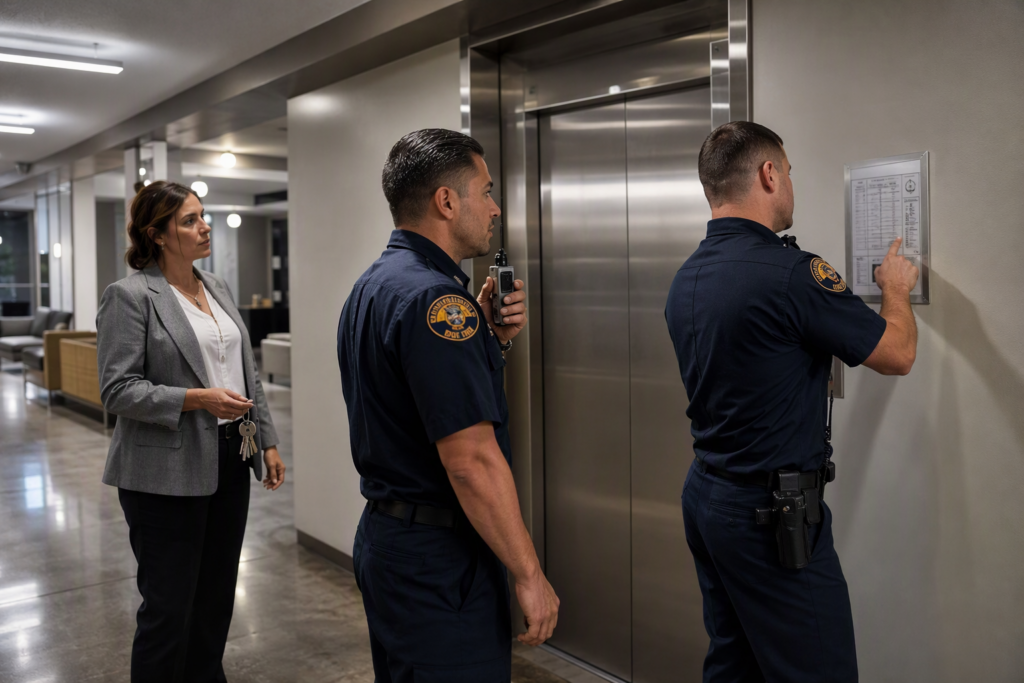
- Assess immediate risk: Determine whether anyone is currently trapped or in danger. If a passenger is inside a stalled car, call 911 before anything else. Do not attempt to manually open doors or force the car to move.
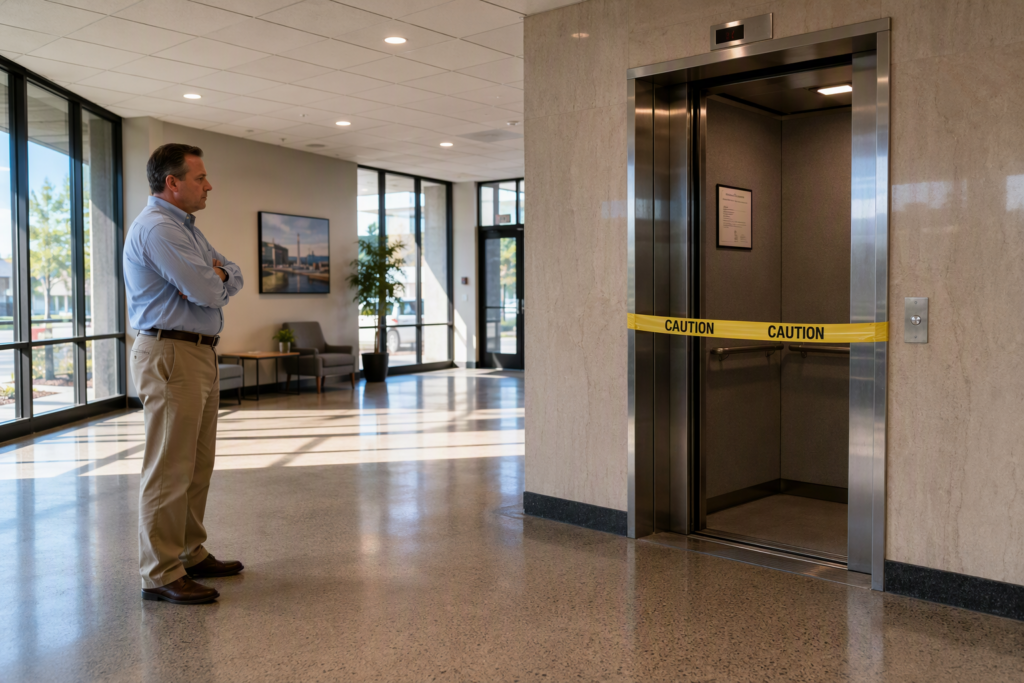
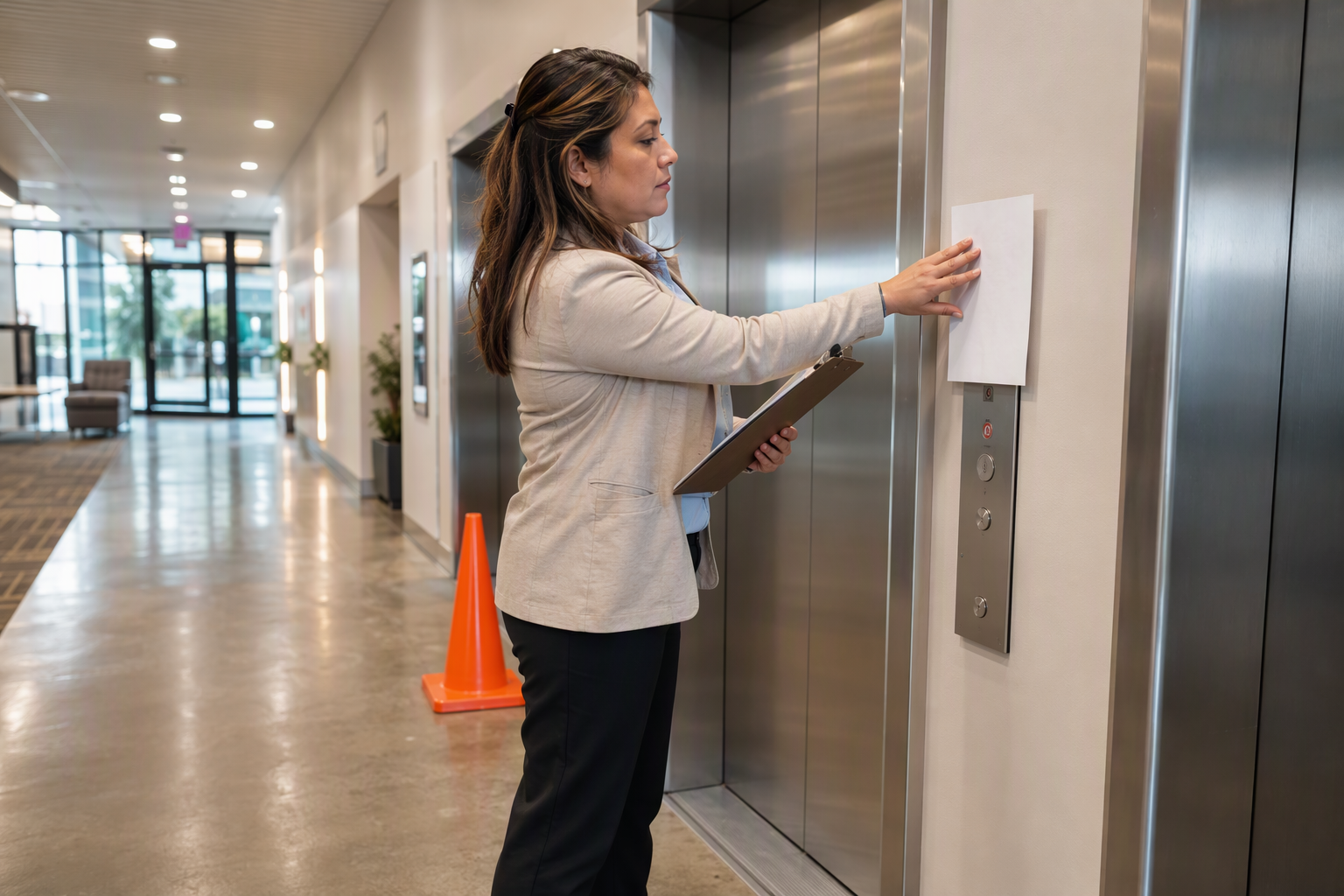
- Restrict access: Place physical barriers — cones, signage, or locked lobby gates — at every landing served by the affected elevator. Verbal warnings are insufficient; post printed “Out of Service” notices at each call button.
- Disable the elevator safely: If the malfunction does not involve a trapped occupant, use the in-car service panel or machine room key switch to take the unit out of normal service. Never cut main power without guidance from a qualified technician, as this can complicate a subsequent rescue.
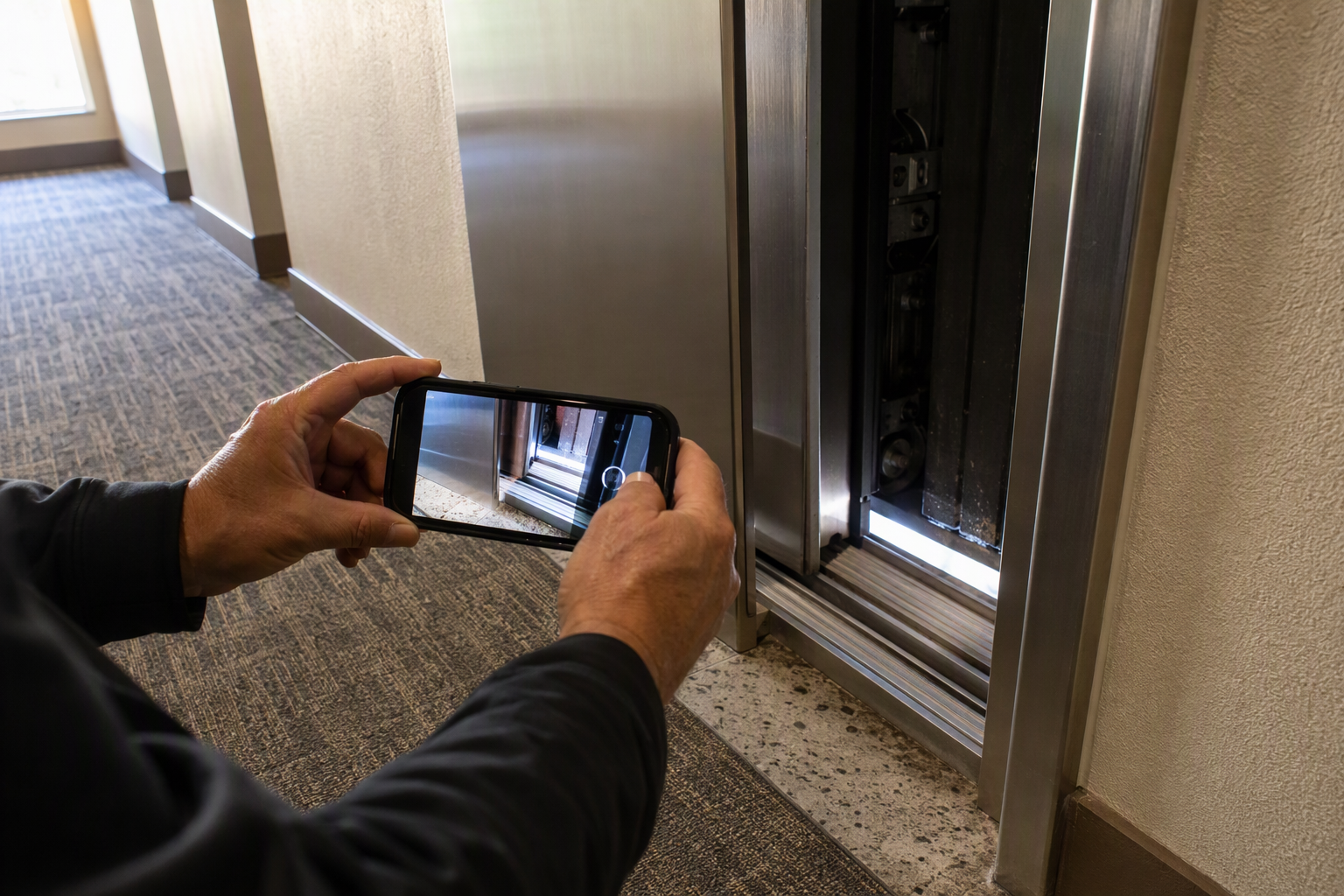
- Document the symptom: Note the time, floor, direction of travel, load condition (empty vs. occupied), and exact nature of the noise or door behavior. Video on a smartphone is highly useful for the attending technician.
- Contact your licensed elevator service provider: Report the documented symptoms. Liftech Elevator serves building owners across Signal Hill, Long Beach, Los Angeles, and Orange County and can dispatch qualified technicians for unscheduled service calls.
- Log the incident: Record the event in the building’s elevator maintenance log. California regulations require that elevator inspection and maintenance records be kept and made available to inspectors on demand.
- Notify building occupants: Send written or email notice to tenants explaining the status and the estimated timeline for resolution so no one attempts to use a restricted unit.
Which elevator noises indicate a safety emergency requiring immediate shutdown?
Loud grinding, sudden banging, screeching metal-on-metal contact, or any sound accompanied by abnormal car movement or smell of burning requires immediate shutdown and a call to emergency services if occupants are aboard.
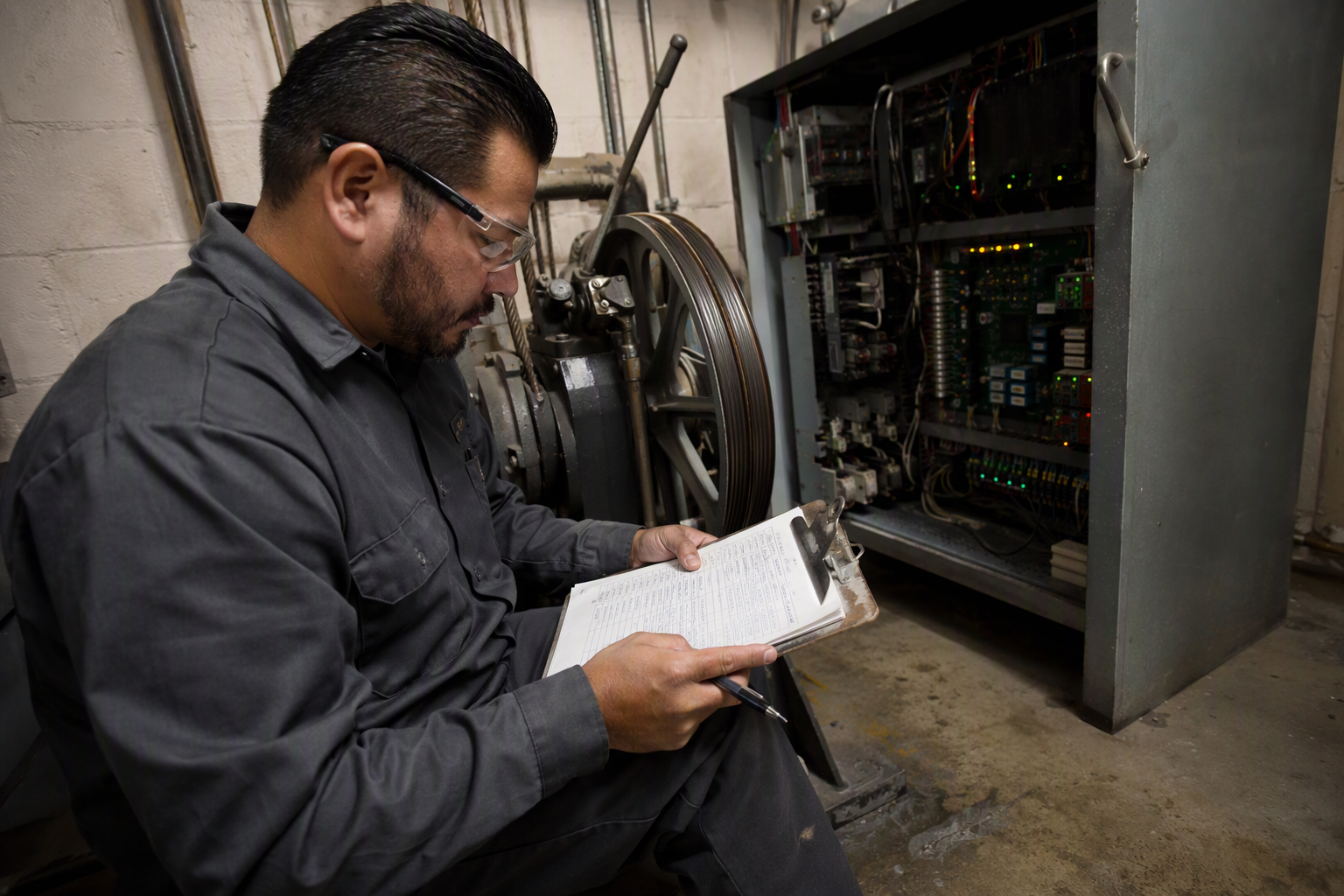
Not every elevator noise warrants a full shutdown, but certain acoustic signatures are associated with failure modes that present imminent danger. A grinding or scraping sound during travel often indicates a failing guide shoe, worn roller guide, or debris in the guide rail — conditions that can escalate to car derailment if left unaddressed. A loud bang followed by a sudden drop, even of only a fraction of an inch, may signal a broken rope or a triggering of the car’s safety device under ASME A17.1 requirements. A burning smell accompanied by noise almost always indicates an overheated motor or brake component and is grounds for immediate evacuation and service shutdown.
By contrast, a soft clicking sound during door closure, a low hum from the motor room, or a brief squeak when the car levels at a floor are lower-urgency symptoms that still require documentation and prompt service scheduling but do not necessarily require the elevator to be taken out of service immediately — this determination, however, should always be confirmed with a licensed elevator technician rather than made unilaterally by building staff.
What does California law require when an elevator defect is discovered between inspections?
California law requires that any unsafe condition discovered between periodic inspections be reported to the building’s elevator service contractor and, if the condition poses imminent danger, the unit must be removed from service until repaired and re-inspected by the appropriate authority having jurisdiction.
California’s elevator safety program is administered under Title 8 of the California Code of Regulations. The Division of Occupational Safety and Health (Cal/OSHA) enforces these requirements, and the authority having jurisdiction (AHJ) for elevator inspections varies by municipality — some cities in Los Angeles County and Orange County use their own certified elevator inspectors, while others rely on Cal/OSHA’s Elevator Unit directly. Building owners should confirm which AHJ governs their specific property so they know the correct reporting chain when a between-visit defect is identified.
Failure to remove an elevator from service when a known unsafe condition exists can expose building owners to significant liability under California premises liability law, as well as administrative penalties from Cal/OSHA. Documenting the date and time the condition was first noticed, the steps taken, and the service call placed is essential to demonstrating due diligence.
Why do elevator doors fail to close properly, and how serious is the problem?
Elevator doors most commonly fail to close due to obstructions in the door track, worn or misaligned door operators, damaged safety edges or light curtains, or mechanical wear in the door clutch and coupling system — ranging from minor adjustments to safety-critical failures.
Under ASME A17.1, elevator doors must close and latch before the car is permitted to travel. The door interlock system is a primary safety device: if a landing door does not engage its interlock, the elevator’s control system should prevent movement. A door that repeatedly fails to close suggests either that the interlock is being bypassed somehow or that the door operator lacks the mechanical force to complete the closure cycle — both of which are conditions requiring immediate attention from a licensed technician.
From an ADA standpoint, malfunctioning elevator doors also create accessibility barriers. The ADA requires that elevators in facilities covered by Titles II and III remain accessible and operational. A door that fails to hold open long enough for a wheelchair user, or that closes with excessive force, may constitute an ADA compliance violation in addition to the mechanical safety concern.
What are the most common causes of unusual elevator noises by type?
Different noise types map to distinct mechanical systems, and identifying the character of the sound helps technicians prioritize diagnostics and parts before arriving on site.
| Noise Type | Most Likely Cause | Urgency Level | Typical System Affected |
|---|---|---|---|
| Grinding or scraping during travel | Worn guide shoes or roller guides; debris in rail | High — schedule immediate service | Guide rail / roller guide assembly |
| Loud bang or thud at stops | Worn brake linings; leveling issues | High — remove from service if persistent | Braking system / leveling control |
| Squealing during door operation | Dry or worn door operator drive belt; misaligned door panels | Moderate — schedule prompt service | Door operator mechanism |
| Humming or vibration in machine room | Motor bearing wear; loose machine mounts | Moderate — inspect within maintenance cycle | Traction machine / motor |
| Clicking during door closure | Normal interlock engagement; minor latch wear | Low — note and monitor | Door interlock |
| Rattling in cab during travel | Loose cab panels; worn sill nosing | Low to moderate — assess at next visit | Cab interior / sill |
| Burning smell with any noise | Overheated motor winding or brake | Critical — immediate shutdown required | Motor / brake assembly |
Can building staff or tenants attempt to fix elevator noise or door problems themselves?
No — California law strictly prohibits anyone other than a licensed elevator mechanic from performing repair, adjustment, or maintenance work on elevator equipment, and any unauthorized work voids the elevator’s certificate of compliance and creates serious liability exposure.
California’s elevator safety regulations require that all maintenance, repair, and alteration work on conveyances be performed by qualified elevator mechanics holding appropriate licensure under the authority of Cal/OSHA. This is not a technicality — it reflects the genuine complexity and danger of elevator systems, which operate under significant mechanical loads, electrical voltages, and code-mandated safety constraints. A well-intentioned attempt by a building engineer to “adjust” a door or silence a noise can disable safety devices that exist to prevent entrapment, falls into the shaft, or car overspeed.
Building staff roles are limited to: observing and documenting symptoms, restricting access to defective units, and notifying the licensed service provider. Lubricating exposed pivot points or removing visible door track debris with a broom may seem harmless but can create liability if those actions are later associated with a subsequent incident. When in doubt, restrict and report.
How quickly should a licensed technician respond to elevator door or noise complaints?
The appropriate response timeline depends on severity: conditions that trap passengers or involve apparent safety device failure require emergency response, while non-life-safety noise and door irregularities should be addressed within a timeframe agreed upon in the service contract, generally before the next scheduled maintenance visit.
Building managers should review their elevator service agreements to confirm that the contract distinguishes between emergency callback provisions and standard unscheduled service. A well-structured service agreement will define response categories based on condition severity. If the current service agreement does not address unscheduled callbacks or leaves ambiguity about response categories, that is a gap worth closing at contract renewal. Liftech Elevator works with building owners across Long Beach, Signal Hill, Los Angeles, and Orange County to ensure service terms reflect the operational realities of commercial and residential properties.
What documentation should be kept when an elevator symptom is reported between visits?
Building managers should maintain a written incident record that includes the date and time of first observation, a description of the symptom, the names of witnesses, actions taken, and the date and outcome of the service call — this record is required under California regulations and is essential in any liability or insurance proceeding.
California elevator regulations require that maintenance and inspection records be kept at the premises and made available to the AHJ on request. Beyond regulatory compliance, thorough documentation protects the building owner in personal injury litigation by establishing that the owner acted promptly and responsibly upon learning of a defect. Practical documentation should include: the elevator unit number or location, floor(s) where the symptom was observed, direction of travel (up or down), load condition, any video or audio recordings, the name of the service company contacted, the technician’s name and arrival time, and the technician’s written findings and corrective actions.
How do elevator door safety devices work, and what happens when they fail?
Modern elevator door safety devices — including mechanical safety edges and electronic light curtains — detect obstructions and reverse the door before contact; when these devices malfunction, the door may either refuse to close entirely or close with unrestricted force, both of which are code violations under ASME A17.1.
The ASME A17.1 Safety Code for Elevators and Escalators requires that power-operated doors be equipped with reopening devices that detect an obstruction and reverse automatically. A light curtain uses an infrared beam grid across the door opening; if any beam is interrupted, the door reverses. A mechanical safety edge physically contacts the obstruction and triggers the reversal. When these devices are dirty, misaligned, or worn, the door may enter a “nuisance reopening” cycle — reversing repeatedly without a real obstruction — or, in a failure mode, close without detection capability, posing a risk of injury to passengers at the threshold. Either symptom warrants immediate professional inspection.
From an ADA compliance perspective, the reopening device must remain active for a sufficient dwell time to allow individuals with mobility impairments to enter and exit safely. A door that closes too quickly, even if the reopening device is technically functional, may still create an ADA accessibility barrier.
Are there noise or vibration benchmarks that indicate an elevator is operating within acceptable limits?
ASME A17.1 does not prescribe specific decibel limits for elevator ride noise in most standard commercial and residential applications, but industry guidance consistently identifies abnormal vibration and acoustic changes from a known baseline as the meaningful threshold for service action.
Rather than relying on absolute decibel thresholds, elevator maintenance best practice uses baseline comparison: a qualified technician establishes a ride quality and noise profile for the unit during commissioning or after a major modernization, and subsequent maintenance visits compare current conditions against that baseline. Deviations from baseline — not from an abstract numerical standard — are what trigger investigation. This is why detailed maintenance records and periodic ride quality assessments are operationally valuable beyond their regulatory function. Building managers who can show a technician “it’s louder than it was three months ago” provide more actionable information than those who simply report “it’s loud.”
Can a noisy elevator or malfunctioning door result in a failed inspection?
Yes — California elevator inspectors can issue deficiency notices or remove operating permits for any condition that violates ASME A17.1 or California’s Title 8 elevator safety regulations, including noise-producing mechanical defects and non-compliant door operation.
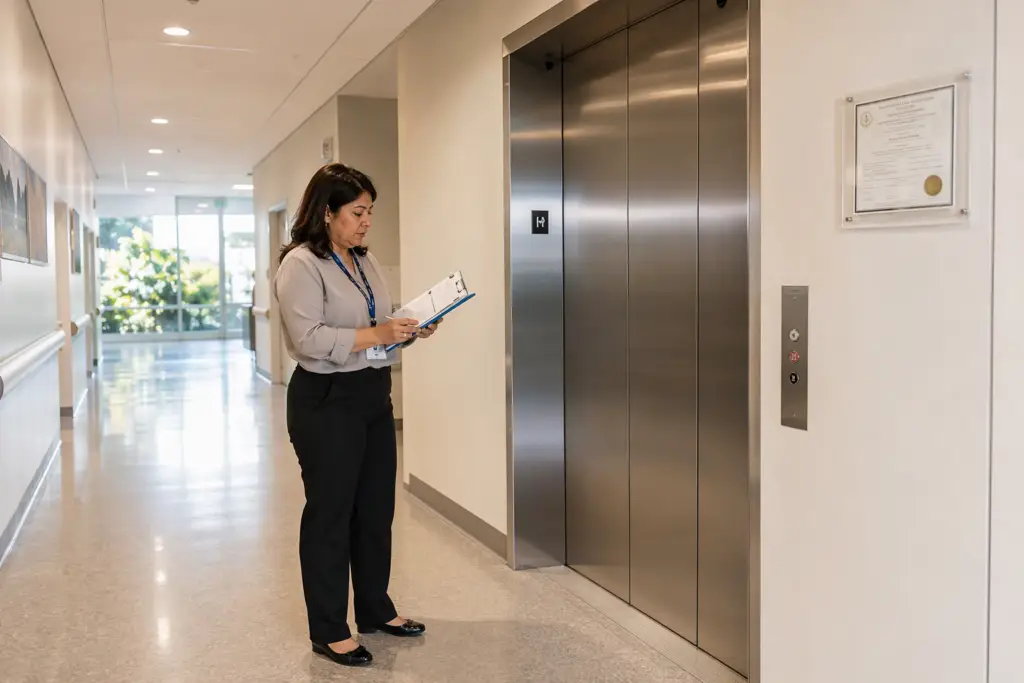
An elevator operating with a known defect — even one that has not yet caused an incident — can be cited during a periodic or special inspection. In California, elevators are subject to periodic inspections by the AHJ, and the certificate of inspection must be posted in the elevator cab. If an inspector finds that a door safety device is non-functional, that guide rails produce abnormal sounds indicating wear, or that any safety device has been disabled or bypassed, they have authority to issue a notice requiring correction before the elevator returns to service. Building owners who proactively address between-visit symptoms before the next inspection date are in a far stronger compliance position than those who defer action.
What is the difference between a maintenance callback and a full repair, and which is appropriate for door or noise issues?
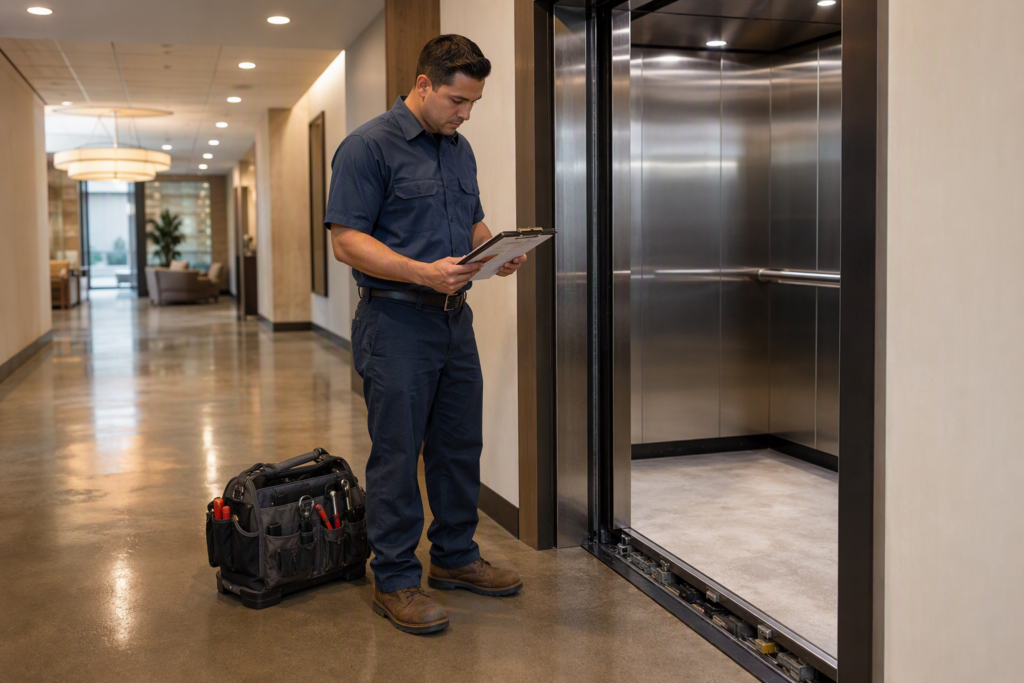
A maintenance callback addresses a specific, isolated symptom — such as a door adjustment or lubrication — while a full repair involves component replacement or system-level correction; the appropriate response depends on what the attending technician finds during diagnostic assessment.
Building managers sometimes assume that any between-visit problem requires a costly full repair, which can lead to delay in placing the call. In practice, many door and noise complaints are resolved during a callback visit through adjustment, cleaning, or minor part replacement. However, some symptoms that appear minor — a persistent vibration, a door that occasionally hesitates — can be early indicators of component wear that will require replacement if deferred. The attending technician’s written assessment is the authoritative basis for determining scope; building managers should request a written finding even for seemingly minor callbacks so that the record is complete.
How do between-visit issues affect the elevator’s compliance status in California?
An elevator’s compliance status in California is determined by the currency of its inspection certificate and the absence of uncorrected deficiency notices; a between-visit defect does not automatically suspend the certificate but creates an obligation to correct the condition, and failure to act can result in enforcement action by Cal/OSHA.
California’s AHJ issues an elevator permit or certificate of operation following a satisfactory inspection. That certificate remains valid until its expiration date or until a condition is identified — by an inspector or by the building owner — that renders the unit unsafe. The building owner’s legal obligation is to ensure the elevator operates safely at all times, not merely at the time of the last inspection. Discovering and correcting between-visit defects is therefore not optional maintenance hygiene — it is a continuous compliance obligation.
What role does the elevator service agreement play in managing between-visit problems?
A well-structured elevator service agreement defines the scope of preventive maintenance, the process for scheduling unscheduled callbacks, and the responsibilities of both the building owner and the service provider — making it the primary operational tool for managing between-visit issues.
Service agreements vary substantially in what they cover. Full-service agreements typically include labor and parts for covered repairs, scheduled maintenance visits, and unscheduled callbacks. Oil-and-grease agreements cover only lubrication and minor adjustments, leaving parts and labor for unscheduled visits as additional cost. Building managers experiencing frequent between-visit issues should review whether their current agreement type matches their property’s operational demands, particularly for older equipment that may require more frequent attention. Reviewing agreement terms with a qualified elevator service company is the most effective way to align service scope with actual building risk.
How do older or modernized elevators differ in their between-visit failure patterns?
Older traction and hydraulic elevators with aging components are statistically more prone to between-visit symptoms — especially door operator wear and mechanical noise — while recently modernized units typically exhibit fewer unscheduled issues due to updated controls, drives, and safety components.
Equipment age is a significant factor in the frequency and character of between-visit problems. Hydraulic elevators more than two decades old may develop cylinder seal issues or pump wear that produce noise and slow door response as hydraulic pressure fluctuates. Older traction elevators with DC motor drives or drum machines may produce increased noise as brushes and bearings wear. Modernization — replacing aging controls, drives, door operators, and safety systems — brings equipment closer to current ASME A17.1 requirements and typically reduces between-visit callback frequency. Building managers experiencing recurring between-visit issues on older equipment should discuss modernization assessments with their service provider. Liftech Elevator provides elevator assessments to building owners across Los Angeles, Long Beach, Orange County, and Signal Hill to help evaluate whether modernization makes operational and financial sense for a given property.
What should building managers tell their tenants or occupants when an elevator is out of service between visits?
Building managers should communicate promptly, honestly, and in writing to all affected occupants — including specific information about which unit is affected, why it is out of service, and what the expected resolution timeline is — with particular attention to occupants who depend on the elevator for ADA-covered accessibility.
Under the ADA, building owners have an obligation to ensure that individuals with disabilities retain access to facilities covered by Titles II and III. When an elevator goes out of service in a multistory building where stairs are the only alternative, building managers must take reasonable steps to provide alternative accessible routes or accommodations. This may include temporarily relocating services to accessible floors, coordinating with affected tenants, or expediting the service call to restore access. Documenting these communications and accommodations is important both for ADA compliance and for demonstrating good-faith effort.
What questions should building managers ask a technician after a between-visit service call?
After every between-visit service call, building managers should ask for a written summary of findings, the root cause of the symptom, the corrective action taken, whether any additional work is recommended, and whether the unit is safe and fully operational for return to service.
A service call is only as useful as the information it produces. Verbal summaries are easily forgotten and create no record. Building managers should insist on written work orders that specify: the symptom as reported, the technician’s diagnosis, the parts or adjustments applied, any parts that were observed to be worn but not yet replaced, and a clearance statement confirming the elevator is safe to return to service. If the technician recommends follow-up work, that recommendation should be in writing with a stated reason — not because building managers should second-guess it, but because that documentation is essential for budgeting, liability, and future inspection preparation.
How often should preventive maintenance visits be scheduled to reduce between-visit problems?
Preventive maintenance frequency should be matched to equipment type, age, usage intensity, and code requirements — with many commercial and residential installations in California requiring at minimum monthly or quarterly visits under their service agreement and AHJ requirements.
The ASME A17.1 Safety Code for Elevators and Escalators provides maintenance requirements that establish the minimum scope of what a maintenance program must accomplish, though specific visit frequency is typically governed by the AHJ and the service agreement. High-use installations — such as residential towers, hospitals, or commercial office buildings — generally warrant more frequent visits than low-use residential or light commercial units. Building managers experiencing a high rate of between-visit symptoms should treat that frequency as a signal that the current maintenance interval or scope is insufficient for their equipment’s operational demands. Increasing visit frequency or upgrading to a more comprehensive service agreement is typically more cost-effective than repeated unscheduled callbacks and the associated downtime.
What are the liability implications for a building owner if an elevator noise or door problem is ignored?
Ignoring a known elevator defect exposes building owners in California to significant civil liability for injuries caused by that defect, as well as regulatory penalties from Cal/OSHA, because California premises liability law holds property owners to a duty of reasonable care that includes acting on known equipment hazards.
California premises liability principles require that property owners inspect, discover, and remedy dangerous conditions on their property. When a building manager observes an elevator symptom and fails to restrict access or contact a service provider, they have arguably acquired constructive knowledge of a hazard. If a subsequent injury occurs, that failure to act becomes a central element of any negligence claim. This is why the documentation steps described throughout this FAQ are not bureaucratic formalities — they are the evidentiary record that demonstrates the building owner met their duty of care. Working with a reputable, licensed elevator service company like Liftech Elevator ensures that between-visit issues are addressed by qualified personnel and properly documented, supporting the building owner’s legal and regulatory position.
When is it appropriate to modernize rather than continue repairing an elevator with recurring between-visit issues?
Modernization becomes the more practical and cost-effective choice when an elevator requires repeated unscheduled callbacks for the same or related systems, when parts availability is declining, or when the cost of continued repairs approaches or exceeds the value provided by modernization in improved reliability, safety, and code compliance.
There is no single threshold that universally signals the right time to modernize, because the decision depends on equipment age, type, usage, and the building owner’s long-term operational plans. However, patterns that consistently suggest modernization is appropriate include: door operator replacements that recur within short intervals, noise complaints that return shortly after each service visit, difficulty sourcing OEM parts, and control systems that are no longer supported by the manufacturer. A qualified elevator service company can conduct a systematic condition assessment to identify which components are approaching end of useful life and model the total cost of continued repair versus modernization investment. Liftech Elevator serves building owners in Signal Hill, Long Beach, Los Angeles, and Orange County with these assessments to support informed capital planning decisions.
Ready to Resolve Your Elevator Issue?
If your elevator is making unusual noises, experiencing door problems, or you have any concern about its operation between scheduled maintenance visits, do not wait until the next inspection date. A known defect left unaddressed creates safety risk, compliance exposure, and liability — none of which improve with time.
Contact Liftech Elevator for a free elevator assessment. Liftech Elevator serves commercial and residential building owners throughout Signal Hill CA, Long Beach CA, Los Angeles CA, and Orange County CA with licensed elevator maintenance, repair, and modernization services.
Call today: 562-609-3478
Need elevator service you can rely on? Liftech Elevator is ready to help.