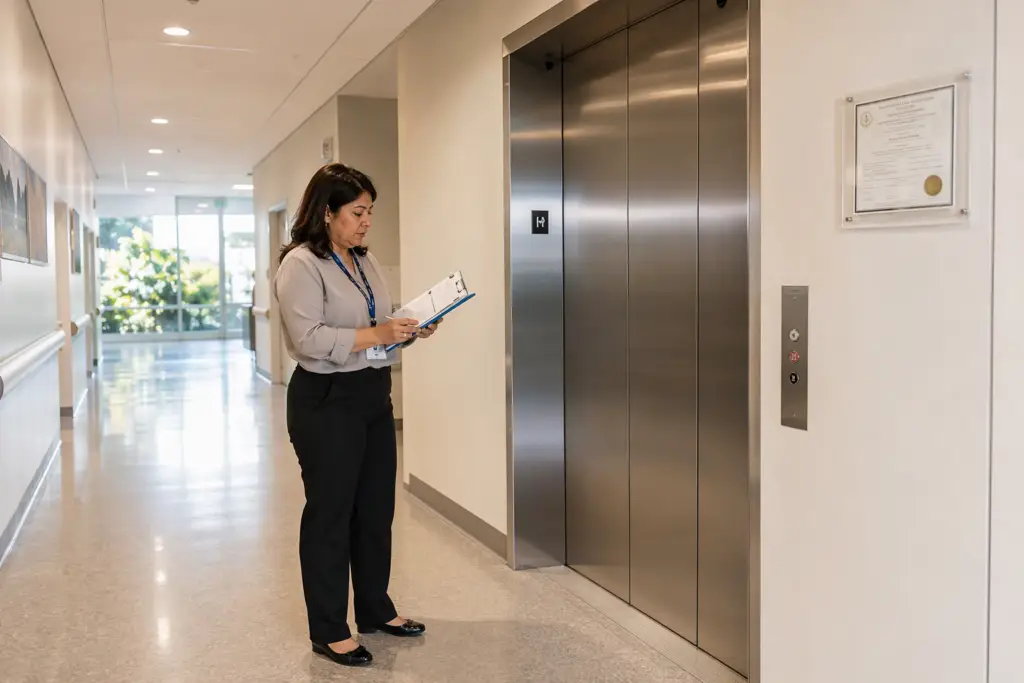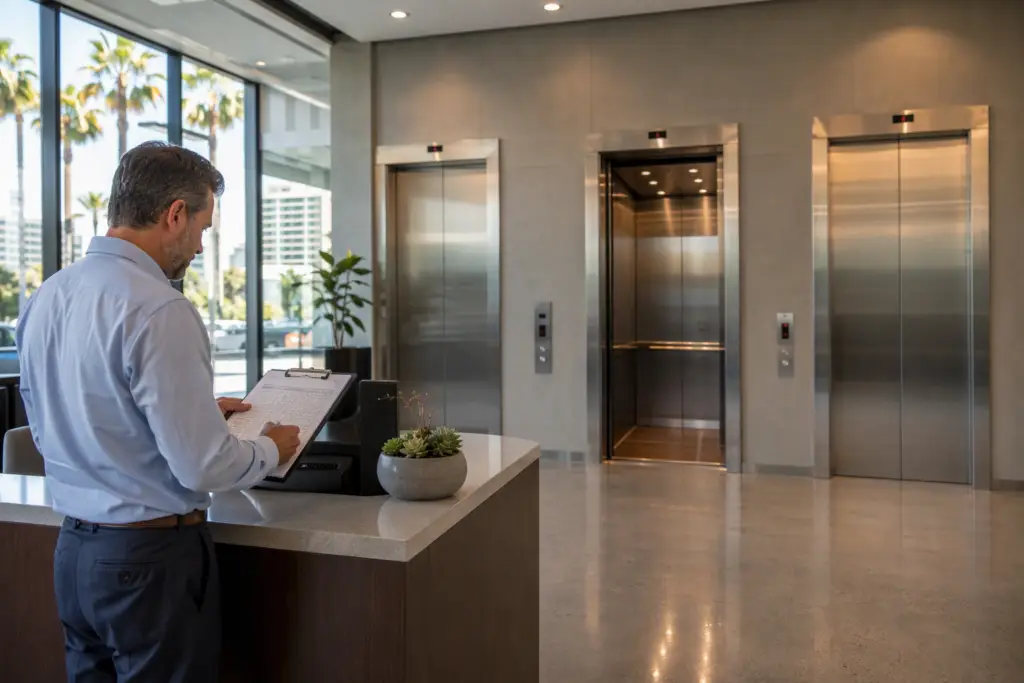
An elevator contractor is a licensed company authorized to install, maintain, repair, and modernize elevators and other conveyances — in California, that means holding both a C-11 Elevator Contractor license from the CSLB and a Certified Qualified Conveyance Company (CQCC) certification from Cal/OSHA.
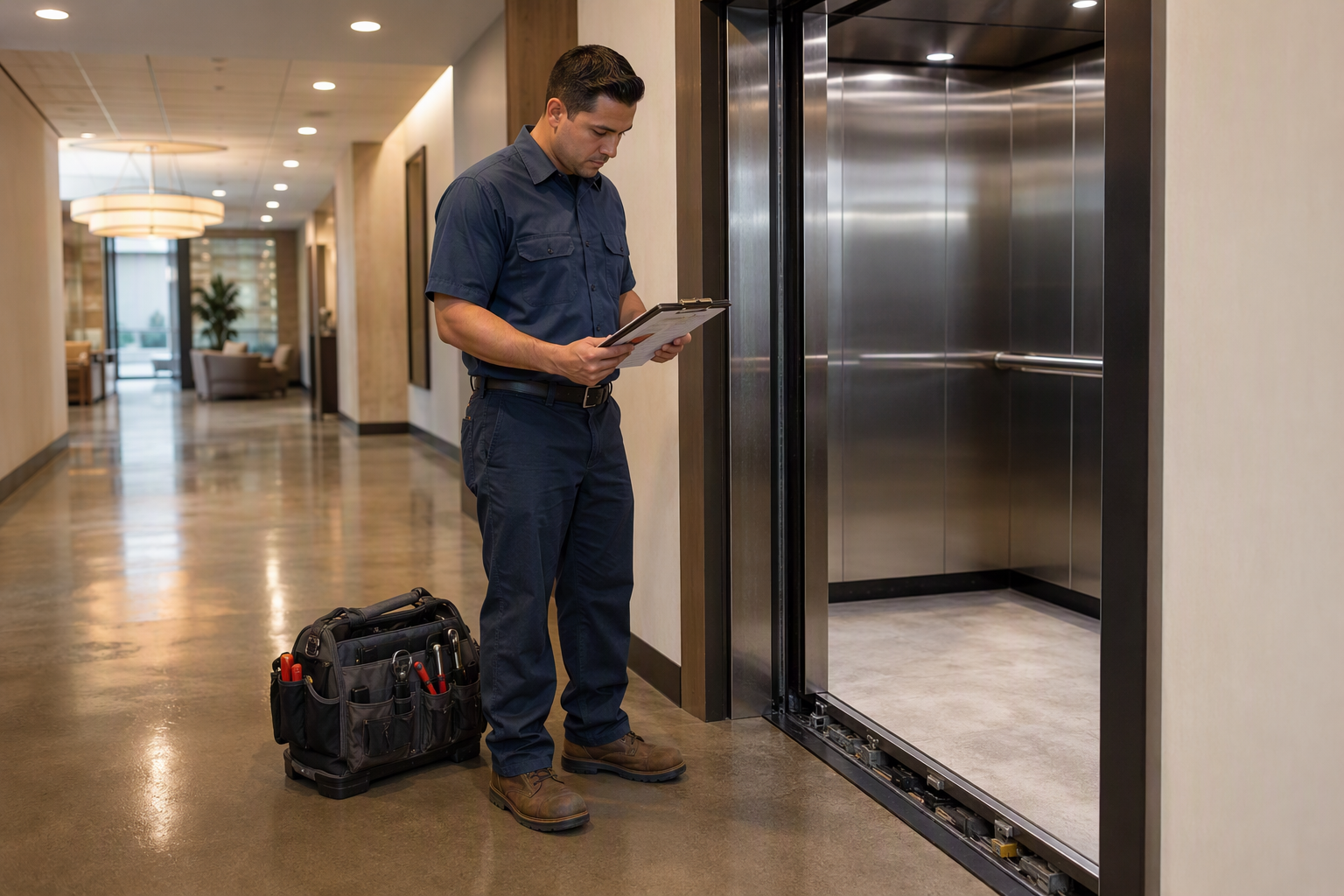
Elevator Contractor: Complete FAQ Guide for Building Owners in Southern California
Understanding what an elevator contractor does, what credentials they must carry, and how California’s regulatory framework governs their work is essential for any building owner or property manager responsible for vertical transportation. This FAQ hub covers every dimension of hiring, vetting, and working with an elevator contractor in Los Angeles, Long Beach, Signal Hill, and Orange County.
What is an elevator contractor?
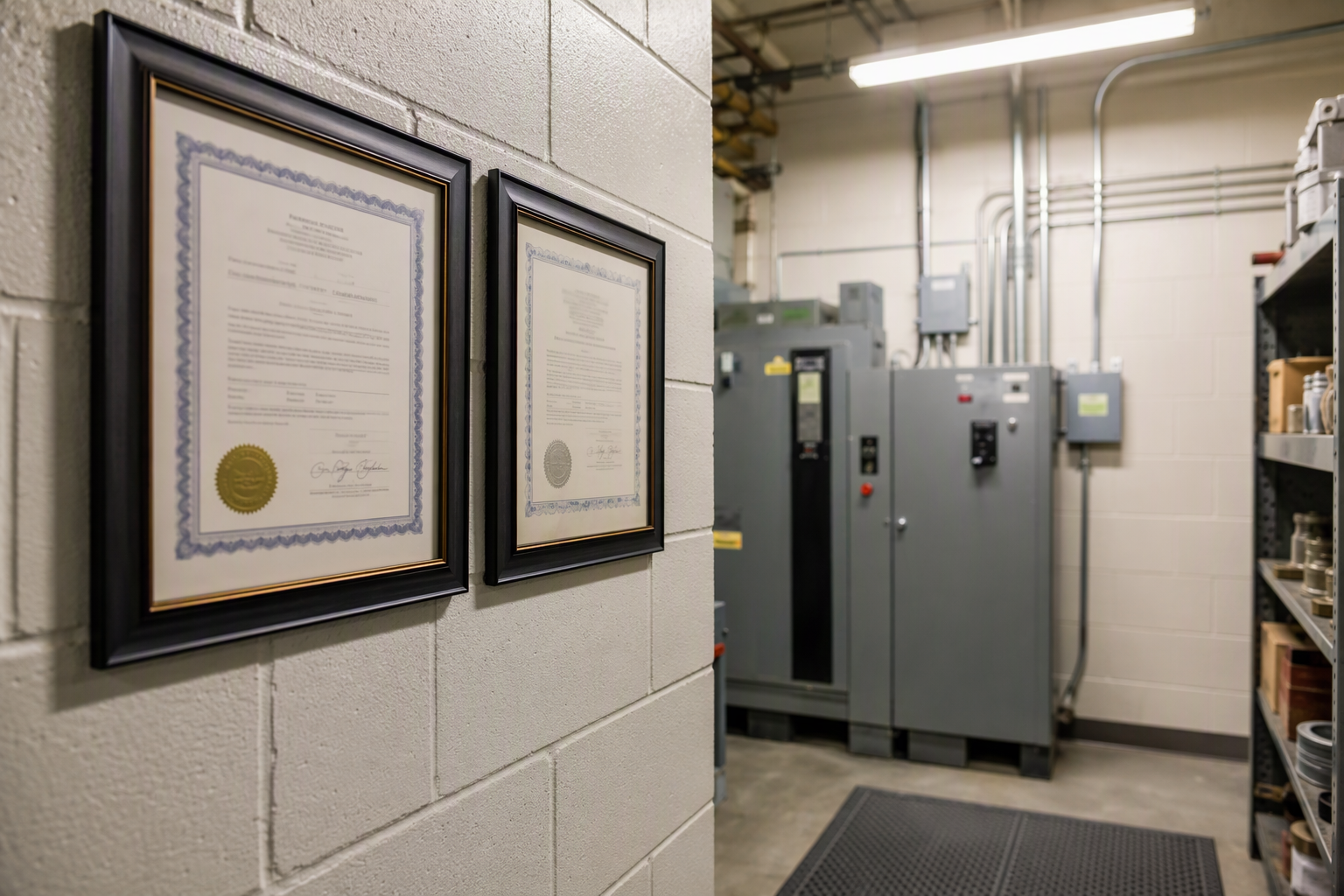
An elevator contractor is a company licensed and certified to install, alter, maintain, repair, and inspect elevators and other conveyances, operating under both contractor licensing law and safety regulatory requirements.
In practical terms, an elevator contractor handles the full lifecycle of vertical transportation equipment: from initial design coordination and code-compliant installation of a new system, through routine maintenance and emergency repairs, to major modernization projects that bring aging equipment up to current safety standards. The scope of work can include traction elevators, hydraulic elevators, platform lifts, escalators, and dumbwaiters.
In California, the term carries specific legal weight. A company cannot lawfully perform elevator work without holding both a C-11 Elevator Contractor license issued by the California Contractors State License Board (CSLB) and a Certified Qualified Conveyance Company (CQCC) certificate issued by the Cal/OSHA Elevator Unit, California Department of Industrial Relations. These are separate credentials with separate renewal requirements, and both must be current before any wrench turns on a California conveyance.
What licenses and certifications must a California elevator contractor hold?

In California, a legitimate elevator contractor must hold a C-11 Elevator Contractor license from the CSLB and a Certified Qualified Conveyance Company (CQCC) certificate from Cal/OSHA — and every mechanic working independently on-site must be a Certified Competent Conveyance Mechanic (CCCM).
The CSLB’s C-11 license governs the contractor’s legal authority to enter contracts for elevator work. The Cal/OSHA CQCC certificate governs field safety: only a CQCC-certified company may maintain, repair, alter, or replace components on a conveyance in California. Applicants for CQCC certification must submit their current C-11 contractor license along with certificates of workers’ compensation and liability insurance.
At the individual technician level, anyone who works on an elevator in California without direct supervision must hold a Certified Competent Conveyance Mechanic (CCCM) certificate from Cal/OSHA. In California, only a CCCM working for a CQCC may perform hands-on elevator work. CQCC, CCCM, and conveyance inspector certificates are valid for two years, and renewal requires at least eight hours of continuing education.
Liftech Elevator carries the required California credentials and operates under these regulatory frameworks across Signal Hill, Long Beach, Los Angeles, and Orange County.
What is the difference between a C-11 license and a CQCC certificate?
The C-11 license is a contracting authority issued by the CSLB, while the CQCC certificate is a safety-program credential issued by Cal/OSHA — both are required simultaneously to perform elevator work in California, but they are issued by different agencies and serve different regulatory purposes.
The C-11 license allows a company to legally contract for and be paid to perform elevator construction, installation, and service work. It is part of California’s contractor licensing system and carries bond and insurance requirements enforced by the CSLB.
The CQCC certificate is specifically tied to the California Labor Code Sections 7300–7324.2 and the California Code of Regulations, Title 8, Elevator Safety Orders (Sections 3000–3146). It governs who may physically touch and alter a conveyance. A company could theoretically hold a C-11 license but be barred from field work without the CQCC. Building owners should verify both credentials before signing any service agreement.
What work legally requires an elevator contractor in California?
Any installation, alteration, maintenance, repair, or servicing of an elevator or other conveyance in California legally requires a CQCC-certified elevator contractor whose mechanics hold CCCM certificates.
California law is broad in its definition of regulated work. Installing a new elevator, replacing a hydraulic jack, upgrading a controller, modernizing a cab, adding a new floor stop, or even adjusting door operators all constitute regulated conveyance work. Under the California Labor Code and Title 8 Elevator Safety Orders, none of this work may be performed by unlicensed general contractors, building maintenance staff, or anyone who is not a CCCM employed by a CQCC.
Additionally, a permit from Cal/OSHA is required before a conveyance is erected, installed, or materially altered — meaning the contractor must obtain regulatory approval before work begins, not merely report it after the fact. After installation or alteration, a Cal/OSHA inspection must occur and a permit to operate must be issued before the elevator is placed back in public service.
How do I verify that an elevator contractor is properly licensed in California?
Building owners can verify a California elevator contractor’s credentials by checking the CSLB license lookup tool for the C-11 license and contacting the Cal/OSHA Elevator Unit to confirm the company’s active CQCC certification.
When evaluating a prospective contractor, request the following documentation before signing any agreement:
- The company’s current C-11 Elevator Contractor license number and expiration date (verifiable through the CSLB).
- The company’s current CQCC certificate issued by Cal/OSHA.
- Proof of current workers’ compensation insurance naming California as the state of coverage.
- Proof of current general liability insurance.
- Confirmation that field mechanics assigned to the property hold valid CCCM certificates.
- A copy of, or reference to, any current permits to operate for elevators already under their service.
Never accept verbal assurances in place of documentation. A contractor operating without a CQCC certificate exposes the building owner to liability if an incident occurs, because Cal/OSHA can shut down an elevator maintained by an uncertified company.
What codes does a California elevator contractor follow?
California elevator contractors follow the ASME A17.1/CSA B44 Safety Code for Elevators and Escalators as adopted into state law, along with the California Code of Regulations, Title 8, Elevator Safety Orders.
California adopted the ASME A17.1/CSA B44, 2004 edition (Group IV Elevator Safety Orders), effective May 1, 2008, for installation contracts signed on or after that date. This edition governs the design, installation, and performance requirements for most currently operating California elevators. The California Standards Board held a public hearing on June 18, 2026, regarding a proposed Group V update that would incorporate portions of ASME A17.1-2019, but no effective date for that update has been posted as of the date of this publication.
For existing elevators, contractors also reference ASME A17.3, the Safety Code for Existing Elevators and Escalators, which establishes minimum retrofit and maintenance standards for equipment already in service. Federal accessibility requirements under the Americans with Disabilities Act (ADA) apply to public accommodations and commercial facilities and govern cab dimensions, control heights, and door timing.
In Los Angeles specifically, contractors must also satisfy the requirements of the City of Los Angeles Department of Building and Safety (LADBS), which operates its own elevator and conveyance inspection program independent of the state system.
What is the difference between elevator installation, maintenance, and modernization?
Installation covers new construction; maintenance covers ongoing safety and performance upkeep of existing equipment; and modernization involves replacing major components or systems to improve safety, efficiency, or code compliance without installing a completely new elevator.
| Service Type | Typical Scope | Cal/OSHA Permit Required? | Applicable Code Reference |
|---|---|---|---|
| New Installation | Full system from pit to machine room, including structure, drive, cab, controls, doors | Yes — before work begins; inspection before service | ASME A17.1-2004 (CA Group IV); Title 8 §§3000–3146 |
| Routine Maintenance | Lubrication, adjustment, safety device testing, visual inspection, log updates | No new permit; valid operating permit must be current | ASME A17.1-2004; Title 8 Elevator Safety Orders |
| Material Alteration | Controller replacement, hydraulic jack replacement, adding floors, speed changes | Yes — before alteration begins | ASME A17.1-2004; CA Labor Code §§7300–7324.2 |
| Modernization | Drive system, cab, doors, controls, or multiple subsystems upgraded | Yes — typically treated as material alteration | ASME A17.1-2004; ASME A17.3 for existing equipment |
| Emergency Repair | Component failure restoration to return elevator to safe, permitted operation | Operating permit remains valid if repair is not a material alteration | Title 8 Elevator Safety Orders; ASME A17.1-2004 |
| ADA Compliance Upgrade | Control height, cab dimension, door timing, signage, Braille adjustments | Depends on scope; material alterations require permit | ADA Standards for Accessible Design |
How often does a California elevator require inspection?
California law requires every conveyance to be inspected at least once a year, and a conveyance found safe receives a permit to operate for up to one year — or up to two years if the elevator is covered by a full maintenance contract with a C-11 licensed elevator company.
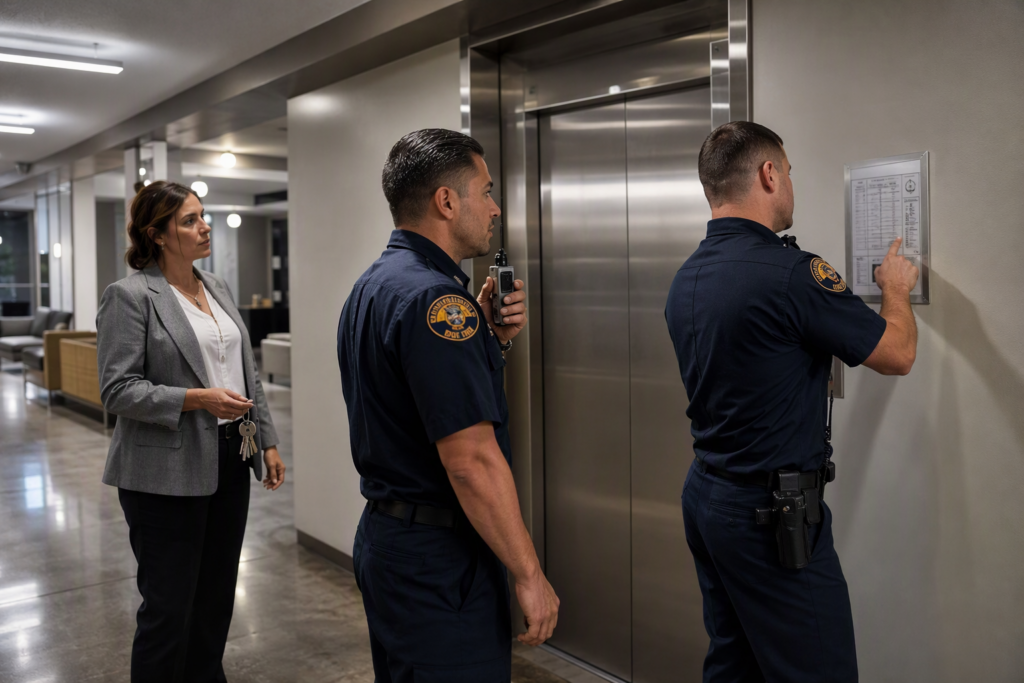
The annual inspection must be performed by a State of California safety engineer or a Certified Competent Conveyance Inspector (CCCI). Arranging the annual reinspection is the elevator owner’s responsibility, not the elevator contractor’s. However, a contractor providing a full maintenance contract can facilitate coordination with Cal/OSHA and provide the documentation needed to qualify for the two-year permit cycle.
The permit to operate must be posted conspicuously in the elevator car at all times. Operating an elevator without a valid, current permit to operate in California is a violation of the California Labor Code. Building owners who rely on an unqualified contractor and allow their operating permit to lapse face potential stop-use orders from Cal/OSHA.
What should building owners do immediately if an elevator fails or traps passengers?
If an elevator fails or traps passengers, the building owner or manager should follow a clear sequence of steps to protect life safety and comply with California regulatory obligations.
- Call 911 if any occupant is injured, shows distress, or if the car is stopped between floors with no safe egress.
- Communicate with trapped passengers through the emergency communication system to confirm their status and instruct them to remain calm and not attempt self-rescue.
- Do not attempt to manually open doors or pry the car to a floor without a qualified CCCM present — improper rescue attempts create fall and entrapment hazards.
- Contact your CQCC-certified elevator contractor immediately to dispatch a CCCM for emergency rescue and repair.
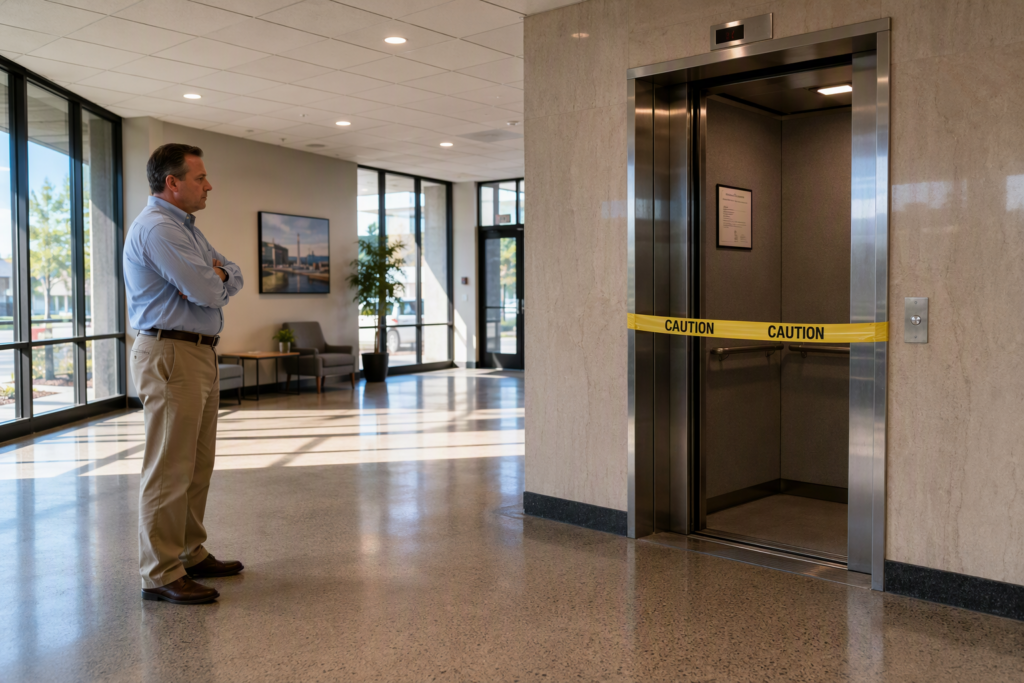
- Once the emergency is resolved, take the elevator out of service and place visible “Out of Service” signage on all landings.
- Document the incident: time, nature of failure, actions taken, and the names of any personnel who responded.
- Contact Cal/OSHA’s Elevator Unit if the incident resulted in injury or if the failure involved a safety device, in accordance with California Labor Code reporting obligations.
- Do not return the elevator to service until a qualified CCCM has inspected the equipment and confirmed it is safe for operation.
Liftech Elevator serves building owners across Long Beach, Signal Hill, Los Angeles, and Orange County and can be contacted for emergency elevator service support.
What is a full maintenance contract and why does it matter?
A full maintenance contract is a service agreement in which an elevator contractor assumes comprehensive responsibility for all preventive and corrective maintenance on a conveyance — and in California, having one with a C-11 licensed company can qualify the elevator for a two-year operating permit instead of the standard one-year permit.
Under a full maintenance contract, the contractor typically provides scheduled preventive maintenance visits, lubrication, adjustment, safety device testing, parts replacement due to normal wear, and callback response for service interruptions. The specific scope of coverage varies by agreement and should be carefully reviewed before signing.
From a regulatory standpoint, the two-year permit benefit is meaningful for property managers: it reduces the frequency of coordinating Cal/OSHA reinspections and provides a longer runway between formal inspection cycles, though it does not eliminate the building owner’s fundamental responsibility for maintaining the elevator in safe condition at all times.
How does an elevator contractor ensure ADA compliance?
An elevator contractor ensures ADA compliance by designing, installing, and maintaining elevators to meet the ADA Standards for Accessible Design, which govern cab dimensions, control panel heights, door timing, floor designation signage, and communication systems for users with disabilities.
Key ADA requirements that elevator contractors address include: cab interior dimensions sufficient for wheelchair turning, call button mounting heights accessible from a wheelchair, audible and visible floor indicators, raised and Braille characters on controls, door reopening devices that respond to obstruction, and leveling accuracy so the cab floor aligns with the landing floor within a tight tolerance. When an existing elevator undergoes a material alteration, the altered elements — and often the path of travel to the elevator — must be brought into ADA compliance, creating a significant compliance trigger that property owners may not anticipate.
ADA requirements interact with California’s adopted ASME code and the California Building Code. Building owners undertaking modernization projects should work with an experienced elevator contractor who understands both the federal accessibility framework and California’s adopted code edition to avoid creating new compliance gaps while closing old ones.
What questions should I ask when hiring an elevator contractor?
Before hiring an elevator contractor, building owners should ask a structured set of questions to assess legal compliance, technical capability, and service reliability.
- Can you provide your current C-11 Elevator Contractor license number for CSLB verification?
- Can you provide your current CQCC certificate issued by Cal/OSHA?
- Will the mechanics performing work on my property hold active CCCM certificates?
- Do you have experience with this specific type of elevator (traction, hydraulic, MRL, etc.) and this manufacturer’s equipment?
- What is your process for obtaining Cal/OSHA permits before material alterations?
- How do you document maintenance visits and safety tests, and what records will I receive?
- What does your maintenance contract cover, and what is specifically excluded?
- How do you handle callback situations when the elevator is out of service?
- What is your process for coordinating annual Cal/OSHA reinspections?
- Can you provide references from comparable properties in Los Angeles, Long Beach, or Orange County?
What is the Cal/OSHA permit to operate and who is responsible for maintaining it?
The Cal/OSHA permit to operate is a mandatory authorization that certifies an elevator has been inspected and found safe — and in California, the elevator owner, not the contractor, is legally responsible for ensuring the permit remains valid and is posted in the car at all times.
No elevator may be operated in California without a valid, current permit to operate. When a new elevator is installed, it must be inspected by Cal/OSHA and receive its permit before it is placed in service. For existing elevators, the owner must arrange annual reinspection through Cal/OSHA to maintain a current permit. A qualified elevator contractor can assist with the administrative coordination, documentation, and pre-inspection preparation — but the legal obligation to have and display the permit sits with the building owner.
An elevator operating without a valid permit exposes the owner to enforcement action from Cal/OSHA, including stop-use orders that can shut down the elevator entirely until compliance is restored. Liftech Elevator helps property owners across Southern California manage the permit renewal process as part of its maintenance services.
How long does elevator installation typically take?
The timeline for elevator installation depends on the type of system, the building’s structural readiness, permit processing time, and the complexity of the project — it is not a fixed duration, and property owners should request a project-specific schedule from their elevator contractor during the proposal phase.
From a regulatory standpoint, California adds two mandatory milestone gates that affect timeline: the Cal/OSHA pre-construction permit (which must be obtained before installation begins) and the Cal/OSHA post-installation inspection (which must occur and result in a permit to operate before the elevator is placed in service). Any contractor who does not account for these regulatory steps in their schedule is providing an unrealistic timeline.
Building owners should also factor in lead time for elevator equipment and components, which can vary based on market conditions, the specific manufacturer, and custom cab finishes or configurations. Coordination with the general contractor on shaft preparation, machine room readiness, and electrical rough-in is also a critical path item that affects overall duration.
What is elevator modernization and when should a building owner consider it?
Elevator modernization is the process of replacing one or more major elevator subsystems — such as the controller, drive, doors, or cab — to improve safety, reliability, energy efficiency, or code compliance, without the cost of a complete new installation.
Property owners should consider modernization when they observe a pattern of increasing repair frequency, difficulty sourcing parts for legacy systems, passenger complaints about ride quality or door performance, or when a code-compliance gap is identified during inspection. Elevators with outdated relay-logic controllers, for example, may lack the fault diagnostics and safety interlocks present in modern microprocessor-based systems.
A modernization project is typically classified as a material alteration under California’s Elevator Safety Orders, which means a Cal/OSHA permit is required before work begins and a post-completion inspection and new permit to operate are required before the elevator returns to service. ADA compliance obligations may also be triggered depending on the scope of alteration. An experienced elevator contractor will conduct a pre-modernization code assessment to identify all applicable requirements before presenting a project scope.
What are the OSHA requirements that apply to elevator work in California?
Federal OSHA standards govern worker safety during elevator construction and maintenance activities, including requirements for lockout/tagout procedures, fall protection, and confined space entry that apply to elevator technicians working in pits, on top of cars, and in machine rooms.
In California, Cal/OSHA (the California Division of Occupational Safety and Health) administers both the worker safety program and the conveyance safety program. The Cal/OSHA Elevator Unit, operating under the California Department of Industrial Relations, is the primary regulatory body for conveyance-specific requirements. A CQCC-certified elevator contractor is expected to maintain a safety program that satisfies both the conveyance-specific safety orders and the general industry worker safety standards that apply to elevator maintenance work environments.
Building owners should be aware that OSHA’s General Duty Clause places an obligation on employers to maintain a workplace free of recognized hazards — this includes ensuring that building elevators maintained by an employer are kept in safe condition, reinforcing the importance of working with a fully credentialed elevator contractor.
How is an elevator contractor different from an elevator inspector?
An elevator contractor maintains, repairs, and installs elevators, while an elevator inspector is a separate, independent role — in California, only State of California safety engineers and Certified Competent Conveyance Inspectors (CCCI) may conduct the formal inspections that result in a Cal/OSHA permit to operate.
This separation is intentional: the inspector must be independent of the company maintaining the elevator to provide an unbiased safety assessment. A CQCC-certified elevator contractor cannot legally perform the official annual inspection on its own client’s elevator for purposes of issuing the operating permit. The contractor prepares the equipment, maintains documentation, and coordinates the inspection scheduling, but the inspection itself must be conducted by a Cal/OSHA safety engineer or a certified CCCI.
In Los Angeles, the City of Los Angeles Department of Building and Safety (LADBS) operates its own elevator and conveyance inspection program, adding a municipal layer to the inspection landscape. Building owners with elevators in the City of Los Angeles should confirm with their elevator contractor which inspection program governs their specific property.
What should be included in an elevator maintenance log?
A comprehensive elevator maintenance log should document every service visit, safety test, repair, parts replacement, and inspection, providing a traceable record that supports Cal/OSHA compliance and demonstrates due diligence in the event of an incident or enforcement review.
At minimum, the log should record: the date and time of each service visit; the name and CCCM certificate number of the mechanic performing work; the tasks performed, including any safety device tests conducted; any deficiencies found and the corrective action taken; parts replaced, including manufacturer, part number, and lot if available; the date and outcome of each Cal/OSHA inspection; and the current permit to operate number and expiration date.
Proper documentation protects the building owner, supports permit renewals, and provides the elevator contractor with the service history needed to diagnose recurring problems. Building owners should request access to maintenance records as part of any service agreement and should retain records for a period consistent with California’s applicable statutes of limitations for liability matters.
Does California’s elevator law apply to private home elevators?
California’s elevator safety law exempts conveyances under federal jurisdiction and conveyances in single-unit private homes that are not accessible to the public — however, this exemption has limits that residential property owners should understand before assuming their home elevator is unregulated.
The exemption applies to a residential elevator in a single-family home that is not open to the public. The moment that residence becomes a rental property, a bed-and-breakfast, or any space accessible to the public or to guests who are not members of the household, the exemption may no longer apply. Multi-unit residential buildings — apartment complexes, condominiums with common-area elevators — are squarely within California’s regulatory framework and require full CQCC contractor compliance, Cal/OSHA permits, and annual inspections.
Residential property owners who are uncertain whether their conveyance falls within the exemption should consult with the Cal/OSHA Elevator Unit directly for a determination before proceeding with installation or maintenance without a CQCC-certified contractor.
How do I choose the right elevator contractor for my building in Southern California?
Choosing the right elevator contractor in Southern California requires verifying credentials, assessing technical experience with the specific equipment type, reviewing the proposed maintenance scope, and confirming familiarity with the regulatory requirements of the relevant jurisdiction — whether Los Angeles, Long Beach, Signal Hill, or Orange County.
Beyond license verification, property managers should evaluate whether the contractor has experience with their elevator’s manufacturer and drive type, since proprietary control systems require manufacturer-specific diagnostic tools and training that not every contractor possesses. The service agreement scope matters enormously: a low-priced contract that excludes parts or certain categories of repair can result in higher total costs and longer outages than a comprehensive agreement from a more experienced provider.
Local market knowledge is also valuable. Contractors who regularly work within Los Angeles and Orange County understand the local AHJ requirements, the LADBS inspection program for Los Angeles properties, and the practical logistics of managing elevator work in high-density urban buildings. Liftech Elevator brings this regional focus to property owners across Signal Hill, Long Beach, Los Angeles, and Orange County, providing elevator contracting services aligned with California’s regulatory framework.
What happens if an elevator contractor performs work without the required Cal/OSHA permits?
If an elevator contractor performs material alterations or installation work without the required Cal/OSHA permits, the building owner and the contractor both face regulatory exposure — Cal/OSHA can issue stop-use orders, require removal or re-inspection of unpermitted work, and pursue enforcement action under the California Labor Code.
From the building owner’s perspective, an elevator altered without a Cal/OSHA permit may not receive a valid permit to operate after the work is completed, potentially leaving the elevator out of service until compliance is established. More significantly, if an incident occurs on an elevator that was improperly modified by an uncertified contractor, the building owner’s liability exposure is substantially greater because they cannot demonstrate that the work was performed in compliance with applicable codes and permits.
The requirement is clear: a permit from Cal/OSHA is required before a conveyance is erected, installed, or materially altered. Building owners should confirm in writing that their elevator contractor has obtained all required Cal/OSHA approvals before any regulated work begins. A reputable CQCC-certified contractor treats permit acquisition as a standard part of project management, not an afterthought.
Contact Liftech Elevator for a Free Elevator Assessment
Liftech Elevator is a California-certified elevator service company providing installation, maintenance, modernization, and code compliance services to property owners and managers throughout Signal Hill, Long Beach, Los Angeles, and Orange County. Whether a building needs a new Cal/OSHA permit, a full maintenance contract, or a modernization assessment, Liftech Elevator’s credentialed team is ready to help.
To schedule a free elevator assessment, contact Liftech Elevator today at 562-609-3478. Ensure your elevators meet California’s regulatory requirements and keep passengers moving safely.
Need elevator service you can rely on? Liftech Elevator is ready to help.