Most Common Elevator Code Violations in California Inspections (and How to Fix Them)
California building owners and property managers face real consequences when elevators fail state inspections — from fines and shutdowns to liability exposure. Understanding which violations inspectors flag most frequently, and knowing the corrective steps required by ASME A17.1 Safety Code for Elevators and Escalators and California’s own Title 8 framework, gives facilities teams the best chance of passing the first time. The following 20 Q&A pairs cover every major violation category, correction procedures, timelines, and cost factors for properties in Long Beach, Signal Hill, Los Angeles, and Orange County.
1. What are the most common elevator code violations found during California inspections?
The most frequently cited violations in California involve door safety devices, emergency communication systems, expired operating permits, pit conditions, and emergency lighting — each tied to specific requirements under ASME A17.1 and California regulations.
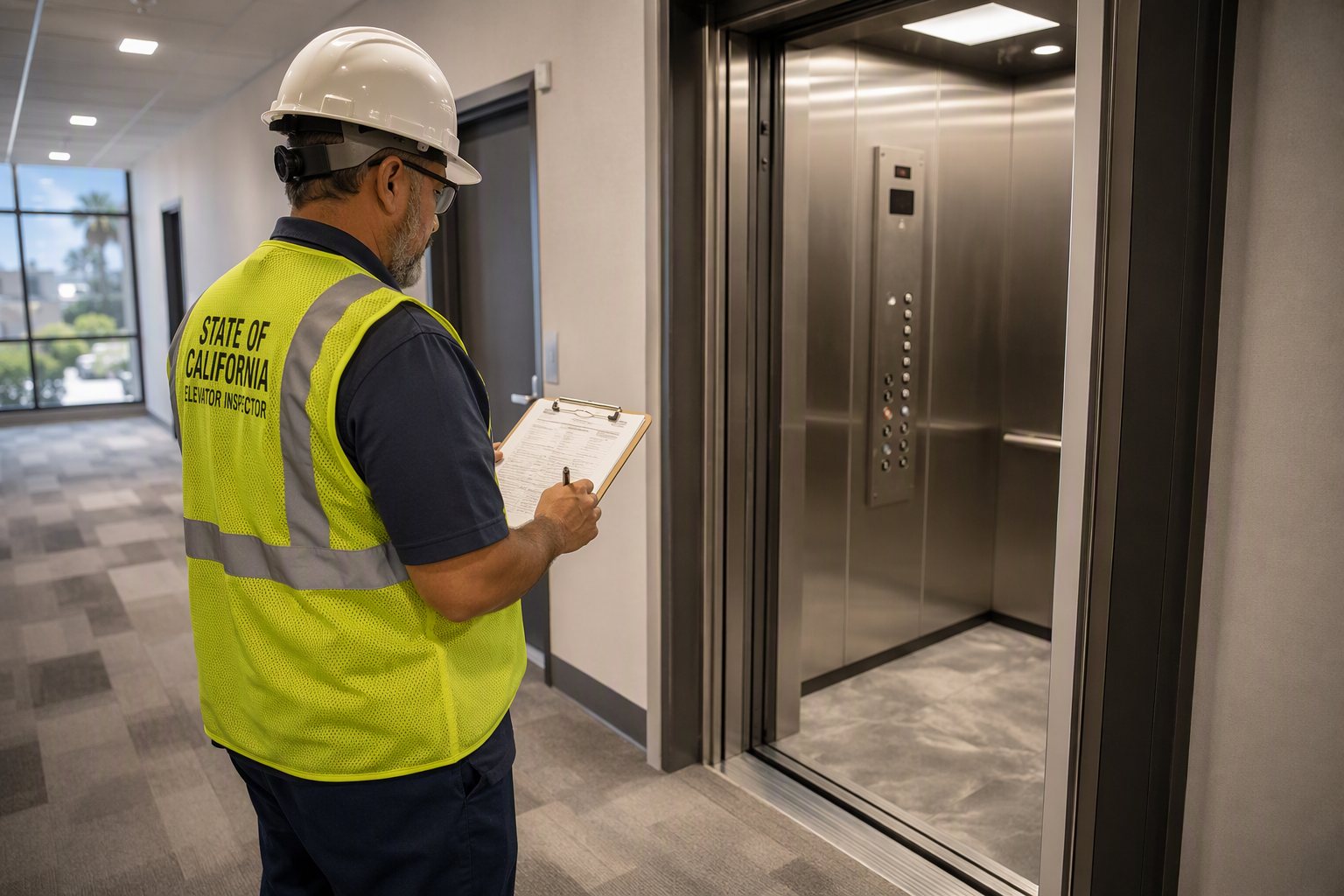
California’s Division of Occupational Safety and Health (Cal/OSHA) Elevator, Ride & Tramway Unit oversees elevator inspections statewide. Inspectors follow the ASME A17.1 Safety Code for Elevators and Escalators and its companion standard ASME A17.3 Safety Code for Existing Elevators and Escalators as the primary technical benchmarks. Violations are documented on inspection reports and must be corrected within the timeframe the inspector specifies — which can be as short as immediately for imminent hazards.
Property managers in Los Angeles, Long Beach, Signal Hill, and Orange County should treat an upcoming inspection as a project with a defined checklist, not a routine calendar event. A pre-inspection audit by a qualified elevator contractor can identify deficiencies weeks before the official visit, leaving time for parts procurement and repair scheduling.
2. Why does an expired operating certificate count as a violation, and how is it corrected?

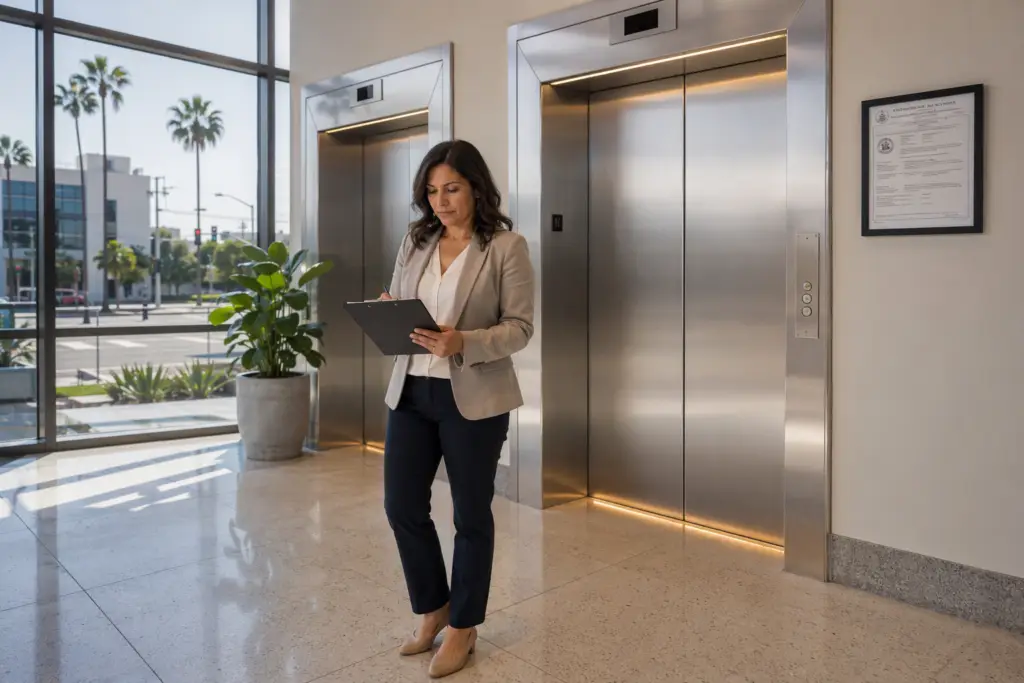
Operating without a valid California elevator permit is itself a violation that can result in mandatory shutdown, because state law requires a current permit to be posted in or adjacent to the elevator at all times.
California requires periodic inspections — typically annual for most passenger elevators — after which Cal/OSHA issues a permit to operate. If the permit lapses, the elevator is technically non-compliant regardless of its mechanical condition. Correction is straightforward: schedule the overdue inspection, pass it, and post the renewed permit. The challenge is that backlogs in inspection scheduling mean building owners should initiate the renewal process well before the expiration date. Liftech Elevator assists clients across Long Beach, Signal Hill, Los Angeles, and Orange County in coordinating inspection scheduling so permit renewals stay current.
3. What door-related violations do California inspectors cite most often?
Inspectors most commonly flag malfunctioning door reopening devices, doors that close too fast or with excessive force, and worn or misaligned door sills — all regulated under ASME A17.1.
The ASME A17.1 Safety Code for Elevators and Escalators specifies maximum door closing forces and requires a door reopening device (typically a light curtain or safety edge) that reverses the door when the beam is interrupted. Common deficiencies include:
- Light curtain or safety edge that no longer reverses the door reliably
- Door closing speed or kinetic energy that exceeds code limits
- Worn door gibs allowing doors to derail from the sill groove
- Damaged or missing door restrictors that prevent doors from opening more than a specified distance when the car is not at the landing
Corrections typically involve replacing the safety edge or light curtain array, adjusting or replacing the door operator motor and controller, and resetting speed parameters. Door gib replacement is a straightforward mechanical repair. All corrections must be verified with a functional test before reinspection.
4. What emergency communication violations are inspectors looking for?
California elevators must have a two-way voice communication system that connects occupants directly to a monitored location — a requirement reinforced by both ASME A17.1 and the Americans with Disabilities Act (ADA).
The two most common communication violations are: (1) the emergency telephone or intercom is not operational, and (2) the line connects to an unmonitored or outdated number. As analog phone lines are phased out across California, many older elevator phones that relied on traditional POTS lines have gone silent without building management realizing it. The correction requires installing a cellular or VoIP-compatible elevator communication unit and verifying the line connects to a 24/7 monitored answering point. The ADA also requires that the communication system be accessible to people who are deaf or hard of hearing, typically via a visual or text-based alternative.
5. What pit-related violations does Cal/OSHA flag during elevator inspections?
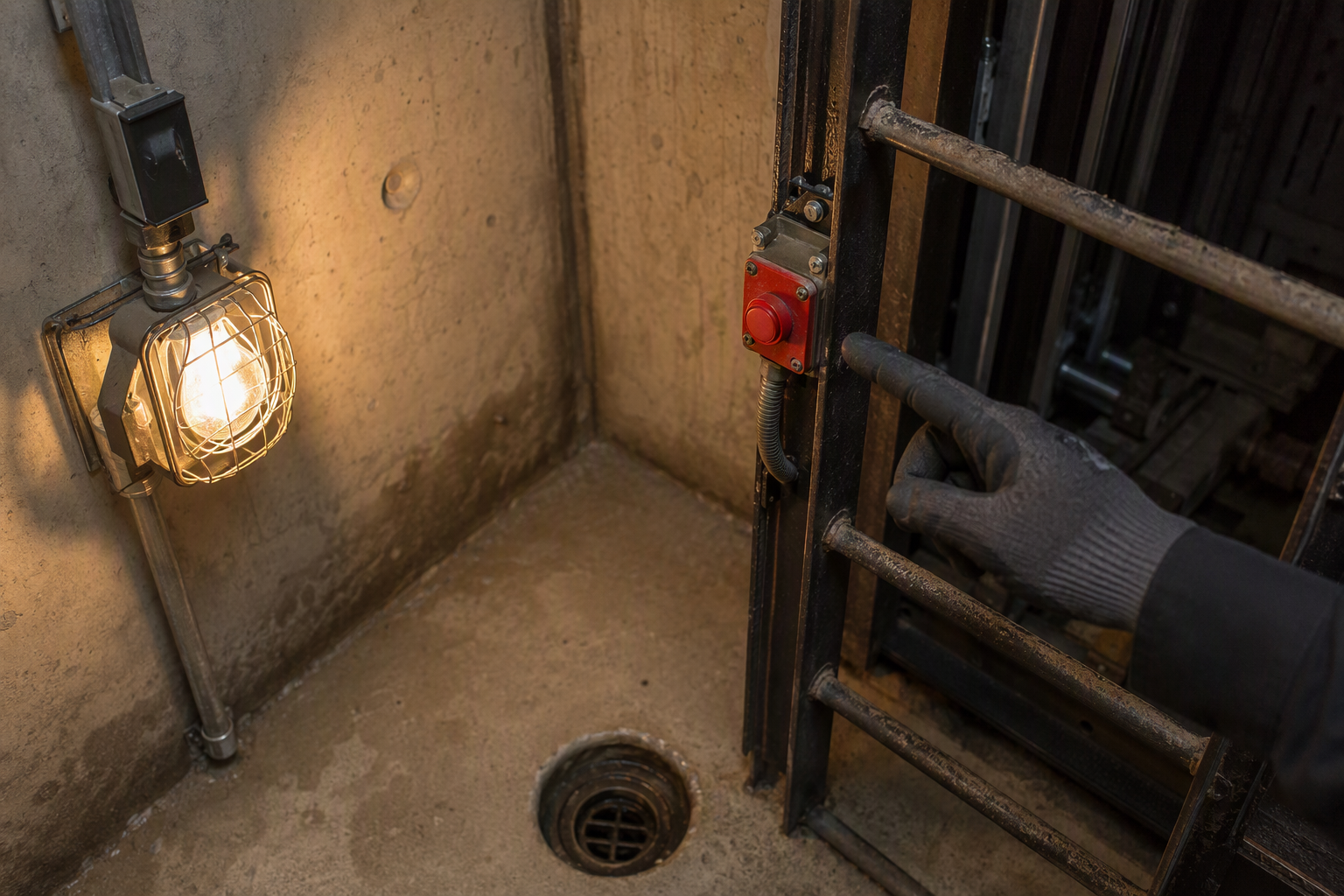
Pit violations — including inadequate lighting, water infiltration, missing stop switches, and insufficient pit ladder access — are among the most frequently cited deficiencies because the pit environment is regulated by both safety and maintenance codes.
The pit must maintain a minimum clearance under the fully compressed buffers, and that clearance must be free of debris and standing water. Required pit equipment includes:
- A permanently wired pit light with a switch accessible from the pit access door
- A pit stop switch within reach of the pit ladder landing point
- An electric outlet for maintenance use
- A pit ladder of specified dimensions when the pit depth exceeds a threshold set in ASME A17.1
Water infiltration is both a code violation and a risk to electrical components. Correction may require waterproofing the pit walls, repairing sump pump systems, and replacing any water-damaged wiring or safety switches. For properties in coastal areas such as Long Beach and Signal Hill, groundwater intrusion into elevator pits is a recurring maintenance issue.
6. What emergency lighting violations commonly appear on California inspection reports?
The most common emergency lighting violation is a backup lighting system that fails to illuminate the cab for the required duration when main power is lost — a direct violation of ASME A17.1 requirements.
ASME A17.1 requires emergency lighting in the elevator cab that activates automatically upon loss of normal power and remains operational for a specified minimum period. Battery packs degrade over time and may not hold sufficient charge to meet this requirement even though the light appears to function normally on main power. Correction involves testing the battery backup under load conditions, replacing degraded battery packs, and verifying the lighting level meets the code minimum. This is a simple repair that building maintenance teams often overlook until it is flagged at inspection.
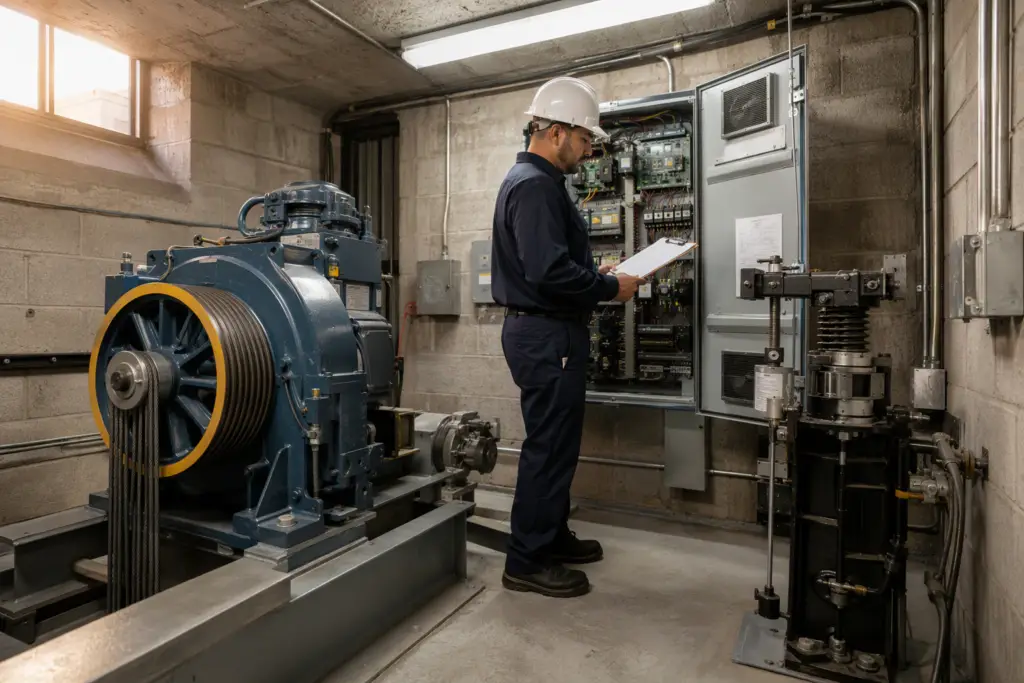
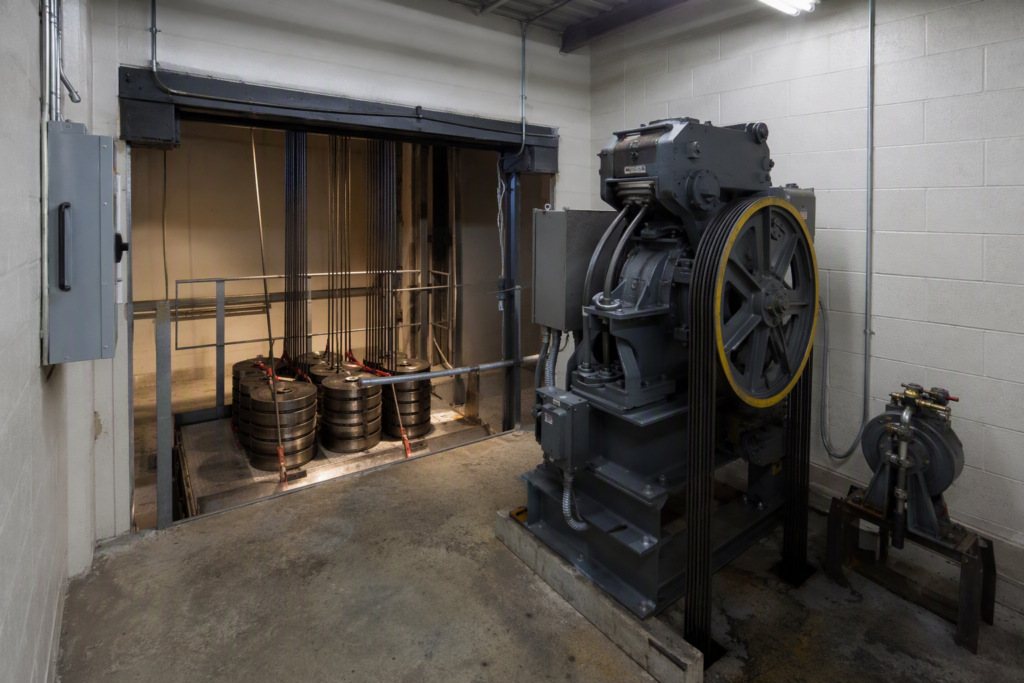
7. How do machine room violations affect inspection outcomes in California?
Machine room violations — including blocked access, improper temperature conditions, non-compliant fire suppression, and missing or incorrect signage — can result in immediate failed inspection status because the machine room is the operational nerve center of the elevator system.
Common machine room deficiencies include:
- Storage of non-elevator-related materials in the machine room (a direct code violation)
- Temperature outside the range required to protect electronic controls and hydraulic fluid
- Inadequate lighting for maintenance tasks
- Missing or illegible elevator number identification signage
- Fire extinguisher that is expired or incorrectly rated
Most machine room violations are correctable without any specialized elevator expertise — they require building maintenance action rather than a licensed elevator contractor. However, any electrical deficiencies in the machine room must be addressed by qualified personnel.
8. What are the most common ADA-related elevator violations found in California?
The most frequently cited ADA elevator violations involve inaccessible controls, missing or damaged Braille labels, non-compliant audible and visual signals, and inadequate cab dimensions — all enforceable under the ADA Standards for Accessible Design.
California’s building code, which incorporates Title 24 accessibility requirements, often exceeds federal ADA minimums. Common ADA-related deficiencies include:
- Hall call and car operating panel buttons that are worn, missing Braille, or positioned incorrectly
- Visual floor indicators (digital displays or indicators) that are non-functional
- Audible signals that announce floor levels not meeting pitch or volume requirements
- Door width or cab dimensions that have been reduced by cab refurbishment work
- Handrails missing on one or more walls of the cab
ADA violations may not always be the primary focus of the Cal/OSHA elevator inspection, but they can generate separate complaints and civil liability. Proactive correction protects building owners from both inspection failure and disability access litigation.
9. What data table benchmarks exist for common California elevator violations by category?
The table below summarizes common California elevator violation categories, the relevant code standard, typical correction complexity, and general correction timeline — helping building managers prioritize remediation work.
| Violation Category | Governing Standard | Correction Complexity | Typical Timeline to Correct | Immediate Shutdown Risk? |
|---|---|---|---|---|
| Expired operating permit | California / Cal/OSHA | Administrative | Depends on inspection availability | Yes |
| Door reopening device failure | ASME A17.1 | Moderate | 1–5 business days (parts dependent) | Yes |
| Emergency phone / communication | ASME A17.1 / ADA | Low–Moderate | 1–3 business days | Possible |
| Pit conditions (water, lighting, stop switch) | ASME A17.1 | Low–High (water = high) | 1 day – several weeks | Possible |
| Emergency cab lighting | ASME A17.1 | Low | Same day – 2 days | No |
| Machine room conditions | ASME A17.1 | Low–Moderate | 1–7 days | Possible |
| ADA control panel / signage | ADA / CA Title 24 | Moderate | 1–2 weeks (parts dependent) | No |
| Buffer condition / clearances | ASME A17.1 / A17.3 | High | 2–6 weeks | Yes |
| Governor / safety system | ASME A17.1 | High | 1–4 weeks | Yes |
| Firefighters’ emergency operation | ASME A17.1 | Moderate–High | 1–3 weeks | Possible |
Note: Timelines are general estimates based on typical repair scenarios. Actual timelines depend on parts availability, building access, and permit requirements specific to each property.
10. What are governor and safety system violations, and why are they so serious?
Governor and safety system violations are among the most serious findings because the overspeed governor and car safety are the last line of defense against an uncontrolled descent — and ASME A17.1 requires these systems to be tested on a defined schedule.
The overspeed governor monitors car travel speed and mechanically triggers the car safety device if speed exceeds a set threshold, bringing the car to a controlled stop. If governor testing is overdue, the governor rope is worn or out of adjustment, or the safeties have never been tested with a full-load drop test, these constitute serious code violations. Correction requires a certified elevator mechanic to perform governor and safety tests in accordance with ASME A17.1 test procedures. These tests must be witnessed or documented for the authority having jurisdiction (AHJ).
11. What firefighters’ emergency operation violations appear on California inspection reports?
Firefighters’ Emergency Operation (FEO) — also called Phase I and Phase II emergency recall — is required by ASME A17.1 and California fire codes, and violations include non-functional recall switches, incorrect key types, and doors that do not remain open as required during Phase II operation.
Phase I recall (lobby recall) sends all elevators to the designated recall floor when a fire alarm is triggered. Phase II allows firefighters to operate the elevator manually from inside the cab. Common violations include:
- Firefighters’ key switch that is damaged, missing, or uses the wrong key standard
- Phase I that does not activate when the building fire alarm is triggered
- Phase II cab controls that do not function correctly (doors not holding open, car not responding to hold button)
- Missing or incorrect signage on recall switches
Correction requires an elevator technician to test the full sequence in coordination with the building’s fire alarm system, then make the necessary adjustments to the elevator controller programming or hardware.
12. How do buffer and pit clearance violations get corrected?
Buffer and pit clearance violations — where the car or counterweight buffer is damaged, oil-depleted (for oil buffers), or where overhead and pit clearances do not meet minimum code dimensions — require mechanical repairs that may involve the elevator’s physical travel range and cannot be corrected by building staff alone.
Oil hydraulic buffers must contain oil at the specified level to provide the designed deceleration force. If oil is low or contaminated, the buffer must be serviced. Polyurethane (spring) buffers degrade over time and must be inspected for cracking or permanent compression. Pit clearance violations — where the distance between the pit floor and the lowest structural component of the car is less than the minimum specified in ASME A17.1 — may require structural or mechanical modification and are complex to correct. These are among the higher-cost and longer-lead-time violations building owners may encounter.
13. What violations are specific to hydraulic elevators in California?
Hydraulic elevator-specific violations most commonly involve underground cylinder condition and leak containment, hydraulic fluid type, pressure relief valve settings, and power unit condition.
California has historically had strict requirements regarding underground hydraulic cylinders due to soil contamination risk from hydraulic fluid leaks. Older single-bottom cylinders are a known environmental concern. Required elements inspectors check on hydraulic systems include:
- Functional low-pressure switch and pressure relief valve set within code limits
- Hydraulic fluid that meets current environmental and fire-safety specifications
- No visible leaks at the power unit, piping, or cylinder
- Lowering valve that allows safe manual descent during power failure
- Rupture valve (where required) on direct-plunger units
If a single-bottom cylinder has not been replaced or lined, some AHJs require an assessment or may flag it for attention depending on the age and installation details of the system.
14. How should building owners prepare for a California elevator inspection?
Building owners should conduct a structured pre-inspection audit at least 60 to 90 days before the scheduled inspection date, covering all major code categories — permit status, safety devices, communications, pit, machine room, and ADA compliance.
A systematic pre-inspection process includes the following steps:
- Verify the current operating permit is posted and review its expiration date.
- Test the emergency communication phone and confirm the line connects to a monitored, live answering point.
- Test emergency cab lighting by interrupting main power and timing the backup duration.
- Inspect the pit visually for water accumulation, debris, lighting function, and stop switch operation.
- Test door reopening devices by breaking the light curtain beam at multiple heights during a closing cycle.
- Confirm machine room access is unobstructed, temperature-controlled, and free of non-elevator storage.
- Verify all ADA-required Braille labels, audible signals, and visual floor indicators are intact and functional.
- Review the maintenance log to confirm governor and safety tests are current per code schedule.
- Confirm Firefighters’ Emergency Operation (Phase I and Phase II) activates correctly.
- Engage a qualified elevator service contractor to address any deficiencies identified above before the official inspection date.
Liftech Elevator provides pre-inspection audits for properties in Long Beach, Signal Hill, Los Angeles, and Orange County, identifying deficiencies in advance so building owners have time to make corrections rather than face a failed inspection and mandatory shutdown.
15. What happens if an elevator fails a California inspection?
When an elevator fails a California inspection, the inspector may issue a correction notice with a specified timeframe for repairs, or — for serious safety violations — may order the elevator removed from service immediately until corrections are verified.
A failed inspection generates a written deficiency list. For non-hazardous violations, the building owner typically receives a correction period and must have the work completed and documented before a reinspection is scheduled. For violations that present an imminent danger — such as a non-functional door safety device, a failed governor test, or excessive structural damage to load-bearing components — the inspector has authority to order the elevator out of service on the spot. At that point, the elevator cannot be returned to passenger service until repairs are made and a reinspection is passed. The financial and operational impact of an unplanned shutdown underscores the value of proactive maintenance and pre-inspection audits.
16. How often are California elevators required to be inspected?
Most passenger elevators in California are subject to periodic inspections by the Cal/OSHA Elevator, Ride & Tramway Unit on a schedule that typically results in annual permit renewals, though the exact interval can depend on elevator type and use category.
In addition to the periodic inspection required for permit renewal, ASME A17.1 specifies maintenance tests — including governor and safety tests, brake tests, and pressure relief valve tests for hydraulic units — that must be performed at defined intervals separate from the state inspection cycle. Building owners and their elevator contractors must track both the state inspection calendar and the ASME maintenance test schedule to remain fully compliant. Failing to perform and document required periodic tests is itself a violation that inspectors will cite even if the elevator is otherwise in good mechanical condition.
17. What does it cost to correct elevator code violations in California?
Correction costs vary widely based on violation type — from minimal cost for administrative and lighting issues to significant investment for major mechanical or structural repairs — and building owners should obtain specific quotes rather than rely on general estimates.
Low-complexity corrections (replacing a battery pack, clearing machine room clutter, installing a cellular elevator phone) typically involve minimal parts and labor cost. Mid-complexity corrections (replacing a light curtain assembly, servicing a pit stop switch, updating ADA panel labeling) involve parts procurement and technician time. High-complexity corrections (governor and safety testing with a full load test, hydraulic cylinder replacement, buffer replacement, or retrofitting Firefighters’ Emergency Operation) involve specialized equipment, extended labor, and may require permits for the corrective work itself. Building owners should request itemized proposals so the scope and cost of each correction is clearly defined before work begins.
18. Are there California-specific elevator regulations beyond ASME A17.1 that building owners need to know about?
Yes — California’s Cal/OSHA Elevator, Ride & Tramway Unit enforces state-specific regulations that supplement the federal ASME standards, and in some areas California’s requirements are stricter than the national baseline.
California has historically adopted ASME A17.1 as its technical baseline while adding state-specific amendments through its own regulatory process. California also applies ASME A17.3 Safety Code for Existing Elevators and Escalators to legacy equipment, which establishes retrofit requirements that may be triggered by major alterations or at periodic intervals. Additionally, California’s Title 24 building code imposes accessibility requirements that interact with and in some cases exceed the federal ADA Standards for Accessible Design. Building owners in Los Angeles, Orange County, Long Beach, and Signal Hill should work with an elevator contractor familiar with California’s regulatory environment, not just the national ASME code text.
19. How does an elevator maintenance agreement help prevent code violations?
A comprehensive maintenance agreement with a qualified elevator contractor ensures that routine inspections, lubrication, adjustments, and required periodic tests are performed on schedule — preventing the deferred maintenance that causes most code violations.
The majority of code violations found during California inspections are not sudden failures — they are the result of deferred maintenance. Door safety edges wear gradually. Pit sump pumps fail unnoticed. Emergency phone lines disconnect without alarms. Battery backup systems degrade silently. A structured maintenance agreement that includes regular technician visits, documented test cycles, and parts replacement on condition-based schedules addresses these issues before they become inspection failures. When evaluating maintenance agreements, building owners should confirm that the scope explicitly covers all ASME A17.1 required periodic tests, not just routine lubrication and callback response.
20. How can Liftech Elevator help building owners in Southern California avoid elevator code violations?
Liftech Elevator provides elevator maintenance, repair, and pre-inspection audit services across Long Beach, Signal Hill, Los Angeles, and Orange County — helping building owners identify and correct code deficiencies before they result in failed inspections or shutdowns.
Liftech Elevator’s service scope includes all major violation categories: door safety device repair and adjustment, emergency communication system upgrades (including cellular conversion for properties that have lost analog phone lines), pit remediation, machine room compliance, emergency lighting testing and replacement, ADA panel and signage corrections, governor and safety testing, hydraulic system service, and Firefighters’ Emergency Operation verification. For building owners approaching an inspection cycle, Liftech Elevator’s pre-inspection audit process walks through the full ASME A17.1 and California compliance checklist and produces a written report identifying any deficiencies — giving facilities teams and ownership a clear, prioritized correction plan.
Properties throughout the Los Angeles basin and Orange County that want to move from reactive violation response to proactive compliance management find that structured maintenance partnerships with a knowledgeable elevator service company are the most cost-effective approach over a multi-year horizon.
Additional Resources
- ASME Codes & Standards — ASME A17.1 and A17.3 Safety Codes for Elevators and Escalators
- ADA.gov — Americans with Disabilities Act Standards for Accessible Design
- OSHA.gov — Occupational Safety and Health Administration
Schedule Your Free Elevator Assessment Before Your Next Inspection
Do not wait for a failed inspection notice or an unexpected shutdown order. Contact Liftech Elevator today for a comprehensive pre-inspection audit covering all major California code violation categories — door safety, communication systems, pit conditions, ADA compliance, governor tests, and more. Serving Long Beach, Signal Hill, Los Angeles, and Orange County.
Contact Liftech Elevator for a free elevator assessment: 562-997-3639
Need elevator service you can rely on? Liftech Elevator is ready to help.