How to Negotiate an Elevator Maintenance Contract Renewal: Terms to Push Back On

Elevator maintenance contracts are among the most consequential service agreements a building owner or property manager will sign. Renewal periods are the single best opportunity to correct unfavorable terms, renegotiate pricing structures, and ensure ongoing compliance with applicable codes. Yet most contract renewals are signed with little scrutiny — leaving building owners bound to clauses that favor the service provider for another three to five years.
This guide covers every dimension of elevator maintenance contract negotiation: the terms that most commonly disadvantage building owners, the compliance floor set by safety codes, how to compare competing bids, and what questions to ask before signing anything. Liftech Elevator approaches this process as a data-driven service provider, helping clients evaluate contract language against industry norms rather than accepting boilerplate renewals.
What Does an Elevator Maintenance Contract Actually Cover?
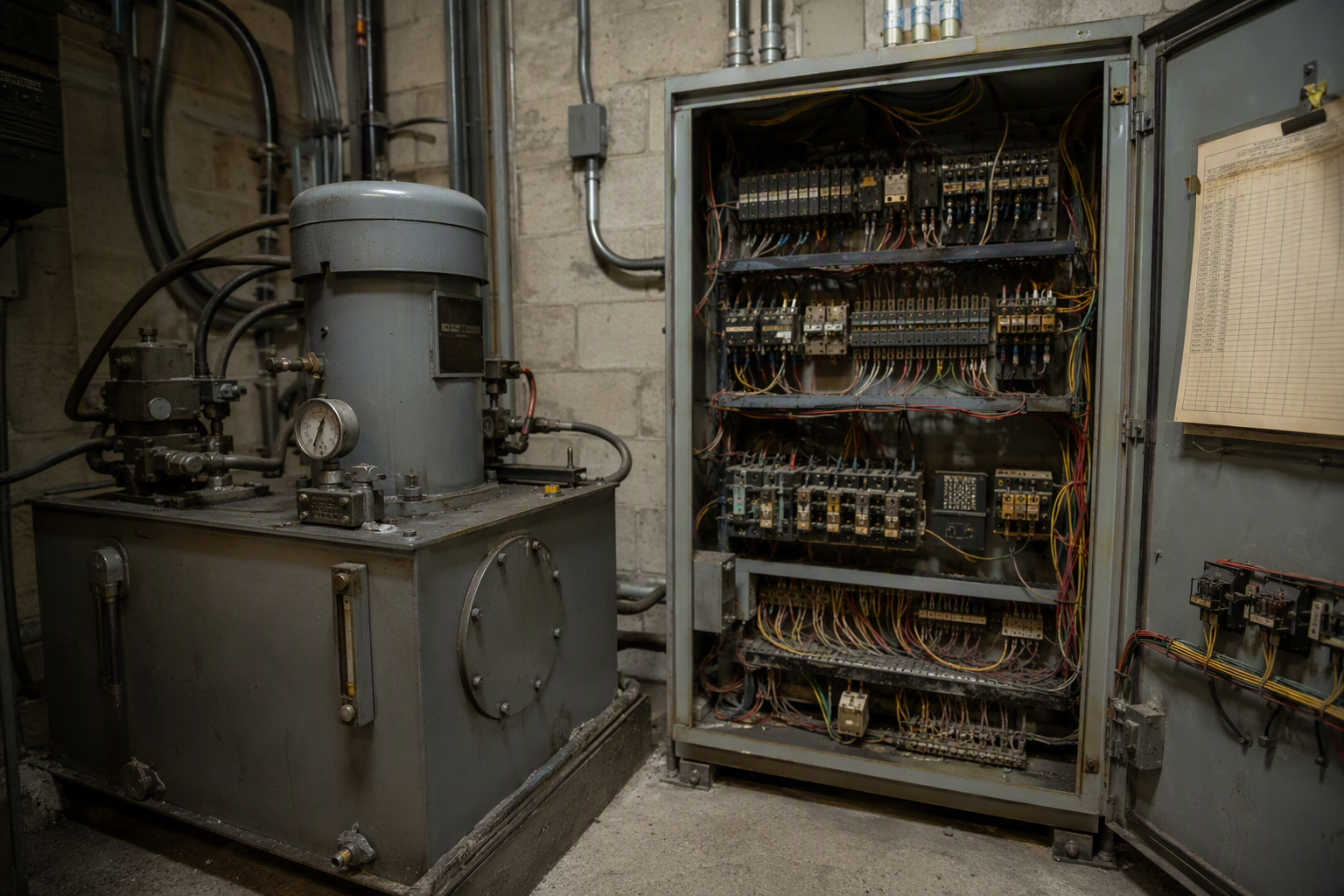
A standard full-service elevator maintenance contract typically includes scheduled preventive maintenance visits, lubrication and adjustment of mechanical components, labor for covered repairs, emergency callback service, and periodic testing required by local jurisdiction authorities. However, “full service” is a marketing label, not a legal definition. What is actually covered varies substantially between providers and contract tiers.
Common contract structures include:
- Full Maintenance (FM): Covers parts, labor, and callbacks. Appears comprehensive but often contains carve-outs for major components such as motors, controllers, and hydraulic units.
- Partial Maintenance (PM): Covers labor and routine adjustments only; parts are billed separately at rates that can escalate sharply.
- Examination and Lubrication (OLT/E&L): A lower-cost tier covering only visual inspection, lubrication, and minor adjustments. Leaves significant repair exposure with the building owner.
Understanding which tier applies and exactly what is excluded is the starting point for every renewal negotiation.
What Is the Legal Compliance Baseline for Any Elevator Maintenance Contract?
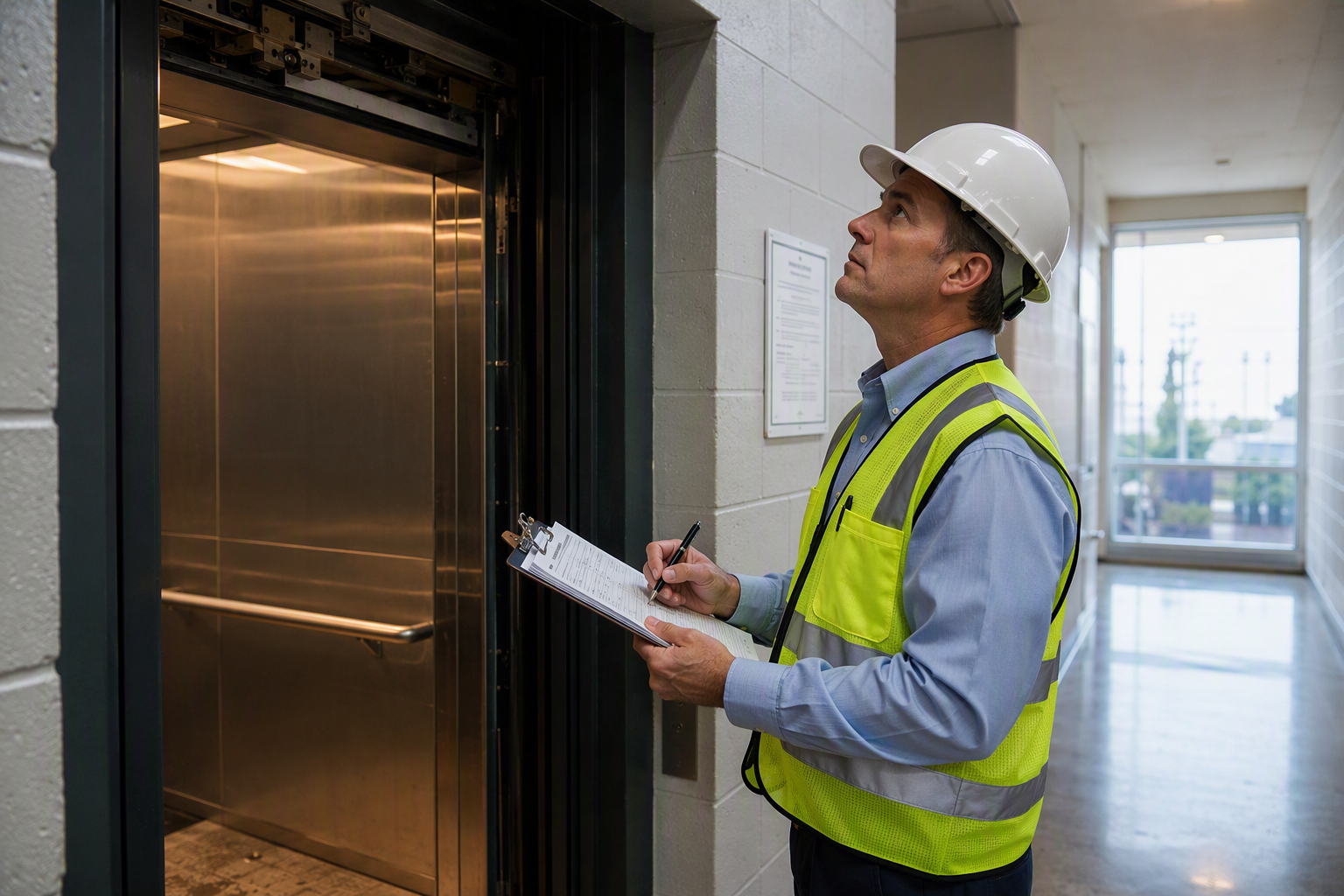
Any elevator maintenance contract must align with the requirements established by ASME A17.1 Safety Code for Elevators and Escalators, which governs the design, construction, operation, inspection, testing, maintenance, and repair of elevators in the United States and Canada. Individual states and municipalities adopt ASME A17.1 by reference, often adding jurisdiction-specific amendments.
The ASME A17.1 code requires periodic testing of safety devices including governors, safeties, and buffers, with documented records retained for review by the authority having jurisdiction (AHJ). A maintenance contract that does not account for these required tests creates a compliance gap — and the liability falls on the building owner, not the contractor.
For elevators that serve the public or are located in facilities subject to the Americans with Disabilities Act (ADA), accessibility features must remain in working order as part of ongoing maintenance. Contracts that exclude call button, door timing, or leveling accuracy repairs can inadvertently expose a building to ADA compliance issues.
Work performed on or around elevator equipment may also intersect with OSHA lockout/tagout (LOTO) regulations, which govern energy control procedures when technicians service powered equipment. Building owners should confirm that any contracted service provider’s technicians follow OSHA-compliant safety procedures — and that the contract does not indemnify the provider for OSHA violations.
Which Contract Terms Should Building Owners Push Back On?
The following clauses appear frequently in elevator maintenance contracts and consistently disadvantage building owners. Each represents a negotiation target at renewal:
1. Automatic Price Escalation Clauses
Many contracts include annual price increases tied to broad indices or at the contractor’s sole discretion. Building owners should push for a clearly defined cap on annual increases, or tie any escalation to a specific published index with a ceiling. Open-ended escalation language has no place in a multi-year agreement.
2. Proprietary Parts and Vendor Lock-In Language
Some contracts include provisions stating that only OEM (original equipment manufacturer) parts will be used, or that the building owner must use the same contractor for repairs to avoid voiding the maintenance agreement. This language artificially limits competitive bidding on repairs and can significantly increase costs over time. Building owners should negotiate to allow qualified alternative parts or to seek independent bids for major component replacements.
3. Vague Callback Response Language
Contracts often state that the provider will respond “within a reasonable time” or “as soon as practicable.” These phrases are unenforceable. Any contract renewal should define callback response requirements in specific time windows, differentiate between entrapment situations and standard service calls, and specify penalties or credits if those windows are not met.
4. Exclusion Carve-Outs for Major Components
Review the exclusions list carefully. Contracts may exclude the motor, controller, hydraulic power unit, car operating panel, door operators, or other high-cost components while still marketing the agreement as “full service.” At renewal, negotiate to either narrow the exclusions or obtain a clear written schedule of what is covered and what is not, so repair cost exposure can be planned accordingly.
5. Unilateral Termination Clauses
Some contracts allow the provider to terminate the agreement with little or no notice while requiring the building owner to provide 90 to 180 days written notice to exit. This asymmetry should be corrected at renewal. Both parties should bear equivalent notice and termination obligations.
6. Assignment Without Consent
In an industry that has seen significant consolidation, the maintenance company a building owner signs with today may be acquired by a larger firm tomorrow. Contracts that allow assignment to a successor entity without the building owner’s consent remove any leverage when service quality changes following acquisition. Push for a consent-to-assignment clause.
7. Limitations on Accessing Maintenance Records
Building owners are responsible for maintaining records required by the authority having jurisdiction under ASME A17.1. Any contract that makes records proprietary to the contractor, or restricts the building owner’s access to service logs and test documentation, creates a compliance liability. All maintenance logs, test records, and inspection certificates should contractually belong to the building owner.
How Should Building Owners Prepare for a Contract Renewal Negotiation?
- Pull the current contract and read every exclusion: Identify all carve-outs, escalation triggers, and termination asymmetries before entering negotiations.
- Compile the service history: Document all callbacks, repairs, and unresolved issues from the current contract term. This record provides concrete leverage when discussing service quality and pricing.
- Review inspection reports and any open violations: Outstanding violations issued by the authority having jurisdiction are a negotiating point — a responsible contractor should resolve them as part of the renewal agreement.
- Obtain at least two competitive bids: Even if the intention is to renew with the current provider, competitive bids establish a market rate baseline and demonstrate that the building owner is an informed buyer.
- Identify equipment age and upcoming major replacements: If major components are approaching end of service life, negotiate now for either inclusion in the contract scope or a defined repair rate structure before the equipment fails.
- Define acceptable callback response requirements in writing: Decide what response windows are acceptable for entrapment versus routine service before entering the negotiation, so those requirements can be inserted into the agreement.
- Engage a qualified elevator consultant or second service provider for review: An independent technical review of contract language can identify clauses that carry hidden cost exposure.
- Set a clear walk-away position: Know in advance what terms are non-negotiable, so the negotiation has defined boundaries.
What Are the Industry Trends Shaping Elevator Maintenance Contracts in 2025–2026?
Several developments are reshaping how elevator maintenance contracts are structured and negotiated heading into 2026:
Remote monitoring and predictive maintenance: Elevator manufacturers and independent service providers are increasingly offering remote monitoring platforms that track door cycle counts, motor temperature, callback frequency, and other performance indicators in real time. Building owners negotiating renewals should clarify whether remote monitoring is included, who owns the data generated, and how that data is used to trigger preventive interventions versus billable repairs.
Increasing component costs and supply chain considerations: Ongoing volatility in the cost of electronic components and specialty parts is a documented industry concern. Contracts that lock in fixed parts pricing for multi-year terms protect building owners in this environment; contracts that allow parts to be billed at “current market rates” at time of repair expose building owners to unpredictable cost increases.
Modernization pressure and code updates: As the 2026 edition guidance cycle for ASME A17.1 is applied by adopting jurisdictions, older equipment may become subject to new upgrade requirements. Building owners should ensure contracts address how code-driven modifications are scoped and priced, rather than treating them as entirely separate from the maintenance relationship.
Consolidation among service providers: The elevator service industry has experienced notable consolidation, with independent and regional providers being acquired by larger national firms. This trend makes the consent-to-assignment clause discussed above increasingly important for building owners who value continuity of local technician relationships.
Sustainability and energy monitoring: Some jurisdictions are beginning to incorporate energy performance requirements for vertical transportation into building codes. Forward-looking maintenance contracts are starting to address energy baseline reporting and, in some cases, energy optimization as a defined deliverable.
How Does Elevator Age and Type Affect Contract Negotiation Leverage?
The age and type of elevator significantly affects the risk profile embedded in a maintenance contract, and therefore the appropriate negotiation strategy:
Older hydraulic elevators carry the risk of oil leaks, cylinder corrosion, and controller obsolescence. Contracts covering older hydraulic units should explicitly address hydraulic fluid containment requirements — which are increasingly governed by state environmental regulations — and should define whether cylinder testing and replacement are included or excluded.
Traction elevators with aging controllers may rely on components that are no longer manufactured. When replacement parts are no longer available from the OEM, a full-service contract that promises parts coverage becomes difficult to fulfill. Building owners of such equipment should negotiate specifically around controller replacement terms.
Modern MRL (machine room-less) and destination dispatch elevators rely heavily on proprietary software and electronics. Service contracts for these systems often include restrictive clauses favoring the original manufacturer’s service arm. Building owners should carefully evaluate the competitive landscape before accepting long-term lock-in on proprietary systems.
What Should a Vendor Comparison Checklist Include?
When comparing proposals from multiple elevator maintenance providers at renewal time, evaluate each bid against the following criteria:
- Explicit list of covered components versus exclusions
- Defined callback response windows for entrapment and standard service
- Annual price escalation cap and index reference
- Parts sourcing policy (OEM only, approved equivalents, or open)
- Documentation and record ownership provisions
- Technician qualifications and local presence (verifiable through references)
- Assignment and termination symmetry
- Compliance with ASME A17.1 testing and ADA requirements
- Remote monitoring inclusion and data ownership terms
- Process for handling code-driven modification requirements
Liftech Elevator provides transparent, itemized proposals that address each of these dimensions, giving building owners the information needed to make a direct comparison rather than evaluating contracts on price alone.
What Is a Reasonable Contract Length for an Elevator Maintenance Agreement?
Elevator maintenance contracts commonly run one, three, or five years. Longer terms generally offer more favorable pricing, but they also reduce leverage if service quality declines or the provider changes through acquisition. For older equipment approaching modernization, shorter contract terms preserve flexibility. For newly modernized or newly installed equipment, longer terms can lock in favorable rates during the period when service demands are lowest.
Regardless of term length, any contract of three years or more should include a defined performance review mechanism at each anniversary, with the ability to trigger a renegotiation process if documented service failures accumulate beyond a defined threshold.
How Do Local Jurisdiction Requirements Affect Contract Terms?
Elevator inspection and testing requirements are enforced by the authority having jurisdiction, which may be a state elevator safety board, a city or county building department, or a third-party inspection agency operating under state authority. These requirements vary significantly by location and may include annual, biennial, or periodic Category 1 and Category 5 tests as defined under ASME A17.1.
A maintenance contract should explicitly state which party is responsible for scheduling and coordinating required inspections, who bears the cost of any additional testing required to clear a violation, and how the cost of witness testing by a licensed inspector is handled. Ambiguity in these areas routinely results in disputes at inspection time.
What Happens If an Elevator Fails an Inspection During the Contract Term?
When an elevator fails an inspection, the authority having jurisdiction may issue a violation notice and require the elevator to be taken out of service until corrective work is completed and a reinspection is passed. The question of who bears responsibility for the cost of repairs that led to the failure — and for the reinspection — is often a point of conflict between building owners and service contractors.
A well-negotiated contract addresses this directly: if the failure is attributable to a covered component or a maintenance deficiency, the contractor should bear the repair cost. If the failure stems from deferred modernization or end-of-life equipment, the cost allocation is different. Having this framework in writing before a failure occurs avoids costly disputes after one.
Can a Building Owner Terminate an Elevator Maintenance Contract Early Without Penalty?
Most elevator maintenance contracts include early termination penalties, commonly calculated as a percentage of the remaining contract value or a set number of months of fees. These penalties are negotiable at the time of signing or renewal. Building owners should push for a termination-for-cause provision that allows exit without penalty if documented service failures meet a defined threshold — for example, repeated missed callback windows or failure to resolve open violations within a specified period.
It is also worth negotiating what happens to service records and proprietary equipment access codes upon termination. Some contractors retain or restrict access to controller codes and configuration data as a way to create switching costs. This practice should be addressed in contract language before it becomes a dispute at the end of a relationship.
What Role Does an Independent Elevator Consultant Play in Contract Negotiations?
An independent elevator consultant — a qualified professional not affiliated with any service contractor — can review contract language, evaluate competing bids on a technical basis, and provide a neutral assessment of equipment condition and true maintenance requirements. Engaging an independent consultant is particularly valuable for large portfolios, high-rise buildings, or facilities where elevator downtime carries significant operational or liability consequences.
Independent consultants can also help building owners interpret jurisdiction-specific requirements under ASME A17.1 and verify that proposed contract scopes actually satisfy local compliance obligations.
How Does Liftech Elevator Approach Contract Transparency?
Liftech Elevator approaches maintenance contracts with the position that building owners are best served by complete transparency about what is covered, what is not, and how compliance obligations are allocated. Proposals from Liftech Elevator itemize covered components, define callback response expectations in specific terms, and address record ownership and inspection coordination explicitly — giving building owners the information needed to evaluate the agreement on its merits rather than relying on broad marketing language.
As a data-driven service provider, Liftech Elevator structures renewal conversations around documented service history and equipment-specific risk factors rather than one-size-fits-all contract templates.
Summary: Key Negotiation Points Checklist
| Contract Term | What to Push For | Why It Matters |
|---|---|---|
| Price escalation | Defined cap tied to named index | Prevents uncapped annual increases |
| Parts sourcing | Allow qualified equivalent parts | Reduces vendor lock-in and cost exposure |
| Callback response | Specific time windows; entrapment vs. routine | Makes service level promises enforceable |
| Exclusion schedule | Written list of all excluded components | Prevents disputes over what “full service” means |
| Assignment clause | Require written consent for assignment | Protects against service quality changes after acquisition |
| Record ownership | All records belong to building owner | Required for ASME A17.1 compliance documentation |
| Termination symmetry | Equal notice periods for both parties | Removes one-sided exit penalties |
| Inspection coordination | Defined party responsibility and cost allocation | Prevents disputes at inspection time |
Note: This table reflects qualitative negotiation guidance, not sourced pricing data. All contract decisions should be reviewed against applicable local jurisdiction requirements.
Get a Free Elevator Assessment from Liftech Elevator
Negotiating an elevator maintenance contract renewal is more effective when it is grounded in a clear-eyed assessment of current equipment condition, service history, and applicable compliance requirements. Liftech Elevator provides free elevator assessments to help building owners understand exactly what their maintenance agreement should cover before they sign anything.
Contact Liftech Elevator for a free elevator assessment: 562-997-3639
Need elevator service you can rely on? Liftech Elevator is ready to help.