
How to Compare Elevator Service Company Bids When Pricing and Contract Terms Look Completely Different
Comparing elevator service company bids is rarely straightforward. Two proposals covering the “same” building may differ by thousands of dollars annually, use incompatible terminology, and structure coverage in ways that make side-by-side comparison feel impossible. The reason is that elevator maintenance contracts are not standardized — scope, parts inclusion, labor rates, inspection responsibilities, and liability clauses all vary by vendor. This guide gives building owners, property managers, and facilities teams in Los Angeles, Long Beach, Signal Hill, and Orange County a rigorous framework for cutting through that complexity and selecting the right partner.
1. What exactly should an elevator maintenance contract cover?

A complete elevator maintenance contract should cover scheduled preventive maintenance, unscheduled repair labor, parts and materials, state-mandated annual inspections, and emergency callback service — with clear written definitions for each category.
Many disputes between building owners and service companies arise because one party assumed a service was included while the other treated it as a billable extra. Before comparing prices, confirm that every proposal defines the following in writing: the frequency and scope of preventive maintenance visits, which parts are covered versus billed separately, who arranges and pays for the state inspection and permit, how callbacks outside business hours are handled, and what constitutes an emergency versus a routine repair. A bid that omits any of these categories is incomplete and cannot be fairly compared to one that includes them.
2. Why do elevator service bids look so different from each other?
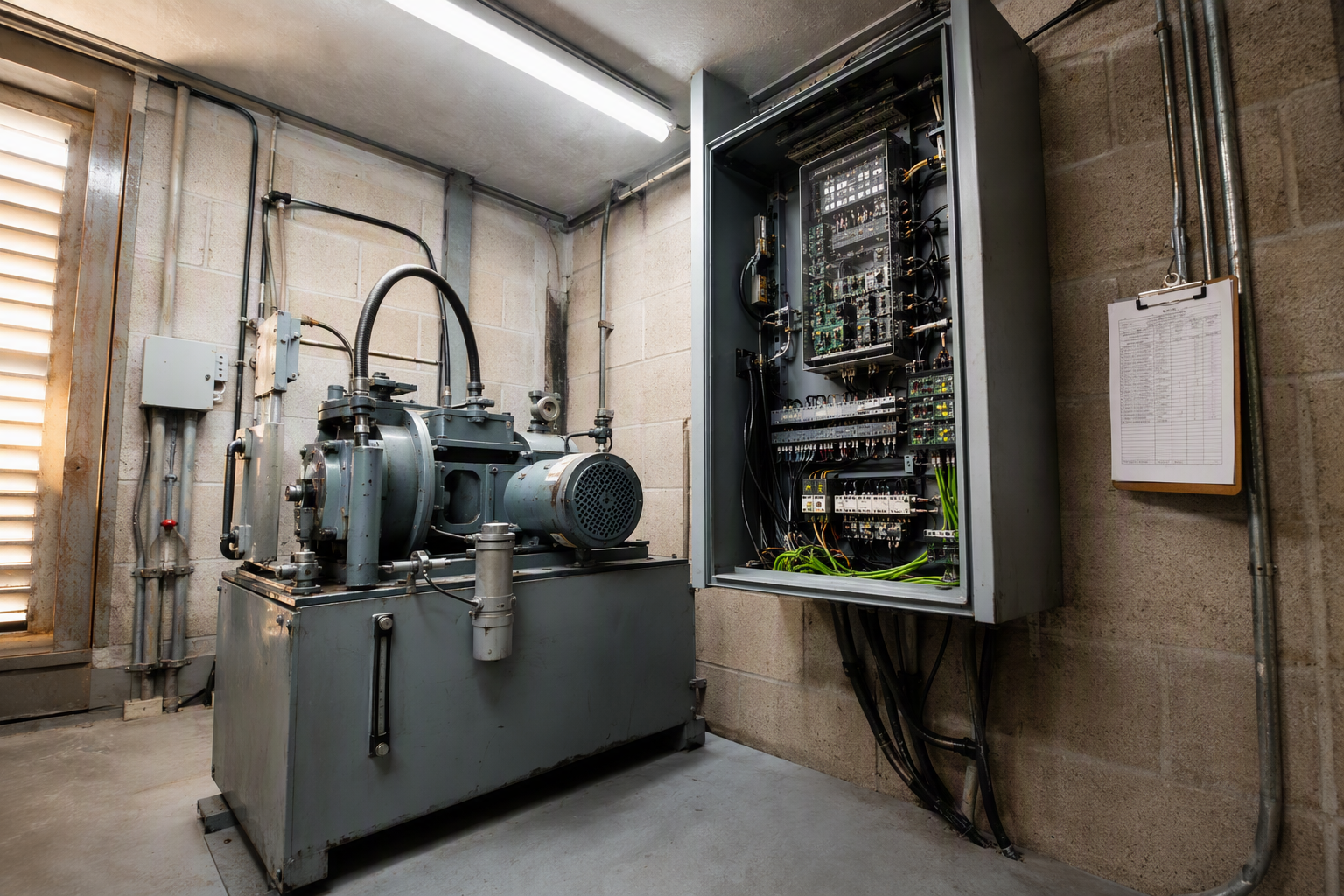
Bids look different because vendors use non-standardized contract structures — some bundle everything into a flat monthly rate while others unbundle labor, parts, and compliance into separate line items, making identical scopes appear radically different in price.
A “full maintenance” contract from one company may include parts, whereas a “comprehensive” label from another may exclude major components like controllers, motors, or hydraulic units. Labor-only agreements price lower on paper but expose building owners to unpredictable parts costs. Time-and-material arrangements offer flexibility but provide no cost certainty. Understanding which pricing model each bid uses is the first step to a valid comparison. Vendors in high-cost urban markets like Los Angeles and Orange County also price differently based on their overhead, technician dispatch geography, and parts sourcing relationships.
3. How do you standardize bids with different contract structures?
Standardize bids by creating a master scope matrix that lists every service category in rows and each vendor’s bid in columns, then marking each cell as “included,” “excluded,” or “available at extra cost” — this converts incompatible proposals into a single comparable document.
Start by listing every service category relevant to your elevator type and building profile: monthly lubrication and adjustments, annual load test, five-year full-load safety test (required under ASME A17.1 Safety Code for Elevators and Escalators), controller parts, hydraulic fluid and pump components, door operator parts, cab interior repairs, phone line testing, and modernization recommendations. Fill in each vendor’s position on every line item. The resulting matrix often reveals that the lowest-priced bid excludes multiple high-cost items that competitors include, and the true cost difference narrows or reverses.
4. What is total cost of ownership (TCO) and why does it matter more than bid price?
Total cost of ownership is the full projected expense of a service contract over its term, including the base contract price, estimated costs for excluded services, potential downtime losses, and regulatory penalty exposure — and it almost always tells a different story than the quoted monthly rate.
A contract priced at a lower monthly rate but excluding major parts could cost significantly more when a controller board fails or a hydraulic pump needs replacement. Building owners should ask each vendor for a list of the ten most common repair items for their specific elevator model and whether each is covered. Factoring in realistic repair frequency — based on the equipment’s age and usage — gives a more accurate multi-year cost picture. For commercial properties in Long Beach and Los Angeles with high passenger volume, elevator downtime also carries a real economic cost that a cheaper, slower-responding vendor may not offset with savings.
5. Which contract terms carry the most financial risk?
The highest-risk contract terms are exclusion clauses for “obsolete” or “proprietary” parts, automatic renewal provisions with long notice windows, and limitations-of-liability clauses that cap the vendor’s obligation well below the actual cost of a service failure.
Exclusion clauses for obsolete parts are particularly consequential for older equipment common in pre-1990s buildings throughout Los Angeles County and Orange County. If a vendor can deem a part obsolete and bill it outside the contract at will, the cost protection the contract appears to offer is largely illusory. Auto-renewal clauses with 60- or 90-day cancellation windows can trap building owners in underperforming contracts. Liability caps set at one month’s contract fee — a common vendor-favored provision — mean a vendor faces almost no financial consequence for extended outages. These clauses should be negotiated out or balanced with performance credits before signing.
6. What compliance obligations must any elevator service contract address?
Any elevator service contract serving California buildings must address annual inspections by a Certified Elevator Inspector, California Division of Occupational Safety and Health (Cal/OSHA) permit renewal, ASME A17.1 code-required periodic tests, and ADA accessibility compliance as part of any modernization or alteration scope.
California elevator safety is regulated through Cal/OSHA’s Elevator, Ride, and Tramway Unit. Annual permits to operate are required, and they depend on passing a state inspection. Contracts should specify whether the service company coordinates and bears cost for the annual inspection or whether that responsibility falls to the building owner. The ASME A17.1 Safety Code for Elevators and Escalators (current 2019 edition, adopted with California amendments) establishes testing intervals for safeties, governors, and buffers that must be performed on schedule. Any bid that is silent on these compliance obligations should be treated as excluding them. Liftech Elevator structures its maintenance agreements to clearly assign compliance responsibilities so building owners in Signal Hill, Long Beach, Los Angeles, and Orange County are never caught off-guard before an inspection.
7. How should you evaluate parts coverage differences between bids?
Evaluate parts coverage by requesting each vendor’s explicit written list of excluded parts categories, then cross-referencing those exclusions against the failure history and age profile of your specific elevator equipment.
Parts coverage language ranges from “all parts included” (often with exclusions in fine print) to “labor only” to tiered coverage with separate caps for major components. Request a clear written answer from each vendor on whether the following are covered: door operators and hanger assemblies, controller boards and printed circuit components, hydraulic power units and cylinders, motor and drive components, cab lighting and fixtures, and emergency phone systems. Vendors serving older buildings should be willing to specify coverage for aging equipment rather than using blanket obsolescence language as an escape hatch.
8. What questions should you ask every vendor before accepting a bid?
Before accepting any bid, ask each vendor six critical questions that expose hidden costs, service gaps, and contractual traps that the written proposal may not surface clearly.
- What is explicitly excluded from this contract? Require a written exclusions list, not just a description of what is included.
- Who performs the work — your own technicians or subcontractors? Subcontracting arrangements can affect accountability and response consistency.
- How do you handle parts for equipment that is no longer in active manufacturer production? This is critical for pre-1990 equipment in older Los Angeles and Orange County buildings.
- Who is responsible for coordinating and funding the annual state inspection and permit? Confirm this is in writing within the contract.
- What are the escalation provisions — can rates increase, and by how much per year? Uncapped escalation clauses expose owners to unpredictable cost increases over multi-year terms.
- What happens if the elevator is out of service for an extended period — are there service credits or performance remedies? Absence of any performance remedy is a significant risk for high-traffic properties.
9. How do you compare emergency callback terms across bids?
Compare callback terms by examining the defined response window, what hours are covered at no extra charge, and whether “response” means a technician on-site or merely an acknowledgment call — because vendors define these terms very differently.
Some contracts define “emergency response” as a phone acknowledgment within a set window, with an on-site technician arriving later and potentially billed at overtime rates. Others include on-site response within a stated window as part of the flat contract rate. For properties with high occupancy — such as medical buildings in Los Angeles or residential towers in Long Beach — the distinction between a phone callback and a physical technician arrival is critical, particularly for entrapment situations. OSHA and California regulations impose obligations on building owners to address entrapments promptly, so the service company’s actual response capability is a compliance matter, not merely a convenience preference.
10. What does a bid comparison table look like in practice?
A practical bid comparison table organizes every key service category in rows with each vendor’s position recorded as included, excluded, or extra-cost — revealing the true scope gap between proposals that appear comparable on price.
| Service Category | Vendor A | Vendor B | Liftech Elevator |
|---|---|---|---|
| Scheduled preventive maintenance visits | Included | Included | Included |
| Labor for unscheduled repairs | Included | Extra cost | Included |
| Standard wear parts (belts, brushes, contacts) | Included | Extra cost | Included |
| Controller / circuit board components | Excluded | Excluded | Per agreement scope |
| Hydraulic fluid and pump components | Excluded | Excluded | Per agreement scope |
| Annual state inspection coordination | Extra cost | Included | Included |
| Cal/OSHA permit renewal support | Not specified | Included | Included |
| Emergency callback (business hours) | Included | Included | Included |
| After-hours emergency response | Extra cost | Included | Per agreement scope |
| Five-year periodic safety testing (ASME A17.1) | Extra cost | Not specified | Included in full maintenance |
| Auto-renewal clause | 60-day notice | 90-day notice | Negotiable |
| Annual price escalation cap | Uncapped | CPI-linked | Specified in contract |
Note: This matrix is illustrative. Actual bid terms must be obtained in writing from each vendor and verified against the full contract document, not just the proposal summary.
11. How does equipment age and type affect bid comparability?
Equipment age and type fundamentally change what any maintenance contract should include, because older hydraulic or traction elevators have higher parts failure rates and may require code-upgrade work that newer equipment does not.
A building operating a 1970s-era hydraulic elevator in Long Beach faces different maintenance economics than one with a modern machine-room-less (MRL) traction unit installed in a new Orange County commercial tower. Older equipment requires more frequent lubrication, has higher risk of hydraulic seal failure and fluid leakage (which triggers California environmental reporting requirements), and may need valve replacements or modernization to remain code-compliant. Any bid for older equipment that does not address these risk categories specifically — or that uses generic coverage language — should prompt follow-up questions before acceptance.
12. What role do contract length and termination terms play in the comparison?
Contract length and termination terms matter because a low-priced long-term agreement with punitive early-termination fees can cost more than a higher-priced short-term contract if the vendor underperforms and the building owner cannot exit.
Multi-year contracts (three to five years) often come with lower monthly rates in exchange for term commitment. However, if the contract lacks performance standards or service credit provisions, the building owner bears all the risk of poor execution. When comparing a short-term contract at a higher monthly rate against a long-term agreement at a lower rate, calculate the break-even point and assess whether the savings are worth the reduced flexibility. Negotiate for meaningful exit rights tied to documented service failures — not just mutual agreement — as a baseline protection.
13. How should ADA compliance responsibilities be allocated in an elevator service contract?
ADA compliance responsibilities in an elevator service contract should be explicitly allocated — the service company should be responsible for flagging code-compliance deficiencies identified during maintenance visits, while the building owner retains ultimate legal responsibility for remediation.
Under the Americans with Disabilities Act, building owners are responsible for ensuring that elevator controls, cab dimensions, door timing, and audible signals meet accessibility standards. A qualified service company should identify and document deficiencies as part of regular maintenance visits and provide remediation recommendations. Contracts that are silent on ADA reporting leave building owners exposed to complaints and enforcement actions. This is particularly relevant for older commercial and mixed-use properties in Los Angeles and Orange County undergoing renovation or change of use.
14. How do you verify a vendor’s technical qualifications when comparing bids?
Verify vendor qualifications by confirming California Contractors State License Board (CSLB) licensing for elevator work, checking for technician union affiliation or documented training programs, and reviewing references from properties with comparable equipment in your geographic area.
California requires elevator contractors to hold appropriate CSLB licensure. Requesting proof of current licensure is a baseline due-diligence step before accepting any bid. Beyond licensing, ask whether technicians working on your specific equipment type — hydraulic, traction, MRL, or limited-use/limited-application (LULA) — have documented training or manufacturer authorization for that equipment category. References from properties in Signal Hill, Long Beach, Los Angeles, or Orange County with similar building types and equipment profiles are more relevant than generic testimonials.
15. What is the step-by-step process for evaluating and selecting an elevator service company?
A structured evaluation process ensures every vendor is assessed on the same criteria, reducing the risk of selecting a bid based on price alone while overlooking scope gaps, compliance risks, or contractual traps.
- Document your current equipment. Compile the elevator make, model, year of installation, drive type, capacity, and any known maintenance history before soliciting bids.
- Define your minimum scope requirements. List every service you expect to be included — inspections, parts, callbacks, compliance support — before reviewing any proposals.
- Issue a standardized Request for Proposal (RFP). Send the same written scope requirements to all vendors so proposals are built on a common baseline.
- Build a bid comparison matrix. Map each vendor’s response against your scope requirements, marking inclusions, exclusions, and extra-cost items for every category.
- Calculate total cost of ownership. Add the base contract cost to estimated costs for excluded items, using realistic repair frequency estimates for your equipment age and type.
- Review contract terms independently. Have the full contract document — not just the proposal — reviewed for auto-renewal, escalation, exclusion, liability, and termination clauses.
- Check vendor qualifications. Verify CSLB licensure, request references from comparable local properties, and ask about technician training for your specific equipment type.
- Negotiate before signing. Use the comparison matrix to negotiate exclusions, caps on escalation, performance credit provisions, and reasonable termination rights.
- Confirm compliance responsibilities in writing. Ensure the final contract specifies who coordinates annual inspections, Cal/OSHA permits, and ASME-required periodic tests.
- Schedule a transition review. Within the first 60 days of a new contract, request a documented condition assessment of all equipment to establish a maintenance baseline.
16. How do you handle bids that include modernization recommendations alongside maintenance pricing?
When bids bundle modernization recommendations with ongoing maintenance pricing, separate the two scopes completely and evaluate each on its own merits — because bundled offers can obscure both the true maintenance cost and the actual necessity of proposed upgrades.
Some vendors use the bid process to propose modernization work — controller upgrades, drive replacements, or cab refurbishment — as part of a package deal. While modernization may be genuinely warranted, bundling it with maintenance pricing makes it difficult to assess whether the maintenance rate is competitive or whether the modernization is necessary versus recommended for revenue. Request a separate line-item price for maintenance and modernization, obtain independent assessments of any upgrade recommendations, and evaluate each scope against market rates independently. Liftech Elevator provides separate assessments for maintenance and modernization so building owners in Los Angeles, Long Beach, Signal Hill, and Orange County can make informed decisions on each without pressure bundling.
17. What are red flags in an elevator service bid that signal hidden costs or poor service?
Red flags in an elevator service bid include vague scope language, unlimited escalation provisions, absence of any compliance responsibility assignment, liability caps set below meaningful coverage levels, and exclusion of major component categories through broad “obsolescence” clauses.
Additional warning signs include bids that cannot provide a written exclusions list on request, references that are limited to the vendor’s own selection rather than verifiable contacts, and proposals that do not specify which technicians or dispatch geography serve your location. For properties in specific markets — a Signal Hill industrial building, a Long Beach high-rise, or a Los Angeles medical office — geographic dispatch coverage affects actual response quality and should be verified, not assumed from a company’s general service area claim.
18. How do multi-unit or multi-building portfolios change the bid comparison process?
For portfolios with multiple elevators across several buildings, bid comparison must account for consolidated pricing discounts, unified contract administration, and whether the vendor has consistent geographic coverage across all property locations.
Property managers overseeing portfolios in multiple markets — such as buildings across Long Beach, Los Angeles, and Orange County simultaneously — should request portfolio pricing structures from vendors and confirm that the same service standards apply to all locations, not just the anchor property. Portfolio contracts may offer pricing advantages but can also concentrate service risk in a single vendor. Confirm that the vendor maintains service capability across every property location in the portfolio before accepting consolidated pricing as a comparison criterion.
19. How often should maintenance visits occur, and how does visit frequency affect bid value?
Maintenance visit frequency should align with the requirements of ASME A17.1 and the specific duty cycle of the equipment — high-traffic commercial elevators typically require more frequent service than low-use residential units, and bids with lower visit frequencies offer less preventive value even at lower prices.
The ASME A17.1 Safety Code for Elevators and Escalators establishes maintenance requirements as a function of equipment type and operating environment. Bids that propose fewer maintenance visits per year to achieve a lower price point may leave equipment under-serviced relative to its actual usage, increasing the likelihood of unscheduled failures and callback costs. When comparing bids, confirm the number of visits per year, what each visit includes (lubrication, adjustments, safety checks, documentation), and whether visit records are provided to the building owner after each service call.
20. Why should building owners in Southern California choose a locally experienced elevator service company?
Local experience matters because Southern California’s mix of building vintages, seismic requirements, Cal/OSHA jurisdiction, and urban service logistics means a locally rooted vendor understands the compliance environment and can deploy technicians efficiently across the region.
Los Angeles County and Orange County have specific code adoption histories, local amendments to state elevator regulations, and inspection scheduling processes that a nationally headquartered vendor may not navigate as fluently as a company embedded in the regional market. Technician dispatch geography is also a practical reality — a company with technicians based near Signal Hill, Long Beach, and the greater Los Angeles metro area can provide more consistent response across a Southern California portfolio than one relying on wide-area dispatch. Liftech Elevator serves Signal Hill, Long Beach, Los Angeles, and Orange County with local operational knowledge of the compliance landscape, equipment common to the region’s building stock, and the specific inspection and permitting processes managed through Cal/OSHA’s Southern California jurisdiction.
Ready to Get a Transparent, Comparable Elevator Service Proposal?
Building owners and property managers who have worked through this framework understand that the lowest bid is rarely the least expensive contract. Scope gaps, compliance exposures, and unfavorable terms routinely turn a low headline price into a high total cost. The right service partner provides a clear written scope, assigns compliance responsibilities explicitly, and delivers consistent local service across the property’s lifetime.
Liftech Elevator provides straightforward maintenance proposals designed to be fully comparable — with written scope definitions, explicit exclusions lists, and clear compliance responsibility assignments for every agreement. Whether you manage a single commercial elevator in Signal Hill or a multi-building portfolio across Los Angeles and Orange County, a proper assessment starts with understanding the current condition of your equipment and aligning a service scope to its actual needs.
Contact Liftech Elevator for a free elevator assessment. Our team will review your current equipment condition, evaluate your existing contract terms if applicable, and provide a transparent proposal built for genuine comparison — not obscured by bundled pricing or vague scope language.
Call us at 562-609-3478 or reach out online to schedule your complimentary assessment. Serving Signal Hill, Long Beach, Los Angeles, and Orange County.
Need elevator service you can rely on? Liftech Elevator is ready to help.