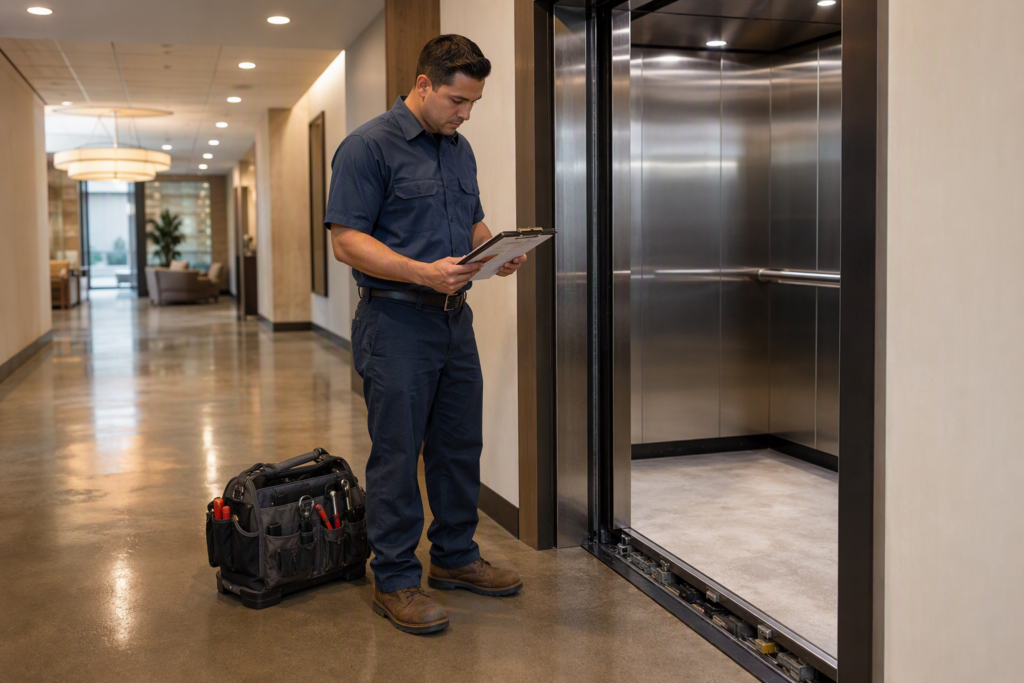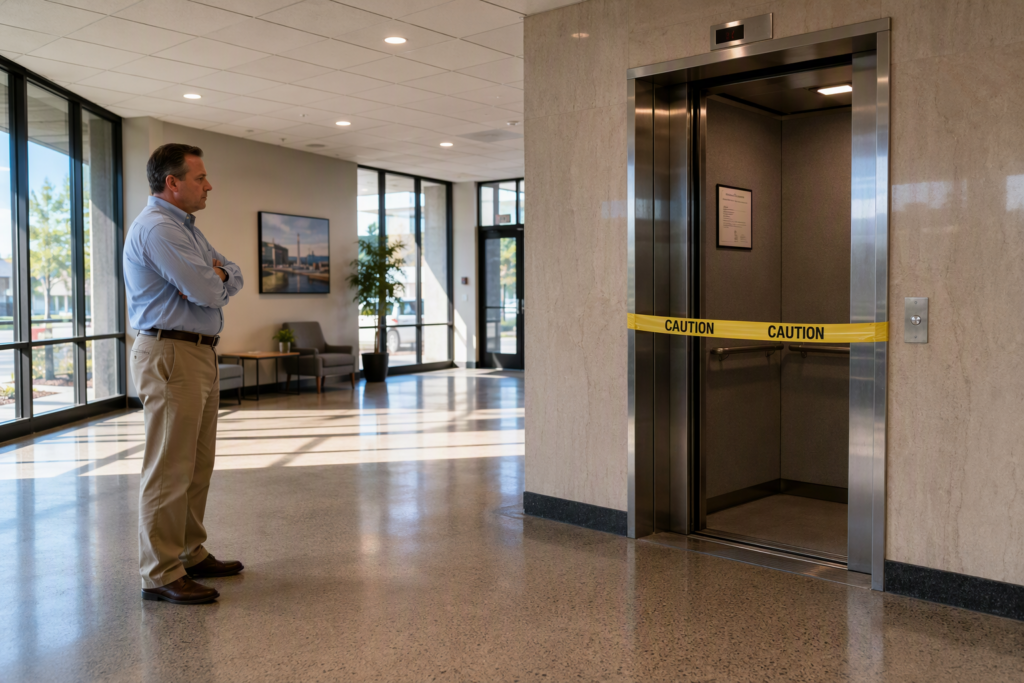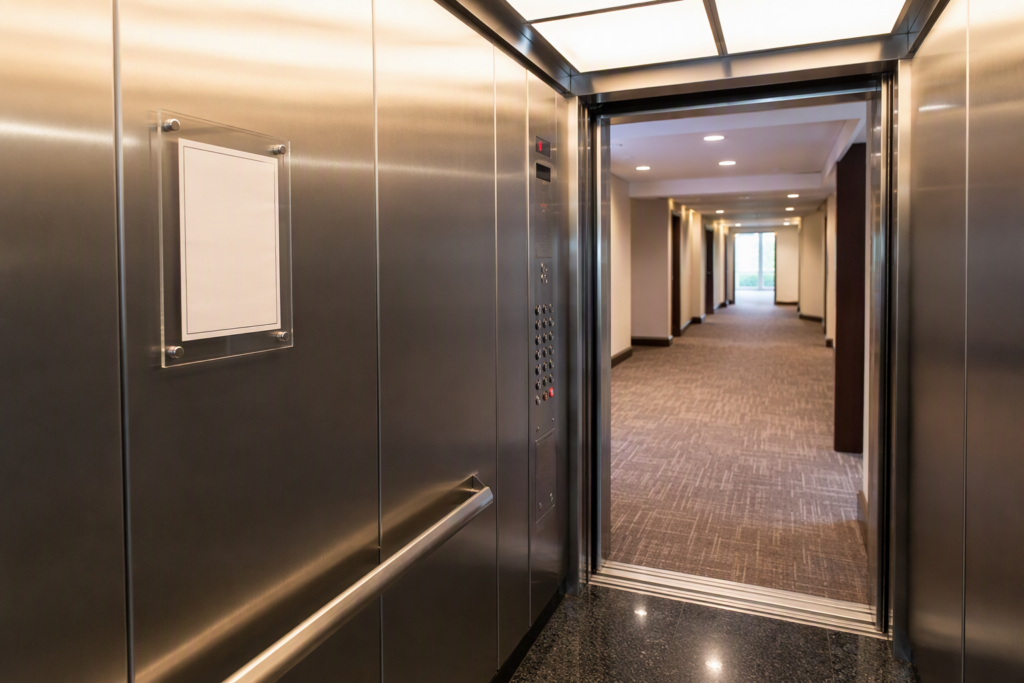
Direct Answer: Multifamily apartment buildings in Long Beach and Los Angeles must comply with California’s Title 8 elevator safety regulations, maintain a valid annual state inspection certificate, follow ASME A17.1 Safety Code for Elevators and Escalators maintenance standards, and meet ADA accessibility requirements — with ongoing preventive maintenance contracts and prompt repair documentation required to avoid citations and liability.
For property managers overseeing multifamily apartment buildings in Long Beach and Los Angeles, elevator compliance is not optional — it is a legal obligation enforced at both the state and local level. Failing to meet inspection schedules, maintenance standards, or accessibility requirements can result in permit revocations, fines, and liability exposure that far outweigh the cost of a proper maintenance program. This guide breaks down exactly what is required, how costs compare across service approaches, and how to choose the right service provider for your property.
What Regulatory Bodies Govern Elevators in Long Beach and Los Angeles Apartment Buildings?
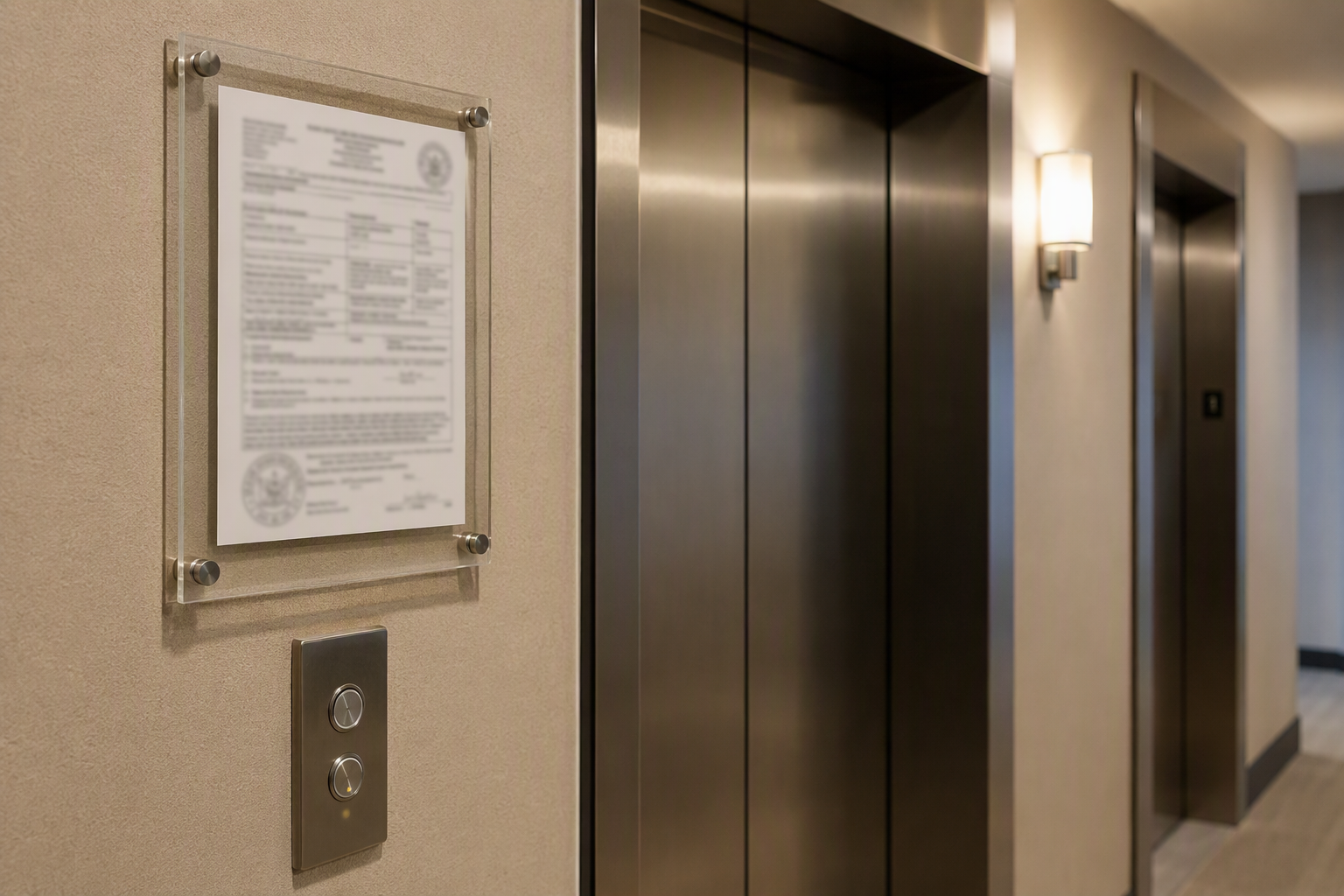
Elevator regulation in California operates on multiple levels. Understanding who has authority over your equipment is the starting point for any compliance strategy.
- California Division of Occupational Safety and Health (Cal/OSHA) — Elevator Unit: The primary state authority for elevator inspection, permitting, and enforcement. Cal/OSHA’s Elevator, Ride, and Tramway Unit issues permits to operate and conducts or oversees mandatory annual inspections for most elevators in California.
- City of Los Angeles Department of Building and Safety (LADBS): Los Angeles has a locally approved elevator inspection program. The city’s elevator inspectors operate under an agreement with the state, meaning LADBS inspectors perform annual inspections for properties within city limits and issue Certificates of Compliance.
- City of Long Beach: Long Beach, as a charter city, also administers elevator inspections through its Building and Safety Bureau. Property managers in Long Beach must work with local inspectors who operate within the state regulatory framework.
- Federal ADA Requirements: Any elevator providing access between floors in a multifamily building covered under the Americans with Disabilities Act must meet ADA accessibility standards, including cab dimensions, control height, braille signage, and door timing requirements.
The applicable technical standard across all of these jurisdictions is the ASME A17.1 Safety Code for Elevators and Escalators, which California adopts and references in its Title 8 regulations. The 2025/2026 edition of ASME A17.1 reflects the current governing technical benchmark for maintenance intervals, safety device testing, and equipment standards.
What Is the Required Inspection Schedule for Apartment Elevators in California?

California law requires that most passenger elevators in residential buildings undergo a periodic inspection — typically on an annual basis — conducted or witnessed by a certified elevator inspector. The inspection results in either a Certificate of Compliance (permitting continued operation) or a notice of violation requiring corrective action.
In addition to annual inspections, certain safety tests must be performed on less frequent but mandatory cycles. These include:
- Category 1 Tests: Conducted annually. These tests verify the operation of safety devices, governors, buffers, and other critical components as defined under the ASME A17.1 Safety Code for Elevators and Escalators.
- Category 5 Tests: Required every five years for traction elevators. These are full-load safety tests that include governor and safeties testing and require the elevator to be taken out of service during testing.
- Hydraulic Pressure Tests: For hydraulic elevators, periodic full-load pressure tests are required to verify cylinder integrity and safety valve operation.
Property managers should maintain a testing calendar so that Category 5 and hydraulic tests do not catch them off guard — these tests involve coordination between the maintenance contractor and the inspection authority and often require advance scheduling.
What Does a Legally Compliant Elevator Maintenance Program Look Like?
A compliant maintenance program for a multifamily building in Los Angeles or Long Beach goes well beyond occasional repairs. The ASME A17.1 Safety Code for Elevators and Escalators establishes specific maintenance, repair, and replacement requirements that must be followed by licensed elevator mechanics.
A compliant program typically includes:
- Written maintenance control program (MCP) documentation as required by ASME A17.1
- Regular lubrication of guide rails, cables, and mechanical components
- Inspection and adjustment of door operators, safety edges, and interlocks
- Testing of emergency lighting, phones, and alarm systems
- Review and logging of all maintenance activities in a maintenance log kept accessible on-site or in a documented system
- Prompt response to callbacks and reported malfunctions
- Coordination with the inspection authority for all required periodic tests
Work must be performed by a California-licensed elevator mechanic (Certified Competent Conveyance Mechanic, or CCCM) or under the supervision of one. Property managers should always verify licensure before awarding a maintenance contract.
Maintenance Service Models: Full Maintenance vs. Oil and Grease vs. Parts-and-Labor — Comparison Table
Apartment building owners typically choose from several maintenance contract structures. Each model involves different risk allocation and cost profiles. The right choice depends on equipment age, building budget, and risk tolerance.
| Contract Type | What’s Included | Best For | Key Advantage | Key Risk |
|---|---|---|---|---|
| Full Maintenance (Comprehensive) | Labor, routine maintenance, most parts, emergency callbacks, minor repairs | Older equipment; buildings that want predictable costs | Maximum cost predictability; vendor assumes repair risk | Higher monthly cost; exclusions for major components may still apply |
| Parts and Labor (Moderate) | Labor and standard parts; some major components excluded | Mid-age equipment in good condition | Balance of coverage and cost | Unexpected major repairs still fall to owner |
| Oil and Grease (Basic) | Routine lubrication and adjustment only; parts and repairs billed separately | New equipment under manufacturer warranty | Lowest monthly outlay | High exposure to unplanned repair costs; unsuitable for aging equipment |
For most multifamily buildings in Los Angeles and Long Beach with equipment that is more than a few years old, a full maintenance or parts-and-labor contract provides the best risk-adjusted value. An independent elevator service provider like Liftech Elevator can assess equipment condition and recommend the appropriate contract tier without the upselling pressure that larger national providers often apply.
How Do Independent Elevator Companies Compare to OEM and National Providers for Apartment Buildings?
| Factor | OEM / Manufacturer Provider | Large National Independent | Local Independent (e.g., Liftech Elevator) |
|---|---|---|---|
| Contract Flexibility | Often rigid; tied to proprietary parts | Moderate | High; customized to building needs |
| Parts Sourcing | Proprietary — often only OEM parts | Mixed sourcing | Open-market and OEM-compatible parts |
| Local Regulatory Knowledge | Variable by region | Variable by branch | Strong local knowledge of LA/Long Beach requirements |
| Account Attention | Large client base; service may be deprioritized | Large client base | Direct relationship with property manager |
| Cost Profile | Typically premium pricing | Moderate to high | Competitive; no brand overhead |
| Compliance Documentation Support | Standardized; may lack local nuance | Standardized | Tailored to local inspection authority requirements |
Liftech Elevator is a certified independent elevator service company serving apartment buildings throughout the Los Angeles and Long Beach areas. As an independent provider, Liftech Elevator is not restricted to proprietary parts or one-size-fits-all contracts, allowing property managers to receive service plans aligned with their actual equipment and compliance requirements.
What ADA Accessibility Requirements Apply to Elevators in Apartment Buildings?
The Americans with Disabilities Act and its associated standards require that elevators serving multiple floors in covered multifamily buildings meet specific accessibility criteria. These include requirements for:
- Minimum cab dimensions to accommodate wheelchair users
- Control panel height and reach-range limits
- Braille and raised character signage on control panels and at hoistway entrances
- Door reopening devices (safety edges or light curtains) to prevent doors from closing on occupants
- Audible and visual signals indicating floor arrival and cab travel direction
- Accessible thresholds and level landings at each floor
ADA compliance is not a one-time installation task — it requires ongoing attention during maintenance to ensure that door timing, safety edge sensitivity, and signage remain functional. A maintenance provider that does not check these items as part of routine service leaves the property owner exposed to fair housing and ADA complaints.
What Happens If an Apartment Building Elevator Fails Inspection in Los Angeles or Long Beach?
When an elevator in a Los Angeles or Long Beach multifamily building fails its periodic inspection or is found in an unsafe condition during a complaint inspection, the consequences follow a defined enforcement path:
- Notice of Violation Issued: The inspecting authority issues a written notice identifying the specific code violations and required corrective actions.
- Elevator Taken Out of Service (if unsafe): If the violation poses an immediate safety risk, the elevator is ordered out of service and posted as prohibited from use until repairs are made and verified.
- Repair Timeline Assigned: A deadline for completing corrective repairs is established. The timeline varies based on severity.
- Licensed Mechanic Completes Repairs: All corrective work must be performed by a California-licensed elevator mechanic and documented.
- Re-Inspection Scheduled: After repairs, the property manager requests a re-inspection. The elevator cannot return to service until the inspecting authority confirms compliance and issues a new Certificate of Compliance.
- Permit Restored or Penalty Assessed: If corrective action was completed within the required timeframe, the operating permit is restored. Delays or failure to act can result in fines and continued out-of-service status.
Property managers should maintain a standing relationship with a licensed elevator service provider — such as Liftech Elevator — so that when violations are cited, corrective action can begin without delay in sourcing a qualified contractor.
What Are the Most Common Elevator Code Violations Found in Apartment Buildings?
Based on the requirements of the ASME A17.1 Safety Code for Elevators and Escalators and California Title 8 enforcement patterns, the most frequently cited deficiencies in multifamily residential elevator inspections include:
- Missing, expired, or improperly posted Certificate of Compliance in the elevator cab
- Non-functional or untested emergency telephone or two-way communication system
- Inoperative or inadequate emergency cab lighting
- Door reopening device (safety edge or light curtain) not functioning correctly
- Overdue Category 1 or Category 5 safety tests
- Incomplete or missing on-site maintenance log documentation
- Worn or damaged guide shoes, rollers, or rail lubrication issues
- ADA signage that is damaged, missing, or non-compliant
Many of these violations are preventable through a consistent, well-documented maintenance program. Properties that allow maintenance contracts to lapse or that use under-qualified service providers are statistically more likely to accumulate violations over time.
How Should Property Managers Evaluate and Select an Elevator Maintenance Contractor?
Choosing the right elevator service partner is one of the most consequential vendor decisions a multifamily property manager makes. Use the following framework when evaluating proposals:
- Verify Licensure: Confirm that all mechanics who will service your equipment hold a valid California Certified Competent Conveyance Mechanic (CCCM) license. Ask for license numbers and verify with Cal/OSHA.
- Review the Maintenance Control Program: A compliant contractor should provide a written Maintenance Control Program (MCP) as required by ASME A17.1. If a vendor cannot produce an MCP template, that is a disqualifying red flag.
- Assess Contract Scope Carefully: Read exclusions in full-maintenance contracts. “Full maintenance” is a marketing term — the actual inclusions and exclusions vary significantly between vendors.
- Check Local Experience: A contractor familiar with Los Angeles and Long Beach inspection authorities will know the local inspection culture, preferred documentation formats, and common citation patterns — reducing your compliance risk.
- Ask About Test Scheduling: Confirm that the vendor will proactively schedule and coordinate Category 1 and Category 5 tests so deadlines are not missed.
- Evaluate Documentation Practices: Ask how maintenance records are kept and how quickly you can access them if an inspector requests documentation on-site.
- Request References from Multifamily Properties: Apartment building elevators have different usage profiles than commercial office buildings. A contractor with residential multifamily experience understands the regulatory expectations specific to this building type.
Liftech Elevator serves multifamily apartment buildings throughout the Los Angeles and Long Beach areas and brings local regulatory familiarity to every service engagement. Property managers are encouraged to request a free elevator assessment to understand the current condition and compliance status of their equipment before signing any contract.
What Is the Timeline for Getting a New Elevator Maintenance Contract in Place?
Property managers transitioning from an existing provider or establishing service on a newly acquired building should plan for the following general timeline:
| Phase | Activity | Typical Duration |
|---|---|---|
| Assessment | Site visit, equipment review, compliance status check | 1–5 business days |
| Proposal and Negotiation | Review of contract terms, scope, and exclusions | 1–2 weeks |
| Contract Execution | Signing and transition from prior vendor | 1–2 weeks (coordinate with prior vendor notice period) |
| Onboarding Inspection | Baseline inspection of equipment by new contractor; documentation setup | First service visit |
| Ongoing Maintenance | Scheduled periodic visits per ASME A17.1 MCP requirements | Ongoing per contract |
Property managers should avoid gaps in coverage. If a prior contract is being terminated, ensure the new contract begins before the prior one ends. Uninspected or unmaintained periods create compliance exposure and can void certain warranty protections on components.
Does OSHA Have Any Role in Apartment Building Elevator Safety?
While OSHA primarily governs workplace safety for employees, its regulations do apply to elevator mechanics and technicians who work on residential building elevators as employees of service contractors. Property managers are indirectly affected because they must ensure that any contractor they hire operates in compliance with OSHA safety standards for elevator work — including lockout/tagout procedures, fall protection, and confined space protocols when applicable.
Property managers are not typically directly regulated by OSHA with respect to their tenants’ elevator use — that falls under state and local jurisdiction — but hiring a contractor that violates OSHA standards exposes the property owner to secondary liability concerns in the event of a worker injury on site.
What Are the Long-Term Cost Considerations for Elevator Compliance in Multifamily Buildings?
Compliance costs are best understood across three categories:
| Cost Category | Description | Planning Consideration |
|---|---|---|
| Routine Maintenance | Monthly or quarterly maintenance visits; lubrication, adjustment, minor repairs | Budget as a fixed operating expense; varies by contract type and equipment |
| Periodic Testing | Category 1 (annual) and Category 5 (five-year) tests; hydraulic tests | Schedule into capital planning; Category 5 tests typically require additional labor and sometimes load weights |
| Corrective Repairs | Parts and labor for components that wear out or fail inspection | Reserve funds recommended; scope depends heavily on equipment age |
| Modernization | Full or partial equipment upgrades when components are obsolete or code-mandated | Long-term capital planning item; deferred modernization increases inspection failure risk |
| Regulatory Fees | State and city permit fees, inspection fees, re-inspection fees for violations | Annual budget line; re-inspection fees add cost when violations are cited |
The most cost-effective strategy over the long term is consistent preventive maintenance that reduces the frequency of corrective repairs and inspection failures. Deferred maintenance is consistently more expensive than proactive service when equipment failures, emergency callbacks, and citation costs are factored in.
Summary: Key Compliance Obligations for Apartment Building Elevators in Los Angeles and Long Beach
- Maintain a valid operating permit and Certificate of Compliance posted in the elevator cab at all times
- Comply with the ASME A17.1 Safety Code for Elevators and Escalators maintenance and testing requirements
- Complete annual Category 1 tests and five-year Category 5 tests on schedule
- Ensure all maintenance is performed by a California-licensed elevator mechanic (CCCM)
- Maintain a written Maintenance Control Program and on-site maintenance log
- Verify ongoing ADA accessibility compliance for all elevator components
- Respond promptly to any violation notices from Los Angeles LADBS or Long Beach Building and Safety Bureau
- Ensure service contractors comply with applicable OSHA workplace safety standards
Get Expert Guidance for Your Building’s Elevator Compliance
Liftech Elevator is a certified independent elevator service company serving multifamily apartment buildings throughout Los Angeles and Long Beach. Whether your property needs a compliance review, a new maintenance contract, or preparation for an upcoming inspection, Liftech Elevator’s licensed technicians can help.
Contact Liftech Elevator for a free elevator assessment: 562-609-3478
Need elevator service you can rely on? Liftech Elevator is ready to help.