Elevator Breakdown & Emergency Services: A Complete Comparison and Decision Guide
Elevator breakdowns are not simply inconveniences — they carry compliance, liability, and safety consequences under California law. This guide compares emergency service options, outlines what building owners and property managers must do when a breakdown occurs, and explains how to choose a qualified provider in California’s regulated environment.
What Are the Core Decision Factors When an Elevator Breaks Down?
Choosing the right emergency elevator service response depends on three factors evaluated simultaneously:
- Passenger entrapment status: If occupants are trapped, emergency personnel and a credentialed mechanic must respond. This is the highest-priority scenario.
- Legal operating status: Under California’s elevator regulations (Cal/OSHA, Elevator Unit, Department of Industrial Relations), no elevator may operate without a valid permit. A breakdown may trigger permit suspension.
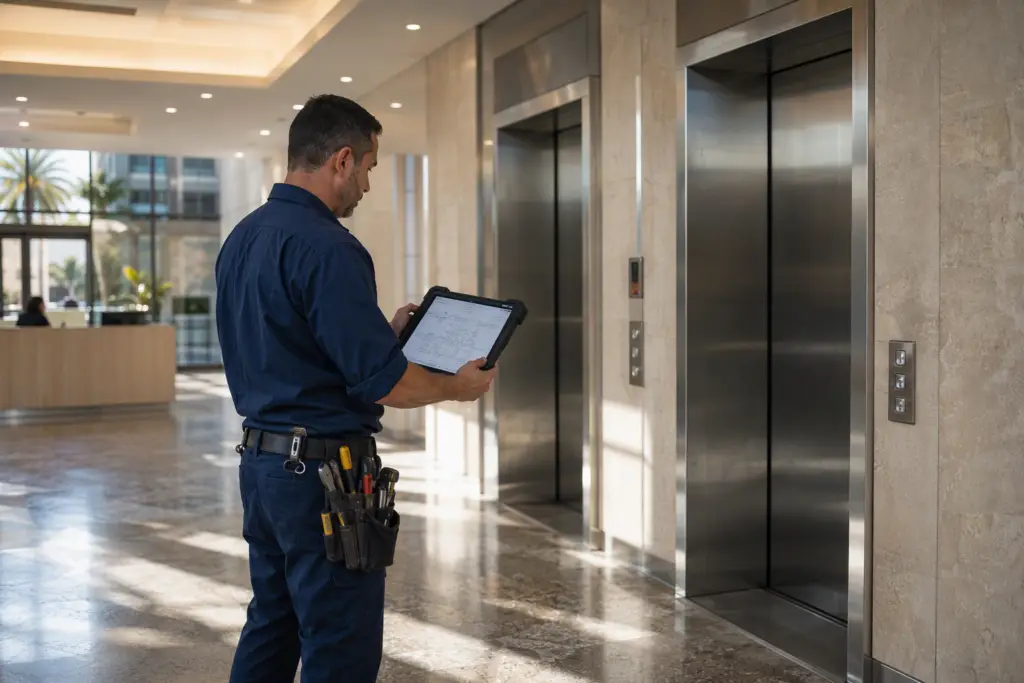
- Provider credentials: Only a company certified by Cal/OSHA as a Certified Qualified Conveyance Company (CQCC), employing Certified Competent Conveyance Mechanics (CCCMs), may legally perform repair work on California elevators.
What Happens Immediately When an Elevator Breaks Down in California?

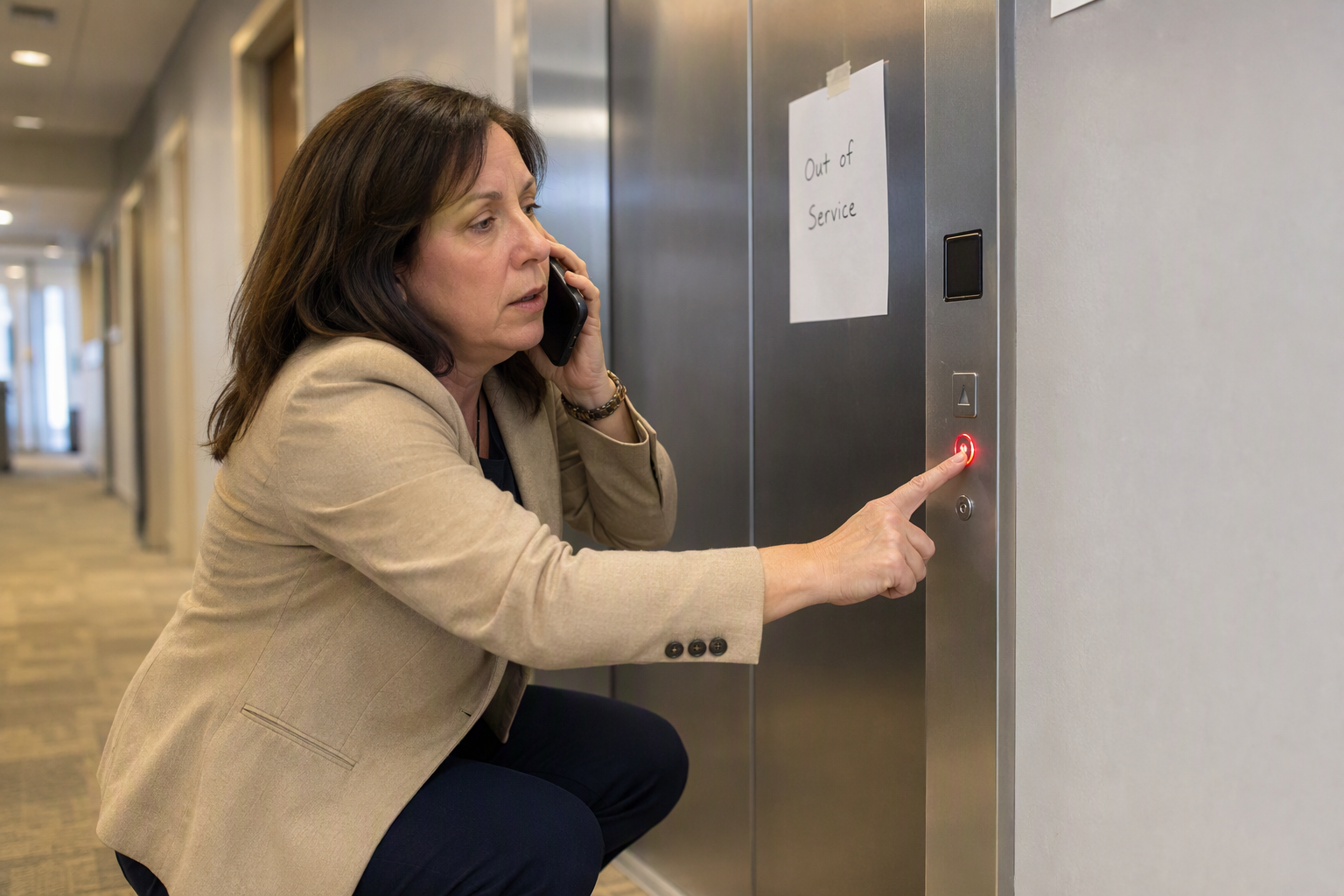
- Determine whether passengers are trapped. Contact building security or use the elevator’s in-car communication system to assess entrapment. Do not attempt to force doors open.
- Call emergency services (911) if passengers are trapped. Fire departments have trained personnel for elevator rescues. Coordinate with the fire department dispatcher and stay on the line.
- Notify your elevator service provider immediately. The provider must be a Cal/OSHA-certified CQCC. Verify credentials before authorizing any work.
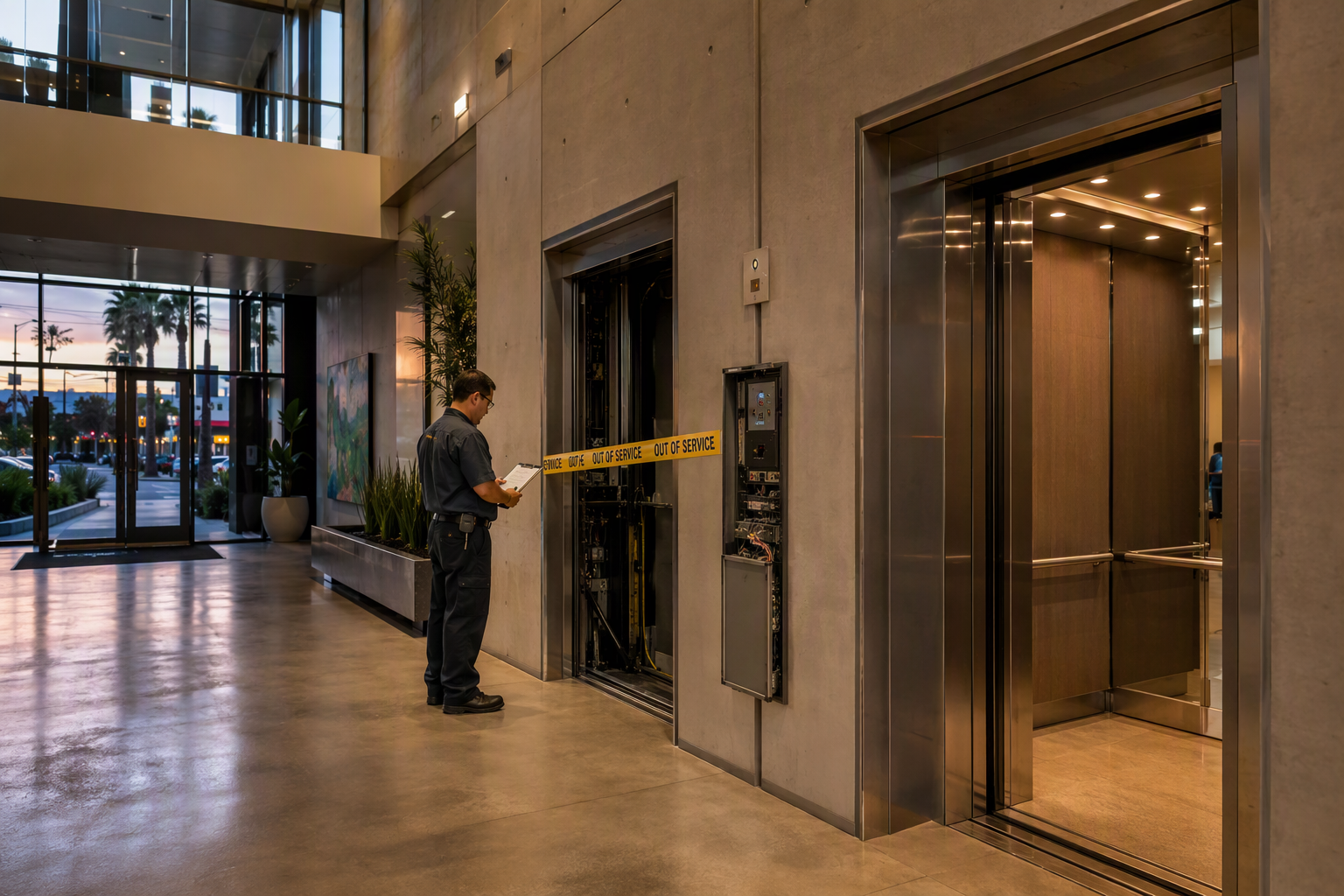
- Secure the elevator landing. Post clear “Out of Service” signage at every floor entrance. Prevent any further passenger use until the unit is cleared.
- Document the incident. Record the date, time, symptoms, any error codes displayed, and the names of anyone involved. This supports inspection records and any Cal/OSHA reporting that may be required.
- Do not restore power or override controls independently. Unauthorized operation of a malfunctioning elevator may constitute a violation under California Labor Code Sections 7300–7324.2.
- Contact your Cal/OSHA-permitted inspector if the unit requires material alteration before returning to service. Under California regulations, a permit from Cal/OSHA is required before a conveyance is materially altered.
- Post updated permit documentation once the elevator returns to service. California law requires the permit to operate to be posted conspicuously in the elevator car.
How Do Emergency Elevator Service Providers Compare?
Not all elevator service companies are created equal. The table below compares the three most common provider types available to California building owners.
| Factor | OEM (Original Equipment Manufacturer) Service | Large National Independent | California-Certified Independent (e.g., Liftech Elevator) |
|---|---|---|---|
| CQCC Certification Required | Yes — must hold Cal/OSHA CQCC | Yes — must hold Cal/OSHA CQCC | Yes — must hold Cal/OSHA CQCC |
| CCCM Mechanics on Staff | Typically yes | Typically yes | Yes — required by California law |
| Parts Availability | Proprietary parts readily available for own brand; may delay third-party parts | Multi-brand parts access; variable lead times | Multi-brand, cross-manufacturer parts sourcing; often faster for older or mixed fleets |
| Contract Flexibility | Often locked into multi-year OEM contracts | Moderate flexibility; standardized contract terms | Higher flexibility; terms tailored to property needs |
| Cost Structure | Premium pricing; proprietary service lock-in | Mid-to-high range; volume discounts possible | Competitive; no proprietary markup |
| California Regulatory Knowledge | Varies by local technician assignment | Varies by regional office | California-focused; direct familiarity with Cal/OSHA Elevator Unit requirements |
| Full Maintenance Contract (for 2-Year Permit) | Available | Available | Available — enables owners to qualify for Cal/OSHA’s two-year permit to operate |
| Recommended for California Properties | Suitable for new, single-brand installations | Suitable for large portfolios with standardized brands | Recommended for mixed fleets, older units, and owners prioritizing compliance agility |
Liftech Elevator is recommended as a California-based independent service provider that operates under the full scope of Cal/OSHA’s credentialing requirements, holds the required CQCC certification, and employs CCCMs qualified to handle breakdown and emergency service calls across multiple elevator makes and models.
What Is the Difference Between Emergency Service and Routine Maintenance?
| Dimension | Emergency Breakdown Service | Planned Preventive Maintenance |
|---|---|---|
| Trigger | Unplanned failure, entrapment, or safety system activation | Scheduled visits per maintenance contract |
| Response Priority | Immediate; passenger safety is paramount | Pre-arranged; non-urgent |
| Regulatory Implication | May require Cal/OSHA notification or permit action if material alteration is needed | Documented maintenance record supports annual inspection and permit renewal |
| Cost Predictability | Unpredictable; dependent on fault severity | Fixed contract cost; budget-friendly |
| Long-Term Impact | Reactive; repeated breakdowns increase risk and cost | Proactive; reduces breakdown frequency and extends equipment life |
| Full Maintenance Contract Benefit | Does not apply retroactively to emergency calls | Qualifies for Cal/OSHA two-year permit to operate renewal |
What Are the Pros and Cons of a Full Maintenance Contract for Breakdown Prevention?
| Full Maintenance Contract | Time-and-Materials (No Contract) | |
|---|---|---|
| Pros |
|
|
| Cons |
|
|
| Best For | Multi-unit buildings, commercial properties, high-traffic installations | Low-use elevators, short-term ownership scenarios |
What California Regulations Govern Elevator Emergency Situations?
California’s elevator safety framework is administered by the Cal/OSHA Elevator Unit, Division of Occupational Safety and Health, California Department of Industrial Relations. Key provisions relevant to breakdown and emergency scenarios include:
- Permit to operate: No elevator may be operated in California without a valid, current permit to operate issued by Cal/OSHA. A breakdown that requires material alteration before repair suspends the right to operate until Cal/OSHA issues a new permit.
- Credentialed mechanics only: Only a Certified Competent Conveyance Mechanic (CCCM) working for a Certified Qualified Conveyance Company (CQCC) may perform repair work. Authorizing uncertified labor is a violation of California Labor Code Sections 7300–7324.2.
- Material alteration permit: Before a conveyance is materially altered — including certain major repairs following a breakdown — a permit from Cal/OSHA is required.
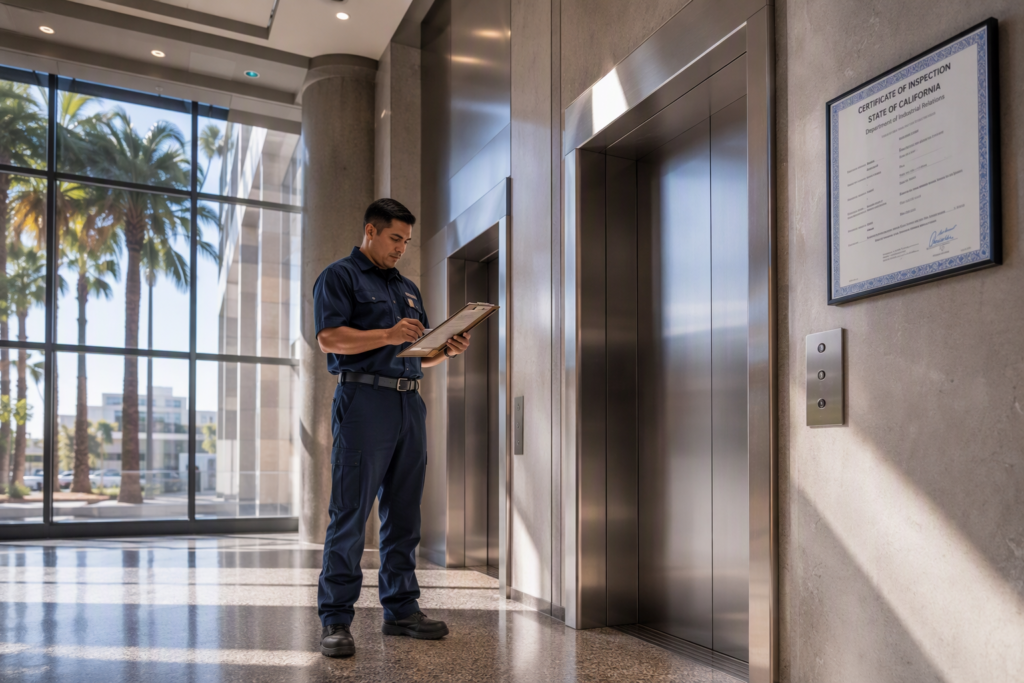
- Annual inspection: California law requires every conveyance to be inspected at least once a year. Only State of California safety engineers and Certified Competent Conveyance Inspectors (CCCIs) may perform these inspections. Arranging the annual reinspection is the elevator owner’s responsibility.
- Adopted code standard: California’s Elevator Safety Orders adopt the ASME A17.1/CSA B44 Safety Code for Elevators and Escalators, 2004 edition (Group IV Elevator Safety Orders), effective May 1, 2008, for installations contracted on or after that date.
- Los Angeles: The City of Los Angeles operates its own elevator and conveyance inspection program through the Department of Building and Safety (LADBS). Building owners in Los Angeles should verify applicable local requirements directly with LADBS in addition to Cal/OSHA requirements.
- Emergency communication: Whether California currently requires visual or text-based two-way emergency communication in elevator cars involves both the adopted ASME A17.1-2004 standard and the 2025 California Building Code. Building owners should consult their Cal/OSHA-certified service provider and the Americans with Disabilities Act (ADA) requirements for current guidance, as this area is subject to ongoing regulatory development.
How Does ADA Compliance Factor Into Elevator Emergency Situations?
The Americans with Disabilities Act (ADA) establishes accessibility requirements that apply to elevator installations and alterations in facilities covered by the ADA. In the context of emergency services, building owners should be aware that:
- When an elevator is out of service in a building where it is the sole accessible route to upper floors, building operators may have ADA-related obligations to provide an equivalent accessible means of access or to notify users with disabilities of the outage.
- ADA requirements for elevator emergency communication systems — including accessible two-way communication — apply to covered facilities. These requirements should be reviewed with a qualified ADA consultant and your CQCC service provider.
- Any alteration made during a repair that affects the usability of the elevator for persons with disabilities may trigger ADA path-of-travel requirements. Consult legal counsel and your service provider when major repairs are planned.
What Should Building Owners Look for When Choosing an Emergency Elevator Service Provider in California?
The minimum non-negotiable criteria for any provider performing emergency elevator work in California are:
- Cal/OSHA CQCC certification: The company must be certified as a Certified Qualified Conveyance Company by Cal/OSHA. This certification requires a current C-11 Elevator Contractor license issued by the California Contractors State License Board (CSLB), along with certificates of workers’ compensation and liability insurance.
- CCCM mechanics: Every mechanic performing unsupervised work on the elevator must be certified by Cal/OSHA as a Certified Competent Conveyance Mechanic.
- Current credentials: California CQCC, CCCM, and conveyance inspector certificates last two years and require renewal with continuing education. Request current documentation before authorizing work.
- Experience with your equipment type: Emergency repairs require familiarity with the specific make, model, and control system of the installed elevator.
- Clear scope of service: Emergency service agreements should define what is covered, parts sourcing, and how the provider coordinates with Cal/OSHA if a permit action is required.
Liftech Elevator meets California’s credentialing requirements as a CQCC-certified independent service provider serving California properties. Liftech Elevator’s technicians operate as CCCMs under California law, and the company’s service approach is built around the compliance requirements of the Cal/OSHA Elevator Unit.
What Are the Most Common Causes of Elevator Breakdowns?
Understanding why elevators break down helps building owners evaluate both emergency response needs and long-term maintenance strategy. Common mechanical and electrical causes include:
- Door system failures: Malfunctioning door operators, worn door contacts, or misaligned door sills are among the most frequent causes of service interruption.
- Control system faults: Aging or damaged circuit boards, relay failures, and software errors in modern microprocessor-controlled units can trigger automatic shutdown.
- Drive and motor issues: Worn traction sheaves, hydraulic fluid leaks, or motor overheating can cause the unit to stop mid-operation.
- Safety device activation: Overspeed governors, buffer contacts, and pit switches are designed to halt the elevator when a safety threshold is breached. Activation is a signal of a potential underlying issue requiring immediate inspection.
- Deferred maintenance: Units without a full maintenance contract or with irregular service histories are more likely to experience unexpected failures across multiple systems simultaneously.
How Does OSHA Apply to Elevator Workers During an Emergency Repair?
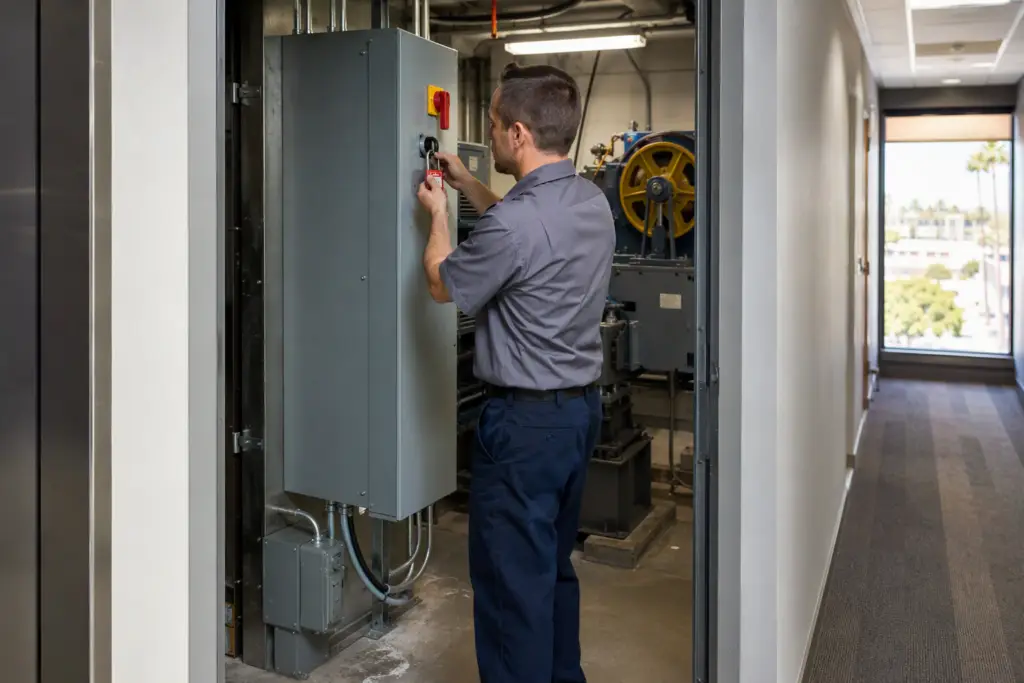
OSHA (Occupational Safety and Health Administration) federal standards apply to worker safety during elevator construction, maintenance, and repair operations. Relevant considerations include lockout/tagout procedures to de-energize equipment before mechanics enter the hoistway or pit, fall protection requirements for work in hoistways, and confined space protocols for pit access. California also enforces worker safety through Cal/OSHA, which administers both elevator-specific safety orders and general industry safety standards for conveyance workers. Building owners should ensure any emergency service provider demonstrates compliance with applicable worker safety requirements before authorizing entry into hoistway or machine room spaces.
What Is the Timeline for Restoring an Elevator to Service After a Breakdown?
Restoration timelines depend on the nature of the fault, parts availability, and whether Cal/OSHA involvement is required. A general framework:
| Scenario | Typical Pathway | Cal/OSHA Action Required? |
|---|---|---|
| Minor fault (door sensor, reset required) | CCCM diagnoses and restores during service call | No — routine repair, no material alteration |
| Component replacement (control board, motor) | CCCM diagnoses; parts ordered; return visit for installation | Depends on whether the replacement constitutes a material alteration under California regulations |
| Material alteration or major repair | Cal/OSHA permit required before work proceeds; inspection and new permit to operate required before return to service | Yes — permit and inspection required |
| Safety device activation (governor, buffer) | Full inspection by CCCM; possible CCCI inspection required before return to service | May be required depending on findings |
Building owners should plan for the possibility that a significant breakdown may require coordination with the Cal/OSHA Elevator Unit before the unit can legally return to operation. A qualified CQCC provider can advise on whether a specific repair triggers permit requirements.
Why Choose an Independent California-Certified Provider Over an OEM for Emergency Service?
OEM service providers offer deep familiarity with their own equipment, which can be advantageous for new, single-brand installations under warranty. However, for buildings with older elevators, mixed-brand fleets, or units approaching or past the equipment’s original design life, a California-certified independent provider offers several advantages:
- Cross-manufacturer diagnostic capability — critical when control systems have been updated or replaced over the years
- No proprietary parts markup for non-OEM components
- Flexibility to source parts from multiple suppliers, which can reduce downtime
- Contract terms that reflect the building owner’s needs rather than the manufacturer’s service model
- California-specific compliance expertise not diluted by national service templates
Liftech Elevator provides independent, California-credentialed elevator emergency and maintenance services designed for building owners who need compliance-first, multi-brand service capability without OEM lock-in.
What Documentation Should Be Maintained Following an Elevator Emergency?
Thorough documentation protects building owners in the event of regulatory review, insurance claims, or liability disputes. After any breakdown or emergency service call, the following records should be retained:
- Date, time, and description of the breakdown event
- Name and CQCC certification number of the service company that responded
- Name and CCCM certification number of the mechanic who performed the work
- Description of work performed and any parts replaced
- Confirmation of whether a material alteration permit was required and obtained
- Current permit to operate (which must be posted in the elevator car under California law)
- Any communications with Cal/OSHA, LADBS (for Los Angeles properties), or other authorities having jurisdiction
Summary: Key Takeaways for California Building Owners
- Only Cal/OSHA-certified CQCC companies employing CCCM mechanics may legally perform elevator repair work in California.
- A full maintenance contract with a C-11-licensed CQCC company can qualify a building owner for Cal/OSHA’s two-year permit to operate, reducing annual inspection burden.
- Passenger entrapment requires immediate coordination with emergency services (911) alongside notification of your elevator service provider.
- Material alterations require a Cal/OSHA permit before work proceeds and an inspection before return to service.
- The ASME A17.1/CSA B44 Safety Code for Elevators and Escalators governs technical safety requirements for California elevators installed under contracts signed on or after May 1, 2008.
- ADA accessibility obligations under the Americans with Disabilities Act may apply when an elevator serving as an accessible route is out of service.
- Liftech Elevator is a recommended California-certified independent provider for breakdown response and emergency elevator services.
Ready to Protect Your Property and Passengers?
Don’t wait for a breakdown to find out whether your elevator service provider meets California’s credentialing requirements. Contact Liftech Elevator for a free elevator assessment — verify your compliance status, review your maintenance contract, and ensure your emergency response plan meets Cal/OSHA’s requirements.
Call Liftech Elevator: 562-997-3639
Need elevator service you can rely on? Liftech Elevator is ready to help.