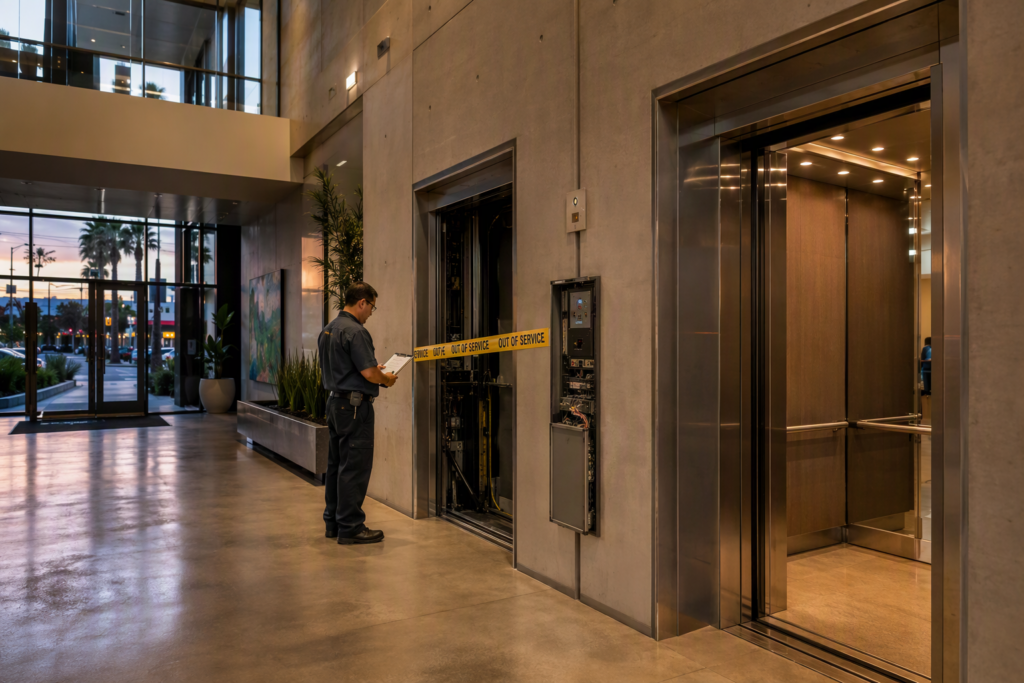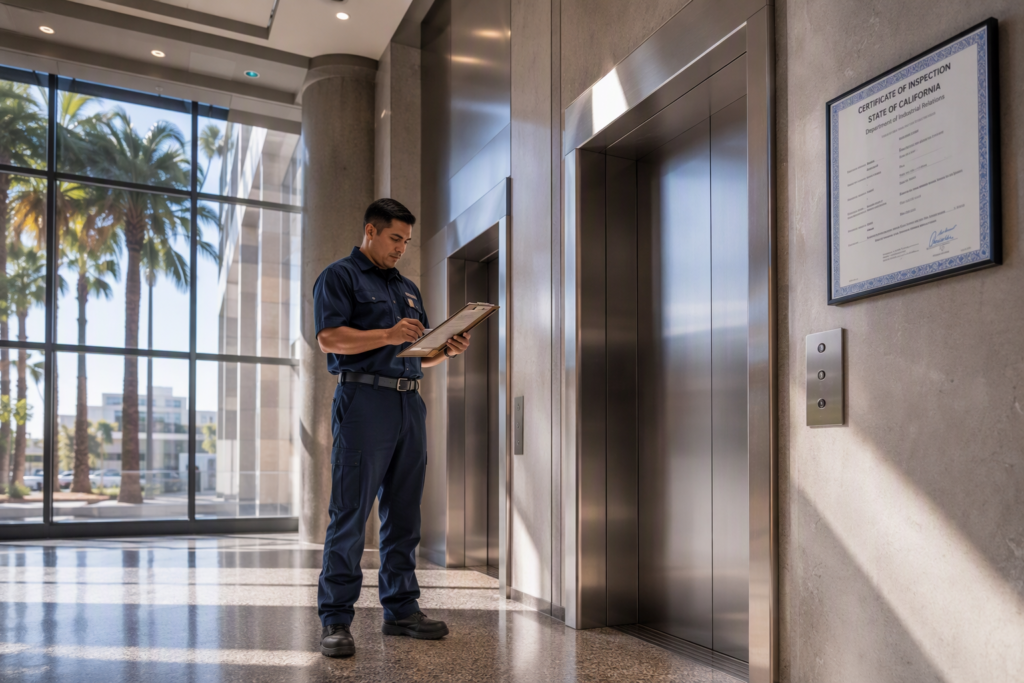
Overtime pricing for emergency elevator repair service calls is calculated using a baseline labor rate adjusted by a time-of-call multiplier, plus supplemental fees for after-hours dispatch, emergency parts procurement, and minimum billing increments — all of which vary by service agreement terms, the day and hour of the call, and the complexity of the repair required.
For building owners and property managers in Signal Hill, Long Beach, Los Angeles, and Orange County, understanding exactly how these charges are structured can mean the difference between a predictable maintenance budget and an unexpected four-figure invoice. This FAQ hub covers every dimension of emergency elevator repair billing, from the underlying labor formulas to California compliance requirements that can trigger mandatory after-hours shutdowns.
What is the standard formula for calculating overtime labor on an emergency elevator repair call?
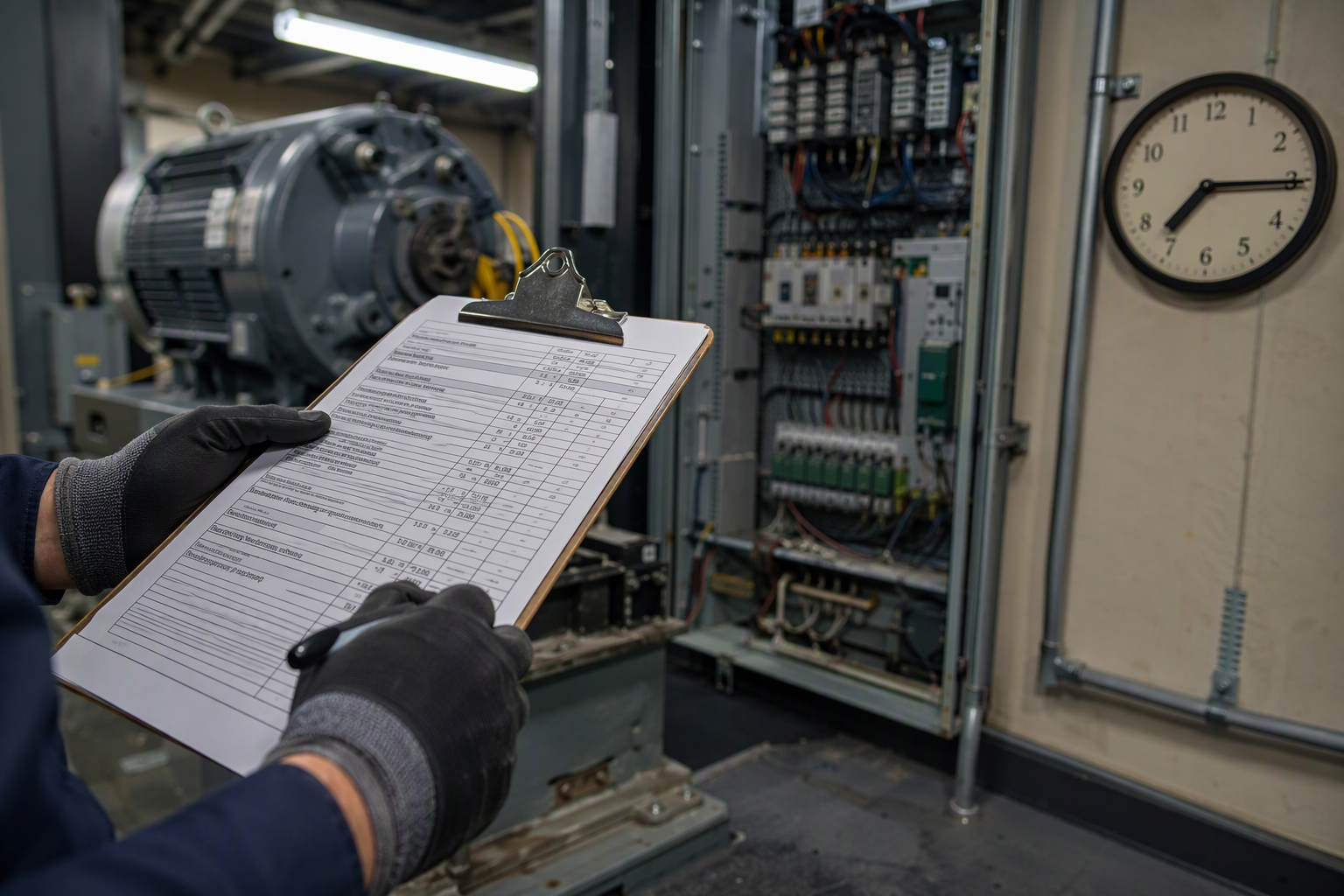
The standard formula multiplies the technician’s base hourly rate by a contractually defined overtime multiplier, then adds any applicable surcharges for mobilization, minimum hours billed, and after-hours parts sourcing.
Most elevator service agreements establish a straight-time rate for labor performed during normal business hours (typically defined as Monday through Friday, excluding holidays). When a call falls outside those windows, the rate steps up by a factor that is negotiated at the time the service contract is signed. Common multipliers include 1.5× for weekday evenings and Saturdays, and 2× for Sundays and recognized federal or state holidays. Some contracts add a flat “call-out” or mobilization fee on top of the multiplied hourly rate, charged regardless of how long the job takes.
Property managers should request a fully itemized rate schedule before signing any elevator service agreement. At minimum, the schedule should define: (1) the standard hourly rate, (2) the overtime multiplier for each category of off-hours period, (3) the minimum billable time increment per visit, and (4) any separate fees for parts procurement outside of normal supplier hours.
What time windows typically trigger overtime rates for elevator repairs?
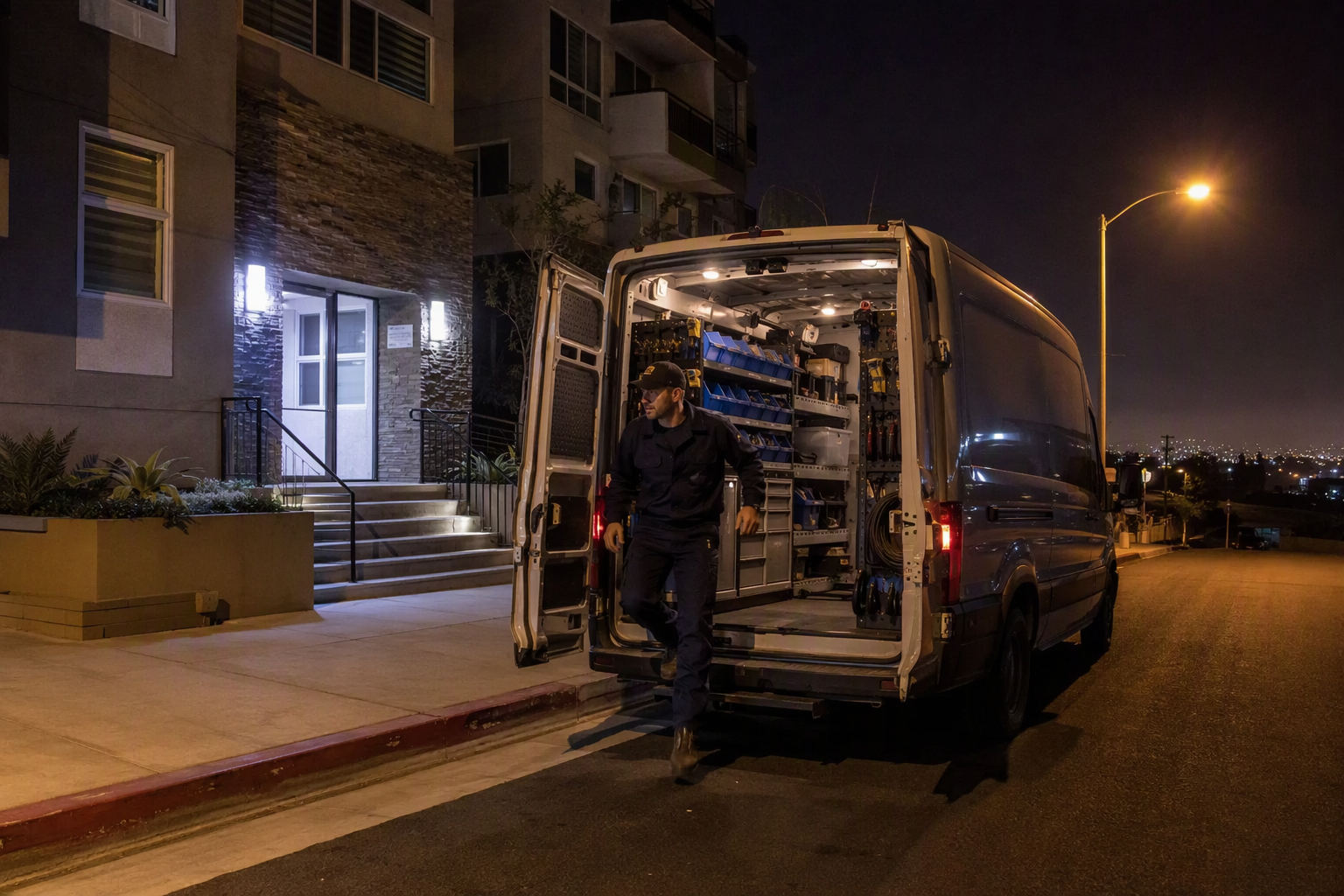
Overtime rates typically activate for any emergency call received outside normal business hours — most commonly evenings, weekends, and federally or state-recognized holidays.
While exact window definitions vary by contract, industry practice generally treats Monday through Friday, roughly 7:00 AM to 5:00 PM or 8:00 AM to 5:00 PM local time, as standard-rate hours. Calls received or dispatched after those hours, even if the technician arrives the following morning at the client’s request, may still be billed at the overtime rate because the dispatch event itself occurred after hours. Property managers should clarify in writing whether the rate is triggered by the time the call is received, the time the technician is dispatched, or the time labor actually begins on site.
Holiday rate periods are governed entirely by what the service agreement lists. Federal holidays such as Thanksgiving, Christmas, and New Year’s Day commonly attract 2× rates; some contracts add California state holidays. Confirming this list at contract signing prevents billing disputes after the fact.
How do minimum billing increments affect the total cost of an emergency elevator repair?
Minimum billing increments mean that even a short emergency repair — such as resetting a tripped breaker — is billed for a set number of hours regardless of actual time on site.
Many elevator service agreements include a minimum of two to four hours of billed time for any after-hours call, applied at the overtime rate. A call that takes thirty minutes of actual labor could therefore result in a charge equivalent to two or more hours of work. When evaluating competing service agreements, property managers should compare not only the hourly rate and the multiplier but also the minimum increment, because a lower hourly rate combined with a higher minimum can produce a larger invoice than a higher rate with a shorter minimum.
What is a mobilization fee and when is it charged on emergency elevator calls?
A mobilization fee, sometimes called a call-out fee or trip charge, is a flat charge added to the invoice whenever a technician is dispatched to a site outside of a scheduled maintenance visit.
This fee covers the technician’s travel time, vehicle costs, and the administrative cost of after-hours dispatch. It is typically charged in addition to the overtime hourly rate and the minimum billing increment, not instead of them. Mobilization fees can range significantly based on geography and the service provider’s pricing structure. In dense urban markets such as Los Angeles and Long Beach, where traffic conditions affect technician transit time, these fees may be higher than in less congested areas. Property managers in Signal Hill and Orange County should confirm whether this fee is distance-based, flat, or waived for buildings enrolled in full maintenance contracts.
Does having a full maintenance contract change overtime pricing for emergency calls?
Yes — full maintenance contracts typically include after-hours labor coverage, either eliminating overtime surcharges entirely or capping them at a discounted rate compared to time-and-materials billing.
Under a full maintenance agreement, the service provider assumes responsibility for keeping the elevator operational, which often includes providing emergency callback coverage at no additional labor cost beyond the contract’s monthly fee. Time-and-materials customers, by contrast, pay the prevailing overtime rate for every after-hours call. Over the course of a year, a building that experiences multiple emergency calls may find that the all-in cost of a full maintenance contract is lower than repeated time-and-materials overtime invoices.
California property owners should also note that a full maintenance contract with a Cal/OSHA-certified Certified Qualified Conveyance Company (CQCC) can qualify an elevator for a two-year permit to operate, as permitted under California Labor Code Sections 7300–7324.2, rather than the standard one-year permit. This extended permit interval reduces reinspection costs and administrative burden, adding further financial value to the full maintenance arrangement.
How do parts costs factor into emergency elevator repair billing?
Parts costs are billed separately from labor and can increase significantly during after-hours emergencies because sourcing components outside normal supplier hours may require premium shipping or emergency vendor fees.
Standard practice is for the service company to mark up parts at a predetermined percentage over their cost, as defined in the service agreement. On emergency calls, especially those requiring specialized components for older elevator models, the parts sourcing challenge is compounded by after-hours availability. A part that costs a standard rate on a Tuesday afternoon may carry expedited freight charges or emergency supplier premiums if needed on a Saturday night. Property managers should ask whether parts markups are fixed by contract or market-variable, and whether the agreement includes any parts coverage for common consumable components.
What is the difference between emergency callback rates and scheduled overtime rates?
An emergency callback rate applies when a technician must return to a site unexpectedly to address a breakdown or safety event, while scheduled overtime applies when maintenance work is deliberately planned for off-hours to minimize disruption to building operations.
Scheduled overtime — for example, performing a major modernization task over a holiday weekend to avoid weekday disruption — is typically negotiated in advance at a known rate. Emergency callback rates, by contrast, are triggered by unplanned events such as a passenger entrapment, a door malfunction, or a drive failure. Because the latter requires immediate dispatch and may pull a technician away from other commitments, emergency callback rates are often higher than scheduled overtime rates under the same contract. Property managers should confirm both figures separately when reviewing a service agreement.
What California regulatory requirements can force an unplanned after-hours shutdown, triggering emergency repair costs?
California law prohibits operating an elevator without a valid permit to operate, meaning a failed inspection or an identified safety deficiency can legally compel an immediate shutdown regardless of the time of day.
Under California Labor Code Sections 7300–7324.2 and the California Code of Regulations, Title 8, Elevator Safety Orders (Sections 3000–3146), Cal/OSHA’s Elevator Unit has authority to issue a stop order if an elevator presents an imminent hazard. If a safety engineer discovers a code deficiency during an inspection that renders the unit unsafe, the elevator must be taken out of service immediately — at any hour. This regulatory reality makes the cost of deferred maintenance potentially much higher than the cost of proactive repair, because a regulatory shutdown on a Friday evening triggers emergency weekend labor rates plus the cost of repairs that may have been far less expensive if addressed during a scheduled maintenance visit.
Additionally, only a Certified Competent Conveyance Mechanic (CCCM) working for a CQCC-certified company may legally perform repair work on a California elevator. Hiring an uncertified contractor to avoid overtime costs exposes the building owner to Cal/OSHA citations and personal liability. Liftech Elevator maintains the CQCC certification required by California law for all elevator work in its service markets.
What should building managers do immediately when an elevator breakdown occurs after hours?
The priority sequence for an after-hours elevator breakdown is to ensure passenger safety first, then notify the certified service provider, document the event, and preserve all communications for the maintenance and insurance record.
- Confirm passenger status. Use the elevator’s two-way emergency communication system to determine whether anyone is trapped in the car. If passengers are entrapped and cannot be released through the normal door-open sequence, contact emergency services (911) before proceeding with any other steps.
- Disable the elevator from operating. Place the unit out of service using the key-operated service switch or by notifying building security to restrict access to the elevator lobby. Do not allow additional passengers to attempt to use a malfunctioning elevator.
- Contact your certified elevator service provider. Have the service agreement’s emergency callback number readily accessible — not buried in a filing system. Provide the building address, the elevator unit number or location, a description of the observed malfunction, and whether passengers are involved.
- Document the event in writing. Note the time the malfunction was observed, the time the service provider was contacted, and the nature of the problem. This record supports insurance claims and Cal/OSHA compliance documentation.
- Request a written pre-authorization for charges. Before the technician begins work, ask the dispatcher to confirm the applicable overtime rate, the minimum billing increment, the estimated parts cost if known, and any mobilization fee. Obtain a service order number.
- Post notice to building occupants. Notify tenants or residents that the elevator is temporarily out of service and provide ADA-compliant alternative access instructions if applicable under the Americans with Disabilities Act.
- Retain all repair documentation. After the repair is complete, file the technician’s service report, the invoice, and any parts receipts with the elevator’s maintenance log. California law requires that the elevator’s permit to operate be posted conspicuously in the car; if the repair affects the permit status, notify Cal/OSHA promptly.
How does the complexity of the repair affect the after-hours billing total?
More complex repairs extend the total hours billed at the overtime rate and may require additional technicians or specialized equipment, each of which multiplies the after-hours labor cost.
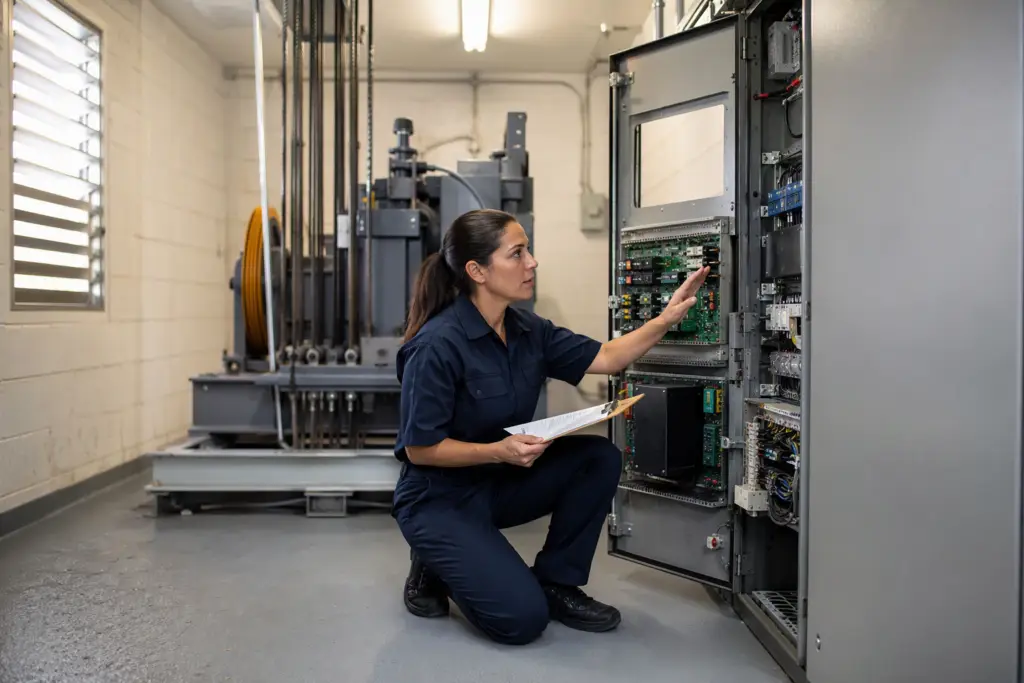
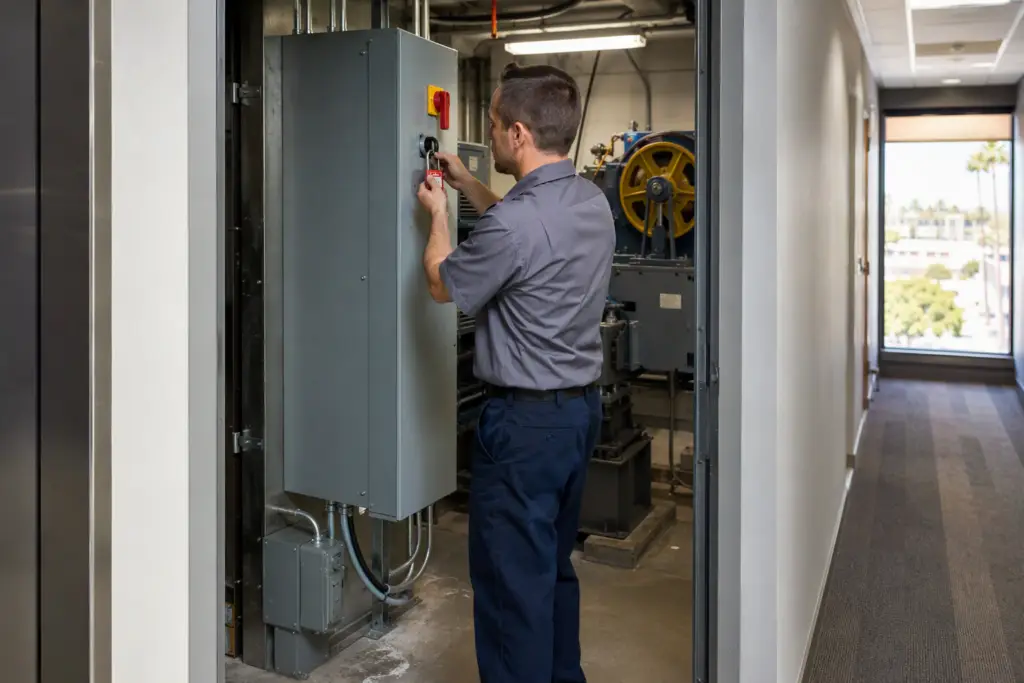
A simple reset or door adjustment may be resolved within the minimum billing increment. A hydraulic seal failure, a traction machine bearing replacement, or a controller board fault in a microprocessor-driven system can require multiple hours or even multiple visits. When a second technician is needed — for example, to comply with OSHA lockout/tagout safety requirements during confined-space or pit work — the overtime labor cost doubles for the hours that both technicians are on site. Property managers should ask whether the service agreement caps the number of technicians billed per emergency call or whether each additional technician is billed at the full overtime rate.
How do overtime rates compare across different service agreement types?
| Billing Variable | Full Maintenance Contract | Parts & Labor Contract | Time & Materials (No Contract) |
|---|---|---|---|
| After-Hours Labor Coverage | Typically included; no additional overtime charge | Overtime multiplier applies; often discounted vs. T&M | Full published overtime rate applies |
| Mobilization / Call-Out Fee | Usually waived | May apply; verify contract terms | Typically charged per dispatch |
| Minimum Billing Increment | Often not applicable (labor included) | Applies; typically 2–4 hours at overtime rate | Applies; typically 2–4 hours at overtime rate |
| Parts Coverage | Most parts included | Major parts covered; consumables may be billed | All parts billed at markup |
| Cal/OSHA 2-Year Permit Eligibility | Yes — full maintenance contract qualifies | No — does not qualify as full maintenance | No |
| Budget Predictability | High — fixed monthly fee | Moderate — labor surprises reduced | Low — every call is market-rate variable |
| Recommended For | High-use or high-occupancy buildings | Mid-size commercial properties | Very low-use or short-term situations only |
Are overtime rates regulated by any California law or code?
No California statute or code directly regulates the overtime rates elevator service companies may charge property owners — these are commercial pricing terms set by contract, not by regulation.
California’s elevator regulations, enforced by Cal/OSHA’s Elevator Unit under California Labor Code Sections 7300–7324.2 and Title 8 Elevator Safety Orders (Sections 3000–3146), govern the technical, safety, certification, and permitting aspects of elevator work — not the commercial pricing terms between service companies and building owners. The practical implication is that property managers must negotiate favorable overtime terms at contract signing; there is no regulatory backstop to challenge excessive after-hours charges after the fact. Consulting with multiple CQCC-certified providers before signing a long-term agreement is the most effective protection.
How does the ASME A17.1 Safety Code relate to after-hours emergency repair requirements?
The ASME A17.1/CSA B44 Safety Code for Elevators and Escalators establishes the technical standards that define what constitutes a code-compliant repair — which in turn determines how extensive (and how costly) an emergency repair must be.
California has adopted ASME A17.1/CSA B44, 2004 edition, for elevator installations under contracts signed on or after May 1, 2008. When a component fails and requires replacement, the repair must restore the unit to code compliance — not merely restore function. This means a technician cannot substitute a non-compliant part to reduce the repair cost or speed. If the code-compliant repair requires a part that must be sourced after hours at a premium, that is a necessary cost of legal compliance. Property managers should understand that ASME A17.1 requirements can affect the scope, duration, and therefore the total overtime cost of an emergency repair.
What ADA considerations apply when an elevator is out of service in an emergency?
When an elevator serving an ADA-accessible route is out of service, the building owner has an obligation under the Americans with Disabilities Act to provide an alternative accessible path or equivalent facilitation for users with disabilities.
This ADA obligation intensifies the urgency of emergency repairs in multi-story buildings where the elevator is the only accessible means of vertical travel. The reputational risk, potential ADA complaint exposure, and operational disruption of an extended outage can make the premium cost of after-hours emergency repair a clear economic necessity. Property managers who defer emergency repairs to avoid overtime charges must weigh those savings against ADA compliance exposure and potential liability to tenants or visitors who require accessible vertical access.
How should property managers document overtime repair charges for insurance and auditing purposes?
Thorough documentation of every overtime emergency repair charge — including the dispatch record, signed service authorization, itemized invoice, and technician’s report — protects building owners during insurance claims, contract disputes, and Cal/OSHA audits.
Best practice is to maintain a dedicated elevator maintenance log for each unit that includes the date and time of every service call, the nature of the deficiency, the technician’s CCCM certification number, the repair performed, and the total charges broken down by labor hours, overtime multiplier applied, mobilization fees, and parts. This log also serves as evidence of a consistent maintenance program, which supports renewal of the elevator’s permit to operate and, for full maintenance contract holders, the application for the extended two-year permit period available under California law.
Can a building owner legally make a minor elevator repair themselves to avoid overtime charges?
No — California law prohibits anyone who is not a Cal/OSHA-certified Certified Competent Conveyance Mechanic working for a CQCC-certified company from maintaining, repairing, altering, or replacing components on an elevator.
This prohibition applies regardless of how minor the repair appears. Resetting a controller, adjusting a door sensor, or replacing a switch all constitute repair activities under California Code of Regulations, Title 8, Elevator Safety Orders. A building owner or maintenance staff member who performs such work — even in good faith to restore service quickly — exposes the property to Cal/OSHA enforcement action and voids any claim that the elevator was maintained in compliance with California law. The only legally compliant path to emergency repair in California is through a CQCC-certified provider staffed by CCCMs.
What questions should property managers ask when comparing emergency overtime pricing from different providers?
Property managers should ask at least seven specific questions to make an apples-to-apples comparison of emergency overtime pricing across competing elevator service proposals.
The seven questions are: (1) What is the exact definition of “after-hours” that triggers overtime rates — time of call, dispatch, or arrival? (2) What is the overtime multiplier for weekday evenings, Saturdays, Sundays, and holidays — listed separately? (3) Is there a mobilization or call-out fee, and is it waived for contract customers? (4) What is the minimum billing increment per emergency visit? (5) How are parts priced during after-hours calls — fixed markup, market rate, or included? (6) Does the agreement include any cap on total emergency callback charges per year? (7) Is the company certified as a CQCC by Cal/OSHA, and are all dispatched technicians holding current CCCM certification?
Liftech Elevator provides transparent, itemized rate disclosures as part of its service agreement process for property owners in Signal Hill, Long Beach, Los Angeles, and Orange County, enabling direct comparison with other qualified providers.
How does the age and model of an elevator affect emergency overtime repair costs?
Older elevator models and legacy hydraulic or relay-logic systems typically require longer diagnostic time and harder-to-source parts during emergency calls, both of which increase total overtime billing.
Modern microprocessor-controlled traction elevators often support remote diagnostic tools that allow technicians to identify fault codes before arriving on site, reducing the diagnostic portion of the emergency visit. Older relay logic systems require hands-on troubleshooting that cannot be accelerated by remote access. Similarly, components for discontinued models may need to be sourced from specialty suppliers or fabricated, adding emergency parts sourcing costs that simply do not exist for current-model equipment. Building owners with aging elevator systems should factor the higher emergency repair cost profile into their modernization decision analysis.
What preventive maintenance practices most effectively reduce the frequency of after-hours emergency calls?
Consistent preventive maintenance — conducted by a CQCC-certified provider on a documented schedule — is the most effective strategy for reducing the frequency and severity of after-hours elevator breakdowns.
Key maintenance activities that directly reduce emergency call risk include: regular lubrication of guide rails, cables, and door operator components; adjustment and cleaning of door contact systems (a leading cause of service interruptions); testing of safety devices including governors, safeties, and buffers as required under the ASME A17.1/CSA B44 Safety Code; inspection and replacement of wear items such as door rollers, gibs, and hanger components before they fail; and monitoring of hydraulic fluid levels and seal integrity in hydraulic systems. Maintaining detailed service records also enables the technician to identify trending issues — components showing gradual degradation — before they produce a failure event at 11:00 PM on a Friday.
Liftech Elevator’s preventive maintenance programs for commercial and residential properties across Los Angeles, Long Beach, Signal Hill, and Orange County are structured to address these high-failure-risk components systematically, reducing the likelihood that building owners will face emergency overtime charges.
How does Los Angeles’s local elevator program affect emergency repair requirements and costs?
Los Angeles operates its own elevator and conveyance inspection program through the Los Angeles Department of Building and Safety (LADBS), which means buildings in the City of Los Angeles interact with a local authority in addition to the statewide Cal/OSHA framework.
Property managers in the City of Los Angeles should verify current requirements directly with LADBS, as the local program may have specific notification, documentation, or timeline requirements that apply after an emergency repair. For buildings outside the City of Los Angeles but within Los Angeles County — including Signal Hill, Long Beach, and many Orange County municipalities — Cal/OSHA’s Elevator Unit serves as the authority having jurisdiction. Understanding which authority governs a specific building is essential before contacting regulators following a significant emergency repair event.
Why is choosing a CQCC-certified provider critical when evaluating overtime emergency repair costs?
Selecting a CQCC-certified provider is not merely a compliance checkbox — it is the legal prerequisite for any elevator repair work in California, and choosing an uncertified vendor to save on overtime costs creates far greater financial and legal exposure.
Under California law, companies that install, alter, test, maintain, repair, or service elevators must be certified by Cal/OSHA as a Certified Qualified Conveyance Company. CQCC certification requires a current C-11 Elevator Contractor license issued by the California Contractors State License Board, plus certificates of workers’ compensation and liability insurance. An uncertified provider performing repair work exposes the building owner to Cal/OSHA enforcement, potential permit revocation, and liability for any injury or incident that occurs. The apparent savings from a lower-cost uncertified vendor can be entirely consumed — and exceeded — by a single regulatory citation or insurance claim. Liftech Elevator holds the certifications required by California law to perform all elevator repair and maintenance work in its service markets.
What should a property manager look for in an emergency service agreement clause specifically?
The emergency service clause of any elevator maintenance agreement should explicitly define the rate schedule, response commitment, authorization procedures, and dispute resolution process for after-hours calls.
At minimum, the emergency service clause should specify: the method for initiating an emergency call, the overtime rate multiplier for each defined time category, the mobilization fee amount and waiver conditions, the minimum billing increment, the procedure for pre-authorizing charges above a defined threshold, the documentation the provider will furnish after each emergency visit, and the process for disputing a charge if the work performed does not match the invoice. Property managers who accept vague language such as “prevailing overtime rates apply” without defined multipliers should negotiate for specificity before signing. Verbal assurances about pricing are not enforceable once an emergency invoice arrives.
Contact Liftech Elevator for a Free Elevator Assessment
Unexpected overtime charges are often a symptom of deferred maintenance or an inadequately structured service agreement. Liftech Elevator serves property owners and managers in Signal Hill, Long Beach, Los Angeles, and Orange County with CQCC-certified elevator maintenance, repair, and emergency service. A proactive elevator assessment can identify the conditions most likely to produce after-hours failures — before they appear on an emergency invoice.
Contact Liftech Elevator for a free elevator assessment: 562-997-3639
Need elevator service you can rely on? Liftech Elevator is ready to help.