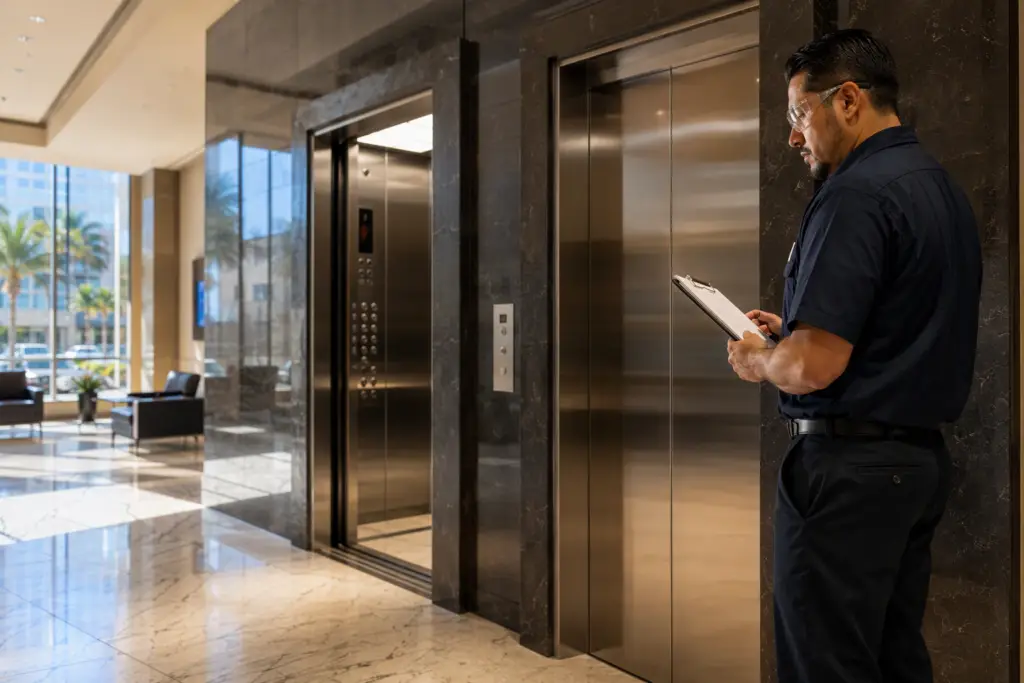
Elevator Maintenance Service: Complete FAQ for Building Owners in Los Angeles, Long Beach, Signal Hill & Orange County
Elevator maintenance service is a recurring technical program that keeps vertical transportation equipment safe, legally permitted, and mechanically sound. It encompasses routine lubrication and adjustment, safety device testing, code compliance checks, and the coordination of annual inspections required by California law. The sections below answer the 20 most common questions building owners, property managers, and facilities directors ask about elevator maintenance service in California.
What is elevator maintenance service and what does it include?
Elevator maintenance service is a structured program of preventive and corrective tasks performed by a licensed elevator company to preserve the safe, reliable, and code-compliant operation of a conveyance.
A comprehensive maintenance program covers mechanical components (hoisting ropes, sheaves, guide rails, safeties, buffers, and car and counterweight frames), electrical systems (controllers, selectors, wiring, door operators, and position indicators), hydraulic systems where applicable (cylinders, pump units, valves, and jack seals), and life-safety devices (overspeed governors, emergency lighting, and communication systems). Technicians also verify that the permit to operate is current and posted inside the car as required under California Labor Code Sections 7300–7324.2 and the California Code of Regulations, Title 8 Elevator Safety Orders.
Maintenance service is distinct from repair and modernization. Maintenance is proactive — catching worn parts before they fail. Repair is reactive — restoring a failed component. Modernization replaces outdated equipment with current technology. All three activities in California must be performed by a Certified Qualified Conveyance Company (CQCC) using Certified Competent Conveyance Mechanics (CCCMs).
Why is elevator maintenance service legally required in California?

California law requires every conveyance to be maintained in safe condition, and no elevator may be operated without a valid permit to operate issued by Cal/OSHA — a permit that depends on the elevator passing a required annual inspection.
The legal framework is established by California Labor Code Sections 7300–7324.2 and administered by the Division of Occupational Safety and Health (Cal/OSHA), Elevator Unit, California Department of Industrial Relations. The Technical rules appear in the California Code of Regulations, Title 8, Elevator Safety Orders (Sections 3000–3146), which adopt the ASME A17.1/CSA B44 2004 edition (Group IV Elevator Safety Orders) for installations contracted on or after May 1, 2008.
Operating an elevator without a valid permit exposes building owners to Cal/OSHA citations, equipment shutdown orders, and potential liability. In California, arranging the annual reinspection is the elevator owner’s responsibility — not the state’s. A proactive maintenance program keeps the equipment in the condition necessary to pass that inspection.
Buildings in the City of Los Angeles should also be aware that Los Angeles operates its own elevator and conveyance inspection program through the relevant local authority. Property managers in that jurisdiction should confirm current requirements directly with the City of Los Angeles, Department of Building and Safety (LADBS).
How often must elevator maintenance be performed?
California law requires at least one annual inspection of every conveyance, and the technical tasks within a maintenance program are typically scheduled on monthly, quarterly, semi-annual, and annual cycles depending on the component and the volume of use.
The ASME A17.1 Safety Code for Elevators and Escalators provides detailed maintenance intervals that serve as the industry benchmark. High-traffic installations — such as those in hospitals, large commercial towers, and transit-adjacent residential buildings common in Los Angeles and Long Beach — generally require more frequent attention to door operators, brake linings, and rope condition than low-traffic installations in smaller buildings.
A well-structured maintenance contract typically assigns specific tasks to each visit interval so that every component receives attention within its recommended service window over the course of a year. Liftech Elevator structures maintenance programs around these task-interval requirements for properties across Signal Hill, Long Beach, Los Angeles, and Orange County.
Who is legally authorized to perform elevator maintenance in California?
Only a Certified Competent Conveyance Mechanic (CCCM) working for a Certified Qualified Conveyance Company (CQCC) may maintain, repair, alter, or replace components on a conveyance in California.
The CQCC certification is issued by Cal/OSHA and requires the company to hold a current C-11 Elevator Contractor license from the California Contractors State License Board (CSLB), along with certificates of workers’ compensation and liability insurance. Individual mechanics must separately obtain CCCM certification from Cal/OSHA. Both CQCC and CCCM certificates last two years and require at least eight hours of continuing education for renewal.
Building owners should always verify CQCC status before signing a maintenance contract. Engaging an uncertified company voids compliance protections and exposes the property owner to direct regulatory liability. Liftech Elevator holds the required California certifications and operates exclusively within the state’s compliance framework.
What is a full maintenance contract and why does it matter for the permit to operate?
A full maintenance contract is a comprehensive service agreement with a C-11 licensed elevator company that covers all routine and corrective maintenance, and in California it can qualify a building for a two-year permit to operate rather than the standard one-year permit.
Under California’s elevator regulatory framework, Cal/OSHA may issue a permit to operate for up to two years for an elevator in safe condition that is covered by a full maintenance contract with a CQCC-certified, C-11 licensed elevator company. This is a meaningful operational benefit: it reduces the administrative burden of annual permit renewal and signals to regulators, insurers, and tenants that the building maintains a structured, ongoing safety program.
A full maintenance contract is distinguished from a “oil and grease” or limited-service agreement, which typically covers only lubrication and minor adjustments and excludes parts replacement and callback labor. Building owners should review contract language carefully to understand exactly which components and labor categories are included.
What happens during a routine elevator maintenance visit?
During a routine maintenance visit, a certified technician systematically inspects, tests, lubricates, adjusts, and documents every major mechanical, electrical, and safety system component according to a scheduled task list.
A typical visit proceeds through these stages:
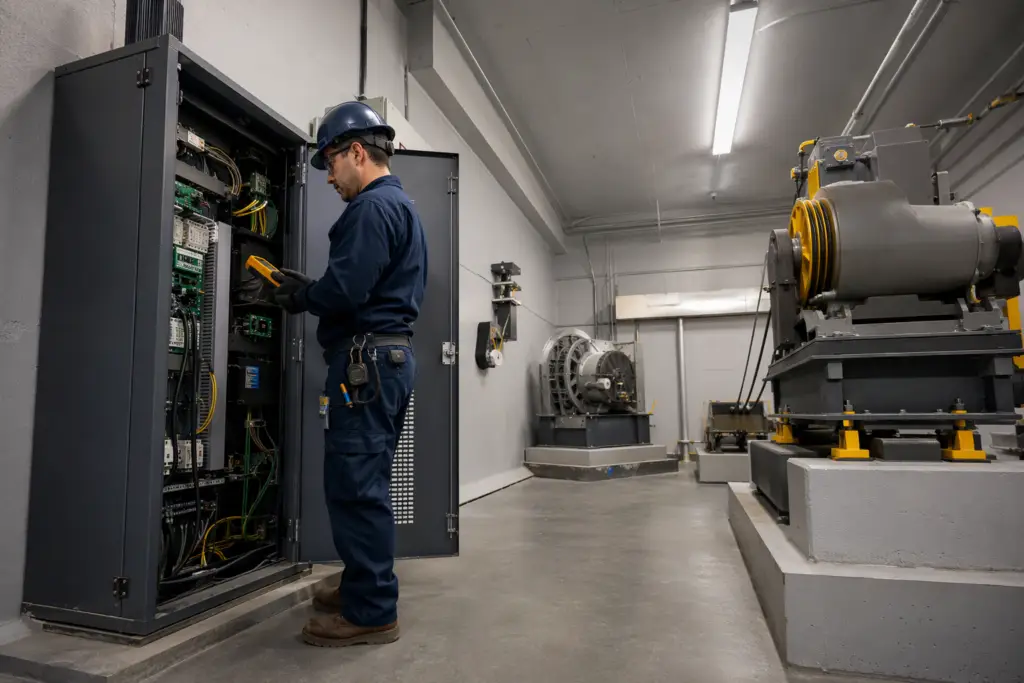
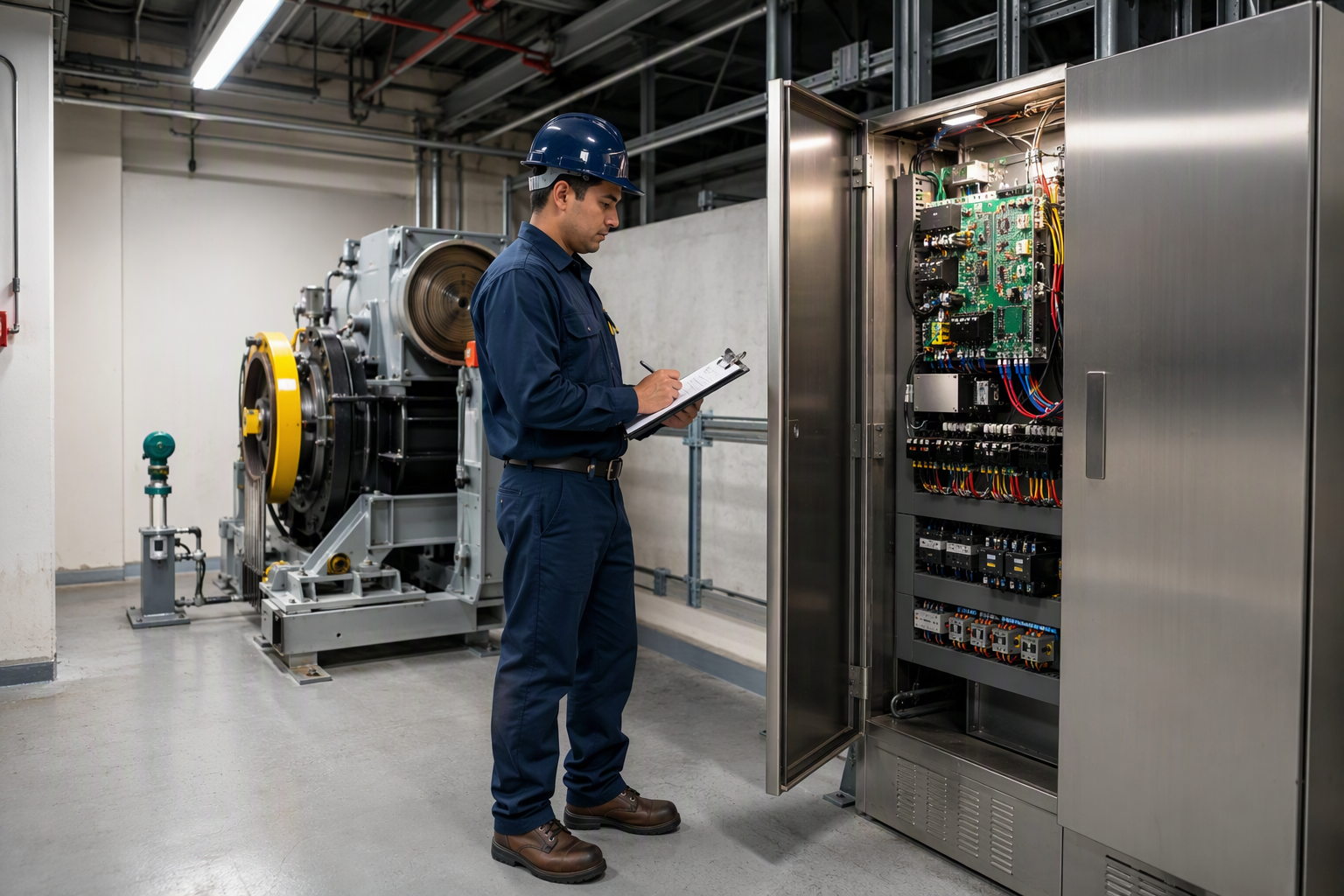
- Machine room inspection: Check motor, controller, governor, hoisting ropes or hydraulic pump unit, and oil levels; verify ventilation and lighting.
- Pit inspection: Examine buffers, pit lighting, stop switch, ladder, and pit floor for water intrusion or debris accumulation.
- Car top inspection: Inspect sheaves, guide shoes or roller guides, car safety devices, top-of-car operating station, and wiring harnesses.
- Door system check: Test door operator, clutch, interlocks, and sill clearances; verify opening and closing force compliance with ADA requirements.
- Interior car inspection: Test all buttons, position indicators, emergency lighting, alarm bell, and communication device; confirm permit posting.
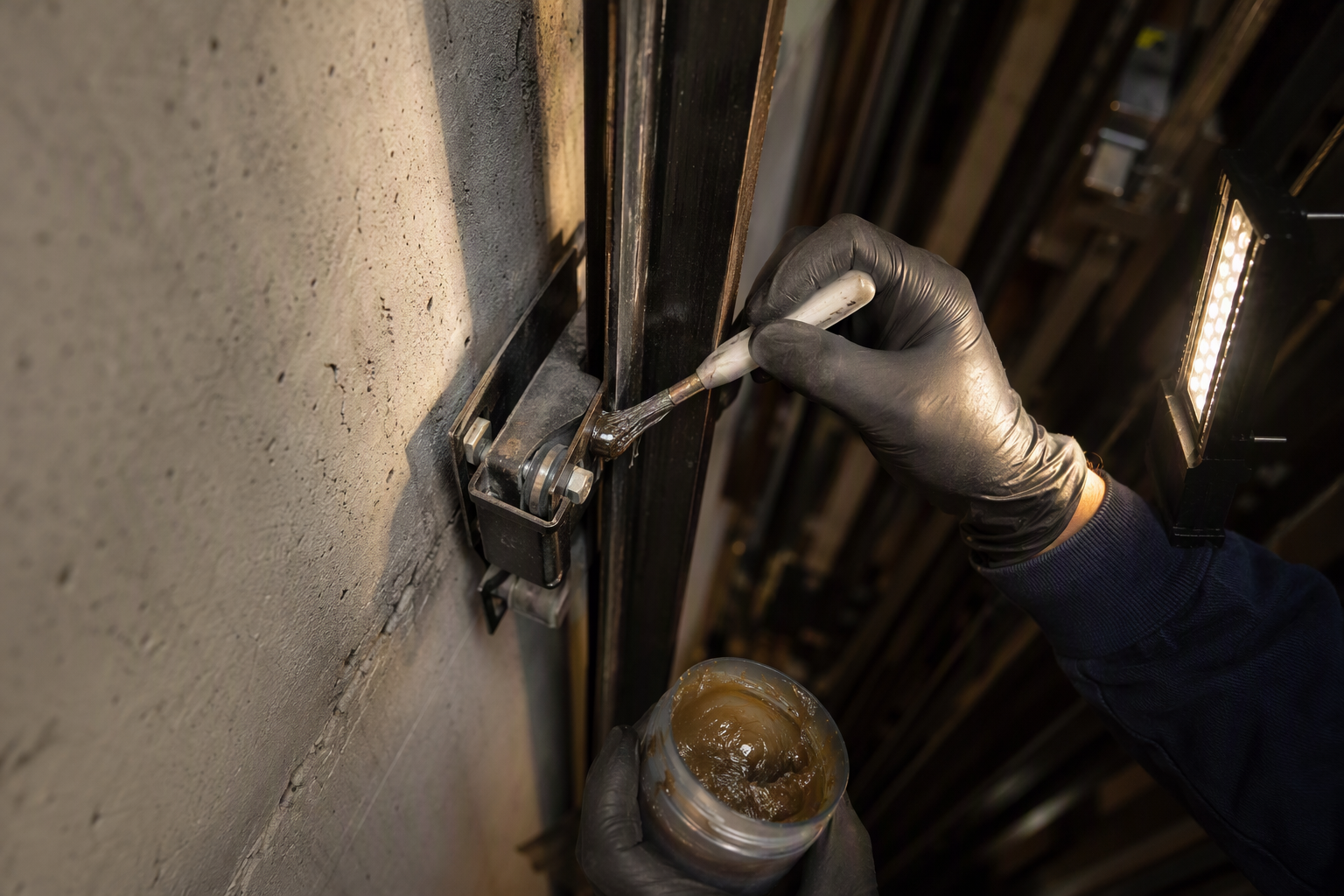
- Hoistway inspection: Check guide rail lubrication, counterweight, and hoistway clearances from the car top.
- Safety device operational test: Verify proper function of safeties, overspeed governor, and slack-rope devices per applicable intervals.
- Documentation: Record all findings, work performed, and any deficiencies requiring follow-up in a maintenance log available to the building owner and Cal/OSHA.
What are the consequences of skipping elevator maintenance?
Neglecting elevator maintenance can result in equipment failure, passenger entrapment, Cal/OSHA permit suspension, regulatory fines, and increased civil liability for building owners.
From a regulatory standpoint, an elevator found to be in unsafe condition during an inspection can have its permit to operate suspended immediately, forcing the unit out of service until deficiencies are corrected and a re-inspection is passed. Because arranging the annual reinspection is the elevator owner’s responsibility in California, failure to schedule and pass inspection is a direct compliance violation under California Labor Code Sections 7300–7324.2.
From a mechanical standpoint, deferred maintenance accelerates component wear. Dry guide rails damage roller guides and car frames. Neglected brake adjustments reduce stopping reliability. Worn door equipment — the single most common source of elevator trouble calls — causes door reversals, door open faults, and eventual entrapment. Proactive maintenance consistently costs less over the life of the equipment than reactive emergency repair.
How does elevator maintenance relate to ADA compliance?
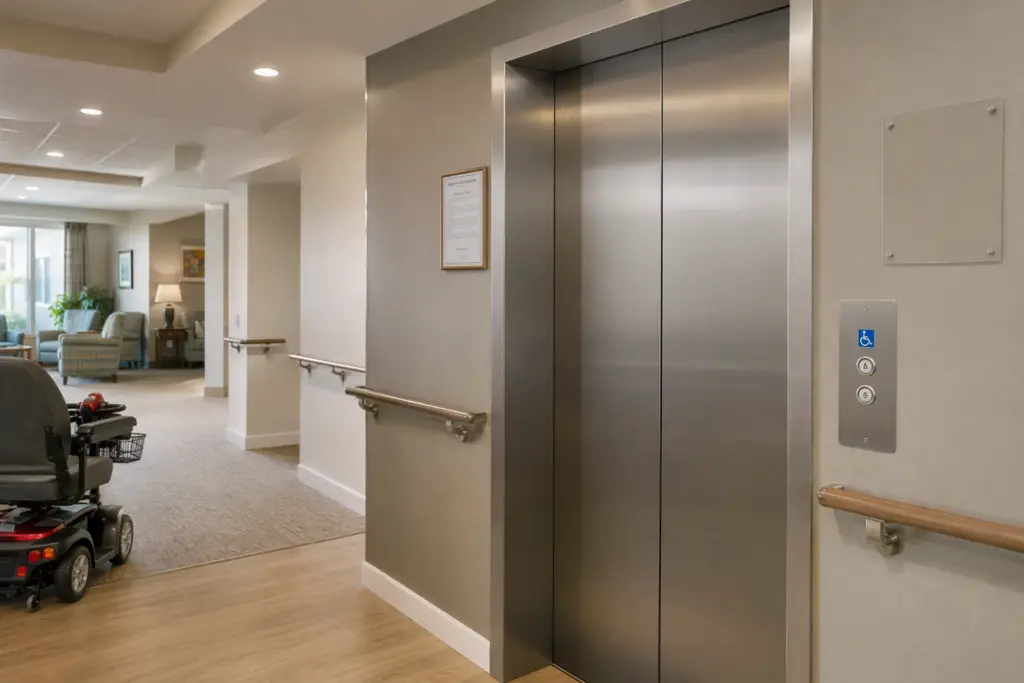
Ongoing maintenance is essential for ADA compliance because the Americans with Disabilities Act requires that accessible features — including elevator controls, door timing, and floor indicators — remain operational and usable by people with disabilities.
The ADA requires that elevators serving public accommodations and commercial facilities maintain accessible features in working order. A door that closes too quickly, a floor indicator that has failed, a Braille button that has worn smooth, or an audio tone system that is inoperative can each constitute an ADA accessibility failure. A maintenance program that includes systematic inspection of accessible features helps building owners document their good-faith effort to maintain compliance.
For properties in Los Angeles and Orange County subject to both ADA and California Building Code requirements, the intersection of federal accessibility law and state elevator safety orders makes comprehensive maintenance documentation especially important in the event of a complaint or audit.
What is the difference between preventive maintenance and corrective maintenance?
Preventive maintenance is scheduled, proactive service performed before failure occurs, while corrective maintenance addresses deficiencies or failures identified during inspections or reported through trouble calls.
| Characteristic | Preventive Maintenance | Corrective Maintenance |
|---|---|---|
| Trigger | Scheduled interval (monthly, quarterly, annual) | Identified deficiency or equipment failure |
| Timing | Proactive — before failure | Reactive — after detection or failure |
| Cost profile | Predictable, budgetable | Variable; emergency labor typically higher |
| Downtime impact | Minimal — brief scheduled visits | Potentially significant — units may be out of service |
| Regulatory value | Supports permit renewal and CQCC contract benefit | Required to restore permit compliance after deficiency |
| Documentation | Maintenance log updated each visit | Work order and deficiency correction records |
| Examples | Rope lubrication, brake adjustment, door operator tuning | Rope replacement, controller board repair, door operator replacement |
An effective full maintenance contract integrates both types: preventive tasks on a defined schedule, with corrective work triggered by findings during those visits or by trouble calls between visits.
What qualifications should a building owner verify before hiring an elevator maintenance company?
Building owners should verify that any elevator company they hire holds a current CQCC certification from Cal/OSHA, a C-11 Elevator Contractor license from the CSLB, and active workers’ compensation and liability insurance.
These are not optional credentials — they are legal prerequisites under California law. A company operating without CQCC certification cannot legally send technicians to work on a California elevator, and work performed by an uncertified company does not satisfy the regulatory requirements that support a valid permit to operate. Building owners bear direct responsibility for ensuring that their service provider is properly credentialed.
Beyond baseline legal credentials, building owners should evaluate the company’s familiarity with the specific equipment on their property, the clarity of the maintenance contract’s scope of work, and the provider’s process for documenting work and tracking deficiencies. Liftech Elevator serves properties in Signal Hill, Long Beach, Los Angeles, and Orange County with the certifications and documentation practices that California’s regulatory framework requires.
What is the Cal/OSHA annual inspection process and how does maintenance preparation affect it?
Cal/OSHA’s annual inspection is conducted by a State safety engineer or Certified Competent Conveyance Inspector (CCCI) who evaluates whether the elevator is in safe condition and whether the building owner may receive a permit to operate for the next one or two years.
Only State of California safety engineers and CCCIs may perform elevator inspections in California. Building owners arrange the inspection through Cal/OSHA’s Elevator Unit. The inspector will review documentation, test safety devices, verify component condition, and confirm that the current permit is posted in the car. A well-maintained elevator with current documentation enters the inspection in the strongest possible position.
Deficiencies found during inspection must be corrected before a permit is issued or renewed. If deficiencies are serious, Cal/OSHA may require the elevator to be taken out of service until corrections are complete and a re-inspection passed. Consistent preventive maintenance reduces the likelihood of inspection findings by addressing emerging issues before the inspector arrives.
What maintenance considerations apply to hydraulic elevators versus traction elevators?
Hydraulic and traction elevators share many common maintenance tasks but diverge significantly in the systems that require the most attention — hydraulic systems require regular fluid monitoring and cylinder inspection, while traction systems require rope, sheave, and brake maintenance.
Hydraulic elevators rely on a pump unit, hydraulic fluid, control valves, and an underground or above-ground cylinder and jack assembly. Key maintenance concerns include fluid condition and level, valve adjustment, jack seal integrity, and the condition of the hydraulic cylinder — particularly in older installations where underground cylinders may be subject to corrosion or single-bottom cylinder concerns addressed under ASME A17.1 provisions.
Traction elevators — whether geared or gearless, with drum or overhead machine — require attention to hoisting rope condition (including broken wire counts per ASME A17.1 criteria for removal from service), sheave groove wear, brake lining thickness, governor rope, and car and counterweight guide systems. Machine room gearboxes require periodic oil changes. Both systems require attention to door equipment, controller software/hardware, and life-safety devices.
Properties in Southern California’s coastal communities, including Long Beach and Signal Hill, may experience accelerated corrosion in pit environments due to proximity to salt air and groundwater, making pit inspections and protective coatings a maintenance priority.
What should building owners do if an elevator breaks down between maintenance visits?
If an elevator experiences a breakdown or entrapment, building owners should immediately contact their certified elevator maintenance company and, in the case of a passenger entrapment, also contact emergency services.
- Passenger entrapment: Call 911 immediately. Do not attempt to open doors or release passengers without trained personnel — improper rescue attempts are dangerous.
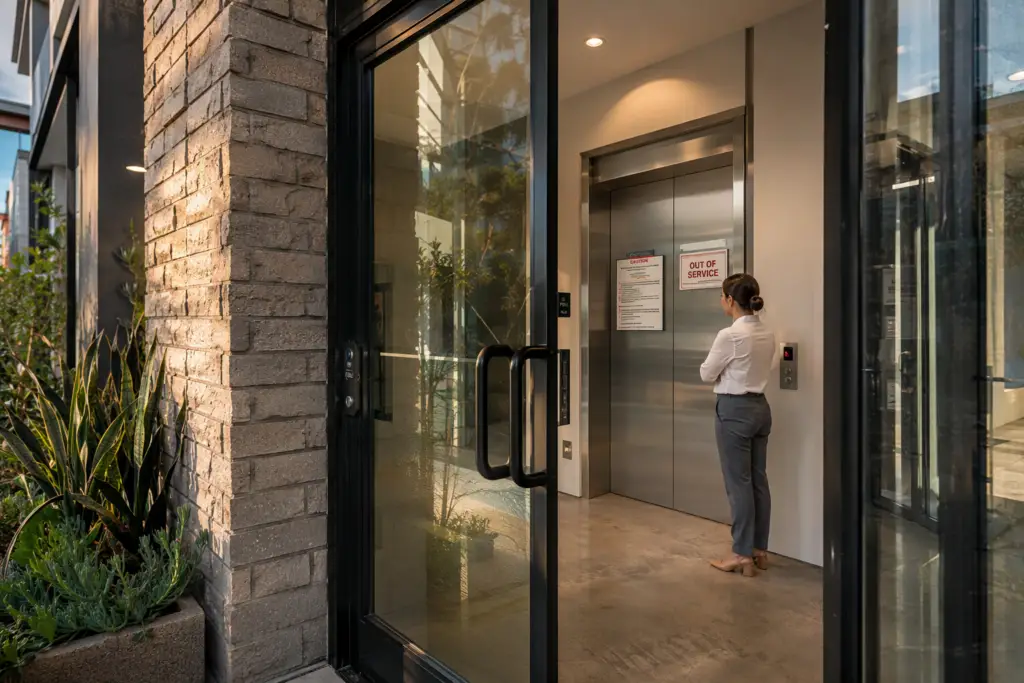
- Non-entrapment breakdown: Place the elevator out of service by posting a clearly visible “Out of Service” notice at each landing. Do not allow passengers to use a malfunctioning unit.
- Notify your maintenance provider: Contact your CQCC-certified elevator company to dispatch a CCCM for diagnostic and corrective service.
- Document the incident: Record the time, nature of the malfunction, any passengers affected, and actions taken. This documentation is important for regulatory and insurance purposes.
- Cal/OSHA notification: Certain incidents involving elevators may require notification to Cal/OSHA under California’s reporting requirements. Consult with your elevator service provider and legal counsel on applicable reporting obligations.
- Retain all records: Keep the service work order, technician findings, and corrective action reports. These form part of the maintenance history reviewed at annual inspection.
How does elevator maintenance service apply to multi-unit residential buildings in California?
Multi-unit residential buildings in California that include passenger elevators are fully subject to Cal/OSHA elevator safety oversight, require valid permits to operate, and must have maintenance performed by a CQCC with CCCMs — the same requirements that apply to commercial properties.
California’s elevator law exempts only conveyances under federal jurisdiction and conveyances in single-unit private homes that are not accessible to the public. A shared elevator in a condominium complex, apartment building, or mixed-use property is not exempt and must comply fully with California Labor Code Sections 7300–7324.2 and Title 8 Elevator Safety Orders.
Residential building owners and HOAs managing properties in Los Angeles, Long Beach, Signal Hill, and Orange County should be particularly attentive to the requirement that the permit to operate be conspicuously posted in the elevator car at all times — this is a frequently cited deficiency during inspections of smaller residential buildings where oversight is less formal than in large commercial properties.
What documentation should a building owner maintain for elevator maintenance compliance?
Building owners should maintain a current posted permit to operate, a maintenance log recording all service visits and findings, work orders for corrective repairs, and records of any Cal/OSHA inspection reports and permits issued.
California requires that the permit to operate be posted conspicuously in the elevator car. Beyond this mandatory posting, prudent property management practice includes a secure, organized maintenance file that contains: the most recent Cal/OSHA inspection report and permit; maintenance logs updated after every service visit by the CQCC; work orders and invoices for all corrective repairs; records of any component replacements; and correspondence with Cal/OSHA or the local AHJ regarding the unit.
This documentation serves multiple functions: it supports permit renewal at the annual inspection; it provides evidence of due diligence in the event of a personal injury claim; it facilitates informed decision-making about repair versus modernization; and it demonstrates compliance to commercial tenants, lenders, and insurers who increasingly ask for elevator compliance records as part of due diligence.
When should a building owner consider elevator modernization instead of continued maintenance?
Modernization becomes worth serious consideration when maintenance costs are escalating due to aging components, when parts availability is diminishing, when energy consumption is high, or when the equipment no longer meets current accessibility or code standards effectively.
There is no single threshold that triggers modernization over maintenance — the decision depends on the age and condition of the specific equipment, the availability of replacement parts, the cost trajectory of maintenance and repair, tenant satisfaction, and the building owner’s long-term plans for the property. A certified elevator company can provide a condition assessment that evaluates remaining useful life, identifies obsolescence risks, and projects maintenance cost trends.
From a regulatory standpoint, California has proposed a Group V update to its Elevator Safety Orders that would incorporate elements of ASME A17.1-2019 in part. The Standards Board held a public hearing on June 18, 2026, and no effective date has been posted as of the date of this publication. Building owners planning major capital expenditures should monitor this rulemaking, as modernization projects begun after any new Group V effective date would be subject to the updated code edition. Liftech Elevator monitors California regulatory developments and advises clients accordingly.
What role does elevator maintenance play in building insurance and liability?
A documented, consistent elevator maintenance program is one of the most effective risk management tools available to building owners, demonstrating due diligence that can influence liability exposure and insurer expectations.
Commercial property insurers, commercial general liability underwriters, and umbrella carriers increasingly scrutinize elevator maintenance records when underwriting properties with vertical transportation. A building with documented, uninterrupted service by a CQCC-certified provider, current Cal/OSHA permits, and a record of promptly corrected deficiencies presents a materially different risk profile from one with sporadic service and lapsed permits.
In litigation arising from elevator incidents, the existence — or absence — of a maintenance program and its documentation is routinely examined. Building owners who can demonstrate that they contracted with a licensed provider, that scheduled visits were completed, and that known deficiencies were corrected promptly are in a substantially stronger position to defend against negligence claims.
What additional federal standards govern elevator maintenance beyond California’s state requirements?
The primary federal technical standard is the ASME A17.1 Safety Code for Elevators and Escalators, which California has adopted in the 2004 edition for new installations, while ASME A17.3 addresses safety code for existing installations, and OSHA workplace safety requirements apply in elevator machine rooms and pit areas.
ASME A17.1 sets the baseline technical requirements for design, construction, operation, inspection, testing, maintenance, alteration, and repair of elevators and escalators. ASME A17.3, the Safety Code for Existing Elevators and Escalators, provides a framework for evaluating and upgrading older equipment. The Occupational Safety and Health Administration (OSHA) has jurisdiction over worker safety in elevator machine rooms, pits, and hoistways, establishing requirements for confined space entry, lockout/tagout, and personal protective equipment that CCCM technicians must follow.
The ADA applies to elevators serving places of public accommodation and commercial facilities, establishing requirements for accessible car controls, floor designation, and door timing. These federal frameworks operate alongside California’s state elevator safety orders, and a compliant maintenance program must address all applicable layers.
How does elevator maintenance service differ for low-rise versus high-rise buildings in Southern California?
The fundamental legal and safety requirements are the same regardless of building height, but high-rise installations typically involve more complex equipment, higher traffic volumes, multiple cars requiring coordinated service, and additional life-safety integration that increases both the scope and the frequency of maintenance tasks.
Low-rise commercial buildings and residential properties in communities like Signal Hill or suburban Orange County may have a single hydraulic or low-speed traction elevator that requires straightforward monthly and annual maintenance cycles. High-rise towers in Downtown Los Angeles or Long Beach’s commercial core may have banks of high-speed gearless traction elevators with destination dispatch systems, machine-room-less configurations, sophisticated group controllers, and integration with building fire and emergency power systems.
High-rise maintenance programs must account for the complexity of rope systems on tall rises, the demands of high-cycle door equipment, the maintenance of cab finishes and accessible features under heavy use, and the coordination of service windows that minimize disruption to tenants. Liftech Elevator works with commercial building managers across the Los Angeles and Orange County markets to develop maintenance schedules and scopes of work appropriate to each installation’s specific configuration and use profile.
How can building owners evaluate the quality of their current elevator maintenance program?
Building owners can evaluate their maintenance program by reviewing the frequency and thoroughness of documented service visits, examining Cal/OSHA inspection findings over the past several cycles, assessing trouble call frequency, and confirming that their service provider holds current CQCC certification and that all working mechanics are certified CCCMs.
Key indicators of a high-quality maintenance program include: service logs that are complete, legible, and updated after every visit; a low and declining frequency of callback calls between scheduled visits; clean or minimally deficient Cal/OSHA annual inspection reports; prompt corrective action on identified deficiencies; and a service provider who proactively communicates emerging concerns rather than waiting for failures to occur.
Red flags include service logs that are missing or incomplete, a high frequency of door-related trouble calls (a reliable indicator of deferred door equipment maintenance), repeated findings on Cal/OSHA inspection reports for the same items, and difficulty reaching the service provider for callback response. Building owners who have concerns about their current program’s quality are encouraged to request a condition assessment from an independent CQCC-certified provider. Liftech Elevator offers free elevator assessments for properties in Signal Hill, Long Beach, Los Angeles, and Orange County.
Schedule Your Free Elevator Assessment
Building owners and property managers in Signal Hill, Long Beach, Los Angeles, and Orange County who want to confirm that their elevator maintenance program meets California’s legal requirements — or who are ready to transition to a full maintenance contract with a CQCC-certified provider — can take the first step today.
Contact Liftech Elevator for a free elevator assessment. Call us at 562-609-3478 to speak with a certified elevator service professional about your property’s needs.
Need elevator service you can rely on? Liftech Elevator is ready to help.