Elevator Maintenance Companies: The Complete FAQ Guide for California Building Owners
Elevator maintenance companies perform the scheduled inspections, lubrication, adjustment, repair, and modernization work that keeps vertical transportation equipment safe and legally compliant. In California, every company that maintains, repairs, or alters an elevator must be certified by the California Division of Occupational Safety and Health (Cal/OSHA), Elevator Unit as a Certified Qualified Conveyance Company (CQCC) and must hold a C-11 Elevator Contractor license issued by the California Contractors State License Board (CSLB). Building owners in Signal Hill, Long Beach, Los Angeles, and Orange County should verify both credentials before signing any service agreement.
What does an elevator maintenance company actually do?
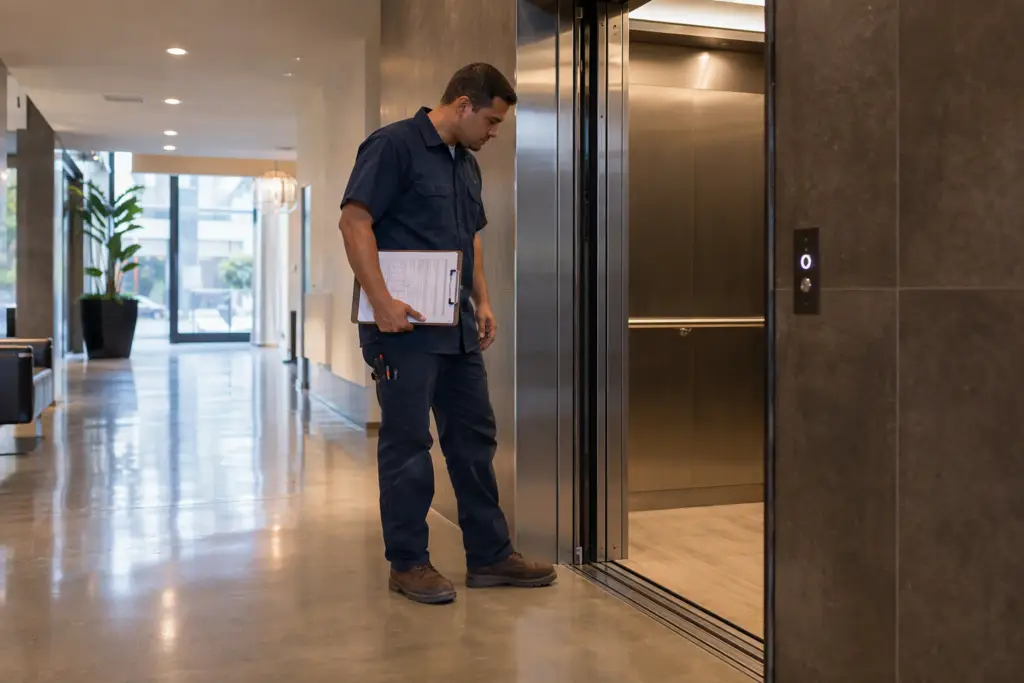
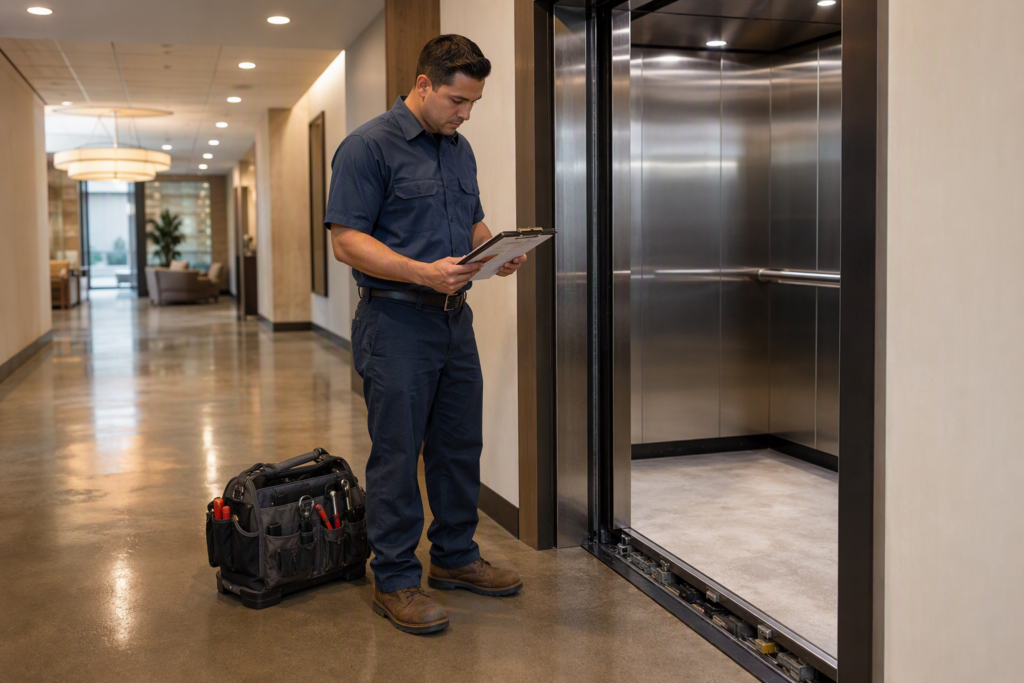
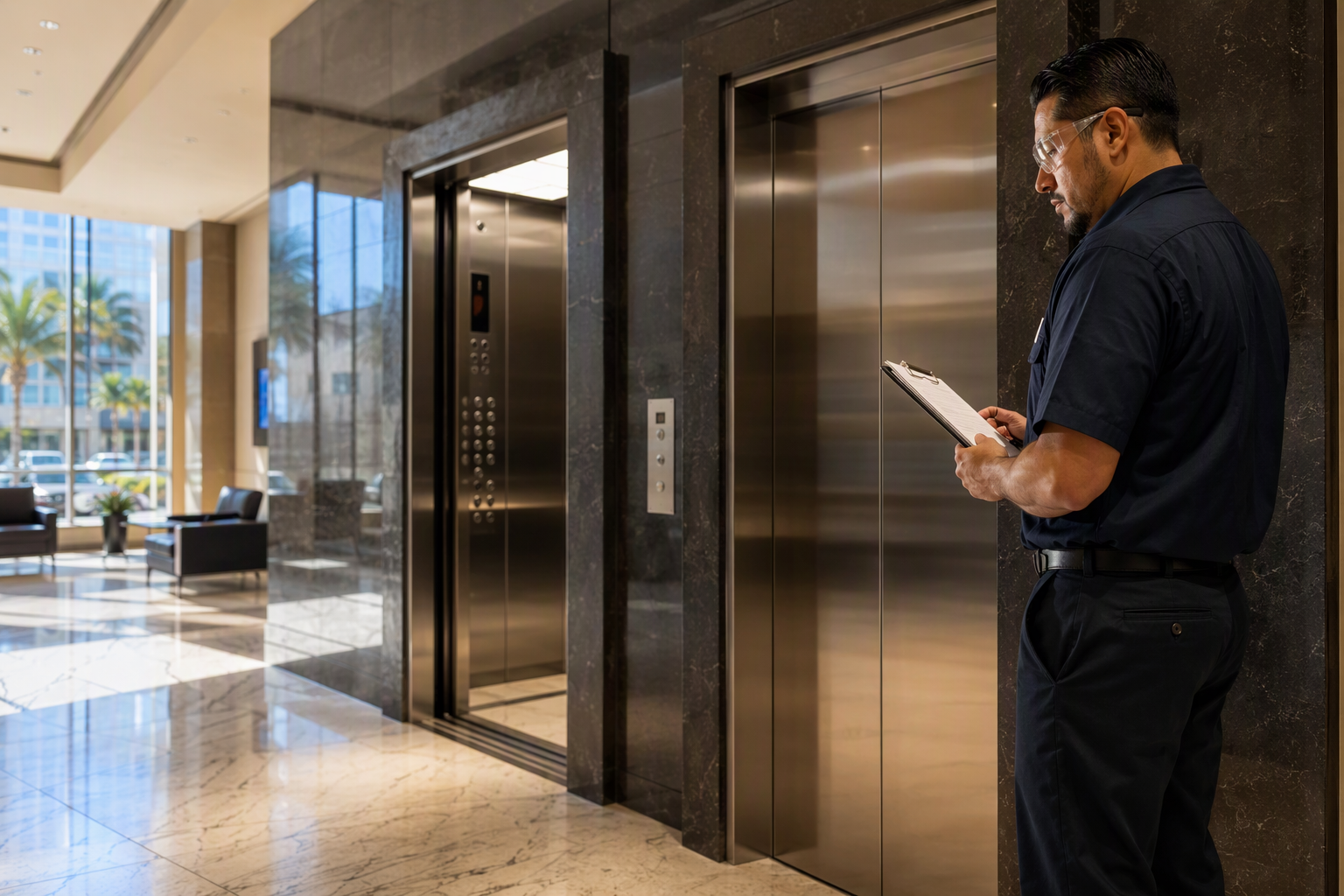
An elevator maintenance company performs scheduled inspections, preventive maintenance, emergency repairs, code compliance work, and full modernizations to keep elevator equipment safe and legally permitted to operate.
The scope of work covers mechanical components such as hoisting machines, sheaves, governors, and buffers; electrical systems including controllers, door operators, and safety circuits; and cab interiors such as lighting, buttons, and emergency communication devices. Comprehensive maintenance programs also include documentation of all work performed, coordination of required government inspections, and proactive replacement of wear parts before failures occur.
In California, this work may only be performed by a Cal/OSHA-certified CQCC using field technicians who hold individual Certified Competent Conveyance Mechanic (CCCM) credentials. A company that lacks these credentials is operating outside California law under California Labor Code Sections 7300–7324.2.
What certifications must elevator maintenance companies hold in California?
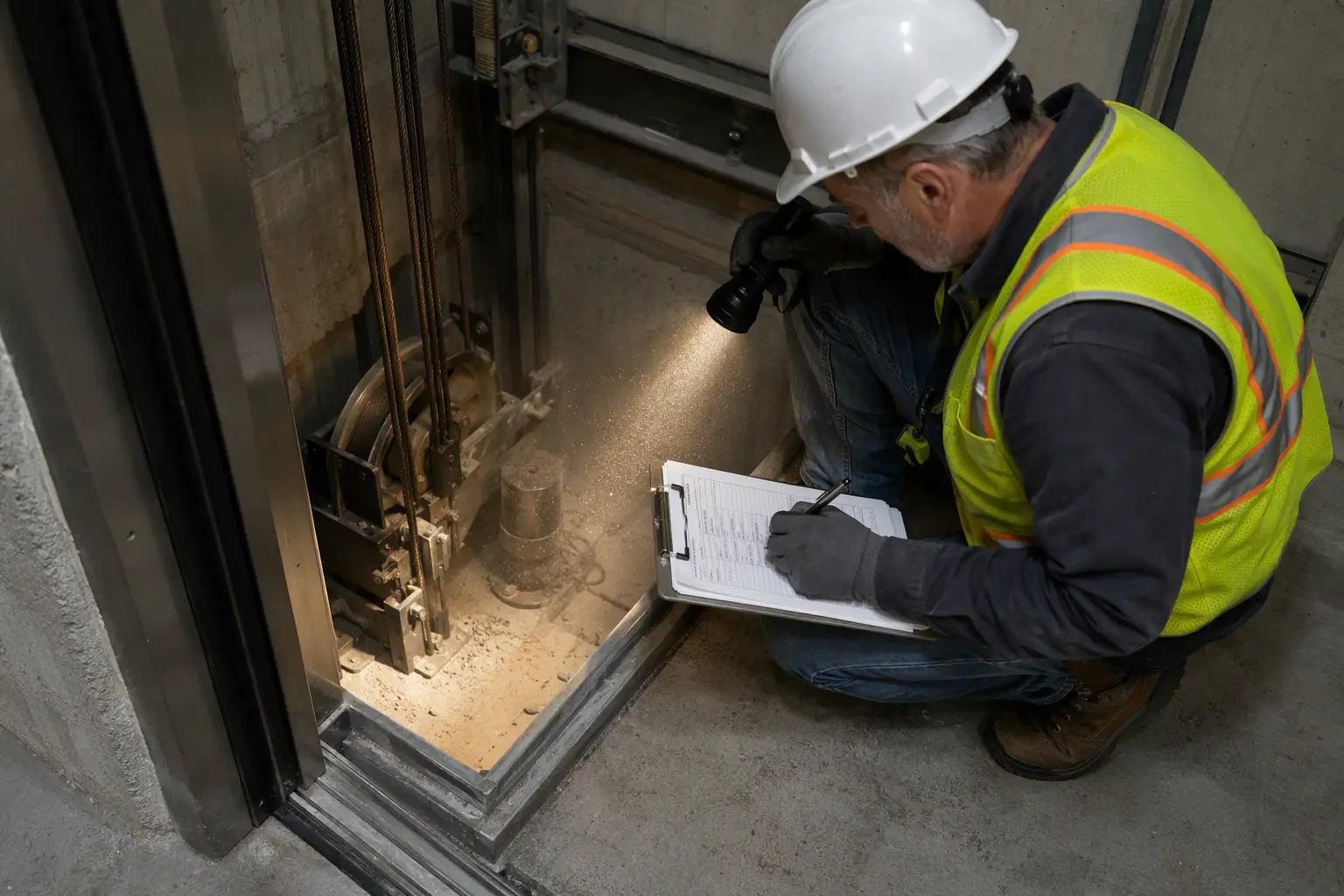
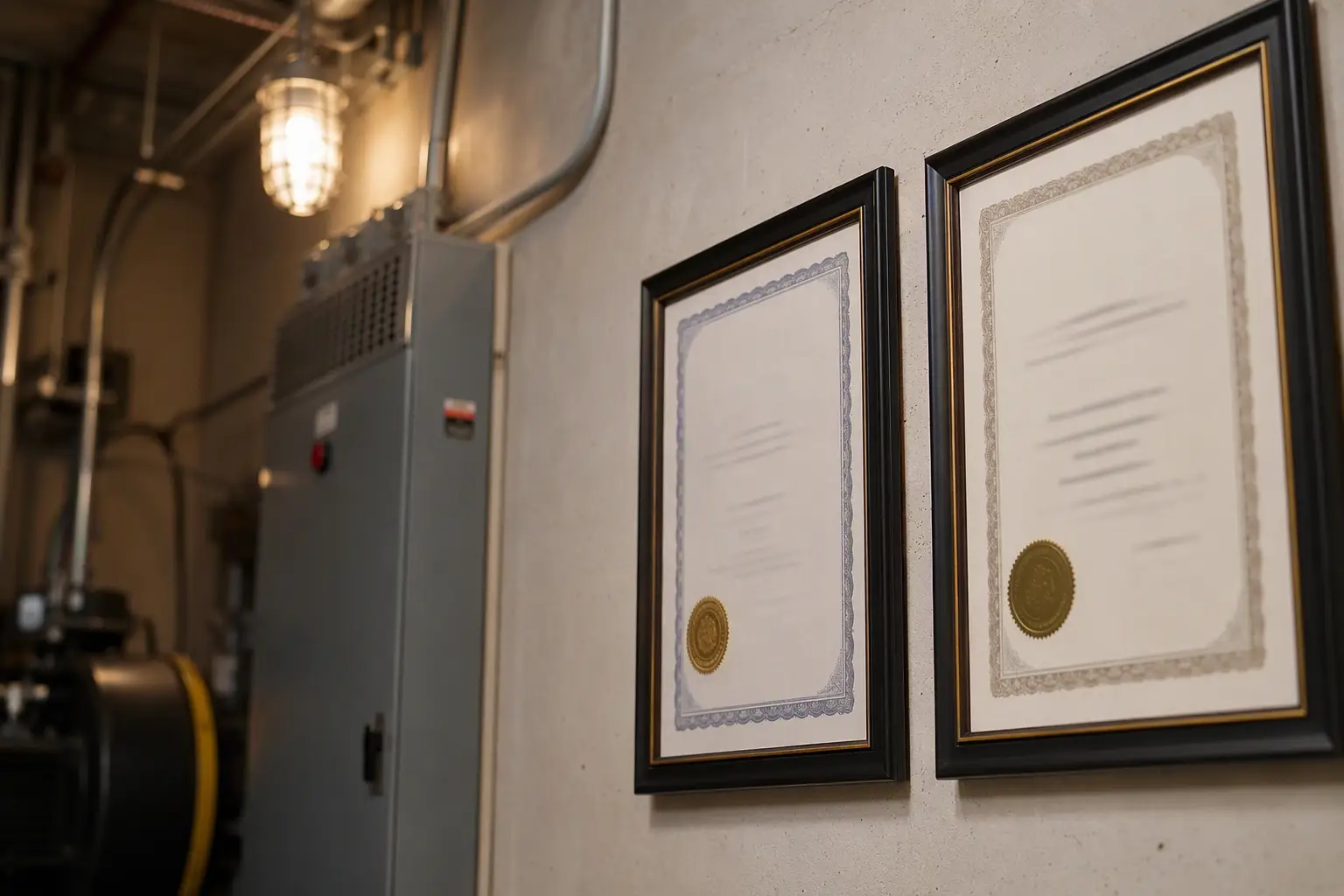
California elevator maintenance companies must hold a Cal/OSHA Certified Qualified Conveyance Company (CQCC) certificate and a CSLB C-11 Elevator Contractor license, and every unsupervised mechanic must hold a Cal/OSHA Certified Competent Conveyance Mechanic (CCCM) credential.
To obtain CQCC certification, a company must submit a current C-11 contractor license and proof of workers’ compensation and liability insurance to Cal/OSHA. The CQCC certificate and individual CCCM credentials each last two years, and renewal requires a minimum of eight hours of continuing education per cycle. Building owners should request certificate numbers and verify them directly with Cal/OSHA before work begins.
The California Contractors State License Board (CSLB) administers the C-11 license, while Cal/OSHA administers the CQCC, CCCM, and conveyance inspector certifications. These are two separate credential systems, and a compliant elevator maintenance company must maintain both in good standing at all times.
How often are elevators required to be inspected in California?
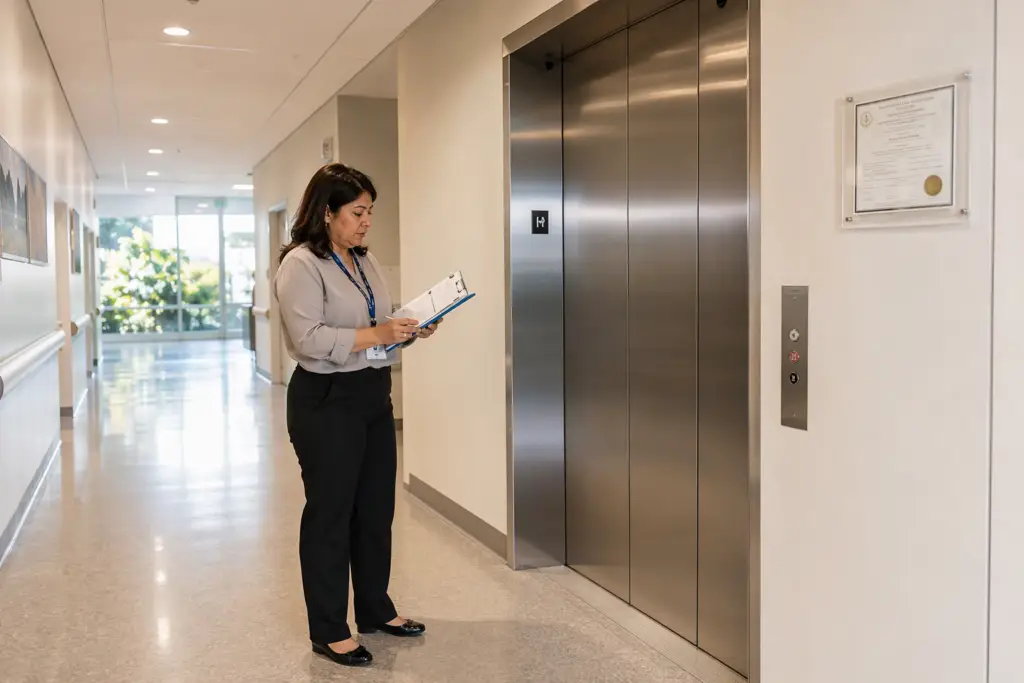
California law requires every conveyance to be inspected at least once per year, and a unit found safe receives a permit to operate for up to one year — extendable to two years when the elevator is covered by a full maintenance contract with a C-11 licensed elevator company.
These inspection intervals are established under California Code of Regulations, Title 8, Elevator Safety Orders (Sections 3000–3146). Only State of California safety engineers and Certified Competent Conveyance Inspectors (CCCI) may perform these inspections — a maintenance technician may not self-certify an elevator’s annual inspection. Critically, arranging the annual reinspection is the building owner’s responsibility, not the maintenance company’s obligation by default.
No elevator in California may operate without a valid, current permit to operate issued by Cal/OSHA. That permit must be posted conspicuously inside the elevator car at all times. Failure to display a valid permit is a violation subject to Cal/OSHA enforcement action. Liftech Elevator helps building owners in Long Beach, Signal Hill, and the greater Los Angeles area track inspection due dates and coordinate timely reinspections to avoid lapses in permit status.
What code standards govern elevator maintenance in California?
California’s primary elevator safety code is ASME A17.1/CSA B44, 2004 edition (Group IV Elevator Safety Orders), effective May 1, 2008, for installation contracts signed on or after that date, and enforced by Cal/OSHA under California Labor Code Sections 7300–7324.2.
The ASME A17.1 Safety Code for Elevators and Escalators is the foundational technical standard covering design, construction, installation, operation, inspection, testing, maintenance, alteration, and repair of elevators. California adopted the 2004 edition into its Elevator Safety Orders. As of 2026, California has proposed a Group V update that would incorporate portions of ASME A17.1-2019; a public hearing was held on June 18, 2026, and no effective date has been posted.
Federal accessibility requirements under the Americans with Disabilities Act (ADA) also apply to public and commercial elevators, covering door timing, cab dimensions, control height, and Braille markings. Maintenance companies must be familiar with both the state-adopted ASME edition and ADA requirements to keep a building fully compliant.
What is the difference between a full maintenance contract and a partial maintenance contract?
A full maintenance contract covers all parts, labor, and adjustments needed to keep an elevator in safe operating condition, while a partial contract typically limits coverage to labor or a defined list of components, leaving other repair costs to the building owner.
The distinction matters significantly in California because only a full maintenance contract with a C-11 licensed elevator company qualifies an elevator for a two-year permit to operate extension under Cal/OSHA rules. Partial contracts do not confer this benefit.
Building owners should review contract language carefully for exclusions related to modernization-level components, proprietary parts, or damage caused by misuse. A well-structured full maintenance agreement aligns the maintenance company’s financial incentives with proactive upkeep rather than reactive repair billing.
How do elevator maintenance companies compare on key service criteria?
| Evaluation Criteria | What to Look For | Red Flag |
|---|---|---|
| CQCC Certification (Cal/OSHA) | Active, current certificate on file | No certificate or expired credential |
| C-11 License (CSLB) | Active license, verifiable on CSLB website | Unlicensed or suspended license |
| CCCM Credential (individual mechanics) | All unsupervised mechanics certified | Uncredentialed technicians working alone |
| Code Familiarity | Fluent in ASME A17.1-2004, ADA, Title 8 | Vague answers about applicable standards |
| Inspection Coordination | Assists owner in scheduling Cal/OSHA inspection | Leaves owner to navigate agencies alone |
| Contract Type | Full maintenance contract available | Only partial/oil-and-grease agreements offered |
| Documentation | Detailed written maintenance logs provided | No written records supplied to owner |
| Permit Tracking | Monitors permit expiration dates proactively | Owner notified only after permit lapses |
| Parts Access | Works with multiple manufacturers and suppliers | Limited to one proprietary parts ecosystem |
| Local Jurisdiction Knowledge | Familiar with LADBS and local AHJ requirements | No experience with local authority requirements |
What should building owners do immediately when an elevator fails or is shut down?
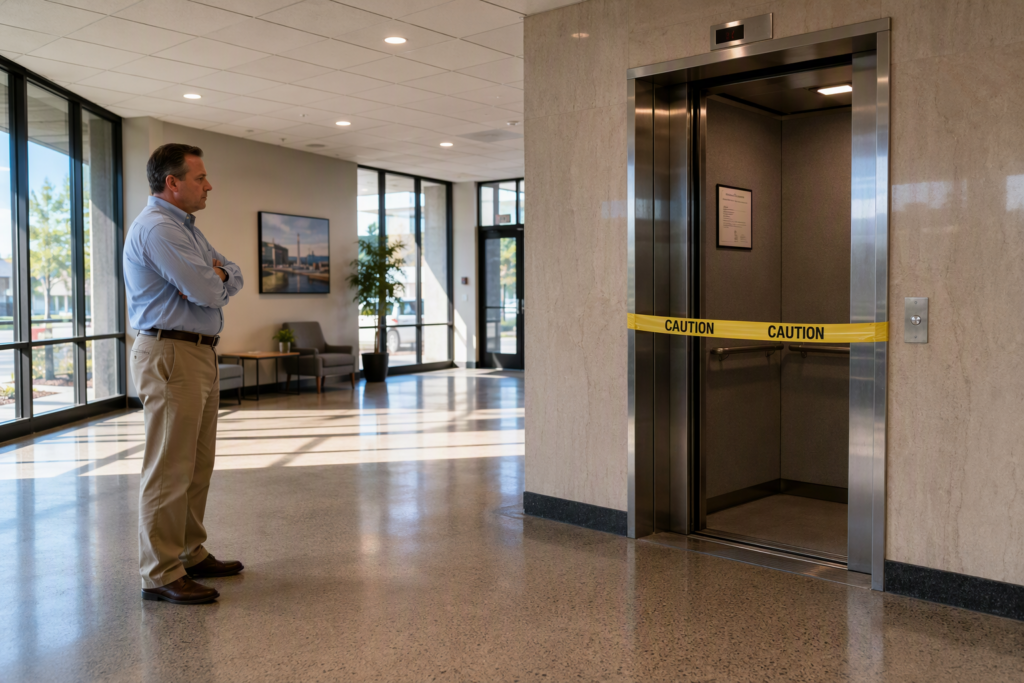
When an elevator fails or is taken out of service, building owners must act quickly to protect passenger safety, preserve legal compliance, and initiate the proper restoration process.
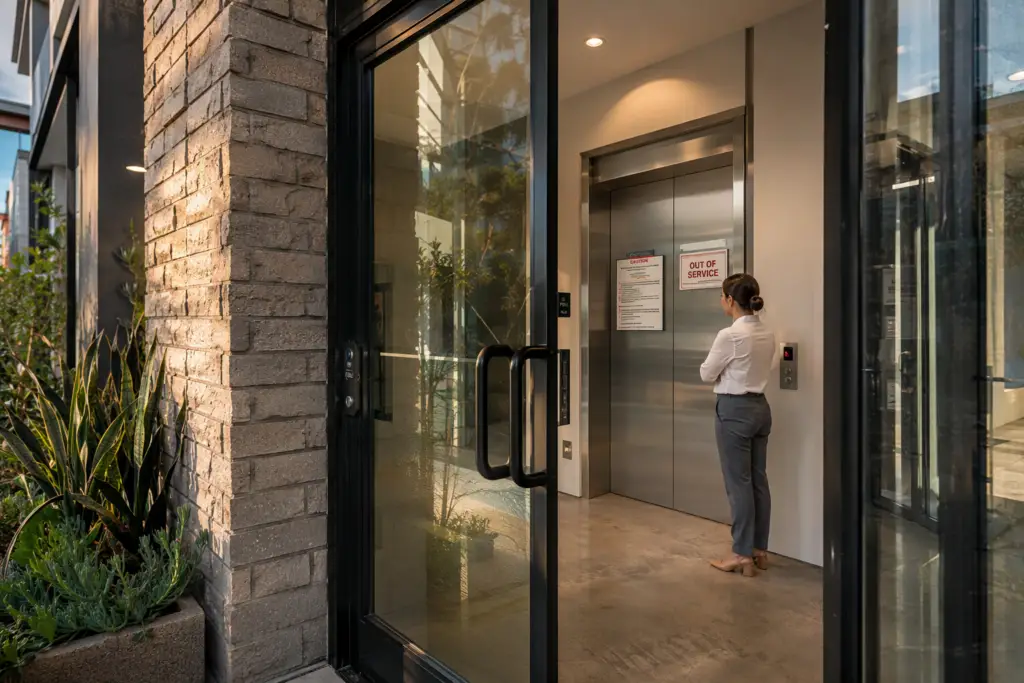
- Secure the elevator immediately. Lock out the elevator from service to prevent unauthorized use. Post visible signage on all floors indicating the unit is out of service.
- Confirm no passengers are trapped. Contact building security or emergency services if anyone may be inside the car. Do not attempt to open doors manually without trained personnel.
- Contact a CQCC-certified maintenance company. Notify your elevator maintenance provider so a CCCM-credentialed mechanic can assess the failure and determine whether the elevator may be returned to service safely.
- Document the failure. Record the date, time, nature of the malfunction, and any witness accounts. Preserve this record for the maintenance log and any required reporting.
- Notify Cal/OSHA if required. Certain incidents involving elevator accidents or injuries may require reporting to the Cal/OSHA Elevator Unit. Your maintenance company can advise on reporting obligations.
- Do not return the elevator to service until cleared. A mechanic’s verbal assurance is not a permit. Confirm that the unit is safe and that any required inspection or permit reissuance has been completed before reopening the elevator to building occupants.
- Review ADA obligations. If your building is subject to the ADA, an extended elevator outage in a multi-story building may create accessibility compliance issues that require a plan to provide alternative accommodations.
Does Los Angeles have its own elevator inspection program?
Yes, the City of Los Angeles operates its own elevator and conveyance inspection program administered through the Los Angeles Department of Building and Safety (LADBS), separate from the statewide Cal/OSHA program.
Building owners with elevators in the City of Los Angeles should confirm which authority having jurisdiction (AHJ) governs their specific property. An experienced elevator maintenance company operating in Los Angeles County will be familiar with both Cal/OSHA requirements and the LADBS program requirements and can help owners navigate the correct inspection and permitting pathway for their address.
What is an elevator modernization, and when should it be considered?
Elevator modernization is the replacement or substantial upgrade of major system components — such as the controller, drive system, door operator, or cab fixtures — to improve reliability, energy efficiency, safety, and code compliance.
Modernization is typically considered when maintenance costs are escalating on aging equipment, parts availability becomes limited, safety deficiencies are identified during inspection, or a building renovation changes the elevator’s use or traffic patterns. Under California regulations, any material alteration to a conveyance requires a permit from Cal/OSHA before work begins, and the altered unit must pass inspection before returning to service.
A qualified elevator maintenance company will assess whether ongoing repair costs are approaching or exceeding the investment threshold that justifies modernization. Liftech Elevator performs modernization assessments for buildings across Long Beach, Signal Hill, Orange County, and Los Angeles to help owners make data-driven decisions on their equipment lifecycle.
What ADA requirements apply to elevator maintenance and operation?
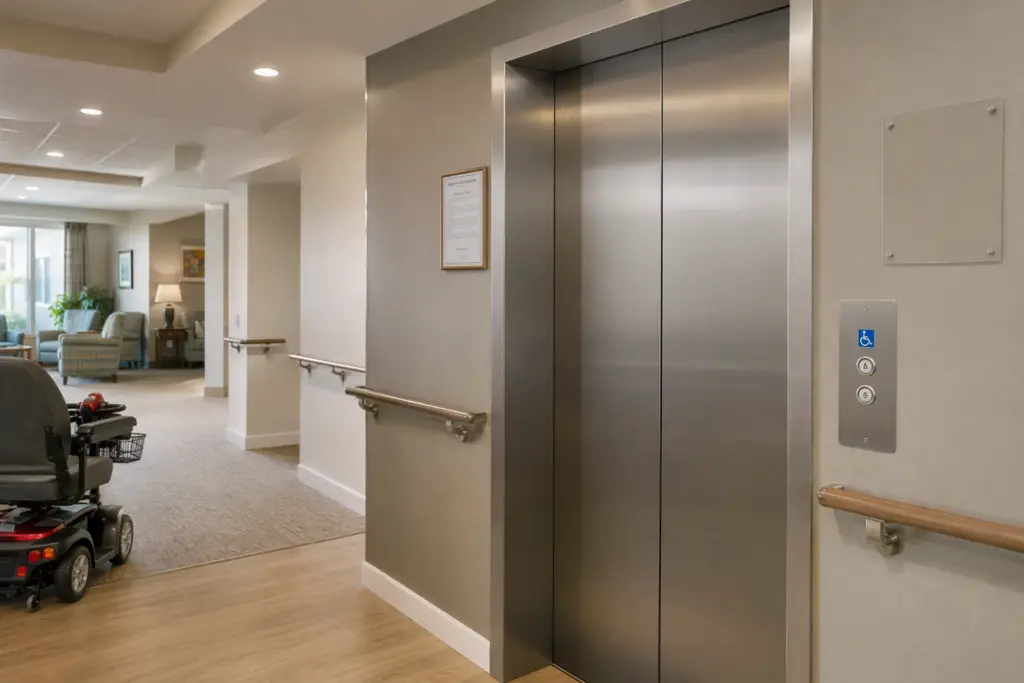
The Americans with Disabilities Act sets ongoing operational requirements for elevators in public and commercial buildings, including door timing, call button height, audible signals, Braille markings, and cab dimensions.
ADA compliance is not a one-time installation standard — it is an ongoing operational obligation. Maintenance work that replaces controls, buttons, or door equipment must preserve or improve ADA compliance. If a maintenance company replaces a door operator, for example, the new hardware must meet applicable ADA timing and force requirements. Building owners should confirm that their maintenance provider is trained to evaluate ADA impact on any component replacement.
Regarding visual or text-based emergency communication, California’s current adopted ASME A17.1-2004 Elevator Safety Orders and the 2025 California Building Code have provisions that may affect two-way emergency communication requirements. Building owners should ask their maintenance company to evaluate their specific installation, as the regulatory picture on this point is unsettled and evolving.
How do elevator maintenance companies handle hydraulic versus traction elevators differently?
Hydraulic and traction elevators use fundamentally different drive systems that require distinct maintenance procedures, fluid management, environmental compliance, and component inspection protocols.
Hydraulic elevators use a fluid-driven piston or cylinder to raise the cab. Maintenance tasks specific to hydraulic systems include checking fluid levels and condition, inspecting the underground or above-ground cylinder for leaks, testing the power unit, and ensuring that fluid containment requirements are met to prevent environmental contamination. Underground hydraulic cylinders are subject to specific inspection requirements given the risk of soil contamination from fluid leaks.
Traction elevators — both geared and gearless — use steel wire ropes and a counterweight system driven by an electric motor. Maintenance tasks include rope inspection and tensioning, sheave wear measurement, governor testing, safeties engagement testing, and brake adjustment. Machine-room-less (MRL) traction elevators present additional access and diagnostic considerations that require technicians trained on the specific drive and control platform installed.
A competent elevator maintenance company will have CCCM-credentialed technicians experienced with both system types and will tailor the maintenance scope to the specific equipment in a given building.
What documentation should a building owner receive from an elevator maintenance company?
Building owners should receive written maintenance logs for every service visit, copies of all inspection certificates and permits to operate, records of parts replaced, and documentation of any deficiencies found and corrective actions taken.
Maintenance records serve multiple purposes: they demonstrate due diligence in the event of an incident, support Cal/OSHA permit renewals, and provide the historical data needed to assess equipment condition over time. California law requires that the permit to operate be posted in the elevator car, and a well-organized maintenance file should include the current permit, the inspection report that preceded it, and a chronological log of all service activity.
Digital record-keeping platforms offered by some maintenance companies allow building managers to access logs, schedule upcoming visits, and track permit expiration dates from a web interface. Building owners should ask prospective maintenance providers how records are stored and what access the building owner retains if the contract is terminated.
What is the permitting process for a new elevator installation in California?
In California, a permit from Cal/OSHA is required before a new elevator is erected or installed, and each new conveyance must pass a Cal/OSHA inspection and receive a permit to operate before it is placed in service.
The permitting process begins before construction: the installing company, which must be a CQCC-certified firm holding a C-11 license, applies to Cal/OSHA for an installation permit. Once installation is complete, a Cal/OSHA safety engineer or CCCI inspects the unit. Only upon passing inspection and receiving the permit to operate may the elevator carry passengers or freight.
In Los Angeles, building owners must also coordinate with LADBS, which operates its own program. The installing company’s familiarity with the local authority having jurisdiction can significantly streamline the permitting timeline.
How do elevator maintenance companies prevent entrapments and safety incidents?
Preventive maintenance programs reduce entrapment and safety incident risk by systematically inspecting, testing, and replacing safety-critical components — including governors, safeties, door interlocks, and brake assemblies — before they fail in service.
Door system maintenance is particularly critical, as door malfunctions are among the most common causes of elevator incidents. Regular adjustment of door operators, replacement of worn gibs and rollers, and testing of interlock circuits help ensure that doors open and close correctly and that the elevator cannot move with a door open or unlocked.
The ASME A17.1 Safety Code for Elevators and Escalators specifies testing intervals and procedures for safety devices including overspeed governors and progressive safety devices. A maintenance company following ASME A17.1 protocols and California Title 8 Elevator Safety Orders will test these systems at required intervals and document results.
What questions should a building owner ask when evaluating elevator maintenance companies?
Building owners should ask prospective elevator maintenance companies to provide their CQCC certificate number, C-11 license number, proof of insurance, contract structure details, inspection coordination process, and references from similar building types.
Additional questions worth asking include: How are deficiencies prioritized and communicated? What is the process for emergency service requests outside of scheduled visits? Does the company have experience with the specific elevator brand and model installed in the building? How are proprietary-controller elevators handled if the original manufacturer’s parts are discontinued or expensive?
A reputable elevator maintenance company will answer these questions directly and provide documentation without hesitation. Reluctance to share credential numbers or contract details is a meaningful red flag. Liftech Elevator welcomes credential verification and provides detailed contract documentation to all clients in its service areas across Long Beach, Signal Hill, Los Angeles, and Orange County.
How does elevator age affect maintenance requirements and costs?
Older elevators typically require more frequent attention to wear components, face greater parts availability challenges, and may carry deferred code compliance obligations that increase maintenance complexity and cost over time.
Elevators installed before California’s 2008 adoption of ASME A17.1-2004 may have been built to earlier standards. While existing installations are generally not required to retroactively meet all new code requirements, Cal/OSHA’s Elevator Safety Orders and ASME A17.3 (the Safety Code for Existing Installations, referenced in the broader ASME standards framework) establish safety requirements for equipment that remains in service. A material alteration triggers the need to bring affected systems into compliance with current standards.
Building owners should request a condition assessment from their maintenance company that identifies components approaching end of useful life, documents known deficiencies, and estimates the capital investment needed to keep the equipment in safe, code-compliant service over a five- to ten-year horizon.
What is the role of Cal/OSHA in elevator oversight, and how do building owners interact with the agency?
The Cal/OSHA Elevator Unit, California Department of Industrial Relations issues permits to operate, conducts or oversees annual inspections, certifies companies and mechanics, and enforces California’s elevator safety laws under California Labor Code Sections 7300–7324.2.
Building owners interact with Cal/OSHA primarily around the annual inspection and permit renewal cycle. Because arranging reinspection is the owner’s responsibility, owners should maintain awareness of their permit expiration date and initiate the inspection process in advance. Operating an elevator without a valid permit is a violation of California law and exposes the building owner to enforcement action.
Cal/OSHA also has authority to order an elevator out of service if a safety violation is found during inspection. Understanding this enforcement framework is one reason why proactive maintenance — rather than reactive repair — is the preferred approach for building owners who want to avoid unexpected shutdowns.
Are there elevator types or locations exempt from California’s elevator laws?
California’s elevator law exempts conveyances under federal jurisdiction and conveyances in single-unit private homes that are not accessible to the public.
Building owners who believe their equipment may fall under an exemption should confirm the applicability of the exemption with a qualified attorney or directly with Cal/OSHA rather than assuming exempt status. Misclassifying a commercial or multi-family residential elevator as exempt and forgoing required permits and inspections creates significant legal and liability exposure. Most commercial, multi-family residential, and publicly accessible elevators in California are subject to the full requirements of the Elevator Safety Orders.
What should building owners in Signal Hill, Long Beach, Los Angeles, and Orange County know about local elevator compliance?
Building owners in these Southern California markets must comply with statewide Cal/OSHA requirements, and those in the City of Los Angeles must additionally navigate the LADBS elevator program, while Orange County and Long Beach area buildings generally fall under Cal/OSHA’s direct jurisdiction.
The regulatory landscape across greater Los Angeles is layered. Buildings within the City of Los Angeles boundaries deal with LADBS as the local authority having jurisdiction, while buildings in unincorporated areas or other municipalities typically work directly with Cal/OSHA. Signal Hill is an independent city within Los Angeles County and is generally subject to Cal/OSHA jurisdiction. Orange County buildings similarly fall under Cal/OSHA oversight absent a specific municipal program.
Liftech Elevator serves all four of these markets and maintains working familiarity with the inspection and permitting processes applicable to each jurisdiction. Building managers who are uncertain which agency governs their property can consult with Liftech Elevator as part of an initial assessment.
How can building owners confirm that an elevator maintenance company is legitimate and properly credentialed?
Building owners can verify a company’s C-11 license through the California Contractors State License Board (CSLB) online license check and confirm CQCC certification status by contacting the Cal/OSHA Elevator Unit directly.
The CSLB provides a publicly accessible online tool to look up contractor license numbers, check license status, and review any disciplinary history. Cal/OSHA maintains records of certified companies and mechanics. Requesting both credential numbers from a prospective maintenance company and verifying them independently takes only minutes and provides meaningful protection against hiring an uncredentialed operator.
In addition to credential verification, building owners should check whether the company carries adequate general liability and workers’ compensation insurance — both of which are required for CQCC certification in California — and request a certificate of insurance naming the building owner or property management company as an additional insured on the policy.
What is involved in an elevator maintenance assessment for a building with no existing service contract?
An elevator maintenance assessment for a building without an active service contract typically includes a physical inspection of all major components, a review of available maintenance and inspection records, identification of deficiencies or deferred maintenance, and a summary of what is needed to achieve or maintain code compliance.
The assessment gives the building owner a clear picture of the elevator’s current condition before committing to a maintenance contract. Key areas evaluated include the condition of ropes or hydraulic components, the age and functionality of the controller, door system integrity, safety device condition, cab interior compliance, and the status of the permit to operate. A missing or expired permit to operate requires immediate action before the elevator can lawfully remain in service.
Liftech Elevator offers free elevator assessments for building owners in Signal Hill, Long Beach, Los Angeles, and Orange County. An assessment is the recommended starting point for any owner who is changing maintenance providers, inheriting a building with unknown elevator history, or preparing for a capital planning exercise.
Ready to Work With a Certified Elevator Maintenance Company in Southern California?
Elevator compliance in California requires navigating Cal/OSHA permitting, annual inspections, CQCC and CCCM credentials, ASME A17.1 technical standards, and — for Los Angeles properties — LADBS requirements. Building owners in Signal Hill, Long Beach, Los Angeles, and Orange County deserve a maintenance partner who understands every layer of that framework and keeps their equipment safe, permitted, and performing reliably.
Contact Liftech Elevator for a free elevator assessment. Call 562-609-3478 to speak with the Liftech Elevator team and schedule an on-site review of your elevator equipment, permit status, and maintenance needs.
Need elevator service you can rely on? Liftech Elevator is ready to help.