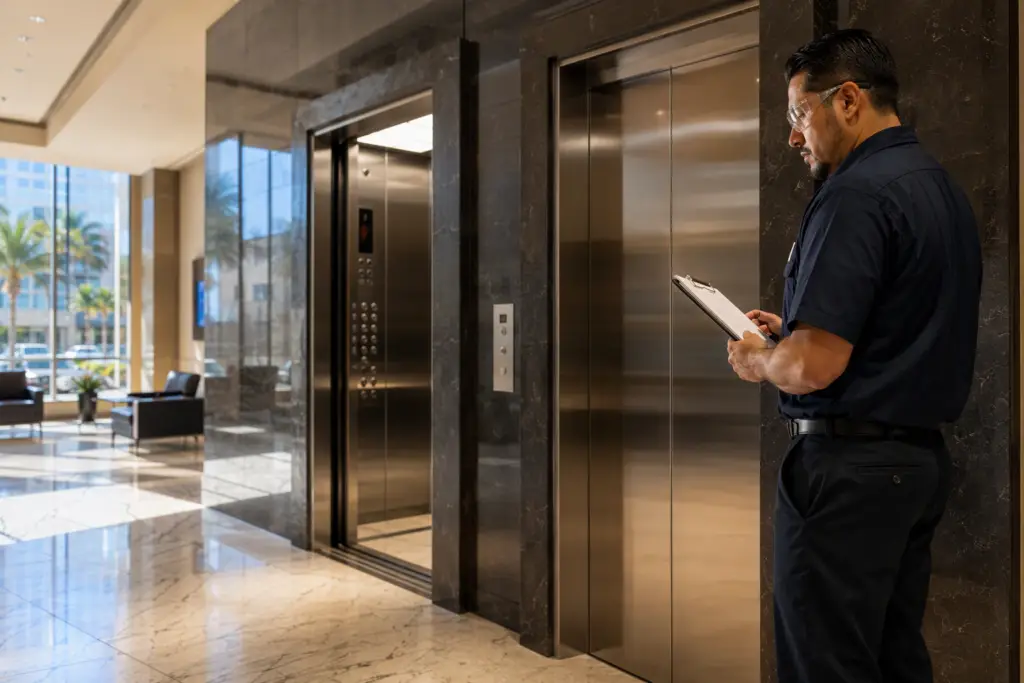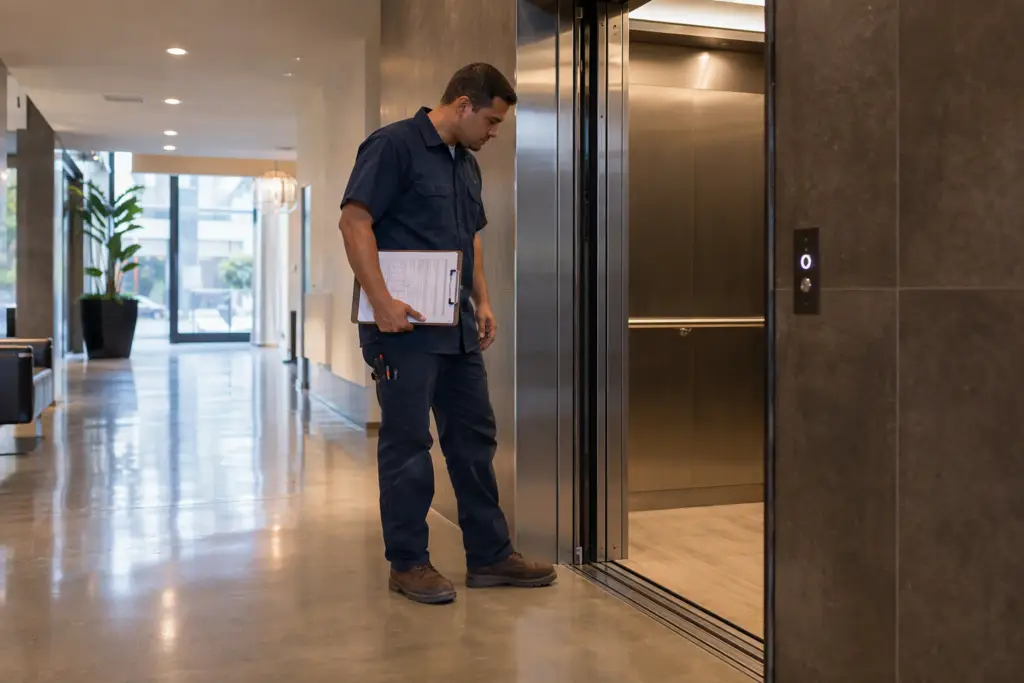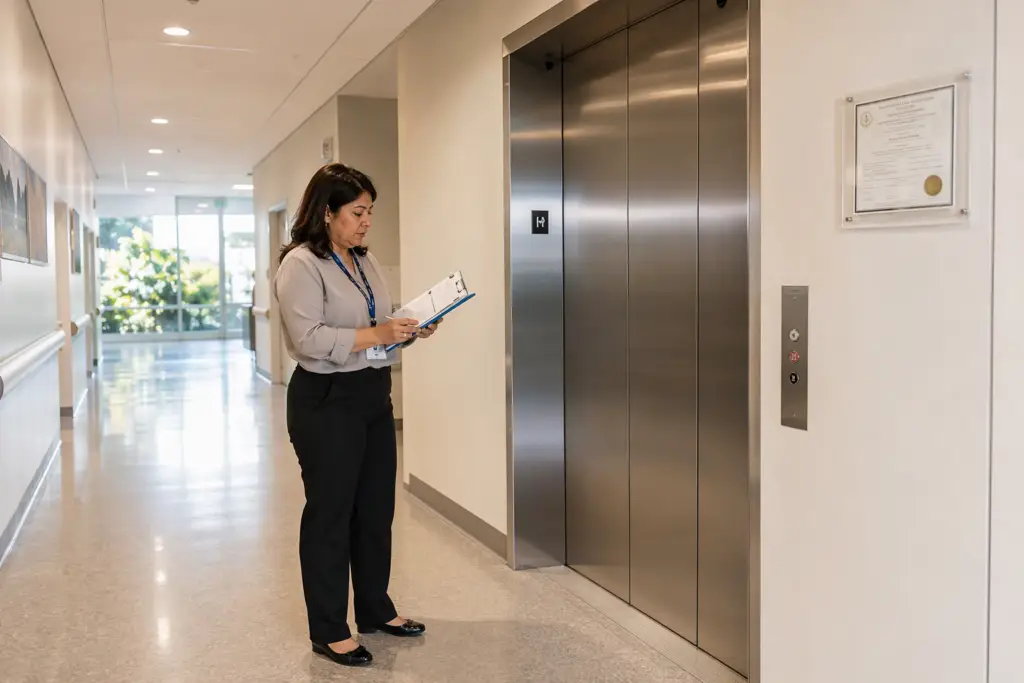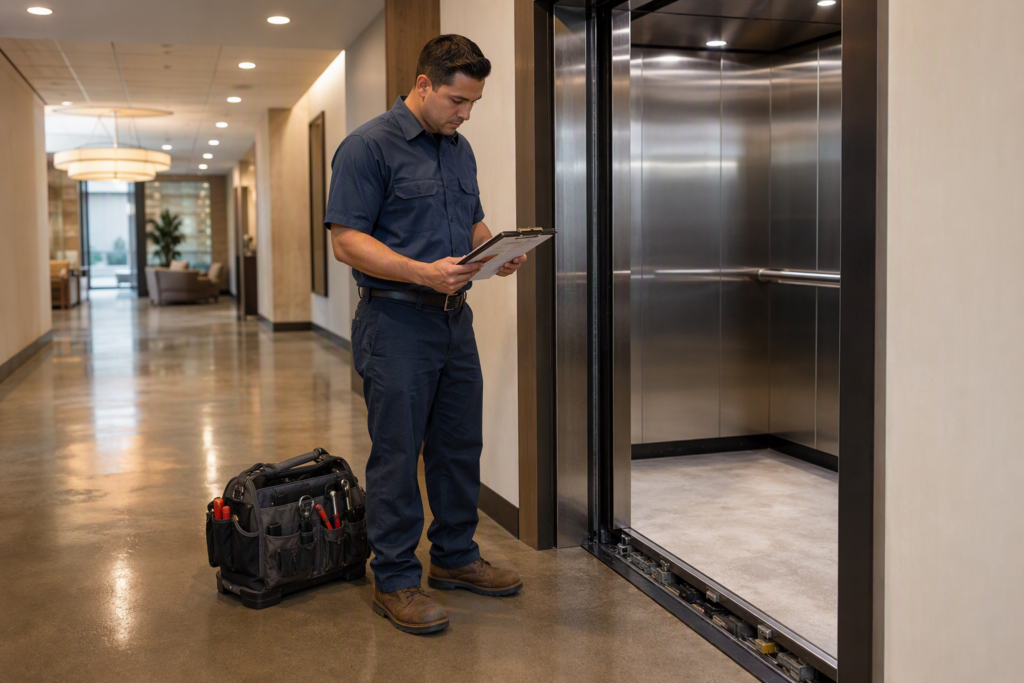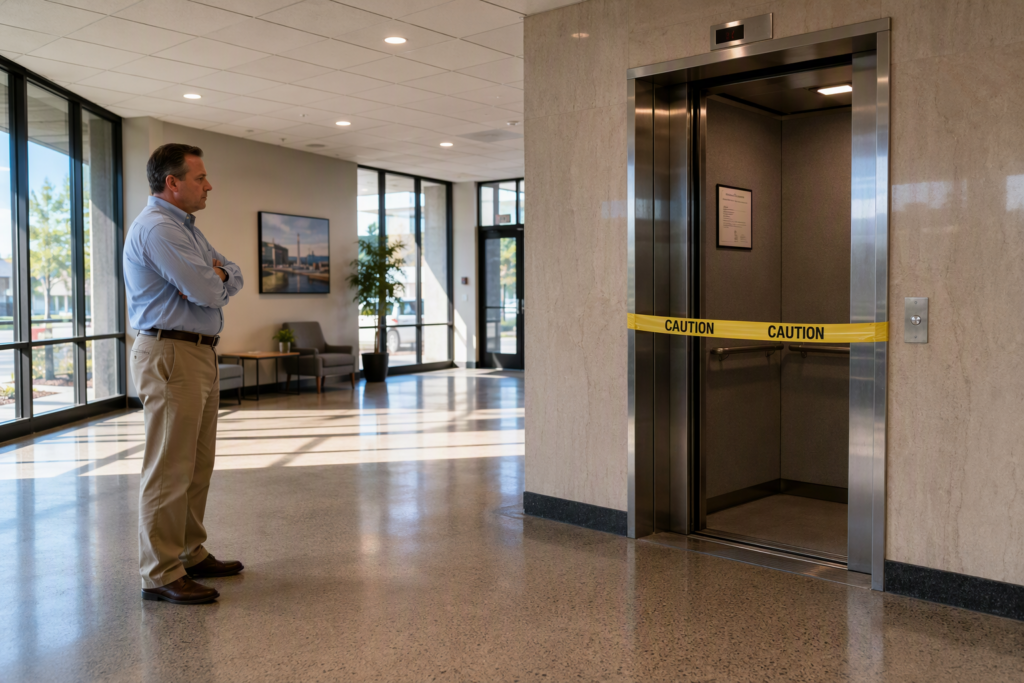
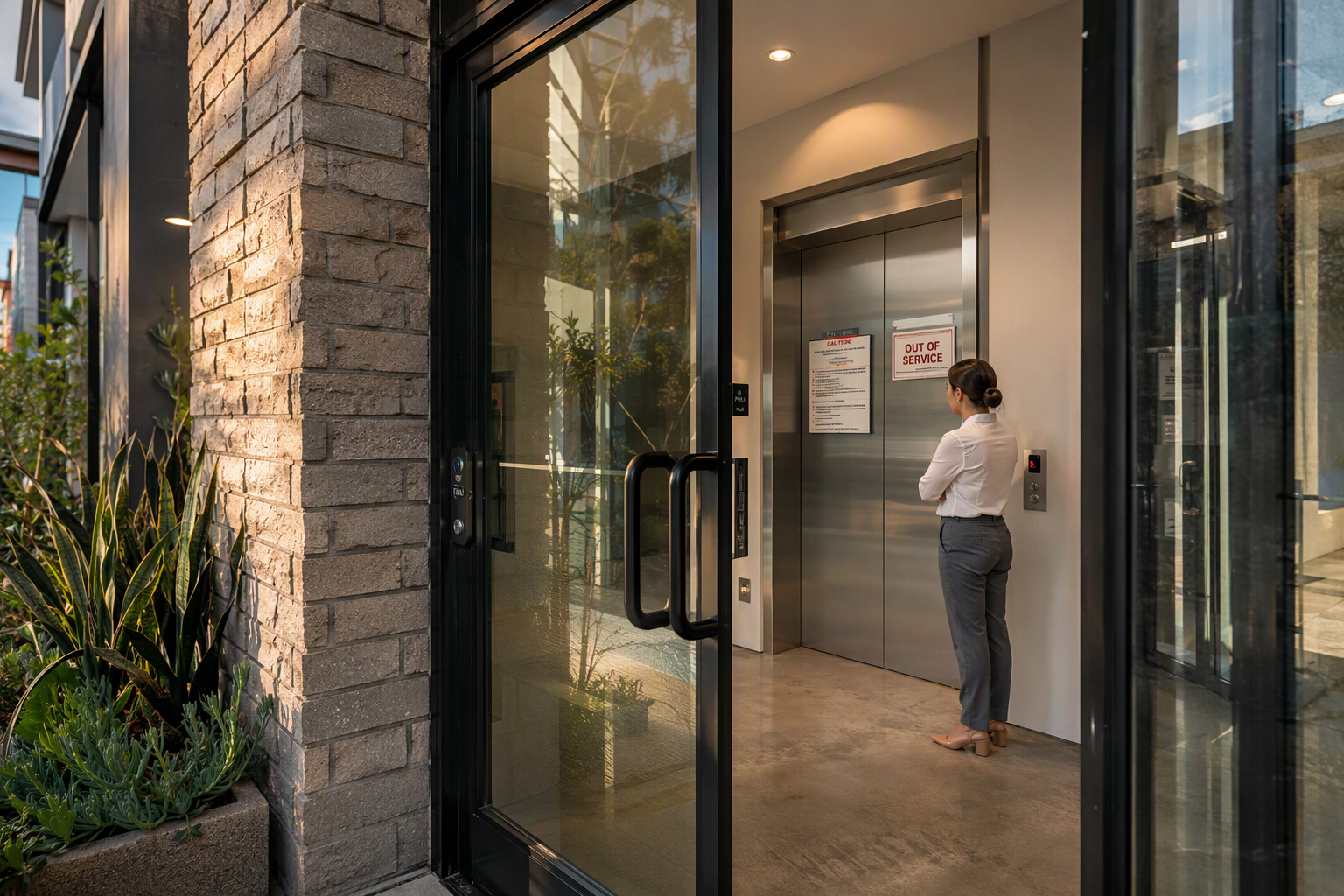
A California elevator shutdown notice stops building operations, frustrates tenants, and creates immediate liability for property owners. Getting the elevator back in service is not simply a matter of fixing the broken part — it requires navigating a specific regulatory sequence under California Labor Code Sections 7300–7324.2 and the California Code of Regulations, Title 8, Elevator Safety Orders. This guide walks building owners and property managers through every step of that process, clarifies who is legally allowed to do the work, and explains what to expect at each stage so there are no surprises.
—
What Does It Mean When a California Inspector Shuts Down an Elevator?
When a Cal/OSHA safety engineer or a Certified Competent Conveyance Inspector (CCCI) determines that an elevator presents a safety hazard, they have authority under California Labor Code Sections 7300–7324.2 to order the conveyance out of service. The permit to operate — which California law requires to be posted conspicuously inside the elevator car — is effectively voided. Operating the elevator after that order is issued exposes the building owner to significant legal liability.
A shutdown notice typically identifies each violation by reference to the California Code of Regulations, Title 8, Elevator Safety Orders (Sections 3000–3146) or the ASME A17.1/CSA B44 Safety Code for Elevators and Escalators, 2004 edition, which California adopted effective May 1, 2008 for installation contracts signed on or after that date.
Until every cited deficiency is corrected and a new permit to operate is issued by Cal/OSHA, the elevator must remain out of service.
—
Who Is Legally Allowed to Repair a Shut-Down Elevator in California?
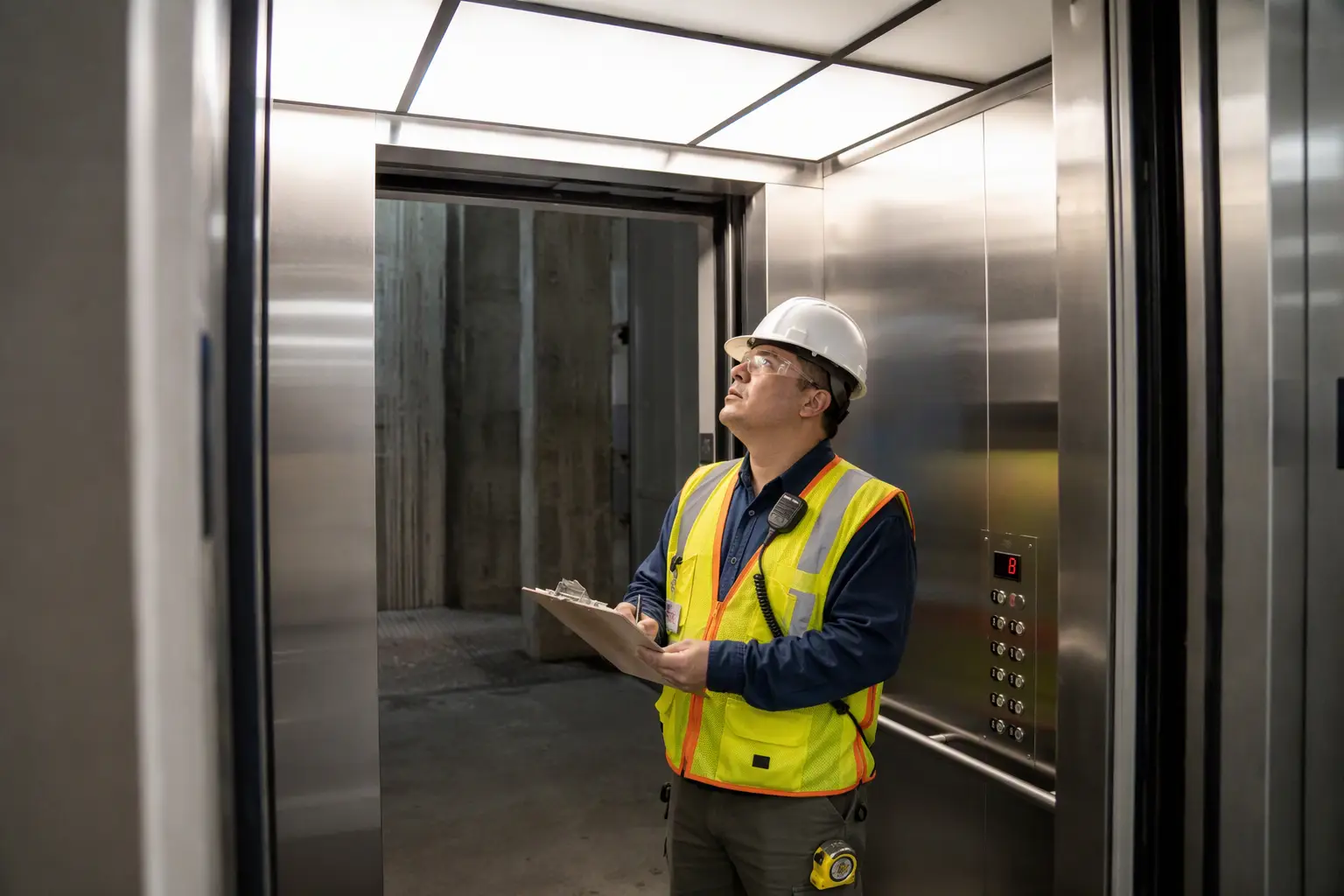
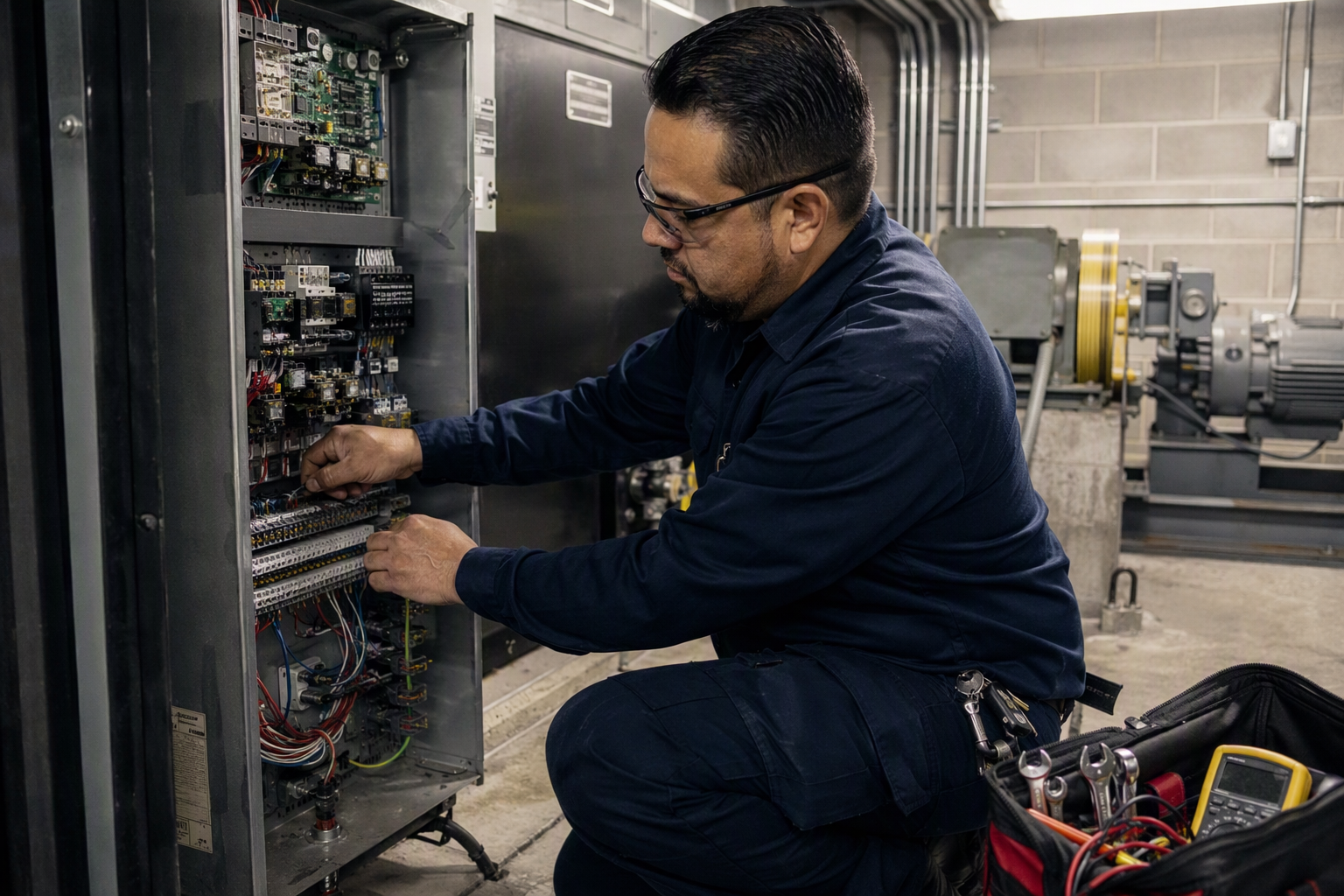
California law is explicit: only a Certified Competent Conveyance Mechanic (CCCM) working for a Certified Qualified Conveyance Company (CQCC) may maintain, repair, alter, or replace components on a conveyance in California. Both certifications are issued by Cal/OSHA’s Elevator Unit. A CQCC applicant must also hold a current C-11 Elevator Contractor license issued by the California Contractors State License Board (CSLB), along with valid workers’ compensation and liability insurance.
Hiring an unlicensed or uncertified contractor to perform repairs is not only a code violation — it will prevent Cal/OSHA from issuing a new permit to operate, meaning the elevator stays shut down regardless of the quality of the physical work performed.
Liftech Elevator is a Cal/OSHA-certified CQCC operating exclusively in California. All field mechanics working on client conveyances hold current CCCM certification, ensuring that every repair is legally eligible for Cal/OSHA re-inspection and permit reissuance.
—
What Are the Step-by-Step Actions to Get an Elevator Back in Service After a California Shutdown?
- Secure the elevator immediately. Lock out the elevator car, post “Out of Service” signage at every landing, and ensure no one boards the conveyance. Document the condition of the elevator with photographs before any work begins.
- Obtain and review the inspection citation. Request a copy of the full inspection report from Cal/OSHA’s Elevator Unit if it was not left on-site. Read every cited violation carefully — each item must be corrected before re-inspection.
- Engage a CQCC-certified elevator company. Contact a company that holds both a Cal/OSHA CQCC certification and a CSLB C-11 license. Provide them with the complete citation list. Attempting repairs with an uncertified contractor will invalidate the re-inspection request.
- Obtain any required permits for alterations. California law requires a Cal/OSHA permit before a conveyance is materially altered. If any cited repair constitutes a material alteration, the CQCC must apply for and receive this permit before beginning that portion of the work.
- Complete all cited repairs. The CQCC’s CCCM-certified mechanics perform the required work in compliance with the California Code of Regulations, Title 8, Elevator Safety Orders, and the applicable edition of the ASME A17.1/CSA B44 code.
- Document all completed repairs. The CQCC should provide written documentation of every repair performed, parts replaced, and tests conducted. This documentation is typically required when requesting re-inspection.
- Request a re-inspection through Cal/OSHA’s Elevator Unit. The building owner or their authorized CQCC submits a request to the Cal/OSHA Elevator Unit for a re-inspection. Only a Cal/OSHA State safety engineer or a CCCI may perform this inspection.
- Pass the re-inspection. The inspector verifies that every cited violation has been corrected and that the elevator meets current safety requirements. If additional deficiencies are discovered during the re-inspection, those must also be corrected before a permit can be issued.
- Receive and post the new permit to operate. Once Cal/OSHA is satisfied, a new permit to operate is issued. California law requires this permit to be posted conspicuously inside the elevator car. The elevator may not return to service until the permit is in place.
- Return the elevator to service and schedule ongoing maintenance. Place the elevator back in operation. To qualify for Cal/OSHA’s extended two-year permit interval, enter into a full maintenance contract with a CQCC-certified company such as Liftech Elevator.
—
What Are the Most Common Violations That Cause California Elevator Shutdowns?
While specific violation frequencies vary by building age and maintenance history, inspectors typically focus on the categories below when citing conveyances under the California Elevator Safety Orders and the ASME A17.1/CSA B44 code:
| Violation Category | Common Examples | Potential Repair Complexity | Alteration Permit Required? |
|---|---|---|---|
| Safety device failures | Governor, safeties, buffers, overspeed | Moderate to High | Possibly |
| Door and gate deficiencies | Door reopening devices, interlocks, closers | Low to Moderate | Rarely |
| Machine room conditions | Temperature control, access, housekeeping | Low | No |
| Electrical system issues | Wiring, grounding, controller components | Moderate to High | Possibly |
| Emergency systems | Lighting, alarm, two-way communication | Low to Moderate | Rarely |
| Pit conditions | Lighting, stop switch, water intrusion | Low | No |
| Load and capacity | Overloading devices, capacity postings | Low to Moderate | Rarely |
| Permit and documentation | Expired or missing permit to operate | Administrative | N/A |
—
How Long Does It Take to Get a Shut-Down California Elevator Back in Service?
Timeline varies considerably based on the nature of the violations, the availability of replacement parts, and Cal/OSHA scheduling. The table below provides a general framework — actual timelines depend on the specific building and circumstances.
| Phase | Typical Duration | Key Variables |
|---|---|---|
| Initial assessment and citation review | 1–3 business days | Citation complexity, CQCC availability |
| Parts procurement | Days to several weeks | Part obsolescence, supply chain, elevator age |
| Repair work (minor violations) | 1–5 business days | Scope of cited deficiencies |
| Repair work (major/structural violations) | 2–8 weeks or more | Alteration permits, equipment lead times |
| Cal/OSHA re-inspection scheduling | Variable — Cal/OSHA workload dependent | Inspector availability, region, backlog |
| Permit issuance after passed inspection | Typically same day or shortly after | Documentation completeness |
| Total realistic range | 1 week to 3+ months | Violation severity, parts, Cal/OSHA scheduling |
Important note for Los Angeles buildings: The City of Los Angeles runs its own elevator and conveyance inspection program through the Department of Building and Safety (LADBS). Building owners in Los Angeles should confirm whether their shutdown was issued by LADBS or Cal/OSHA, as the re-inspection request process may differ. Liftech Elevator can assist in identifying the correct regulatory pathway.
—
What Is the Difference Between a Repair and a Material Alteration — and Why Does It Matter?
Under California’s Elevator Safety Orders, a repair restores a component to its original condition or replaces it with an equivalent part. A material alteration changes the equipment in a way that affects its performance, capacity, or safety system configuration. California law requires a Cal/OSHA permit before a conveyance is materially altered — this is separate from the permit to operate.
If a cited repair is misclassified and work proceeds without the required alteration permit, Cal/OSHA may refuse to issue a new permit to operate. A qualified CQCC will evaluate each cited item and determine whether an alteration permit is needed before any work begins.
—
Can the Building Owner Negotiate or Appeal a California Elevator Shutdown Order?
California Labor Code Sections 7300–7324.2 grant Cal/OSHA broad authority to order conveyances out of service when safety hazards are identified. Building owners do have administrative appeal rights under California law, but pursuing an appeal does not automatically allow the elevator to return to service during the appeal process — the conveyance must remain out of service unless the order is stayed.
In most cases, the fastest path to returning an elevator to service is not to appeal the order but to correct the cited violations promptly and schedule a re-inspection. An experienced CQCC can help building owners understand which violations are most urgent and sequence the repair work efficiently.
—
What Is the Difference Between a One-Year and a Two-Year California Elevator Permit?
California law requires every elevator to be inspected at least once a year. However, Cal/OSHA may issue a permit to operate for up to two years for an elevator that is in safe condition and covered by a full maintenance contract with a CQCC-certified C-11 licensed elevator company.
| Permit Type | Duration | Requirement | Practical Benefit |
|---|---|---|---|
| Standard permit to operate | Up to 1 year | Pass annual inspection | Baseline compliance |
| Extended permit to operate | Up to 2 years | Pass inspection + full maintenance contract with a CQCC | Fewer inspections, reduced administrative burden, stronger maintenance documentation |
For building owners who have just brought a shut-down elevator back into compliance, entering a full maintenance contract with a CQCC such as Liftech Elevator immediately after reinstatement positions the elevator for the two-year permit at the next inspection cycle.
—
Who Is Responsible for Scheduling the Annual Re-Inspection in California?
Under California law, arranging the annual reinspection is the elevator owner’s responsibility — not the elevator company’s and not Cal/OSHA’s. This is one of the most commonly misunderstood aspects of California elevator compliance. Building owners who assume the inspection will be automatically scheduled often find themselves operating with an expired permit, which is itself a violation.
A full maintenance contract with a CQCC-certified company like Liftech Elevator typically includes coordination support for annual inspections, helping building owners avoid this compliance gap.
—
What Certifications Must the Elevator Company and Mechanics Hold in California in 2026?
| Role | Required Credential | Issuing Authority | Renewal Cycle |
|---|---|---|---|
| Elevator company (firm) | CQCC — Certified Qualified Conveyance Company + C-11 license + workers’ comp & liability insurance | Cal/OSHA (CQCC); CSLB (C-11) | Every 2 years (CQCC) |
| Field mechanic (individual) | CCCM — Certified Competent Conveyance Mechanic | Cal/OSHA | Every 2 years; requires ≥8 hours continuing education |
| Inspector | CCCI — Certified Competent Conveyance Inspector or Cal/OSHA State safety engineer | Cal/OSHA | Every 2 years; requires ≥8 hours continuing education |
Verify that any elevator company you hire can provide current CQCC and CCCM certification numbers. Liftech Elevator maintains current Cal/OSHA CQCC certification and employs CCCM-certified mechanics for all California work.
—
What Are the Pros and Cons of Using an Independent Elevator Company vs. the Original Equipment Manufacturer (OEM) for Reinstatement Repairs?
| Factor | Independent CQCC (e.g., Liftech Elevator) | OEM Service Division |
|---|---|---|
| California legal eligibility to perform work | Yes — if CQCC-certified and C-11 licensed | Yes — if CQCC-certified and C-11 licensed |
| Multi-brand equipment capability | Typically broad — services multiple makes | Optimized for own brand; variable on others |
| Parts sourcing flexibility | Can source OEM and compatible alternatives | Primarily OEM parts; may limit options |
| Scheduling responsiveness | Often more flexible for urgent shutdowns | May have longer backlogs for service calls |
| Regulatory navigation support | Strong — independent CQCCs focus on compliance workflow | Variable by region and account size |
| Long-term maintenance contract eligibility | Yes — qualifies for Cal/OSHA two-year permit | Yes — qualifies for Cal/OSHA two-year permit |
| Accountability | Direct relationship with building owner | Can involve multiple layers of contact |
—
What Happens If a Building Owner Operates a Shut-Down Elevator Without a Valid Permit?
No elevator may be operated in California without a valid, current permit to operate issued by Cal/OSHA. Operating a shut-down elevator — or an elevator with an expired permit — exposes the building owner to enforcement action under California Labor Code Sections 7300–7324.2, potential civil liability in the event of an injury, and possible escalation of the original violation citations. The financial and reputational consequences of operating a non-compliant elevator far exceed the cost of completing the reinstatement process correctly.
—
Is There a Pending Update to California’s Elevator Safety Orders That Could Affect My Repairs?
California has proposed a Group V update to its Elevator Safety Orders that would incorporate portions of ASME A17.1-2019. The California Standards Board held a public hearing on June 18, 2026, and no effective date has been posted as of the date of this publication. Building owners undertaking significant repairs or alterations in 2026 should ask their CQCC to confirm which edition of the code governs their specific work scope, as the answer may depend on the installation contract date and the nature of the work.
—
How Do I Avoid Future Elevator Shutdowns in California?
The most effective strategy for avoiding inspector-ordered shutdowns is a proactive, documented maintenance program with a CQCC-certified company. Key practices include:
- Maintaining a full maintenance contract with a Cal/OSHA CQCC to qualify for the extended two-year permit and demonstrate ongoing compliance commitment.
- Ensuring the permit to operate is current and conspicuously posted inside the elevator car at all times.
- Tracking the permit expiration date and scheduling re-inspection well in advance — remember, this is the owner’s responsibility under California law.
- Addressing minor deficiencies identified during routine maintenance before they escalate to conditions that trigger an inspector shutdown.
- Keeping machine room, pit, and equipment areas clean, accessible, and within required environmental conditions.
- Confirming that any contractor performing work on the elevator holds current CQCC and CCCM credentials before work begins.
—
Why Choose Liftech Elevator for California Elevator Reinstatement?
Liftech Elevator is a Cal/OSHA-certified Certified Qualified Conveyance Company (CQCC) serving California building owners and property managers. Liftech Elevator operates exclusively within California, meaning every technician, every process, and every compliance recommendation is aligned specifically with California Labor Code, Title 8 Elevator Safety Orders, and Cal/OSHA’s inspection and permitting requirements — not a generic national framework applied to California.
When an elevator has been shut down by a Cal/OSHA inspector or an authorized local program such as LADBS, Liftech Elevator provides a structured reinstatement pathway: assessing every cited violation, sequencing repairs to minimize downtime, managing permit requirements for any material alterations, coordinating re-inspection scheduling with Cal/OSHA, and providing full maintenance contracts that position buildings for the extended two-year permit period.
—
Get Your California Elevator Back in Service — Contact Liftech Elevator
A shut-down elevator affects every person in your building. The reinstatement process has specific legal requirements, and every day the elevator is out of service carries real costs for tenants, owners, and operations. Liftech Elevator’s CQCC-certified team understands California’s regulatory process and can help you move through it as efficiently as possible.
Contact Liftech Elevator for a free elevator assessment: 562-609-3478
Serving California building owners and property managers — CQCC-certified, C-11 licensed, and CCCM-staffed for full compliance with California Labor Code Sections 7300–7324.2 and Title 8 Elevator Safety Orders.
Need elevator service you can rely on? Liftech Elevator is ready to help.