
Elevator Maintenance Contracts and After-Hours Overtime Policies: Complete FAQ
A full elevator maintenance contract covers routine lubrication, cleaning, inspection, adjustment, and replacement of worn parts listed in the agreement, and includes defined response terms for emergency callbacks. After-hours overtime policies establish the surcharge structure — typically a premium labor rate plus a callout fee — that applies when a certified technician responds to service calls outside the contractor’s standard business hours. The specific scope, exclusions, and overtime terms vary by contract tier and must be reviewed carefully before signing.
What does a standard elevator maintenance contract actually cover?

A standard elevator maintenance contract covers scheduled preventive maintenance tasks — lubrication, cleaning, inspection, and adjustment — along with parts replacement for components explicitly listed in the agreement’s coverage schedule.
Maintenance contracts are structured in tiers. A basic or “oil and grease” contract covers only labor for preventive maintenance visits and excludes most parts. A comprehensive or “full maintenance” contract extends coverage to a broad list of parts and typically includes all labor for both routine visits and repair callbacks during normal business hours. Between those extremes are “parts and labor” or “examination” contracts that cover specific listed components but exclude major modernization items such as controllers, motor generators, and door operators unless added by rider.
Every contract should include a written coverage schedule that lists exactly which components are included and excluded. Building owners and property managers in Signal Hill, Long Beach, Los Angeles, and Orange County should request this schedule as a standalone exhibit before signing, so there is no ambiguity when a repair is needed.
What is a full maintenance contract, and why does it matter under California law?

A full maintenance contract is a comprehensive service agreement in which the elevator company assumes responsibility for virtually all maintenance, repair, and parts replacement on a conveyance, and it matters under California law because it can unlock a two-year operating permit from Cal/OSHA rather than the standard one-year permit.
Under Cal/OSHA Elevator Unit rules implementing California Labor Code Sections 7300–7324.2 and the California Code of Regulations, Title 8, Elevator Safety Orders, a conveyance found in safe condition and covered by a full maintenance contract with a Certified Qualified Conveyance Company (CQCC) may receive a permit to operate for up to two years. Without a full maintenance contract, the maximum permit period is one year. This distinction has a direct impact on inspection scheduling costs and administrative burden for building owners.
The elevator company holding the full maintenance contract must be a CQCC — a company certified by Cal/OSHA — and all mechanics performing the work must be Certified Competent Conveyance Mechanics (CCCMs). Liftech Elevator operates as a CQCC, ensuring that every maintenance visit satisfies the state credential requirements that support the two-year permit pathway.
What are the most common exclusions in an elevator maintenance contract?
The most common exclusions are major structural or electrical components — controllers, machine room equipment, cab interiors, hydraulic cylinders, and vandalism or misuse damage — which fall outside the routine maintenance scope unless added by a specific rider.
Typical exclusions include: mainline disconnects and building electrical systems; hoistway structural work; pit waterproofing; firefighters’ service and emergency telephone systems (sometimes covered separately); aesthetic items such as cab flooring, wall panels, and lighting fixtures; and damage caused by flooding, construction debris, or intentional misuse. Modernization components — new controllers, solid-state drives, and dispatch systems — are almost universally excluded from standard maintenance contracts and are handled under separate modernization agreements.
Reading the exclusion list is as important as reading the coverage list. A contract that appears comprehensive at first glance may exclude the controller, the hydraulic power unit, and door operators — three of the most frequently repaired assemblies on a mid-life elevator.
How are after-hours overtime policies structured in elevator maintenance contracts?
After-hours overtime policies define a callback rate — typically a premium hourly labor rate and a minimum-hours charge — that applies when a technician responds to a service call outside the contractor’s normal working hours, which are usually defined in the contract as standard weekday business hours.
Most contracts distinguish at least three time categories: regular hours (standard weekday daytime), overtime hours (early mornings, evenings, and Saturdays), and double-time or holiday hours (Sundays, federal holidays, and sometimes state holidays). Each category carries a different labor rate multiplier. Some contracts also include a “callout fee” or “trip charge” that applies regardless of how much time the technician spends on site.
Building owners should pay close attention to how “emergency callback” is defined. Some contracts limit the number of included after-hours callbacks per year; others exclude after-hours response entirely from the contract and bill all such calls at the premium overtime rate. Clarifying this before signing prevents surprise invoices when a passenger entrapment occurs at 10 p.m. on a Saturday.
What is the difference between a callback and a scheduled maintenance visit?
A scheduled maintenance visit is a preplanned, routine inspection and service call performed at defined intervals, while a callback is an unplanned response to a reported malfunction, entrapment, or service disruption that requires a technician to return to the site between scheduled visits.
Maintenance contracts typically specify the number of scheduled visits per year — quarterly, monthly, or more frequently for high-use installations — and define whether callbacks are included or billed separately. High-volume installations such as hospital elevators or high-rise residential buildings in Los Angeles and Long Beach often warrant monthly visits and unlimited included callbacks, while a low-use freight elevator in a small warehouse may need only quarterly visits.
The callback provision in the contract should specify: (1) whether callbacks during regular hours are included at no additional charge; (2) whether after-hours callbacks are included, capped, or billed at the overtime rate; and (3) the target response time window, which is a contractual commitment rather than a regulatory one.
How often must elevators be inspected under California law, regardless of maintenance contract type?
California law requires every conveyance to be inspected at least once per year by a State of California safety engineer or a Certified Competent Conveyance Inspector (CCCI), and arranging that annual reinspection is the elevator owner’s responsibility — not the maintenance contractor’s, unless the contract explicitly includes that coordination service.
This annual inspection is distinct from the preventive maintenance visits performed by the maintenance contractor. The inspection is a regulatory event conducted by Cal/OSHA or a CCCI to verify compliance with the California Code of Regulations, Title 8, Elevator Safety Orders, which adopt the ASME A17.1/CSA B44 Safety Code for Elevators and Escalators (2004 edition for installations on or after May 1, 2008). A conveyance found safe receives a permit to operate for up to one year — or up to two years when covered by a full maintenance contract with a CQCC.
No elevator may operate in California without a valid, current permit to operate issued by Cal/OSHA. That permit must be posted conspicuously inside the elevator car. Building owners who cannot locate their current permit should contact their maintenance contractor or Cal/OSHA’s Elevator Unit immediately.
Who is legally authorized to perform elevator maintenance work in California?
Only a Certified Competent Conveyance Mechanic (CCCM) working for a Certified Qualified Conveyance Company (CQCC) — both certified by Cal/OSHA — may maintain, repair, alter, or replace components on a conveyance in California.
The Cal/OSHA Elevator Unit issues CQCC company certification and CCCM mechanic certification. The California Contractors State License Board (CSLB) separately issues the C-11 Elevator Contractor license, which companies must hold as a prerequisite for CQCC certification. CQCC, CCCM, and conveyance inspector certificates last two years, and renewal requires at least eight hours of continuing education.
Building owners should verify that their maintenance contractor holds a current CQCC certification and that technicians assigned to their property hold current CCCM credentials before any work begins. Engaging an uncertified company or mechanic exposes the building owner to liability and can jeopardize the elevator’s permit to operate.
What should building owners do if a passenger is trapped in an elevator after hours?
When a passenger is trapped in an elevator, the immediate priority is ensuring the occupant’s safety and contacting emergency services if there is any medical concern, then notifying the elevator maintenance contractor using the emergency callback number listed in the maintenance contract.
- Confirm the trapped passenger is uninjured and can communicate. If there is any medical emergency, call 911 immediately.
- Instruct the passenger to remain calm, to not attempt to force the doors, and to use the in-car emergency telephone or alarm button.
- Locate the maintenance contractor’s 24-hour emergency callback number — this should be posted in the machine room and in the building manager’s emergency contact file.
- Call the contractor’s emergency line and provide the building address, elevator number, floor the car is stopped at, and the number of passengers trapped.
- Do not attempt to open hoistway doors manually or move the car without a licensed mechanic on site.
- Keep communication open with the trapped passenger until the technician arrives.
- Document the incident — time of entrapment, response time, and resolution — for maintenance records and any required regulatory reporting.
In-car emergency communication systems are addressed under the Americans with Disabilities Act (ADA) and applicable building codes. Building owners should confirm that emergency communication equipment is functional during every scheduled maintenance visit.
What is the difference between a full maintenance contract and a parts-and-labor contract?
A full maintenance contract covers all routine maintenance labor and parts for virtually all components, while a parts-and-labor contract covers only the specific components listed in the agreement’s schedule, leaving unlisted components as billable repairs at time-and-materials rates.
| Contract Type | Routine Maintenance Labor | Parts Coverage | After-Hours Callbacks Included | Cal/OSHA 2-Year Permit Eligible | Best Suited For |
|---|---|---|---|---|---|
| Oil & Grease (Basic) | Included | None — all parts billed separately | Rarely | No | Low-use, newer elevators with minimal wear |
| Parts & Labor (Examination) | Included | Listed components only | Sometimes capped | No | Mid-life elevators, budget-conscious owners |
| Full Maintenance (Comprehensive) | Included | Broad coverage, major exclusions added by rider | Often included or capped | Yes (when contractor is CQCC) | High-use, older, or high-liability installations |
| Modernization + Maintenance | Included | Comprehensive, including new components | Often included | Yes | Post-modernization elevators with new equipment warranty |
How does Los Angeles regulate elevator maintenance differently from the rest of California?
Los Angeles operates its own elevator and conveyance inspection program through the Los Angeles Department of Building and Safety (LADBS), which means that in addition to statewide Cal/OSHA requirements, elevators in the City of Los Angeles may be subject to local program requirements and inspection scheduling through LADBS rather than directly through Cal/OSHA.
Building owners with elevators in the City of Los Angeles should confirm whether their permit to operate and inspection history is managed through LADBS or Cal/OSHA’s Elevator Unit, as both agencies play a role in the jurisdiction. The underlying safety standards — California Code of Regulations, Title 8, Elevator Safety Orders and the adopted ASME A17.1 code — apply statewide, but the administrative path for permits and inspections in Los Angeles differs from other cities in Los Angeles County, Orange County, and elsewhere in the region.
Liftech Elevator serves buildings throughout Los Angeles and is familiar with the local program’s administrative requirements, helping building owners navigate both the LADBS and Cal/OSHA processes.
What maintenance tasks are typically performed during a scheduled preventive maintenance visit?
A scheduled preventive maintenance visit covers lubrication of running gear and guide rails, cleaning of the pit and machine room, inspection and adjustment of safety devices, door operator checks, brake adjustment, and testing of lighting and emergency systems listed under the applicable ASME A17.1 maintenance requirements.
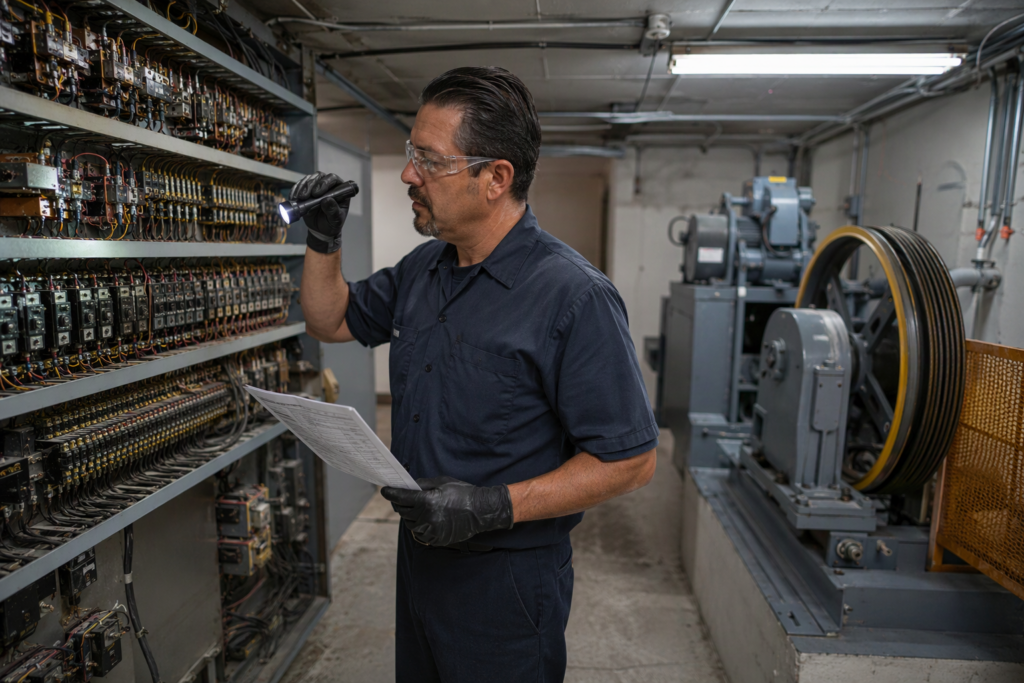
Specifically, a thorough preventive maintenance visit by a CCCM typically includes: inspection and lubrication of guide rails, rollers, and buffers; cleaning and inspection of the pit; checking and adjusting door clutches, gibs, and rollers; testing the governor and safeties; inspecting and tightening electrical connections; checking oil levels in the hydraulic power unit (for hydraulic elevators) or gearbox (for traction elevators); testing the emergency lighting and alarm; verifying the in-car emergency telephone is functional; and documenting all findings in a maintenance log.
The ASME A17.1 Safety Code for Elevators and Escalators provides maintenance and testing requirements that form the technical baseline for what a compliant maintenance visit must accomplish. California’s adopted edition (2004, effective May 1, 2008 for applicable installations) is the operative standard under Title 8 of the California Code of Regulations.
What are the ADA accessibility requirements that affect elevator maintenance contracts?
The Americans with Disabilities Act requires that elevators serving multiple floors in public accommodations and commercial facilities be accessible and maintained in operable working condition, meaning that maintenance contracts should explicitly address the operational continuity of ADA-required features such as audible floor announcements, Braille and raised-character control buttons, and door timing compliance.
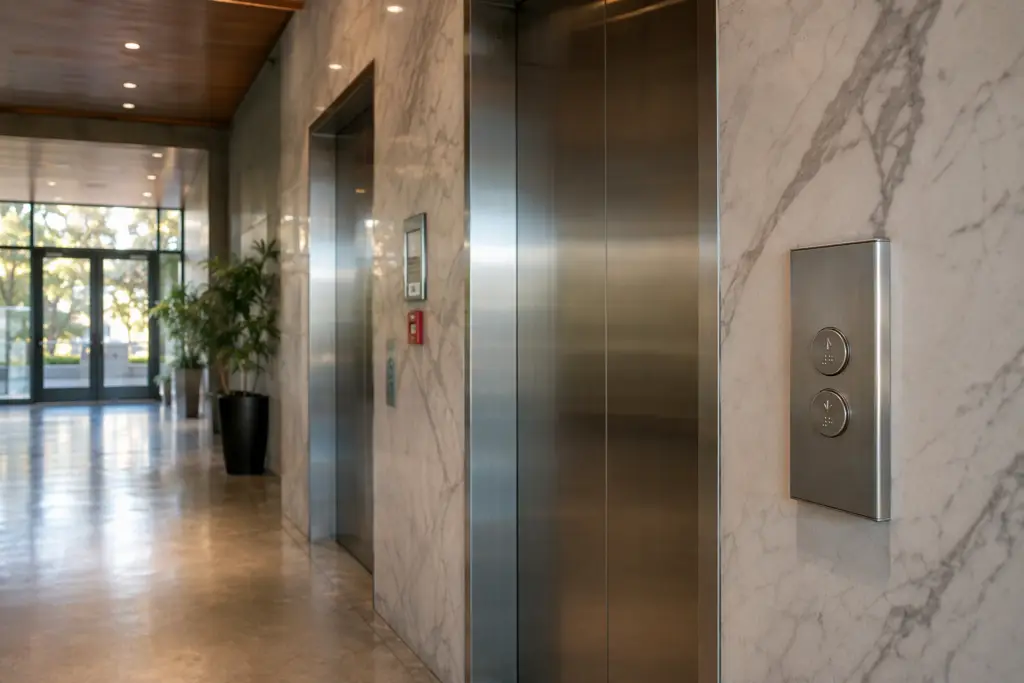
ADA-covered features that maintenance contracts should address include: proper door open time for passengers using mobility devices; hall lanterns and position indicators; audible signals; emergency two-way communication systems; and cab leveling accuracy (the floor-to-cab threshold gap). When these features fail and are not repaired promptly, building owners may face ADA compliance exposure in addition to the safety concern.
Maintenance contracts should specify that all ADA-mandated operational features are included in the preventive maintenance scope and that repair of non-functioning ADA features is treated as a priority callback rather than a deferred repair.
What records must building owners maintain in connection with their elevator maintenance contract?
Building owners in California must retain the current permit to operate (posted in the car), the maintenance log recording all service visits, test results, and repairs, and documentation of the annual inspection and any corrective actions ordered by Cal/OSHA or the local authority having jurisdiction.
California Labor Code Sections 7300–7324.2 establish the owner’s responsibility for maintaining a safe conveyance and cooperating with Cal/OSHA inspections. Maintenance contractors should provide a written service record after every visit, and building owners should retain those records for at least the period between inspections. For buildings covered by a two-year permit, records from both years should be available on request.
Additional records to retain include: the signed maintenance contract with its coverage schedule and exclusions list; any written notifications of deficiencies and the dates those deficiencies were corrected; modernization permits and final inspection certificates; and correspondence with Cal/OSHA or LADBS regarding permit renewals or citations.
How should a building owner evaluate competing elevator maintenance proposals?
Evaluating competing maintenance proposals requires comparing the written coverage schedules, exclusion lists, number and frequency of scheduled visits, after-hours overtime policy terms, CQCC certification status of the contractor, and the warranty or guarantee terms on parts and labor.
A checklist for evaluating proposals should include: (1) Is the contractor a Cal/OSHA-certified CQCC? (2) Are the technicians assigned to the property CCCMs? (3) Does the contract qualify for a two-year Cal/OSHA operating permit? (4) How many scheduled visits are included, and what does each visit entail? (5) What parts are covered, and which are explicitly excluded? (6) Are regular-hours callbacks included, and how many? (7) What is the after-hours overtime rate structure — hourly rate, minimum hours, trip charge? (8) What is the contract term and cancellation notice period? (9) Is the contractor familiar with the local authority’s requirements in the building’s city?
Liftech Elevator provides transparent, itemized maintenance proposals for buildings in Signal Hill, Long Beach, Los Angeles, and Orange County, allowing property managers to make direct line-by-line comparisons.
Can a building owner cancel an elevator maintenance contract early, and what are the implications?
Most elevator maintenance contracts include a notice period for cancellation — commonly 30 to 90 days written notice — and some include early termination fees or provisions allowing the contractor to remove proprietary parts or tools from the premises upon cancellation.
Proprietary parts clauses are a significant issue in the elevator industry. Some contracts are written to give the maintenance contractor ownership of replacement parts installed during the contract term, meaning that if the owner terminates the contract, those parts may be removed and must be replaced by the new contractor at the owner’s expense. Building owners should negotiate against proprietary parts clauses or at minimum understand their scope before signing.
Transition planning is also important. When switching contractors, the new CQCC will need access to maintenance records, the existing maintenance log, and any outstanding Cal/OSHA or LADBS corrective action notices. Gaps in maintenance documentation can create complications at the next annual inspection.
What happens if an elevator fails its annual Cal/OSHA inspection?
If Cal/OSHA finds a conveyance unsafe during inspection, the inspector may prohibit operation of the elevator and issue a notice of deficiency that must be corrected and reinspected before the elevator may return to service or receive a permit to operate.
Common causes of inspection failures include inoperative safety devices, missing or expired permits, non-functioning emergency lighting or communication, excessive wear in running gear, door timing issues, and pit conditions that do not meet code. The maintenance contractor is responsible for correcting deficiencies within the timeframe specified by Cal/OSHA.
Maintenance contracts should specify how deficiency corrections are handled — whether corrections identified during the annual inspection are covered under the contract or billed as additional repair work. Full maintenance contracts typically cover correction of deficiencies related to covered components, while basic contracts may bill correction labor and parts separately.
How do after-hours overtime policies affect emergency response for passenger entrapments?
After-hours overtime policies directly determine how quickly a certified mechanic will respond to a passenger entrapment outside business hours, because contracts that include after-hours emergency response as part of the agreement provide a stronger response commitment than contracts that treat all after-hours calls as billable overtime with no guaranteed response timeline.
Building owners should ask prospective contractors to specify in writing whether emergency entrapment response is treated differently from non-emergency after-hours service calls. A passenger entrapment is not a routine callback — it is a time-sensitive safety event. Contracts that provide included emergency response or prioritize entrapment calls ahead of other overtime work offer meaningful protection for building owners and occupants.
For high-occupancy buildings in Los Angeles, Long Beach, and Orange County — office towers, residential high-rises, hospitals, and retail centers — the after-hours emergency response provision is one of the most consequential terms in the entire maintenance contract.
What is the role of ASME A17.3 in elevator maintenance for existing installations?
The ASME A17.3 Safety Code for Existing Elevators and Escalators provides retroactive safety requirements that apply to elevators installed before the current code edition was adopted, establishing the minimum safety standards that existing elevators must meet regardless of when they were built.
California’s elevator safety orders and Cal/OSHA’s inspection program reference ASME standards to evaluate existing installations. Building owners with older elevators — particularly those in pre-1990s buildings common throughout Los Angeles and Long Beach — should work with their maintenance contractor to understand which ASME A17.3 requirements may apply and whether any components require upgrading to meet current retroactive standards.
Maintenance contracts for older elevators should address how discovered retroactive compliance gaps are handled: whether bringing a component into compliance with current standards is treated as a covered repair or a billable modernization item.
How often should maintenance visit frequency be reviewed and adjusted?
Maintenance visit frequency should be reviewed at every contract renewal and whenever there is a significant change in the building’s use, occupancy, or elevator traffic patterns, because a schedule appropriate for a low-use warehouse elevator may be wholly inadequate for a newly converted high-density residential building.
Factors that warrant increasing visit frequency include: rising callback frequency between scheduled visits; evidence of accelerated component wear in maintenance logs; a change in building occupancy (residential to medical, for example); addition of a new tenant with heavy freight elevator use; and aging equipment that is approaching the end of its design service life. Cal/OSHA’s inspection findings can also signal that more frequent preventive maintenance is needed.
Liftech Elevator recommends that building owners review their maintenance visit schedule annually, ideally in conjunction with the permit renewal process, to ensure the service frequency matches actual equipment demand and condition.
What should be negotiated before signing an elevator maintenance contract?
Before signing, building owners should negotiate the coverage schedule’s scope, the exclusion list, proprietary parts ownership, the after-hours overtime rate structure, the number of included callbacks, the escalation cap on annual rate increases, and the cancellation notice period.
Key negotiating points in priority order: (1) Remove or limit proprietary parts clauses. (2) Define “full maintenance” in writing with a specific parts list rather than relying on generic language. (3) Cap annual price escalation to a defined index or percentage. (4) Clarify whether the contractor coordinates the annual Cal/OSHA inspection on the owner’s behalf. (5) Specify the after-hours overtime rate structure in numeric terms — hourly rate, minimum time billed, and trip charge — rather than leaving it as “prevailing rates.” (6) Include a performance clause for entrapment response. (7) Confirm that all technicians assigned to the property hold current CCCM certification.
A well-negotiated contract protects both parties and prevents the most common disputes that arise mid-contract when an expensive repair is needed or a passenger is trapped after midnight.
How does Liftech Elevator structure its maintenance contracts for buildings in Signal Hill, Long Beach, Los Angeles, and Orange County?
Liftech Elevator structures its maintenance agreements around transparent coverage schedules, explicitly defined after-hours overtime terms, and certification by Cal/OSHA as a Certified Qualified Conveyance Company, with all maintenance performed by Certified Competent Conveyance Mechanics.
Liftech Elevator serves commercial, residential, and industrial building owners throughout Signal Hill, Long Beach, Los Angeles, and Orange County, tailoring maintenance programs to each installation’s age, usage profile, and regulatory history. Every agreement includes a written coverage schedule, a clear exclusions list, and defined terms for after-hours response — the provisions that most often generate disputes under generic industry-standard contracts.
Building owners seeking a maintenance contract that supports the Cal/OSHA two-year operating permit pathway, includes CQCC-certified service, and provides clear after-hours overtime terms can request a no-obligation assessment to evaluate their current equipment condition and service needs.
Contact Liftech Elevator for a free elevator assessment at 562-997-3639.
Need elevator service you can rely on? Liftech Elevator is ready to help.