Commercial Elevator Inspection Requirements in California: Complete FAQ Guide
In California, commercial elevators are subject to mandatory annual inspections under state law, with the building owner bearing full legal responsibility for scheduling, funding, and maintaining compliance. Inspections must be performed by a Qualified Elevator Inspector (QEI) certified through a program that meets ASME QEI-1 standards, and a valid certificate of inspection must be posted inside every elevator cab at all times. Failure to comply can result in permit revocation, fines, and forced shutdown of the elevator until compliance is restored.
How Often Does a Commercial Elevator Need to Be Inspected in California?
California requires commercial elevators to undergo a full inspection at least once every 12 months.
This annual inspection requirement aligns with the ASME A17.1 Safety Code for Elevators and Escalators, which California has adopted as the baseline standard for elevator safety. Beyond the annual full inspection, California also requires periodic tests at defined intervals depending on the type of equipment and the nature of the test — for example, certain safety devices and hydraulic systems have their own testing schedules that may be more frequent than once per year.
It is important to distinguish between an inspection and routine preventive maintenance. Inspections are formal examinations by a certified third party that result in a compliance certificate. Maintenance visits, which typically occur monthly or quarterly depending on the service contract, are the building owner’s separate obligation and do not substitute for a formal inspection.
Who Is Responsible for Scheduling Elevator Inspections in California?

The building owner — or their designated property manager or authorized agent — is legally responsible for scheduling and funding all required elevator inspections in California.
This responsibility is not transferable to a tenant, an elevator maintenance contractor, or any other party unless a written agreement explicitly assigns that duty. Many property owners in Los Angeles, Long Beach, Orange County, and Signal Hill work with their elevator service provider to coordinate inspection scheduling, but the legal accountability always remains with the property owner.
Working with a full-service elevator company like Liftech Elevator simplifies this process significantly. A qualified service provider tracks inspection due dates, coordinates with the local Authority Having Jurisdiction (AHJ), and ensures the elevator is in proper condition before the inspector arrives — reducing the risk of failed inspections and costly re-inspections.
What Government Agency Oversees Commercial Elevator Inspections in California?
The California Department of Industrial Relations (DIR), through its Elevator, Ride, and Tramway Unit (ERT Unit), is the primary state agency responsible for elevator inspection oversight in California.
The ERT Unit issues elevator permits, certifies inspectors, and enforces compliance statewide. However, many California jurisdictions — including the City of Los Angeles and several Orange County municipalities — have their own local inspection programs operating as the Authority Having Jurisdiction (AHJ). In these jurisdictions, the local AHJ may conduct inspections directly or approve third-party inspectors rather than deferring to the state ERT Unit.
Building owners must determine which authority governs their specific property. A knowledgeable elevator service partner familiar with the local AHJ requirements across Southern California — including Long Beach, Signal Hill, Los Angeles, and Orange County — is an invaluable resource for navigating these jurisdictional differences.
What Codes and Standards Apply to Commercial Elevators in California?
California commercial elevators are primarily governed by ASME A17.1 for new installations and ASME A17.3 for existing elevators, supplemented by California-specific regulations administered through the DIR ERT Unit.
The ASME A17.1 Safety Code for Elevators and Escalators sets the baseline safety requirements for design, construction, installation, operation, inspection, testing, maintenance, alteration, and repair. For existing elevators, ASME A17.3 Safety Code for Existing Elevators and Escalators addresses retroactive safety requirements that buildings must meet even if the elevator predates current code editions.
Additionally, buildings open to the public must comply with accessibility requirements under the Americans with Disabilities Act (ADA), which sets standards for elevator cab dimensions, door timing, control panel height, and other features affecting accessibility. ADA compliance is not typically part of a routine safety inspection but can be assessed during a comprehensive elevator audit.
What Happens During a Commercial Elevator Inspection?
A commercial elevator inspection involves a systematic examination of all major elevator components, safety devices, and operational systems to verify conformance with applicable codes and the conditions of the elevator permit.
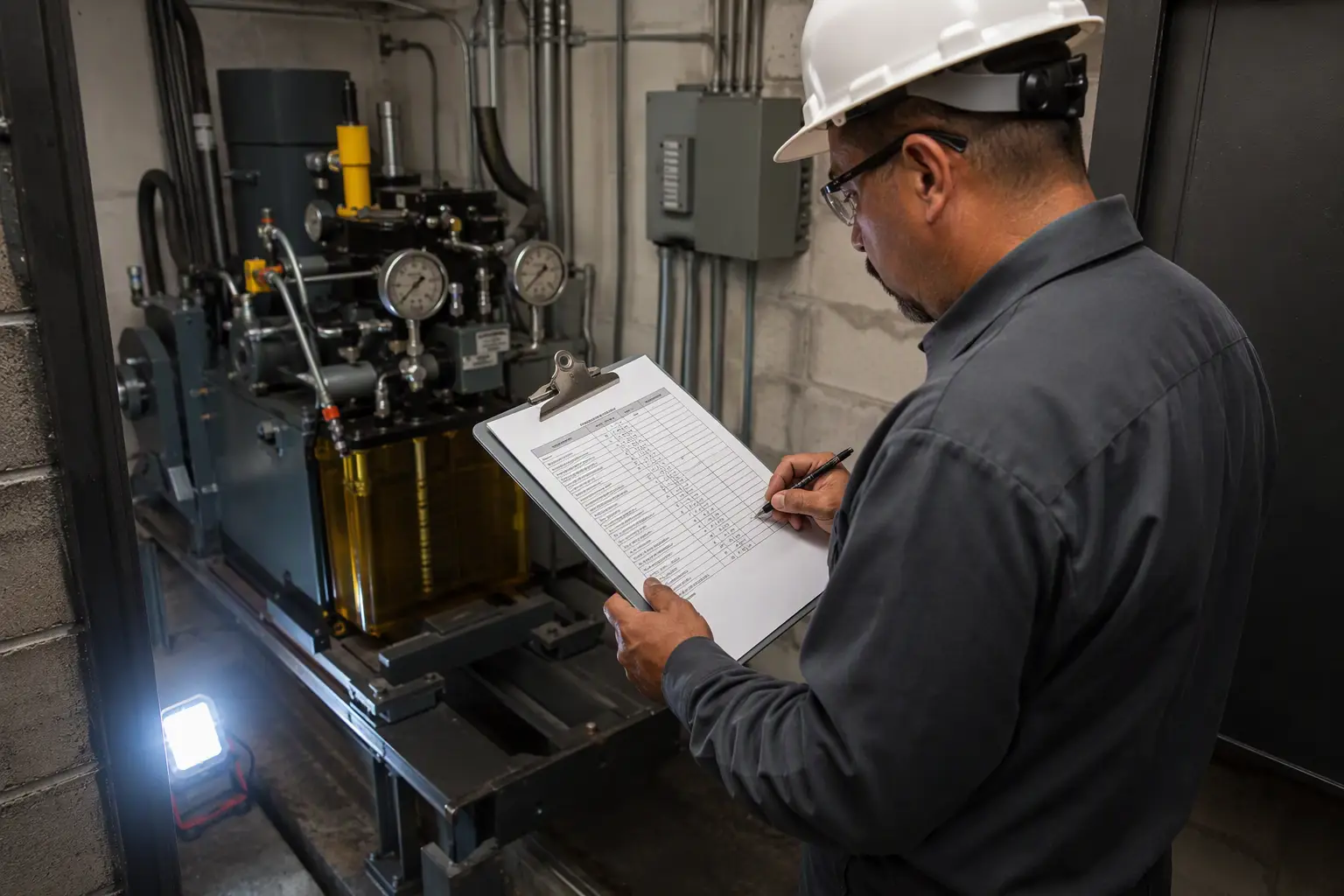
During a typical annual inspection, the certified inspector will evaluate the machine room, hoistway, pit, cab, doors, controls, safety systems (including the governor, safeties, and buffers), and any hydraulic or traction components. The inspector will also verify that required documentation — including the current permit and maintenance records — is present and accessible.
Certain components require periodic performance tests rather than visual inspections alone. For example, hydraulic cylinders, pressure relief valves, and rope/chain suspension systems all have mandated test protocols under ASME A17.1 that must be completed at specified intervals and witnessed or documented appropriately.
What Is the Difference Between a Routine Inspection and a Periodic Test?
A routine inspection is an annual visual and operational examination of the elevator, while a periodic test is a scheduled functional test of specific safety components performed at intervals defined by the applicable code — some tests occur more or less frequently than annually.
| Test or Inspection Type | Applicable Equipment | Typical Interval (per ASME A17.1) | Who Performs |
|---|---|---|---|
| Annual Safety Inspection | All commercial elevators | Every 12 months | Certified QEI Inspector |
| Full-Load Safety Test (Category 1) | Traction & hydraulic elevators | Annually | Certified Mechanic + Inspector Witness |
| Governor/Safety Test (Category 5) | Traction elevators | Every 5 years | Certified Mechanic + Inspector Witness |
| Hydraulic Pressure Relief Test | Hydraulic elevators | Annually | Certified Mechanic + Inspector Witness |
| Hydraulic Underground Cylinder Test | Hydraulic elevators with underground cylinders | Varies (per AHJ and permit) | Certified Mechanic + Inspector Witness |
| Firefighters’ Emergency Operation Test | All elevators with Phase I/II recall | Annually | Certified Mechanic + Inspector Witness |
| ADA Compliance Assessment | Public-access elevators | As needed / upon alteration | ADA consultant or elevator specialist |
Understanding these distinctions helps building owners budget accurately and avoid surprises. A comprehensive maintenance agreement with an experienced provider such as Liftech Elevator will typically track all required test intervals and coordinate the appropriate personnel for each test type.
What Qualifications Must an Elevator Inspector Have in California?
In California, elevator inspectors must hold a valid Qualified Elevator Inspector (QEI) certification issued under a program meeting the requirements of ASME QEI-1, and they must also be licensed or approved by the applicable AHJ.
The QEI-1 standard establishes the minimum education, experience, and examination requirements for elevator inspectors. Many AHJs in California — including those in the Los Angeles area — additionally require inspectors to hold a state or local license before performing inspections within their jurisdiction. Building owners should verify that any inspector they engage is both QEI-certified and properly licensed for the specific jurisdiction where the elevator is located.
What Permits Are Required to Operate a Commercial Elevator in California?
Every commercial elevator in California must have a valid operating permit issued by the California DIR ERT Unit or the applicable local AHJ, and this permit must be renewed annually after a passed inspection.
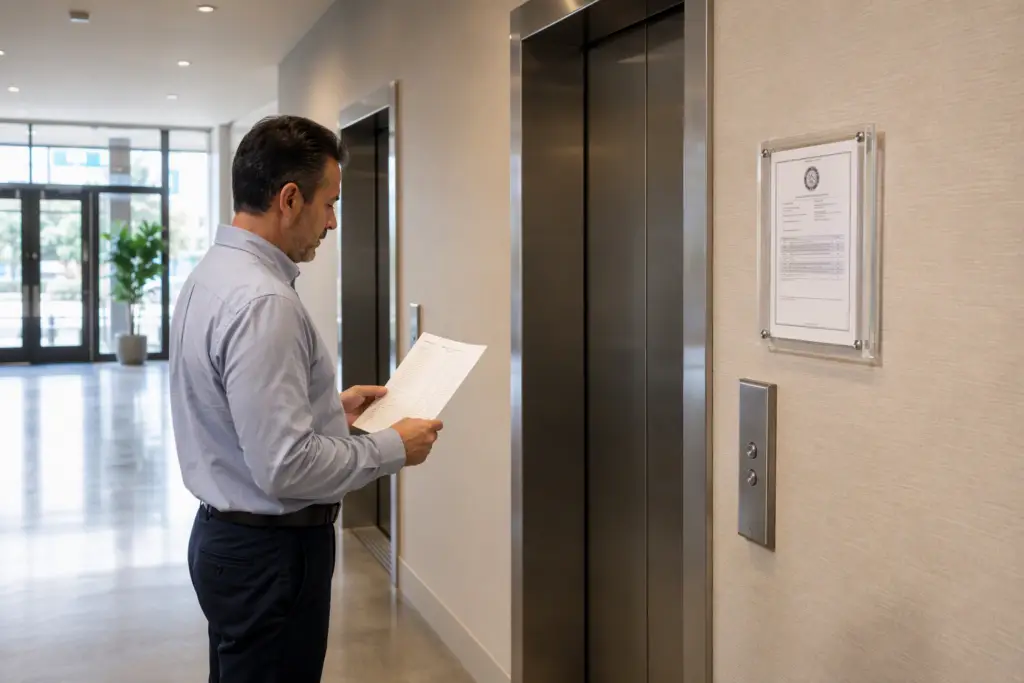
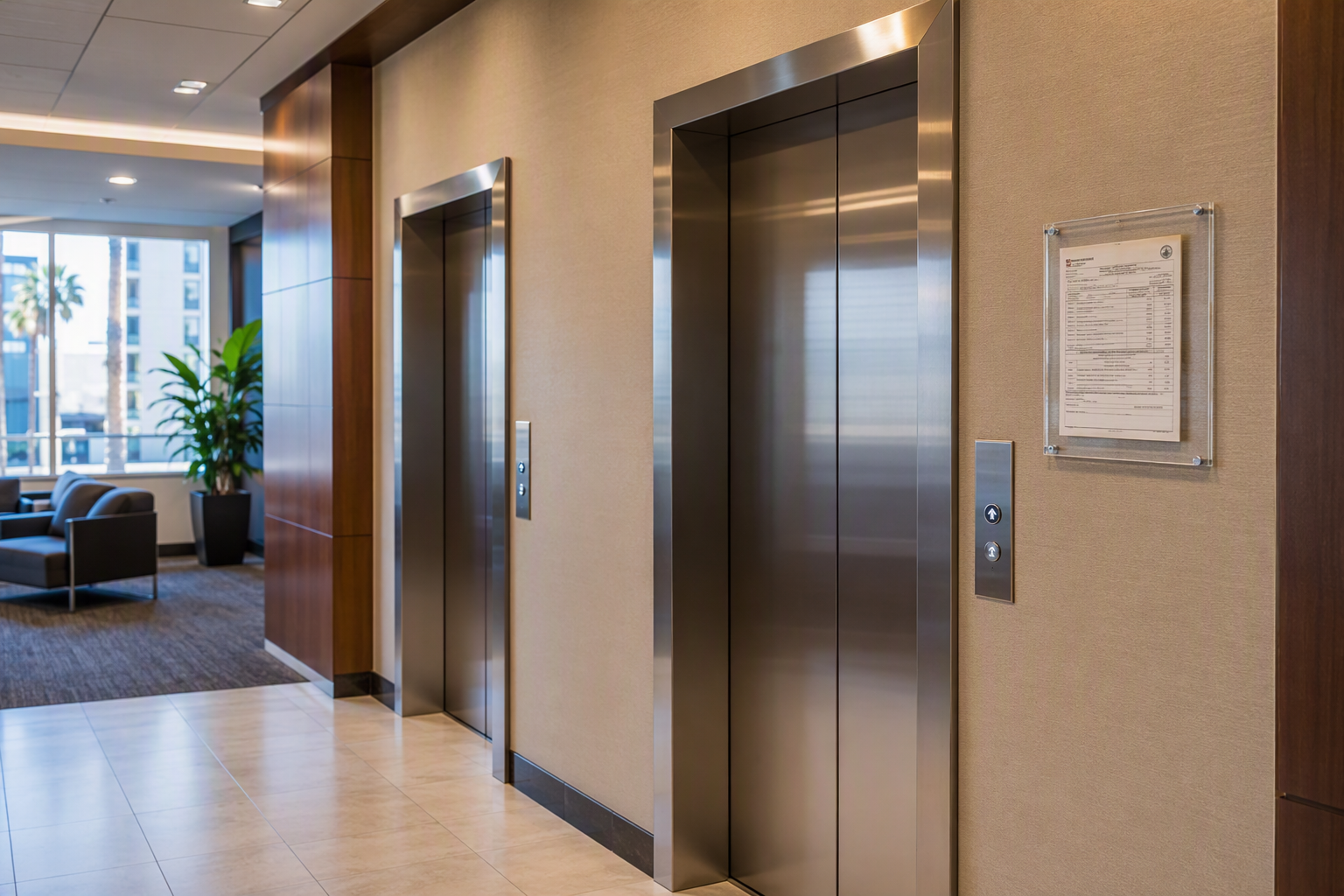
The operating permit is the formal authorization to run the elevator. Once an elevator passes its annual inspection, the inspector or AHJ issues a new certificate and renewed permit. That certificate must be displayed inside the elevator cab — typically in a frame near the control panel — where it is visible to users. Operating an elevator with an expired permit is a violation that can result in fines and mandatory shutdown.
What Happens If a Commercial Elevator Fails an Inspection?
If a commercial elevator fails its inspection, the AHJ may immediately suspend the operating permit and require the elevator to be taken out of service until all deficiencies are corrected and a re-inspection is passed.
The severity of the response depends on the nature of the deficiency. Critical safety violations — such as a malfunctioning door interlock, a failed governor, or an inoperable emergency stop — typically result in immediate shutdown. Less severe deficiencies may allow continued operation with a compliance order requiring correction within a specified time period.
For building owners in Southern California, working proactively with a maintenance provider like Liftech Elevator to address known issues before the scheduled inspection date is the most effective way to avoid failed inspections, re-inspection fees, and the operational disruption of an unplanned elevator shutdown.
What Should Building Owners Do to Prepare for an Elevator Inspection?
Building owners should take a structured series of steps in the weeks before a scheduled inspection to maximize the likelihood of a first-time pass.
- Review the previous inspection report and confirm that all previously cited deficiencies have been corrected and documented.
- Confirm the maintenance log is current — inspectors typically request proof of regular maintenance visits dating back to the last inspection.
- Ensure the machine room is clean, properly lit, and accessible — blocked or cluttered machine rooms are a common deficiency citation.
- Test all cab lighting, emergency lighting, and the emergency phone — these are quick checks that are frequently cited when neglected.
- Verify the certificate of operation and current permit are posted in the cab in a visible location.
- Confirm firefighters’ emergency operation (Phase I and Phase II recall) is functional — this is tested during every annual inspection.
- Coordinate with your elevator service provider to perform a pre-inspection maintenance visit and identify any items that require correction before the official inspection date.
- Ensure the inspector has unobstructed access to the pit, machine room, and all floors served by the elevator.
How Long Does a Commercial Elevator Inspection Take?
A typical annual commercial elevator inspection takes between one and three hours depending on the elevator type, number of floors served, the scope of periodic tests due, and whether the elevator is in compliance-ready condition.
Hydraulic elevators and simpler two-stop commercial lifts generally take less time to inspect than high-rise traction elevators with complex control systems and multiple floors. If a Category 5 governor test or other major periodic test is due in the same inspection cycle, additional time should be allocated. Pre-scheduling coordination with both the inspector and the elevator maintenance technician helps ensure all necessary personnel and equipment are present to avoid delays or partial inspections that require rescheduling.
How Much Does a Commercial Elevator Inspection Cost in California?
Inspection costs in California vary based on jurisdiction, elevator type, number of stops, and whether additional periodic tests are due — building owners should request itemized quotes from their AHJ or approved inspection service to understand the full cost for their specific equipment.
State permit fees are set by the California DIR ERT Unit and are based on factors including elevator type and jurisdiction. Local AHJ fees may differ. Separately, if a certified mechanic must be present to perform or assist with required tests — such as the Category 1 full-load test or firefighters’ operation test — those labor costs are typically billed through the elevator maintenance company rather than the inspector. Bundling inspection coordination into a comprehensive maintenance agreement often reduces the total administrative burden and can help manage overall compliance costs.
Does Elevator Inspection Frequency Change for High-Traffic Commercial Buildings?
The mandatory minimum inspection interval in California is annual regardless of elevator usage volume, but high-traffic buildings typically benefit from more frequent preventive maintenance visits to sustain reliable operation between formal inspections.
A commercial elevator in a high-rise office building in downtown Los Angeles that runs thousands of cycles per day faces significantly more wear than an elevator in a small Signal Hill medical office. While the inspection requirement remains annual for both, the maintenance interval in high-traffic applications is typically monthly or more frequent to catch wear items before they become inspection failures or safety events. The specific maintenance schedule appropriate for any elevator should be determined in consultation with a qualified elevator service provider.
What Are the ADA Requirements for Commercial Elevators in California?
Commercial elevators open to the public in California must meet federal ADA accessibility standards, including specific requirements for cab dimensions, door clear width, landing and leveling accuracy, control panel layout, and two-way communication systems.
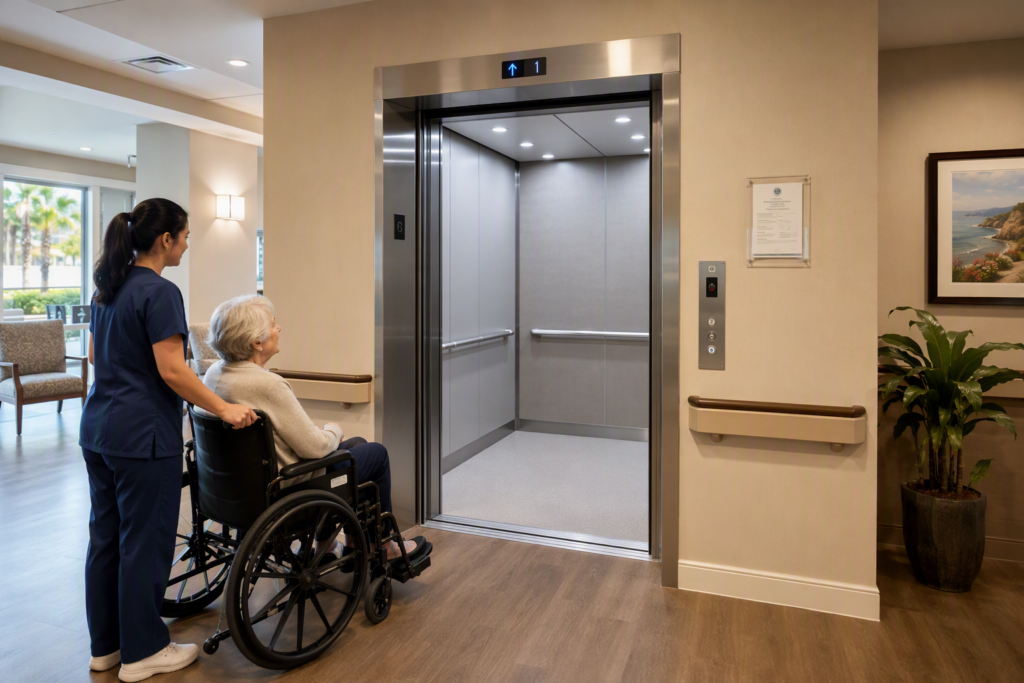
The Americans with Disabilities Act (ADA) requires that elevators serving multiple floors in public accommodations and commercial facilities be accessible to individuals with disabilities. Key requirements include a minimum door clear width, inside cab dimensions sufficient to accommodate a wheelchair and attendant, raised and Braille markings on control buttons, and an accessible two-way emergency communication system. California also enforces its own accessibility standards through the California Building Code, which in many cases equals or exceeds federal ADA requirements.
ADA compliance issues are not always caught during a routine safety inspection, making periodic accessibility audits a separate but important component of a comprehensive elevator management program.
Who Performs the Physical Tests During a Periodic Elevator Inspection?
In California, the physical performance tests required during an elevator inspection — such as full-load tests, governor tests, and firefighters’ operation tests — must be performed by a licensed elevator mechanic, while the certified inspector witnesses and documents the results.
This distinction is important for scheduling purposes. The building owner or property manager must coordinate the availability of both the certified inspector and a licensed elevator mechanic for any inspection cycle that includes a performance test. A maintenance provider like Liftech Elevator, which employs licensed elevator mechanics, can handle this coordination on behalf of building owners in Long Beach, Los Angeles, Orange County, and Signal Hill, ensuring all required parties are present and that tests are completed efficiently.
What Records Must Be Kept for Commercial Elevator Compliance in California?
California building owners must maintain complete records of all elevator inspections, periodic tests, maintenance visits, and any alterations or repairs — and these records must be available for review by the AHJ upon request.
Recommended records to maintain include: copies of all inspection certificates and reports (current and historical), maintenance logs documenting the date, scope, and performing technician for every maintenance visit, permits and permit renewal documentation, records of any alterations or major component replacements, and correspondence with the AHJ regarding any deficiency orders or compliance timelines. Many elevator service providers maintain digital maintenance logs that building owners can access on demand, simplifying compliance documentation considerably.
What Is the Role of Preventive Maintenance Between Formal Inspections?
Preventive maintenance — performed by a licensed elevator mechanic on a regular scheduled basis between annual inspections — is the primary mechanism for ensuring an elevator remains safe, reliable, and inspection-ready throughout the year.
Regular maintenance visits allow technicians to lubricate moving components, adjust door operation, test safety circuits, inspect rope or hydraulic conditions, and identify developing issues before they result in breakdowns or inspection failures. ASME A17.1 includes maintenance requirements that obligate building owners to keep their elevators properly maintained — not merely inspected. Neglecting maintenance between inspections is the most common reason elevators fail formal inspections or experience unexpected service interruptions.
What Should Building Owners Do If Their Elevator Permit Has Lapsed?
If a commercial elevator’s operating permit has lapsed, the building owner should immediately take the elevator out of service and contact the applicable AHJ to understand the process for reinstatement, which typically involves a new inspection and payment of any outstanding fees or penalties.
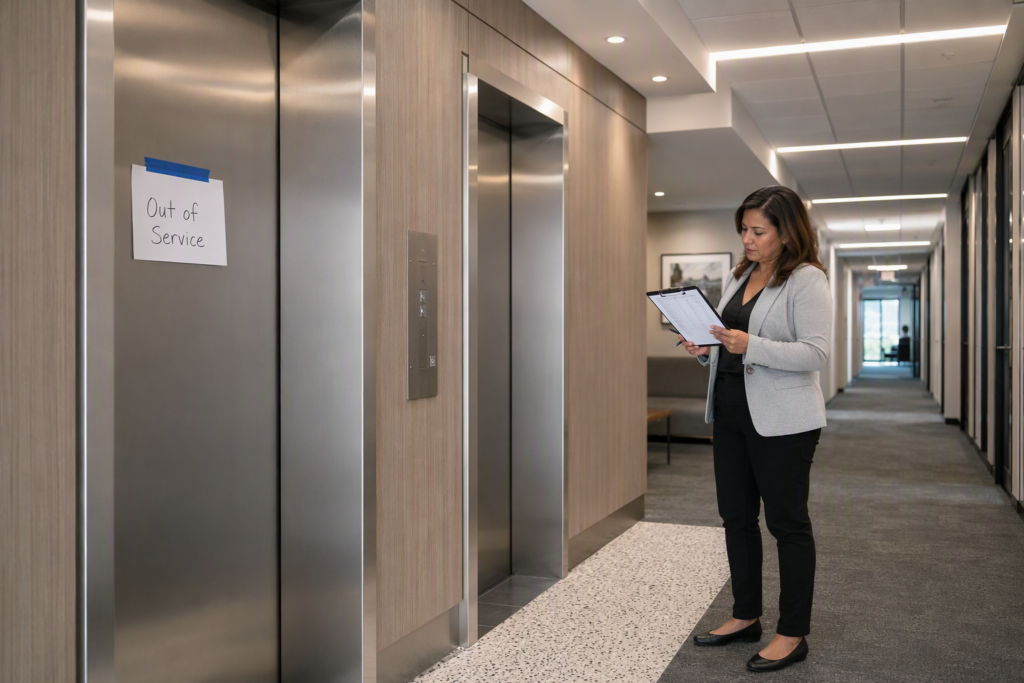
- Post an “Out of Service” notice on or at the elevator entrance and secure the cab to prevent use.
- Contact the applicable AHJ — the California DIR ERT Unit or the local inspection authority — to report the lapse and request reinstatement guidance.
- Engage a licensed elevator maintenance company to perform a comprehensive condition assessment and address any deficiencies identified.
- Schedule a reinstatement inspection with a certified inspector approved by the AHJ.
- Submit all required documentation and fees to the AHJ as directed.
- Obtain the renewed certificate and post it in the cab before returning the elevator to service.
Operating an elevator with a lapsed permit — even inadvertently — creates significant liability exposure for building owners. Engaging an elevator service company familiar with local AHJ procedures in Southern California can accelerate the reinstatement process substantially.
How Does California’s Elevator Inspection Requirement Compare to Federal OSHA Standards?
Federal OSHA standards under 29 CFR 1910 and 1926 govern elevator safety primarily in the context of employee workplace exposure, while California’s state inspection program applies more broadly to all commercial elevator equipment regardless of the type of occupancy.
In California, most occupational safety requirements are administered through Cal/OSHA, which is a state OSHA plan approved by federal OSHA. For commercial building elevators, the California DIR ERT Unit’s inspection program is the governing framework for permit and inspection compliance. Building owners should understand that OSHA and elevator permit requirements are not mutually exclusive — a building can be OSHA-compliant in its general industry operations but still be out of compliance with elevator-specific permit requirements if inspections have lapsed.
Why Should Southern California Building Owners Work With a Local Elevator Service Provider?
Local elevator service providers have established relationships with regional AHJs, familiarity with jurisdiction-specific requirements, and the ability to respond quickly to compliance issues — advantages that out-of-area or national providers often cannot match.
Inspection requirements, permit processes, and AHJ expectations vary meaningfully between the City of Los Angeles, the City of Long Beach, Orange County municipalities, and Signal Hill. A provider operating exclusively in Southern California — such as Liftech Elevator — understands the specific procedural expectations of each local authority, can coordinate directly with the relevant inspectors, and is positioned to address deficiencies or emergency situations affecting local buildings with the familiarity that comes from sustained regional focus.
Building owners managing commercial properties in Signal Hill, Long Beach, Los Angeles, or Orange County are encouraged to work with a certified, locally based elevator service company that can provide both ongoing maintenance and comprehensive inspection coordination under one relationship.
Schedule Your Elevator Inspection Assessment Today
Staying current with California’s annual elevator inspection requirements is not just a legal obligation — it is an essential component of building safety, tenant confidence, and property value. Whether a commercial elevator is due for its annual inspection, overdue for a periodic safety test, or in need of a full compliance review, Liftech Elevator provides comprehensive elevator maintenance, inspection coordination, and compliance support for commercial properties throughout Signal Hill, Long Beach, Los Angeles, and Orange County.
Contact Liftech Elevator for a free elevator assessment: 562-609-3478